Key Takeaways
- A canvasser is a field organizer who conducts door-to-door outreach to engage voters, gather data, and build support for political campaigns, nonprofits, or advocacy organizations — earning $15-25/hour in 2026.
- Canvassers spend 70-80% of their time walking neighborhoods, knocking doors, and recording voter interactions using mobile apps like Door Knock, with the remaining time on training and team coordination.
- Successful canvassers need strong communication skills, physical stamina for 15,000+ daily steps, comfort with rejection (70-80% no-answer rate), and proficiency with canvassing software and voter databases.
- The canvasser role has evolved significantly by 2026 with AI-powered route optimization, real-time data sync, and predictive analytics replacing paper walk lists and manual data entry from previous election cycles.
A canvasser is a field organizer who conducts face-to-face outreach by going door-to-door in assigned neighborhoods to engage voters, collect data, and build support for political campaigns, nonprofit organizations, or advocacy groups. In 2026, canvassers use mobile-first platforms like Door Knock to navigate optimized routes, record voter interactions in real-time, and sync data instantly with campaign headquarters — replacing the clipboard-and-paper methods that dominated field organizing just a few election cycles ago.
The role has become increasingly professionalized as campaigns recognize that quality voter contact drives election outcomes more effectively than digital advertising alone. Modern canvassers serve as the human interface between campaigns and communities, gathering nuanced voter intelligence that no algorithm can replicate while building the personal connections that move undecided voters and activate supporters.
What Does a Canvasser Do? Core Responsibilities
Canvassers perform five primary functions that directly impact campaign success. Understanding these responsibilities helps both job seekers evaluate fit and campaign managers set realistic expectations.
Door-to-Door Voter Contact
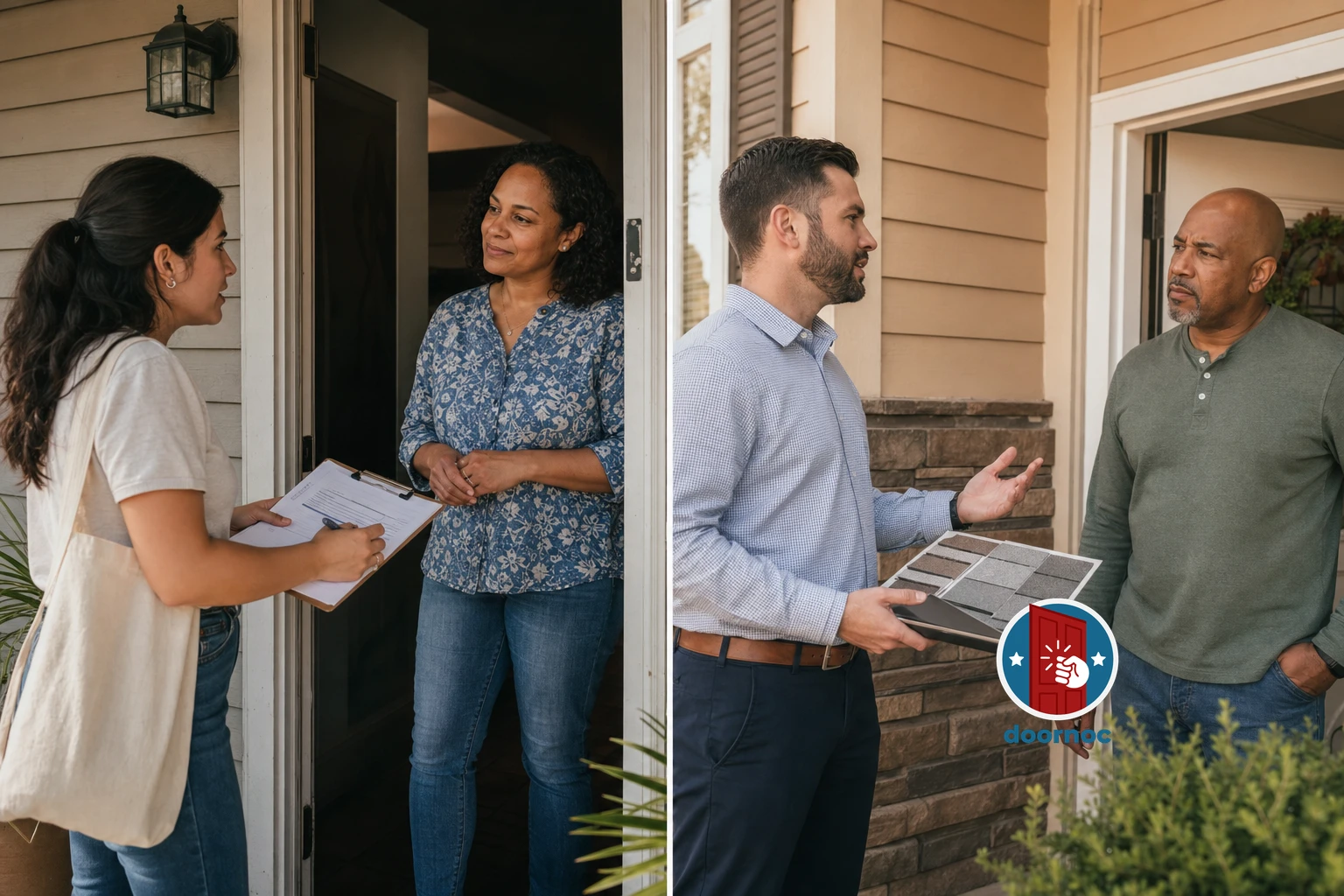
Canvassers spend 70-80% of their shift walking assigned territories and knocking on doors to engage voters in brief conversations. You’ll introduce yourself, deliver a scripted message about your candidate or cause, ask persuasion or identification questions, and record responses in your canvassing software. This face-to-face contact remains the most effective voter persuasion method — research from the 2024 and 2025 election cycles shows door-to-door canvassing increases voter turnout by 7-10 percentage points among contacted households.
A typical 4-hour canvassing shift involves knocking 80-150 doors depending on neighborhood density and contact rates. You’ll have meaningful conversations with 15-30 voters on average, as most doors yield no answer (people at work, not home, or choosing not to respond). The job requires comfort with high rejection rates — even experienced canvassers connect with only 20-30% of doors knocked.
Data Collection and Voter Intelligence
Every voter interaction generates valuable data that campaigns use to refine strategy. Canvassers record detailed information including voter support level (strong support, lean support, undecided, lean opposition, strong opposition), key issues mentioned, volunteer interest, and contact quality. Modern door-to-door canvassing software makes this process seamless — you tap responses on your phone screen immediately after each conversation rather than transcribing paper notes later.
This real-time data sync transformed field organizing between 2024 and 2026. Campaign managers now see updated contact rates, persuasion numbers, and volunteer recruitment metrics within minutes rather than waiting for end-of-day data entry. Field directors can identify underperforming turfs, adjust messaging based on issue feedback, and reallocate resources to high-opportunity neighborhoods while canvassers are still in the field.
Route Planning and Territory Management
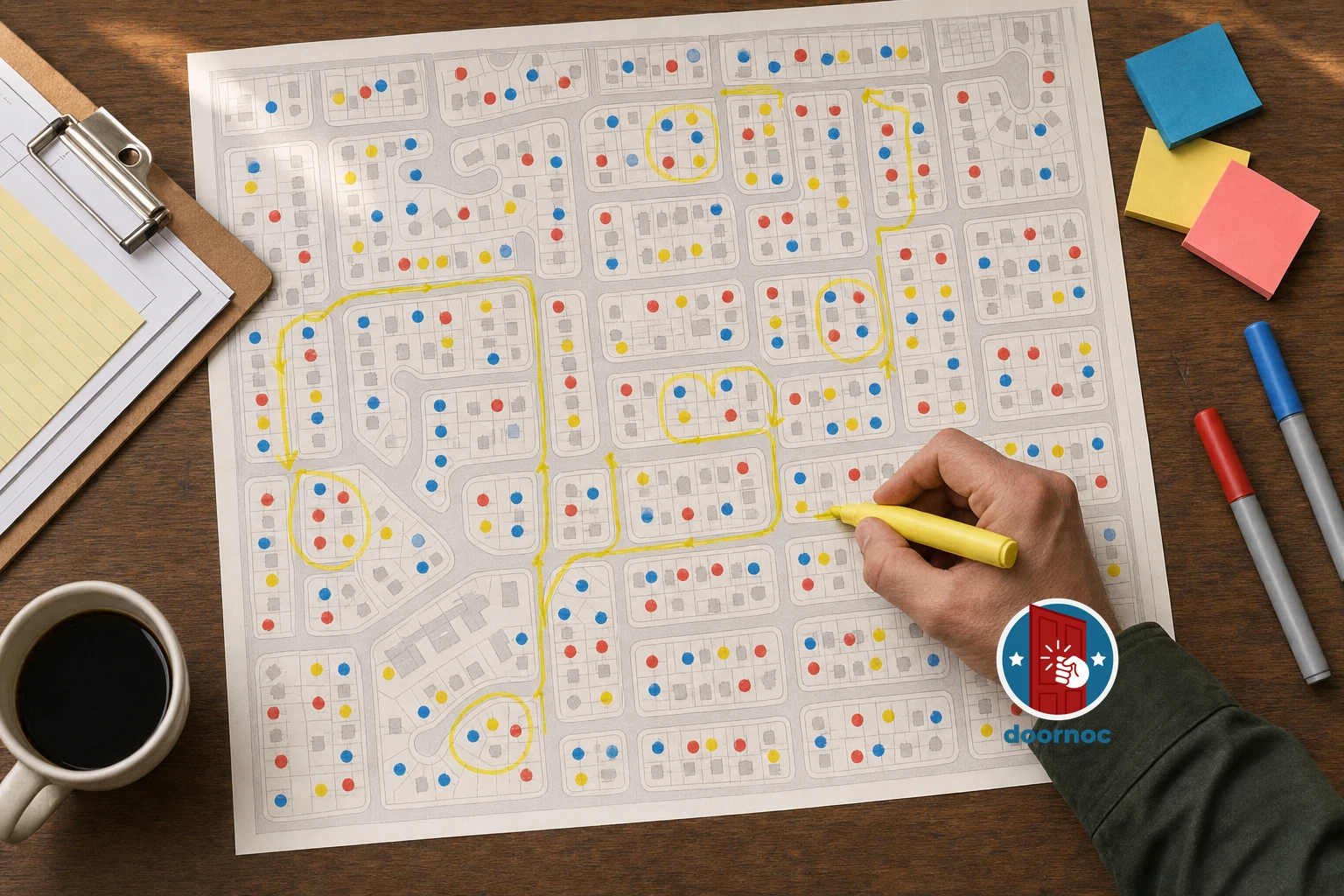
Canvassers receive assigned turfs — specific geographic areas containing 200-500 targeted voter households. You’re responsible for efficiently covering your territory by planning logical walking routes that minimize backtracking and maximize contact opportunities. Smart route planning can increase your doors-per-hour rate by 30-40% compared to random walking patterns.
In 2026, most campaigns use AI-powered route optimization that automatically sequences your door list based on geographic clustering, historical contact rates, and time-of-day patterns. Door Knock’s route planning features generate walking paths that account for one-way streets, cul-de-sacs, and apartment complexes while prioritizing high-value targets. You still need spatial reasoning skills to adapt routes on the fly when encountering locked buildings, aggressive dogs, or unexpected street closures.
Script Delivery and Message Discipline
Canvassers follow carefully tested canvassing scripts designed to deliver consistent messaging across thousands of voter contacts. You’re not reading robotically from a page — effective canvassers internalize key talking points and deliver them conversationally while maintaining message discipline. Campaigns lose persuasion effectiveness when canvassers improvise or inject personal opinions that contradict campaign strategy.
The best canvassers balance authenticity with consistency. You’ll personalize greetings, adapt to voter concerns, and build genuine rapport while ensuring every voter hears the campaign’s core message and persuasion points. This requires active listening skills — you need to recognize when voters raise objections that require scripted responses versus when they’re sharing information that should be noted for follow-up.
Team Coordination and Reporting
Canvassers participate in daily team meetings for training, route assignments, and performance feedback. You’ll report to a team lead or field organizer who monitors your progress, answers questions, and provides coaching on difficult conversations. High-performing canvassers share successful persuasion techniques, flag common voter objections, and help newer team members improve their contact rates.
End-of-shift debriefs serve multiple purposes beyond data submission. You’ll discuss what messaging resonated, which neighborhoods had high contact rates, and what issues voters raised most frequently. This qualitative intelligence helps campaigns adjust strategy in ways that raw data can’t capture — knowing that voters in a specific precinct consistently mention property taxes tells field directors to emphasize that issue in future contacts.
Canvasser Job Requirements and Skills
Successful canvassers combine interpersonal abilities with physical stamina and technical competence. Understanding these requirements helps you assess whether canvassing aligns with your strengths and interests.
Communication and Interpersonal Skills
You’ll initiate conversations with strangers who didn’t invite you to their door, often interrupting dinner or weekend relaxation. This requires confidence, friendliness, and the ability to read social cues quickly. Strong canvassers establish rapport within 10-15 seconds through warm greetings, genuine smiles, and respectful body language that signals “I’m here to listen, not lecture.”
Active listening separates adequate canvassers from excellent ones. You need to hear what voters actually say rather than waiting for your turn to talk. When a voter mentions concern about school funding, effective canvassers acknowledge that concern specifically (“I hear you — school budgets have been tight”) before connecting it to campaign messaging. This validation builds trust and opens voters to persuasion more effectively than launching into scripted talking points.
Physical Stamina and Outdoor Work Tolerance
Canvassing is physically demanding work. You’ll walk 6-10 miles per 4-hour shift, climb stairs in apartment buildings, and stand on porches for 3-5 minute conversations. Experienced canvassers average 15,000-20,000 steps per shift. The job requires comfortable walking shoes, weather-appropriate clothing, and the fitness level to maintain energy and enthusiasm throughout your route.
You’ll work outdoors in all weather conditions — campaigns don’t pause field operations for rain, heat, or cold. Summer canvassing in southern states means 95°F temperatures and high humidity. Winter canvassing in northern states means knocking doors in snow and 20°F cold. Successful canvassers dress in layers, carry water bottles, and develop strategies for staying comfortable and professional regardless of conditions.
Rejection Tolerance and Persistence
Most doors you knock won’t answer. Of those that do answer, many voters will politely decline to talk or express opposition to your candidate. You’ll encounter occasional rudeness, door slams, and aggressive responses. Effective canvassers develop emotional resilience — you can’t take rejection personally or let one negative interaction affect your energy at the next door.
This psychological stamina improves with experience. New canvassers often feel discouraged after their first shift when they complete 100 door knocks but only have 15 conversations. Veteran canvassers understand that field organizing is a numbers game — your job is to maximize quality contacts, not to convince every voter. The 27 canvassing tips that win elections emphasize maintaining positive energy and professional demeanor regardless of response rates.
Technology and Data Management
Modern canvassing requires smartphone proficiency and comfort learning new software platforms. You’ll use mobile apps to navigate routes, access voter information, record responses, and sync data in real-time. Most campaigns provide brief training on their chosen platform, but you need baseline tech literacy — comfortable downloading apps, troubleshooting connectivity issues, and managing battery life during long shifts.
Data accuracy is critical. Campaign strategy depends on reliable field data, so you must record voter responses precisely rather than guessing or selecting random options to move faster. This attention to detail matters more than raw speed — a canvasser who completes 80 doors with accurate data provides more value than one who rushes through 120 doors with sloppy recording.
Schedule Flexibility and Reliability
Campaigns need canvassers during high-contact windows when voters are home — typically weekday evenings (5-8 PM) and weekend afternoons (11 AM-6 PM). You’ll commit to regular shifts and must show up consistently. Field operations collapse when canvassers no-show without notice, leaving territories uncovered and forcing last-minute scrambles to reassign routes.
Peak campaign periods (the final 2-3 weeks before Election Day) require increased availability. Many campaigns offer full-time hours during GOTV (Get Out The Vote) periods, with shifts extending to 6-8 hours daily. Part-time canvassers who can scale up to full-time during crunch periods become invaluable team members who receive first consideration for future campaign roles.
Types of Canvassing Jobs in 2026
The canvasser role varies significantly based on organization type, campaign phase, and specific objectives. Understanding these variations helps you target positions that match your interests and career goals.
Political Campaign Canvassers
Political campaigns hire canvassers for specific election cycles, typically 3-12 months depending on race competitiveness and budget. You’ll focus on voter persuasion, supporter identification, and GOTV activities. Campaign canvassing is intense, deadline-driven work with clear metrics and high accountability. You’ll know exactly how many doors you need to knock, what contact rate you need to achieve, and how your performance compares to team goals.
Political canvassers experience the full campaign arc — early persuasion conversations with undecided voters, mid-campaign volunteer recruitment, and final GOTV efforts to ensure supporters actually vote. This variety keeps the work engaging but also requires adaptability as scripts, targets, and priorities shift throughout the cycle. The 15 canvassing techniques that win elections apply directly to political campaign work.
Nonprofit and Advocacy Canvassers
Nonprofit organizations hire year-round canvassers for fundraising, membership recruitment, and issue advocacy. You’ll knock doors to sign up monthly donors, gather petition signatures, or raise awareness about environmental, social justice, or policy issues. Nonprofit canvassing offers more stable employment than campaign work but typically involves more direct fundraising asks that some people find uncomfortable.
Advocacy canvassing requires deep knowledge of your organization’s issues and the ability to engage voters in substantive policy conversations. You’re not just identifying support levels — you’re educating community members about complex topics and motivating them to take action. This work appeals to canvassers who want to build expertise in specific issue areas rather than moving between different campaigns every election cycle.
Petition and Ballot Initiative Canvassers
Ballot initiative campaigns hire canvassers specifically to gather voter signatures to qualify measures for the ballot. This work is highly transactional — you need to collect X signatures by Y deadline, often with strict legal requirements about signature validity. Petition canvassers typically work in high-traffic public locations (shopping centers, farmers markets, transit stations) rather than going door-to-door, though some campaigns use both approaches.
Petition work pays by signature in some states (where legal) or hourly with signature quotas. You need thick skin for this role — you’ll approach hundreds of people per shift, and most will decline to sign. Successful petition canvassers develop quick pitch techniques that communicate the issue and ask in 30-60 seconds, maximizing signature opportunities during peak foot traffic periods.
Commercial and Market Research Canvassers
Some businesses hire canvassers for market research, product promotion, or customer acquisition. You might conduct neighborhood surveys, distribute promotional materials, or sign up customers for services like solar installation or internet plans. Commercial canvassing typically pays better than political work ($18-25/hour) but involves sales pressure and commission structures that some people find stressful.
This work develops transferable sales and customer service skills valuable in many careers. You’ll learn objection handling, closing techniques, and consultative selling approaches that apply beyond canvassing. However, commercial canvassing lacks the mission-driven purpose that attracts many people to political and nonprofit field organizing.
How to Become a Canvasser: Getting Started
Breaking into canvassing requires minimal formal qualifications but benefits from strategic approach to finding opportunities and demonstrating relevant skills.
Finding Canvasser Job Openings
Political campaigns post canvasser positions on job boards like Indeed, Democratic GAIN, Republican Jobs, and Idealist.org. Check campaign websites directly — competitive races hire field staff continuously throughout the election cycle. Local party offices (Democratic and Republican county committees) maintain lists of active campaigns seeking canvassers and can connect you with hiring managers.
Nonprofit organizations advertise canvasser positions year-round. Search for “canvasser,” “field organizer,” or “community organizer” on nonprofit job sites. Environmental groups (Sierra Club, Environment America), social justice organizations (ACLU, Planned Parenthood), and consumer advocacy groups (PIRG network) hire canvassers in most major cities.
Networking accelerates the process. Attend local political meetings, volunteer for campaigns, and connect with field organizers on LinkedIn. Many canvasser positions get filled through referrals before public posting. Demonstrating enthusiasm and availability often matters more than formal experience for entry-level roles.
Application and Interview Process
Canvasser applications typically require basic information — contact details, availability, transportation method, and brief work history. Some organizations ask why you’re interested in their cause or candidate. Keep responses genuine and concise — field directors value authenticity over polished corporate speak.
Interviews for canvasser positions are informal conversations assessing personality fit, communication skills, and commitment level. Expect questions about your availability, comfort with outdoor work, and how you handle rejection. Interviewers often conduct brief role-play scenarios — you might practice a door-knock introduction or respond to a mock voter objection. These exercises test your ability to think on your feet and communicate clearly under pressure.
Demonstrate reliability and enthusiasm during interviews. Field directors hire canvassers they trust to show up consistently and maintain positive energy. Mention any customer service, sales, or volunteer experience that demonstrates people skills. If you lack direct canvassing experience, emphasize transferable skills like active listening, problem-solving, and comfort with technology.
Training and Onboarding
Most campaigns provide 2-4 hours of initial training covering campaign messaging, canvassing scripts, software platforms, and field techniques. You’ll learn how to navigate your canvassing app, record voter responses accurately, and handle common scenarios (aggressive dogs, locked buildings, hostile voters). Many organizations pair new canvassers with experienced mentors for their first few shifts.
Training quality varies significantly between organizations. Well-run campaigns invest in comprehensive onboarding that includes role-play practice, shadowing experienced canvassers, and gradual responsibility increase. Less organized campaigns might hand you a phone, assign a turf, and expect you to figure it out. Ask about training structure during interviews to gauge organizational professionalism.
Continuous learning separates good canvassers from great ones. Pay attention to feedback from team leads, observe techniques used by high performers, and actively work to improve your contact rates and persuasion effectiveness. The best canvassers treat each shift as skill-building practice rather than just completing assigned doors.
Canvasser Career Path and Advancement
Canvassing serves as entry point to careers in political organizing, nonprofit management, and public affairs. Understanding advancement opportunities helps you leverage canvassing experience strategically.
From Canvasser to Team Lead
High-performing canvassers often get promoted to team lead positions within 4-8 weeks. Team leads supervise 5-10 canvassers, manage turf assignments, conduct training, and ensure data quality. This role pays $2-5 more per hour than base canvasser rates and provides valuable management experience. You’ll learn how to motivate teams, provide constructive feedback, and balance individual contributor work with supervisory responsibilities.
Team leads need both strong canvassing skills and emerging leadership abilities. You must hit your own contact goals while helping struggling team members improve performance. This dual responsibility teaches time management and delegation — critical skills for any management career. Many field organizers started as team leads who demonstrated ability to develop others.
Field Organizer and Campaign Manager Roles
Field organizer positions require 1-2 years of canvassing experience and represent the first salaried campaign role for most political professionals. Field organizers earn $45,000-65,000 annually, manage territories of 3,000-10,000 voters, and coordinate teams of 20-50 volunteers and paid canvassers. You’ll analyze field data, develop volunteer recruitment strategies, and report directly to campaign leadership.
Successful field organizers advance to regional field director, statewide field director, or campaign manager positions earning $75,000-120,000. These roles require proven ability to build field operations from scratch, recruit and train large volunteer teams, and drive measurable results. Most campaign managers and political consultants spent years working their way up from entry-level canvasser positions.
Transferable Skills for Other Careers
Canvassing develops skills valuable far beyond political campaigns. You’ll build communication abilities applicable to sales, customer service, and client relations roles. Data management experience translates to CRM systems used across industries. Team coordination and performance tracking prepare you for operations and project management positions.
Many former canvassers transition into nonprofit program management, corporate sales, public relations, and government affairs. The ability to engage strangers, handle rejection gracefully, and work independently with minimal supervision appeals to employers across sectors. Canvassing also builds professional networks — the field organizer you work for today might hire you for a consulting firm or advocacy organization in five years.
Canvassing Technology and Tools in 2026
The technology stack supporting modern canvassing has evolved dramatically since 2024, making field operations more efficient and data-driven than ever before.
 Five diverse canvassers celebrating around a glowing tablet at dusk on a residential sidewalk in a candid team moment.
Mobile Canvassing Platforms
Every professional campaign in 2026 uses mobile-first canvassing software that replaces paper walk lists and manual data entry. Canvassers access complete voter files on their smartphones, including names, addresses, vote history, party registration, and previous contact notes. You navigate optimized routes using GPS mapping, record responses with simple tap interfaces, and sync data instantly to campaign databases.
Door Knock represents the current generation of canvassing platforms built specifically for political field organizing. The app works offline (critical for rural areas with spotty cell service), provides real-time performance dashboards, and uses AI to optimize route sequencing based on contact probability. Field directors can monitor team progress live, identify canvassers who need support, and adjust territory assignments without waiting for end-of-day reports.
Voter Data Integration
Modern canvassing platforms integrate directly with voter file providers like MailVotes, NGP VAN, and i360. This integration means canvassers see the most current voter data available, including recent address changes, early vote status, and contact history from phone banking. You’re not just knocking doors randomly — you’re executing data-driven contact strategies that prioritize high-value targets.
Voter Intelligence features provide door briefs with talking points customized to individual voters based on their demographic profile, issue interests, and voting behavior. This personalization increases persuasion effectiveness — you can reference specific concerns that resonate with each household rather than delivering generic messages to everyone.
Performance Analytics and Accountability
Real-time analytics transformed field management between 2024 and 2026. Campaign managers now track contact rates, persuasion ratios, and volunteer recruitment by canvasser, team, and turf. You’ll see exactly how your performance compares to team averages and campaign goals. This transparency drives accountability — canvassers who consistently underperform get additional coaching or reassignment to different roles.
Some campaigns gamify performance metrics with leaderboards, achievement badges, and team competitions. While not everyone responds to competitive motivation, many canvassers find that public recognition for high contact rates or persuasion effectiveness increases engagement and effort. The key is balancing metrics-driven accountability with the human relationship-building that makes canvassing effective.
Canvasser Compensation and Benefits
Understanding pay structures, benefits, and total compensation helps you evaluate canvasser opportunities and negotiate effectively.
Hourly Rates and Performance Bonuses
Entry-level canvassers earn $15-18/hour in most markets, with experienced canvassers earning $18-22/hour. Team leads and precinct captains earn $22-28/hour. These rates increased 15-20% between 2024 and 2026 as campaigns competed for limited field staff in tight labor markets. Urban areas with higher costs of living typically pay $2-4 more per hour than rural markets.
Many campaigns offer performance bonuses tied to contact goals or persuasion metrics. You might earn an extra $50-100 weekly for exceeding your door-knock target by 20% or recruiting 5+ volunteers. These bonuses reward productivity without creating perverse incentives that compromise data quality. Avoid campaigns that pay per door knocked — this structure encourages rushing through contacts and recording inaccurate data.
Benefits and Perks
Most canvasser positions are part-time hourly roles without traditional benefits. However, full-time field organizer positions typically include health insurance, paid time off, and sometimes retirement contributions. Campaign work rarely offers benefits due to the temporary nature of election cycles — you’re hired for 3-6 months, not permanent employment.
Non-monetary perks vary by organization. Some campaigns provide transportation stipends or mileage reimbursement. Many offer free campaign merchandise (t-shirts, hats, water bottles). The best campaigns create team culture through social events, recognition programs, and opportunities to meet the candidate or organizational leadership. These perks won’t pay rent but contribute to job satisfaction and team cohesion.
Seasonal and Full-Time Opportunities
Political canvassing follows election cycles — hiring peaks 3-6 months before Election Day and ends immediately after the election. Experienced canvassers often work multiple campaigns per year, moving from local races to statewide campaigns to federal races. This cycle creates feast-or-famine income patterns that require financial planning.
Nonprofit canvassing offers more stable year-round employment but typically at slightly lower hourly rates ($14-20/hour). Some canvassers work political campaigns during election seasons and nonprofit organizations during off-years, maximizing income while building diverse experience. The most successful career canvassers develop reputations that generate consistent job offers across multiple organizations.
Common Challenges and How to Overcome Them
Every canvasser faces predictable obstacles. Knowing these challenges in advance and developing coping strategies improves performance and job satisfaction.
Managing Rejection and Maintaining Motivation
The hardest part of canvassing isn’t the physical work — it’s maintaining enthusiasm after your 50th no-answer door or 10th hostile response. New canvassers often take rejection personally, interpreting door slams as commentary on their worth rather than normal field organizing outcomes. This emotional drain causes burnout faster than physical fatigue.
Successful canvassers reframe rejection as neutral data rather than personal failure. A voter who says “not interested” isn’t rejecting you — they’re declining a political conversation. Record the response, move to the next door, and maintain professional energy. The 17 door knocking tips that win elections emphasize mental resilience and positive self-talk as critical skills.
Building in small rewards helps sustain motivation. Many canvassers set micro-goals — “I’ll take a water break after completing this block” or “I’ll check my phone after 20 more doors.” These incremental achievements create momentum and make large turf assignments feel manageable. Celebrating small wins (“I had three great conversations this hour!”) maintains positive energy better than fixating on total doors remaining.
Weather and Physical Discomfort
You’ll canvass in conditions that keep most people indoors. Summer heat exhaustion, winter frostbite, and rainstorm soaking are occupational hazards. The physical discomfort can sap motivation and reduce performance if you don’t prepare properly.
Dress in layers that you can adjust as temperature and exertion levels change. Bring water bottles and healthy snacks — your energy and mood plummet when dehydrated or hungry. Many experienced canvassers carry small backpacks with sunscreen, rain jacket, hand warmers, and blister treatment. These simple preparations prevent minor discomforts from derailing entire shifts.
Know your limits and communicate with field leadership when conditions become unsafe. Campaigns should pause canvassing during severe weather (lightning, extreme heat advisories, dangerous cold). Pushing through genuinely dangerous conditions doesn’t demonstrate dedication — it risks injury and reduces long-term team effectiveness.
Technology Issues and Data Management
App crashes, dead phone batteries, and lost cell service create frustration when you’re trying to record voter responses efficiently. Technology failures feel particularly stressful when you’re standing on a porch with a voter waiting for you to log their information.
Carry portable battery packs and charge your phone overnight before every shift. Download offline maps and voter lists before leaving for your turf — this prevents connectivity issues from stopping your progress. Learn your app’s offline functionality so you can continue working even without cell service, with data syncing automatically once connection resumes.
When technology fails completely, switch to paper backup. Carry a small notepad and pen to record critical information (address, voter name, response) that you’ll enter into the system later. Losing data from 50 conversations because you didn’t have backup documentation is worse than spending 30 minutes on data entry after your shift.
Safety and Conflict De-escalation
Most canvassing interactions are neutral or positive, but you’ll occasionally encounter aggressive dogs, hostile property owners, or unsafe neighborhoods. Knowing how to assess and respond to threats keeps you safe while maintaining professional composure.
Trust your instincts about unsafe situations. If a property feels dangerous (aggressive dog, threatening behavior, suspicious activity), skip it and move to the next door. No voter contact is worth risking your safety. Mark the address as inaccessible in your app and notify your team lead for follow-up through different contact methods.
When voters become verbally hostile, remain calm and polite. Thank them for their time and leave immediately — don’t argue or defend your candidate. Most aggressive responses reflect frustration with politics generally rather than personal attacks on you. Understanding the difference between canvassing and soliciting helps you respond confidently to property owners who claim you’re trespassing (you’re not — political canvassing is constitutionally protected speech).
The Future of Canvassing: What’s Changing
Field organizing continues evolving as technology, voter behavior, and campaign strategy shift. Understanding these trends helps canvassers stay relevant and advance their careers.
AI-Powered Persuasion and Micro-Targeting
Campaigns increasingly use predictive models to identify which voters are most persuadable and what messages resonate with specific demographic groups. By 2026, canvassers receive AI-generated talking points customized for each household based on machine learning analysis of similar voters. This micro-targeting increases persuasion effectiveness but requires canvassers to quickly absorb and deliver varied messages rather than memorizing a single script.
The next evolution involves real-time message testing. Canvassers will try different persuasion approaches with similar voters, recording which arguments work best. AI systems will analyze this feedback and adjust messaging recommendations continuously. This transforms canvassers from message deliverers into field researchers conducting ongoing experiments.
Integration with Digital Organizing
Field and digital organizing increasingly work together rather than operating as separate campaign functions. Canvassers in 2026 collect phone numbers and social media handles to enable follow-up contact through multiple channels. You might have a door conversation with a persuadable voter, then that voter receives targeted Facebook ads reinforcing your message and a follow-up text message with voting information.
This integration requires canvassers to think beyond single interactions. You’re not just identifying support levels — you’re initiating multi-touch persuasion sequences that combine in-person conversation with digital reinforcement. Understanding how your door contacts feed into broader campaign strategy makes you more valuable to field directors.
Volunteer-Powered Campaigns and Hybrid Models
Some campaigns are shifting from paid canvasser models to volunteer-driven field operations supported by paid organizers. This approach reduces costs while building grassroots energy, but it requires different management skills. Canvassers who can recruit, train, and motivate volunteers become more valuable than those who only knock doors themselves.
Hybrid models combine paid canvassers for high-priority targets with volunteer teams for broader coverage. You might spend mornings knocking doors in swing precincts, then spend afternoons training and managing volunteers who canvas lower-priority areas. This evolution creates more diverse and interesting work while developing leadership skills.
Why Canvassing Matters: Impact on Elections and Democracy
Understanding the broader significance of canvassing helps maintain motivation and sense of purpose during difficult shifts.
The Proven Effectiveness of Door-to-Door Contact
Decades of political science research confirms that door-to-door canvassing increases voter turnout more effectively than any other contact method. A quality in-person conversation increases the probability that a contacted voter will cast a ballot by 7-10 percentage points. Phone calls increase turnout by 2-4 points. Digital ads and direct mail have minimal measurable impact on turnout.
This effectiveness stems from the personal connection that canvassing creates. When a real human shows up at your door, makes eye contact, and asks you to vote, it triggers social pressure and reciprocity that digital contact can’t replicate. Voters who receive door contacts feel more connected to campaigns and more accountable for following through on voting commitments.
Building Democratic Participation
Canvassing serves democracy beyond helping specific candidates win. Door-to-door conversations increase political engagement, civic knowledge, and community connection. Voters who receive canvassing contacts are more likely to discuss politics with friends, research candidates, and participate in local government — effects that persist beyond individual elections.
You’re not just collecting data or delivering messages. You’re creating moments of democratic participation that remind people their voices matter. In an era of declining civic engagement and increasing political alienation, canvassers serve as human connective tissue linking communities to democratic processes.
Career Fulfillment and Purpose-Driven Work
Many canvassers cite mission alignment and impact as primary job satisfactions. You see direct results from your work — voters you persuade, volunteers you recruit, and ultimately election outcomes you helped create. This tangible impact provides meaning that many corporate jobs lack.
The relationships you build with team members, voters, and community leaders often outlast individual campaigns. Former canvassers frequently cite field organizing as formative experiences that shaped their values, built lifelong friendships, and launched careers in public service. The work is hard, but the purpose and camaraderie make it worthwhile for people who value making a difference over maximizing income.
Frequently Asked Questions
How much do canvassers make in 2026?
Canvassers typically earn $15-25 per hour in 2026, with experienced field organizers earning $18-22/hour and leadership roles (team leads, precinct captains) earning $22-28/hour. Campaign canvassers often receive performance bonuses based on contact goals, while nonprofit canvassers may earn slightly less but have more stable year-round employment.
What qualifications do you need to be a canvasser?
Most canvasser positions require no formal qualifications beyond a high school diploma or equivalent. Key requirements include being at least 18 years old, having reliable transportation, owning a smartphone, and possessing strong interpersonal skills. Previous customer service, sales, or volunteer experience is helpful but not mandatory for entry-level positions.
Is canvassing a good job for college students?
Yes, canvassing is excellent for college students seeking flexible, part-time work with transferable skills. Most campaigns offer evening and weekend shifts that accommodate class schedules, pay competitive hourly rates, and provide valuable experience in communication, data management, and political organizing that enhances resumes for careers in public policy, nonprofit management, or political consulting.
What’s the difference between a canvasser and a field organizer?
A canvasser focuses primarily on door-to-door voter contact and data collection, while a field organizer manages teams of canvassers, coordinates volunteer recruitment, analyzes field data, and develops territory strategy. Field organizers typically earn $45,000-65,000 annually and require 1-2 years of canvassing experience, whereas canvassers are entry-level positions paid hourly.
How many doors does a canvasser knock per day?
Experienced canvassers typically knock 80-150 doors per 4-hour shift in 2026, completing 15-30 meaningful voter conversations depending on contact rates and neighborhood density. High-performing canvassers in optimized routes using tools like Door Knock can reach 40+ contacts per shift during peak GOTV periods when voters are more likely to be home.