


Nearly half of school board races were uncontested in a study covering more than 50,000 elections across 16 states. That changes the starting question for anyone considering how to become a school board member: the first task isn’t building a large political operation. It’s finding the next available seat and deciding whether the household can support the meeting and preparation hours after a win.
An expiring seat on a staggered board can offer a practical entry into local government. But ballot access, campaign readiness, and readiness to serve are separate tests. A candidate needs to pass all of them before treating an election announcement as a commitment.
How Long a School Board Term Lasts
Local school board terms commonly run two, four, or six years, often with staggered elections, and no national standard sets the length. The National School Boards Association survey counts approximately 90,000 members governing 13,500 districts, with roughly 88% elected and 12% appointed.
Your district’s rules decide the path, so start with the local clerk.
School board term length and how seats turn over
| Example | Term length | How seats turn over | What to verify |
|---|---|---|---|
| Typical locally elected board | Two, four, or six years | Often staggered so only some seats are on the ballot | State statute and district policy |
| Delaware | Changed for members elected after Dec. 31, 2021, so confirm the current length | Confirm the local stagger | State filing deadline and required checks |
| Minnetonka Public Schools 2025 | Four years | Four seats on the ballot with six candidates, according to the district election notice | District election notice |
| U.S. school boards overall | No single national term | About 88% of members elected and 12% appointed | Whether this seat is elected or appointed |
Staggering determines the opportunity. A staggered board works like a relay: only part of the membership hands off at each election, so a district can hold an election without putting every seat before voters. Which seat is open shapes the race. A four-year seat whose incumbent has announced retirement produces an open contest. The same seat with an incumbent running again means challenging a name voters already know.
A prospective candidate should get these items from the district clerk:
- Term length: the full term and whether the opening fills an unexpired term.
- Seats available: which positions appear on the coming ballot.
- Election geography: whether voters elect members at large or from subdistricts.
The state election authority should confirm the term and election structure. A clerk’s current notice and the state’s governing rules carry more weight than a secondhand guide.
Term length also sets the size of the commitment. Multiply the meeting and preparation load by the years on the seat, then decide whether the household can carry that schedule before any paperwork is filed.
Eligibility Rules That Change by State
Qualification is a local legal test, not a personality test. Citizenship, adulthood, district residence, and voter registration are common starting points, but they aren’t a complete national checklist. The comparison below identifies questions to resolve before campaigning.
School board eligibility in seven jurisdictions
| Place | Age | Residency and registration | Extra limits |
|---|---|---|---|
| Common U.S. baseline | 18 | Citizen, state and district resident, registered voter | Confirm every item locally |
| Illinois | 18 baseline | At least one year in the state and district | Local disqualifications still apply |
| Delaware | 18 | Citizen and district resident | Criminal-background and Child Protection Registry checks |
| Texas | 18 | Registered voter in the territory by the filing deadline and district residency | Disqualifying-crime rules |
| New York | 18 | Generally one continuous year; some districts use 30 days to three years; qualified-voter status | Employees barred; some same-household bans; ability to read and write |
| Indiana | Confirm locally | At least one year | Statement of economic interest may be required |
| Louisiana | 18 | Two years in the state and one year of local domicile | High-school diploma or equivalent and literacy |
| Oklahoma 2025–2026 packet | Confirm locally | Six months of district residency and voter registration | Diploma or equivalency; current district employees barred; felony and embezzlement limits |
The baseline and Illinois and Delaware examples illustrate why an address alone doesn’t establish eligibility. A candidate may live within district boundaries yet fail a residency-duration requirement, or qualify by residence while still needing registration or required checks.
The Texas secretary of state’s qualifications guidance describes the state’s age, registration, residency, and disqualifying-crime requirements; the jurisdictional examples also identify Indiana’s residence and economic-interest requirements and Louisiana’s education, domicile, and literacy requirements. These are separate compliance questions, not interchangeable versions of a national rule.
Check conflicts before collecting support
Under the New York State School Boards Association’s candidate guidance, candidates generally must be citizens, qualified district voters, able to read and write, and at least 18, with one continuous year of district residence, although local exceptions range from 30 days to three years. The guidance also identifies district-employment and same-household restrictions.
A move, a district job, or a family member’s board service can therefore matter before a candidate ever knocks a door. The relevant question isn’t whether the community knows the candidate. It’s whether the candidate satisfies the legal conditions on the date the law specifies.
The Oklahoma school board candidate packet for 2025–2026 requires six months of district residency and voter registration, a diploma or equivalency, and compliance with employment and criminal-history restrictions. Its ethics-reporting procedures also changed beginning November 1, 2025, another reason to use the current packet rather than a previous candidate’s paperwork.
Before campaigning: Employment conflicts and household restrictions deserve the same attention as age and residence.
A useful self-check fits on a short worksheet:
- Citizenship: Confirm the applicable requirement.
- Age: Record the qualifying date, not merely the birthday.
- Registration: Verify status and the correct electoral territory.
- Residency clock: Document the move-in date and required continuous residence.
- Job or household conflict: Obtain clarification before announcing.
For appointed seats, the route runs through the appointing body’s process rather than a voter-contact campaign. The district clerk should identify who fills the seat, where applications go, and which qualifications and interviews apply.
Time Money and Access Before You Commit
A reachable race isn’t a cost-free commitment. A compact electorate can make direct contact manageable, but candidates still need transportation, printing, childcare, accessible events, and time away from paid work.
Election geography changes that calculation. An at-large candidate may need to reach households across the district, while a subdistrict candidate works within a smaller electoral boundary. Neither arrangement eliminates the need to hear from families outside the candidate’s existing network.
Test the household calendar
Before filing, the candidate and household should resolve practical constraints:
- Evening availability: Identify work shifts, caregiving, and recurring obligations that conflict with meetings.
- Campaign expenses: Include translated materials, rides to filing offices, and childcare during canvassing.
- Access: Arrange accessible gathering places and language support rather than assuming every voter can attend the same event.
- Income risk: Determine whether unpaid or lightly compensated service is financially sustainable.
A local-office campaign cost guide can help turn those categories into a working budget. For candidates balancing employment, family obligations, and volunteer leadership, Tuff’s guidance on how to prioritize work across competing projects offers a useful way to assign owners and protect preparation time.
Low spending doesn’t remove the need for dependable hours.
The commitment test is straightforward: can the candidate attend night meetings throughout the term, can the household absorb the financial tradeoff, and can the campaign return to the same streets for follow-up conversations?
A negative answer isn’t a judgment on civic commitment. Delaying a cycle, volunteering, or serving on an advisory committee can be more responsible than filing for a role the household can’t sustain.
How to File Petitions and Reach the Ballot
A complete, correctly filed packet is what gets you on the ballot. School board seats are usually staggered, so a single vacancy or expiring term is what opens a race, and the filing window around it can be short. Treat the packet like a take-home exam graded as one submission: a missing page fails the whole thing, no matter how strong the rest is.
Map the sequence before the first signature is collected.
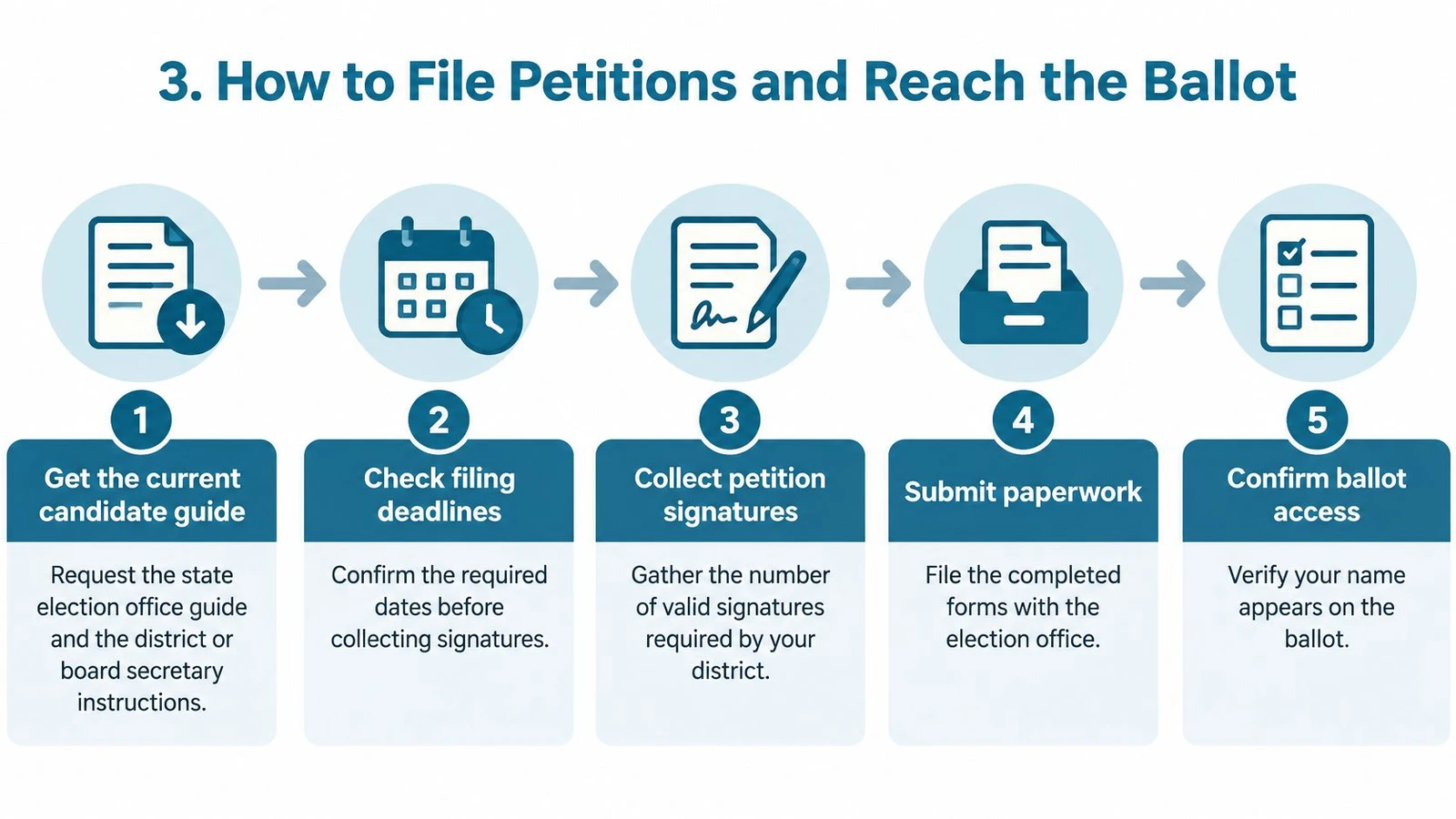
Complete the filing sequence
-
Get the current candidate guide. Request the state election office’s materials and the district or board secretary’s instructions. Discard last cycle’s blank forms. An old petition can look familiar while omitting a required field or using obsolete language.
-
Build a deadline matrix. Give notice of candidacy, petitions, financial disclosure, committee registration, and required checks separate rows. Record the filing office, opening date, closing date, required attachments, and completion status. A missing disclosure page belongs on this checklist, not in a last-minute search through email.
-
Calculate the district’s signature requirement. Confirm the relevant boundaries and eligible signers before printing petitions. Thresholds can differ between two districts in the same state: Indiana, for example, sets different counts for a metropolitan board district and a community school corporation. A neighboring district’s rule is never a substitute.
-
Collect extra valid signatures. Petition circulators should use the correct forms and verify that signers belong to the eligible territory. Extra signatures create a cushion for entries that get struck, and that cushion matters more in a small district where the required count is already low. A signature from outside the required district still fails even when the signer strongly supports the candidate.
-
Submit the complete packet and confirm acceptance. File before the closing deadline, retain the receipt, and ask the administrator how ballot appearance will be confirmed. Waiting until the final afternoon leaves little room to replace an attachment, correct notarization, or reach the right office.
Petition and filing rules in sample states
| Place | Packet | Signature rule | Timing trap |
|---|---|---|---|
| Illinois | Declaration and nomination petitions | A minimum number of registered voters, capped at a small percentage of eligible voters | A filing window that opens and closes well before election day |
| Indiana | Nomination petition, plus economic-interest paperwork where required | The Indiana candidate guide requires 10 registered voters in the board district or inside the community school corporation | Use the current state candidate calendar |
| Iowa | Notarized affidavit of candidacy and nomination petitions filed together | Calculated from the district’s registered-voter total on a reference date the state sets | Separate filing of the pieces gets the packet rejected |
| Delaware | Candidate filing plus criminal-background and Child Protection Registry checks | The county election office confirms the count for each seat | A state-set deadline, not a generic national date |
The packet must work as a whole. Iowa’s combined-filing rule is the clearest warning: completing both documents is not enough if they arrive separately. A correct signature count also settles nothing about whether each signer is eligible or whether the petition reached the right official.
Two habits catch the errors that slip past the person who assembled the packet. First, designate a filing reviewer who did not prepare it, and have that person check names, dates, blank fields, attachments, signatures, and notarization against the official checklist. Second, have the reviewer compare each page against the clerk’s checklist and initial every field that was changed, so corrections leave a visible trail.
The review should also separate administrative guidance from legal advice. If an employment conflict, a criminal-history restriction, or a disputed residency question remains unresolved, the candidate needs authoritative clarification; an accepted filing does not settle eligibility on its own.
On filing day, photograph every completed page and the receipt. A secure copy of exactly what was submitted makes later questions much easier to answer. The paperwork is the short half of this job, because the meeting and preparation hours that follow are what the seat asks for.
Build a Small Campaign Around Likely Voters
In a study of more than 50,000 elections across 16 states, incumbents who sought reelection won more than 80% of the time, while only about 59% ran again. School board seats rarely change hands because a challenger defeats a sitting member. They change hands through retirement, so the practical distinction is between challenging someone entrenched and organizing early for a seat that person plans to leave.
Most of those vacancies are staggered and land in low-turnout races, which makes the real test everything that happens before filing day: identifying expiring seats, confirming boundaries, and learning the district’s actual arguments. Attend meetings and listen first, then choose the campaign message.
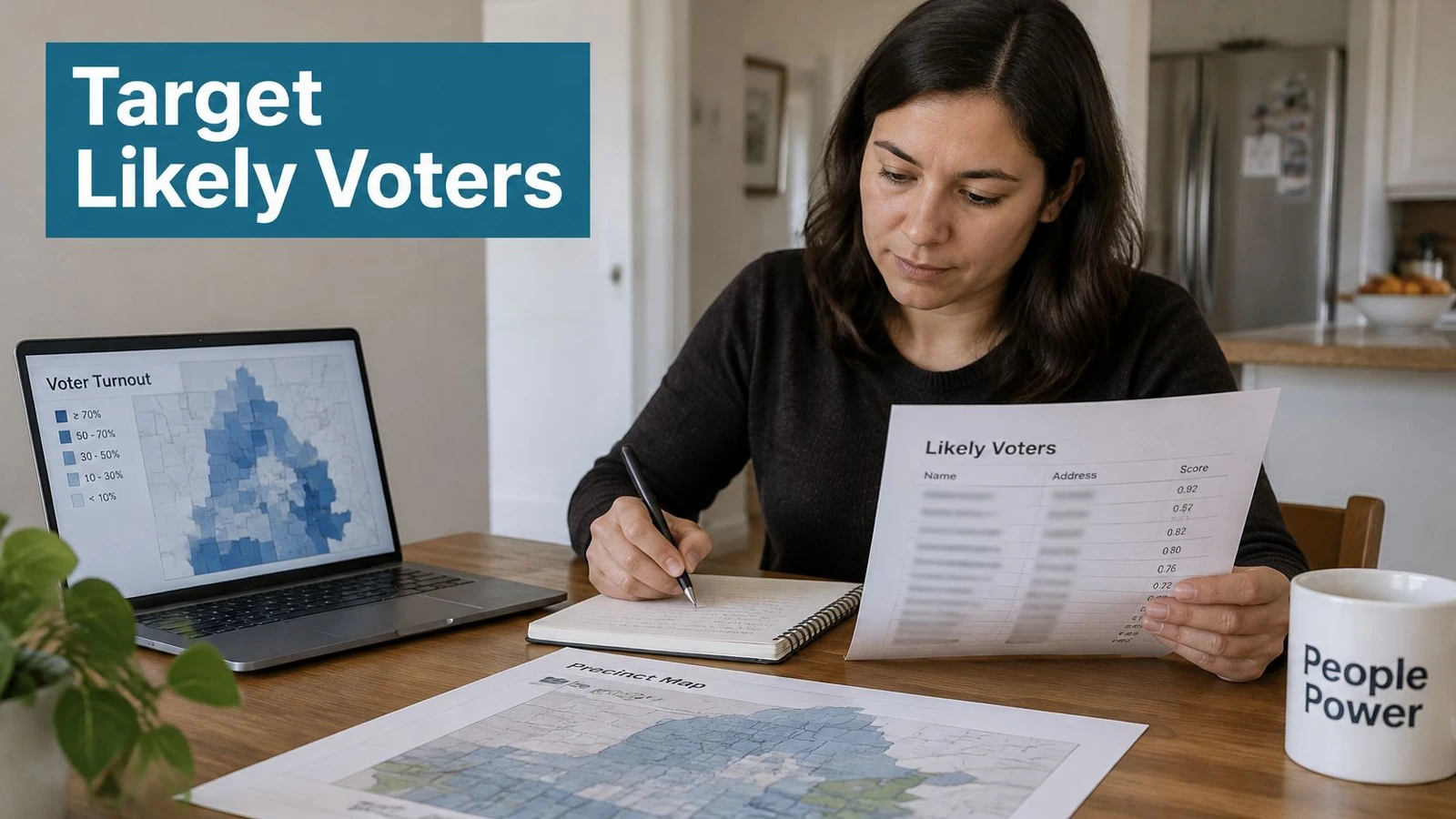
Set a vote goal before choosing tactics
Start with the election administrator’s past results, including the quiet races most voters ignored. Compare elections with similar timing, seat structure, and competition, then examine ballots cast, candidate totals, and the result needed to win. Total voter registration is the wrong denominator, because an off-cycle contest draws only a fraction of it.
Multi-seat elections require particular care. Voters may select several candidates at once, so the sum of candidate votes is larger than the number of people who participated. Dividing ballots cast by the number of seats produces a false winning target, and a campaign built on it will knock too few doors.
The working calculation is:
Vote goal: Use the last comparable winning result as a planning reference, adjust for the current contest, and add a cushion for uncertain support.
Work backward from that target to a contact plan. A supporter commitment is not a guaranteed vote, and an unanswered door is not evidence of opposition. Schedule enough conversations to separate confirmed support from polite assumptions, and expect some slippage between the porch and the polls.
Keep the message measurable
A useful platform connects district concerns to observable outcomes. Bus reliability, reading progress, and the schedule for a building project give families something concrete to discuss. Promises to personally direct teachers or fix individual staffing decisions cross the governance line, since boards act on budgets and policy rather than day-to-day personnel calls.
Candidates can use school board candidate statement examples to shape a concise introduction, then test whether residents understand the priorities without additional explanation.
Sort the contact list by the next appropriate action:
- Likely supporters: Confirm support and invite a specific volunteer commitment.
- Persuadable residents: Record the issue raised and schedule a relevant follow-up.
- Educators: Arrange conversations off duty and respect workplace rules.
- Regular local voters: Make sure the election date and the school board contest are on their radar.
A shared, privacy-conscious contact record should track attempts, supporter commitments, volunteer assignments, and legally available ballot-return information. Access should match each role. On doornoc, admins, consultants, managers, canvassers and volunteers are invited by email, a consultant gets admin rights across several campaigns, and a volunteer sees only assigned routes. Sensitive student or family information stays out of campaign notes regardless of the tool.
Weekend walking routes, a community forum, and a modest printing and childcare budget can form a workable field plan. Judge each activity by the same standard: whether it produces useful conversations and reliable follow-through.
Online communication supports that work without replacing it. Engagement numbers and ballot commitments measure different things, a distinction a measurement guide for social media teams spells out in detail. A viral post still is not a precinct. Local residency, voter eligibility, and an actual commitment matter more than the size of an online audience.
What the Seat Asks After Election Day
A school board member needs more than campaign stamina. A 2025 USC EdPolicy Hub study of 10 California members, reported by EdSource, identified partisan and local politics, substantial time demands, relationships, and learning how to effect change as major difficulties; the same reporting described a district permitted to pay trustees $400 per month, with proposed legislation that would raise that amount to $2,000.
Those figures aren’t a national pay scale, and the proposal shouldn’t be treated as enacted compensation. Each candidate needs the district’s actual reimbursement and compensation rules before making household plans.
Budget preparation time, not just meeting time
For a hypothetical monthly planning exercise, a candidate might reserve 10 to 20 hours for evening meetings, packet reading, school visits, correspondence, and training, then add capacity for budget season. That’s a stress test for the household calendar, not a measured national workload estimate.
A practical preparation routine starts when the agenda arrives. The member reads the recommendations and supporting material, marks unclear assumptions, and sends factual questions through the board’s established channel before the meeting.
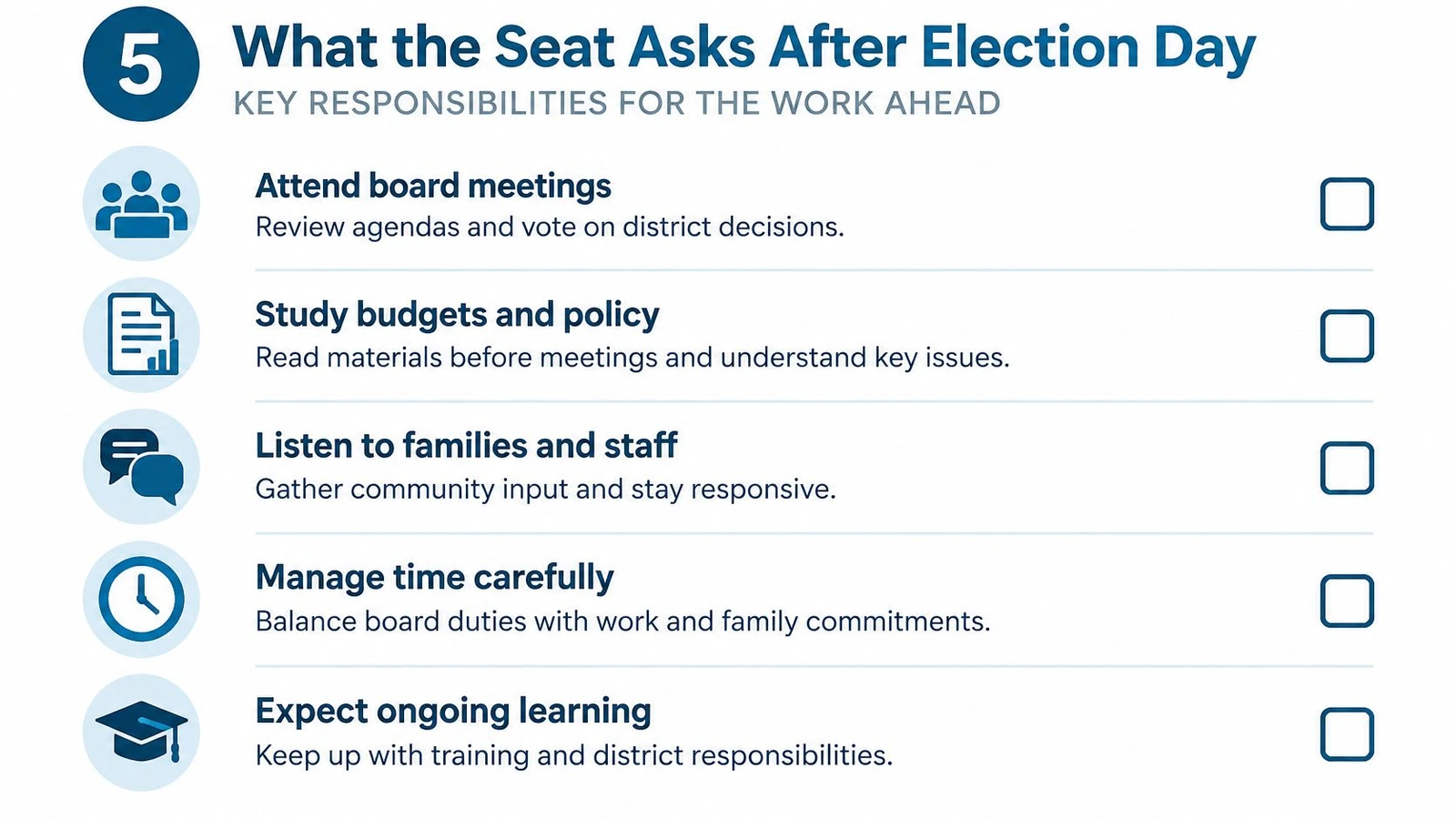
Respect the governance boundary
The board hires and evaluates the superintendent and establishes policy and budget direction. The superintendent manages daily staffing and instruction. For example, a member can question districtwide staffing assumptions during budget review without personally directing a principal’s employee assignments.
A separate school board duties post can cover the full role. For feasibility purposes, the essential distinction is that an individual member doesn’t become the district’s day-to-day manager.
Closer Innovation Labs on school administration offers useful context for understanding operational pressures without taking over administrators’ work. Public comment likewise calls for listening and lawful response under board procedures, not an argument with every speaker.
A proposed first-100-days checklist can stay focused:
- Orientation: Complete required training and identify further learning needs.
- Financial context: Read the current and preceding budgets alongside district priorities.
- Working relationships: Meet the superintendent within the board president’s communication norms.
- Legal boundaries: Learn public-records, open-meeting, confidentiality, and ethics requirements.
- Contentious issues: Establish a response process for misinformation, harassment, and threats.
A constituent case-management framework can help distinguish an incoming concern from its appropriate referral. Confidential student and personnel matters should remain in authorized district channels.
Confirm Your District and Start Contact
Email the district clerk this week and ask for the current candidate packet. Eligibility checks were covered earlier; the task now is matching that packet to your address, your residency clock, and the seat you intend to pursue.
Build the filing calendar around a personal deadline ahead of the statutory cutoff. A missing attachment or an unclear instruction then becomes a routine question for the clerk rather than a scramble on the final filing afternoon.
Turn official answers into a decision
Once eligibility and household capacity are clear, the candidate can choose the appropriate expiring or open seat and build a vote goal from comparable low-turnout returns. The first contact list should hold parents, neighbors, and community members the candidate can reach, each with a follow-up plan.
A workable first month:
- Week 1: Request the packet and put board meeting observation on the household calendar.
- Week 2: Match the packet to the precise position and electoral boundary, then attend a meeting.
- Week 3: Give each campaign task an owner and a completion date, including the filing review.
- Week 4: Contact reachable voters and flag the households that merit a return visit.
For the broader mechanics of a first local campaign, how to run for office covers the basics. When planning turns into walking the district, door to door canvassing software builds routes for the team, and each volunteer sees only the routes assigned to them.
Set the personal filing date two weeks ahead of the statutory cutoff and reserve the official deadline for corrections only. If the household calendar cannot absorb the unpaid meeting and preparation hours after Election Day, the right target is the next staggered vacancy.
doornoc serves campaigns from local school board races to congressional contests, with tools for organizing route-based voter contact. Candidates ready to turn a qualified school board candidacy into a walking plan can visit doornoc to organize campaign-team outreach.
Looking for a tool to run this? doornoc’s canvassing software bundles voter data, automatic turf cutting, the mobile app, and live reporting in one platform.