

School board candidate statements live in tight spaces, often just 150 to 250 words, where voters may read only a few lines before deciding whether to continue. A strong statement therefore does more than introduce a candidate. It connects a credible personal reason for running to specific, checkable commitments and gives voters a clear reason to remember the candidate.
This listicle presents eight practical models for school board candidate statement examples, including statements from a classroom teacher, parent, financial professional, incumbent, small business owner, and retired educator. Each example includes short analysis covering what works, where it carries risk, and how to adapt it to local issues and word limits.
The guide also provides a fill-in template, five openers for “why I am running for school board” questions, and condensed 50- and 100-word candidate bios for websites and walk literature. For broader campaign preparation, review how to run for office.
The strongest statements rely on a few deliberate persuasive moves, and this guide breaks down the techniques behind them. Learn more about making your content more convincing.
Use the models as starting points, not scripts. Replace broad claims with local facts, test every promise against available evidence, and edit until each sentence earns its place.
1. Teacher-Candidate Voter Guide Statement (Classroom Perspective)
This approach is especially effective for a classroom teacher seeking election as a school board member. It converts professional experience into a concise answer to “Why I am running for school board?” while grounding policy promises in conditions voters already understand: class sizes, staffing, reading support, and classroom resources. Among school board candidate statement examples, this format is persuasive because it presents the candidate as both a decision-maker and someone accountable to families.

Example Candidate Statement
I have spent eleven years teaching fourth-grade reading in this district, and I am running for school board because I see daily what our budget decisions mean inside the classroom. Class sizes in my building have grown while support staff hours have shrunk, and families deserve a board that tracks those trade-offs openly. If elected, I will push for a public dashboard showing per-school staffing and spending so parents can see where dollars go. I will also prioritize early literacy, because every child who reads at grade level by third grade has a better chance at every later subject. I will listen first to teachers, bus drivers, custodians, and parents before voting on major changes, and I will report back to voters on what I heard and what I decided. Our schools work best when the people who know them most have a seat at the table. I ask for your vote so I can bring that classroom perspective to every budget and policy decision the board makes over the next four years.
Why It Works
- Specific credibility: Eleven years and a named grade level establish genuine familiarity with district conditions.
- Observable evidence: Class sizes and reduced staff hours give voters concrete problems to evaluate.
- Checkable commitments: A public staffing and spending dashboard is easier to verify than a broad promise to “support schools.”
- Clear process: Listening before voting and reporting afterward create a defined accountability cycle.
A strong voter-guide statement does not merely promise better outcomes. It shows how the candidate would reach them.
Practical Application
Candidates should disclose any current district employment or contractual relationship directly in the statement. The dashboard proposal should also reflect what the district can realistically publish, including available data, update schedules, and responsible staff.
Before using this format, check the local election office’s word limit. Add the election date and voting location if space permits, making the statement both an introduction and a useful voter prompt. For fuller campaign planning, consult guidance on how to run for office. Local teacher associations and League of Women Voters groups may also review candidate statements, but candidates should still confirm all claims independently.
When adapting the sample, retain the sequence: experience, evidence, commitment, process, and request. That structure helps explain why the candidate is running without turning the statement into a résumé or relying on education-sector jargon.
2. Parent-Advocate Voter Guide Statement (First-Time Candidate)
A first-time candidate can build credibility by showing how parent experience translates into a disciplined civic plan. This approach is especially useful when voters feel excluded from board decisions. It presents familiar concerns, such as meeting access, agendas, safety procedures, and curriculum review, as problems the candidate can address through specific communication commitments. Among school board candidate statement examples, it works because it replaces formal credentials with trust, preparation, and observable promises.
Example Candidate Statement
My two children attend public schools here, and like many parents I started attending board meetings because I wanted answers I could not find elsewhere. I am running because I believe the board should be easier to follow for the families it serves. I will commit to publishing meeting summaries in plain language within 48 hours, posting agendas early enough for parents to read them, and holding at least two evening listening sessions per year in neighborhoods outside the central campus. On safety, I support clear, written procedures that families can read and that staff apply consistently. On curriculum, I will ask for transparent review timelines so parents can give input before materials are adopted. I have worked as a project coordinator for a local nonprofit for nine years, where I managed budgets and timelines and reported results to funders. I bring that discipline to the board table. I am asking for your support so the board can earn trust through openness rather than asking families to take its word for it.
Why It Works
- Relevant motivation: The statement explains why the candidate became involved and identifies a problem grounded in family experience.
- Specific commitments: Publication deadlines, agenda timing, listening sessions, and review procedures can be checked.
- Credible preparation: Nine years of project coordination supports claims about organizational discipline without turning the statement into a résumé.
- Constituent access: Evening sessions in different neighborhoods address concerns that attendance at central meetings is difficult for working families.
- Issue balance: Safety, curriculum, and communication show that transparency is applied to decisions, not presented as a standalone theme.
A first-time candidate does not need a long record in public office. The statement is stronger when it proves preparation, offers a clear process, and limits promises to specific actions.
Practical Application
Attend several meetings before filing and note what families struggle to understand. Then tailor the statement to those observed barriers. For example, candidates might commit to an accessible agenda archive, a recorded public comment period, or a documented response to written public comments.
Only promise publication timelines the district can realistically meet. Confirm in advance who will prepare summaries, translate them, publish them, and update links. State clearly that the candidate’s children’s schools will not influence votes on staffing, contracts, transportation, or academic programs.
For additional guidance, candidates can learn more about how to run for office with no experience. The statement above also offers a concise model for candidate statement examples and a clear answer to “Why I am running for school board?” while avoiding slogans and an extended biography.
3. Former Financial Professional Voter Guide Statement (Fiscal Focus)
A finance or budgeting background helps a school board candidate answer a question many voters consider first: how will the district spend taxpayer money? This approach turns technical knowledge into plain-language commitments about forecasting, reserves, contracts, and public reporting. Among school board candidate statement examples, the fiscal version is effective because it gives voters a clear view of the candidate’s decision-making process without sounding like a campaign of cuts.

Example Candidate Statement
For twenty-two years I worked as a financial analyst for regional manufacturers, and I am running for school board to bring that same rigor to our district budget. Taxpayers are entitled to know how their money is spent, and the board should be able to explain every major line item in terms a resident can understand. I will ask staff for a multi-year forecast before any new program is approved, so we know the true recurring cost. I will support a reserve policy that protects classroom services during downturns instead of forcing mid-year cuts. I also want to review contracts for transportation and facilities every cycle to confirm we are getting fair value, and I will ask that the results of those reviews be shared publicly. Fiscal responsibility is not about cutting for its own sake; it is about making sure dollars reach students. I will vote for priorities I can defend publicly and will explain my reasoning on any split decision. If you want a board member who will read the numbers closely and ask hard questions in open session, I would welcome your vote.
Why It Works
- Relevant credibility: Twenty-two years in financial analysis establishes expertise directly connected to the candidate’s proposals.
- Plain-language promises: Forecasting, reserves, and contract review are explained through their practical purpose rather than technical jargon.
- Student connection: The statement presents fiscal discipline as a way to protect classroom services, not simply reduce spending.
- Public accountability: Publishing contract-review results and explaining split votes creates records voters can examine.
Financial expertise is most persuasive when it shows residents exactly how careful decisions affect students, families, and taxpayers.
Practical Application
Candidates should pull the current budget, board policies, reserve level, and major contracts before finalizing this statement. Translate terms such as “variance” and “amortization” into everyday language, and tie every budget claim to an outcome voters can picture, such as stable transportation, adequate classroom staffing, or access to counseling. Avoid suggesting that a particular program should be cut unless the candidate has reviewed its cost and consequences.
This format works best for candidates who can demonstrate real financial experience without making the statement sound like a résumé. Keep the sequence: experience, resident concern, specific fiscal commitments, public process, and vote request. Candidates preparing a broader campaign can use how to run for office to plan deadlines and messaging. For a shorter doorstep version, adapt the core fiscal message for the free canvassing script.
4. Incumbent Re-Election Voter Guide Statement (Record-Based)
This format is designed for an incumbent seeking another term. Instead of relying on general praise, it gives voters a short, verifiable record of accomplishments, disputed votes, and unfinished priorities. Among school board candidate statement examples, this approach is especially useful because it lets voters check claims against meeting minutes, recorded votes, and annual accountability reports before deciding.
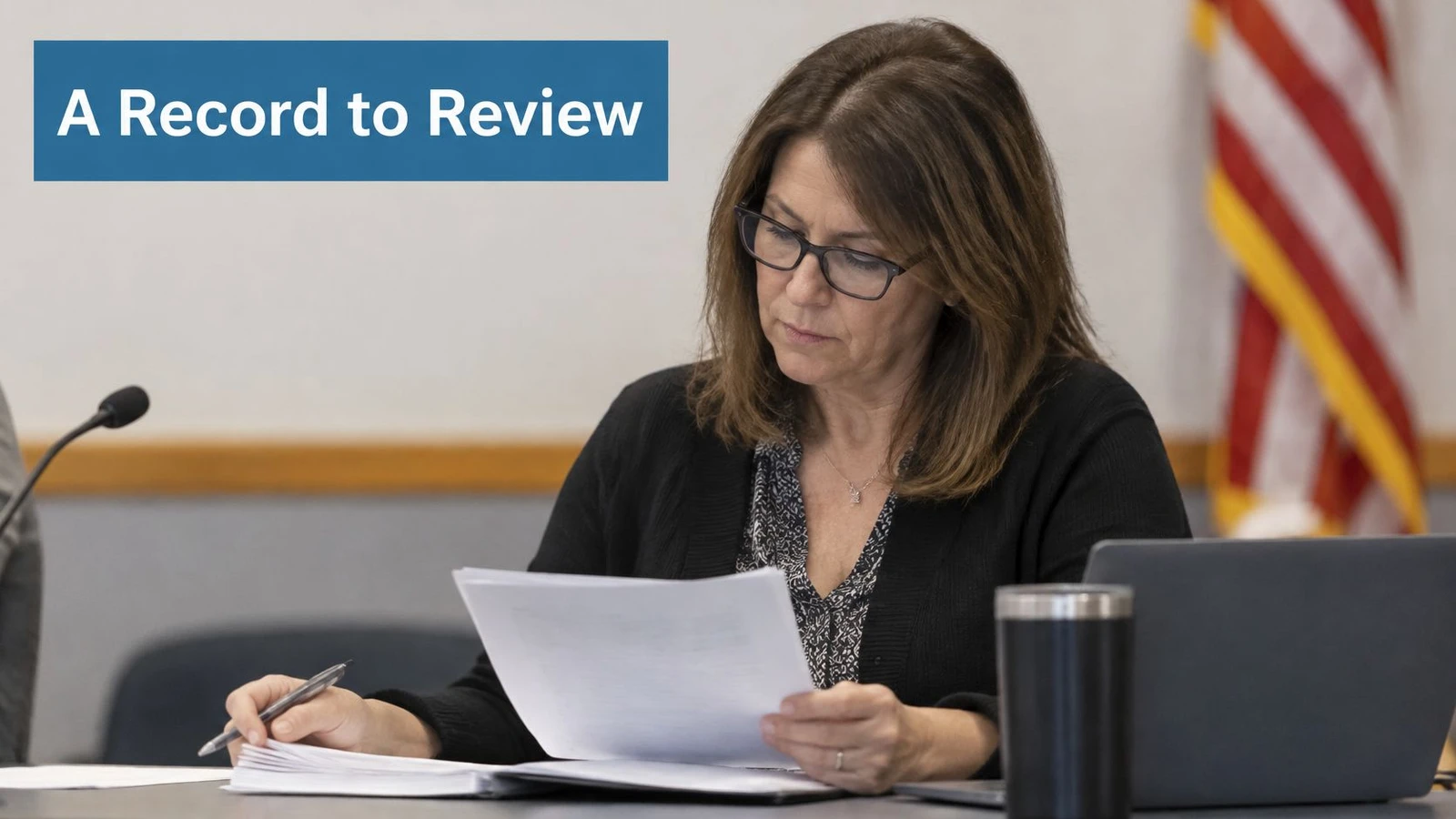
Example Candidate Statement
I was first elected to the school board four years ago, and I am asking for your support for a second term. During my first term, the board adopted a new attendance-monitoring process that helped identify students who were missing school early, and we added two counselors to serve middle schools. I also helped establish the public comment rules that now allow residents to speak at the start of every regular meeting. There is more work ahead. I want to finish the facilities plan so that aging buildings are prioritized by safety and enrollment data rather than by political pressure. I will continue to press for teacher retention incentives in hard-to-staff subjects. I have voted against proposals I believed were rushed, and I have publicly explained each of those votes. I believe voters should be able to judge a record, not just a promise. I invite you to review the minutes and votes from my term and to ask me about any decision directly. I would be grateful for your vote in November.
Why It Works
- Verifiable record: Attendance procedures, added counselors, and public-comment rules can be confirmed through minutes and district reports.
- Proper attribution: “The board” identifies collective decisions, while “I helped” narrows the candidate’s role.
- Accountable dissent: Naming votes against proposals demonstrates independence without making vague claims about political courage.
- Forward-looking priorities: The facilities plan and teacher-retention incentives show that reelection is based on unfinished work, not personal satisfaction in office.
The strongest incumbent statement does not ask voters to reward four years in the abstract. It gives them a record they can inspect in minutes.
Practical Application
Candidates should link directly to the district’s minutes and votes page and prepare a short list of dissenting votes for candidate forums. Use “I” for personal votes or actions led, and “the board” for collective decisions. Each goal should include a date or reporting milestone, such as presenting a facilities recommendation by a specified board meeting.
This approach works best when the record is documented and current. Candidates should also update accomplishments before publication, explain how they influenced key decisions, and avoid claiming credit for staff work they did not lead. For guidance on campaign preparation, review how to run for office. A related free canvassing script can adapt the same record points for doorstep conversations.
5. Small Business Owner Voter Guide Statement (Workforce Focus)
This approach helps a business owner connect school policy to workforce readiness without reducing education to job placement. Among school board candidate statement examples, it works best when the candidate pairs career pathways with academic goals, then applies business experience to transparent oversight and measurable progress.
Example Candidate Statement
I own a hardware store two miles from the high school, and I have employed more than a dozen students through summer and part-time jobs. I am running for school board because I want the district to graduate students who are ready for work and further study alike. I support expanding career and technical education pathways, including partnerships with local employers who can offer internships and apprenticeships. I also want clearer communication about graduation requirements so families can plan years in advance. Running a business has taught me to make decisions with incomplete information, to set measurable goals, and to be accountable when results fall short. I will apply those habits to the board by asking for quarterly progress reports on the district’s stated goals and by making those reports available to the public. I will also hold myself to the same standard in my own conduct: respond to every constituent message within three business days, and keep a public list of commitments I have made. I am asking for your vote on election day so we can build a school system that matches the needs of our community.
Why It Works
- Local credibility: The store’s location and student employees establish a direct connection to the district.
- Broad definition of success: “Ready for work and further study” acknowledges college-bound and career-bound students.
- Specific proposal: Internships, apprenticeships, and quarterly reports are more useful than general promises about workforce preparation.
- Built-in accountability: Public commitments and measurable standards signal how the candidate intends to govern.
A business owner’s strongest board-level credential is not simply commercial experience, but the ability to set goals, track results, and explain outcomes.
Practical Application
Candidates should disclose any district contracts or business dealings and explain how potential conflicts will be handled. When possible, name a realistic local partnership, such as an apprenticeship offered by a nearby manufacturer or employer association.
Balancing workforce and academic priorities in the same paragraph is essential. Graduation requirements, literacy, college access, and career readiness should appear as connected goals rather than competing agendas. Candidates should also promise a response time they can maintain during busy seasons.
Campaign staff can pair this voter-guide format with a 50-word website bio or a 100-word version for walk literature. Candidates seeking broader campaign guidance may consult how to run for office. For direct voter outreach, adapt the message for the free canvassing script.
6. Retired Educator Voter Guide Statement (Governance and Student Support)
A retired administrator can offer voters the benefit of long experience without implying that the candidate will interfere with day-to-day school operations. This format is especially useful for voters who want proven leadership, clear oversight, and stronger support for students with disabilities. Among school board candidate statement examples, it works because it turns institutional knowledge into a short argument for board service, then defines a realistic role for the candidate.
Example Candidate Statement
After thirty-four years as a high school principal, I retired from the classroom but not from caring about students. I am running for school board because I know how much a well-run school depends on steady leadership, fair discipline, and honest conversations with families. My priorities are simple: safe buildings, consistent behavior policies applied fairly across all schools, and support for students with disabilities who too often wait months for services. I will advocate for reviewing special education staffing ratios each year and for reporting wait times publicly. I also believe the board should spend more time on student outcomes and less time on personnel matters that belong to administrators. I have worked with many board members over the years, and I know the difference between governance and management. I will respect that line. If elected, I will attend every school event I can, visit classrooms regularly, and report back what I see. Students get one chance at each grade. I want to help make sure they get the support they need the first time.
Why It Works
- Credible perspective: Thirty-four years establishes relevant experience without turning the statement into a résumé.
- Defined role: The governance-management distinction shows voters that the candidate understands board oversight.
- Specific priorities: Staffing ratios, service wait times, behavior policies, and safe buildings are concrete issues.
- Visible accountability: Classroom visits and regular reports give voters a way to judge whether the candidate follows through.
A retired educator’s strongest statement explains what experience taught them, then shows how that knowledge would shape board decisions.
Practical Application
Name the district’s current behavior, special education staffing, facilities, and reporting policies before stating what the board should review. Include one measurable past achievement, such as reducing disciplinary referrals or improving service-delivery timelines, rather than relying only on years of service.
The candidate should also explain how they will keep current after retirement through board meetings, district briefings, professional associations, and communication with current administrators. Keep the governance explanation brief, since repeated detail can sound defensive.
Use this approach when the candidate’s record supports a credibility-focused campaign. For additional guidance, review how to run for office and adapt the free canvassing script for voter-facing conversations.
7. Fill-In Template and ‘Why I Am Running for School Board’ Openers
This method offers a reusable structure for candidates who need a clear, voter-ready statement without drafting from a blank page. Especially useful among school board candidate statement examples, it combines a concise opening, relevant background, specific priorities, accountability, and a clear request for votes. The template can produce statements of 150 to 250 words, making it suitable for most local voter guides.
Fill-In Template
[Candidate Name] is running for [Seat or Position] on the [District Name] School Board. [Why I am running for school board, in one or two sentences.] [Background: occupation, years in the community, relevant experience, and whether you have children in the district.] [Priority one and one concrete action.] [Priority two and one concrete action.] [Priority three and one concrete action, if space permits.] [Accountability: how you will report back through meeting summaries, public reports, or listening sessions.] [Closing: a clear request for votes on [Election Date], with website or contact information.]
This format addresses both common searches: candidate statement examples and why I am running for school board. The opener answers the central question immediately, while the remaining sections establish qualifications and give voters reasons to trust the candidate.
Five Openers
- “I am running for school board because every child in our district deserves a classroom that is safe, stable, and fully staffed.”
- “I am running for school board because I have seen how budget decisions show up in the classroom and I want those decisions to be easier for families to understand.”
- “I am running for school board because families need a board that explains its choices in plain language before it votes.”
- “I am running for school board because I want to bring my experience in [field] to the table and help the district make decisions backed by clear data.”
- “I am running for school board because our schools have served my family well, and I want to give back by helping them improve for the next generation.”
Why It Works
- Flexible structure: Candidates can emphasize teaching, finance, parent experience, special education, or facilities.
- Concrete priorities: Each promise includes an action a reader can understand and verify.
- Easy editing: Short sections make the statement manageable within strict word limits.
- Voter focus: Background information connects directly to the candidate’s proposed work.
A dependable template should make the candidate’s priorities clearer, not make every candidate sound identical.
Practical Application
Replace every bracket, remove duplicate ideas, and read the statement aloud. Check the local election office’s rules before drafting. For campaign planning, review how to run for office, and adapt the opener for a doorstep conversation script.
Website and walk literature also require shorter bios. A 50-word bio should identify the candidate, local ties, and central reason for running. A 100-word bio can add two priorities, relevant experience, and contact information. Unlike a voter-guide statement, these versions should be concise introductions rather than compressed policy platforms.
For message discipline, separate the statement from campaign slogans. Review great political campaign slogans as a separate resource, then keep the candidate statement focused on qualifications, actions, accountability, and the request for votes.
8. Short Candidate Bios (50 and 100 Words) for Websites and Walk Literature
Short bios give voters a quick, consistent introduction across campaign materials. The 50-word version fits on walk literature, while the 100-word version works on websites, social profiles, and handouts. Using the same sequence in both makes campaign messaging easier to maintain: who the candidate is, why they are running, what they will do, and how voters can participate.
Example Candidate Statement
50-word bio
Jordan Lee is an engineer and six-year resident of District 7. A parent of two district students, Jordan wants to expand early literacy, publish budgets in plain language, and hold open listening sessions. Jordan previously served on the District Facilities Committee. Learn more and get involved at campaign website.
100-word bio
Jordan Lee is an engineer and six-year resident of District 7, where Jordan has volunteered in two elementary-school reading programs. Jordan is running for Seat 3 on the District 7 School Board because families deserve clear information and a stronger voice in decisions affecting students. Priorities include early literacy, classroom staffing, and transparent school spending. If elected, Jordan will publish budget summaries in plain language, hold at least two community listening sessions each year, and report back to voters on progress. Jordan welcomes questions and can be reached at email address. Election day is [Election Date]. Learn more at campaign website.
Why It Works
- Fast context: Occupation, residence, and community ties establish relevance immediately.
- Clear purpose: The reason for running answers “Why I am running for school board?” without requiring a full voter guide statement.
- Specific priorities: Early literacy, staffing, and budget transparency are easier to evaluate than broad promises.
- Consistent structure: Each version follows identity, motivation, commitments, and participation.
- Actionable ending: Contact information and a website give voters a clear next step.
A short bio should answer the first questions a voter has, not attempt to fit every detail of a campaign into a small space.
Doorstep Version
The following doorstep introduction follows the same structure as the free canvassing script, so volunteers can move from a short greeting into a fuller conversation.
Hi, I am Jordan, and I am running for school board. I want to make budgets easier to understand and get more early reading support in our schools. Can I tell you a bit more about my plan and answer any questions?
Practical Application
Update the 50-word bio first whenever priorities change, then confirm that the 100-word version, website, and walk materials reflect the same message. Count words before printing, use consistent name and title spelling, and include a short contact note. Link the website bio to the full campaign literature guide for voters who want additional details.
Keep the doorstep introduction under 30 seconds when spoken aloud. Use the full free canvassing script for longer conversations, and consult how to run for office before beginning outreach. Among school board candidate statement examples, condensed bios are especially useful for repeat voter contact because volunteers can explain the candidate consistently without carrying a full voter guide statement.
8 School Board Candidate Statement Examples Compared
| Example | Implementation Complexity | Resource Requirements | Expected Outcome | Ideal Use Case | Key Advantage |
|---|---|---|---|---|---|
| Teacher-Candidate Statement | Moderate | Classroom experience, district data, conflict-of-interest disclosure | Builds credibility and sets specific, trackable priorities | Candidates with direct school experience | Connects policy commitments to firsthand classroom knowledge |
| Parent-Advocate Statement | Moderate | Board-meeting experience, time for summaries and listening sessions | Signals openness and improves family access to board decisions | First-time candidates focused on transparency | Uses relatable motivation and verifiable process commitments |
| Former Financial Professional Statement | Moderate | Budget research, forecasting knowledge, contract information | Demonstrates fiscal oversight tied to student services | Candidates emphasizing budget accountability | Turns financial expertise into concrete public commitments |
| Incumbent Re-Election Statement | Moderate | Voting record, meeting minutes, accomplishment details | Lets voters assess past performance and future plans | Incumbents seeking another term | Offers a record voters can independently verify |
| Small Business Owner Statement | Moderate | Local workforce knowledge, partnership research, conflict disclosures | Highlights career readiness and measurable district goals | Candidates focused on workforce preparation | Connects school pathways with local employment needs |
| Retired Educator Statement | Moderate | Current policy research, education experience, classroom access | Emphasizes governance, student support, and leadership experience | Retired administrators or educators seeking board roles | Shows relevant experience while clarifying the board’s role |
| Fill-In Template and Openers | Low | Candidate details, priorities, election rules, proofreading | Produces a structured statement suited to voter-guide limits | Candidates needing a starting point or repeatable format | Speeds drafting and keeps commitments focused |
| Short Candidate Bios | Low | Candidate background, core priorities, contact details, word counts | Creates consistent short profiles for print, web, and canvassing | Campaigns using multiple communication channels | Adapts one message to different formats and space limits |
Turn These Models Into Your Own Winning Statement
The strongest school board candidate statement examples do more than describe a candidate’s background. They translate personal experience into a clear public case, connect that case to local priorities, and give voters evidence they can use to evaluate the candidate.
Each model in this article offers a different starting point: the classroom, family, fiscal management, public service, business, or retired education. Use those perspectives, but replace broad claims with details only you can provide. A teacher might describe one student success alongside a commitment to stronger reading support. A business owner might connect workforce preparation to local hiring needs. An incumbent should cite specific records rather than asking voters to trust a general claim of accomplishment.
Verifiable commitments beat general praise.
The most effective statements also answer practical questions. What problem will the candidate prioritize? How will the candidate measure progress? Which decisions require board expertise, and which belong to administrators? Disclosing a potential conflict does not weaken a candidacy; it shows that voters will not discover an uncomfortable fact after the election.
Disclose conflicts before voters ask.
A Replicable Method for Building Your Statement
-
Begin with a personal reason for running.
Explain the moment, experience, or community concern that made the issue impossible to ignore. Avoid a generic opening about wanting to “make a difference.” Specificity gives the statement credibility from the first sentence. -
Choose two or three priorities.
Select issues supported by evidence from the district. Focus on what the board can influence, such as academic supports, school safety, budgeting, special education, early literacy, facilities, or family engagement. -
Attach one checkable commitment to each priority.
Replace “I will support students” with a measurable action, such as reviewing reading data each semester, proposing a facilities plan, or holding a quarterly community forum on special education. -
Show how your background connects to the work.
Do not list every job or credential. Explain which experience helps you understand the issue and how that experience will shape your decisions. -
Acknowledge limitations and conflicts.
State relevant professional relationships, financial interests, family connections, or other matters that could affect board work. Explain how you intend to manage them. -
Fit the statement to the local limit.
The same core message will need different treatment for a 150-word voter guide, a 200-word website version, and a longer candidate forum response. Keep the priorities and commitments consistent while adjusting the depth.
Start with the reason, add the proof, and finish with a testable promise.
A Checklist for Localizing Each Model
- Teacher perspective: Replace classroom examples with local grade levels, programs, or achievement gaps. Avoid claiming authority over decisions made by teachers or administrators.
- Parent perspective: Name the experiences parents understand, such as transportation, special education, school meals, safety, or communication. Show how the candidate would listen before proposing solutions.
- Fiscal perspective: Include a recent district figure and explain what it means for the classroom. A budget position should address both oversight and the purpose of spending.
- Incumbent perspective: Cite two or three record-based examples, including outcomes and any unfinished work. Do not turn achievements into a list of promises.
- Business perspective: Connect workforce concerns to local employers and student pathways. Avoid reducing education to employment alone.
- Retired educator perspective: Explain how retirement and board service affect time, independence, and institutional knowledge. Be precise about whether the candidate is retired, formerly employed, or currently serving.
For campaign teams reviewing candidate statement examples, compare each draft against the same criteria: local relevance, measurable commitments, clear qualifications, conflict disclosure, readability, and compliance with the submission rules. Search for why I am running for school board openers that reveal a credible reason to serve, then test whether the rest of the statement delivers on that reason.
Keep Every Version Consistent
Short candidate bios require separate editing, but they should not sound like different candidates. A 50-word version can cover current role, relevant experience, and one issue. A 100-word version can add a second priority, one proof point, and community connection. The same facts and tone should carry across the website, voter guide, campaign literature, social profiles, and canvassing materials.
Before publication, count words rather than estimating. Read the statement aloud, remove repeated phrases, check names and dates, and confirm that every commitment can be defended. If campaign staff need guidance on the broader process, this guide to how to run for office can help organize planning and preparation.
Draft your statement this week, then test it at a candidate forum or on the doorstep. For a doorstep version of the conversation, use the free canvassing script to practice moving from personal experience to a clear issue and a specific commitment. doornoc supports campaigns of every political affiliation, from local school board races to congressional contests, with tools that turn voter lists into walk routes and record every door volunteers knock.
Looking for a tool to run this? doornoc’s canvassing software bundles voter data, automatic turf cutting, the mobile app, and live reporting in one platform.