

A resident leaves another frustrating council meeting, hears neighbors suggest a run for mayor, and asks someone in the next town how filing works. That’s a reasonable starting point for a conversation, but a dangerous starting point for paperwork. Age, residency, voter registration, and filing-fee or petition rules vary by state law and city charter; copying a neighboring town’s process can invalidate a candidacy.
Qualifications Your Town Clerk Must Confirm
Sample mayoral qualification rules by place
Every row is a local example to recheck; none of them sets a national standard. Where an age or voter-status rule is not identified below, the clerk must supply the answer before the candidate assumes eligibility.
| Place | Age | Residency | Voter status | Fee or petition |
|---|---|---|---|---|
| St. Louis, Missouri, local example | At least 30 | U.S. citizen 5 years; city resident 5 years; assessed city taxpayer 2 years | Confirm with election authority | $100 fee, nomination certificate, clearance of delinquent local taxes and utilities, and sworn affidavit, under the St. Louis candidate-filing requirements. |
| Castle Rock, Colorado, local example | Confirm in current candidate guide | A consecutive-month residency period before the election; the clerk confirms the exact length | Registered town elector | Signatures from registered electors gathered separately in each district rather than as one town-wide total, with petitions and acceptance documents due on a deadline set ahead of the election. |
| Miami, Florida, local example | Confirm in current candidate guide | Continuous city residence at least 1 year; real residence during the term | City elector | $100 qualification fee or petition alternative, according to Miami’s candidate-qualifying guidance. |
| Manitou Springs, Colorado, local example | Confirm in current candidate guide | City residence 1 year immediately before election; U.S. citizenship 5 years | Registered city elector | 25 valid signatures from registered electors in the municipality. |
| Montana statutory floor, local example | At least 21 | State residence 3 years; city, town, or annexed-area residence 2 years | Confirm applicable municipal requirements | Fee and nomination procedure require local confirmation under the Montana mayoral qualification statute. |
| Los Angeles, fee-or-petition pattern only | † | † | † | A filing fee paired with a lower signature minimum, or a higher signature count in place of the fee. |
† For the Los Angeles row, the clerk must supply the age, residency, and voter-status answers. The row appears only to show that a city can offer a choice between paying a fee with fewer signatures and gathering more signatures instead.
A local legal process, not a national pathway
The large-city examples prove one narrow point: a municipality may demand a fee, signatures, or both, and it can stack several requirements on top of each other. They say nothing about the rules in a small town. A blank-looking cell is never permission to proceed.
Ask the clerk for written confirmation of the controlling state law, the charter provisions, and the current election instructions. One question deserves an explicit answer: whether residents elect the mayor directly or council members select the mayor from among themselves.
Campaign paperwork also stays separate from unrelated personal legal matters. A prospective candidate already working through a Georgia divorce and a disputed financial disclosure can turn to Miles Hansford Law Firm’s resource on uncovering concealed marital property in Georgia for that issue; it does not answer campaign disclosure or ballot eligibility questions.
Get the current packet before announcing
An informal assurance from a former candidate is not a filing document. Obtain the current candidate guide, identify the official responsible for interpreting it, and keep written answers to every ambiguous question.
That packet is the compliance record for the race. The same clerk conversation should surface the meeting schedule, hours, and public exposure attached to the office, because those facts decide whether winning is worth pursuing at all. Public announcements wait until eligibility, nomination mechanics, and the ability to serve have been confirmed.
Decide Whether You Can Serve After You Win
Winning an election doesn’t create administrative capacity. A candidate who can organize volunteers but can’t attend evening meetings, respond during emergencies, or work with municipal staff isn’t ready to file.
The first gate is therefore a job assessment, not petition collection. Interviews with the clerk, finance officer, outgoing mayor, and county election administrator should happen before campaign spending or signature work begins.

Find out who actually runs the town
A strong mayor may administer departments and supervise executive staff. In a council-manager government, a professional manager may handle daily operations while the mayor chairs meetings and represents the town. The council may control appropriations even when residents expect the mayor to solve every budget problem.
The interviews need concrete answers:
- Staff supervision: Who hires, evaluates, and directs municipal employees?
- Financial authority: Who approves spending, signs contracts, and prepares the proposed budget?
- Records responsibilities: Who receives public-records requests, preserves official communications, and obtains legal advice?
- Emergency coverage: Who takes the call when infrastructure fails or severe weather disrupts services?
- Meeting load: Which evenings involve council sessions, committee meetings, regional boards, or preparation?
A candidate should compare those obligations with an actual work and household calendar. An advertised part-time position can still involve unpredictable interruptions.
Check staffing and safety before committing
Updates from the Elections & Voting Information Center describe especially sharp job-satisfaction declines in jurisdictions with fewer than 5,001 registered voters, resource shortages affecting nearly 30% of election officials overall and more than 40% in some mid-sized jurisdictions, and a 2025 survey in which 38% of local election officials reported work-related threats, harassment, or abuse.
Those findings concern election officials, not a measured rate of danger for mayors. They nevertheless justify asking direct questions about local staffing shortages, hostile-contact procedures, and access to safety support.
The prospective candidate should inspect the municipal budget, vacancies, meeting calendar, and emergency arrangements. Household members should understand that public meetings can run long and that public service can attract unwanted attention.
Filing should wait until the candidate knows which duties belong to the mayor and has the hours, staffing support, and safety arrangements to carry them.
The decision is personal but operational: go if the responsibilities fit, or wait if the necessary support isn’t available. A failed capacity check means no petition work.
How to File Petitions That Survive Review
Treat signatures as a verification task: each one has to pass a registration and geography check. A supporter’s enthusiasm doesn’t establish either, and a correct signature can still be rejected if the petition form is incomplete.
Follow the clerk’s sequence
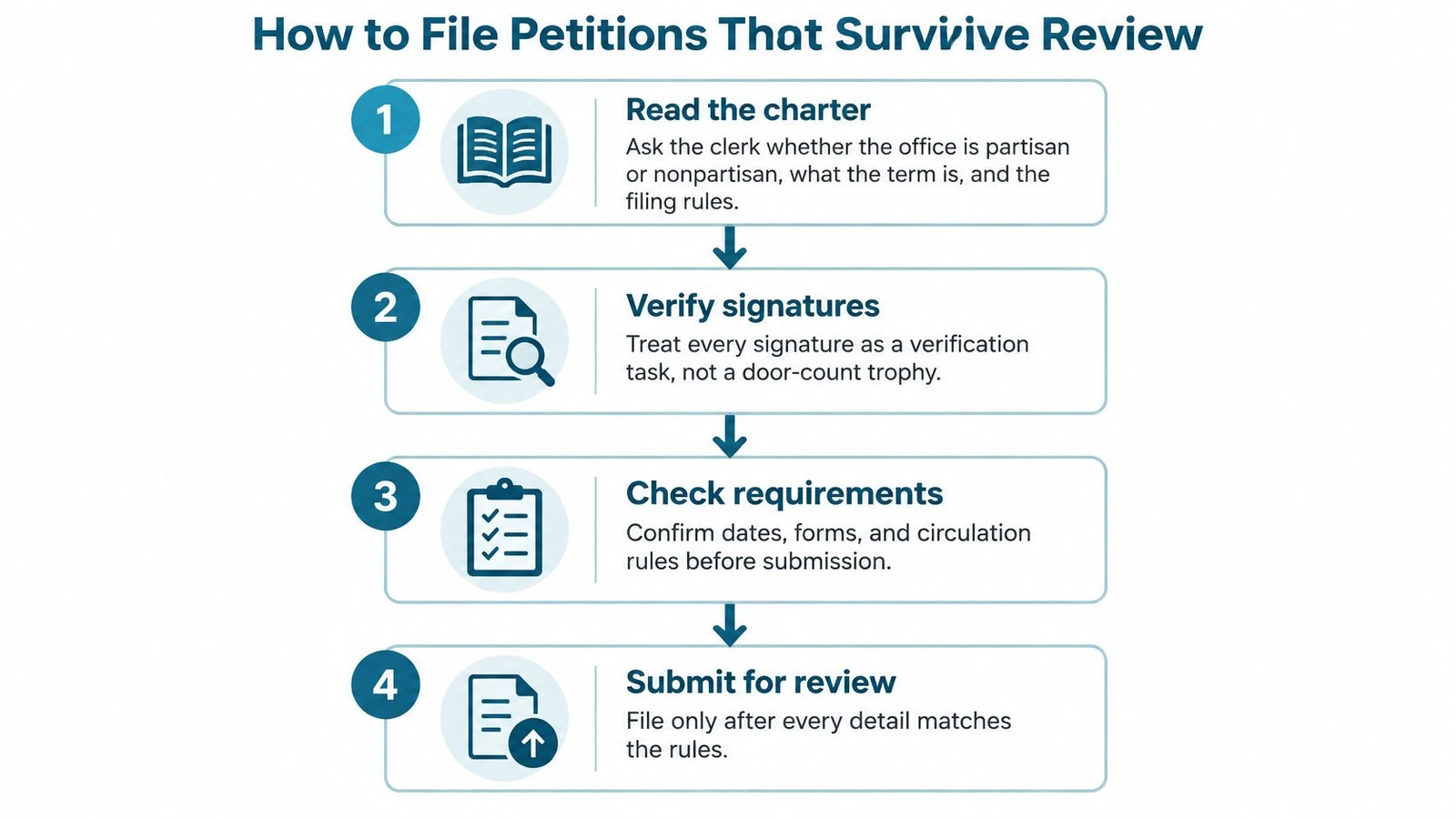
- Read the charter and election instructions. Confirm whether the office is partisan or nonpartisan, the term length, and whether a runoff applies. These rules set the ballot pathway and filing calendar.
- Request the official petition and acceptance forms as soon as the authorized window opens. Use the current forms, not homemade substitutes or old copies.
- Confirm signer geography. Ask whether signers must be registered electors in the town, a ward, or a particular district. A town resident may not qualify for a district-specific petition.
- Check each signer’s name, address, and registration through lawful available methods while the signer is present. Track the petition page, collection date, and circulator on a separate sheet.
- Confirm the mechanics. Ask whether signatures can replace the fee, whether each page needs circulator information or notarization, and which official determines validity.
- Collect above the minimum, inspect every page, and file before the deadline. Submit early enough to fix problems if local rules allow corrections.
Signature minimums and filing clocks
| Place | Minimum signatures | Clock to calendar |
|---|---|---|
| Denver | At least 300 registered voters living in the city and county | File no later than 55 days before election; gathering is tied to a 91-day period, according to the Denver municipal candidate packet. |
| San Francisco | Check the current nomination petition instructions for the applicable minimum | Confirm the filing deadline and circulation window with the San Francisco Department of Elections. |
| Castle Rock, Colorado | Check the current candidate packet for the applicable minimum and geographic requirements | Confirm the filing deadline and circulation window with the Castle Rock Town Clerk. |
| The candidate’s town | Obtain the exact minimum and any fee-substitution rule | Record issuance, circulation cutoff, clerk certification, and filing day together. |
Set a separate cushion for every required geography. Extra signatures in one district do not cover a shortage in another when the rules require separate totals.
Leave with a reviewable packet
Make every petition page traceable without collecting unnecessary personal information. Have someone other than the collector inspect page completeness, order, circulator statements, and required attachments.
Watch for three common filing failures:
- Late submission: A complete packet still misses the ballot if it arrives after the deadline.
- Wrong district: A registered voter may be ineligible for a district-specific petition.
- Incomplete paperwork: Missing circulator details or attachments can undermine otherwise valid signatures.
Finish with a signer tracking sheet and a calendar showing petition issuance, the circulation cutoff, certification, and the filing deadline.
Budget a Race the Size of Your Town
The published ranges in how much does it cost to run for local office provide a starting benchmark. A small-town candidate should compare a locally priced plan against those ranges, not copy a national spending table or assume every expense applies.
Prepare separate budgets for a quiet race and a contested race. The quiet version covers qualification, basic public information, and household contact; the contested version adds the repeat contact and materials needed to earn support.
Build spending from addresses and actual quotes
The basic field-material calculation is:
Households to reach × printed-piece cost × planned passes + filing fees or petition-printing costs.
That’s the starting subtotal, not the entire budget. Local quotes should then cover:
- Compliance and banking: A dedicated campaign account, applicable bank charges, and a treasurer or compliance officer where required.
- Printed materials: Palm cards and a modest yard-sign order tied to actual placement requests.
- Public information: A simple website with candidate background, priorities, contact details, and voting information.
- Field operations: Voter-file costs, volunteer fuel reimbursement where lawful, and food for scheduled shifts.
Add a contested-race cushion, then cap the total at what local donors can realistically contribute. A campaign shouldn’t order materials against hoped-for donations.
Separate affordability from payment timing
A 2024 study of U.S. mayoral elections reports that America’s smallest towns account for 84% of municipalities and finds both the highest mayoral turnout and the most uncontested elections in that group.
Low population therefore doesn’t mean no work, but it doesn’t justify a big-city media buy either. Household coverage and actual competition should determine spending.
Payment timing matters as much as the total. A candidate may need to pay a printer before promised contributions arrive; the small-business forecasting framework in anticipate cash gaps with AI2Fin offers useful context for matching expected receipts with obligations, although campaign accounting must follow election rules.
The campaign should establish the required account before accepting contributions, retain every receipt, and confirm committee-registration and first-report deadlines. Keep personal and campaign funds separate. Buying signs before confirming the filing window and treating a coffee-shop pledge as cash on hand are preventable money mistakes.
Run the Race on a 90-Day Calendar
90-day small-town mayoral plan
| Phase | Window | Main work | Weekly counts |
|---|---|---|---|
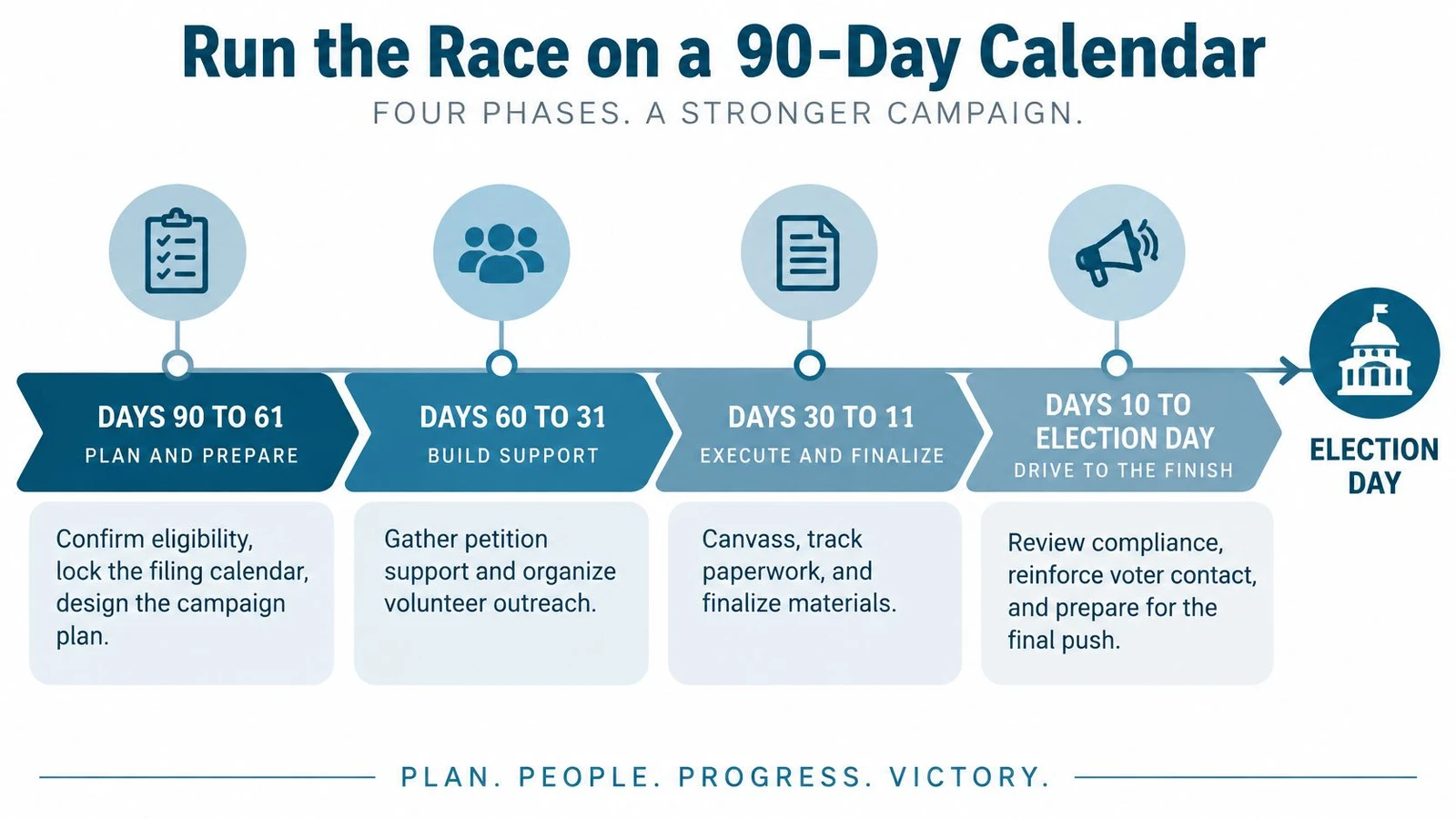
| Qualify and map the town | Days 90–61 | Eligibility, filing calendar, official petition preparation, voter file, banking, compliance, complete household list | Filing tasks closed |
| Listen and bank signatures | Days 60–31 | Signature collection, issue listening, volunteer recruitment, message testing | Valid signatures and volunteer shifts |
| Persuade undecided households | Days 30–15 | High-turnout and undecided doors, lawful early-vote reminders, missing-data repair | Conversations and open follow-ups |
| Turn supporters out | Final 14 days | Repeat contact, visibility, volunteer shifts, vote-plan confirmation | Households attempted and vote plans confirmed |
The Denver timing in the petition table applies here, and it shows the risk clearly: a campaign that waits until the last month may have missed ballot access before it begins meaningful persuasion.
Put legal dates ahead of campaign phases
The phases run inside the lawful window, so official dates always control the schedule. Pull every deadline from the clerk or election office before day 90, including petition issue dates, filing cutoffs, and finance-report due dates. If the town’s deadline falls earlier, petition work moves earlier; a convenient campaign template never outranks a filing deadline.
Petition preparation covers organizing the approved forms and tracking the process; the wording on those documents stays exactly as the clerk issued it. Reserve hours for rejected signatures, bad addresses, clerk questions, and finance-report preparation, because paperwork problems arrive on their own schedule.
Early listening should produce a short, credible message about local problems the mayor can influence directly. Volunteers should record recurring concerns without turning every doorstep complaint into a new campaign promise.
During persuasion, the candidate needs prepared answers about cost, authority, and council cooperation. A proposal is ready for a public forum only when the candidate can explain who would implement it and how the town would pay for it.
Measure completed work every week
Each weekly review should contain these operating counts:
- Households attempted: Distinguish new coverage from repeat attempts.
- Conversations: Count real exchanges; literature left at an empty house adds nothing to the tally.
- Valid signatures: Separate reviewed signatures from an unexamined stack.
- Volunteer shifts: Record completed shifts and staffing gaps.
- Open follow-ups: Name the owner and next action for each unresolved request.
If the week’s counts show fewer shifts than the plan assumed, shrink the territory target or recruit before the next week starts. Carrying a fictional number forward only hides the gap.
The candidate’s schedule should include protected blocks for fundraising, forum preparation, household visits, and compliance. Leaving those activities to spare time guarantees that urgent messages will crowd them out.
The broader political campaign planning guide can help connect those assignments into a working campaign. The local calendar still needs a named owner who verifies completion and chases gaps, week after week.
Operating standard: A campaign calendar is a set of weekly counts and assigned responsibilities. Vague commitments to work harder change nothing on their own.
The final phase should emphasize supporter contact and accurate voting logistics; the platform itself should already be settled by then. Campaign staff should verify official voting instructions before distributing them and avoid promising ballot assistance that local law doesn’t permit.
The candidate should finish with the phases on a single page, the election date at the top, and legal deadlines marked prominently. Every phase needs reserved hours for exceptions, because real campaigns never produce perfectly clean lists or uninterrupted schedules.
Knock Every Household on a Walkable List
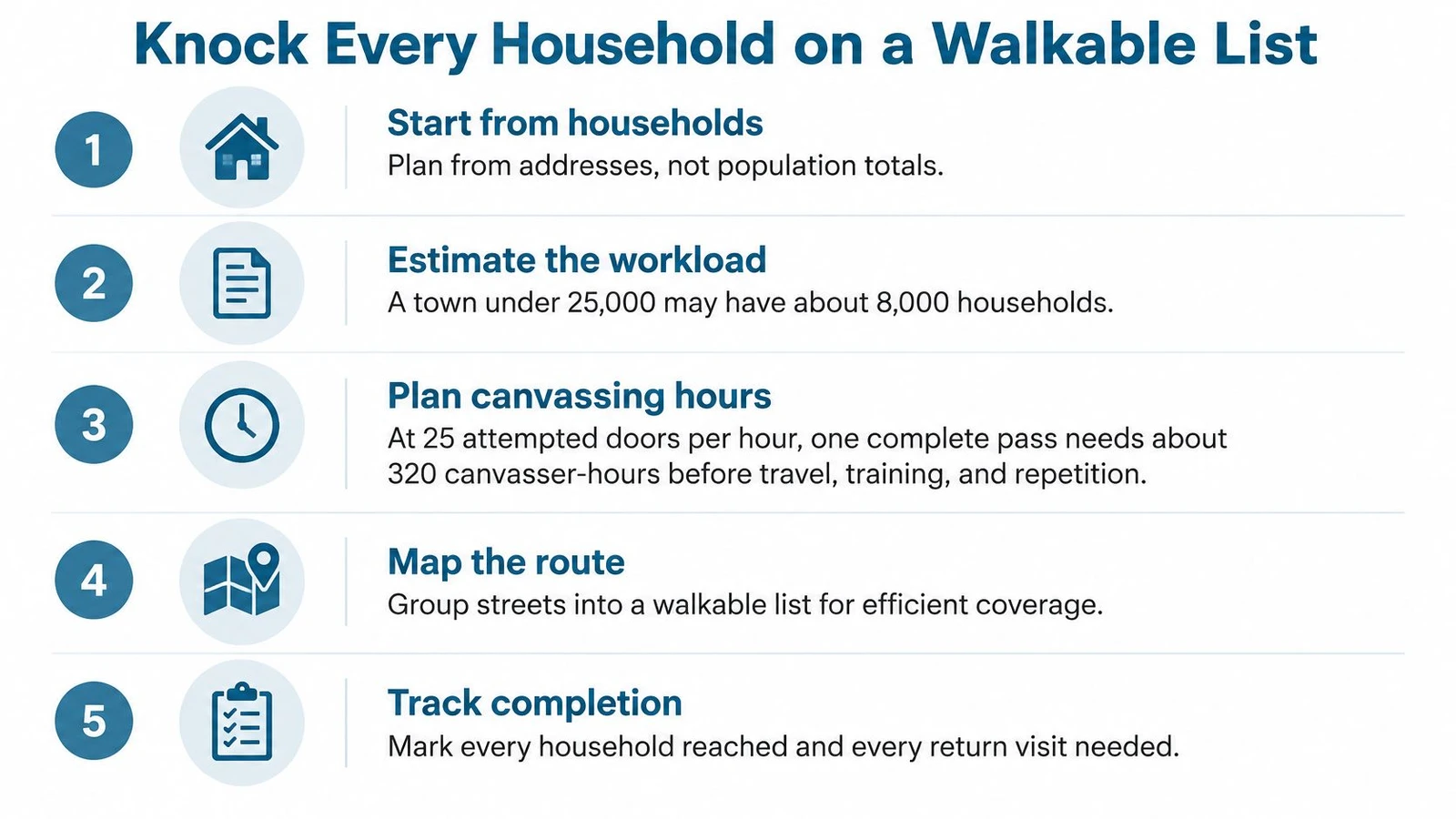
Start from households, not population. In a hypothetical town with 8,000 households, at 25 attempted doors per hour, a complete pass requires about 320 canvasser-hours before travel, training, weather, and repeat attempts. Run that math before filing anything. If the committed volunteer schedule can’t cover the base figure plus a margin for return visits, the field plan fails on paper first.
Eight teams contributing five canvasser-hours weekly over eight weeks would produce that base capacity. Sixteen teams at the same commitment would produce 640 canvasser-hours, enough for a nominal second pass only if the assumed pace holds. Actual schedules still need spare capacity for interruptions, inaccessible addresses, and volunteers who miss a shift.
Build coverage that can be checked
- Create the master address list. Include residential addresses across the municipality, not just familiar streets or neighborhoods with existing supporters. Reconcile duplicates and distinguish households from individual voters.
- Divide the list into balanced walking routes, then assign each route to a named person. Routes should reflect safe crossings, distance, and likely shift length rather than an equal-looking shape on a map.
- Record a status after every attempt: reached, not home, moved, inaccessible, refused, or follow-up needed. Keep contact outcome separate from support level.
- Return to not-home addresses at a different time of day. A repeated unanswered attempt at the same hour doesn’t test a different opportunity.
- Use the final pass to confirm support and voting plans. Record what remains unresolved rather than assuming an earlier positive conversation guarantees participation.
The Town of Vail recorded 1,793 ballots cast in its 2023 municipal election, representing 41% turnout among 4,354 registered voters. That’s a town-specific result, and it sets the scale: a race this size is decided by a field plan that covers every address on a usable list and records each contact, because that running record is the only count that shows who was reached.
Keep the doorstep process disciplined
Canvassers should carry identification, use a lawful script, respect refusals and access restrictions, and avoid recording sensitive information unrelated to campaign work. Safety decisions belong to the walker: skip a dark porch, a hostile dog, or an isolated street and log the address as inaccessible for a later attempt. A resident’s unanswered policy question should go to a designated campaign contact rather than receive an improvised promise.
For the mechanics of drawing routes, assigning them to named walkers, and logging every attempt, the guide to organized block walking covers the process step by step.
The field lead should review incomplete routes after each shift and assign returns deliberately. Mark a route complete only after every household has a recorded outcome.
A household is done only when its status is recorded, not when a volunteer remembers walking past it.
Confirm the Clerk Packet Before You Announce
The go, wait, or stop call was already settled at the service gate, where staffing, time, and safety either passed or they did not. What remains is a narrower check: the packet in your hands has to match the packet the clerk issued for this cycle, not a version from a prior election or a neighboring town.
Turn approval into assigned work
For a candidate with a go decision, the opening workweek should produce tangible outputs:
- A dated candidate checklist. Request the current guide and put every controlling deadline on the same calendar.
- A money timeline. Ask when committee registration, banking, and the first finance report begin. Open the account at the required point and don’t accept money before the applicable setup is complete.
- A household universe and initial routes. Reconcile the address list, establish contact-status rules, and divide the first assignments into manageable shifts.
- A named owner for every job. Invite a small team and give each route a named owner. Someone must also own compliance and outstanding resident questions.
Built to be powerful enough for large statewide campaigns yet simple enough for a first-time candidate, doornoc turns selected voters into walk routes by drawing a shape, running Auto Turf, uploading a list, or importing a MailVotes list, then assigns each route to one or more members invited by email.
The clerk’s instructions and the candidate’s judgment still own the packet. The useful finish line before announcement is a dated checklist with a defensible decision, confirmed responsibilities, and work assigned to actual people.
doornoc offers route creation and team assignments for campaigns that need organized household coverage. A first-time mayoral candidate with a clerk-confirmed path can visit doornoc to turn the field plan into assigned walking routes and coordinated volunteer work.
Looking for a tool to run this? doornoc’s canvassing software bundles voter data, automatic turf cutting, the mobile app, and live reporting in one platform.