
Key Takeaways
- Successful political campaigns in 2026 require 12-18 months of planning for competitive races, with clear phases from exploratory committees through Election Day operations
- Your campaign budget should allocate 40-45% to voter contact (field and digital), 25-30% to media, 15-20% to staff, and 10-15% to infrastructure and compliance
- Modern campaigns integrate door-to-door canvassing with digital targeting, using real-time data synchronization to optimize voter contact across all channels
- Building a winning coalition requires identifying your base voters (35-40% of electorate), persuadable voters (20-25%), and GOTV targets within 6-8 months before Election Day
Running for political office in 2026 requires more than passion and good ideas—it demands strategic planning, disciplined execution, and the right infrastructure to reach voters effectively. Whether you’re running for city council, state legislature, or Congress, understanding how to run a political campaign from the ground up will determine whether your message reaches the voters who matter most.
The fundamentals of campaign management have evolved significantly. Modern campaigns in 2026 integrate traditional field operations with sophisticated digital targeting, real-time data analytics, and mobile-first voter contact tools. This guide provides the complete framework you need to build a winning campaign from your exploratory committee through Election Day.
What Does Running for Office Actually Involve?
Running for office means building an organization capable of identifying, persuading, and mobilizing voters while simultaneously raising money, managing staff, navigating legal compliance, and maintaining message discipline across multiple channels. A political campaign is fundamentally a startup business with a fixed deadline and binary outcome—you either win or lose on Election Day.
Successful campaigns operate across six core functional areas simultaneously. Your field operation contacts voters directly through door-to-door canvassing and phone banking. Your communications team manages messaging, media relations, and digital content. Your finance operation raises funds and manages the budget. Your data team targets voters and tracks progress. Your compliance team ensures legal requirements are met. Your scheduling operation maximizes the candidate’s time.
The complexity scales with the office you’re seeking. A city council race might require 3-5 staff members and 50 active volunteers. A competitive state legislative race needs 8-12 paid staff and 200+ volunteers. A Congressional campaign demands 25-40 staff members, thousands of volunteers, and sophisticated infrastructure across multiple counties.
The Complete Campaign Timeline: 18 Months to Election Day
Your campaign timeline determines whether you’ll have sufficient resources, infrastructure, and voter contact capacity when it matters most. Here’s the proven timeline that winning campaigns follow in 2026.
Months 18-15: Exploratory Phase
Form an exploratory committee to test campaign viability before making a formal announcement. During this phase, you’re assessing three critical questions: Can you raise enough money? Can you build a winning coalition? Can you withstand opposition research?
Conduct thorough opposition research on yourself. Hire a professional firm to compile everything opponents might use against you—voting records, social media history, business dealings, legal issues, and controversial statements. Better to discover vulnerabilities now than three weeks before Election Day. Budget $5,000-$15,000 for professional opposition research depending on your race level.
Begin building your finance committee. Identify 15-20 individuals who can each raise $10,000-$50,000 through their networks. Your initial fundraising goal should be reaching 60-70% of your total budget before announcement. If you can’t demonstrate fundraising viability during the exploratory phase, you’re not ready to run.
Recruit your campaign manager during this period. Your manager is your single most important hire—they’ll build your entire campaign infrastructure. For state legislative races, budget $60,000-$90,000 for a manager’s annual salary. Congressional races require $100,000-$150,000 for experienced managers.
Months 15-12: Pre-Announcement Phase
Finalize your campaign plan document—a comprehensive 30-50 page blueprint covering strategy, budget, timeline, staffing, and voter contact goals. Your campaign plan should identify your path to 50%+1 votes with specific targets for base voters, persuadable voters, and turnout numbers.
Hire your core team: campaign manager, finance director, and communications director. These three positions form your campaign’s leadership structure. Budget 15-20% of total campaign funds for staff salaries across the entire election cycle.
Establish your campaign infrastructure. Register your campaign committee with relevant election authorities. Open a dedicated campaign bank account. Set up your compliance system for tracking contributions and expenditures. Launch your campaign website and social media presence. Secure campaign office space if your budget allows (not essential for smaller races).
Develop your initial messaging through focus groups and polling. Budget $15,000-$30,000 for a benchmark poll in competitive races. Your poll should test name recognition, favorability, issue priorities, and message effectiveness. Use these insights to craft your announcement speech and early campaign messaging.
Months 12-9: Campaign Launch Phase
Make your formal announcement 12 months before Election Day. Your announcement should generate earned media coverage, energize early supporters, and establish your campaign narrative. Plan an announcement event that demonstrates organizational strength—100+ attendees for local races, 300+ for state legislative, 500+ for Congressional campaigns.
Launch your fundraising operation at full capacity. Schedule 20-25 fundraising calls daily for the candidate (yes, daily). Host 2-3 fundraising events monthly. Your finance director should track toward raising 70-80% of your total budget by six months before Election Day. Early money is the most valuable money—it funds infrastructure that multiplies your effectiveness.
Begin building your volunteer infrastructure. Recruit precinct captains for every precinct in your district. These grassroots leaders will become your field operation’s backbone. Host monthly volunteer meetings to train canvassers, build community, and maintain momentum. Your goal is recruiting 1 volunteer per 100 voters in your district by six months out.
Start regular voter contact. Launch your digital marketing strategy with targeted social media advertising. Begin preliminary door-knocking in high-priority precincts to test messages and build volunteer capacity. Track every voter interaction in your database—this early contact data becomes invaluable for targeting persuadable voters later.
Months 9-6: Building Momentum Phase
Expand your field operation significantly. Hire field organizers if your budget allows—one organizer per 15,000-20,000 voters in competitive races. Your field team should be recruiting volunteers, planning canvassing operations, and tracking voter contact metrics weekly.
Complete your voter targeting model. Work with your data team to segment the electorate into clear categories: base supporters (will vote for you), base opponents (will vote against you), persuadable voters (could swing either way), and low-propensity voters (need turnout motivation). Your voter data filtering strategies should identify exactly which doors to knock and which voters to ignore.
Launch your paid media program if budget allows. Television, radio, and digital advertising should reinforce your field operation’s messaging. Coordinate ad buys with your canvassing schedule—voters who see your ads and meet your volunteers are significantly more likely to support you.
Secure key endorsements from elected officials, organizations, and community leaders. Endorsements provide third-party validation and access to new volunteer and donor networks. Prioritize endorsements that come with tangible resources—volunteer lists, fundraising support, or organizational infrastructure.
Months 6-3: Persuasion Phase
This is your persuasion window—the period when undecided voters are beginning to pay attention but haven’t made final decisions. Your campaign should be operating at 70-80% capacity, with intensive voter contact across all channels.
Implement your comprehensive door-to-door campaign strategy. Your canvassing operation should be contacting 500-2,000 voters daily depending on district size. Use mobile canvassing tools to track conversations in real-time, allowing your team to adjust messaging and targeting based on live feedback from voters.
Ramp up your digital advertising significantly. Your political marketing strategy should include targeted social media ads, programmatic display advertising, and email campaigns reaching voters multiple times weekly. Budget 25-30% of your total campaign funds for media during this phase.
Prepare for debates and forums. Most competitive races include 3-5 candidate forums during this period. Treat debate prep seriously—schedule full-day mock debates with your team playing opponents and moderators. Poor debate performance can derail momentum, while strong performances generate earned media and volunteer enthusiasm.
Conduct a tracking poll if budget allows ($8,000-$15,000 for state legislative races). Your tracking poll measures whether your persuasion efforts are working and identifies any emerging vulnerabilities. Use tracking data to adjust your message and targeting for the final three months.
Months 3-1: Intensification Phase
Scale your operation to maximum capacity. Your field team should be contacting 1,000-3,000 voters daily through doors and phones. Your volunteer operation should be activating 100+ volunteers weekly. Your candidate should be attending 4-6 events daily—candidate time is your most valuable resource in the final stretch.
Launch your GOTV (Get Out The Vote) targeting. Identify low-propensity supporters who need turnout motivation. These voters support you but have inconsistent voting histories. Your voter turnout strategies should include multiple contact points—doors, phones, texts, and mail—reminding them about Election Day.
Maximize your paid media. The final month typically consumes 40-50% of your total media budget. Voters are paying attention now, and message frequency matters. Your ads should be everywhere your target voters are—television, radio, digital platforms, and mailboxes.
Prepare your Election Day operation. Recruit poll watchers for every precinct. Train volunteers on Election Day roles—poll monitoring, voter transportation, last-minute door-knocking. Build your phone bank capacity for final GOTV calls. Test your voter contact technology to ensure it works flawlessly on Election Day.
Final 30 Days: The Sprint to Victory
The final month is organized chaos. Your campaign should be operating 16-18 hours daily, seven days per week. Every decision focuses on one question: Will this help us reach our vote goal?
Your field operation should be executing a final voter contact surge. Contact every identified supporter at least twice in the final two weeks—once to confirm support, once to ensure they have a voting plan. Use mobile canvassing platforms to track these conversations and flag any supporters showing hesitation.
Your candidate schedule should be ruthlessly efficient. Every hour should be allocated to high-value activities—fundraising calls (yes, still fundraising), high-traffic voter contact locations, earned media opportunities, and volunteer motivation events. Eliminate low-value activities like small private meetings or events outside your district.
Your communications team should be monitoring media constantly and responding to attacks within hours. Opposition research attacks typically intensify in the final weeks. Have response plans prepared for likely attacks, and be ready to respond decisively.
Building Your Campaign Budget: Where Money Goes
Your campaign budget determines what’s possible. Understanding how to allocate resources effectively separates winning campaigns from well-intentioned failures.
For a competitive state legislative race in 2026, expect to raise and spend $200,000-$400,000. Congressional races in competitive districts require $1.5-$3 million. Local races vary widely—$15,000-$75,000 depending on district size and competitiveness.
Allocate your budget across these categories:
Voter Contact (40-45% of budget): This includes field operations, phone banking, digital advertising, direct mail, and canvassing technology. Your voter contact budget is your campaign’s core investment—this is how you actually reach voters. Within this category, allocate 15-20% to field operations (staff and technology), 15-20% to digital advertising, and 10-15% to mail and phones.
Media and Communications (25-30% of budget): Television and radio advertising (if your market allows), video production, photography, website development, and social media management. In expensive media markets, this percentage may increase to 35-40% of total budget.
Staff and Consultants (15-20% of budget): Campaign manager, field director, finance director, communications director, and specialized consultants (polling, media buying, compliance). Your staff budget should be front-loaded—hire key positions early even if it means spending more upfront.
Infrastructure and Compliance (10-15% of budget): Office rent, phones, computers, software subscriptions, legal fees, accounting services, and compliance reporting. Don’t skimp on infrastructure—poor technology and inadequate office space hamper productivity.
Fundraising Costs (5-8% of budget): Event expenses, fundraising consultant fees, donor management software, and fundraising materials. Budget 6-8% of every dollar raised for the cost of raising it.
Building Your Campaign Team: Key Roles
Your campaign team determines execution quality. Here’s how to structure your organization for races at different levels.
Essential Positions for All Campaigns
Campaign Manager: Your manager oversees everything—strategy, budget, staff, and daily operations. They’re your chief operating officer, making hundreds of tactical decisions daily while keeping the campaign on strategic course. Hire someone with experience managing campaigns at your race level or higher. A great manager is worth 2-3 mediocre staff members.
Finance Director: Raises money, manages the budget, ensures compliance, and tracks expenditures. Your finance director should be raising 3-5 times their salary. For state legislative races, expect to pay $45,000-$65,000 annually. Congressional races pay $75,000-$100,000.
Field Director: Builds and manages your voter contact operation—canvassing, phone banking, volunteer recruitment, and GOTV. Your field director should have experience managing volunteers and hitting voter contact goals. Budget $40,000-$60,000 for state legislative races, $65,000-$85,000 for Congressional campaigns.
Additional Positions for Larger Campaigns
Communications Director: Manages messaging, media relations, social media, and content creation. Essential for Congressional races and competitive state legislative contests. Budget $50,000-$75,000.
Digital Director: Oversees website, social media advertising, email campaigns, and online fundraising. Increasingly essential as voter contact shifts digital. Budget $45,000-$65,000.
Data Director: Manages voter file, builds targeting models, tracks metrics, and provides strategic analysis. Critical for data-driven campaigns. Budget $50,000-$70,000.
Field Organizers: Each organizer manages volunteers and voter contact in a specific geographic area. Hire one organizer per 15,000-20,000 voters in competitive races. Budget $35,000-$45,000 per organizer.
Voter Contact Strategy: Reaching the Right People
Your voter contact strategy determines whether your message reaches the voters who will decide the election. Modern campaigns in 2026 integrate multiple contact methods, using data to optimize which voters receive which messages through which channels.
The Voter Contact Hierarchy
Not all voter contact is equally effective. Research consistently shows that personal contact outperforms impersonal contact, and repeated contact outperforms single contact.
Tier 1 - Personal Contact: Door-to-door canvassing and personal phone calls from volunteers are your most effective voter contact methods. A quality door conversation increases vote likelihood by 7-10 percentage points. A personal phone call increases it by 3-5 points. These methods are labor-intensive but highly effective for persuasion and turnout.
Tier 2 - Semi-Personal Contact: Peer-to-peer texting, personalized direct mail, and targeted social media ads are moderately effective. They lack the personal touch of face-to-face conversation but reach voters in their personal space. These methods work well for turnout reminders and light persuasion.
Tier 3 - Mass Contact: Television ads, radio spots, and mass digital advertising build name recognition and reinforce messaging but rarely persuade voters by themselves. Use mass media to amplify your field operation’s message, not replace it.
Winning campaigns use all three tiers strategically. Your field operation provides high-quality personal contact with priority voters. Your digital operation reinforces field messaging and reaches voters who don’t answer doors. Your mass media builds name recognition and credibility.
Door-to-Door Canvassing: Your Most Powerful Tool
Despite technological advances, door-to-door canvassing remains the single most effective voter contact method in 2026. The cost per vote of canvassing is higher than phone banking or digital ads, but the persuasion rate is 2-3 times better.
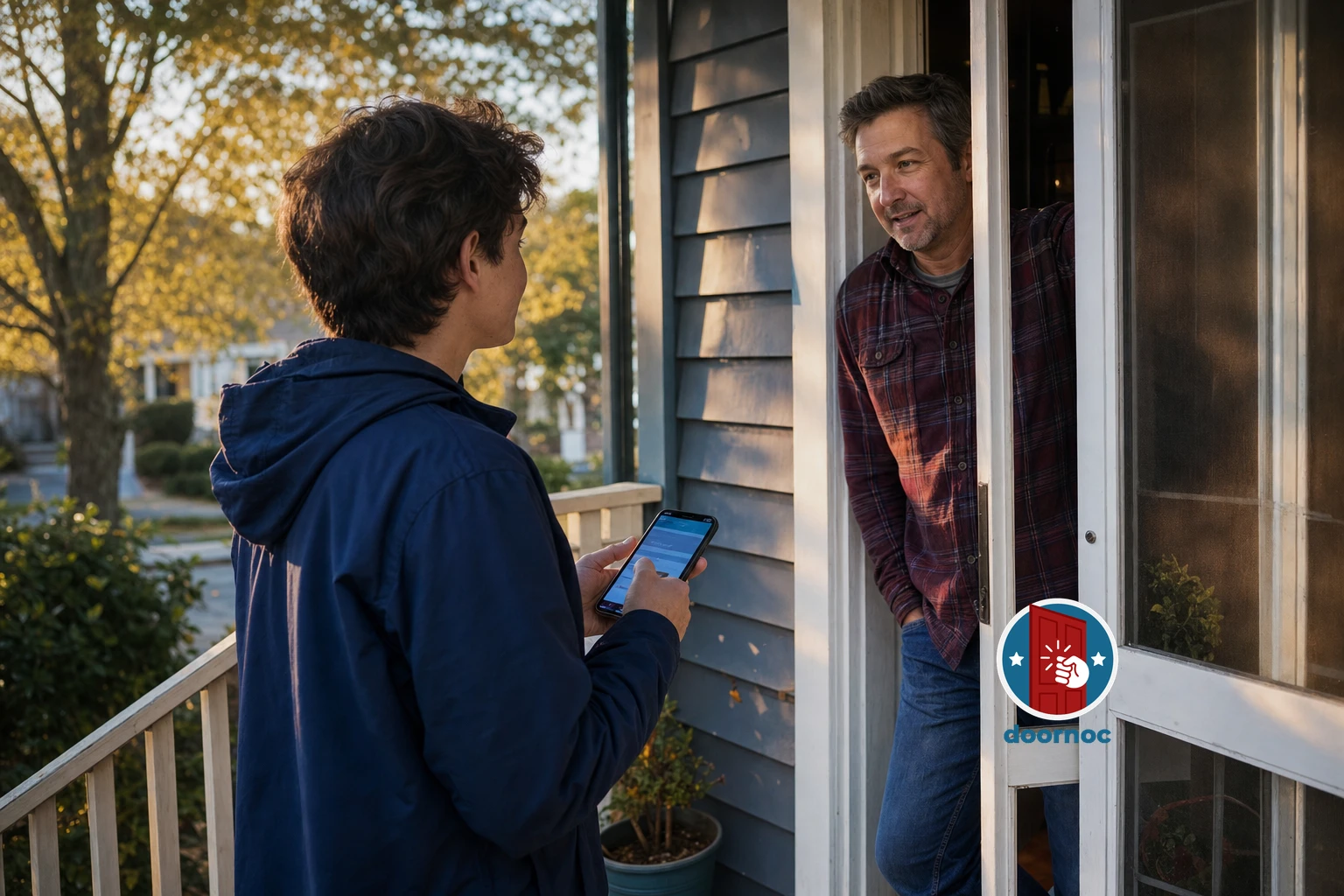
Your canvassing operation should be using modern canvassing software that provides real-time data synchronization, offline functionality, and smart route optimization. Tools like Door Knock allow your volunteers to access voter data, record conversations, and track progress from their smartphones, eliminating the clipboard-and-paper approach that wastes time and loses data.
Plan your canvassing schedule strategically. Begin with high-priority persuadable voters 6-9 months before Election Day. Shift to GOTV targeting in the final 4-6 weeks. Your canvassers should be contacting 15-25 voters per hour in suburban areas, 8-12 per hour in rural areas, and 20-30 per hour in urban areas.
Track your canvassing metrics religiously. Monitor doors knocked, conversations completed, supporters identified, and persuadable voters contacted. Your field director should be reviewing these metrics daily and adjusting targeting based on performance.
Phone Banking: Volume Contact Method
Phone banking allows you to contact more voters with fewer volunteers than door-knocking, but with lower effectiveness. Use phone banking for voter identification early in the campaign, GOTV reminders in the final week, and reaching voters in areas where door-knocking is impractical.
Your phone banking operation should be contacting 30-50 voters per volunteer per hour. Lower contact rates indicate poor list quality or inadequate volunteer training. Use predictive dialers for large-scale operations—they increase contact rates by 40-60% compared to manual dialing.
Script your phone conversations carefully. Volunteers should be having conversations, not reading scripts robotically. Train volunteers to listen, respond authentically, and record meaningful data. A phone conversation that identifies a persuadable voter is valuable; a phone call that annoys a supporter is counterproductive.
Digital Voter Contact: Precision Targeting
Digital advertising in 2026 allows unprecedented precision in reaching specific voters with tailored messages. Your digital operation should be running coordinated campaigns across Facebook, Instagram, YouTube, and programmatic display networks.
Use your voter file to build custom audiences for social media advertising. Upload your target voter lists to Facebook and Instagram to ensure your ads reach actual voters in your district, not just random users who fit demographic profiles. This targeting precision makes digital advertising highly cost-effective compared to traditional media.
Your digital ads should be testing multiple messages simultaneously. Run A/B tests comparing different video scripts, images, and calls-to-action. Let data determine which messages work—don’t rely on gut instinct. Winning campaigns test 10-15 different ad variations and scale up the winners.
Budget $0.50-$2.00 per voter for digital advertising depending on your market’s competitiveness. In a district with 50,000 voters, plan to spend $25,000-$100,000 on digital ads across the entire campaign.
Fundraising: The Campaign’s Lifeblood
No money, no campaign. Fundraising is the constraint that determines everything else—staff size, voter contact capacity, media reach, and ultimately your competitiveness.
 Candidate reviewing tablet data at desk with phone-banking volunteers and precinct map screen in evening campaign office
The Fundraising Reality
Candidates hate fundraising. You’ll hate it too. Make peace with this reality: you’ll spend 30-40% of your time raising money, especially in the campaign’s first year. Successful candidates treat fundraising as a core campaign activity, not a distraction from “real” campaigning.
Your fundraising goal should be reaching 60-70% of your total budget before announcing your candidacy. This early money funds your infrastructure—staff, technology, and initial voter contact. Campaigns that announce without adequate funds raised inevitably struggle, cutting corners on staff and technology that compound into larger problems.
Building Your Donor Base
Your donor base consists of three concentric circles. Your innermost circle includes 20-30 major donors who contribute the maximum allowed amount ($3,300 per election for federal races in 2026, varying amounts for state and local races). These donors are typically personal friends, family members, and business associates. Cultivate these relationships personally—they’re funding your campaign’s foundation.
Your second circle includes 100-200 significant donors who contribute $250-$1,000. These donors come from your extended network—professional associations, community organizations, and political networks. They give because they know you personally or strongly support your candidacy. Maintain regular contact with these donors through personal calls, small events, and campaign updates.
Your outer circle includes 500-2,000 small donors who contribute $25-$250. These donors give because they support your message and want to participate in your campaign. Cultivate this base through email campaigns, social media, and grassroots fundraising events. Small donors often become volunteers—they’re investing not just money but emotional commitment.
Fundraising Methods That Work
Call time is your most effective fundraising method. Block 3-4 hours daily for fundraising calls—yes, daily. Your finance director should prepare call lists with background information on each prospect. Make 20-25 calls per session. Your goal is scheduling 3-5 meetings or securing 2-3 commitments per call time session.
Fundraising events generate significant revenue while building community support. Host 2-3 events monthly at different price points. High-dollar events ($250-$1,000 per person) should be intimate gatherings of 20-40 people at someone’s home. Mid-level events ($50-$100 per person) can accommodate 50-100 people at restaurants or community spaces. Grassroots events ($25-$50 per person) should be large, energetic gatherings of 100+ supporters.
Online fundraising grows more important every cycle. Build an email list from day one, collecting addresses at every event and door-knock. Send fundraising emails 2-3 times weekly in the final months. Your emails should tell compelling stories, create urgency, and make specific asks. Generic “please donate” emails don’t work—specific asks tied to specific needs generate 3-5 times more revenue.
Data and Targeting: The Modern Campaign Foundation
Data-driven campaigns in 2026 outperform gut-instinct campaigns by every metric. Your data operation should be identifying target voters, tracking contact attempts, measuring persuasion effectiveness, and optimizing resource allocation.
Building Your Voter File
Your voter file is your campaign’s central database—every voter in your district with demographic information, voting history, and contact data. Purchase your initial voter file from your state party or a commercial vendor like L2 or TargetSmart. Budget $2,000-$5,000 for a quality voter file depending on district size.
Enhance your voter file with additional data layers. Append consumer data, demographic modeling, and issue scores to better understand each voter. Your goal is building a comprehensive profile that predicts vote likelihood, issue priorities, and persuadability.
Integrate your voter file with your canvassing technology. Modern campaigns use platforms like Door Knock that sync voter data to volunteers’ smartphones in real-time. When a volunteer knocks a door and records a conversation, that data immediately updates your central database. This real-time synchronization allows your campaign to adjust targeting daily based on field results.
Voter Targeting Models
Your targeting model segments the electorate into actionable categories. The most effective model divides voters into four groups:
Base Supporters (35-40% of voters): These voters will definitely support you. They share your party affiliation and demographic profile. Your base provides your vote floor—the minimum votes you’ll receive even with a poor campaign. Contact your base 2-3 times throughout the campaign to ensure they vote, but don’t waste resources persuading them.
Base Opponents (35-40% of voters): These voters will definitely oppose you. They support your opponent’s party and are unlikely to be persuaded. Ignore these voters completely. Every dollar spent trying to persuade base opponents is wasted—they won’t vote for you regardless of your message.
Persuadable Voters (20-25% of voters): These voters could support either candidate depending on the campaign. They’re true swing voters—ticket-splitters, weak partisans, and issue-focused independents. Your persuasion campaign should focus 80% of resources on these voters. Contact them 4-6 times through multiple channels—doors, phones, mail, and digital ads.
Low-Propensity Supporters (5-10% of voters): These voters support you but have inconsistent voting histories. They need turnout motivation, not persuasion. Focus GOTV resources on these voters in the final 2-3 weeks. Contact them 3-4 times with turnout reminders and voting logistics information.
Measuring What Matters
Track these key metrics weekly:
Voter Contact Progress: How many target voters have you contacted? What percentage of your persuadable voter universe has received at least one contact? You should be contacting 60-70% of persuadable voters by Election Day.
Fundraising Pace: Are you on track to hit your budget goals? Compare actual fundraising to your timeline projections. If you’re falling behind, adjust your fundraising schedule immediately.
Volunteer Recruitment: How many active volunteers are you recruiting monthly? Your volunteer base should be growing 15-20% monthly in the campaign’s first year, accelerating to 30-40% monthly in the final quarter.
Support Identification: How many supporters have you identified through voter contact? Your field operation should be identifying 100-300 new supporters weekly depending on district size.
Use these metrics to make strategic adjustments. If voter contact is falling behind, reallocate resources from other activities to field operations. If fundraising is lagging, increase the candidate’s call time. Data-driven campaigns adjust tactics based on performance; gut-instinct campaigns stick with failing strategies too long.
The Final 72 Hours: Election Day Operations
Election Day operations determine whether your identified supporters actually vote. Your GOTV operation should be a well-oiled machine executing a precise plan developed weeks earlier.
Pre-Election Day Preparation
Your Election Day plan should be finalized 10 days before Election Day. Recruit poll watchers for every precinct—volunteers who monitor polling places and report turnout numbers throughout the day. Train poll watchers on their legal rights and responsibilities.
Build your phone bank capacity for Election Day calls. You’ll need 50-100 volunteers making calls throughout the day, reminding supporters to vote and offering rides to polls. Secure a location with sufficient phones and internet capacity.
Prepare your voter contact lists. Pull lists of all identified supporters who haven’t voted early. Organize these lists by precinct and time of day. Your field operation will be working through these lists systematically, contacting supporters who haven’t voted yet.
Test your technology extensively. Ensure your voter contact software works offline (critical for Election Day when internet can be unreliable). Verify that your phone systems can handle high call volumes. Test your data synchronization to ensure poll watcher reports update your central database in real-time.
Election Day Execution
Your Election Day operation runs from 6:00 AM until polls close. Organize your day into four shifts: morning (6:00 AM - 11:00 AM), midday (11:00 AM - 3:00 PM), evening (3:00 PM - 6:00 PM), and final push (6:00 PM until polls close).
Your poll watchers should be reporting turnout numbers hourly. Use these numbers to identify precincts where your supporters are underperforming. Redirect field resources to these precincts immediately. Modern campaigns use real-time dashboards showing precinct-by-precinct turnout, allowing campaign managers to make tactical adjustments throughout the day.
Your phone bank should be calling identified supporters who haven’t voted yet. Make 3-4 contact attempts per voter—morning, midday, evening, and final push. Offer rides to voters who need transportation. Track which supporters have voted using poll watcher reports and early vote data.
Your field teams should be knocking doors in high-priority precincts, targeting identified supporters who haven’t voted. Use mobile canvassing apps to track which doors have been knocked and which voters still need contact. Focus on low-propensity supporters who need extra motivation.
Your candidate should be visiting polling places throughout the day, thanking poll workers and greeting voters. This visibility energizes your supporters and generates last-minute earned media. Schedule 15-20 polling place visits across your district, prioritizing high-traffic locations in competitive precincts.
Common Campaign Mistakes to Avoid
Learning from others’ mistakes is cheaper than learning from your own. Here are the most common failures that sink campaigns:
Starting Too Late: Campaigns that announce 6-9 months before Election Day rarely have time to raise adequate funds, build infrastructure, or contact enough voters. Start 12-18 months out for competitive races.
Hiring the Wrong Campaign Manager: Your manager determines everything. Hiring someone without relevant experience or proven success is campaign malpractice. Pay for quality—a great manager is worth double their salary.
Ignoring Data: Campaigns that rely on gut instinct instead of data waste resources on ineffective activities. Invest in quality data and use it to drive every decision.
Spreading Resources Too Thin: Trying to reach every voter with every message through every channel is impossible. Focus resources on persuadable voters in competitive precincts. Ignore base opponents completely.
Neglecting Fundraising: Candidates who avoid fundraising because it’s uncomfortable inevitably run out of money at critical moments. Treat fundraising as a core campaign activity, not a distraction.
Poor Volunteer Management: Recruiting volunteers without proper training, clear roles, and consistent appreciation leads to high turnover and low productivity. Invest in volunteer infrastructure—it multiplies your campaign’s capacity.
Message Inconsistency: Campaigns that change messages weekly confuse voters and waste money. Develop your core message early through polling and focus groups, then repeat it consistently across all channels.
Technology Underinvestment: Campaigns that use paper lists and manual data entry waste countless volunteer hours and lose valuable data. Invest in modern canvassing software and voter contact tools—they pay for themselves through increased efficiency.
Winning in 2026: Putting It All Together
Running for office in 2026 means building a sophisticated organization that integrates traditional field operations with modern data analytics and digital targeting. Your campaign succeeds by identifying the right voters, delivering the right message, and ensuring those voters actually cast ballots.
Start early—18 months before Election Day for competitive races. Hire quality staff, especially your campaign manager. Invest in data and technology that multiplies your effectiveness. Focus resources on persuadable voters, not base opponents. Contact your target voters 4-6 times through multiple channels. Run a disciplined GOTV operation in the final 72 hours.
The campaigns that win in 2026 are the ones that treat politics as both an art and a science—combining compelling messaging with rigorous data analysis, passionate volunteers with sophisticated technology, and candidate charisma with organizational discipline. Build that kind of campaign, and you’ll give yourself the best possible chance of victory on Election Day.
Frequently Asked Questions
How much does it cost to run a political campaign in 2026?
Local races typically cost $15,000-$75,000, state legislative seats run $100,000-$500,000, and Congressional campaigns average $1.5-$3 million. Your actual budget depends on district competitiveness, media market costs, and voter contact methods. Plan to raise 60-70% of your budget before announcing your candidacy.
How long does it take to run a political campaign?
Competitive campaigns require 12-18 months of active campaigning, though exploratory work should begin 18-24 months before Election Day. Local races may succeed with 6-9 months of intensive effort, while Congressional and statewide races demand longer timelines for fundraising, coalition building, and voter contact.
What is the first step when running for political office?
Form an exploratory committee 18-24 months before Election Day to test fundraising viability, assess district competitiveness, and build your initial support network. During this 3-6 month exploratory phase, conduct opposition research on yourself, identify potential campaign staff, and develop preliminary messaging before formally announcing.
Do I need a campaign manager to run for office?
Yes, for any race beyond hyperlocal positions. A skilled campaign manager is your single most important hire, overseeing strategy, budget, staff, and daily operations. Budget 15-20% of your total campaign funds for a manager’s salary, hiring them 9-12 months before Election Day for competitive races.
How do I get my name on the ballot?
Requirements vary by state and office level, but typically involve filing a declaration of candidacy, paying filing fees ($500-$5,000 for most races), and collecting petition signatures (usually 1-5% of registered voters in your district). Start the ballot access process 4-6 months before your state’s filing deadline to allow time for signature collection and verification.