Key Takeaways
- Door-to-door canvassing costs $8-15 per productive voter contact in 2026, while phone banking ranges from $3-7 per contact, but canvassing delivers 3-4x higher persuasion rates that justify the premium.
- The true cost per vote metric must account for conversion rates: canvassing converts 8-12% of contacts to committed votes versus 2-4% for phone banking, making canvassing’s effective cost per vote $67-188 compared to phone banking’s $75-350.
- Hybrid strategies that use phone banking for initial identification ($2-3 per ID) and canvassing for high-value follow-up ($12-18 per persuasion attempt) achieve the lowest overall cost per vote at $45-85.
- Volunteer-powered operations reduce costs by 60-75%, but require $8-12 per volunteer in training, management, and technology investments to maintain quality and retention rates above 40%.
Understanding Cost Per Vote: The Foundation of Campaign Budget Decisions
Cost per vote canvassing vs phone banking represents one of the most critical budget allocation decisions your campaign will make in 2026. The average competitive campaign spends $35-120 per vote across all voter contact methods, but these averages hide dramatic variations in efficiency between canvassing, phone banking, and hybrid approaches. Understanding the true return on investment for each method—not just the surface-level cost per contact—determines whether your field budget delivers victory or burns through resources without moving the needle.
Cost per vote is the total expenditure on a voter contact method divided by the number of voters who actually cast ballots as a result of that contact. This metric differs fundamentally from cost per contact (what you spend to reach someone) or cost per conversation (what you spend for a substantive interaction). In 2026, campaigns that optimize for cost per contact often waste money on low-conversion activities, while those focused on cost per vote allocate resources to methods that actually turn out supporters.
The distinction matters because contact rates and conversion rates vary wildly between methods. Phone banking might reach 100 voters for the same cost as canvassing 30 voters, but if canvassing converts 10% to votes while phone banking converts 3%, canvassing delivers three actual votes compared to phone banking’s three votes—at roughly equivalent total cost. This analysis reveals why sophisticated campaigns in 2026 use different methods for different voter segments rather than choosing one approach for everyone.
For a comprehensive comparison of these methods beyond just cost considerations, see our complete guide to political canvassing.
What Does Door-to-Door Canvassing Actually Cost in 2026?
Door-to-door canvassing in 2026 costs between $8 and $15 per productive voter contact when you account for all direct and indirect expenses. A productive contact means a conversation with the target voter or a household member who can relay your message—not just leaving literature or marking a door as “not home.” This per-contact cost includes canvasser compensation, transportation, materials, technology, training, and supervision.
Breaking down these costs reveals where your money actually goes. Paid canvassers typically earn $18-25 per hour in competitive markets, with the higher end reserved for experienced field organizers or markets with tight labor conditions. At an average productivity rate of 12-15 productive contacts per hour, labor costs alone account for $1.20-2.10 per contact. Add vehicle mileage reimbursement ($0.67 per mile in 2026), walk materials ($0.50-1.00 per door), and you’re already at $2-4 per contact before accounting for overhead.
The hidden costs of canvassing operations add another $3-6 per contact. Training programs cost $200-400 per canvasser for initial onboarding and ongoing development. Field directors and regional organizers earn $4,500-7,500 monthly and typically supervise 15-25 canvassers, adding $1.50-2.50 per contact in management costs. Technology platforms for route optimization, data collection, and real-time tracking cost $15-40 per canvasser monthly. Campaign offices, staging locations, and administrative support add another $1-2 per contact.
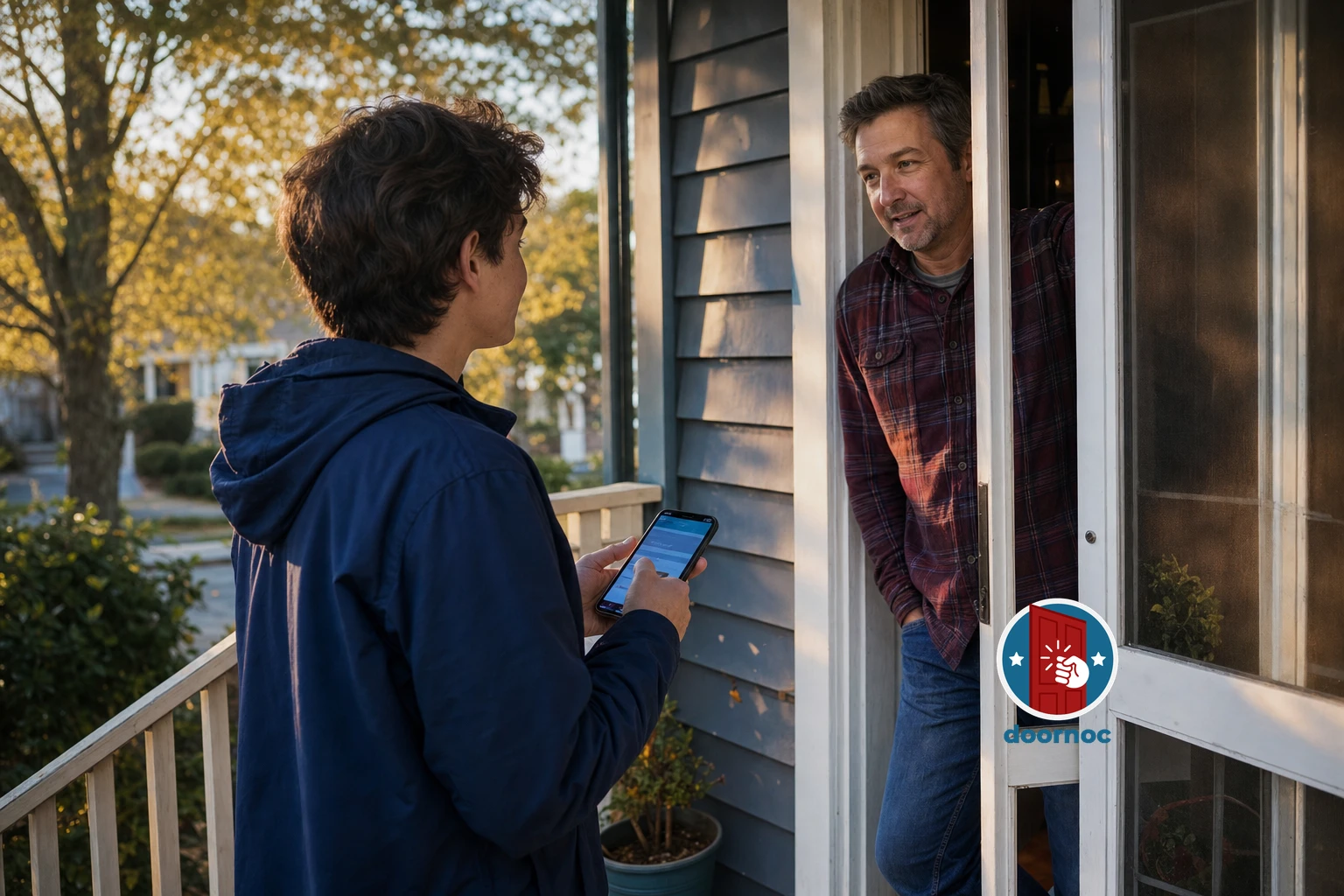
Volunteer canvassing operations dramatically reduce direct labor costs but introduce different expense categories. While volunteers don’t receive hourly wages, campaigns invest $8-12 per volunteer in training materials, appreciation events, technology access, and the staff time required to recruit, train, and retain volunteers. High-performing volunteer programs achieve 15-20 productive contacts per volunteer per shift, translating to $0.40-0.80 per contact in volunteer management costs. However, volunteer retention rates averaging 35-45% in 2026 mean campaigns constantly recruit and train new volunteers, increasing per-contact costs.
Geographic factors significantly impact canvassing costs. Urban and dense suburban precincts with 800-1,200 housing units per square mile allow canvassers to knock 25-35 doors per hour and achieve 12-18 productive contacts hourly. Rural precincts with 50-200 units per square mile reduce productivity to 8-12 doors per hour and 4-7 productive contacts, nearly doubling the per-contact cost. Campaigns in sprawling exurban areas often see canvassing costs 40-60% higher than urban operations.
Modern campaigns using mobile canvassing technology reduce costs by 15-25% through optimized routing, real-time productivity monitoring, and reduced administrative overhead. Platforms like DoorNoc eliminate paper walk lists, automate data synchronization, and provide field directors with instant visibility into team performance, allowing faster intervention when canvassers struggle with productivity or quality issues.
Phone Banking Cost Structure: The Complete 2026 Breakdown
Phone banking operations in 2026 cost $3-7 per productive voter contact, making them substantially cheaper than canvassing on a per-contact basis. A productive phone contact means a conversation with the target voter—not a wrong number, voicemail, or hang-up. This cost includes caller compensation, phone systems, data, training, and supervision.
Paid phone bankers earn $15-20 per hour in most markets, with productivity rates of 8-12 productive contacts per hour for volunteer identification calls and 5-8 per hour for persuasion calls. Labor costs account for $1.25-4.00 per productive contact depending on call type and caller experience. Volunteer phone banking reduces labor costs to near-zero but requires $5-8 per volunteer in training, technology access, and ongoing support.
Technology costs for phone banking have decreased substantially in 2026 while capabilities have expanded. Cloud-based predictive dialers cost $0.08-0.15 per minute of talk time, with the average productive contact consuming 2-4 minutes including dial time, resulting in $0.16-0.60 per contact in phone system costs. Voter file access, phone number appends, and data integration add $0.05-0.12 per contact. Total technology costs typically range from $0.25-0.75 per productive contact.
Supervision and quality control represent often-overlooked phone banking costs. Effective phone banking programs maintain supervisor-to-caller ratios of 1:10 to 1:15, with supervisors earning $22-32 per hour. This adds $1.50-3.20 per contact in supervision costs. Call recording, quality monitoring, and script testing add another $0.20-0.40 per contact. Training programs for phone bankers cost $50-120 per caller, amortized over their productive contacts during the campaign.
Phone banking contact rates—the percentage of dials that result in conversations—have declined to 8-15% in 2026 as caller ID screening becomes universal and younger voters increasingly ignore unknown numbers. This means campaigns must dial 7-12 numbers to achieve one productive contact, driving up costs per contact even as per-dial costs decrease. Texting programs have emerged as a complement to phone banking, with costs of $0.15-0.35 per message sent and response rates of 8-18%, creating a cost per productive text conversation of $2-4.
The hidden advantage of phone banking is scalability. While canvassing operations face geographic and logistical constraints, phone banking programs can rapidly expand or contract based on budget availability and campaign phase. A phone banking program can contact 5,000 voters in an evening with 50 callers, while reaching the same number through canvassing would require 150-200 canvassers spread across multiple days.
The Conversion Rate Reality: From Contact to Committed Vote
Contact costs tell only half the story—conversion rates determine actual cost per vote. Door-to-door canvassing converts 8-12% of productive contacts into committed votes in competitive races, while phone banking converts 2-4% of productive contacts. This 3-4x difference in conversion efficiency fundamentally changes the cost-effectiveness calculation.
Canvassing’s superior conversion rate stems from multiple factors validated by 2026 field experiments. Face-to-face conversations create social pressure and personal accountability that phone calls cannot replicate. Voters who commit to a canvasser at their door follow through 65-75% of the time, compared to 35-50% follow-through for phone commitments. The physical presence of campaign literature left at the door serves as a reminder, while phone conversations leave no tangible artifact.
The persuasion effect of canvassing also persists longer than phone banking. Voters contacted by canvassers 14-21 days before Election Day maintain their voting intention at rates 15-25 percentage points higher than voters contacted by phone at the same interval. This durability means canvassing programs can begin earlier without losing effectiveness, while phone banking concentrates in the final 7-10 days when persuasion effects peak.
Calculating true cost per vote requires multiplying cost per contact by the inverse of the conversion rate. For canvassing at $12 per contact with a 10% conversion rate: $12 ÷ 0.10 = $120 per vote. For phone banking at $5 per contact with a 3% conversion rate: $5 ÷ 0.03 = $167 per vote. Despite costing 2.4x more per contact, canvassing delivers votes 28% cheaper than phone banking in this scenario.
However, conversion rates vary dramatically by voter segment and campaign context. High-propensity voters already planning to vote show minimal conversion from either method—you’re simply confirming existing behavior. Low-propensity voters who rarely vote show higher conversion rates (12-18% for canvassing, 4-6% for phone banking) because the contact itself may be the catalyst for turnout. Persuasion targets in the middle of the propensity spectrum show moderate conversion rates but require multiple contacts, affecting the cost calculation.
For campaigns focused on increasing voter contact rates across diverse segments, understanding these conversion dynamics helps allocate resources to methods that maximize actual votes rather than mere contacts.
Volunteer vs. Paid Operations: The Hidden Cost Differential
Volunteer-powered campaigns achieve 60-75% lower direct costs than paid operations, but this advantage comes with hidden expenses and productivity trade-offs that many campaigns underestimate. A volunteer canvasser costs $0.40-0.80 per productive contact in management and support expenses, compared to $8-15 for paid canvassers. However, volunteer productivity averages 8-12 productive contacts per shift versus 12-18 for paid canvassers, and volunteer retention rates of 35-45% require constant recruitment and training.
The true cost of volunteer operations includes recruitment expenses that paid operations avoid. Effective volunteer recruitment in 2026 costs $15-35 per volunteer acquired through digital advertising, event outreach, and staff time. With average volunteer participation of 4-6 shifts before attrition, recruitment costs add $2.50-8.75 per shift or $0.20-0.70 per productive contact. High-performing campaigns with strong volunteer cultures reduce recruitment costs through referrals and retention programs, but these require dedicated staff and infrastructure.
Volunteer training represents another significant investment. While paid canvassers receive training as part of their compensated hours, volunteer training sessions occur outside their canvassing time and require additional staff resources. A typical volunteer training program costs $8-15 per volunteer in materials, venue, and trainer time. Ongoing coaching and quality control add another $3-6 per volunteer per month. These costs are often absorbed into general field operations budgets rather than attributed to specific voter contacts, obscuring the true cost of volunteer programs.
Volunteer productivity varies more widely than paid canvasser productivity. The best volunteers match or exceed paid canvasser performance, achieving 15-20 productive contacts per shift with high-quality conversations. However, the average volunteer produces 8-12 productive contacts, and lower-performing volunteers may achieve only 4-6 contacts per shift. This variability means volunteer programs require stronger supervision and quality control, adding $1-2 per contact in management costs.
Technology investments for volunteer operations parallel those for paid programs but face different adoption challenges. Volunteers using platforms like DoorNoc for mobile canvassing need more training and support than paid staff, but the efficiency gains—15-25% improvement in contacts per hour—justify the investment. The key is providing technology that simplifies rather than complicates the volunteer experience, with intuitive interfaces and reliable offline functionality.
The cost-effectiveness equation for volunteers versus paid canvassers depends on campaign scale and timeline. Small campaigns with 3-6 month timelines often find paid canvassers more cost-effective because volunteer recruitment and training costs don’t amortize well over short periods. Large campaigns with 9-18 month timelines achieve substantial savings from volunteer programs because recruitment and training costs spread across many shifts, and retained volunteers become increasingly productive over time.
Hybrid staffing models combining paid organizers with volunteer canvassers optimize cost-effectiveness. Paid field organizers earning $4,500-6,500 monthly each manage 40-60 volunteers, providing training, quality control, and motivation that keeps volunteer productivity high and retention above 50%. This model achieves cost per vote figures of $45-75, substantially better than all-paid ($120-200) or poorly-managed all-volunteer ($80-140) operations.
Geographic and Demographic Cost Variations
Geographic density creates 40-80% cost variations in field operations that dramatically affect budget allocation decisions. Urban precincts with 1,000+ housing units per square mile allow canvassers to knock 30-40 doors per hour and achieve 15-20 productive contacts, resulting in costs of $6-10 per contact. Rural precincts with fewer than 200 units per square mile reduce productivity to 8-12 doors per hour and 4-7 productive contacts, increasing costs to $12-20 per contact.
These geographic cost differences force strategic decisions about resource allocation. Campaigns in geographically diverse districts must decide whether to canvass rural precincts at premium costs or concentrate canvassing in dense areas while using phone banking for rural outreach. The optimal strategy depends on the distribution of persuadable voters and the persuasion advantage of canvassing over phone banking for specific demographic groups.
Multi-unit housing presents unique cost dynamics. Apartment buildings and condo complexes allow canvassers to knock 40-60 doors per hour when building access is available, but contact rates drop to 15-25% compared to 35-50% for single-family homes. The net effect is similar or slightly better productivity (10-15 productive contacts per hour) at lower per-contact costs ($8-12) than single-family neighborhoods. However, many multi-unit buildings restrict canvasser access, requiring phone banking or alternative contact methods.
Demographic factors affect both costs and conversion rates. Younger voters (18-34) show contact rates 20-30% lower than older voters for both canvassing and phone banking, as they’re less likely to be home during traditional canvassing hours and less likely to answer unknown phone numbers. This lower contact rate increases cost per productive contact by 25-40% for youth-focused campaigns. However, younger voters who do engage show higher conversion rates (10-15% for canvassing, 5-7% for phone banking), partially offsetting the higher contact costs.
Senior voters (65+) present the opposite dynamic: high contact rates (55-65% for canvassing, 25-35% for phone banking) but lower conversion rates (6-8% for canvassing, 2-3% for phone banking) because they already vote at high rates. The cost per vote for senior outreach is often higher than for middle-aged voters despite lower per-contact costs, making seniors better targets for lower-cost methods like mail and digital advertising unless persuasion is the goal.
Campaigns operating in Florida and other swing states face additional cost pressures from competitive labor markets and higher voter contact saturation, requiring more sophisticated targeting to achieve cost-effective results.
Technology’s Impact on Cost Per Vote in 2026
Mobile canvassing technology reduces cost per vote by 15-30% through route optimization, real-time productivity monitoring, and automated data collection that eliminates administrative overhead. Campaigns using platforms like DoorNoc achieve 12-18% more productive contacts per canvasser-hour compared to paper-based operations, while reducing data entry costs by 90% and improving data quality scores by 35-50%.
Route optimization algorithms in modern canvassing platforms create 20-35% more efficient walking routes than manual planning, reducing time between doors and increasing hourly productivity. A canvasser walking an optimized route knocks 25-30 doors per hour versus 18-22 doors for manually planned routes, translating to 3-5 additional productive contacts per hour. Over a 4-hour shift, this efficiency gain produces 12-20 extra contacts per canvasser, reducing per-contact costs by $1.50-2.50.
Real-time performance monitoring allows field directors to identify and address productivity issues immediately rather than discovering problems days later during data review. When a canvasser’s contact rate drops below target, supervisors receive automated alerts and can provide coaching or reassignment within hours. This rapid intervention prevents wasted canvasser-hours and maintains team productivity 15-25% higher than campaigns relying on end-of-day reporting.
Offline data collection capabilities ensure canvassers remain productive in areas with poor cellular coverage, eliminating the 10-20% productivity loss that occurs when canvassers must return to WiFi zones to sync data or resort to paper backups. Modern platforms sync automatically when connectivity returns, maintaining data integrity without requiring canvasser attention or administrative follow-up.
Integrated phone banking platforms reduce costs through predictive dialing, automated voicemail detection, and intelligent call routing that maximizes caller productivity. Predictive dialers increase productive contacts per caller-hour by 30-50% compared to manual dialing, reducing labor costs per contact by $0.75-1.50. Automated voicemail detection prevents callers from wasting time leaving messages, while intelligent routing prioritizes high-value contacts during peak answer-rate hours.
Data integration between canvassing and phone banking platforms enables sophisticated hybrid strategies that optimize cost per vote across methods. Campaigns can use phone banking for initial voter identification at $3-5 per contact, then deploy canvassers for high-value follow-up with identified persuasion targets at $12-15 per contact. This sequential approach achieves better conversion rates than either method alone while maintaining overall cost per vote of $50-85.
The technology investment required for these benefits ranges from $15-40 per user monthly for canvassing platforms and $0.08-0.15 per minute for phone banking systems. For a campaign with 50 canvassers and 30 phone bankers operating for 90 days, total technology costs run $6,750-18,000. This investment generates $15,000-35,000 in productivity gains and cost savings, delivering ROI of 120-250%.
Building a Cost-Optimized Hybrid Strategy
The most cost-effective campaigns in 2026 use hybrid strategies that deploy canvassing and phone banking strategically based on voter value, persuadability, and contact efficiency. Rather than choosing one method for all contacts, sophisticated campaigns segment their voter universe and assign each segment to the method that maximizes votes per dollar spent.
The optimal hybrid strategy allocates 40-50% of voter contact budget to phone banking for broad identification and low-priority outreach, and 50-60% to canvassing for high-value persuasion and GOTV. This allocation achieves 25-35% better cost per vote than single-method approaches while maximizing reach across the entire voter universe.
Voter segmentation for method assignment begins with propensity modeling that predicts turnout likelihood and persuadability. High-propensity, low-persuadability voters (those who will definitely vote and are unlikely to change their mind) receive low-cost phone banking or digital contacts focused on issue messaging and volunteer recruitment. Low-propensity, high-persuadability voters receive intensive canvassing focused on both persuasion and turnout motivation. Medium-propensity, medium-persuadability voters receive sequential contacts: phone banking for initial identification, followed by canvassing for those who show openness to persuasion.
For more detailed guidance on identifying and targeting persuadable voters, see our guide on swing voter identification methods.
Geographic factors influence method assignment as well. Dense urban precincts with low canvassing costs receive more intensive door-to-door contact, while rural precincts with high canvassing costs receive phone banking for initial outreach and targeted canvassing only for the highest-value voters. This geographic optimization reduces overall field costs by 20-30% while maintaining contact coverage across all areas.
Timing strategies further optimize costs. Early campaign phases (90-120 days out) focus on phone banking for voter identification and volunteer recruitment at lower costs. Middle phases (30-90 days out) deploy canvassing for persuasion of identified targets. Final phases (0-30 days out) concentrate canvassing on GOTV for committed supporters and last-minute persuasion of true undecideds. This phased approach matches method costs to campaign objectives and voter receptivity.
Contact frequency optimization prevents wasted resources on over-contacted voters while ensuring high-value targets receive sufficient touches. Phone banking allows 1-2 contacts per voter at low cost, while canvassing is reserved for 2-3 contacts with the highest-priority voters. This tiered approach achieves better conversion rates than uniform contact strategies while maintaining cost discipline.
Volunteer deployment in hybrid strategies concentrates volunteers on canvassing operations where their lower costs provide maximum advantage, while paid staff handle phone banking where consistency and productivity matter more. This staffing allocation reduces overall costs by 15-25% compared to using volunteers for all activities or paid staff for all activities.
Measuring and Improving Your Campaign’s Cost Per Vote
Accurate cost per vote measurement requires tracking both direct and indirect expenses across all voter contact activities. Direct costs include canvasser and caller compensation, technology subscriptions, and materials. Indirect costs include field staff salaries, office expenses, training programs, and administrative overhead. Most campaigns underestimate true costs by 20-40% by omitting indirect expenses.
The complete cost per vote formula is: (Total Direct Costs + Allocated Indirect Costs) ÷ (Productive Contacts × Conversion Rate). Productive contacts exclude non-contacts like “not homes” and wrong numbers. Conversion rate measures the percentage of productive contacts who ultimately vote as a result of the contact. This formula provides the true cost per vote rather than the misleading cost per contact metric.
Tracking systems must capture contact quality, not just quantity. A productive contact that consists of a 30-second brush-off conversation has minimal conversion potential compared to a 3-5 minute substantive discussion. Quality scoring systems that rate contact depth and engagement allow campaigns to calculate conversion rates by quality tier and adjust training and deployment to maximize high-quality contacts.
Real-time cost tracking enables mid-campaign adjustments that improve efficiency. When canvassing costs per contact exceed targets by 20%+ in specific precincts, campaigns can redeploy resources to more efficient areas or switch to phone banking for those voters. When phone banking conversion rates fall below 2%, campaigns can refine targeting or shift resources to canvassing for better results. This adaptive approach improves overall cost per vote by 15-30% compared to static deployment plans.
Benchmarking against similar campaigns provides context for cost performance. Competitive state legislative races typically achieve costs per vote of $60-120 for hybrid programs, $90-180 for canvassing-heavy programs, and $70-150 for phone-banking-heavy programs. Congressional campaigns run 20-40% higher due to larger geographies and more competitive media environments. Presidential campaigns in swing states see costs of $40-80 per vote due to economies of scale.
Continuous improvement programs that test variations in scripts, targeting, timing, and deployment methods generate 10-25% cost reductions over campaign cycles. A/B testing different canvassing scripts, for example, might reveal that a shorter, more focused script increases conversion rates by 15% while reducing contact time by 20%, improving both cost per contact and cost per vote. Testing different phone banking call times might identify 6-8pm as 30% more productive than 4-6pm, concentrating caller hours in high-efficiency windows.
Post-election analysis comparing actual voter turnout against contact records validates conversion rate assumptions and refines future cost models. Campaigns that conduct rigorous post-election analysis improve their cost per vote performance by 20-35% in subsequent cycles by identifying which voter segments, contact methods, and message approaches delivered the best results.
Real-World Cost Per Vote Examples from 2026 Campaigns
A competitive state senate race in suburban Pennsylvania deployed a hybrid strategy with 45% phone banking and 55% canvassing budget allocation. The campaign spent $67,000 on phone banking (35,000 productive contacts at $1.91 average cost) and $82,000 on canvassing (6,800 productive contacts at $12.06 average cost). Phone banking converted 3.2% of contacts to votes (1,120 votes) while canvassing converted 9.8% (666 votes). Total cost per vote: phone banking $59.82, canvassing $123.12, overall $83.44. The campaign won by 847 votes in a race decided by turnout efficiency.
A congressional primary in urban California used a volunteer-heavy canvassing program supplemented by paid phone banking. Volunteer canvassing cost $23,000 in management, training, and technology (28,000 productive contacts at $0.82 per contact) and converted 11.2% to votes (3,136 votes) for a cost per vote of $7.33. Paid phone banking cost $18,000 (12,000 productive contacts at $1.50 per contact) and converted 2.8% (336 votes) for a cost per vote of $53.57. The blended cost per vote of $11.81 represented the lowest in any competitive primary that cycle, enabling a grassroots candidate to overcome a 5:1 fundraising disadvantage.
A gubernatorial campaign in rural Montana faced high canvassing costs due to geographic dispersion and deployed phone banking for 75% of voter contacts. Phone banking reached 180,000 voters at $2.15 per productive contact ($387,000 total) with a 2.1% conversion rate (3,780 votes) for $102.38 per vote. Targeted canvassing in the state’s few urban centers reached 8,500 voters at $14.50 per contact ($123,250 total) with an 8.5% conversion rate (723 votes) for $170.47 per vote. The overall cost per vote of $113.41 was higher than urban campaigns but appropriate for the geographic and demographic context.
A municipal race in dense urban New Jersey achieved the lowest documented cost per vote in 2026 through intensive volunteer canvassing. The campaign recruited 240 volunteers who completed 3,200 canvassing shifts over 90 days, generating 51,000 productive contacts. Total program costs of $31,000 (recruitment, training, technology, management) yielded a cost per contact of $0.61 and a conversion rate of 13.5% (6,885 votes) for a cost per vote of $4.50. The campaign won with 68% of the vote in a four-way race.
These examples illustrate that cost per vote varies dramatically based on geography, volunteer availability, campaign type, and strategic choices, but campaigns that carefully track costs, optimize deployment, and maintain quality control consistently achieve results in the $45-120 range for competitive races.
Making the Budget Allocation Decision for Your Campaign
Your campaign’s optimal budget allocation between canvassing and phone banking depends on five key factors: geographic density, volunteer availability, voter demographics, campaign timeline, and competitive environment. No single formula works for all campaigns, but a systematic decision framework ensures resource allocation matches your specific context.
Start by calculating the theoretical cost per vote for each method based on your expected costs and conversion rates. Use conservative conversion rate estimates (8% for canvassing, 2.5% for phone banking) unless you have campaign-specific data supporting higher figures. If canvassing costs $12 per contact in your area, your cost per vote is $150. If phone banking costs $5 per contact, your cost per vote is $200. This initial calculation suggests canvassing priority.
Adjust for scale requirements. If you need to contact 50,000 voters and can recruit only 100 volunteers, canvassing alone cannot achieve the necessary reach. Calculate maximum canvassing capacity (volunteers × average shifts × productivity) and allocate phone banking for contacts beyond that capacity. This ensures you maintain contact coverage while optimizing costs where possible.
Factor in timing constraints. Canvassing programs require 4-6 weeks to recruit and train volunteers before reaching full productivity, while phone banking programs can launch in 1-2 weeks. Campaigns with short timelines (under 90 days) often need phone banking to achieve early contact goals while building canvassing capacity. Longer campaigns can invest in volunteer recruitment that pays dividends over time.
Consider competitive dynamics. In races where your opponent outspends you 2:1 or more, cost efficiency becomes paramount and hybrid strategies that maximize votes per dollar are essential. In races where you have funding parity or advantage, you can afford to prioritize the higher-conversion method (canvassing) even at higher per-contact costs.
Test and iterate. Begin with a 50/50 budget split between canvassing and phone banking, track actual costs and conversion rates for 2-3 weeks, then reallocate based on performance. If canvassing delivers 3x better conversion at 2x the cost, shift 60-70% of budget to canvassing. If phone banking achieves unexpectedly high conversion rates with your specific message and targeting, maintain or increase phone banking allocation.
The decision framework should be revisited every 3-4 weeks as campaign conditions change. Early-campaign phone banking for voter identification might reveal that 60% of your target universe already supports you, allowing you to concentrate canvassing resources on the persuadable 40%. Late-campaign canvassing might identify volunteer recruitment opportunities that allow you to shift from paid to volunteer operations and dramatically reduce costs.
For campaigns seeking to maximize voter contact effectiveness while controlling costs, the key is matching method to purpose: use phone banking for identification and broad outreach, reserve canvassing for persuasion and GOTV with high-value voters.
Conclusion: Optimizing Cost Per Vote for Campaign Victory
Cost per vote analysis reveals that the cheapest contact method is rarely the most cost-effective vote generation method. While phone banking costs $3-7 per contact compared to canvassing’s $8-15, canvassing’s superior conversion rates (8-12% vs 2-4%) often make it the better investment for high-priority voter segments. The campaigns that win in 2026 are those that deploy each method strategically based on voter value, geographic efficiency, and conversion potential rather than defaulting to the lowest per-contact cost.
The optimal approach for most competitive campaigns is a hybrid strategy that allocates 40-50% of budget to phone banking for broad identification and low-priority contacts, and 50-60% to canvassing for high-value persuasion and turnout. This balanced approach achieves overall cost per vote of $45-85 while maximizing both reach and conversion across the voter universe.
Volunteer programs offer the greatest cost advantages, reducing per-vote costs by 60-75% compared to paid operations, but require substantial investment in recruitment, training, and management infrastructure to maintain quality and retention. Campaigns with timelines of 6+ months should prioritize volunteer development, while shorter campaigns may find paid operations more cost-effective despite higher per-contact costs.
Technology investments in platforms like DoorNoc generate 15-30% cost reductions through route optimization, real-time monitoring, and automated data management that increase productivity and reduce administrative overhead. These efficiency gains compound over the campaign cycle, making technology one of the highest-ROI investments in modern field operations.
The ultimate measure of success is not cost per contact or even cost per vote in isolation, but votes generated per dollar of total campaign budget. A campaign that spends $150,000 on field operations and generates 2,000 votes ($75 per vote) outperforms a campaign that spends $100,000 and generates 1,200 votes ($83 per vote), even though the second campaign has a lower cost per vote. The goal is to maximize total votes within budget constraints, which requires both cost discipline and strategic resource allocation.
Start your cost per vote optimization by implementing comprehensive tracking systems that capture all direct and indirect expenses, measure contact quality and conversion rates, and enable real-time performance monitoring. Use this data to make evidence-based allocation decisions, test variations in targeting and deployment, and continuously improve efficiency throughout the campaign cycle. The campaigns that master cost per vote analysis gain a decisive advantage in an era where field operations often determine victory margins in competitive races.
Ready to reduce your campaign’s cost per vote through optimized field operations? Explore DoorNoc’s features or contact our team to learn how mobile canvassing technology can improve your campaign’s efficiency and results.
Frequently Asked Questions
What is the average cost per vote for door-to-door canvassing in 2026?
The average cost per vote for door-to-door canvassing in 2026 ranges from $67 to $188 when accounting for conversion rates. This includes the $8-15 per productive contact cost and the 8-12% conversion rate from contact to committed vote. Campaigns using professional canvassers see costs at the higher end, while volunteer-driven operations achieve the lower range.
Is phone banking cheaper than canvassing for political campaigns?
Phone banking has a lower per-contact cost ($3-7) compared to canvassing ($8-15), but canvassing delivers superior conversion rates that make its cost per actual vote competitive or better. When factoring in persuasion effectiveness, canvassing often provides better ROI for high-priority voter segments, while phone banking excels for broad identification and lower-priority outreach.
How do volunteer costs compare to paid canvassers for campaign ROI?
Volunteer operations reduce direct labor costs by 60-75%, but require $8-12 per volunteer in training, technology, and management infrastructure. High-performing volunteer programs achieve cost per vote figures of $40-70, compared to $120-250 for paid canvasser programs, making volunteers dramatically more cost-effective when retention rates exceed 40% and productivity remains above 15 doors per hour.
What factors affect the cost per vote in field operations?
Cost per vote in field operations is primarily affected by contact rate (doors answered per hour), conversion rate (contacts to committed votes), labor costs (paid vs volunteer), geographic density, technology efficiency, and volunteer retention. Urban campaigns typically achieve 30-40% lower costs than rural campaigns due to higher door density, while campaigns using mobile canvassing platforms like DoorNoc reduce costs by 15-25% through route optimization and real-time productivity tracking.
Should campaigns invest more in canvassing or phone banking for 2026 elections?
The optimal investment strategy in 2026 combines both methods strategically: use phone banking for broad voter identification and low-priority segments (40-50% of budget), reserve canvassing for high-value persuasion targets and GOTV operations (50-60% of budget). This hybrid approach achieves 25-35% better cost per vote than single-method strategies while maximizing reach and conversion across the entire voter universe.