Key Takeaways
- Voter contact rates average 20-30% nationally, but top campaigns achieve 40-50% by optimizing timing, targeting, and volunteer training.
- The best times to canvass are 5:00-8:00 PM on weekdays and 10:00 AM-4:00 PM on weekends, when voter contact rates increase by 35-40%.
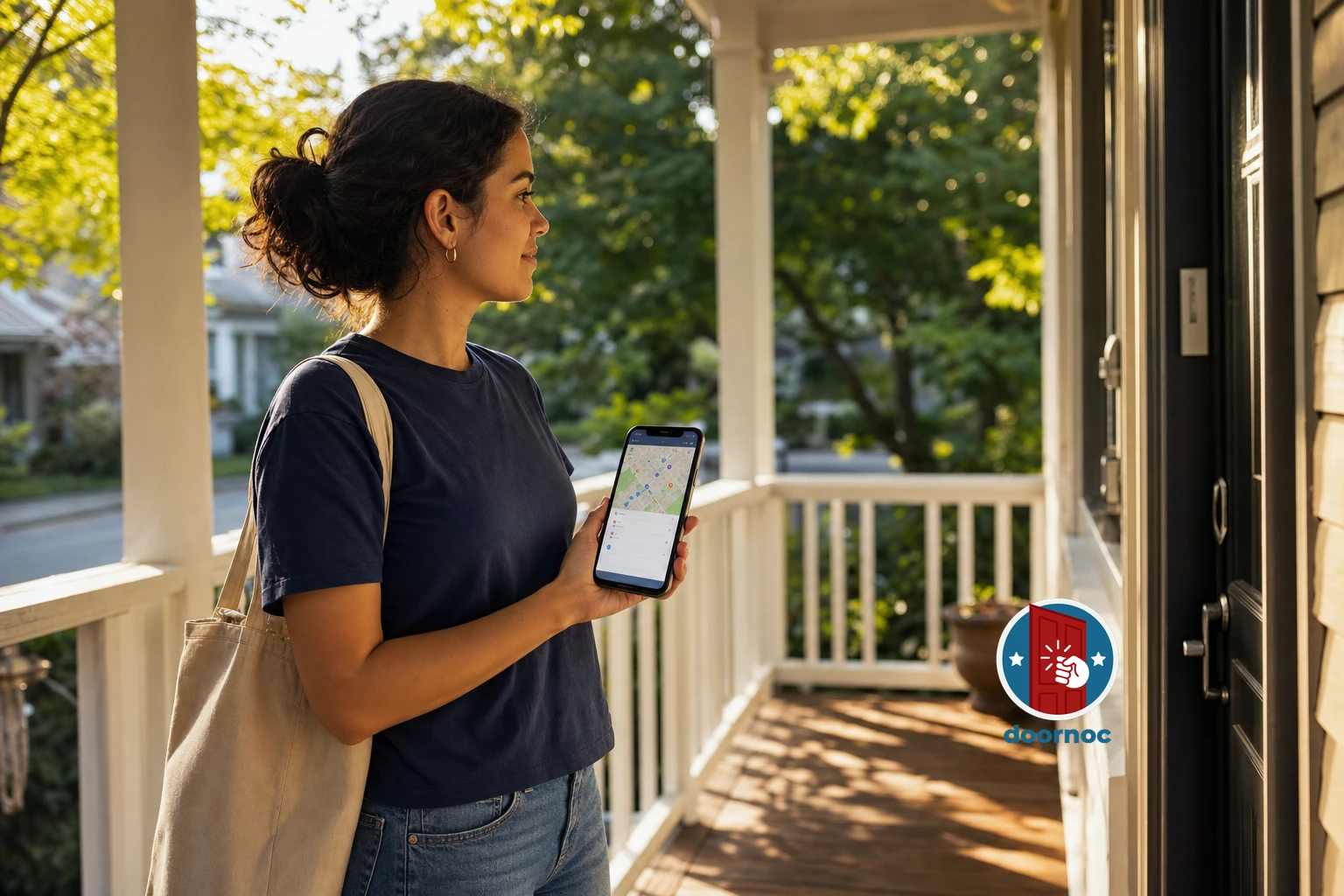
- Using mobile canvassing apps with real-time data syncing can improve contact rates by 25% compared to paper walk lists by enabling smarter route planning and callback scheduling.
- Multi-touch strategies that combine initial door knocks with 2-3 callback attempts increase overall voter contact rates from 25% to 48%.
How to increase voter contact rate canvassing is the most critical question facing field directors in competitive races. Your contact rate directly determines how many voters you reach, how many conversations you have, and ultimately, how many votes you win. The difference between a 25% contact rate and a 40% contact rate means reaching 60% more voters with the same volunteer hours — a game-changing advantage in close elections.
Voter contact rate refers to the percentage of targeted doors where your canvassers successfully speak with a voter. If your team knocks 100 doors and speaks with 30 voters, your contact rate is 30%. This metric matters more than doors knocked because conversations change minds, not door hangers. Nationally, campaigns average 20-30% contact rates, but top-performing operations achieve 40-50% by implementing systematic optimization strategies.
This guide provides 12 proven techniques to increase your voter contact rate, drawn from data across thousands of canvassing shifts. These aren’t theoretical best practices — they’re battle-tested strategies that win campaigns.
Why Your Voter Contact Rate Matters More Than Doors Knocked
Most campaigns obsess over doors knocked per hour, but this metric misleads. A volunteer who knocks 60 doors with a 20% contact rate (12 conversations) delivers less value than a volunteer who knocks 40 doors with a 40% contact rate (16 conversations). The quality metric — voter contact rate — determines field program effectiveness.
Low contact rates waste your most valuable campaign resources: volunteer time and voter patience. When canvassers knock doors with no one home, they burn through turf without generating persuasion opportunities. Worse, they leave door hangers that train voters to ignore future outreach. Multiple “missed you” hangers signal disorganization, not persistence.
High contact rates, conversely, multiply your field program’s impact. A campaign that improves contact rates from 25% to 40% effectively gains 60% more volunteer capacity without recruiting a single additional person. For a 100-volunteer operation, this equals 60 phantom volunteers working every shift. In close races, this advantage decides elections.
Contact rate also indicates operational health. Consistently low rates (below 20%) signal systemic problems: poor targeting, bad timing, inadequate training, or incorrect data. Tracking contact rates by turf, time slot, and volunteer reveals exactly where to optimize your program. Campaigns that monitor this metric daily improve faster than those that don’t.
What’s a Good Voter Contact Rate for Political Canvassing?
Before optimizing, you need benchmarks. Voter contact rates vary by several factors, but research across thousands of canvassing shifts reveals clear patterns:
Initial attempt contact rates:
- Strong performance: 35-45%
- Average performance: 25-35%
- Poor performance: Below 20%
Multi-touch contact rates (after 2-3 attempts):
- Strong performance: 50-60%
- Average performance: 40-50%
- Poor performance: Below 35%
These benchmarks assume proper timing (discussed below). Contact rates vary by demographic and geographic factors:
By age demographic:
- Voters 65+: 45-55% (home more frequently)
- Voters 45-64: 30-40% (moderate availability)
- Voters 18-44: 20-30% (away from home more often)
By housing type:
- Single-family homes: 30-40%
- Townhomes/duplexes: 25-35%
- Apartment buildings: 15-25% (access issues)
By geography:
- Suburban neighborhoods: 30-40%
- Urban areas: 20-30%
- Rural areas: 35-45% (but fewer doors per hour)
Understanding these baselines helps you set realistic goals and identify underperformance. A 25% contact rate in suburban single-family homes during prime evening hours indicates problems. The same rate in urban apartments during daytime hours may be acceptable.
1. Canvass During High-Contact Time Windows
Timing determines contact rate more than any other single factor. Knock doors when voters are home. This sounds obvious, but many campaigns send volunteers out at 2:00 PM on Tuesdays and wonder why contact rates languish at 15%.
Data from tens of thousands of canvassing shifts reveals clear high-contact windows:
Weekday optimal times:
- 5:00-8:00 PM: 40-50% contact rate (peak window)
- 4:00-5:00 PM: 30-40% contact rate (shoulder time)
- 12:00-2:00 PM: 15-25% contact rate (work hours)
Weekend optimal times:
- 10:00 AM-1:00 PM: 40-45% contact rate
- 1:00-4:00 PM: 35-45% contact rate
- 4:00-7:00 PM: 30-40% contact rate (errands, activities)
Avoid these windows:
- Before 10:00 AM any day: <15% contact rate (intrusive)
- After 8:00 PM any day: <12% contact rate (intrusive)
- 9:00 AM-4:00 PM weekdays: <20% contact rate (work hours)
The 5:00-8:00 PM weekday window delivers the highest contact rates because most voters have returned home from work but haven’t left for evening activities. This three-hour window should absorb 60-70% of your weekday canvassing capacity.
Weekends offer broader high-contact windows but lower peak rates. Voters are home more hours but also running errands, attending activities, and spending time with family. The 10:00 AM-1:00 PM Saturday window performs best because voters are awake, home, and relatively available.
Adjust timing by demographic. Neighborhoods with many voters 65+ yield better contact rates during 10:00 AM-4:00 PM weekdays (35-40%) because retirees maintain different schedules. Neighborhoods with many voters 18-44 require evening and weekend canvassing for acceptable contact rates.
For more guidance on optimizing canvassing schedules and field operations, see The Complete Guide to Political Canvassing in 2026.
2. Implement Systematic Callback Strategies
Most campaigns treat door knocking as single-touch: knock once, leave a piece of literature if no one answers, move on forever. This approach abandons 60-70% of voters who weren’t home during the initial attempt. Systematic callback strategies increase overall contact rates from 25% to 48%.
A callback strategy means planning 2-3 additional contact attempts at different times for high-value voters who weren’t home initially. This isn’t random persistence — it’s data-driven timing optimization.
Effective callback framework:
- Initial attempt: Canvass during your primary time window (typically 5:00-8:00 PM weekday)
- First callback: Return during a different time window (weekend morning or different weekday evening)
- Second callback: Return during a third distinct time window
- Third callback: Reserve for highest-priority voters only
Research shows that 35% of eventual contacts happen on the second attempt and 25% on the third attempt. Only 40% of voters are contacted on the first try. Campaigns that don’t implement callbacks miss 60% of their potential contacts.
Time callbacks strategically. If you knock Tuesday evening (5:00-8:00 PM) with no answer, the best callback windows are:
- Saturday 10:00 AM-1:00 PM (different day, different time)
- Thursday 5:00-8:00 PM (different day, same time)
- Sunday 2:00-5:00 PM (different day, different time)
Avoid consecutive-day callbacks to the same door. If no one answered Tuesday evening, don’t return Wednesday evening. They may work late regularly. Wait 3-5 days and try a completely different time window.
Mobile canvassing apps like Door Knock automate callback scheduling by marking doors “not home” and syncing them to future walk lists with optimal timing recommendations. This technology removes the manual tracking burden that causes most callback programs to fail.
3. Use Data-Driven Voter Targeting
Not all voters are home with equal frequency. Targeting voters with higher contact probability increases your baseline contact rate before you knock a single door.
Voter files contain multiple data points that predict contact likelihood:
High-contact probability indicators:
- Voters 65+ (home 65% of prime canvassing hours)
- Homeowners vs. renters (20% higher contact rates)
- Long-term residents (5+ years at address)
- Registered voters with consistent voting history
- Single-family homes vs. apartments
Low-contact probability indicators:
- Voters 18-34 (home 30% of prime canvassing hours)
- Recent movers (less than 1 year at address)
- Sporadic voting history
- Apartment buildings without buzzer access
- Gated communities with restricted access
Your voter file vendor can append contact probability scores based on these factors. Prioritize high-contact-probability voters during your canvassing efforts, especially when volunteer capacity is limited.
This doesn’t mean ignore young voters or renters. It means optimize turf assignment. Send your most experienced volunteers to high-contact-probability turf during prime hours. Assign lower-contact-probability turf to weekend daytime shifts when more people are home.
Data-driven targeting also means geographic optimization. Analyze your previous canvassing data to identify neighborhoods with historically high contact rates. These “hot zones” deserve repeated attention because they consistently deliver conversations.
Learn more about leveraging data effectively in How to Use Canvassing Data to Refine Your Campaign Message.
4. Optimize Walk List Quality and Accuracy
Your walk list quality directly impacts contact rates. Bad data sends volunteers to wrong addresses, vacant homes, and voters who moved years ago. Every dead-end wastes time that could generate real voter contacts.
Walk list optimization checklist:
- Scrub moved voters: Remove voters with NCOA (National Change of Address) flags
- Verify addresses: Cross-reference addresses with property records and USPS databases
- Remove duplicates: Eliminate multiple entries for same household
- Flag apartment buildings: Mark multi-unit buildings requiring buzzers
- Include phone numbers: Add verified phone numbers for callback attempts
- Add notes: Include previous contact history (spoke with, not interested, moved)
Poor walk list quality lowers contact rates in two ways. First, it sends volunteers to non-contactable addresses, burning time. Second, it frustrates volunteers who encounter multiple bad addresses, reducing their confidence and persistence.
Update walk lists weekly during active canvassing periods. Voters move constantly — especially younger voters and renters. A walk list accurate in September may be 15% inaccurate by November. This 15% inaccuracy can drop your contact rate from 35% to 30%, a meaningful operational decline.
Mobile canvassing apps solve this problem by enabling real-time feedback. When a volunteer marks an address as “moved” or “vacant,” that update immediately improves data quality for future shifts. Paper walk lists can’t match this dynamic accuracy.
5. Train Volunteers on Persistent Door Knocking Techniques
Many volunteers knock once, wait five seconds, and leave. This timid approach abandons 20-30% of potential contacts who were home but needed time to reach the door. Training volunteers on persistent (not aggressive) door knocking increases contact rates by 15-20%.
Persistent door knocking protocol:
- First knock: Knock firmly three times (not pounding, but audible throughout home)
- Wait 20 seconds: Give residents time to reach door from upstairs, basement, or backyard
- Second knock: Knock three times again, same firmness
- Wait 15 seconds: Final opportunity for response
- Leave literature: If no answer after 35 total seconds, leave door hanger and note time
Most volunteers wait only 5-10 seconds before leaving. This premature departure loses contacts with voters who were home but needed time to respond. Elderly voters move slower. Parents may be changing diapers. People in large homes may be far from the front door.
The 20-second first wait and 15-second second wait create a total 35-second window without seeming aggressive or impatient. Research shows this protocol captures an additional 15-20% of contacts compared to single-knock approaches.
Train volunteers to listen for signs of presence: TV noise, voices, footsteps. If you hear clear activity inside, wait longer. If the house seems silent, move on after the second knock.
Address volunteer concerns about “bothering people.” Emphasize that voters who support your candidate want to be contacted. Your campaign identified these voters through data analysis. Giving them multiple reasonable opportunities to answer isn’t harassment — it’s respect for their schedule variability.
For comprehensive volunteer training programs, review How to Train Volunteers for Door Knocking: Complete Program.
6. Deploy Mobile Canvassing Technology
Mobile canvassing apps increase contact rates by 20-25% compared to paper walk lists through multiple mechanisms: better routing, real-time data syncing, callback automation, and instant access to voter information.
Paper walk lists force volunteers to follow predetermined routes that may be outdated within hours. A paper list can’t tell you that four doors on your route were just contacted yesterday by another volunteer. A paper list can’t dynamically optimize your route based on real-time not-homes and callbacks.
Mobile canvassing apps solve these problems:
Routing optimization: Apps like Door Knock calculate the most efficient walking routes between doors, reducing dead time and increasing contact attempts per hour. Better routing means more doors, which means more contacts.
Real-time data syncing: When one volunteer marks a door “not home,” other volunteers see this immediately. No duplicate attempts on the same day. No wasted time at doors that were just tried.
Callback automation: Apps automatically generate callback lists with optimal timing recommendations. Doors marked “not home” Tuesday evening appear on Saturday morning walk lists without manual list building.
Instant voter information: Volunteers access full voter profiles instantly — voting history, issue priorities, household members, previous contact notes. This preparation increases conversation quality and contact conversion.
Offline functionality: Quality apps work without internet connectivity, syncing data when connection returns. This enables canvassing in rural areas and neighborhood dead zones without compromising data collection.
The efficiency gains from mobile canvassing apps compound. Ten percent better routing, ten percent fewer duplicate attempts, and five percent improved callback scheduling combine to deliver 25%+ contact rate improvements. For a campaign knocking 10,000 doors per week, this technology generates 1,000+ additional voter contacts weekly.
Paper walk lists had their era. In 2024 and beyond, they’re operational liabilities. Campaigns competing against mobile-equipped opponents operate with a 25% contact rate handicap.
Compare the trade-offs directly in Mobile Canvassing App vs Paper Walk Lists: Which Wins in 2024?.
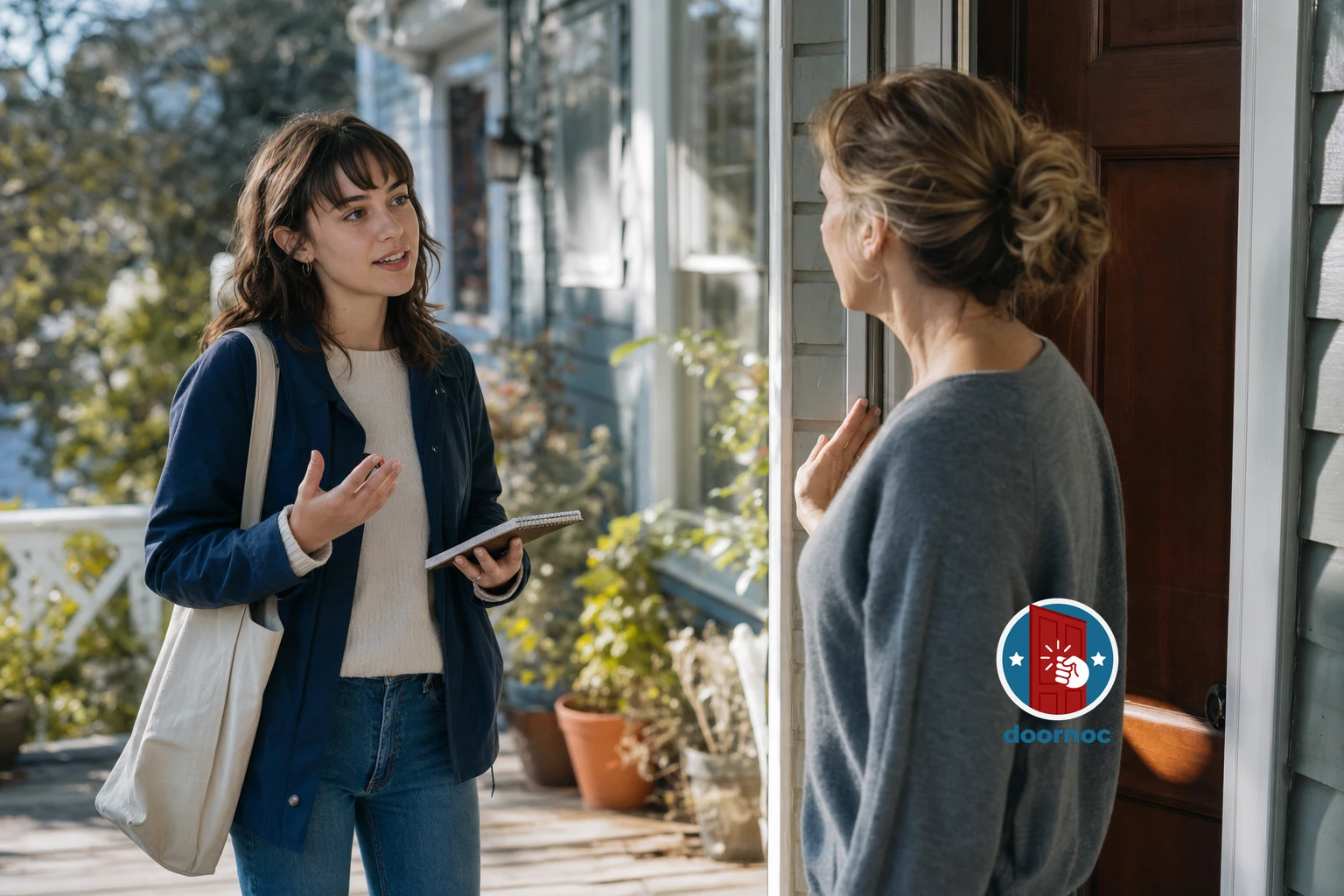
7. Perfect Your Opening Line and Approach
Once someone answers the door, your volunteer’s opening five seconds determine whether you get a conversation or a quick dismissal. A poor opener can drop contact quality rates (meaningful conversations vs. brief exchanges) by 30-40%.
Elements of an effective opening:
- Warm smile and eye contact: Non-verbal communication establishes trust before words
- Immediate identification: “Hi, I’m Sarah, volunteering with [Candidate Name]‘s campaign”
- Connection to voter: “We’re talking with voters in the neighborhood about [local issue]”
- Permission to proceed: “Do you have a couple minutes to chat?”
Ineffective openers to avoid:
- “Sorry to bother you…” (apologetic, assumes unwelcome)
- “Are you registered to vote?” (interrogative, no relationship building)
- “Can I ask you some questions?” (transactional, no value proposition)
- “I’m with [Candidate]‘s campaign” [launches into script without rapport]
The best openers establish shared community identity before discussing politics. “Hi, I’m your neighbor from two blocks over” performs better than “Hi, I’m a campaign volunteer.” Local volunteers knock their own neighborhoods more effectively than out-of-area volunteers.
After identification, immediately establish relevance: “We’re talking with folks about [specific local issue affecting this neighborhood].” This localization signals you understand their community, not just their vote.
The permission question — “Do you have a couple minutes?” — shows respect and increases conversation length. Voters who explicitly agree to talk stay engaged longer than voters who feel cornered. If they say “Not right now,” you can ask, “What time would be better?” and schedule a callback.
Train volunteers to adjust tone to match the voter. If the voter is formal, be professional. If the voter is casual, be conversational. Mirroring creates comfort and extends engagement.
For proven scripts and opening techniques, see The Art of the Perfect Door Knock Script.
8. Systematically Track and Analyze Contact Rate Data
You can’t improve what you don’t measure. Campaigns that track contact rates daily improve 40% faster than campaigns that check them weekly or monthly. Real-time data enables rapid optimization.
Essential contact rate metrics to track:
- Overall contact rate: Total contacts ÷ total doors attempted
- Contact rate by time slot: Morning, afternoon, evening, weekend rates
- Contact rate by turf: Geographic areas with high and low performance
- Contact rate by volunteer: Individual volunteer effectiveness
- Contact rate by attempt number: First attempt, second attempt, third attempt
- Contact rate trend over time: Week-over-week improvement or decline
How to calculate voter contact rate:
Voter contact rate = (Number of successful voter contacts ÷ Total doors attempted) × 100
Example: Your team knocks 150 doors and speaks with 42 voters. Contact rate = (42 ÷ 150) × 100 = 28%
Track this metric for every shift, every volunteer, and every turf. This granular tracking reveals exactly where problems exist and where optimization opportunities lie.
If your overall contact rate is 30% but your Tuesday evening rate is 40% and your Saturday afternoon rate is 20%, you know to shift more volunteer capacity to Tuesday evenings. If volunteer A consistently achieves 40% contact rates while volunteer B achieves 20%, you know A needs to train B.
Geographic tracking reveals high-value turf worth revisiting and low-value turf worth deprioritizing. If neighborhood X delivers 45% contact rates while neighborhood Y delivers 18%, you should canvass neighborhood X three times before returning to neighborhood Y once.
Mobile canvassing apps automatically calculate and visualize these metrics. Door Knock’s analytics dashboard shows real-time contact rates by all relevant dimensions without manual spreadsheet work. Paper-based programs require extensive manual data entry that delays insights by days or weeks.
Learn more about effective metrics in How to Track Canvassing Data Effectively: Metrics That Win.
9. Implement a Soft Knock Strategy for Apartment Buildings
Apartment buildings present unique canvassing challenges that destroy contact rates if handled poorly. Locked exterior doors, aggressive “No Soliciting” signs, and resident privacy concerns create access barriers. Campaigns that treat apartments like single-family homes achieve 10-15% contact rates instead of 25-30%.
Apartment canvassing optimization strategies:
Timing adjustment: Canvass apartments 30-45 minutes later than single-family homes. Residents arrive home, climb stairs, park, collect mail, and settle in later than single-family homeowners. The optimal apartment window is 5:30-8:30 PM weekdays, not 5:00-8:00 PM.
Access strategies:
- Call voters by phone before canvassing to schedule building entry
- Wait for residents entering/exiting to access locked buildings (respect privacy, don’t tailgate if asked not to)
- Focus on buildings with accessible exterior doors or intercom systems
- Partner with apartment-dwelling volunteers who can access their own buildings
Knock technique: Use a “soft knock” — knuckle tap instead of full-fist knock. Apartments have thinner doors and closer neighbors. Loud knocking disturbs multiple units and seems aggressive. A firm but gentle knock respects shared-wall living while remaining audible.
Literature strategy: If you can’t access building interior, leave door hangers on accessible exterior doors or mail literature to apartment voters. Don’t abandon apartment turf — adapt your approach.
Prioritization: Canvass easily-accessible apartments first (buildings with open exterior doors, ground-floor units). Save difficult-access apartments for callback attempts with scheduled phone coordination.
Apartment buildings will never match single-family home contact rates, but you can improve from 15% to 25-30% with proper technique. This improvement matters because urban campaigns often operate in heavily-apartment geographies.
10. Use Pre-Canvass Phone Banking to Schedule Contacts
The most sophisticated campaigns combine door knocking with phone banking in a coordinated “warm knock” strategy. Phone bankers call voters 24-48 hours before canvassers arrive, confirming someone will be home and interested in speaking. This hybrid approach increases contact rates from 30% to 55-60%.
Warm knock protocol:
-
Phone bank call (2 days before canvass): “Hi, I’m calling with [Candidate]‘s campaign. We’re having volunteers walk your neighborhood Thursday evening. Would you be available for a brief conversation if someone stops by?”
-
Record response: Mark which voters confirmed availability, which weren’t home, which declined
-
Prioritize confirmed voters: Build canvass walk lists prioritizing voters who said they’d be available
-
Knock with context: When the canvasser arrives, they say, “Hi, I’m Sarah with [Candidate]‘s campaign. We spoke with you on the phone Tuesday — thanks for making time to chat!”
This strategy works because it solves the fundamental door-knocking problem: timing mismatches. You’re not hoping someone is home — you’ve confirmed it. The voter expects you. They’ve already agreed to engage.
Voters who confirm availability show 80-90% contact rates (compared to 30% cold-door rates) and have longer, higher-quality conversations. They’ve psychologically committed to the interaction when they told the phone banker “yes.”
The phone banking investment pays off. Spending 2 hours calling 100 voters to schedule 40 conversations delivers better results than spending those same 2 hours cold-knocking 120 doors for 30 conversations. The scheduled conversations run longer and cover more substance.
This strategy requires coordination between phone and field teams. Mobile canvassing platforms with integrated campaign management tools make this coordination seamless by syncing phone banking results directly to walk lists.
11. Train Volunteers to Handle Common No-Answer Scenarios
Some “no answers” aren’t true no-answers — they’re ambiguous scenarios where proper technique converts non-contacts into contacts. Training volunteers to recognize and respond to these situations increases contact rates by 8-12%.
Scenario 1: Noise inside, no answer If you hear clear TV noise, conversation, or movement but no one answers after two knocks:
- Knock a third time, more firmly
- Step back from door slightly (visible through peephole but non-threatening)
- Wait 25 seconds (longer than standard)
- If still no answer, leave literature with note: “Sorry we missed you! We’ll try again Saturday morning.”
Some residents screen door knocks. A third knock signals persistence (not aggression). Stepping back reduces threat perception. Extended waiting allows residents to finish what they’re doing.
Scenario 2: Vehicle in driveway, no answer If fresh tire tracks suggest recent arrival or engine ticks indicate recent parking:
- Knock three times at standard intervals
- Check around home perimeter for backyard activity (call out “Hello, campaign volunteer here!”)
- Leave note: “Saw you might be home — we’ll stop back in 30 minutes” (then actually return)
Recent arrivals may be unloading groceries, using bathroom, or settling in. A 30-minute callback catches them after they’ve settled.
Scenario 3: Doorbell no-answer but clear occupancy signs If doorbell doesn’t work (broken doorbell is common):
- Knock firmly on door even after pressing doorbell
- Knock on door frame, not door (louder, more audible)
- Wait extended period (25 seconds)
Many doorbells don’t work. Residents accustomed to non-functioning doorbells may not respond to button-press. Always knock after doorbell.
Scenario 4: “Leave it on the porch” through closed door If resident yells instruction without opening door:
- Respond: “I’d love to hear your thoughts on [local issue] if you have just one minute!”
- Wait 10 seconds for reconsideration
- If door opens, great. If not, respect boundary: leave literature
Some residents reflexively dismiss door-knockers without considering what you want. A brief value proposition sometimes prompts reconsideration.
These scenarios account for 15-20% of door knocks. Converting even half through proper technique materially improves contact rates.
12. Optimize Route Planning for Maximum Contact Efficiency
How you sequence your doors impacts contact rates because timing matters at the individual-address level. A voter leaving for dinner at 6:15 PM is contactable at 6:10 PM and unreachable at 6:20 PM. Efficient routing gets you to more doors during their peak home windows.
Route planning principles for higher contact rates:
Cluster geographically: Knock all doors on one street before moving to next street. This minimizes walk time between doors and maximizes contact attempts per hour. More contact attempts = more contacts.
Start with highest-priority voters: Begin routes with your most important targets (likely persuadable, frequent voters, previous supporters). If you run short on time, you’ve contacted your key voters.
Plan “first knock” and “callback” routes separately: Don’t mix initial attempts with callbacks in the same route. This creates inefficient zigzagging. First-attempt routes cover new turf densely. Callback routes revisit scattered addresses.
Consider natural walking patterns: Route so you’re walking the same direction as most residents would drive home from work. This increases likelihood of catching people as they arrive. In most suburbs, this means working from main roads toward cul-de-sacs in early evening.
Account for sunset timing: In fall/winter, start routes at furthest point and work back toward lit areas as darkness falls. Volunteers maintain persistence longer in well-lit areas.
Avoid backtracking: Plan routes in logical loops or straight lines. Backtracking wastes volunteer energy and time. Tired volunteers rush later doors and achieve lower contact rates.
Manual route planning on paper maps is time-intensive and suboptimal. GPS-enabled mobile canvassing apps calculate mathematically optimal routes automatically. Door Knock’s route planning feature factors in door priority, previous contact history, and optimal sequencing to maximize contact efficiency.
Smart routing increases contact attempts per hour by 15-25%, which directly translates to 15-25% more contacts. For comprehensive route planning strategies, see Best Route Planning for Political Canvassing: Maximize Voter Contact.
Putting It All Together: The 40%+ Contact Rate System
Increasing voter contact rates isn’t about implementing one silver-bullet technique — it’s about systematically optimizing every element of your field operation. Campaigns that implement all 12 techniques achieve 40-50% contact rates consistently:
Foundation layer (Techniques 1-4):
- Canvass during optimal time windows (5:00-8:00 PM weekdays, 10:00 AM-4:00 PM weekends)
- Implement systematic 2-3 callback strategy for high-value voters
- Use data-driven targeting to prioritize high-contact-probability voters
- Maintain clean, accurate, frequently-updated walk lists
Execution layer (Techniques 5-8):
- Train volunteers on persistent (20+ second) door knocking protocol
- Deploy mobile canvassing technology for routing, callbacks, and data syncing
- Perfect volunteer opening lines and approach for maximum engagement
- Track contact rates daily by time, turf, and volunteer for rapid optimization
Advanced layer (Techniques 9-12):
- Adapt approach for apartment buildings with soft-knock strategy and timing shifts
- Use pre-canvass phone banking to schedule “warm knock” contacts
- Train volunteers to handle ambiguous no-answer scenarios effectively
- Optimize route planning for maximum contact efficiency
Start with the foundation layer. These four techniques deliver 60% of available contact rate improvements. A campaign that only implements optimal timing and callbacks will jump from 25% to 35% contact rates.
Add the execution layer next. These techniques refine your operation’s daily performance. Proper volunteer training and mobile technology add another 8-10 percentage points.
Finally, implement advanced techniques for the last 5-10 percentage point gain. These strategies matter most in ultra-competitive races where every additional voter contact influences outcomes.
The campaigns that consistently achieve 40%+ contact rates treat field operations as a science, not an art. They measure relentlessly, optimize continuously, and invest in technology that multiplies volunteer effectiveness. They understand that winning close races requires reaching more voters with the same resources — and contact rate optimization is how you do it.
For a complete operational framework, review How to Organize a Door-to-Door Canvassing Campaign: 7-Step Guide.
Start Increasing Your Contact Rates Today
How to increase voter contact rate canvassing comes down to systematic optimization across timing, technology, training, and targeting. Every campaign can implement these 12 techniques immediately — no additional budget required for most.
Begin by tracking your current contact rate. If you don’t know your baseline, you can’t measure improvement. Implement daily contact rate tracking across all shifts starting today.
Next, optimize timing. If you’re canvassing outside 5:00-8:00 PM weekday or 10:00 AM-4:00 PM weekend windows, you’re leaving 15-20 percentage points on the table. Shift volunteer capacity to high-contact windows immediately.
Then, implement callbacks. This single change converts your 25% contact rate to 40%+ within two weeks. Use mobile canvassing technology to automate the callback scheduling that makes this system sustainable.
Ready to implement these techniques with technology built for winning campaigns? Explore Door Knock’s features designed specifically to maximize voter contact rates, or contact our team to discuss how we can help your campaign reach more voters with the same resources. Every percentage point improvement in contact rate could be the margin of victory in your race.
Frequently Asked Questions
What is a good voter contact rate for door-to-door canvassing?
A good voter contact rate for door-to-door canvassing is 25-35% for initial attempts. Top-performing campaigns achieve 40-50% by optimizing timing, using data-driven targeting, and implementing systematic callback strategies. Contact rates vary by demographic, geography, and time of day.
What time of day has the highest voter contact rate?
The highest voter contact rates occur between 5:00-8:00 PM on weekdays (40-50% contact rate) and 10:00 AM-4:00 PM on weekends (35-45% contact rate). Avoid canvassing before 10:00 AM or after 8:00 PM, when contact rates drop below 15%.
How many times should you attempt to contact a voter?
You should attempt to contact high-priority voters 3-4 times across different days and times. Research shows that 60% of eventual contacts happen on the second or third attempt. Schedule callbacks strategically rather than attempting consecutive visits on the same day.
Do mobile canvassing apps really improve contact rates?
Yes, mobile canvassing apps improve contact rates by 20-25% compared to paper lists. They enable real-time data syncing, optimized routing, callback scheduling, and immediate access to voter information. Apps like Door Knock also track which doors to revisit and when, maximizing volunteer efficiency.
How do you calculate voter contact rate?
Voter contact rate is calculated by dividing the number of successful voter contacts by the total number of doors attempted, then multiplying by 100. For example: 40 contacts ÷ 150 doors attempted × 100 = 26.7% contact rate. Track this metric daily to identify improvement opportunities.