Key Takeaways
- Strategic route planning increases voter contact rates by 35-45% compared to random door knocking approaches
- Proper turf cutting (dividing canvassing territories) prevents volunteer overlap and ensures complete neighborhood coverage
- Optimized walking patterns reduce canvasser fatigue and increase productive hours by eliminating backtracking and inefficient movements
- Data-driven route planning using voter file prioritization helps campaigns focus resources on high-value targets and persuadable voters
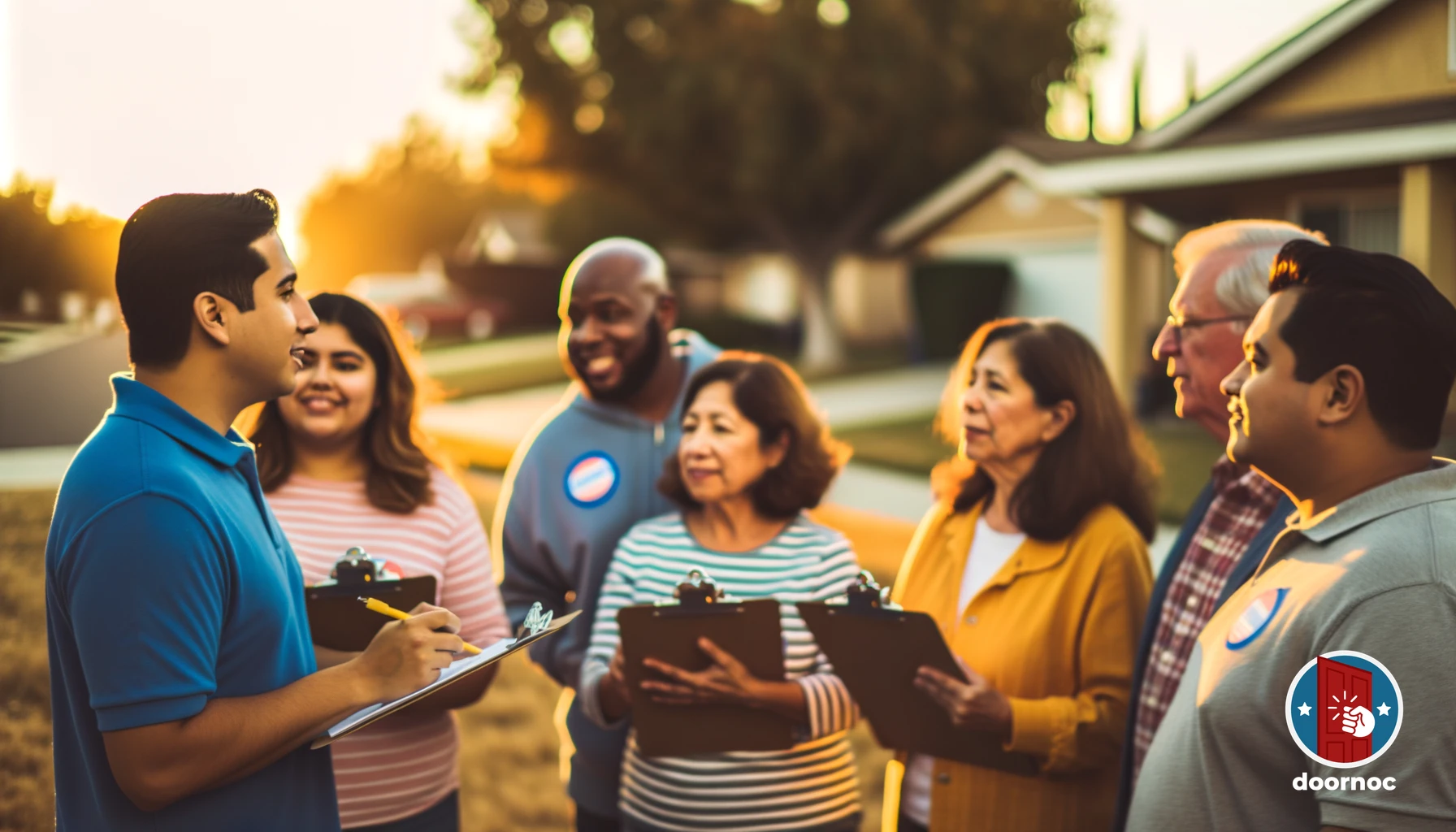
Campaign volunteers preparing for a door-to-door canvassing shift.

Effective canvassing requires proper training and team coordination.

Building genuine connections with voters at the doorstep.
Best route planning for political canvassing is the difference between a field program that struggles to reach voters and one that systematically contacts every persuadable household in your district. While passionate volunteers are essential, sending them out with poorly planned routes wastes 30-40% of their time on inefficient walking patterns, duplicate contacts, and coverage gaps.
What Is Canvassing Route Optimization?
Canvassing route optimization refers to the systematic planning of door-to-door paths that maximize voter contacts while minimizing wasted time and volunteer fatigue. It combines geographic analysis, voter file prioritization, and walking pattern design to create efficient territories (turfs) that volunteers can complete within a single shift.
Effective route optimization considers multiple factors: housing density, street layouts, voter priority scores, historical contact rates, and physical barriers like highways or parks. A well-optimized route allows canvassers to spend 85-90% of their time actually talking to voters rather than navigating between doors.
According to field operations data from competitive 2022 congressional races, campaigns using algorithmic route planning contacted 42% more voters per volunteer hour than campaigns relying on manual map divisions. This efficiency gain compounds over weeks of canvassing, potentially reaching thousands of additional persuadable voters in tight races.
Why Traditional Route Planning Fails Campaigns
Most campaigns approach route planning with outdated methods that create systematic inefficiencies. The most common mistake is the “grid approach” — simply dividing a map into equal-sized squares without considering actual housing density or voter distribution.
This creates turfs where one volunteer might have 200 target doors while another has only 75, leading to wasted capacity and volunteer frustration. Geographic barriers like golf courses, industrial zones, or bodies of water get ignored, forcing canvassers to walk unnecessarily long distances between actual neighborhoods.
Another critical failure point is ignoring voter file data during initial route design. Campaigns that cut turfs before filtering for priority voters waste significant time having volunteers knock on doors of voters who aren’t persuadable, aren’t likely to vote, or strongly support the opponent.
The backtracking problem compounds these issues. Volunteers without optimized routes frequently find themselves walking the same streets multiple times or making inefficient zigzag patterns that add 20-30 minutes of pure walking time to every shift. This physical fatigue reduces conversation quality and increases volunteer burnout.
The Hidden Cost of Poor Route Planning
Consider a 50-volunteer canvassing operation working three nights per week for eight weeks leading up to Election Day. If poor route planning costs each volunteer just 30 minutes of productive time per shift, the campaign loses 600 volunteer hours — equivalent to losing 12 full-time volunteers for the entire campaign.
Translated to voter contacts at an average rate of 40 doors per hour, those lost hours represent approximately 24,000 missed voter conversations. In a close race with 100,000 total voters, that inefficiency could literally determine the election outcome.
Strategic Turf Cutting: The Foundation of Efficient Canvassing
Turf cutting is the practice of dividing your overall canvassing area into manageable territories that individual volunteers can complete in a single shift. Strategic turf cutting balances several competing priorities: equitable workload distribution, geographic logic, voter priority concentration, and practical navigation.
Start by filtering your voter file to identify your actual target universe. This typically includes persuadable voters (moderates, undecideds, soft supporters), sporadic voters who need turnout encouragement, and sometimes strong supporters for volunteer recruitment. Excluding voters outside your target universe immediately makes routes 25-35% more efficient.
Next, consider the “door per hour” capacity in different neighborhood types. Dense urban apartment buildings might yield 80-100 doors per hour, suburban single-family neighborhoods 35-50 doors per hour, and rural areas only 15-25 doors per hour when accounting for driving time between properties.
The 150-Door Rule for Turf Sizing
A practical benchmark for suburban and mixed-density areas is the “150-door turf” — sized so an average volunteer can knock all target doors in a 3-4 hour evening shift. This assumes approximately 40-50 actual contacts per hour (accounting for no-answers, brief conversations, and walking between doors).
Urban turfs should contain more doors (200-300) because of higher density and contact rates, while rural turfs should contain fewer (50-100) because of greater distances and driving time. The goal is equalizing time investment, not door counts.
Always cut turfs along natural boundaries that volunteers can easily identify: major roads, school attendance zones, visible landmarks. Nothing frustrates canvassers more than turfs with arbitrary boundaries that split neighborhoods mid-block or require constant map checking to determine if a house is “in” or “out” of their territory.
The Serpentine Pattern: Most Efficient Walking Route
Once you’ve cut appropriate turfs, the walking pattern within each territory determines actual efficiency. The serpentine (or S-pattern) approach is consistently the most efficient for standard residential neighborhoods with houses on both sides of the street.
Start at one corner of your turf and work down one side of the first street, knocking every target door. At the end of the block, cross the street once and work back up the opposite side. This creates a continuous flowing pattern that eliminates redundant street crossings and provides natural progress tracking.
The serpentine pattern reduces unnecessary walking by 15-20% compared to zigzagging back and forth across streets after each door. It also reduces safety risks from repeated street crossings and makes it easier for volunteers to remember which doors they’ve already attempted.
Adapting Patterns for Different Housing Types
Urban high-rise buildings require a modified “floor-by-floor” pattern. Knock all target apartments on one floor before moving to the next, and plan your route to minimize elevator wait times by working buildings with fewer target units first during peak evening hours when elevators are busiest.
For cul-de-sac suburban developments, use a “loop” pattern where you work around the entire circular street in one direction, maintaining the same one-side-then-the-other principle. Don’t jump randomly between houses just because doors are close to each other — systematic patterns prevent accidental skips.
Rural areas require “cluster routing” where you identify groups of 3-8 houses that are walkable, drive to that cluster, complete it entirely, then drive to the next cluster. Plan these driving segments to minimize total mileage and avoid backtracking on the same rural roads.
Leveraging Data for Priority-Based Route Optimization
Sophisticated campaigns don’t just optimize for geographic efficiency — they optimize for voter value. Priority-based route planning ensures that high-value targets (strong persuasion targets, key demographic groups, high-turnout-propensity voters) get contacted first and most frequently.
Your voter file should include scores for multiple factors: persuadability (how likely a voter can be convinced), turnout propensity (how likely they’ll actually vote), and support level (current candidate preference). Combine these into a composite priority score that guides both initial turf cutting and daily canvassing order.
Create “A-priority” turfs composed almost entirely of high-value voters that you’ll canvass multiple times throughout the campaign. “B-priority” turfs contain moderate-value voters for single-contact universal coverage. This tiered approach ensures you’re maximizing persuasion opportunities rather than treating all doors equally.
The 60/40 Split Strategy
An effective resource allocation formula is the 60/40 split: dedicate 60% of your canvassing hours to repeated contacts with the highest-priority 25% of voters, and 40% of hours to broader coverage of remaining target universe. This concentrates effort on voters most likely to determine the election outcome.
Implement this by creating two rotation schedules. High-priority turfs get canvassed every 2-3 weeks, allowing for multiple conversations that build voter relationships and reinforce messaging. Lower-priority turfs get canvassed once for basic universal contact and name recognition.
Use your door knocking data to continuously refine priorities. Voters who engage positively should get elevated priority for follow-up contacts. Voters who definitively support your opponent or refuse to engage should be dropped from future routes to maximize efficiency.
Technology Solutions for Dynamic Route Optimization
While manual map planning can work for very small campaigns, modern field operations require technology to optimize routes at scale. Mobile-first platforms like Door Knock use algorithms that consider housing density, voter priorities, street networks, and volunteer starting locations to generate optimized routes automatically.
These systems solve the “traveling salesman problem” — finding the shortest path that visits all target locations — which is mathematically complex for routes with 100+ doors. What would take a human planner hours to approximate, route optimization software calculates in seconds with provably more efficient results.
Real-time route adjustment is another critical technology advantage. When volunteers complete their assigned turf faster than expected or when certain areas have unexpectedly low contact rates, smart systems can dynamically reassign nearby doors to prevent wasted capacity and ensure complete coverage.
Key Features for Route Planning Technology
Look for platforms that offer offline map access, so canvassers don’t need constant cellular connectivity to navigate routes. Rural areas and buildings with poor reception will still allow uninterrupted canvassing when maps are cached locally on the device.
Integration with voter file data is essential — your route planning tool should automatically filter and prioritize based on custom voter scores, demographic attributes, and past contact history. Manual data entry defeats the purpose of optimization.
Team coordination features prevent the common problem of duplicate coverage. If your Tuesday volunteer team partially completes a neighborhood, your Thursday team’s routes should automatically adjust to cover remaining uncontacted doors rather than starting the same area over.
The route optimization capabilities in modern canvassing platforms have been shown to increase contacts per hour by 35-40% compared to static paper maps, while also reducing volunteer navigation confusion and improving data quality through structured mobile data entry.
Weather and Daylight Optimization Strategies
Route planning must account for temporal factors that dramatically affect canvassing efficiency. Daylight hours constrain evening canvassing operations, with available time varying from 4.5 hours in winter months to 6+ hours in summer months for typical post-work volunteer shifts.
Plan evening routes to hit highest-priority doors during peak contact hours (5:30-7:30 PM when people are home but haven’t yet settled in for the night). Save lower-priority or difficult-to-access locations for early or late portions of shifts when contact rates naturally drop.
Weather forecasting should influence route assignments. On predicted rainy days, assign volunteers to neighborhoods with more covered porches, shorter walkways, and higher apartment concentrations. Save sprawling suburban developments with long driveway approaches for dry weather days.
Seasonal Route Adaptation
Winter campaigns face unique challenges: shorter daylight, icy sidewalks, and voters less willing to answer doors in cold weather. Compensate by creating tighter geographic clusters that minimize outdoor walking time, and prioritize neighborhoods with good sidewalk maintenance and street lighting.
During extremely hot summer months, plan routes with shade considerations. Neighborhoods with mature tree canopy allow for longer productive shifts than newly developed areas with no shade. Consider shifting start times earlier (4:00 PM instead of 5:00 PM) to avoid peak heat hours while still catching people home from work.
Holiday periods require special route adaptations. The week of Thanksgiving through New Year’s is typically low-contact-rate time when many voters travel. Rather than burning volunteer hours on low-yield canvassing, either pause field operations or create special “super-priority” micro-turfs targeting only the absolute highest-value voters who remain local.
Managing Multi-Day Campaign Route Progressions
Efficient campaigns think beyond individual shift planning to optimize route sequencing across the entire campaign timeline. The goal is systematic coverage that prevents gaps while allowing for strategic repeated contacts with priority voters.
Create a master progression plan that divides your full canvass universe into weekly blocks. Week 1 covers priority area A, Week 2 covers priority area B, etc., with the full cycle repeating every 3-4 weeks for multiple contacts. This creates predictable volunteer assignments while ensuring no neighborhoods get neglected.
Color-code your campaign map to track completion status: white for not yet canvassed, yellow for partial coverage, green for complete first-round coverage, blue for second-round coverage. This visual tracking makes it immediately obvious where you have coverage gaps requiring attention.
The 80% Rule for Route Completion
Don’t let perfection be the enemy of good. The “80% rule” states that once you’ve contacted 80% of target doors in a turf, move on to fresh territory rather than endlessly chasing difficult-to-reach voters. That final 20% requires disproportionate effort for diminishing returns.
Track individual door attempt history to identify chronic no-contacts — voters who are never home during typical canvassing hours. After three unsuccessful attempts, flag these voters for alternative contact methods (phone calls, targeted mail) rather than continued door knocking that wastes volunteer time.
Your campaign integrations should sync door knock attempts with your broader voter contact program, so other teams know which voters have been unreachable through field contacts and can adjust accordingly.
Training Volunteers for Route Discipline
Even perfectly optimized routes fail if volunteers don’t follow them consistently. Volunteer training must emphasize route discipline as a campaign priority, not an optional suggestion. Explain that deviating from assigned routes creates coverage gaps, duplicate contacts, and data quality problems that undermine the entire field program.
Provide clear written and visual route instructions. A good route packet includes a printed map with the walking pattern clearly marked, a list of target addresses in recommended knock order, and any special instructions about building access codes or neighborhood characteristics.
Role-play scenarios where volunteers feel tempted to deviate from routes — seeing a neighbor’s house not on their list, wanting to skip a house with a candidate yard sign, or choosing to jump streets because weather is bad. Reinforce that route discipline serves strategic goals beyond individual volunteer preference.
Real-Time Route Monitoring and Feedback
Use mobile check-ins to monitor whether volunteers are following assigned routes in real-time. If a volunteer has been in the same location for an unusually long time, a field manager can send a supportive check-in message asking if they need help or have questions.
End-of-shift debriefs should include route completion review. Did the volunteer finish their full assignment? If not, was it because the route was incorrectly sized, because contact rates were higher than expected (a good problem), or because the volunteer got off track? This feedback loop continuously improves your route planning accuracy.
Recognize and celebrate volunteers who demonstrate excellent route discipline. Public acknowledgment during team meetings of “most efficient canvasser” based on contacts-per-hour metrics creates positive peer pressure and reinforces that following optimized routes is valued behavior.
For comprehensive guidance on volunteer management, see our post on building and motivating your volunteer canvassing team.
Advanced Optimization: A/B Testing Route Strategies
Sophisticated campaigns treat route optimization as an ongoing experimental process rather than a one-time planning exercise. A/B testing different route strategies provides empirical data about what works best in your specific context.
Assign comparable turfs to different routing approaches and track results rigorously. For example, test serpentine pattern vs. clustered-door pattern in similar suburban neighborhoods, measuring contacts per hour, volunteer satisfaction, and conversation quality scores.
Test priority-based vs. geography-based turf cutting by creating matched pairs of neighborhoods with similar voter profiles. Route half using strict priority-score ordering (even if it means slightly less efficient walking patterns) and half using pure geographic optimization. Compare which approach yields better persuasion results and voter commitment rates.
Key Metrics for Route Optimization Testing
Track contacts per volunteer hour as your primary efficiency metric, but don’t ignore secondary factors like volunteer fatigue scores, data quality ratings, and volunteer retention between shifts. A route that generates slightly higher door contacts but exhausts volunteers might hurt long-term campaign capacity.
Measure “quality contact” rates — doors where you had meaningful conversations versus quick brush-offs or no-answers. Some routing strategies might generate high door knock numbers but lower actual conversation rates if they push volunteers through neighborhoods at times when residents aren’t available.
Monitor your campaign data analytics to understand how different routing approaches correlate with voter persuasion and turnout outcomes. The ultimate test isn’t efficiency metrics but electoral results.
Integration with Broader Field Strategy
Route planning doesn’t exist in isolation — it must integrate seamlessly with your broader field strategy, including phone banking, voter registration drives, and event-based voter contact. Optimize your canvassing routes to complement rather than duplicate other contact efforts.
Exclude voters from canvassing routes if they’ve already been successfully contacted through other channels within the past week. Someone who had a good phone conversation with your campaign doesn’t need a door knock three days later — reallocate that route capacity to voters you haven’t yet reached.
Coordinate canvassing routes with literature drops, yard sign placements, and volunteer recruitment goals. A well-planned route might include both voter persuasion contacts and identification of strong supporters willing to display yard signs or host small events.
Multi-Channel Routing Optimization
Create “hybrid routes” in areas where voter contact is consistently difficult through door knocking. These routes combine attempted door knocks with immediate follow-up actions: leaving targeted literature if no one answers, collecting cell phone numbers for text banking, or noting household characteristics for future targeting.
Use canvassing route data to optimize digital advertising geo-targeting. Neighborhoods where you’re actively canvassing should receive coordinated digital ads that reinforce your door knocking messages. This multi-touch approach increases overall persuasion effectiveness.
For additional strategies on connecting field data with campaign messaging, read our guide on using canvassing data to refine your campaign message.
Rural and Low-Density Routing Challenges
Rural campaigns face unique route optimization challenges that require different strategies than suburban or urban operations. The fundamental problem is geographic dispersion — target voters might be spread across dozens of miles with low housing density making walking routes impractical.
Implement “driving routes” where volunteers use vehicles to move between small clusters of homes rather than attempting to walk long rural roads. Plan these routes to minimize total mileage while hitting all target households, essentially creating a delivery route rather than a walking route.
Prioritize even more aggressively in rural settings. The high time cost of reaching each door means you can’t afford to visit lower-priority voters. Focus rural canvassing on absolute top-tier targets: highly persuadable voters, key demographic groups, or supporters who can become local influencers.
The Cluster Identification Method
Use mapping software to identify “clusters” of 3-5 target houses within a quarter-mile radius. These become your basic routing units. Plan routes that connect clusters with minimal backtracking, treating the spaces between clusters as pure driving transitions.
Rural routes should be sized based on time rather than door count. A 3-hour rural shift might cover only 40-60 doors compared to 120-180 in suburban areas, and that’s acceptable — you’re optimizing for the geographic reality of your district.
Consider recruiting rural volunteers who already live in target areas, reducing drive time overhead. A volunteer who lives in a rural district and can canvass their immediate neighborhood is far more efficient than sending urban volunteers on hour-long drives to cover sparse rural territory.
Learn more about adapting canvassing strategies to different environments in The Complete Guide to Political Canvassing in 2026.
Measuring and Improving Route Performance
Continuous measurement is essential for route optimization improvement. Establish clear metrics and tracking systems that capture both efficiency data and outcome data from every canvassing shift.
Track contacts per hour for each volunteer on each shift, broken down by turf and time of day. This granular data reveals patterns: perhaps certain neighborhoods have better evening contact rates, or certain volunteers are consistently more efficient regardless of route assignment.
Measure route completion rates. What percentage of assigned doors does the average volunteer actually knock? Low completion rates might indicate oversized turfs, difficult routes, or volunteer motivation issues. Adjust future routes based on realistic completion expectations.
Dashboard Metrics for Field Directors
Create a field director dashboard tracking: total doors knocked per day, average contacts per volunteer hour, turf completion percentage, geographic coverage heat map, and volunteer participation rates. Review these daily during active campaign phases.
Compare projected vs. actual contact rates for different turf types. If your route planning assumed 45 contacts per hour in a neighborhood but actual data shows only 32, adjust future route sizing for similar areas. This calibration process makes your planning progressively more accurate.
Implement weekly route optimization reviews where field staff analyze the past week’s data and adjust the coming week’s routes accordingly. This agile approach prevents repeated mistakes and quickly identifies successful tactics worth replicating.
Modern canvassing platforms provide these analytics automatically, eliminating manual spreadsheet compilation and making data-driven optimization accessible even for under-resourced campaigns.
Common Route Planning Mistakes to Avoid
Even experienced campaigns make predictable route planning errors that undermine efficiency. The “coverage fallacy” is treating all neighborhoods as equally important simply because they’re in your district. Not all turf deserves equal canvassing attention — ruthlessly prioritize based on persuadable voter concentration.
The “map bias” error involves cutting turfs that look balanced on a map but ignore actual walking reality. A turf split by a highway overpass might appear compact but require a 15-minute detour to actually cross between sections. Always walk-test or drive-test proposed routes before deploying volunteers.
Ignoring historical data from previous campaigns is a costly mistake. If your party’s past canvassing showed certain neighborhoods have 75% no-contact rates during evening hours, don’t keep sending volunteers there at the same times. Adapt based on learned patterns.
The Over-Optimization Trap
Paradoxically, excessive route complexity can reduce efficiency. A route that requires volunteers to constantly check their phones for next-door guidance or make complicated routing decisions creates cognitive overhead that slows down actual door knocking.
Strive for “simple enough to remember” route designs where volunteers can internalize the basic pattern (work down this street, turn left, work back up next street) without constant navigation reference. Intuitive routes reduce mistakes and decision fatigue.
Don’t sacrifice strategic voter targeting for marginal geographic efficiency gains. If contacting an important voter cluster requires slightly inefficient routing, accept that tradeoff — electoral outcomes matter more than theoretical efficiency perfection.
For foundational canvassing principles, review our 10 Best Practices for Effective Door-to-Door Canvassing.
Building Your Route Planning Workflow
Establish a consistent weekly workflow for route planning that ensures nothing falls through the cracks. Assign specific responsibility for route creation — typically your field director or a dedicated field organizer — with clear deadlines and quality standards.
Monday: Review previous week’s canvassing data and adjust priority scores in voter file based on contact outcomes.
Tuesday: Generate optimized routes for the coming weekend and evening shifts, taking into account volunteer availability, weather forecasts, and campaign priority areas.
Wednesday: Field managers review and approve routes, checking for obvious errors or strategic misalignments.
Thursday: Routes distributed to volunteers via email or app, with check-in calls to volunteers who have questions or need training refreshers.
Friday-Sunday: Execute canvassing with real-time monitoring and same-day data review to catch issues immediately.
Route Planning Checklist
Before finalizing any route, verify: (1) All target doors are actually accessible and not behind gates/private roads. (2) Route size matches volunteer skill level and available time. (3) Priority voters are front-loaded in route order. (4) Walking pattern follows efficient serpentine or logical loop. (5) Natural start and end points are clearly marked. (6) Special instructions for unusual buildings or access considerations are noted.
Maintain a route library of previously successful turfs that can be quickly redeployed with updated voter data. Don’t reinvent routing geometry every week — retain what works and iterate incrementally.
For step-by-step implementation guidance, see How to Organize a Door-to-Door Canvassing Campaign: 7-Step Guide.
Conclusion: Route Planning as Competitive Advantage
In close elections, superior route planning is a genuine competitive advantage that translates directly into more voter contacts, better volunteer retention, and ultimately more votes. Campaigns that treat route optimization as a core strategic competency rather than an administrative task consistently outperform in field operations.
The difference between mediocre and excellent route planning is approximately 30-40% more voter contacts with the same volunteer resources. Over a multi-month campaign, that efficiency gain compounds into thousands of additional conversations that can swing close races.
Invest in the tools, training, and analytical processes necessary for sophisticated route optimization. Whether you use purpose-built canvassing software like Door Knock, adapt existing mapping tools, or develop custom solutions, prioritize this capability as essential campaign infrastructure.
Remember that route planning serves your ultimate goal: persuading and turning out voters to win elections. Stay focused on outcomes, measure relentlessly, adapt continuously, and leverage technology to scale what works. The campaigns that master route optimization are the campaigns that maximize their field program impact and give themselves the best chance at victory.
Ready to transform your field operations with intelligent route optimization? Contact our team to learn how Door Knock can help your campaign knock more doors, reach more voters, and win your election.
Frequently Asked Questions
What is the most efficient route pattern for door-to-door canvassing?
The most efficient pattern is the “serpentine” or “S-pattern” approach, where canvassers work one side of the street completely before crossing to work back down the other side. This eliminates unnecessary street crossings and reduces walking time by approximately 15-20% compared to zigzag patterns.
How many doors should a canvasser knock in one shift?
An experienced canvasser typically contacts 30-50 doors per hour in suburban areas, or 60-100 per hour in dense urban settings. A standard 4-hour shift should yield 120-200 meaningful voter contacts in moderate-density neighborhoods, though actual numbers vary based on terrain, voter availability, and conversation length.
What is turf cutting and why does it matter for campaigns?
Turf cutting is the strategic division of canvassing territories into manageable sections assigned to individual volunteers or teams. It matters because proper turf cutting prevents duplicate door knocks, ensures complete coverage of target areas, and allows campaign managers to track progress and accountability across different neighborhoods.
Should campaigns prioritize clustering doors or spreading out geographically?
Campaigns should prioritize clustering high-priority doors within walkable geographic areas. This “density-first” approach maximizes contacts per hour while minimizing travel time. Spreading out only makes sense when high-value targets are genuinely sparse, or when building coalition presence across diverse communities is strategically important.
How do you optimize canvassing routes in rural areas with spread-out housing?
In rural areas, optimize by using driving routes between clusters of 3-5 homes, planning circuits that minimize backtracking, and leveraging map data to identify actual housing density versus empty land. Consider hybrid approaches where canvassers drive to neighborhood clusters rather than attempting to walk long rural roads with sparse housing.