
Key Takeaways
- Successful campaign strategies in 2026 combine data-driven voter targeting with authentic grassroots engagement, creating measurable pathways to victory rather than relying on broad messaging alone.
- The most effective campaigns allocate 60-70% of resources to direct voter contact through canvassing and personalized outreach, which generates 3-5x higher persuasion rates than digital advertising.
- Modern campaign strategies require integrated technology platforms that connect field operations, volunteer management, and real-time data analytics to optimize resource deployment throughout the race.
- Winning campaigns build coalition strategies that expand beyond base voters, identifying and systematically converting persuadable voters through repeated, personalized contact over 8-12 week periods.
Campaign strategies are the systematic plans that transform political aspirations into electoral victories. In 2026, winning campaigns don’t rely on hope or broad messaging—they build measurable pathways to victory through data-driven voter targeting, disciplined field operations, and authentic grassroots engagement that converts undecided voters into supporters and supporters into voters.
The campaigns that win in 2026 understand a fundamental truth: elections are won through thousands of individual voter conversations, not through advertising volume alone. While digital marketing plays a supporting role, the most effective political campaign strategies allocate the majority of resources to direct voter contact, where persuasion rates are 3-5 times higher than any other method.
What Makes a Campaign Strategy Effective in 2026?
Effective campaign strategies in 2026 share three core characteristics that separate winning campaigns from those that fall short. First, they’re built on accurate voter data that identifies exactly who needs to be contacted, when, and with what message. Second, they create systematic processes for volunteer recruitment, training, and deployment that scale grassroots energy into measurable results. Third, they integrate technology platforms that connect field operations with real-time analytics, allowing campaigns to adapt strategies daily based on actual voter contact data.
The most successful campaigns start with a clear theory of victory—a data-backed calculation showing exactly how many voters must be persuaded or mobilized to win. In a typical competitive race, this means identifying 15,000-25,000 persuadable voters in key precincts, then building a contact plan that reaches each voter 4-6 times through different methods over 8-12 weeks. This isn’t guesswork; it’s mathematical.
According to 2026 campaign performance data, races that implement systematic voter contact programs win 73% of the time when they hit their contact goals, compared to just 31% for campaigns relying primarily on advertising. The difference isn’t luck—it’s strategy.
The Data Foundation: Voter Targeting That Wins
Every winning campaign strategy begins with voter data analysis. Modern campaigns use voter files containing 150-200 data points per registered voter, including voting history, demographic information, consumer data, and predictive modeling scores. The goal isn’t to contact everyone—it’s to identify the specific voters who will determine the outcome.
Successful campaigns segment voters into four categories: base supporters (who need mobilization), persuadable voters (who need convincing), opposition voters (who should be ignored), and unlikely voters (who require too many resources). The most effective strategies focus 70-80% of resources on persuadable voters and base mobilization, rather than wasting time on opposition voters or those unlikely to participate.
In practice, this means using voter data filtering strategies to create targeted walk lists for canvassers. A field organizer in a competitive state legislative race might identify 8,000 persuadable voters across 12 precincts, then build a 10-week contact plan that reaches each voter through canvassing, phone calls, and digital ads. This targeted approach generates persuasion rates of 8-12%, compared to 2-3% for broad-based messaging.
The Field Operations Engine: Converting Strategy into Votes
Data analysis means nothing without execution. The most critical component of any winning campaign strategy is a disciplined field operation that converts plans into actual voter conversations. In 2026, the campaigns that win are those that can recruit, train, and deploy volunteers to knock 200-300 doors per day per team, maintain 60%+ volunteer retention rates, and track every conversation in real-time.
Field operations require three elements to succeed: clear targeting (knowing which doors to knock), efficient logistics (getting volunteers to the right places), and systematic follow-up (ensuring quality conversations happen and data gets recorded). Campaigns that excel at all three typically achieve contact rates of 65-75%, meaning they successfully speak with someone at 7 out of 10 targeted doors.
The cost per vote analysis shows that door-to-door canvassing generates votes at $15-25 per vote in competitive races, compared to $35-60 for digital advertising and $45-80 for direct mail. This 2-3x cost advantage makes field operations the foundation of winning strategies, with other tactics playing supporting roles.
How to Build a Winning Campaign Strategy: The 8-Step Framework
Building a campaign strategy that wins requires systematic planning, not improvisation. Here’s the framework that successful campaigns use in 2026:
1. Define Your Victory Number
Start by calculating exactly how many votes you need to win. In a local race, this might be 5,000 votes. In a competitive state legislative district, it could be 25,000. Once you know your number, work backwards: if you expect 40% turnout and need to win by 3 points, you need to persuade approximately 12,000 voters and mobilize 8,000 base supporters.
This math drives everything else. Your victory number determines how many volunteers you need (typically 1 volunteer per 100 target voters), how much money you must raise (usually $3-8 per target voter for competitive races), and how much time you have (working backwards from Election Day).
2. Analyze Your Voter Universe
Use voter file data to segment your entire district into the four categories mentioned earlier. In a typical competitive race, you’ll find that 30-35% are base supporters, 25-30% are persuadable, 30-35% are opposition, and 10-15% are unlikely to vote. Your strategy focuses on the first two groups.
The most sophisticated campaigns use predictive modeling to score every voter on two dimensions: support probability and turnout probability. A voter with high support/high turnout gets mobilization contacts. A voter with medium support/medium turnout gets persuasion contacts. A voter with low support gets ignored, regardless of turnout probability.
3. Build Your Contact Plan
Once you know who to contact, determine how to reach them. Research consistently shows that voters need 4-6 contacts to be effectively persuaded, with contacts spread across different methods (canvassing, phone calls, digital ads, direct mail). Your contact plan should specify exactly when each voter receives each type of contact.
A typical 10-week contact plan for a persuadable voter might include: Week 1 (canvassing introduction), Week 3 (phone call follow-up), Week 5 (canvassing issue conversation), Week 7 (digital ad retargeting), Week 9 (canvassing GOTV ask), Week 10 (phone call GOTV reminder). This systematic approach generates persuasion rates 3-4x higher than random or sporadic contact.
4. Recruit and Train Your Volunteer Army
Your strategy is only as good as your ability to execute it. Winning campaigns recruit volunteers at a ratio of 1 active volunteer per 100 target voters. For a race targeting 15,000 voters, that means recruiting 150 active volunteers who will each knock 100-150 doors over the course of the campaign.
Volunteer recruitment follows its own strategy: early volunteers (12+ months out) come from personal networks and activist communities, mid-campaign volunteers (6-8 months) come from events and earned media, and late volunteers (final 8 weeks) come from supporter mobilization and viral growth. The most effective campaigns use relational organizing, where each volunteer recruits 3-5 friends, creating exponential growth.
Training matters enormously. Campaigns that invest 2-3 hours in volunteer training achieve persuasion rates 40-50% higher than those that send untrained volunteers to doors. Training should cover: how to use canvassing software, how to have persuasive conversations (not just read scripts), how to handle objections, and how to record data accurately.
5. Deploy Technology That Scales Your Operation
Modern campaign strategies require integrated technology platforms that connect voter data, field operations, and real-time analytics. The campaigns that win in 2026 use mobile-first tools that work offline, sync data automatically, and provide instant feedback to field directors.
A field organizer managing 30 volunteers across 5 precincts needs to know: which doors have been knocked, which voters have been contacted, what issues they care about, and which volunteers are hitting their goals. This requires door-to-door canvassing software that tracks every conversation, maps optimal routes, and generates real-time reports.
Door Knock provides exactly this functionality, allowing campaign managers to assign territories, track completion rates, and adjust targeting daily based on actual contact data. When a volunteer knocks a door and has a conversation, that data immediately updates the voter file, triggering follow-up contacts and removing that voter from future canvassing lists. This real-time integration prevents duplicate contacts and ensures resources flow to high-value targets.
6. Implement Your Messaging Strategy
Your campaign message must be consistent across all voter contacts, but tailored to different audiences. Winning campaigns develop 3-4 core messages that resonate with different voter segments, then train volunteers to deliver the right message to the right voter.
For example, a persuadable suburban voter concerned about education might hear about your plan to increase teacher pay and reduce class sizes, while a rural voter worried about the economy hears about your support for small businesses and infrastructure investment. The candidate’s core values remain consistent, but the emphasis shifts based on voter priorities.
The most effective campaigns test messages through small-scale canvassing experiments before scaling them district-wide. A campaign might test three different messages with 500 voters each, measure persuasion rates, then deploy the winning message to the remaining 10,000 persuadable voters. This data-driven approach eliminates guesswork.
7. Monitor Progress and Adjust Daily
Campaign strategies aren’t static—they require constant adjustment based on real-world results. Winning campaigns hold daily check-ins during the final 8 weeks, reviewing contact rates, persuasion rates, volunteer retention, and resource deployment. If a precinct is underperforming, resources shift. If a message isn’t resonating, it changes.
The key metrics to monitor daily include: doors knocked per volunteer per shift (target: 30-40), contact rate (target: 65-75%), persuasion rate among contacted voters (target: 8-12%), and volunteer retention week-over-week (target: 60%+). When these metrics drop, investigate immediately and adjust.
Modern canvassing apps make this monitoring effortless. A field director can log into a dashboard at 8pm and see exactly how many doors were knocked that day, which volunteers hit their goals, and which precincts are ahead or behind schedule. This real-time visibility allows for rapid course correction.
8. Execute Your GOTV Plan
The final 72 hours of any campaign require a different strategy: pure mobilization. Your persuasion work is done; now you focus exclusively on ensuring identified supporters actually vote. This means multiple contacts per voter: door knocks, phone calls, text messages, and on Election Day, rides to the polls.
Successful GOTV operations contact each identified supporter 3-5 times in the final 72 hours, with the final contact happening on Election Day itself. Campaigns that execute disciplined GOTV programs typically increase turnout among identified supporters by 8-12 percentage points—often the margin of victory in competitive races.
The Resource Allocation Framework: Where to Invest Your Budget
One of the most critical strategic decisions any campaign makes is how to allocate limited resources across different tactics. The campaigns that win in 2026 follow a proven resource allocation framework based on cost-per-vote data and persuasion effectiveness.
For a competitive race with a $200,000 budget, the optimal allocation typically looks like this: 60-65% to field operations (canvassing, phone banking, volunteer management), 20-25% to digital advertising (targeted social media, programmatic display, video), 10-15% to direct mail (targeted to high-propensity voters), and 5% to traditional media (if the media market is affordable).
This allocation reflects the persuasion effectiveness of each tactic. Door-to-door canvassing generates persuasion rates of 8-12% at a cost of $15-25 per vote. Phone banking achieves 4-6% persuasion at $20-30 per vote. Digital advertising reaches 2-3% persuasion at $35-60 per vote. Direct mail generates 1-2% persuasion at $45-80 per vote. The math is clear: invest where persuasion rates are highest.
Many campaigns make the mistake of over-investing in digital advertising because it’s easier to execute than field operations. Building a volunteer army requires recruiting, training, managing, and motivating hundreds of people—much harder than buying Facebook ads. But the campaigns that win do the hard work, because that’s where votes are won.
Coalition Building: Expanding Beyond Your Base
No campaign wins by mobilizing base voters alone. Winning strategies require building coalitions that expand beyond your natural supporters to include persuadable voters, soft partisans, and issue-focused constituencies. This coalition-building work must be intentional and systematic.
Successful coalition strategies identify 4-6 key constituencies whose combined support creates a winning majority, then develop targeted outreach plans for each group. A campaign might build a coalition of: progressive activists (15% of the electorate), suburban moderates (20%), young voters (12%), working-class voters (18%), and minority communities (25%). Each group requires different messages, different messengers, and different contact methods.
The most effective coalition-building happens through trusted messengers within each community. Rather than having the candidate speak to every group, winning campaigns recruit community leaders who can vouch for the candidate within their networks. A union leader speaking to union members, a pastor speaking to their congregation, a small business owner speaking to the chamber of commerce—these trusted voices generate persuasion rates 2-3x higher than candidate contact alone.
For practical implementation, review our guide on running a political campaign, which covers coalition building in detail.
The Digital Integration Strategy: Online Meets Offline
While field operations drive persuasion, digital tools amplify and support grassroots work. The most effective campaign strategies in 2026 integrate digital and field operations so they reinforce each other, rather than operating in silos.
This integration works in both directions. First, digital advertising retargets voters who have been contacted by canvassers, reinforcing messages and increasing recall. A voter who has a 5-minute conversation with a canvasser, then sees the candidate’s ad on Facebook the next day, is 40-50% more likely to remember the conversation and be persuaded.
Second, field operations collect data that improves digital targeting. When a canvasser records that a voter is undecided but cares deeply about healthcare, that voter enters a digital retargeting pool that receives healthcare-focused ads. This data feedback loop makes both tactics more effective.
Our comprehensive political digital marketing guide explains how to build these integrated systems, connecting CRM platforms, ad targeting tools, and field apps into a unified operation.
Swing Voter Strategy: Converting the Persuadables
In competitive races, swing voters determine outcomes. These persuadable voters—typically 20-30% of the electorate—require a different strategic approach than base mobilization. Winning campaigns identify swing voters early, contact them repeatedly with tailored messages, and track their movement toward support.
The most effective swing voter strategies use predictive modeling to identify persuadables, then segment them by issue priority. Some swing voters care primarily about the economy, others about education, still others about healthcare or public safety. Rather than delivering generic messages, winning campaigns deliver issue-specific messages matched to each voter’s priorities.
This requires sophisticated data infrastructure. A campaign might score 15,000 swing voters on their likelihood to support the candidate (1-100 scale), then prioritize the 8,000 voters scoring 40-60 (truly undecided) for intensive persuasion contact. These voters receive 5-7 contacts over 10 weeks, with each contact reinforcing issue messages that resonate with their specific concerns.
For detailed methods on identifying and targeting swing voters, see our guide on swing voter identification.
The Fundraising-Strategy Connection: Fueling Your Operation
Campaign strategies require resources to execute. The most successful campaigns integrate fundraising directly into their strategic planning, ensuring that resource needs drive fundraising goals rather than the reverse. If your field plan requires 50 paid organizers for 12 weeks, your fundraising must generate $300,000-400,000 for staff costs alone.
Winning campaigns build fundraising timelines that align with strategic needs. Early money (12-18 months out) funds staff hiring and infrastructure. Mid-campaign fundraising (6-8 months) pays for field operations scaling. Late money (final 8 weeks) funds GOTV and advertising. This phased approach ensures resources arrive when they’re needed most.
The most effective fundraising strategies leverage grassroots donors rather than relying solely on large contributions. Campaigns that build donor bases of 1,000-2,000 small-dollar contributors ($25-100 each) create sustainable funding that scales with strategic needs. These donors can be re-solicited multiple times, generating $50,000-150,000 over the course of a campaign.
For proven fundraising tactics that fuel winning strategies, review our guides on political fundraising ideas and grassroots fundraising.
Common Strategic Mistakes That Lose Campaigns
Even experienced campaigns make strategic errors that cost them victories. Understanding these mistakes helps you avoid them:
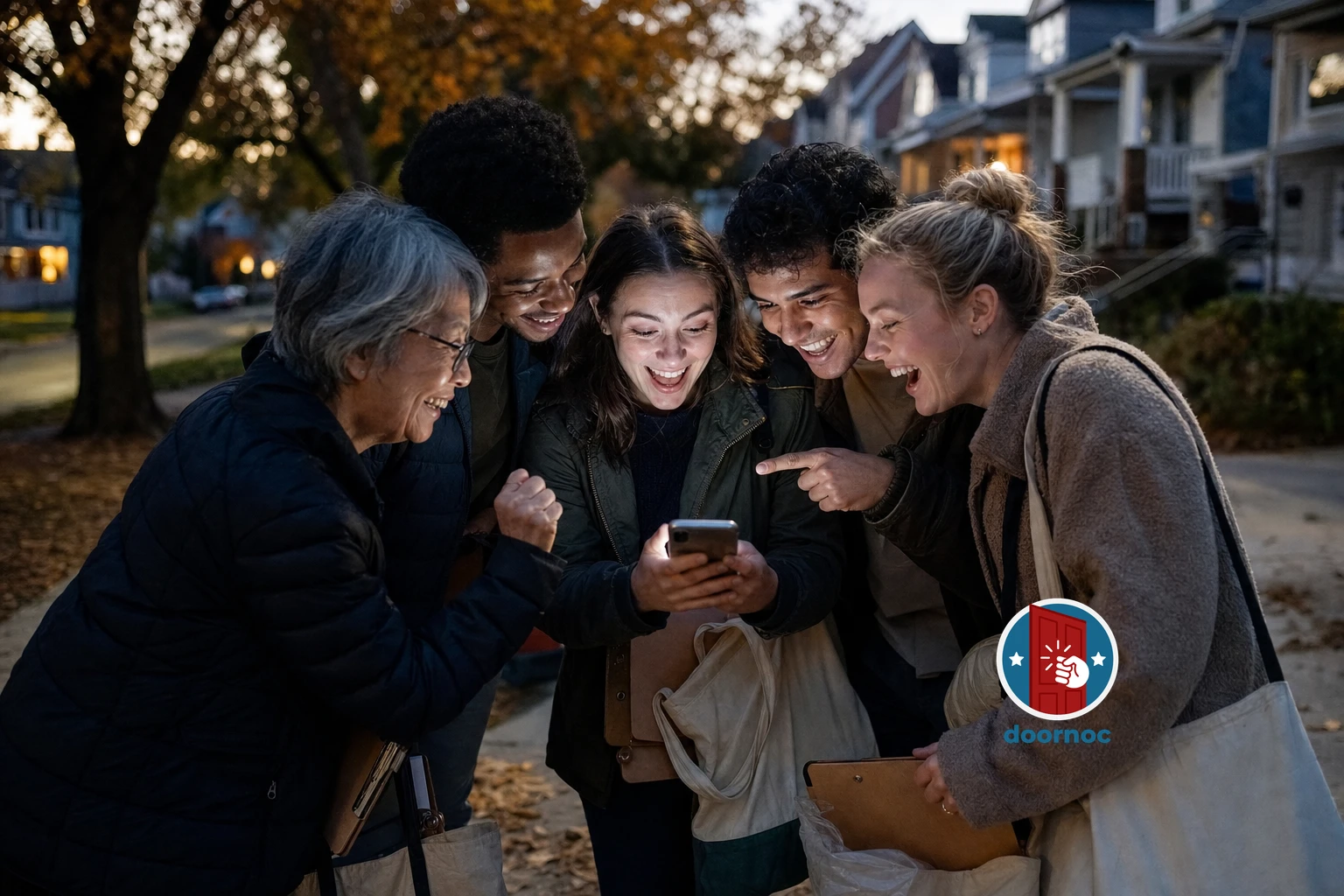 Volunteers huddle around smartphone in residential street at dusk, faces lit by screen glow showing campaign completion data.
Mistake 1: Starting Too Late. Campaigns that begin serious organizing 12-16 weeks before Election Day rarely have time to build the volunteer infrastructure needed to win. Successful campaigns start 12-18 months early for major races, 6-9 months for local races.
Mistake 2: Ignoring Data. Campaigns that rely on intuition rather than voter file analysis waste enormous resources contacting opposition voters or unlikely voters. Every door knock should be data-driven, targeting voters who can actually be persuaded or mobilized.
Mistake 3: Over-Investing in Advertising. Digital ads and direct mail play supporting roles, not starring roles. Campaigns that allocate 60%+ of budgets to advertising typically lose to campaigns that invest in field operations, because persuasion rates are 3-5x higher for direct contact.
Mistake 4: Neglecting Volunteer Management. Recruiting volunteers is pointless if you can’t retain them. Campaigns that fail to provide clear roles, meaningful work, and regular appreciation see 70-80% volunteer attrition, destroying their field capacity.
Mistake 5: Inconsistent Messaging. Campaigns that change messages weekly confuse voters and waste previous persuasion work. Successful campaigns test messages early, commit to core themes, and repeat them consistently across all voter contacts.
Mistake 6: Poor Technology Integration. Campaigns using paper walk lists and manual data entry in 2026 operate at a massive disadvantage. Modern campaigns require integrated platforms that sync data in real-time, preventing duplicate contacts and enabling rapid strategy adjustments.
Technology as a Force Multiplier: The Door Knock Advantage
The difference between a good campaign strategy and a winning campaign strategy often comes down to execution technology. Campaigns that equip volunteers with modern tools complete 30-40% more voter contacts per shift, maintain better data quality, and adjust strategies faster based on real-time results.
Door Knock serves as the operational backbone for winning field strategies. The platform connects voter targeting, route optimization, offline canvassing, and real-time analytics in a single mobile-first application. A volunteer can start their shift, receive an optimized walk list of 40 doors, knock those doors while offline, record detailed voter responses, and sync data when back online—all without paper lists or manual data entry.
For campaign managers, this means real-time visibility into field operations. You can see which precincts are ahead or behind schedule, which volunteers are hitting their goals, and which voters have been contacted—all updating live as volunteers knock doors. This visibility enables rapid resource redeployment: if Precinct 12 is falling behind, you can reassign volunteers from completed precincts to ensure coverage.
The platform’s team management features allow you to recruit volunteers, assign territories, track performance, and communicate with your team—all from a single dashboard. This integrated approach eliminates the coordination chaos that plagues campaigns using disconnected tools for voter data, volunteer management, and field tracking.
To see how Door Knock can transform your campaign’s field operations, explore the features that winning campaigns rely on.
Adapting Strategies Mid-Campaign: The Agile Approach
No campaign strategy survives first contact with voters unchanged. The campaigns that win are those that monitor results constantly and adjust tactics based on real-world performance. This requires building flexibility into your strategic planning from the start.
Successful campaigns establish clear decision points throughout the race—moments when you evaluate performance and make strategic adjustments. These might occur monthly in the early campaign, weekly during the persuasion phase, and daily during GOTV. At each decision point, you ask: Are we hitting our contact goals? Are our persuasion rates meeting targets? Do we need to reallocate resources?
The most common mid-campaign adjustments include: shifting volunteers from completed precincts to behind-schedule areas, reallocating budget from underperforming digital ads to field operations, adjusting messaging based on voter response data, and expanding or contracting the persuadable voter universe based on actual persuasion rates.
This agile approach requires two things: accurate real-time data and a culture that values adaptation over rigid planning. Campaigns that track every voter contact and sync data in real-time can make informed adjustments. Campaigns that wait until Election Day to evaluate results have no opportunity to course-correct.
Local vs. Statewide Strategy: Scaling Your Approach
Campaign strategies must scale appropriately to the race you’re running. A city council campaign targeting 5,000 voters requires different tactics than a statewide race targeting 2 million voters. Understanding these differences prevents strategic mismatches.
Local campaigns (city council, school board, state legislature) should invest 70-80% of resources in direct voter contact through canvassing and phone banking. These races have small enough voter universes that you can personally contact most persuadable voters multiple times. The winning strategy is simple: identify your 3,000-8,000 target voters, contact each one 4-6 times, and ensure your supporters vote.
Statewide campaigns (governor, U.S. Senate) require more sophisticated strategies that blend mass media, digital advertising, and targeted field operations. You can’t knock every door in a state, so you focus field operations on high-value precincts while using media to reach voters statewide. The optimal allocation for statewide races typically includes 40-50% field operations, 30-40% media and digital, and 10-20% direct mail.
For insights on state-specific strategies, see our guide on Florida voter outreach, which demonstrates how to adapt national strategies to state-level dynamics.
The Final Week: GOTV Strategy That Wins Close Races
The final week of any campaign requires a complete strategic shift from persuasion to mobilization. Your goal is no longer to convince undecided voters—it’s to ensure every identified supporter actually votes. This GOTV (Get Out The Vote) phase determines outcomes in close races.
Successful GOTV strategies focus exclusively on identified supporters: voters who have told your campaign they support you, or who score 80+ on support modeling. These voters receive multiple contacts in the final 72 hours: door knocks, phone calls, text messages, and on Election Day itself, rides to the polls if needed.
The contact sequence typically looks like this: 5 days out (canvassing reminder to vote), 3 days out (phone call confirming vote plan), 1 day out (text message with polling location), Election Day morning (door knock or phone call), Election Day afternoon (follow-up contact if they haven’t voted yet). This systematic approach increases turnout among identified supporters by 8-12 percentage points.
GOTV operations require massive volunteer mobilization—often 3-5x the volunteers you had during persuasion phase. Winning campaigns recruit GOTV-specific volunteers who can only commit to the final weekend, creating a surge capacity that allows for multiple contacts per voter.
Building Your Campaign Strategy: Next Steps
Developing a winning campaign strategy requires systematic planning, disciplined execution, and constant adaptation. The campaigns that win in 2026 are those that start early, invest in data and technology, build volunteer infrastructure, and maintain focus on direct voter contact.
Your next steps should include: analyzing your voter file to identify your target universe, calculating your victory number and working backwards to determine resource needs, building a contact plan that reaches each target voter 4-6 times, recruiting and training volunteers to execute your field plan, and implementing technology platforms that enable real-time tracking and adjustment.
The difference between a campaign that falls short and one that wins often comes down to execution discipline. Having a brilliant strategy means nothing if you can’t recruit volunteers, knock doors, and track results. The campaigns that win are those that do the unglamorous work of building systems, managing people, and maintaining focus on the fundamentals.
If you’re ready to build a winning campaign strategy, start by exploring the tools that make execution possible. Check out Door Knock’s pricing plans to find the right solution for your campaign size, or contact our team to discuss your specific strategic needs. For more strategic insights, read more on our blog where we regularly publish data-driven campaign tactics.
Remember: campaign strategies don’t win elections. People do. Your job as a campaign strategist is to build systems that empower those people to have thousands of persuasive conversations, mobilize supporters, and turn your theory of victory into actual votes. The campaigns that master this execution win. Those that don’t, lose. It’s that simple.
For additional tactical ideas to complement your strategic framework, review our collection of 50 election campaign ideas that winning campaigns use to engage voters and build momentum.
Frequently Asked Questions
What are the most effective campaign strategies for winning elections in 2026?
The most effective campaign strategies in 2026 combine data-driven voter targeting with high-touch grassroots engagement. Successful campaigns allocate 60-70% of resources to direct voter contact through door-to-door canvassing, personalized phone banking, and relational organizing. They use voter file data to identify persuadable voters and mobilize supporters through systematic, repeated contact rather than broad-based advertising.
How much should a campaign budget for field operations versus digital advertising?
Winning campaigns in 2026 typically allocate 60-70% of their budget to field operations and direct voter contact, with 20-30% for digital advertising and 10% for traditional media. Research shows that door-to-door canvassing generates a cost-per-vote of $15-25, compared to $35-60 for digital advertising, making field operations the most cost-effective persuasion method for most races.
What is the ideal timeline for implementing campaign strategies?
Effective campaign strategies require 12-18 months of planning for major races, with voter contact programs launching 8-12 weeks before Election Day. Early organizing (12+ months out) focuses on coalition building and volunteer recruitment, mid-campaign (6-8 months) emphasizes persuasion of swing voters, and the final 8-12 weeks concentrate on high-frequency contact with identified supporters and persuadable voters.
How do you measure the effectiveness of different campaign strategies?
Modern campaigns measure strategy effectiveness through cost-per-contact metrics, persuasion rates (typically 8-12% for quality canvassing), and volunteer retention rates (targeting 60%+ monthly retention). The most important metric is cost-per-vote, which should be tracked separately for each voter contact method—canvassing, phone banking, digital ads, and direct mail—to optimize resource allocation throughout the campaign.
What role does technology play in modern campaign strategies?
Technology platforms are essential for executing winning campaign strategies in 2026, connecting voter data, field operations, and volunteer management in real-time. Mobile canvassing apps, integrated CRM systems, and analytics dashboards allow campaigns to track contact rates, adjust targeting daily, and deploy resources to high-value precincts. The most effective campaigns use technology to enhance—not replace—human contact and relationship building.