


Can a school board member promise to fix a classroom problem if that member has no authority to direct the teacher? That question exposes the distinction residents and first-time candidates most need to understand: public influence isn’t the same as legal authority.
So, what do school board members do? They make collective decisions about district priorities, public money, policy, and leadership. Understanding where those decisions end and school administration begins helps residents seek action through the right channel and helps candidates assess the job realistically.
Core Duties of a School Board at a Glance
A board’s duties cover districtwide decisions, while individual members contribute through discussion, questions, and votes.
| Duty | What the board decides | Who carries it out |
|---|---|---|
| Budget approval | Adopts the annual budget and local tax rate where authorized | Superintendent administers the budget |
| Superintendent | Hires and evaluates the superintendent | Superintendent manages other district staff |
| Policy | Adopts policies governing district operations | Superintendent implements the policies |
| Curriculum and goals | Approves curriculum and sets educational goals | Staff design and deliver instruction |
| Employment contracts | Approves employment contracts | Superintendent and HR staff manage hiring |
| Labor negotiations | Sets the board’s position in negotiations | Negotiating team and administrators conduct negotiations |
| Community communication | Explains district decisions to residents | Board members and district communications staff |
| Facilities and resources | Sets expectations for buildings, staffing, and resources | Superintendent and facilities staff manage operations |
The New Jersey School Boards Association’s membership guidance describes members as policymakers and overseers, with responsibilities that include curriculum approval, employment contracts, budget adoption, and superintendent evaluation. In practice, the board sets districtwide expectations and reviews results; administrators organize the work needed to meet them.
For example, the board can adopt a safety-audit expectation for school buildings and request a written report on completion. District staff then conduct the audits and report their findings. If the audit identifies equipment that needs to be collected from several locations, staff handle the logistics, such as how to plan multi-location recall collections.
A useful self-check for residents is to review local meeting agendas. Repeated discussion of learning goals, budget performance, policy, and leadership points to governance work. An individual member can raise questions and propose action, while formal districtwide decisions are made by the board through its established process.
Why Boards Govern Instead of Running Schools
A school board acts through collective decisions. Authority belongs to the board acting together in a legally convened meeting. One member can raise concerns and advocate for action, but cannot direct district employees or commit the board alone.
Chicago Public Schools’ bylaws state that an individual member has no separate legal authority. The board is not bound by that member’s statements unless the member is acting under official board instructions.
Where each request should go
| Request type | Appropriate channel | What one member can do |
|---|---|---|
| Complaint about a teacher or principal | Superintendent and staff chain of command | Listen, seek an appropriate status update, and refer the concern |
| New or changed policy | Board agenda and a majority vote | Propose an agenda item and cast a vote |
| Question about spending | Budget documents and public meetings | Request financial reports through board procedures |
| Building repair or safety issue | Superintendent and facilities staff | Ask for a written report and timeline |
| Curriculum change | Staff recommendation, then a board vote | Raise the issue for public discussion |
The distinction is between starting a conversation and making a decision. A member can listen, identify recurring concerns, request information through established channels, and advocate for an agenda item. The board decides policy and other matters within its authority through its meeting process; members should not promise an outcome before that decision.
Residents exploring how to get politically involved can begin by learning which channel handles a concern. Directing an issue to the right place gives the authorized person or body a chance to respond, though it cannot guarantee a particular result.
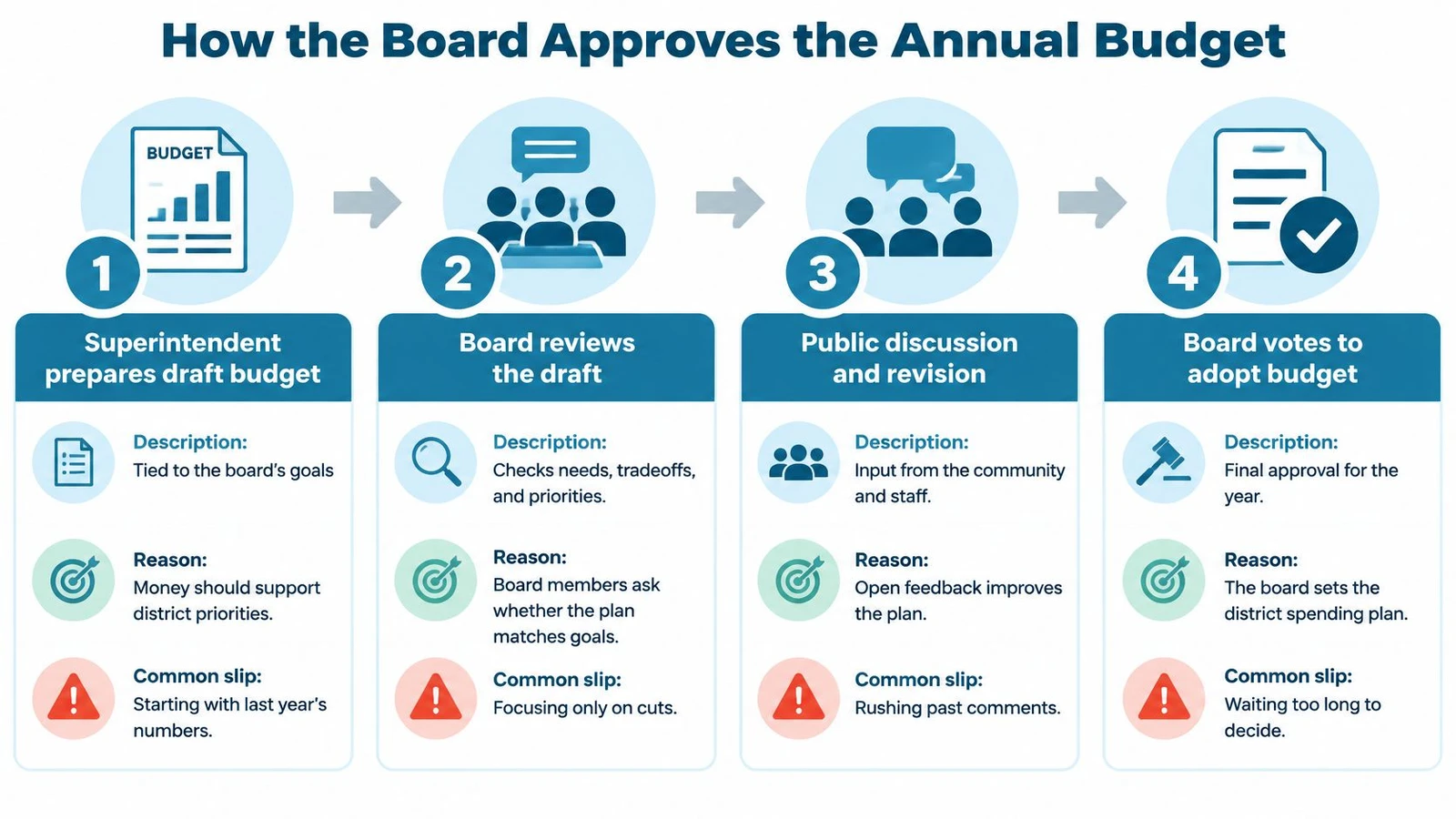
How the Board Approves the Annual Budget
Budget approval connects educational priorities to actual spending. The Texas Education Agency’s explanation of school boards identifies annual budget and local tax-rate approval among board responsibilities, while distinguishing oversight from daily administration.
A practical budget review sequence
-
Prepare a goal-linked draft. The superintendent develops a spending proposal tied to board priorities. Carrying forward last year’s line items can preserve spending without examining whether it still meets student needs.
-
Examine the assumptions. Staff brief members on revenue, enrollment, staffing, and capital needs during work sessions. Members shouldn’t encounter the essential numbers for the first time at the adoption vote.
-
Review tradeoffs publicly. Members question proposed spending and request revisions through the board’s process. For added classroom capacity, Pacific Mobile Structures, Inc.’s guide to budgeting for modular classroom installation offers context for examining installation-related scope rather than considering the classroom structure alone.
-
Hear from residents. The board holds the applicable public hearing on the proposed budget and local tax rate where it has that authority. Treating comments as a formality misses an opportunity to identify overlooked needs.
-
Adopt the spending plan. Members vote on the budget, including amendments considered through the required process. Unresolved assumptions shouldn’t remain hidden behind an approval motion.
-
Monitor actual spending. Periodic reports should compare expenditures with the adopted budget and explain significant differences. Approval without follow-up leaves members unable to judge whether resources supported the intended goals.
Alabama’s school-board governance statute illustrates the connection by requiring operating budgets aligned with board objectives and monitoring through data review. Reviewing financial documents is oversight, not an instruction to staff about every purchase; state law determines the applicable deadlines and hearing rules.
A useful financial report answers both questions: Was the money spent as authorized, and did the spending support the board’s priorities?
Hiring and Evaluating the Superintendent
- Agree on measurable goals. At the start of the contract, establish expectations such as stronger reading proficiency, improved graduation outcomes, or a balanced budget.
- Require written progress reports. Reports should connect evidence to agreed goals rather than list activities alone.
- Schedule the evaluation. Follow the process established by state law, the contract, and district policy, including applicable confidentiality requirements.
- Document feedback and contract decisions. Record the board’s assessment and address renewal, compensation, or improvement expectations through the authorized process.
- Communicate the outcome appropriately. Announce public actions without disclosing protected personnel information.
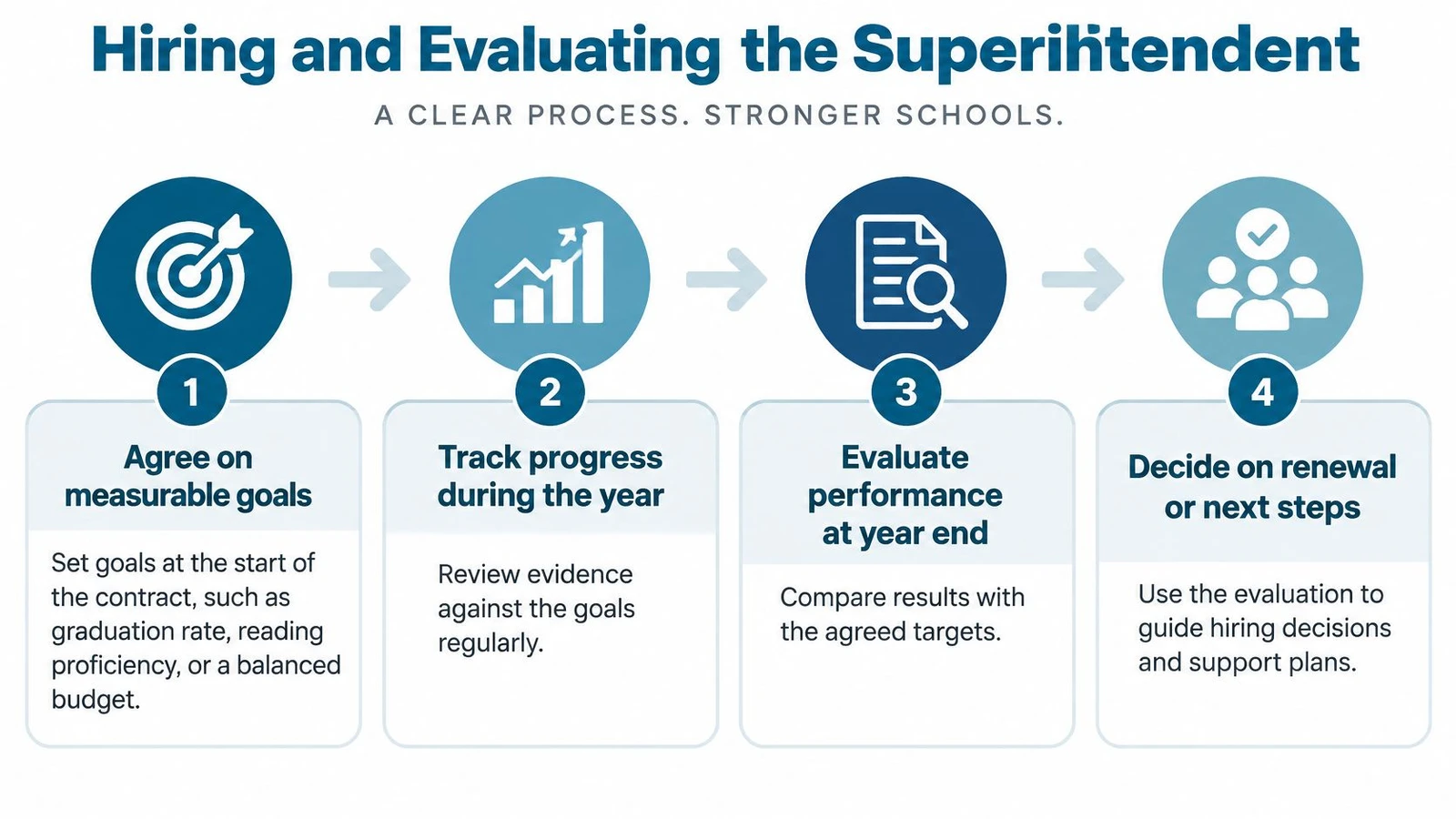
The National School Boards Association’s governance resources place hiring and evaluating the superintendent with the board, while assigning district administration and staff supervision to the superintendent. Hiring therefore requires agreement about the leadership the district needs, not merely agreement about a preferred applicant.
The evaluation tests results against goals. A member who calls a principal to reverse a hiring decision has stepped outside that responsibility.
A useful boundary test
Consider a discussion about persistent staff vacancies. Setting a districtwide retention goal belongs at board level; deciding which applicant receives a particular classroom assignment belongs within administration.
Residents can apply that test to recent meeting discussions. Was the board establishing an outcome and examining evidence, or attempting to make the superintendent’s operational choices?
Setting Policy and Holding Open Meetings
Policy is the district’s rulebook. It covers expectations for employees, curriculum, student conduct, budgets, and other major decisions.
The board writes the rulebook and the superintendent referees the game. Members shouldn’t blow the whistle on individual plays.

From proposal to binding policy
A typical policy proposal moves from introduction to public discussion, revision, and adoption by the required vote. Some districts use an initial reading followed by adoption at a later meeting; local rules determine whether that sequence is required.
After adoption, the superintendent translates the policy into administrative procedures. For example, a cybersecurity policy might establish expectations for incident reporting and protecting district information, while technology staff decide how to carry them out. Nutmeg Technologies’ explanation of how major malware types differ can help members understand terminology without turning a policy discussion into technical management.
The North Carolina School Boards Association’s new-member handbook states that no individual member, committee, or group may act for the board without majority authorization. It also explains that official meetings must comply with applicable open-meetings and public-records laws.
Public process is part of the decision
In practice, residents should look for posted agendas, recorded votes, accessible minutes, and deliberation conducted through lawful meetings. Private emails or texts among a majority shouldn’t become a substitute for public deliberation.
Closed sessions aren’t a general permission to avoid scrutiny. Notice requirements, permitted closed-session subjects, and policy-reading procedures differ by jurisdiction, so local bylaws and state law control.
Resident check: A clear decision record identifies what the board approved, how members voted, and who is responsible for implementation.
How Much Time the Role Takes and Why It Varies
How many hours should a school board member set aside each month? The answer depends on the district and the work on its calendar. Meetings are only one part of the commitment; members also prepare, communicate with residents, and follow up on board decisions.
Board workload by survey source
| Source | Monthly time on board work | Share of members |
|---|---|---|
| Brookings survey, large districts | At least 40 hours | 30% |
| Brookings survey, small districts | At least 40 hours | 3% |
| Earlier national evidence | More than 40 hours | 19% |
| Earlier national evidence | 15 to 40 hours | 48% |
| Earlier national evidence | Fewer than 15 hours | 33% |
These figures come from different survey groups, so they should not be read as one shared distribution or a trend over time.
Estimating the actual commitment
A useful estimate counts the work surrounding decisions, not just time spent in the meeting room:
- Meetings: Include business meetings, committee meetings, and work sessions.
- Preparation: Set aside time to read budget documents, policy drafts, performance reports, and evaluation materials.
- Public contact: Allow for resident correspondence and school or community events.
- Learning and unexpected work: Leave room for training, urgent decisions, and district problems that require attention.
The calendar can change quickly. Enrollment, budget complexity, contentious policy questions, and crises may increase the hours required. Training obligations and meeting schedules also vary by jurisdiction.
To estimate a typical month, add these tasks to the district’s calendar and compare the total with work and family commitments. Then account for busier periods, such as budget adoption or a superintendent transition.
Time spent on governance should support the board’s oversight role. A member who takes on routine operational supervision may be crossing into work that belongs to the superintendent and staff.
Confirm the Role Fits Your Time Before You Act
- Check the legal position. Confirm eligibility, term length, and whether seats are elected or appointed with the relevant state and district offices.
- Build a realistic time estimate. Include preparation and resident contact, not just scheduled meetings.
- Review recent agendas and minutes. Reading several months of records reveals recurring issues and unfinished decisions.
- Observe public meetings. Watch how members question staff, handle disagreement, and explain votes.
- Identify the attraction. Budget and policy work, superintendent accountability, and constituent advocacy require different interests, but service involves all of them.
Match expectations to local authority
Some boards govern independent districts; others operate within broader local-government structures. That distinction affects funding authority, so candidates should determine which decisions the local board can make.
For prospective candidates, how to run for office provides broader preparation, while school board candidate statement examples can help clarify a public-service purpose. The earlier guide on becoming a school board member is a companion for understanding entry into the role.
doornoc powers campaigns across the country, from local school board races to congressional contests. Understanding the office should come before committing to a campaign.
Frequently Asked Questions
Are school board members paid?
Many members serve without pay, although compensation arrangements differ by jurisdiction. The district’s published compensation policy is the appropriate place to check for a salary, stipend, or expense reimbursement.
Can one school board member fire a teacher or change a school rule?
No, an individual member generally can’t take either action alone. Personnel matters follow the superintendent’s administrative process and applicable law, while board-level policy changes require collective action.
How often do school boards meet?
Districts commonly schedule regular business meetings alongside work sessions or committee meetings. The published board calendar provides a more reliable picture of the commitment than the business-meeting schedule alone.
What is the difference between a school board and a superintendent?
The board governs by setting priorities, approving policy and resources, and holding leadership accountable. The superintendent administers the district and implements those decisions.
Can residents contact a board member directly?
Yes, members can listen and direct concerns to the appropriate channel, but they can’t promise an operational resolution alone. Residents considering service can consult the guide on how to become a school board member to assess the position more fully.
doornoc offers browser-based canvassing software for campaigns and constituent records and casework tools for elected offices. Candidates and office staff can visit doornoc to explore tools for recording door-to-door conversations or organizing constituent concerns while keeping campaign outreach separate from the board’s formal decision-making process.
Looking for a tool to run this? doornoc’s canvassing software bundles voter data, automatic turf cutting, the mobile app, and live reporting in one platform.