
The candidate forum is tomorrow, the draft is still a résumé, and the organizer has just cut the speaking slot. The campaign manager wants another policy point. The candidate needs something simpler: a speech neighbors can understand, remember, and act on.
Learning how to write a campaign speech starts with choosing what to leave out. For local candidates, the strongest working draft connects a recognizable problem to a defensible commitment, then gives listeners a clear next step. Every paragraph should survive a one-listen repeat test, and every promise should survive a proof audit.
Start With One Voter and One Message
Start with the room before the podium. A candidate forum, PTA meeting, church breakfast, and canvass launch each carries a different job: persuading undecided neighbors, reassuring skeptical residents, or mobilizing existing supporters.
Those jobs call for different language. A study of campaign-trail rhetoric published in Marketing Letters found that appeals aimed at partisan supporters can mobilize turnout while generating backlash among swing voters. Keep the conviction and make the reasoning visible: separate language that rewards agreement from language that explains a decision.

Give the Message a Real Listener
Before drafting, name five actual listeners. These are people whose concerns the campaign can describe from real conversations, rather than demographic stereotypes pulled from a targeting memo.
- Retired teacher: Explain how the proposal protects dependable public services.
- Small-business owner: Identify the practical consequence for access, staffing, or operating costs.
- District parent: Connect the decision to a child’s ordinary school day.
- Renter: Explain who benefits, including residents who don’t own property.
- Skeptic: Name the constraint and the evidence that would demonstrate progress.
For each listener, write one sentence that answers their strongest reasonable objection. If the campaign can’t name that objection, another conversation will do more than another adjective. The skeptic’s entry doubles as a small proof audit: whatever evidence it demands is what the final promise has to survive.
Separate the Message From Its Packaging
A supporter-facing paragraph can emphasize shared responsibility and the stakes of participation. A persuasion paragraph has to show competence, fairness, and the trade-off behind the proposal. The underlying commitment stays the same in both, which is what keeps the speech honest when the audience changes.
That consistency belongs to the wider discipline of running for office, alongside voter contact and the campaign’s choice of priorities. Voters who heard the speech should recognize the same problem, the same plan, and the same ask when a canvasser knocks on their door.
Message test: A listener outside the campaign should be able to explain the problem, the proposed change, and the requested action without borrowing the candidate’s slogans.
A hypothetical road-repair campaign could use this spine: Residents need a public repair list, not unexplained delays; the candidate proposes transparent priorities and asks neighbors to attend the budget hearing. Every later paragraph must earn its place against that sentence.
Read the spine aloud once. If a neighbor cannot repeat it at the kitchen table after a single hearing, the speech is still a draft.
Build the Stump Speech Around Story, Problem, Plan and Ask
A stump speech is a repeatable structure, not a manuscript that must sound identical everywhere. Its essential sequence is story, problem, plan, ask. The candidate can shorten the explanation without losing the argument.
The structure also prevents biography from swallowing the speech. A candidate’s background matters when it explains motivation or establishes relevant competence, not merely because it fills a campaign brochure.
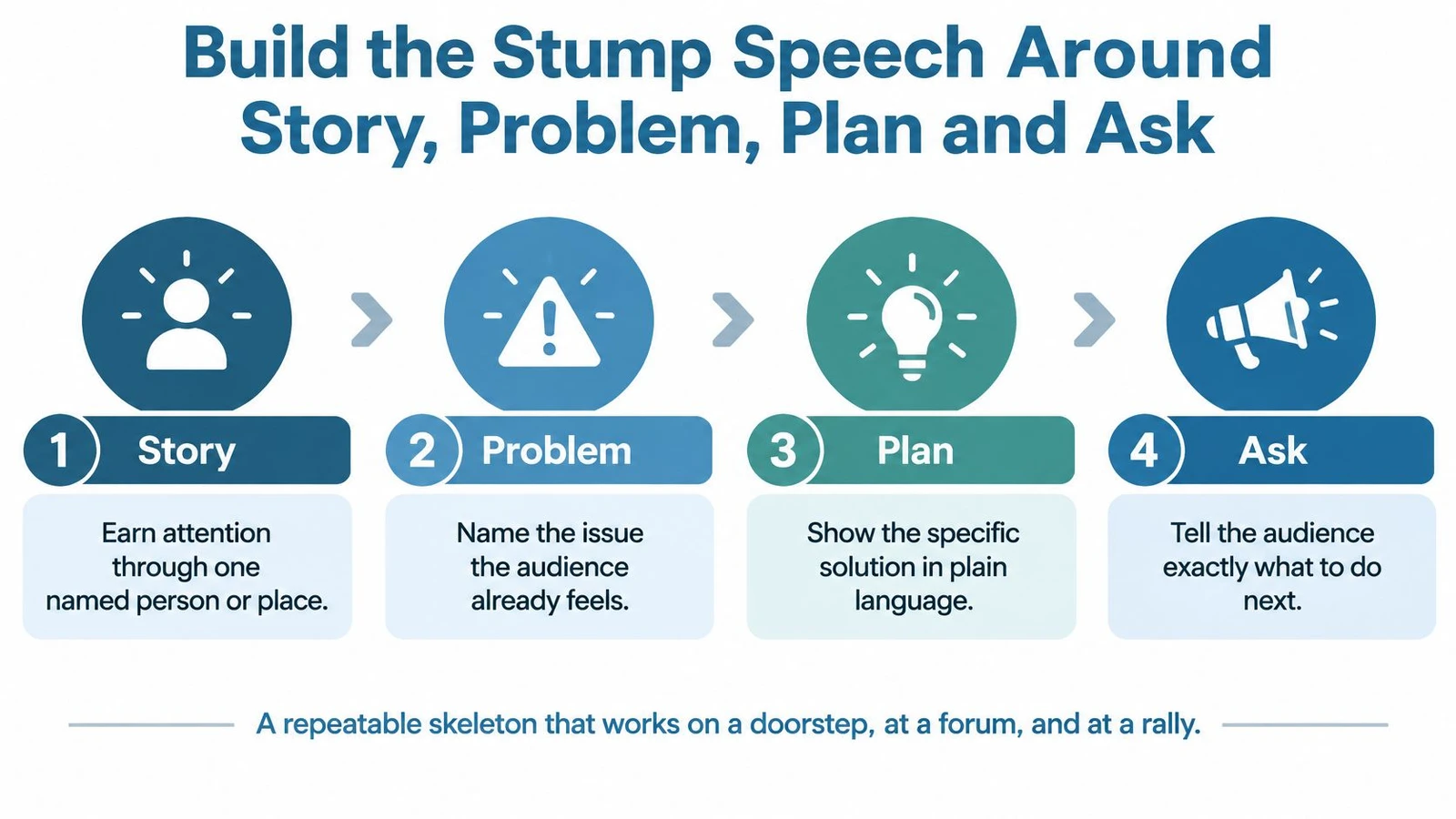
The four parts of a stump speech
The following examples describe a hypothetical Mill Road campaign, not reported local conditions.
| Part | Job in the speech | Question it answers | Local example |
|---|---|---|---|
| Story | Earns attention through one named person or place | Why should listeners care? | A Mill Road resident whose basement floods after every storm |
| Problem | Names one issue the audience already feels | What is broken? | Flooding closes the Mill Road underpass three times each spring |
| Plan | Gives one to three specific fixes | What will the candidate do about it? | Fund a drainage study first, then bid the repairs in rank order |
| Ask | Requests one clear action | What happens next? | Attend the next council meeting and bring one neighbor |
Draft the argument in order
-
Story. Open with a specific person or place, a concrete detail, and what happened. In the hypothetical example, resident Elena carrying soaked boxes out of a Mill Road basement gives the audience something recognizable; an extended account of the candidate’s childhood doesn’t.
-
Problem. Explain the public failure behind the incident, keeping the draft to no more than two problems. Use a verified local measure, such as closure records or repair delays, rather than attaching an invented number to a genuine frustration.
-
Plan. Give one to three actions and identify who would carry them out, the funding question, and when implementation could begin. A drainage survey followed by ranked repairs is understandable; a list of ten unrelated commitments isn’t a usable governing argument.
-
Ask. Request a single action that fits the venue, such as attending a hearing, volunteering, or voting. General support isn’t an instruction, and several competing requests make the ending harder to remember.
Transitions should explain the logic. A brief statement connecting the public failure to the decision to run bridges problem and plan; a sentence connecting the proposed work to residents’ participation bridges plan and ask.
For teams drafting under deadline, Lumi Humanizer’s a guide to faster proposal turnaround offers a related writing workflow resource. The useful discipline is to settle the proposed action and supporting evidence before spending time polishing the prose.
The finished draft should let a listener recite the problem, plan, and ask after one hearing. If the story is memorable but the proposed action disappears, shorten the story rather than adding another slogan.
Back Every Promise With Proof You Can Defend
The dangerous local promise isn’t always an obviously extravagant one. It may concern a state funding formula, a county road, or a superintendent’s operational decision that the officeholder cannot personally control.
The National Democratic Institute’s message-development guide recommends plain language, realistic promises, and validators such as relevant experience, knowledge, and a record of results. A credible speech therefore needs more than a compelling outcome. It needs an accurate account of the candidate’s authority.
Replace the slogan with a commitment
Consider a hypothetical city council promise to fix every street in District 3. That sentence conceals the condition of the roads, available revenue, procurement requirements, and the votes of other council members.
A defensible replacement commits the candidate to advocating for a ranked repair list in the first budget, using the city’s pavement survey, and reporting progress every quarter. The candidate still expresses urgency, but promises an identifiable action rather than unilateral control over an entire capital program.
A school board candidate faces the same distinction. A promise that every child will read by third grade becomes a commitment to request grade-level reading results each term and a funded intervention plan for students below benchmark. The board member can seek oversight and budget decisions without pretending to direct every classroom.
Run the proof audit
Each commitment needs written answers to these questions:
- Evidence: Which document, record, or observation establishes the problem?
- Authority: What can this officeholder initiate, vote on, request, or publish?
- Trade-off: What cost, competing priority, or implementation limit must be acknowledged?
A useful validator answers a specific doubt. Budget-committee service may establish familiarity with appropriations; PTA experience may explain the candidate’s understanding of family communication. Neither should become a résumé recital or substitute for checking the proposal.
Defensible promise: State the action within the candidate’s control, identify the dependency outside it, and explain how residents can check delivery.
Preemptive clarification strengthens the speech’s substance. Briefly explain who pays, who decides, and what must happen before work starts, instead of leaving those questions for a reporter or opponent.
Narrower commitments aren’t automatically more persuasive, and confidence alone doesn’t establish credibility. But a checkable promise gives skeptical residents a better basis for judgment than an assurance that everything will improve.
Run the Same Speech for City Council and School Board
Timing for a 2-minute and a 5-minute stump speech
| Part | 2-minute version | 5-minute version |
|---|---|---|
| Story | 25 seconds | 60 seconds |
| Problem | 30 seconds | 75 seconds |
| Plan | 50 seconds | 125 seconds |
| Ask | 15 seconds | 40 seconds |
| Total | 120 seconds | 300 seconds |
These are drafting budgets, not guaranteed delivery speeds. Pauses, applause, and difficult phrasing all consume speaking time, and timed rehearsal determines the actual cut.
The shorter version preserves the story and ask while reducing the plan to its central fix. The longer version earns its additional time with a second proof point and a second plan item, and every addition must survive the same two tests: a listener should be able to repeat it after one hearing, and the campaign should be able to defend it in writing.
City council example
The Mill Road outline in the stump speech section already shows the compressed form: one storm-damage story, one documented drainage problem, one repair-priority commitment, one budget hearing to attend. Stretching that outline to five minutes means adding a second documented maintenance failure and explaining how staff would estimate repair costs. The added detail clarifies the funding decision and keeps the limit honest, since a survey ranks repairs while construction still requires a separate vote.
School board example
The same structure holds when the office controls different levers.
- Story: A seventh grader transfers mid-year and struggles to catch up in math.
- Problem: Two middle schools have math results below the state average, a comparison the campaign must verify against the relevant assessment.
- Plan: The candidate proposes seeking funding for semester tutoring and requesting a monthly progress report to the board.
- Ask: Families should attend the budget workshop and ask how the district will fund and evaluate tutoring.
A monthly report can credibly cover attendance, participation, and available assessment results; claiming fresh test scores every month would promise data the district may not have. For written introductions that must carry similar commitments, these school board candidate statement examples provide another format to consider.
Adapt the language without changing the deal
Within either race, the problem and promise stay stable. The example, vocabulary, local consequence, and practical next step can change: a ward meeting may emphasize drainage, while a school audience may need an explanation involving bus routes or classroom support.
The National Democratic Institute’s communication guide connects audience-appropriate language with authenticity and a consistent factual record. Every version must describe the same commitment, so that any listener, reporter, or opponent comparing two rooms hears identical terms.
For multilingual rooms, a qualified reviewer should check plain-language versions of the story and ask, preserving the same action and event details. For listeners unfamiliar with the issue, retain one fix and repeat the action request rather than adding background they cannot absorb in a single hearing.
Write an Opening and Closing Voters Repeat
A ceremonial opening spends the audience’s attention before the argument begins. A declaration that attendance is an honor can usually be replaced with the first concrete sentence about the community.
Three opening types deserve a draft:
- Concrete scene: A hypothetical Harbor Avenue bus stop leaves an older resident standing in sleet without shelter.
- Verified local number: A documented service delay establishes the scale of a familiar problem.
- Direct problem: Residents can’t find out why one repair moves ahead while another remains unfinished.
Let outsiders choose the opening
Political experience isn’t a reliable substitute for testing. A 2024 study in the Proceedings of the National Academy of Sciences evaluated 172 political messages across 21 issues and found that practitioners were barely better than chance at predicting persuasive effectiveness, performing no better than ordinary participants.
A small recall panel won’t establish a causal persuasion effect. It can still expose confusing language, misplaced emphasis, and an opening that listeners remember for the wrong reason.
Magic Genie’s news intro guidance for content teams offers a useful adjacent resource for putting the concrete event before background. Campaign staff can also review political campaign slogan examples, while keeping the distinction clear: a slogan compresses an argument; it doesn’t supply evidence.
Close on the requested action
The opening and closing should use the same central wording. For a hypothetical repair campaign, the repeatable line could be:
Residents deserve a public repair list and a clear account of progress.
The city council close can then request that residents bring a neighbor to the March budget hearing. A school board close can invite families to examine reading results at the next board meeting and hold the board accountable for its response.
Required acknowledgments belong before the final action sentence. The ending should leave listeners knowing what to do, not merely knowing that the candidate has finished.
Revise, Rehearse and Test Before You Speak
Vivid wording earns its place only when it makes a defensible proposal clearer. A meta-analysis of political metaphor experiments found a small overall persuasive effect from metaphorical framing and no statistically reliable effect on behavioral intentions. Describing government as something to repair only helps if the speech then explains the repair.
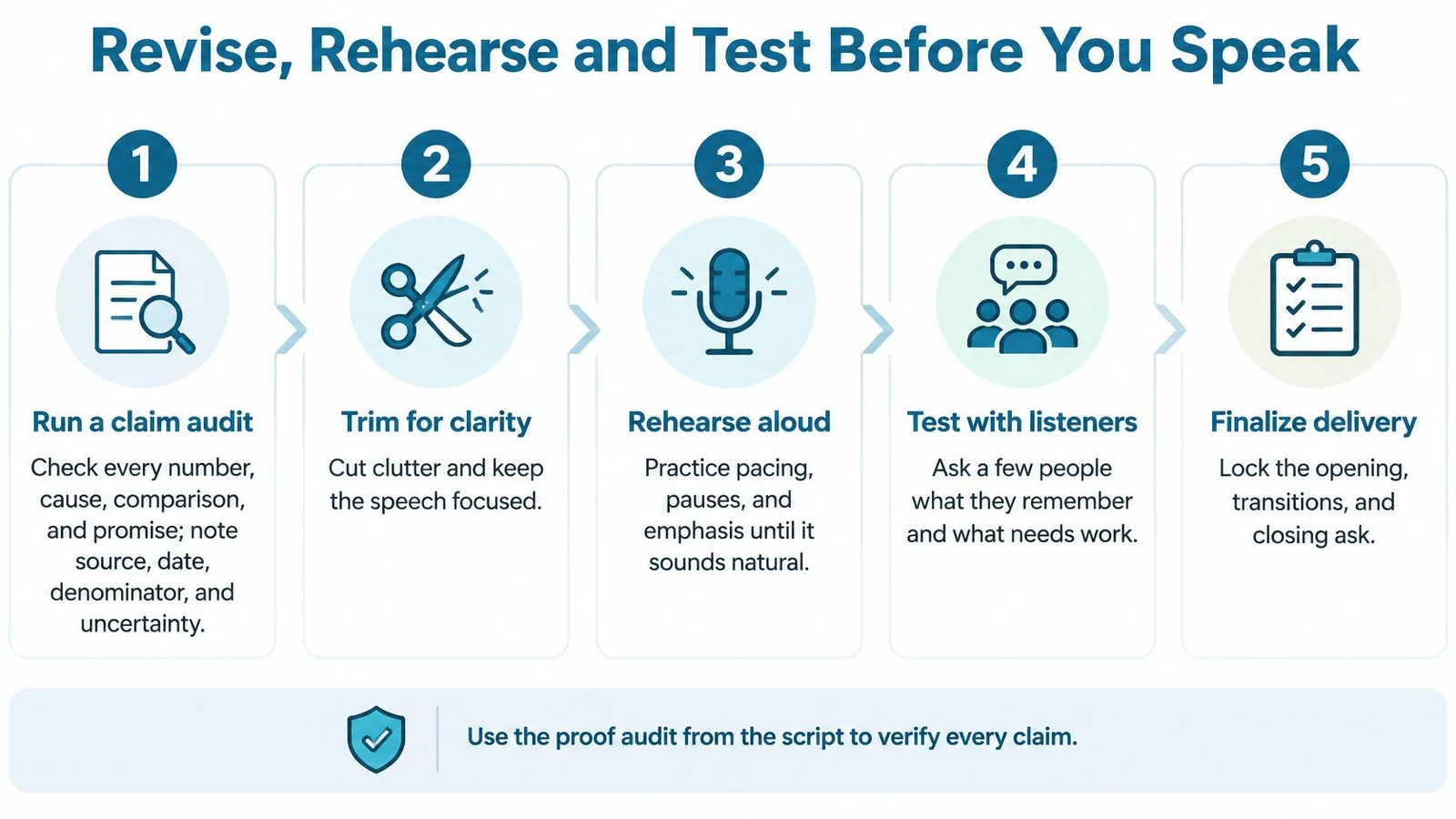
Use a pre-delivery checklist
-
Audit every claim. Record the source, date, denominator, and uncertainty behind each number, causal assertion, comparison, and promise. Cut any statement that cannot survive one follow-up question.
-
Lead with the accurate fact. Explain its local consequence without unnecessarily repeating an opponent’s false allegation.
-
Read aloud with a timer. As an editing rule, inspect sentences longer than about 25 words and replace jargon with ordinary language. Cut material rather than speeding up to beat the clock.
-
Mark the transitions. Pause between the human story and the policy explanation so listeners can follow the shift in purpose.
-
Invite an independent challenge. Hand the draft to a reviewer outside the writing team and ask for exaggeration, ambiguity, and unsupported causal links.
-
Rehearse both lengths standing up. Run the two-minute and five-minute versions three times each, practicing eye contact and recovery after an interruption.
A doorstep conversation needs an even shorter entry point. Write a 30-second version that keeps the story and the ask, then stops so the resident can answer.
Any line that fails on a first hearing should be shortened before it reaches a voter’s porch.
Door conversations also surface wording that residents misunderstand. This guide to using canvassing data to refine a campaign message explains how field feedback can inform revisions without treating every reaction as representative.
Treat each draft as a working version. Change one element per rehearsal cycle and keep the earlier copy, so a weaker close or a confusing transition can be traced back to the edit that caused it. When the speech holds its problem, plan, and ask through noise, interruptions, and a skeptical listener, it is ready for the stage.
Frequently Asked Questions
How long should a campaign speech be?
Let the agenda set the ceiling, then build a short version and a full version that share the same story, problem, plan, and ask. If the organizer gives five minutes and the room is restless, the candidate should deliver the short version cleanly rather than race through the full one.
Does a candidate need a different speech for every event?
The core should stay stable so repeated exposure helps voters remember it. What changes is the local example, the vocabulary for the room, and the action request: attend a hearing at a neighborhood meeting, knock doors at a canvass launch.
Should a campaign speech mention the opponent?
A contrast is worth making when it cites a vote, a public statement, or a policy choice the campaign can prove. The useful test is whether the line survives a proof audit: what decision is being challenged, what would change, and why a voter should care at the next meeting.
What if a candidate has never given a speech before?
Begin with the story and ask, then write one plain explanation in between. Rehearse standing up, record it on a phone, and fix passages where the candidate speeds up, trips over phrasing, or loses the reason the room should act.
What should a candidate do when a speech runs long?
Decide in advance which paragraph is expendable. Protect the opening commitment and the closing ask, cut the second example or the extra statistic first, and pause after the cut so the transition still sounds intentional.
How should a candidate handle a question they cannot answer?
Say what is known, name the limit plainly, and offer a concrete follow-up such as checking the ordinance or reporting back at the next forum. A guessed answer creates a proof problem later, while a precise promise to find out keeps credibility intact.
doornoc offers browser-based canvassing software for the door-to-door side of a race. Visit doornoc to organize voter lists and walk routes, and record the notes residents share at their doors.
Looking for a tool to run this? doornoc’s canvassing software bundles voter data, automatic turf cutting, the mobile app, and live reporting in one platform.