

A PAC’s bookkeeping obligations can begin before its registration paperwork is filed. The Federal Election Commission’s PAC registration guidance explains that the first report must include receipts and disbursements from before registration, so an organizer can create a reporting problem before the committee is formally registered.
A political action committee, or PAC, raises and spends money for political activity. Connected PACs operate through sponsoring organizations; non-connected PACs operate without those sponsors; leadership PACs are controlled by candidates or officeholders; and super PACs finance independent expenditures rather than candidate contributions. Understanding how to start a PAC means choosing the right structure, then building a compliance system before money moves.
Choose Your PAC Type and Filing Path
A committee planning to contribute directly to candidates needs a different legal structure from one financing independent advocacy. The intended spending decides the form, and organizers who pick a name first and sort out the category later create extra work for themselves.
The FEC’s guide to political action committees distinguishes the principal types below and describes leadership PAC contributions of up to $5,000 per election to federal candidate committees.
PAC types by sponsor, donors and giving rights
| PAC type | Who sponsors or controls it | Who can contribute | Can it give to candidates? |
|---|---|---|---|
| Connected PAC, formally a separate segregated fund | A corporation, labor union, membership group or trade association | Mainly eligible individuals tied to the sponsor | Yes, within federal limits |
| Non-connected PAC | No sponsoring organization | The general public, subject to federal source restrictions and limits | Yes, within federal limits |
| Leadership PAC | A federal candidate or officeholder, separate from their authorized campaign committee | Permissible donors within federal limits | Yes, up to the per-election limit described above |
| Super PAC | Organizers operating an independent-expenditure-only committee | Unlimited contributions from permissible sources, including corporations and labor organizations | No |
Match the structure to the intended activity
A plan built around direct candidate contributions rules out the super PAC form, which may fund independent expenditures only. If an employer or membership organization will sponsor the committee and solicit its eligible associated individuals, a connected structure may fit. A group seeking support from the general public without such a sponsor should examine the non-connected path.
Leadership PAC status means something narrower than a grassroots label. It describes a committee established, financed, maintained or controlled by a federal candidate or officeholder, separate from that person’s authorized campaign committee.
Settle the filing path before solicitation
These questions belong in writing before the first ask:
- Recipients: Which candidates or committees will receive money? Federal activity requires a federal compliance review.
- Jurisdictions: Which states will the committee operate in? State-only election activity starts with the relevant state election agency.
- Responsibility: Who will serve as treasurer, maintain records and meet deadlines?
Registration starts the compliance file; it does not finish it. The answers above determine which records the committee must keep from the first dollar, including money raised and spent before the paperwork goes in.
Fundraising plans should follow these decisions, not precede them. A list of political fundraising ideas that win campaigns is useful only after the committee knows which donors it may solicit.
For field operations, canvassing software can plan walk routes and record door-to-door results, though it does not replace campaign-finance bookkeeping or a compliance review.
Before launch: A named treasurer, documented funding rules and an identifiable recordkeeping system matter more than a polished announcement.
This article provides general information, not legal advice. Organizers should confirm the proposed structure with a campaign-finance attorney or the relevant election agency before accepting donations.
Federal and State Setup Side by Side
Registration in one jurisdiction settles nothing in the other. A federal filing leaves state obligations untouched, and a state registration confers no authority to contribute to federal candidates. A committee active in both registers in both, on each jurisdiction’s own trigger and deadline.
The comparison below works as a launch checklist. The federal trigger attaches to organizations that meet the applicable political-committee definition, not to every group that discusses public issues.
Federal and state PAC requirements compared
| Requirement | Federal PAC | State PAC |
|---|---|---|
| Registration trigger | Contributions or expenditures exceed the federal calendar-year threshold | Set by each state’s definition of a political committee |
| Filing office | Federal Election Commission | State election agency |
| Deadline after trigger | Statement of Organization due within the federal registration window | Set by state law |
| Treasurer | Required, with responsibility for report accuracy and timeliness | Appointed under the applicable state rules |
| Bank account | Dedicated committee account, established before transactions as a practical control | Committee account established and used under state rules |
| Reporting schedule | Generally monthly or quarterly in federal election years, with applicable election-related reports | Monthly, quarterly, pre-election, post-election or activity-triggered |
| Contribution limits | Traditional PAC receipts and candidate contributions have separate limits | Some states cap PAC gifts, some allow larger amounts, and some impose no candidate contribution cap |
Registration is the first entry in a compliance file, not a finished task. Money raised and spent while a committee builds toward the trigger counts toward that trigger, and the first report has to capture that early activity. Organizers who wait for the filing to begin recordkeeping end up reconstructing months of transactions from memory and bank statements.
Separate money coming in from money going out
For 2025–2026, the FEC’s nonconnected PAC contribution-limit guidance lists $5,000 per year from an individual or other permissible source to a traditional nonconnected PAC, while a multicandidate PAC may give $5,000 per election to a federal candidate committee.
Those are different transactions with different counting periods. A donor’s payment into the PAC doesn’t establish how much the PAC can send to a candidate, and a new committee shouldn’t assume it qualifies for multicandidate treatment.
Super PACs can accept unlimited contributions from permissible sources because they make independent expenditures rather than candidate contributions. The treasurer still screens every donor’s eligibility before depositing funds, including the restrictions on foreign nationals and federal contractors.
Build controls around cumulative totals
A contribution review should examine the donor’s earlier payments, not just the latest check. Multiple individually acceptable receipts can combine into an excessive cumulative contribution, and the problem surfaces only when someone adds up the running total.
The intake record should include the donor’s identity, receipt date, amount, source documentation and running total. Potentially excessive or prohibited receipts need prompt review and handling under the applicable procedures, rather than being retained as ordinary operating funds.
Contributions and spending made before registration still count toward the trigger and belong in the first report.
For a committee operating across jurisdictions, the useful question isn’t which rules seem easier. It’s which rules govern each receipt, payment and intended recipient.
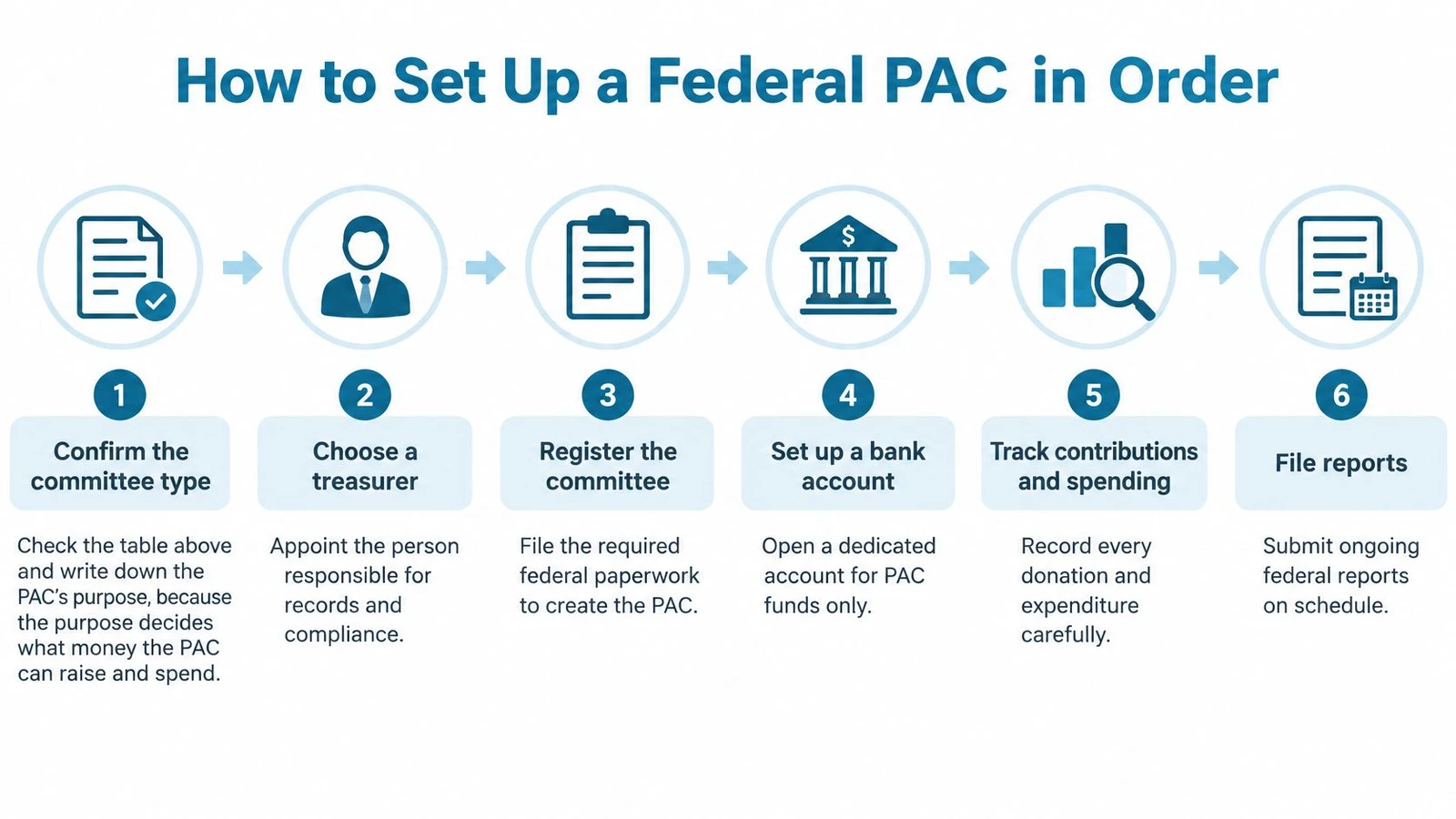
How to Set Up a Federal PAC in Order
The federal setup process should leave a clear trail from the committee’s purpose to its bank activity and reports. The operational sequence below puts financial controls in place before transactions, even when registration occurs later.
Establish the committee and its controls
-
Confirm the committee type and write its purpose. State whether the PAC will contribute to candidates, conduct independent spending or use another permitted structure. This gives the treasurer a basis for reviewing proposed donations and expenditures.
-
Appoint the treasurer and records custodian. Assemble a compliance file containing the committee name, any connected organization, responsible officers, bank depository and written approval procedures. Someone other than the person requesting a payment should review its supporting documentation where staffing permits.
-
Open a dedicated committee bank account. Obtain the tax identification information needed for setup and keep committee transactions separate from organizers’ personal finances. A dedicated account makes bank reconciliation and source tracing substantially easier.
-
Track activity from the beginning. Record formation, accounting, legal, communications and voter-contact expenses rather than waiting for fundraising to start. Organizer-paid bills should go to the treasurer for classification, not disappear into an informal reimbursement list.
Register and preserve the reporting trail
-
Monitor the trigger and file promptly. The FEC’s federal participation guidance explains that a group generally must register when its major purpose is federal campaign activity and it raises or spends more than $1,000 during a calendar year, filing Form 1 within 10 days after crossing the threshold. Voluntary earlier registration can provide a formal compliance structure before substantial fundraising.
-
Prepare the first report from the complete ledger. The FEC’s hybrid PAC registration guidance requires reporting pre-registration receipts and disbursements and identifies organizational information such as committee type, principal location, treasurer, affiliations and depository. The ledger therefore needs invoices, receipts, payment records and donor documentation from the outset.
-
Collect contributor information during intake. Maintain the identification information needed for disclosure, including occupation and employer where applicable, and screen for prohibited sources. Asking after a report is nearly due is slower and less reliable than collecting it with the contribution.
-
Keep organizational information current. Changes to the committee’s name, address or treasurer require an amended organizational filing within the applicable deadline. Registration also begins continuing reporting duties; inactivity alone doesn’t terminate the committee.
The launch check is straightforward: the account is open, the treasurer is named, and every transaction traces to supporting documentation. Missing paperwork should be resolved before another solicitation or payment adds to the backlog.
How to Set Up a State PAC and What Changes
The destination state’s rules control a state PAC from the first dollar raised. Organizers need the actual political-committee definition, registration instructions and reporting calendar for the elections they intend to influence, pulled from that state’s election agency rather than adapted from a federal checklist.
A state committee that later enters federal races faces a second layer of rules. Before the committee makes or accepts covered federal contributions, review the FEC’s guidance on who can and cannot contribute alongside the federal registration order covered earlier in this guide.
Establish the state filing account
- Read the definition first. Identify which fundraising, spending or organizational activities trigger registration under state law. Activity that crosses the trigger belongs in the first report, so the committee’s ledger starts before the registration form is filed.
- Locate the election agency’s filing portal. Confirm account creation, submission credentials and the method for receiving agency notices. Assign responsibility for monitoring those notices.
- Register and appoint the treasurer. Verify who signs reports, who maintains supporting records and how officer changes are reported.
- Establish the committee bank account. Route receipts and payments through the designated account under state rules, so disclosures can be reconciled against bank activity.
The agency’s general information page is an overview. The committee’s working file is the instructions, filing confirmations and correspondence specific to its activity, saved together so another responsible officer can reconstruct every decision.
Map disclosure and spending rules
State reports commonly cover receipts, donors, expenditures, debts and account balances. The treasurer should identify the required report types and reporting periods before setting internal bookkeeping deadlines.
Contribution rules require a separate check for the races the PAC will support. Pull the current limits directly from the state election agency at the start of each cycle, and confirm which limits apply to contributions to candidates, to other committees and to party accounts, since a state may treat each recipient type differently. A summary saved from a prior election can go stale.
For advertising, retain the vendor agreement, final communication, distribution dates and payment documentation. A political campaign advertisement planning guide can help organize production work, while the committee still runs the jurisdiction’s disclaimer and disclosure review itself.
Multistate control: Keep a separate requirements checklist for each state, even when the same treasurer handles every filing.
Before adding a federal recipient, obtain a federal compliance review. Before expanding into another state, confirm that state’s registration, banking, contribution and reporting requirements rather than copying the original setup.
Reporting Dates and Ongoing Compliance Duties
The FEC’s supplemental filing information for PACs in 2026 identifies the selected deadlines below; this isn’t the complete filing calendar for every committee.
2026 federal PAC filing dates
| Date | Report or deadline | Who it applies to |
|---|---|---|
| Within 10 days of passing $1,000 | Form 1 Statement of Organization | New federal nonconnected or hybrid PACs |
| April 15, 2026 | April quarterly report | Quarterly filers |
| October 15, 2026 | October quarterly report | Quarterly filers |
| October 22, 2026 | Pre-general report | Quarterly filers with election-related activity not previously reported |
| December 3, 2026 | Post-general report, the upcoming remaining deadline on this calendar | Quarterly filers |
Registration is the start of the compliance system, and the first report reaches back further than most new treasurers expect. A committee’s opening disclosure covers receipts and disbursements from its first dollar, so spending made before Form 1 was filed still has to appear.
Make filing readiness a recurring task
Pre-election reports are triggered by activity, not the calendar alone. A quarterly filer owes the pre-general report, due October 22, 2026, when it has election-related activity for the November election that no earlier report covered; the same trigger applies to the pre-election report for any primary or special election the committee participates in.
A practical closing routine before each due date includes:
- Reconcile the bank: Match deposits, payments and outstanding items to the ledger.
- Validate donors: Resolve missing identification and review cumulative contributions.
- Classify activity: Check receipts, disbursements, debts and any unusual transactions.
- Review communications: Record the date, amount, candidate, election, vendor, disclaimer and advocacy content before approving independent spending.
- Preserve submission evidence: Save the filed report, acceptance confirmation and supporting workpapers.
Independent expenditures can trigger 24-hour and 48-hour reports outside the regular calendar, depending on the amount spent and how close to election day the communication runs. A payment-approval process therefore needs a disclosure check before the communication runs, not after the invoice arrives.
Keep election filings separate from other obligations
Treasurers remain responsible for report timeliness and accuracy, and late or missing filings can result in civil penalties. A quiet reporting period doesn’t automatically remove a filing obligation, and an inactive committee shouldn’t stop reporting without completing the applicable termination process.
The operational political campaign timeline should share reminders with the compliance calendar, while keeping each filing’s owner and requirements explicit.
If the organization also has employment or ordinary business-administration responsibilities, Bookkeeping and Accounting of Florida Inc.’s guide to small business filing and payroll obligations offers a separate administrative checklist. It can help staff distinguish payroll and business tasks from campaign-finance reports, which remain governed by the election calendar above.
Frequently Asked Questions
Do I need to register with the FEC if my PAC only works in one state?
Not automatically: a committee working only in state elections normally starts with that state’s election authority. Operating geographically within a state doesn’t rule out federal obligations, however, if the committee supports federal candidates or undertakes other covered federal activity.
What is the federal registration threshold for a PAC?
A nonconnected PAC generally becomes subject to FEC registration when it raises or spends more than $1,000 in a calendar year, and Form 1 is due within 10 days, according to the FEC’s nonconnected PAC guidance. That guidance also requires an amended Form 1 within 10 days of changes to information such as the committee’s name, address or treasurer.
Does a PAC need a treasurer?
Yes, federal PACs need a treasurer, and state committees must appoint one under their applicable state rules. Organizers should name someone before accepting donations who can maintain records, review transactions and take responsibility for accurate, timely reporting, rather than treating the role as an honorary appointment.
Can a super PAC give money directly to candidates?
No, a super PAC is an independent-expenditure-only committee and can’t contribute directly to candidates. Its ability to accept unlimited permissible contributions doesn’t remove donor-source restrictions or allow coordination of its independent expenditures with candidates.
doornoc offers browser-based canvassing tools for voter lists, turf planning, door-knock recording and field reports. Once the PAC’s compliance structure is established, organizers planning a door-to-door program can visit doornoc to organize field activity while keeping financial records and election filings in a separate compliance system.
Looking for a tool to run this? doornoc’s canvassing software bundles voter data, automatic turf cutting, the mobile app, and live reporting in one platform.