
Friday is the media deadline. The script is still being revised, a vendor is pushing broadcast television, another is promising precise digital targeting, and the field director wants to know what canvassers should ask at the doors on Saturday. The campaign has enough money for a serious buy, but not enough to waste on an attractive dashboard that can’t answer whether voters changed their minds.
A political campaign advertisement works best as one part of a coordinated persuasion system. Television, connected TV, digital video, radio, mail, and signage each create different opportunities, constraints, and evidence. The campaign needs to choose the format according to the job, then connect exposure data to conversations, volunteer activity, donations, and turnout indicators that staff can verify outside the platform report.
Why Format Choice Matters More Than Ever
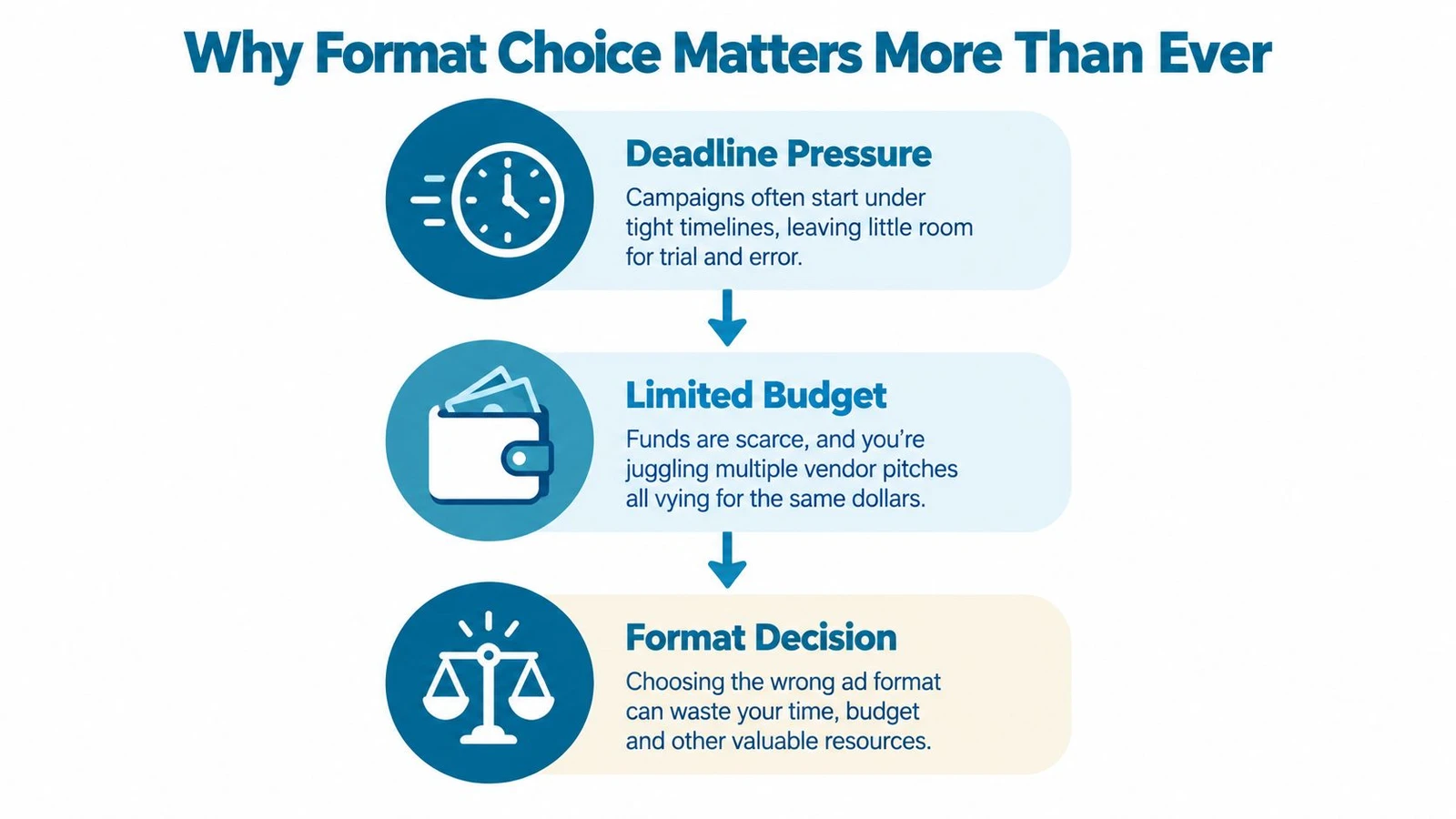
A campaign under deadline pressure usually makes its first media decision too early. Staff hear a proposal for a polished television spot, approve a broad digital package, and only later ask whether the message was designed for persuasion, name recognition, or turnout. That sequence reverses the practical order. The campaign should define the voter action first, then choose the format that can deliver and measure it.
The historical shift began with the 1952 U.S. presidential election between Dwight D. Eisenhower and Adlai Stevenson. Eisenhower’s campaign used short, professionally produced television spots instead of relying mainly on long speeches or political broadcasts. The advertisements aired in 40 of the 48 states, and voters in 11 states reportedly encountered four or five Eisenhower spots per day, establishing a model built around concise messages, visual presentation, emotional framing, and repetition. The Museum of Broadcast Communications documents this development in political television.
That lesson still applies, even though the screens have multiplied. A television spot can carry a broad emotional argument. Connected TV can narrow delivery by geography or household context. A short social video can test several openings quickly. Mail can give a complicated contrast more room, while signage reinforces a name and visual identity without asking voters to process a full argument.
Start with the job of the ad
A useful internal vocabulary separates three jobs:
- Persuasion: Move an undecided or weakly committed voter toward a candidate.
- Mobilization: Turn an existing supporter into a voter, volunteer, donor, or participant.
- Introduction: Build basic familiarity with a candidate, biography, or central promise.
The same line can’t perform all three jobs equally well. A persuasion ad may need contrast and proof. A mobilization ad needs a clear action, timing, and low-friction instruction. An introduction ad needs a memorable identity and a reason to care before it attempts a detailed policy argument.
Treat production as a budget decision
The campaign isn’t only buying airtime. It is buying the ability to adapt. A single master script may need a broadcast cut, a vertical video, a connected-TV version, a radio read, and a mail headline. Each version should preserve the core claim while changing its opening, pacing, captioning, visual density, and call to action.
Practical rule: If the team can’t describe the desired voter action in one sentence, it isn’t ready to approve the format or the script.
The central decision is therefore not television versus digital. It is whether the campaign can create a coordinated set of assets that match the audience, deadline, and measurement plan. The wrong format wastes more than media money. It can leave canvassers with a message voters never recall, or a field team collecting answers that the media team never sees.
How Political Ads Actually Move Voters
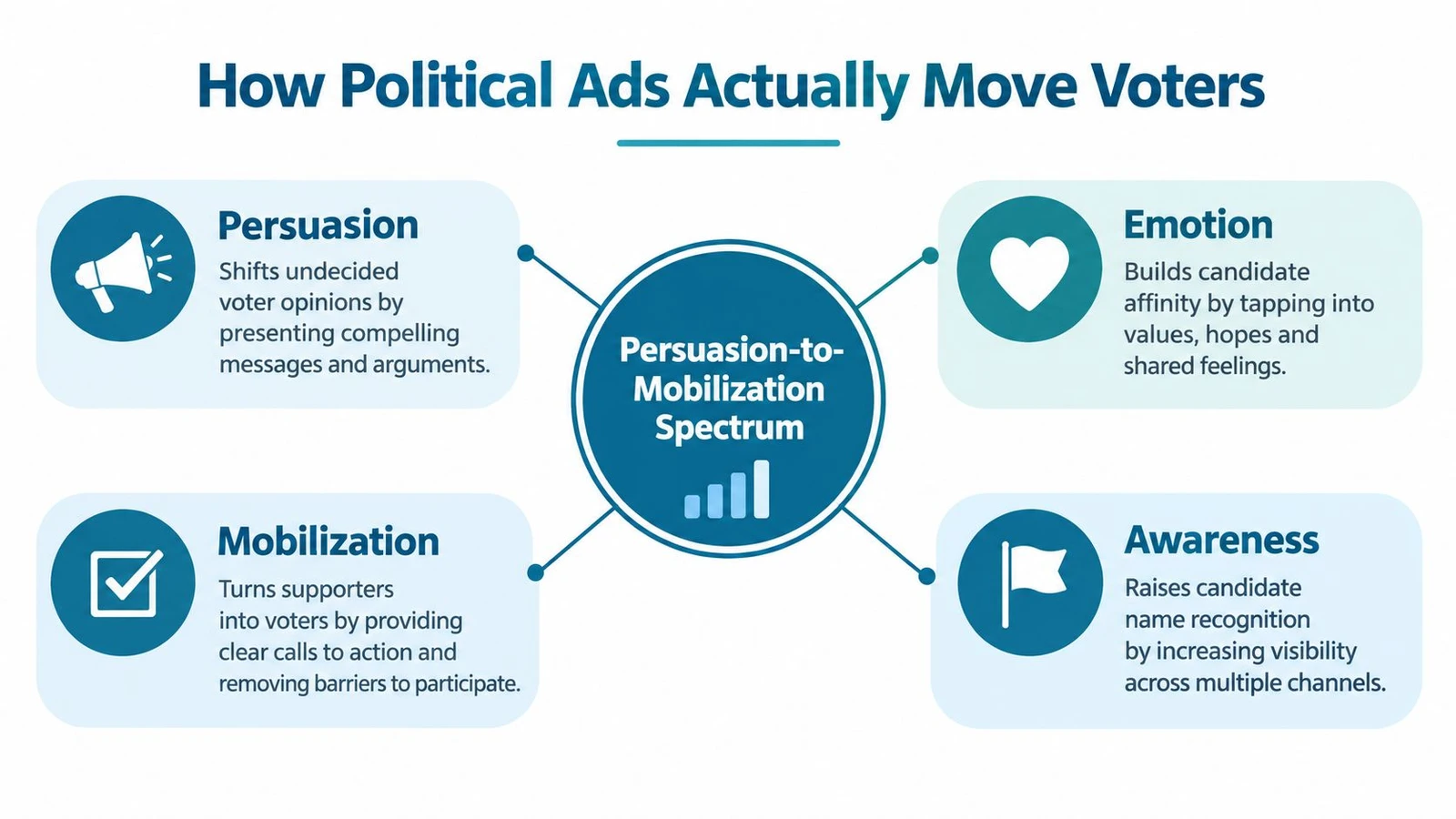
A political advertisement can expose a voter to a candidate without persuading that voter. That distinction should shape the first question in every media meeting: which outcome is the campaign optimizing?
For a persuasion objective, the relevant outcome is a change in candidate preference or issue position. For mobilization, the outcome may be a completed vote, volunteer signup, donation, event attendance, or response to a contact attempt. Awareness sits earlier in the chain. It can make a candidate recognizable, but recognition alone doesn’t establish support.
Match the format to the voter task
Broadcast television remains useful when the campaign needs broad audiovisual reach and repeated exposure. Its weakness is waste. A district or local race may pay to reach many people who can’t vote in the contest, while platform reporting offers limited evidence that a particular viewer changed position.
Connected TV and online video preserve the emotional strengths of visual advertising while offering more detailed delivery controls. They can help campaigns reach selected geographic or audience groups, but precise delivery still isn’t proof of persuasion. Streaming inventory can also be constrained in competitive markets, so a narrow audience plan may trade away useful reach.
Radio works through sound and repetition, making it practical for a focused message that doesn’t require visual proof. Direct mail supports longer explanations and physical reminders, but staff must assume that attention is earned rather than guaranteed. Social platforms can test creative rapidly, yet a fast click or completed view may indicate curiosity, not support.
Build a sequence instead of a single bet
A mixed strategy lets each channel do the work it handles best. An introduction message can establish the candidate. A persuasion message can explain the contrast. A mobilization message can give supporters the action and timing they need. Field staff can then ask whether voters recognize the message, accept its premise, or need a correction.
Digital advertising spending represented approximately 2% to 3% of political advertising spending in 2016 and about 18% in 2020, reaching roughly $1.6 billion in the United States, according to experimental research summarized by Stanford researchers in this analysis of digital political advertising. Those figures show the channel’s expansion, not a guarantee that more exposure produces more votes.
The same research reports that removing political advertising from two major social platforms produced no detectable effects on candidate favorability, turnout, or participation in a large experimental evaluation. The operational conclusion is direct: delivery is an input, not an outcome. A campaign should define the downstream behavior before it buys the impression.
The Main Advertising Formats and When Each One Pays Off
The format decision becomes easier when the buyer asks four questions: who needs to see the message, how quickly can the asset ship, what kind of attention does the format create, and what evidence will exist after launch?
| Format | Reach | Speed | Cost Tier | Measurement |
|---|---|---|---|---|
| Broadcast television | Broad, often geographically inefficient | Slower production and placement | High | Strong delivery data, limited causal evidence |
| Connected TV | More selective household or geographic delivery | Moderate | High to very high in competitive markets | Detailed delivery reporting, outcome measurement requires design |
| Online video | Flexible audience and creative testing | Fast | Low to medium | Strong platform reporting, weaker proof of persuasion |
| Radio | Broad audio reach in selected markets | Fast | Low to medium | Limited direct outcome evidence |
| Direct mail | Defined voter universe | Moderate | Medium | Response and field matching can support evaluation |
| Out-of-home signage | Public visibility and name reinforcement | Moderate | Medium to high | Limited direct measurement |
Broadcast television
Broadcast pays off when the campaign needs scale, emotional storytelling, and a message that benefits from shared public visibility. It becomes inefficient when the media market extends well beyond the electorate or when the campaign can’t afford enough repetition to make the creative memorable. The production timeline also demands discipline. Legal review, footage, voiceover, captions, trafficking, and station deadlines should be scheduled before the final edit.
Connected TV and online video
Connected TV is useful when the campaign wants television-quality storytelling with more selective delivery and richer reporting. Online video is the better testing laboratory. Teams can test openings, issue frames, speaker choices, and calls to action before committing the strongest version to a larger placement.
A campaign using an AI-assisted creative workflow should still require human review for factual claims, disclosures, accessibility, and brand consistency. A tool such as ShortGenius AI ad creative tool can help a team develop variations quickly, but speed doesn’t replace the approval chain.
Radio, mail, and signage
Radio pays off when the message works without visuals and the campaign needs a relatively quick production path. Mail is better when the argument needs context, documentation, or a targeted contrast. Signage is primarily an awareness tool. It reinforces the candidate’s name, face, and central identity, but it shouldn’t carry a complicated argument that voters must remember from a passing glance.
For teams coordinating media and field operations, the political digital marketing guide for 2026 offers a useful planning reference. The practical standard remains simple: every format should have a defined job, a delivery plan, and a field question that can test whether the message reached voters in a meaningful way.
Legal and Compliance Rules That Change the Ad
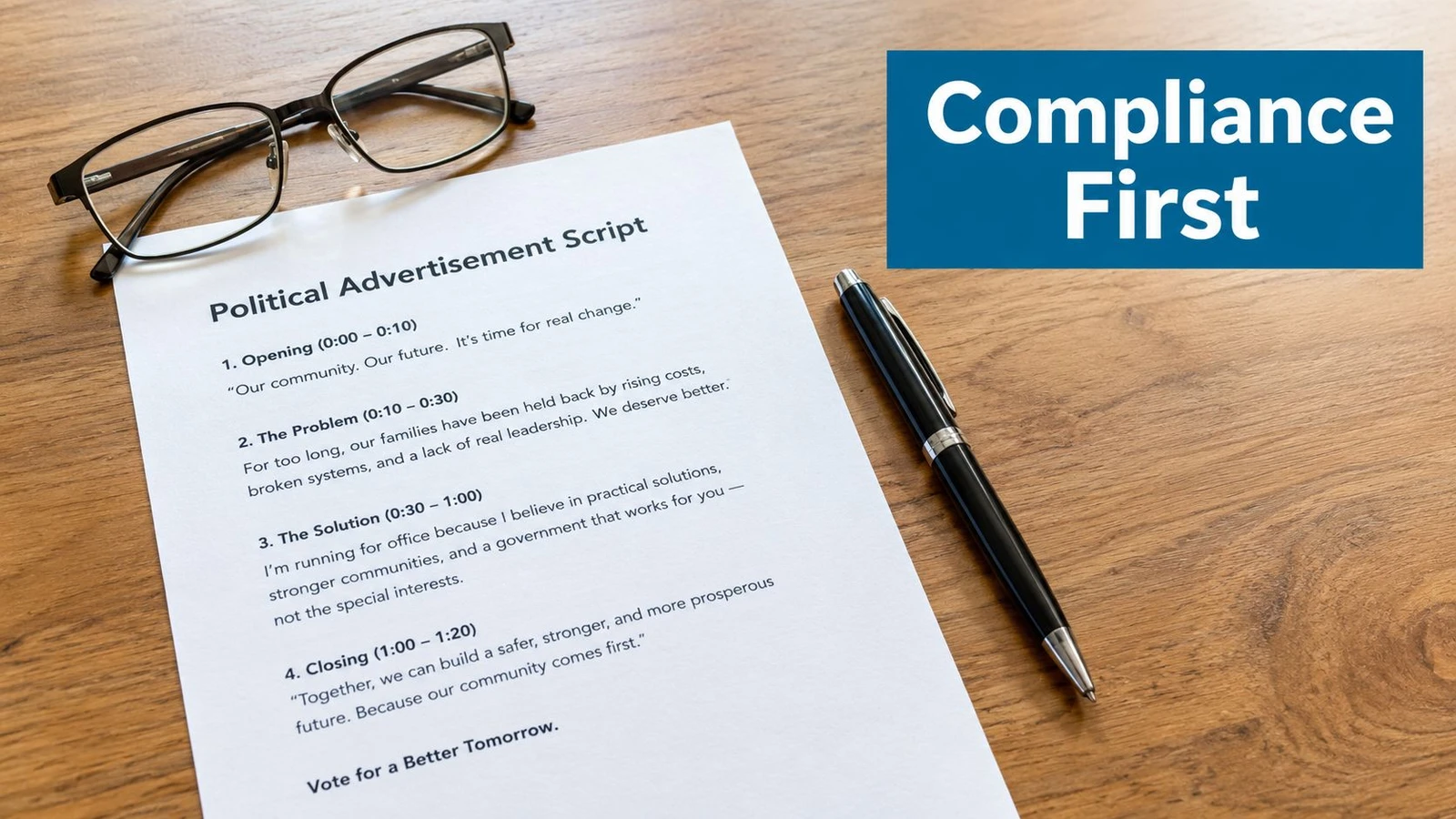
Compliance isn’t a final box checked after creative approval. It changes the script, the visual treatment, the targeting plan, the archive process, and sometimes the format itself.
Federal campaign ads generally require the applicable sponsor disclaimer, while state and local rules can add requirements around wording, placement, issue advocacy, ballot measures, and authorization. Platform policies may impose separate limits on political advertising, identity verification, targeting, archives, and synthetic media. The campaign’s legal reviewer should identify the governing rules before production, not after the master file is delivered.
Use a preflight checklist
Before an ad goes live, the campaign should verify:
- Sponsor identity: Confirm that the disclaimer names the correct committee or responsible organization.
- Authorization: Establish whether the candidate, committee, outside group, or ballot campaign approved the communication.
- Coordination risk: Document firewalls and communications when outside organizations are involved.
- Claim support: Preserve the evidence, source language, date, and relevant context for every factual assertion.
- Audience rules: Review whether targeting criteria create legal, ethical, or platform-policy problems.
- Synthetic content: Identify generated or manipulated audio, video, imagery, and disclosures required by the relevant jurisdiction or distributor.
- Archive record: Save the final creative, approval history, targeting context, spend record, and publication details.
The European Union’s Regulation 2024/900 became fully applicable on October 10, 2025, requiring political ads to identify sponsors, costs, and, where applicable, the targeted audience, with a public repository for online political advertisements, according to the implementation summary referenced in the supplied research. A U.S. campaign operating elsewhere should not assume that domestic practices answer every disclosure question.
Treat AI provenance as campaign evidence
AI-generated media creates an operational problem beyond whether a disclaimer appears. Staff need to know what source material was used, who approved the output, which claims were checked, and how a field representative should respond if a voter reports a manipulated video.
Researchers tracking the 2026 cycle identified approximately $80 million in spending across nearly 170 unique political ads using AI, as reported in the supplied research. Labels also don’t work uniformly. Their effect can depend on timing and placement, while disclosure notices may compete with other information for limited voter attention.
A campaign should document the provenance of synthetic assets and prepare a short correction script before publication. Teams responsible for governance can use NIST and operational controls as a reference point for assigning ownership, recording approvals, and managing evidence. Legal review remains specific to the jurisdiction and communication, but the workflow should be consistent enough that field staff can act quickly.
Crafting Messages That Hold Up Across Channels
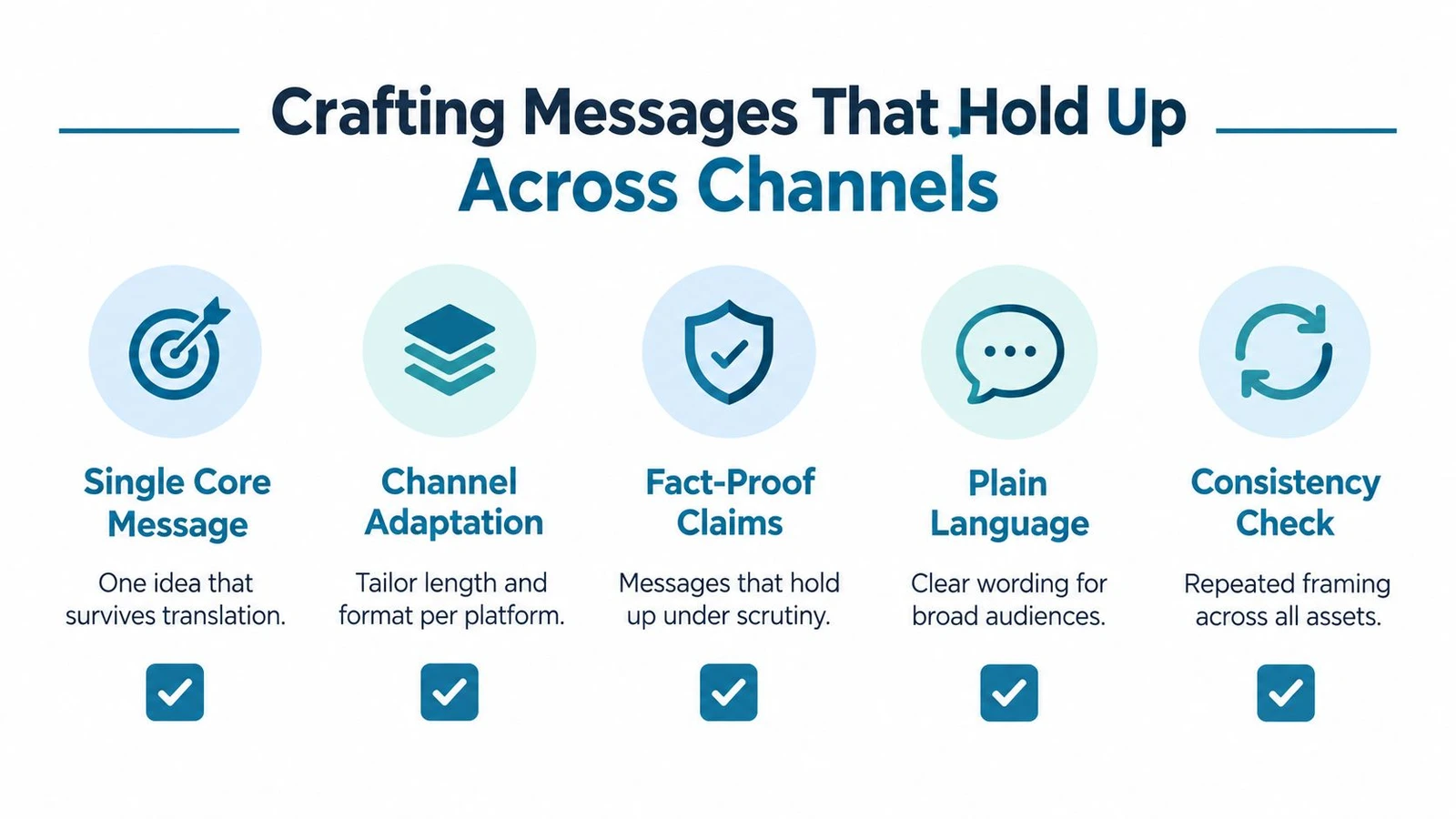
Most weak ads aren’t rescued by better placement. They fail because the campaign tries to fit a speech, a biography, three policy promises, and a contrast into one short asset. A durable message starts with one core idea that can survive translation from a television script to a vertical video, a mail headline, a radio read, and a canvasser’s opening question.
Build the message spine
The message spine should answer four questions:
- What is the hook? Give the voter a reason to pay attention immediately.
- What is the contrast or promise? State what differs, without forcing the audience to infer the point.
- What supports it? Use a fact, record, lived experience, or clearly sourced example that the campaign can defend.
- What should the voter do? Ask for a vote, conversation, volunteer action, donation, or another specific response.
A broadcast version may lead with a person speaking directly to camera. A short digital cut may begin with the strongest sentence as on-screen text. Mail may place the proof in a larger block. The meaning should remain stable, but the route to attention should fit the medium.
Run a small testing loop
The campaign doesn’t need to test every imaginable variation. It needs to compare a few meaningful alternatives against a defined objective. One version might lead with cost of living, another with public safety, and a third with candidate biography. Each should use the same audience definition and measurement rule where possible.
A practical loop looks like this:
- Write the shared claim: Keep the central proposition identical.
- Change one major feature: Test the opening, messenger, proof point, or ask.
- Check comprehension: Ask whether viewers can recall the candidate and the point.
- Check resistance: Record which claims prompt questions, disbelief, or requests for evidence.
- Adapt by channel: Preserve the winning frame while changing length, captions, aspect ratio, and pacing.
- Lock the production version: Stop testing once the deadline requires reliable delivery.
Protect consistency without flattening the creative
Statewide and multi-market campaigns often create local cuts that drift from the approved argument. Each local version should have a named owner, a fact sheet, a current disclaimer, and a short list of permitted substitutions. Common failures include opening with background instead of the point, using too many claims, burying the ask, and relying on visuals that don’t work without sound.
A message that voters can repeat at the door is usually stronger than one that only looks polished in the edit suite.
Metrics That Actually Tell You If the Ad Worked
Clicks, impressions, completed views, and cost per thousand impressions describe delivery. They don’t establish that the ad caused a voter to change preference, turn out, donate, volunteer, or answer a canvasser differently.
A campaign needs two measurement layers. The first confirms whether the ad reached the intended audience and delivered the planned frequency. The second tests whether exposed voters behaved or responded differently from comparable voters who weren’t exposed.
Separate delivery from causation
Randomized experiments are the cleanest way to estimate causal effects when the campaign can assign exposure or hold out comparable groups. An archive covering 146 experiments, 617 advertisements, 51 U.S. campaigns, and more than 500,000 respondents estimated average immediate vote-choice effects of 2.3 percentage points in 2018 down-ballot races, 1.2 points in 2020 down-ballot races, and 0.8 points in the 2020 presidential contest. The American Political Science Review article describes the archive and its implications.
Those averages shouldn’t become a universal benchmark. Effects vary by race, context, creative, audience, and objective. The researchers estimate that campaigns should devote approximately 10% to 13% of media budgets to experimentation under their modeling assumptions, which gives media directors a practical basis for reserving test capacity rather than spending every dollar on unmeasured delivery.
Join ad records to field evidence
A useful field measurement stack includes:
- Exposure record: Audience definition, geography, creative version, placement, and delivery period.
- Comparison design: Holdout, randomized assignment, matched geography, or another documented counterfactual.
- Conversation outcome: Whether canvassers heard recognition, agreement, confusion, concern, or a correction request.
- Contact history: Door attempts, completed conversations, survey responses, volunteer interest, and follow-up needs.
- Behavioral indicator: Donation, event participation, volunteer signup, supporter identification, or turnout-support signal.
The field team should ask questions that map to the ad’s job. If the advertisement raised an issue concern, canvassers can record whether voters mention that issue without prompting, whether they recall the campaign’s position, and whether they ask for evidence. A campaign operations system can connect those responses to turf, contact history, and message version, turning a platform impression into a testable field observation.
For a practical framework to interpret cross-platform ad data, the campaign should standardize naming conventions before launch. The campaign analytics dashboard should show delivery and field outcomes separately, so a high-reach asset can’t appear successful merely because it generated cheap impressions.
Keep holdouts operationally simple
A small geographic or audience holdout can be more useful than a complex attribution model that staff can’t explain. The campaign should define the unit of comparison, protect the holdout from accidental exposure where possible, and wait long enough to observe the relevant field response. If the objective is persuasion, a short survey or canvass response may be more informative than a click. If the objective is mobilization, the measurement window should match the action being requested.
Better Targeting Is Not Automatically Better Campaigning
Precision targeting can improve delivery while making the campaign’s understanding of voters worse. A narrow audience may receive a carefully crafted message, but staff may never learn whether the voter accepted it, misunderstood it, or saw it in a context that changed its meaning.
The supplied research identifies a contrarian finding: mistargeted political ads can increase political cognition even when they don’t produce persuasion. That means a wrongly targeted advertisement may still introduce an issue, provoke a question, or create a new conversation at the door. Targeting accuracy matters, but the campaign shouldn’t treat it as a substitute for listening.
Transparency creates a similar trade-off. Labels and disclosures can support accountability, yet disclosure-heavy creative may become noise when voters are already processing several competing elements. A label’s timing and placement can influence its effect, so merely adding more notice text doesn’t guarantee better understanding.
The corrective operating checklist is practical:
- Set a sample policy: Decide what evidence is sufficient before treating a segment as successful.
- Track exposure separately: Record reach, attention, persuasion, and mobilization as different outcomes.
- Ask the field: Give canvassers and callers a way to record message recall and recurring questions.
- Verify before rebutting: Route repeated misinformation themes into cited conversation briefs rather than improvising corrections.
- Review targeting failures: Study who received the message and what those voters did afterward.
- Close the loop: Feed verified field findings back into creative, audience selection, and follow-up timing.
Campaigns that need a stronger process for segmenting voter data effectively should begin with the outcome, not the available audience filter. The best political campaign advertisement is not the one with the most precise targeting. It’s the one whose exposure, meaning, and voter response the campaign can trace well enough to make the next decision.
doornoc connects mobile canvassing, voter data, route planning, and campaign reporting so field teams can verify what voters heard and how they responded. Visit doornoc to connect advertising questions with organized conversations at the doors, reliable contact records, and same-day campaign decisions.
Looking for a tool to run this? doornoc’s canvassing software bundles voter data, automatic turf cutting, the mobile app, and live reporting in one platform.