A first-time school-board candidate sits at the kitchen table, comparing yard-sign designs while a volunteer asks when door knocking starts. Then someone mentions the filing deadline. The signs can wait. Before a campaign becomes visible, its candidate needs a calendar that separates getting on the ballot, finding supporters, and helping those supporters vote.
A Local Race Runs on a Twelve Month Clock
A useful political campaign timeline starts with the local election authority, not a presidential calendar. For a city-council candidate, the first planning question is whether the office, district, and election date are correct. The next is which deadline could end the candidacy before campaigning really begins.
The familiar November date isn’t a safe assumption for every municipality. The official federal presidential election process places Election Day on the first Tuesday after the first Monday in November, but city and school-board candidates must verify their own election schedule.

A calendar with two speeds
The practical model is twelve months of preparation followed by an eight-week close. The monthly calendar establishes eligibility, launch, money, voter lists, and field capacity. The weekly calendar changes the assignment as voting approaches.
A campaign calendar works like a kitchen timer. It tells the team when to switch tasks, not merely when to record another milestone. Supporter identification should eventually give way to vote plans and ballot completion.
For the bigger national picture, the complete campaign-planning guide covers the longer presidential-scale process. This local plan doesn’t retell that eighteen-month sequence of announcements, primaries, conventions, and Electoral College steps.
National primary and convention dates don’t set a municipal filing day.
The working sequence below runs month by month from twelve months out through month three, then week by week through election night. Before using it, the candidate should put the office sought and confirmed local Election Day at the top of a blank calendar.
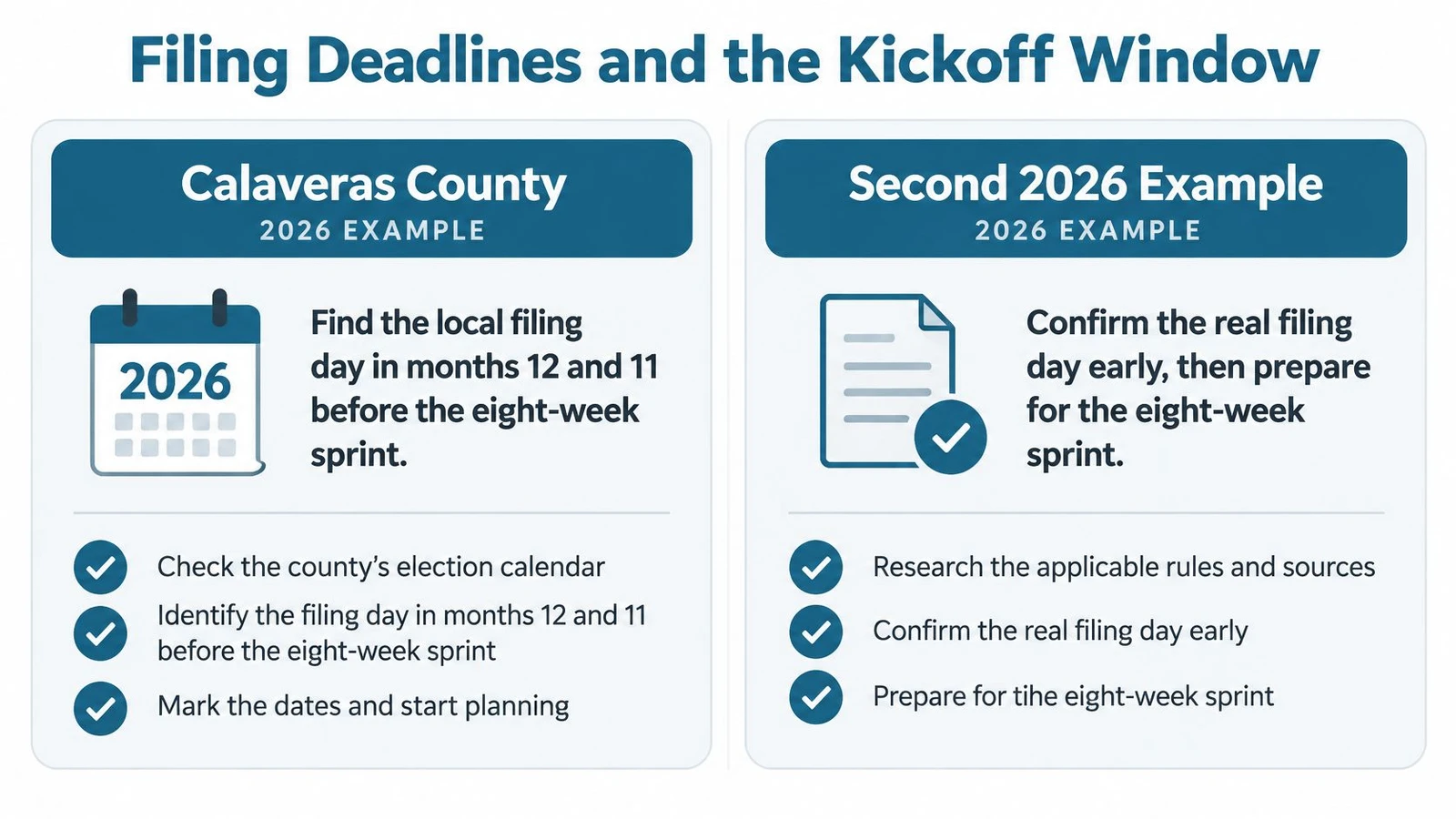
Filing Deadlines and the Kickoff Window
The legal filing date comes before the preferred launch date in planning priority. A candidate can reschedule a kickoff gathering. Missing the applicable filing deadline may leave no comparable remedy.
Months twelve and eleven should therefore include direct contact with the election authority. The candidate needs the calendar for the particular office and ballot-access route, not a general election announcement.
2026 local filing windows compared
The Calaveras County candidate-filing guidance provides the following 2026 county window and electronic-filing threshold; the contrasting Maryland 2026 calendar sets a February 24 candidate-filing deadline and an August 3 general-election petition deadline.
| Jurisdiction | Filing window | Extra requirement |
|---|---|---|
| Calaveras County, California | Nomination and declaration July 13 to August 7, extension to August 12 | Electronic filing for local candidates and officeholders who raised or spent at least $2,000 |
| Maryland | Candidate-filing deadline February 24; general-election petition deadline August 3 | Confirm whether regular candidate filing or general-election petition access applies |
The lesson is the spread, not a date another candidate should copy. A February deadline puts kickoff preparation and signature or petition work in the first quarter. A July–August filing window still calls for forms, petition planning, and finance setup well before filing opens.
Separate the announcement from ballot access
The public launch announces the candidacy to residents, donors, volunteers, and reporters. Legal filing submits the required documents through the prescribed process. An extension or petition deadline serves a particular legal purpose and shouldn’t be treated as automatic extra time.
A candidate preparing to file should complete a short checklist:
- Confirm the authority. Call the election office or read its official candidate instructions for the exact office.
- Download the forms. Keep the current packet and submission instructions together.
- Check signatures and fees. Establish who may sign, how signatures are submitted, and which payment or alternative applies.
- Assign finance responsibility. Name a treasurer if required and establish who maintains records.
- Set an internal buffer. Put the legal deadline and a two-week preparation buffer on the working calendar.
Filing rule: The actual county, municipal, or applicable state deadline is the immovable milestone.
The buffer is a management choice, not an extension of legal rights. It leaves room to review incomplete paperwork, obtain clarification, and document acceptance.
The candidate’s immediate assignment is to verify the home jurisdiction’s rules this week. California and Maryland illustrate why verification matters, not which dates belong on another locality’s calendar.
Month by Month Plan From Twelve Months Out
A November election gives a local campaign a useful planning clock, but it does not set a universal calendar. A school-board race, a city contest with an earlier election, or a race with a separate primary may need a different sequence. Use this as an operating plan, then shift each month to match the local election date.
| Month out | Milestone | Done when |
|---|---|---|
| 12 | Set the campaign’s working calendar and voter universe | Election month is reflected in the calendar, and the relevant district or precinct and voter filters have been reviewed |
| 11 | Public kickoff or launch | Candidacy is announced to donors, volunteers, and local press |
| 10 | Build the voter universe | District or precinct, party, election history, and age filters are reviewed |
| 9 | Begin early-donor outreach and finance setup | First asks are made and contributions are logged |
| 8 | Set up the field team | A field lead is named and volunteers are recruited |
| 7 | Explore issues and test the message | Talking points reflect real voter conversations |
| 6 | Start voter identification | The team records likely supporters and voter concerns |
| 5 | Establish recurring fundraising | The campaign has a repeatable ask rhythm and has tested one mail or digital approach |
| 4 | Expand turf and train canvassers | Walk lists are sized for a shift and volunteers have practiced |
| 3 | Confirm early-voting rules and reserve GOTV funds | The local early-voting method is confirmed and close-out cash is set aside |
The calendar separates three jobs. Early months establish the voter file and identify who supports the campaign, who is undecided, and who needs more conversation. Persuasion takes repeated, relevant contact; identification is the work of learning where voters stand. The final two weeks should focus on helping supporters complete their ballots, rather than repeating the same persuasion conversations at every door.
What counts as a finished milestone
A milestone is finished when its evidence is saved. For the voter universe, that means the team has reviewed the geography and filters, then saved the list it will work from. In a nonpartisan school-board contest, party alone should not stand in for likely support.
A kickoff is complete when the campaign has follow-up assignments for supporters, volunteers, and donors. A field lead is ready when they can assign shifts and review results. A volunteer bench consists of people who have agreed to a next action.
Give every milestone an owner
A shared calendar should name the person responsible, the work that must happen first, and the evidence that closes the task. A countdown can keep approaching commitments visible. Pretty Progress describes how planners can track event milestones with countdown widgets.
For example, a launch announcement needs approved wording, an invitation list, and someone responsible for follow-up. Settling those decisions before invitations are printed helps avoid rework. The calendar should show dependencies, not just event dates.
Field growth also has a sequence. Train a small team to record answers consistently before expanding turf. Otherwise, the campaign may gather more responses without collecting information the team can use.
- Attach an owner. Name the person responsible for each row.
- Define the evidence. Save the reviewed voter list or completed practice route.
- Review dependencies. Identify what needs to happen before the next assignment begins.
Mark months twelve, eleven, and six on the actual calendar first. Those checkpoints establish the working plan, the public start, and the first organized identification effort.
Fundraising Phases Tied to Real Deadlines
A local campaign must establish its own contribution rules before the first ask. For the 2025–2026 federal cycle, the Federal Election Commission’s contribution-limit guidance sets an individual limit of $3,500 per election to a candidate committee, but that federal limit isn’t permission for an equivalent municipal contribution.
State and local rules can use different limits, donor categories, and restrictions. The treasurer should identify which rules govern the particular committee and how contributions will be checked before acceptance.
Build money around work that must be paid for
Months twelve through nine are the setup and early-donor phase. The campaign establishes the appropriate account and records, confirms the applicable rules, and begins personal asks. Each contribution needs enough information for the treasurer to classify and report it correctly.
Months eight through four establish a recurring fundraising rhythm. The manager should compare expected receipts with approved spending before adding field shifts or ordering communications. The practical question isn’t how much has been raised, but which upcoming commitments the available cash can cover.
A local-office campaign cost breakdown can help organize the budget categories. Actual commitments should still come from the campaign’s own vendor quotes, staffing decisions, and delivery schedule.
The final eight weeks call for a reserve push, not the first serious fundraising attempt. The reserve should cover planned mail, field staffing, communications, and get-out-the-vote work, with responsibility assigned for approving each expense.
Treat reporting as a reconciliation gate
For a federal comparison, the FEC’s 2026 quarterly reporting schedule lists July 15 and October 15 quarterly deadlines, an October 22 pre-general deadline, and a December 3 post-general deadline. Those dates illustrate reporting gates, not the forms or deadlines a local committee should adopt.
Before each applicable local cutoff, the treasurer should reconcile deposits, invoices, reimbursements, and unpaid commitments. Late, unlabeled spending makes both reporting and the closing cash forecast harder.
The campaign’s money plan should fit on three practical lines:
- Applicable limit. Record the governing rule and the person responsible for checking contributions.
- Monthly ask target. Tie fundraising activity to the spending calendar rather than an optimistic total.
- Closing reserve. Name the costs that must remain funded through voting and post-election reconciliation.
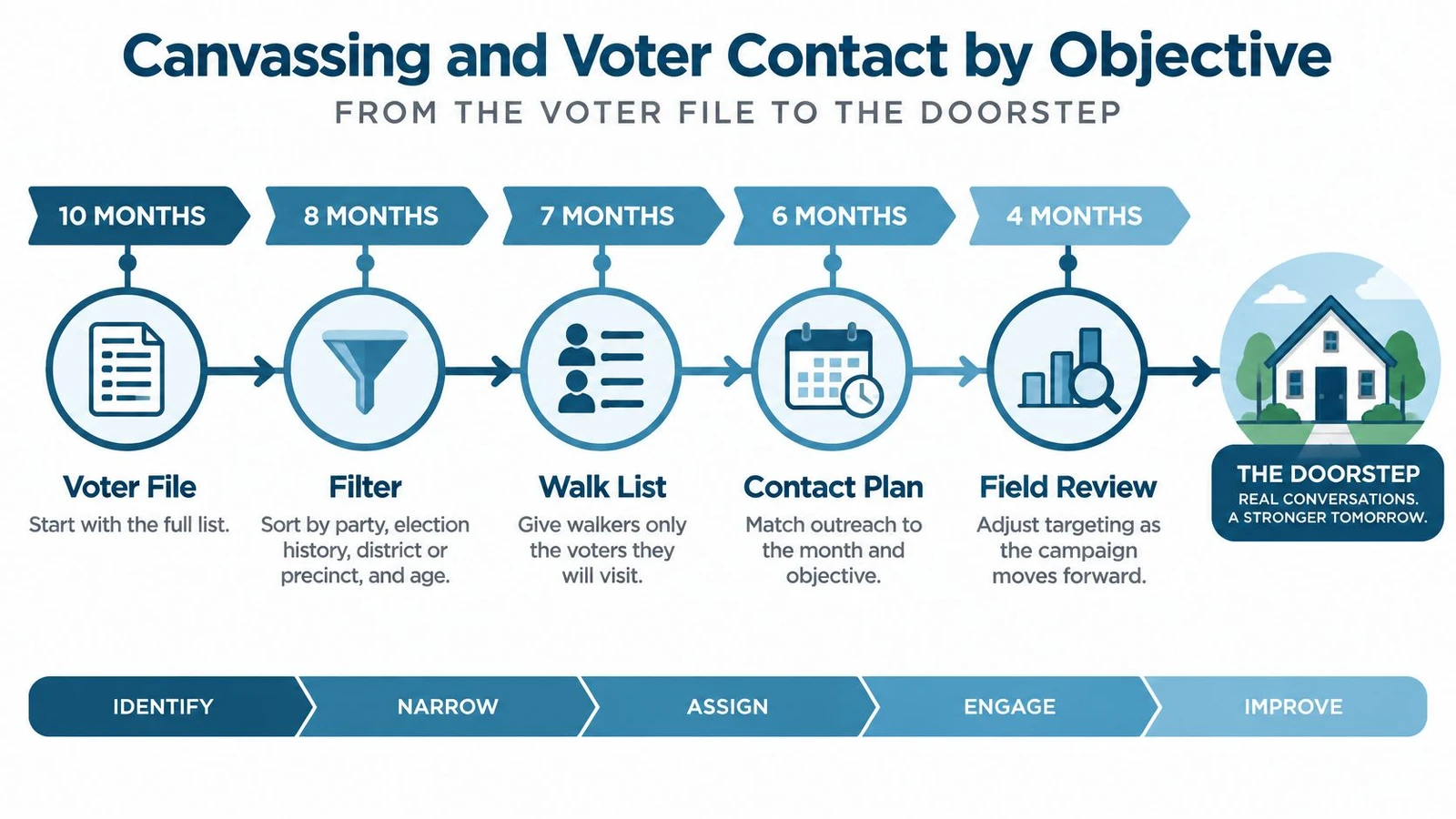
Canvassing and Voter Contact by Objective
A resident might raise concerns about school transportation, express support for the candidate, ask how to register, or need help making a voting plan. Each conversation has a different purpose, so scripts and measures of success should match the job. A door knock is one way to pursue an objective.
Build a team before expanding the walk
- Name the field lead in month eight. This person coordinates assignments, answers volunteer questions, and sets the standard for recording conversations.
- Turn selected voters into routes sized for a shift. Account for street layout, travel between doors, and time to talk.
- Assign people, not just turf. Recruit managers, canvassers, and volunteers, then assign each route to one or more team members.
- Practice a short script for the current objective. An identification script needs a clear support question; an issue-discovery script needs room to listen.
- Review who answered and what each person said before assigning follow-up routes. Record an unanswered door as no contact, not opposition.
The political campaign strategy should guide which objective is in season. Choosing between door knocking and digital voter contact means selecting a channel that fits the purpose, audience, and timing.
For campaigns using doornoc, the voter file can be filtered after campaign setup, and selected voters can be turned into routes using a drawn shape, Auto Turf, an uploaded list, or a MailVotes import. Team members are invited by email and routes assigned to one or more people. A MailVotes list can move into doornoc without a CSV handoff.
Match the script to the job
Months seven and six can focus on learning residents’ concerns and identifying supporters. Keep those findings distinct: a resident who cares strongly about school transportation has shared an issue, but that conversation alone does not establish support.
Registration checks belong before the applicable deadline. Give residents official instructions rather than improvising eligibility advice.
Field discipline: Label each planned canvass as identification, registration, persuasion, or turnout.
The label makes results easier to interpret. An identification route should produce support information; a turnout conversation should help resolve voting barriers. Record those outcomes separately so the campaign can choose the right follow-up.
The Final Eight Weeks Week by Week
More late doors aren’t automatically better. The American Political Science Review analysis of campaign contact reports average persuasive effects near zero in general elections across a meta-analysis of 40 field experiments, with persuasion emerging mainly under unusual conditions and some early effects decaying; the accompanying turnout evidence includes a United Kingdom experiment in which leaflets plus face-to-face canvassing increased turnout by 4.9 percentage points when timed within roughly two weeks of relevant postal-ballot or polling milestones.
That turnout result isn’t a promised lift for a local U.S. race. The useful distinction is between trying to change a preference and helping an existing supporter complete the act of voting.
Final eight weeks through election night
| When | Primary job | Stop doing |
|---|---|---|
| Week 8 | Finish supporter identification; persuade only flagged undecideds | Broad persuasion canvasses |
| Week 7 | Vote-plan conversations with supporters | New turf with no contact history |
| Week 6 | Ballot-access information if early or absentee voting is open locally | Assuming a national early-vote start date |
| Week 5 | Follow up with supporters who haven’t voted | Re-knocking confirmed voters |
| Week 4 | Leaflet plus face-to-face turnout contact; peak volunteer shifts | Message testing |
| Week 3 | Reallocate canvassers using daily results | Equal time on finished routes |
| Week 2 | Mobilization only: site, hours, and rides | Issue persuasion |
| Election week and election night | Election-day voting help, then returns, thanks, and record reconciliation | New voter-contact experiments |
This is an operating template, not a substitute for local voting dates. A campaign with an earlier ballot-return period should move ballot-specific work forward. Leaflet delivery should also match the relevant voting milestone rather than happen on a fixed week merely because the table names it.
Review outcomes rather than door totals
The daily field review should distinguish attempted contacts, completed conversations, identified supporters, unresolved voting questions, and confirmed voting information where available. Staff shouldn’t assume that an absent voter has voted or that someone who received instructions completed a ballot.
A supporter who intends to vote by mail needs different follow-up from a supporter planning to vote on Election Day. The manager should assign the next useful action, not send both people through the same repeated script.
- Identification review. Check whether support levels are clearly known.
- Vote-plan review. Check whether supporters have selected a method and understand the next step.
- Mobilization review. Prioritize unresolved access questions and supporters still needing follow-up.
During the final two weeks, volunteers should focus on ballot completion rather than renewed issue persuasion. Polling-site information, official hours, lawful ride arrangements, and clear ballot instructions are more actionable than another broad message test.
Election night requires its own assignment sheet: monitor official returns, keep volunteers informed, thank the team, and avoid treating incomplete results as final. After the count, the treasurer and field lead should reconcile money, outstanding obligations, and contact records.
Early Voting Windows and the Three Dates
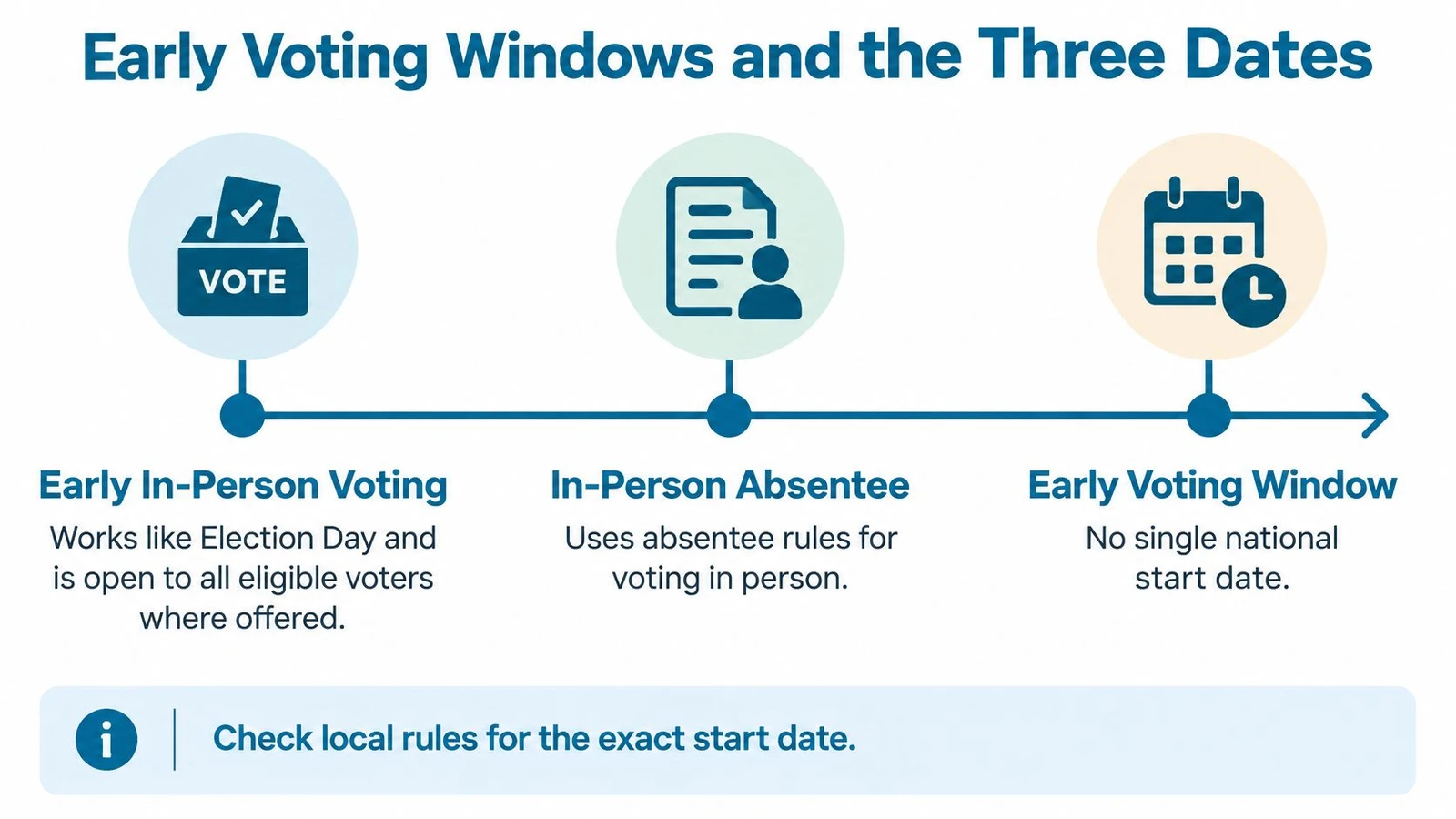
Early voting has no single national start date. The National Conference of State Legislatures’ early-voting guide distinguishes early in-person voting, which works like Election Day voting and is available to all eligible voters where offered, from in-person absentee voting, in which a voter requests, completes, and signs an absentee ballot at a polling place.
Those procedures can sound interchangeable in casual conversation. For campaign planning, the distinction matters because volunteers need the correct instructions, locations, and applicable requirements rather than a generic invitation to vote early.
Turn the local window into contact assignments
In month three, the field lead should obtain the local voting window directly from the election authority and save the official instructions. If early voting isn’t offered, the calendar should say so explicitly rather than leave a blank that volunteers may interpret incorrectly.
The voter universe can then be organized by likely method: early in person, mail or absentee, and Election Day. A stated preference should remain editable. A resident may change plans, and the contact record should preserve the latest information without pretending that intention equals completion.
Each group needs a suitable channel and timing:
- Early in-person voters. Provide the official locations and operating schedule while the window remains open.
- Mail or absentee voters. Share the relevant official request, completion, and return instructions.
- Election Day voters. Confirm the correct site and official hours, and record any unresolved access needs.
The distinction between general outreach and get-out-the-vote work becomes concrete here. A reminder is useful only if it reaches the supporter while the required action remains possible.
Keep ballot information separate from assumptions
Once voting begins locally, scripts should use confirmed ballot-access facts. Volunteers shouldn’t interpret a returned-ballot question, eligibility dispute, or ballot problem themselves. Such questions should go to the election authority through an established referral process.
Records should also distinguish self-reported voting from any official voting-status information available to the campaign. Neither tells the campaign how someone voted. Managers should limit access to contact records to the people who need them for their assigned work.
A local political campaign timeline is ready for use when the manager can connect each upcoming deadline to an owner and a concrete task. The final planning action is simple: the candidate and field lead should leave with the filing deadline, the early-vote start, and Election Day written down, with the absence of an early-voting option clearly noted where applicable.
doornoc offers contact-list and territory management, route planning, door-interaction recording, and team-performance tracking for carrying this calendar into field work. Built for both statewide teams and first-time city-council candidates, the nonpartisan platform serves campaigns across political affiliations. Campaign managers can visit doornoc to organize routes and contact records around the next identification, persuasion, or turnout assignment.
Looking for a tool to run this? doornoc’s canvassing software bundles voter data, automatic turf cutting, the mobile app, and live reporting in one platform.