GOTV, or get-out-the-vote, is the final campaign phase focused on mobilizing identified supporters to vote, and modern mail interventions produce an average turnout increase of 1.3 percentage points. The practical challenge isn’t only choosing the right message. It’s reaching enough of the right people, recording what happened, and acting on that information before voting ends.
The campaign has already spent months persuading undecided voters. Ads have run, debates are finished, endorsements are public, and the field team has a working list of likely supporters. Then the final stretch arrives. Volunteers need doors, routes, scripts, contact statuses, escalation plans, and reliable reporting. A supporter who remains on a spreadsheet isn’t a completed contact, and a completed contact isn’t necessarily a vote.
That distinction explains what GOTV really is. It isn’t a last-minute burst of general awareness. It’s a coordinated mobilization operation designed to convert support into participation.
Defining GOTV in Modern Campaigns
A canvasser reaches a target address near the end of a campaign. The resident may support the campaign, but the volunteer still needs to confirm whether the person knows the voting options, has a plan, faces a practical barrier, or has already voted. The conversation is useful only if the result enters the campaign’s workflow and leads to an appropriate follow-up.
GOTV is the final field phase that mobilizes identified supporters to vote. Persuasion tries to change a voter’s preference. GOTV works with people the campaign already considers supportive or highly likely to support its candidate or cause. The objective shifts from “Who can be convinced?” to “Who needs a clear, timely path to casting a ballot?”
Identification is not contact
Campaign teams often treat a voter file as evidence of progress. It isn’t. A list can identify priority households, but it doesn’t reveal whether volunteers reached the doors, whether a phone number worked, whether a message was understood, or whether a supporter needs assistance.
The operational sequence is straightforward:
- Prioritize supporters. Define the audience using available voter information, previous interactions, volunteer records, and campaign criteria.
- Assign contact channels. Match door knocking, calls, texts, mail, or digital reminders to the geography and audience.
- Deploy the team. Give volunteers usable routes, concise scripts, clear reporting options, and escalation guidance.
- Record outcomes. Capture contact status, support level, voting plan, barriers, and follow-up needs.
- Reallocate effort. Move people and time toward uncontacted priority voters or unresolved barriers.
A campaign that identifies thousands of targets but reaches only a fraction has a logistics problem, not necessarily a messaging problem. The gap between the target universe and the people contacted is the central GOTV bottleneck.
The field director’s real question
The useful question isn’t whether a tactic sounds persuasive. It’s whether the operation can put a trained person in front of the right voter, capture the result, and complete the next action quickly.
A practical guide to canvassing helps clarify the difference between general outreach and structured door-to-door contact. In GOTV, every interaction should have a purpose. A volunteer may confirm a voting plan, provide location information, flag a language need, request a follow-up, or record that the household was unavailable.
Practical rule: Treat every target as a workflow record, not just a name on a list.
That mindset changes staffing, route design, volunteer training, and reporting. A polished script cannot compensate for routes that waste walking time. A large volunteer roster cannot compensate for unclear instructions. GOTV succeeds when campaign intent becomes completed, documented voter contact.
The History and Evolution of Get Out the Vote
The phrase “get out the vote” sounds like a product of modern campaign technology, but the underlying practice is much older. Historical evidence traces the earliest printed citation of the phrase to May 1861 in an Ohio newspaper, while related wording such as “get out the voters” appeared as early as 1838 during Pennsylvania constitutional debates. These origins are documented in the history of the phrase and its changing meaning.
The early meaning was more physical than contemporary campaign language suggests. Mobilization could involve helping voters reach polling places, coordinating local political workers, and making sure supporters completed the journey from intention to participation. The phrase described an action plan rooted in transportation, proximity, personal relationships, and election-day coordination.
A practice shaped by the electorate
GOTV changed as voting rights and campaign communication changed. After women’s suffrage expanded the electorate in 1920, campaigns had a broader group of eligible voters to organize. The operation became less about moving a small known group and more about coordinating participation across larger communities.
Mass media later added another layer. Radio, television, direct mail, and eventually digital communication allowed campaigns to remind and mobilize people beyond the reach of local political organizers. Yet each new channel created the same underlying requirement: a campaign still needed to know whom it was trying to reach and whether that contact occurred.
The tools became more advanced, but the job remained recognizable. Campaigns had to identify supporters, communicate a reason to vote, reduce practical friction, and track completion.
From physical choreography to data operations
Modern GOTV adds data systems to an old organizing function. A campaign can now segment audiences, assign territories, monitor contact progress, and update voter records during the field period. That doesn’t make the work automatic. It makes the quality of the underlying operations more visible.
The historical lesson is useful for current practitioners. GOTV isn’t defined by door knocking, text messages, or dashboards. It’s defined by the conversion of political support into completed participation. The method changes with voting rules, media habits, and available technology, while the operational question remains constant: which supporters still need a timely, workable path to vote?
Core GOTV Tactics and Field Strategies
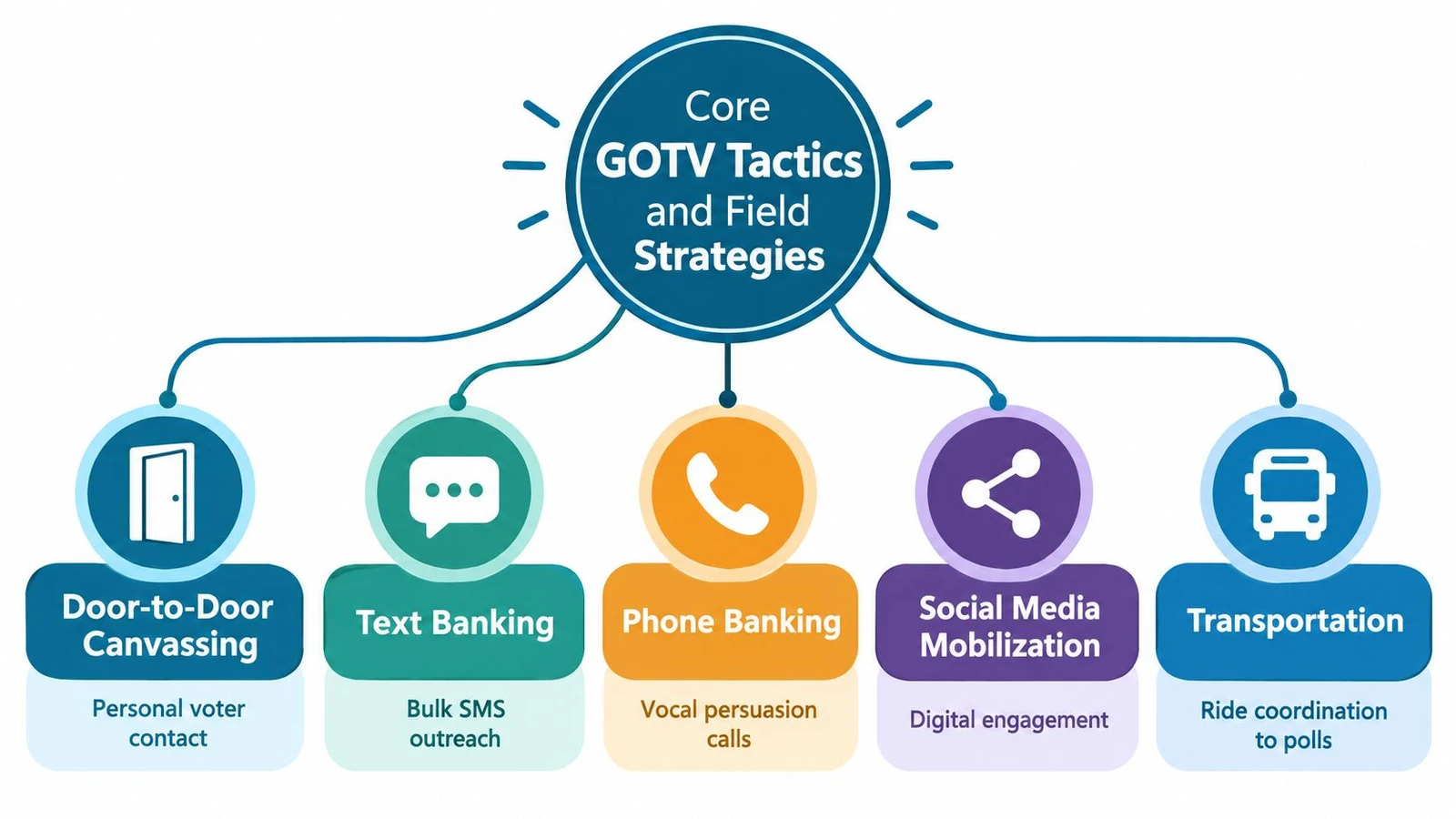
A practical GOTV plan uses channels for different jobs rather than treating them as interchangeable. Door-to-door contact creates rich conversations and reveals barriers. Phone banks extend coverage across larger areas. Texts and mail provide repeatable reminders. Digital outreach can reinforce the campaign’s presence, but it rarely resolves a household’s specific voting problem by itself.
Match the channel to the task
Door-to-door canvassing is valuable when the campaign needs a two-way exchange. Volunteers can confirm support, ask about voting plans, identify accessibility concerns, and provide a personal prompt. The trade-off is operational intensity. Routes must be walkable, turf must be balanced, and volunteers need accurate instructions.
Phone banking can cover dispersed supporters without requiring travel. It works well for confirmations, reminders, and follow-up queues. Answer rates, outdated numbers, and volunteer consistency can limit its usefulness, so call outcomes need clear categories rather than vague notes.
Text messaging offers speed and convenient follow-up. A campaign can send a reminder, ask whether a supporter has a plan, and route replies to trained staff. Text programs need disciplined list management and response handling. Sending messages is easier than resolving the issues voters raise in return.
Direct mail provides a physical reminder that can reach households without volunteer availability. It can carry voting information and a simple action request, but it gives the campaign less immediate visibility into whether the recipient saw or understood it.
Digital outreach helps repeat the campaign’s voting message across familiar online spaces. It can support recognition and timing, but broad exposure shouldn’t be mistaken for confirmed contact. Digital impressions don’t tell a field director which supporter still needs a ride, a reminder, or help finding the correct voting location.
Build the operation around turf
Route design determines how much of the volunteer shift becomes voter contact. A sound turf system separates priority households, creates realistic walking routes, prevents duplicated assignments, and makes unfinished work visible. Teams should also account for apartment access, private roads, steep terrain, disconnected streets, and locations where volunteers may lose connectivity.
Volunteer training has the same practical character. A short briefing should cover the objective, introduction, privacy boundaries, response categories, safety expectations, and the handoff process for questions. Training should include what to do when a supporter has already voted, declines to speak, requests assistance, or raises an issue outside the volunteer’s role.
The canvassing techniques guide can help field teams expand their door-to-door approach, but tactics only matter when the campaign can deploy them consistently. A smaller, well-managed route operation can outperform a larger team that spends shifts searching for addresses or submitting incomplete reports.
Field standard: A channel is only as strong as its contact record, follow-up path, and ability to reach the next priority voter.
A useful sequence begins with personal contact in dense priority areas, adds calls or texts to close gaps, uses mail for reinforcement, and reserves staff attention for unresolved barriers. The mix should change as actual contact results come in, not remain fixed because it appeared in the original plan.
What Research Says About GOTV Effectiveness
GOTV works, but the effect is neither automatic nor uniform. A 2026 Cambridge meta-regression of mail-delivered GOTV field experiments found an average turnout increase of +1.3 percentage points, with a 95% confidence interval from +0.9 to +1.6 points. The findings are reported in the Cambridge analysis of mail-delivered GOTV interventions.
That result is meaningful, but it should reset expectations. A reminder or contact program isn’t a guaranteed conversion engine. Context matters, including the type of election, the voting environment, the audience, the message, the timing, and whether the campaign can reach its targets.
Reach changes the result
Canvassing research highlights the difference between effect among contacted voters and effect across the entire target universe. A pooled estimate of 51 canvassing experiments found that canvassing raised turnout by about 4.3 percentage points among those contacted. If a campaign reaches only 25% of its targets, the effect across the full target universe falls to about 1 point or less, as explained in the Social Innovations Journal analysis of canvassing reach.
The operational implication is direct. A stronger script may improve a conversation, but it can’t help a household the campaign never reaches. Contact rate, route completion, list quality, and follow-up discipline often matter more than another round of message refinement.
The persuasive moment is worthless if the operation never creates it.
Personal contact isn’t universally superior
Direct contact is often treated as the default winner, yet channel performance depends on the setting. A UK field experiment found that party leaflets increased turnout by 4.3 percentage points, while adding canvass visits contributed only 0.6 points beyond leaflets alone and wasn’t statistically significant compared with leaflets by themselves. The same research found canvassing had negligible effects in postal-voter households. These findings appear in the UK field experiment on leaflets and canvass visits.
That doesn’t make canvassing ineffective. It means campaigns should ask where personal contact adds value. A face-to-face conversation may be useful for voters with questions or barriers, while a lower-touch reminder may be sufficient for a supporter who already has a firm plan.
A Brazilian mobilization experiment reported a 4.7 percentage point increase in online voting, further showing that the voting environment affects results. The evidence supports a measured approach: test channel fit, monitor actual reach, and avoid assuming that the most labor-intensive tactic will produce the largest return in every audience.
For teams comparing field labor with calling capacity, the cost-per-vote canvassing and phone-banking analysis offers a useful framework. The decision should rest on contactability, geography, staffing, and the specific barrier the campaign is trying to remove.
Building a GOTV Operation with Modern Tools
Technology should reduce administrative friction, not replace field judgment. A practical system connects voter data, territory assignment, volunteer activity, contact records, and reporting so the field director can see where the plan is working and where it is breaking down.
Start with clean targeting
The operation begins with a defined target universe and consistent records. Campaign staff should decide which fields matter, how support levels will be recorded, which households need follow-up, and who can access sensitive information. Imported lists need matching and geocoding before volunteers receive routes. Manual spreadsheet transfers create avoidable opportunities for duplicates, missing addresses, and mismatched records.
A useful platform should support common list formats, preserve the campaign’s chosen fields, and make it clear when a record has been updated. Staff shouldn’t need to rebuild the same universe each time a route changes.
Turn lists into usable routes
Auto-generated turf can produce balanced, walkable assignments faster than manual map work, but staff still need to review the output. Routes should respect roads, barriers, geographic boundaries, building access, and local volunteer capacity. Custom geography tools are useful when a campaign needs to work within a neighborhood boundary, precinct-like area, or event zone.
Offline collection is equally important. Canvassers may lose service in rural areas, large buildings, or dense neighborhoods with unreliable connectivity. An offline-first mobile workflow lets volunteers record interactions and synchronize them when the device reconnects, instead of forcing them to postpone reporting or keep notes separately.
Use live reporting for decisions
A dashboard should answer operational questions quickly:
- Who is working? Identify active teams, stalled routes, and volunteer assignments that need support.
- What is complete? Separate finished turf from attempted turf and distinguish contacts from unanswered doors.
- Where are gaps forming? Find priority areas with weak completion, poor contactability, or unresolved follow-up.
- What should change today? Reassign volunteers, alter channel mix, add staff support, or schedule another pass.
The value of real-time reporting is not visual polish. It’s the ability to make a decision while the field team can still act on it. Contact logs become useful intelligence when they drive a next step, such as a call, a reminder, a supervisor review, or a route reassignment.
An integrated canvassing platform such as doornoc combines mobile door-knocking, offline data collection, route planning, live tracking, voter data services, and operational reporting. Campaigns evaluating any field system should test the full workflow from list import to final contact export, with special attention to offline behavior, permissions, route balance, and the speed of same-day reporting.
GOTV in Action and Examples
The most useful GOTV examples are not stories about a single magical tactic. They are comparisons between operations that solved different problems.
A dense local race may benefit from door-to-door contact because volunteers can visit many priority households within a compact area and resolve questions in person. The campaign’s success depends on route quality, volunteer attendance, and whether staff records each interaction. A geographically dispersed race may need phone and text programs to reach supporters who are too far apart for efficient walking routes. The trade-off is weaker visibility into whether a person received or understood the message.
A mail-centered program offers another model. It can deliver a consistent reminder across a defined audience without relying on volunteer availability. The evidence discussed earlier shows that mail can produce measurable turnout effects, but the average result is modest and varies by context. That makes delivery, audience selection, timing, and message clarity more important than claims that the channel works universally.
Compare the operational choices
A campaign with limited staff might prioritize the following:
- Dense priority turf: Use door knocking first, then send follow-up messages to households that weren’t reached.
- Scattered supporters: Use calls or texts for initial coverage, reserving field visits for high-priority unresolved records.
- Postal or early voters: Confirm the relevant voting plan and avoid assuming election-day contact is the right intervention.
- Known access barriers: Assign trained staff or designated volunteers to handle transportation, accessibility, language, or information needs.
- Incomplete reporting: Pause expansion and repair the contact workflow before adding more targets.
The common thread is precision. Strong programs define the audience, choose a channel that fits the environment, measure actual contact, and redirect resources when the first plan doesn’t match field conditions.
What campaigns should measure
Turnout is the ultimate outcome, but field teams need earlier indicators to manage the operation. They should monitor route completion, successful contacts, supporter confirmations, unanswered targets, unresolved requests, and follow-up completion. Those measures don’t prove that a person voted, but they show whether the campaign is creating the conditions required for participation.
A campaign shouldn’t celebrate a large number of attempted contacts if priority households remain untouched. It shouldn’t expand into new neighborhoods while volunteers leave completed conversations unrecorded. The strongest example is often the least dramatic: a team that notices a contact gap, changes the route plan, assigns the right channel, and closes the gap before voting ends.
GOTV is therefore less a final message than a final operating system. Identification starts the work. Contact rate determines how much of the target universe receives it. Accurate records and rapid adjustments determine whether the campaign can keep moving supporters from intention to action.
doornoc provides campaign teams with mobile canvassing, route planning, offline contact collection, voter data workflows, and real-time field reporting for GOTV operations. Visit doornoc to evaluate how its tools can help turn identified supporters into completed, trackable contacts.
Looking for a tool to run this? doornoc’s canvassing software bundles voter data, automatic turf cutting, the mobile app, and live reporting in one platform.