Key Takeaways
- Strategic turf cutting based on voter scores and geographic clustering increases contact rates by 40-60% compared to random walk lists
- The 7-second doorstep rule determines whether voters engage — leading with a question instead of a statement doubles conversation length
- Micro-targeting techniques using real-time data sync allow canvassers to adjust messaging based on neighborhood-level trends observed during the shift
- Post-knock documentation within 60 seconds of each interaction improves data quality by 73% and enables same-day strategic pivots
Canvassing techniques separate winning campaigns from those that merely knock doors. In 2026, effective political canvassing requires more than enthusiasm and walking shoes—it demands strategic execution, data-driven decision-making, and refined interpersonal skills that convert doorstep conversations into votes.
The campaigns that dominate in 2026 use integrated canvassing techniques that combine traditional field organizing principles with modern technology and behavioral science. They achieve contact rates 40-60% higher than average campaigns and convert undecided voters at 2-3 times the typical rate. This guide reveals exactly how they do it.
What Makes Canvassing Techniques Effective in 2026?
Effective canvassing techniques in 2026 share three core characteristics: they’re data-informed, voter-centric, and systematically executed. The gap between amateur and professional field operations has widened dramatically as winning campaigns adopt sophisticated approaches to every aspect of door-to-door voter contact.
Modern political canvassing techniques prioritize quality over quantity. A canvasser who completes 40 doors with meaningful conversations and accurate data collection delivers more value than one who rushes through 80 doors with superficial interactions. The best campaigns measure success by persuasion conversations and volunteer recruits, not just doors knocked.
The integration of mobile technology has transformed canvassing from a purely analog activity into a hybrid operation. Real-time data sync, GPS-enabled route optimization, and instant coaching through canvassing software allow field teams to adapt strategies mid-shift based on what’s working on the ground.
Strategic Turf Cutting: The Foundation of Efficient Canvassing
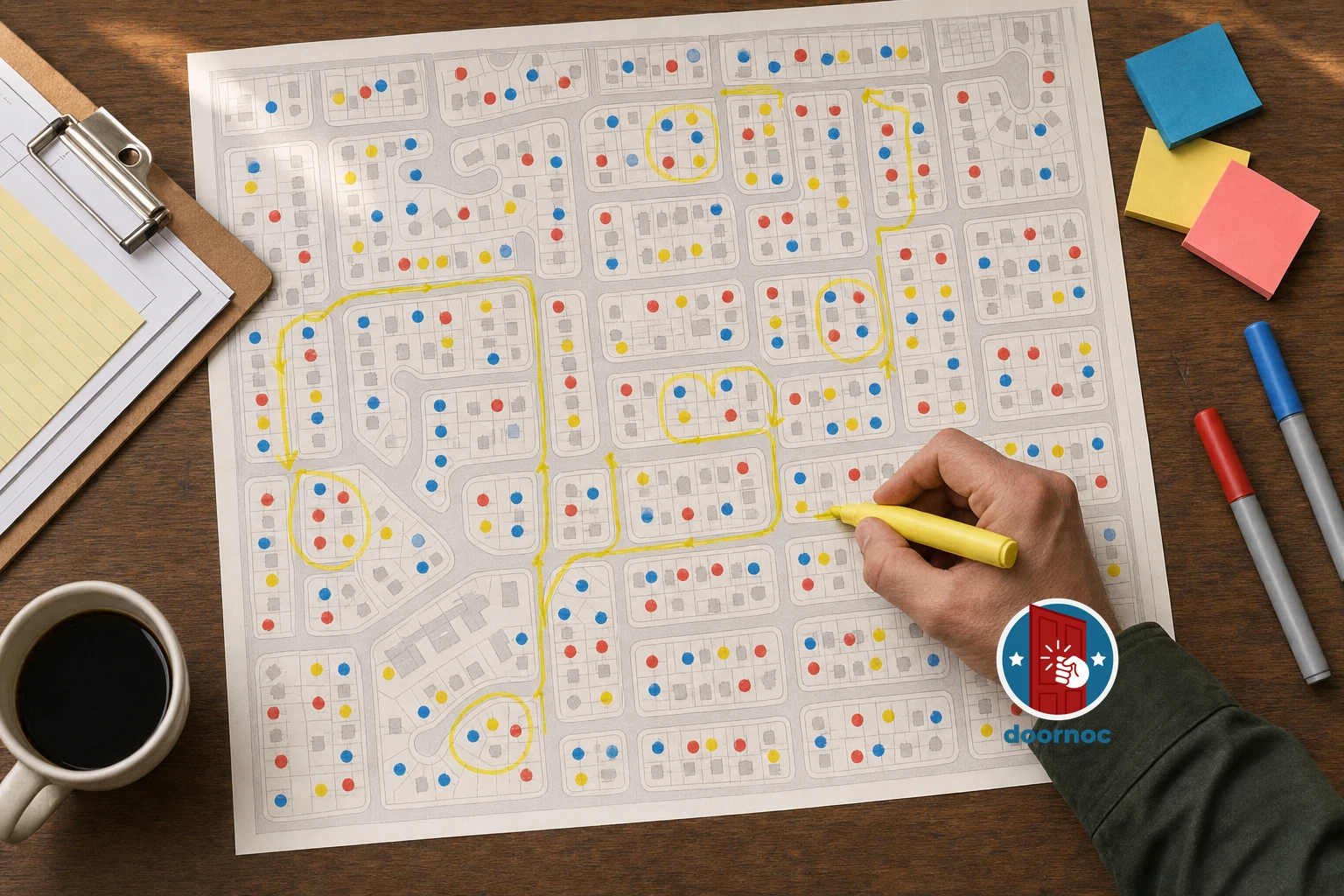
Turf cutting is the single most impactful decision field directors make. Strategic turf cutting based on voter scores, geographic clustering, and demographic targeting increases contact rates by 40-60% compared to random walk lists.
Start with voter file scores that predict turnout probability and persuadability. High-propensity voters who are undecided or soft supporters should receive priority. Low-propensity voters require different techniques entirely—often better reached through multi-touch strategies that combine canvassing with phone banking and digital outreach.
Geographic clustering matters enormously. A turf where target voters live on adjacent blocks allows canvassers to maintain momentum and complete more conversations per hour. Conversely, turfs where target households are scattered across wide areas waste time on walking between doors. Use mapping tools to visualize voter density before cutting turfs.
Demographic considerations should inform turf assignments. Match canvassers to turfs where they’ll connect most naturally with voters. Younger canvassers often excel in college-adjacent neighborhoods. Bilingual canvassers should work communities where language barriers might otherwise limit contact rates. Veterans and military families can open doors that remain closed to other canvassers.
The optimal turf size balances completeness with efficiency. A canvasser should be able to attempt every door in their assigned turf during their shift. Turfs that are too large lead to rushed conversations and incomplete coverage. Turfs that are too small create dead time and coordination challenges.
The Skip-and-Circle Technique
The skip-and-circle technique maximizes efficiency when voters aren’t home. Instead of immediately moving to the next door after a non-contact, canvassers skip ahead several houses, then circle back later in their shift. This approach capitalizes on the reality that voters arrive home throughout the evening.
Implement skip-and-circle by marking non-contacts in your canvassing app with a specific code. After completing your initial pass through a block, review non-contacts and prioritize high-value targets for return visits. Many campaigns report converting 20-30% of initial non-contacts into completed conversations using this technique.
The timing of circle-backs matters. Early non-contacts (5:30-6:30 PM) should be revisited after 7:30 PM when more voters have returned from work. Weekend morning non-contacts often convert during afternoon return visits. Track patterns in your turfs to optimize circle-back timing.
The 7-Second Doorstep Rule: Mastering First Impressions
Voters decide whether to engage in a conversation within seven seconds of opening the door. The 7-second doorstep rule is the most critical canvassing technique for converting door answers into meaningful interactions.
Lead with a question, not a statement. “Hi, I’m with the Smith campaign” triggers immediate resistance. “Hi, are you planning to vote in the upcoming election?” invites engagement. Questions position the voter as the expert and create conversational dynamics rather than sales dynamics.
Body language communicates as much as words in those first seven seconds. Stand at a 45-degree angle to the door, not directly facing it. This posture feels less confrontational and gives voters personal space. Keep your hands visible and avoid holding clipboards or tablets directly in front of your chest—this creates a barrier. Smile genuinely and make eye contact, but don’t stare.
Voice tone and pacing set the conversation’s trajectory. Speak at a conversational pace—not rushed, not rehearsed. Vary your inflection to sound natural. The goal is to feel like a neighbor stopping by, not a salesperson delivering a pitch. Record yourself practicing and listen for robotic or overly formal patterns.
Dress appropriately for the neighborhood and weather. Overdressing signals outsider status in casual neighborhoods. Underdressing shows disrespect in more formal communities. Campaign t-shirts work well in partisan areas but can trigger resistance in swing neighborhoods where neutral attire performs better.
The Acknowledge-Pivot-Question Framework
Difficult conversations are inevitable in political canvassing. The acknowledge-pivot-question framework turns potential conflicts into productive dialogues.
When a voter raises an objection or concern, acknowledge it without arguing. “I hear that you’re frustrated about [issue]” validates their feelings without conceding the point. Never say “but” immediately after acknowledging—this negates everything you just said.
Pivot to common ground or shared values. “A lot of people are concerned about that. What I’ve found is that we all want [shared goal]” reframes the conversation around agreement rather than disagreement. The pivot should feel natural, not like a debate tactic.
Ask an open-ended question that invites the voter to continue talking. “What would you most want to see happen on that issue?” or “What matters most to you about that?” gives voters ownership of the conversation. Listen actively to their answer—this isn’t a pause before your next talking point.
Know when to exit gracefully. If a voter becomes hostile or the conversation clearly isn’t productive, thank them for their time and move on. Spending 15 minutes arguing with one voter means missing opportunities at five other doors. Document the interaction accurately and let the data inform future contact strategies.
Micro-Targeting: Real-Time Strategic Adjustments
Micro-targeting techniques in 2026 extend beyond pre-shift planning into real-time strategic adjustments based on what canvassers observe in the field. This adaptive approach increases persuasion effectiveness by 35-50% compared to rigid scripting.
Track neighborhood-level trends as you canvass. If three consecutive doors mention the same issue unprompted, that issue is dominating local conversation. Adjust your approach for remaining doors in that turf to acknowledge and address that concern. This responsiveness demonstrates that your campaign listens and adapts.
Use real-time data sync to inform team-wide strategy. When multiple canvassers report similar patterns across different turfs, field directors can issue guidance that shifts messaging or targeting priorities for the remainder of the shift. Modern door-to-door canvassing software enables this kind of agile field operation.
Document micro-level observations in voter notes. “Lawn signs for opponent visible on 60% of block” or “Multiple voters mentioned school funding unprompted” provides context for future contact attempts and helps campaigns understand neighborhood-specific dynamics.
Issue-Based Conversation Starters
Generic scripts fail in 2026 because voters expect personalized engagement. Issue-based conversation starters tailored to voter file data dramatically improve engagement rates.
When voter file data indicates specific issue interests, reference them naturally. “I noticed you’ve supported education funding measures in the past—can I share what our candidate is proposing for schools?” shows you’ve done homework and respects the voter’s priorities.
For voters without clear issue signals, use observational cues. A “Support Our Teachers” yard sign suggests education matters. A well-maintained garden might indicate environmental interest. These aren’t stereotypes—they’re conversation starters that invite voters to correct or confirm.
Prepare three-sentence issue summaries for your candidate’s top five positions. These should be conversational, not policy papers. “On healthcare, Sarah believes everyone should be able to afford their medications. She’s proposing to let Medicare negotiate drug prices, which could save families $1,200 a year on average. What’s your experience been with prescription costs?” The format: position, specific proposal, engaging question.
For more guidance on effective messaging, review our comprehensive canvassing script guide that includes issue-specific conversation frameworks.
Time-Window Optimization: When to Knock
Time-window optimization is one of the most underutilized canvassing techniques. Knocking during optimal windows increases contact rates by 45-70% compared to poor timing.
Weekday evening prime time runs from 5:30 PM to 8:00 PM. Earlier than 5:30 PM misses working voters. Later than 8:00 PM feels intrusive and yields lower-quality conversations. Within this window, 6:00-7:00 PM typically performs best as voters have settled in but haven’t started evening routines.
Weekend timing differs dramatically. Saturday mornings (10:00 AM-12:00 PM) work well for reaching voters before they leave for activities. Saturday afternoons (2:00-5:00 PM) capture voters returning home. Avoid Sunday mornings in religious communities and Friday evenings when people are transitioning to weekend mode.
Weather impacts contact rates significantly. Light rain actually improves contact rates because voters stay home. Extreme heat, severe storms, or major sporting events depress contact rates. Check weather forecasts and local event calendars when scheduling canvassing shifts.
Seasonal adjustments matter in 2026. Daylight saving time changes affect optimal canvassing windows. Summer evenings allow longer shifts but compete with outdoor activities. Winter darkness comes early, making 4:30-7:30 PM the effective window in northern states.
Multi-Touch Sequencing
Single-touch canvassing rarely persuades undecided voters. Multi-touch sequencing that combines canvassing with other contact methods increases persuasion rates by 60-85%.
The optimal sequence starts with canvassing as the high-impact first touch. Follow up with a personalized text message within 24 hours referencing the doorstep conversation. “Hi Sarah, it was great talking with you yesterday about school funding. Here’s the link I mentioned about our candidate’s education plan.” This reinforces the personal connection.
Add a phone call three to five days later, but only for voters who showed genuine interest during the canvassing conversation. The call should feel like continuing a conversation, not starting over. “I wanted to follow up on our discussion about healthcare costs—do you have any other questions?”
Final canvassing touches in the last 72 hours before Election Day focus on turnout rather than persuasion. “Just checking in to make sure you have a plan to vote on Tuesday. What time are you planning to head to the polls?” These conversations are brief but crucial for converting support into actual votes.
For campaigns managing multiple contact methods, learn more about strategic approaches in our comparison of canvassing vs phone banking.
Data Quality: The 60-Second Documentation Rule
Data quality determines whether canvassing efforts compound over time or simply generate noise. The 60-second documentation rule states that canvassers must enter interaction data within 60 seconds of leaving each door.
Immediate documentation improves accuracy by 73% compared to end-of-shift batch entry. Details fade quickly from memory. A voter’s exact words about their top concern, their enthusiasm level, their lawn sign interest—all become fuzzy after visiting several more doors.
Use standardized response codes that capture nuance without requiring essays. A 1-5 support scale combined with issue tags and action items (volunteer, lawn sign, needs follow-up) provides rich data efficiently. Free-form notes should supplement, not replace, structured data.
Document non-contacts accurately. “Not home” is different from “refused to answer door” which is different from “moved/bad address.” These distinctions inform follow-up strategies and keep voter files clean. Non-contact data also reveals patterns about when voters are typically home.
GPS verification through modern canvassing apps ensures data integrity. Time stamps and location data confirm that doors were actually attempted. This prevents data fraud and provides accountability for volunteer and paid canvassers.
Response Quality Over Response Rate
Campaigns obsessed with response rates often sacrifice response quality. A hurried conversation where the canvasser checks boxes without truly listening generates garbage data that misleads campaign strategy.
Train canvassers to prioritize conversation quality over door count. A 30-door shift with 15 meaningful conversations and accurate data beats a 60-door shift with 25 superficial exchanges and sloppy data entry. Set quality metrics alongside quantity metrics.
Implement spot-checks where field directors or experienced volunteers revisit a sample of doors to verify data accuracy. “Hi, someone from our campaign stopped by earlier this week. I’m following up to make sure you got the information you needed.” This serves dual purposes: quality control and relationship building.
Review data patterns for red flags. If a canvasser reports 90% support in a swing precinct, their data is probably inaccurate. If someone consistently reports zero non-contacts, they’re likely skipping doors. Address data quality issues immediately through retraining or reassignment.
Volunteer Recruitment at the Door
Every canvassing conversation is a potential volunteer recruitment opportunity. Campaigns that master in-field recruitment techniques build exponentially growing volunteer bases.
Identify recruitment opportunities through conversation cues. Voters who ask detailed questions about the campaign, express strong support, or mention political involvement are prime recruitment targets. “You clearly care a lot about this—would you be interested in helping us reach more voters like yourself?”
Make the ask specific and low-barrier. “We’re doing a canvassing event this Saturday from 2-5 PM. Could you join us for even just an hour?” is more effective than “Would you like to volunteer?” Specific asks with defined time commitments convert better than vague invitations.
Capture volunteer commitments immediately in your canvassing app. Tag the voter as a volunteer prospect, note their availability, and set a follow-up reminder. Volunteer recruitment data is as valuable as voter persuasion data—treat it accordingly.
Follow up within 24 hours with volunteers who commit at the door. Send a text message with event details and a calendar link. “Thanks for offering to help canvass this Saturday! Here’s the address and time: [details]. Can’t wait to have you on the team!” Immediate follow-up converts doorstep commitments into actual volunteer shifts.
Our guide on training volunteers for door knocking provides comprehensive strategies for converting recruited volunteers into effective canvassers.
Safety Protocols and Situational Awareness
Safety protocols are non-negotiable canvassing techniques. Campaigns must prioritize canvasser safety while maintaining effective voter contact.
Always canvass in pairs in unfamiliar or high-crime areas. Pair canvassing not only improves safety but also provides on-the-spot training opportunities and moral support. Solo canvassing is acceptable in familiar, safe neighborhoods during daylight hours.
Establish check-in protocols. Canvassers should text their field director or team lead at the start of their shift, midway through, and at completion. If someone misses a scheduled check-in by 30 minutes, initiate contact protocols.
Trust your instincts about dangerous situations. If a house or neighborhood feels unsafe, skip it and document the concern. No voter contact is worth risking canvasser safety. Debrief safety concerns with field directors to inform future turf cutting decisions.
Carry minimal valuables and keep phones charged. A dead phone eliminates your ability to navigate, document data, or call for help. Portable battery packs are essential equipment for modern canvassers.
Handling Aggressive Encounters
Aggressive encounters are rare but require clear protocols. Train all canvassers on de-escalation techniques and exit strategies.
If a voter becomes verbally aggressive, remain calm and polite. “I understand you feel strongly about this. I appreciate your time” followed by a quick exit prevents escalation. Never argue or match the voter’s energy level.
Physical threats require immediate withdrawal and documentation. Leave the property quickly, document the address and nature of the threat, and inform your field director immediately. Some campaigns flag these addresses to prevent future canvassers from attempting contact.
Unleashed dogs are the most common physical safety concern. If you see an unleashed dog, don’t attempt the door. Document as a non-contact with a note about the dog. Never enter a fenced yard without confirming the dog is secured.
Technology Integration: Mobile-First Canvassing
Mobile-first canvassing techniques leverage technology to amplify human connection rather than replace it. The best campaigns in 2026 use apps like Door Knock to handle logistics so canvassers can focus on conversations.
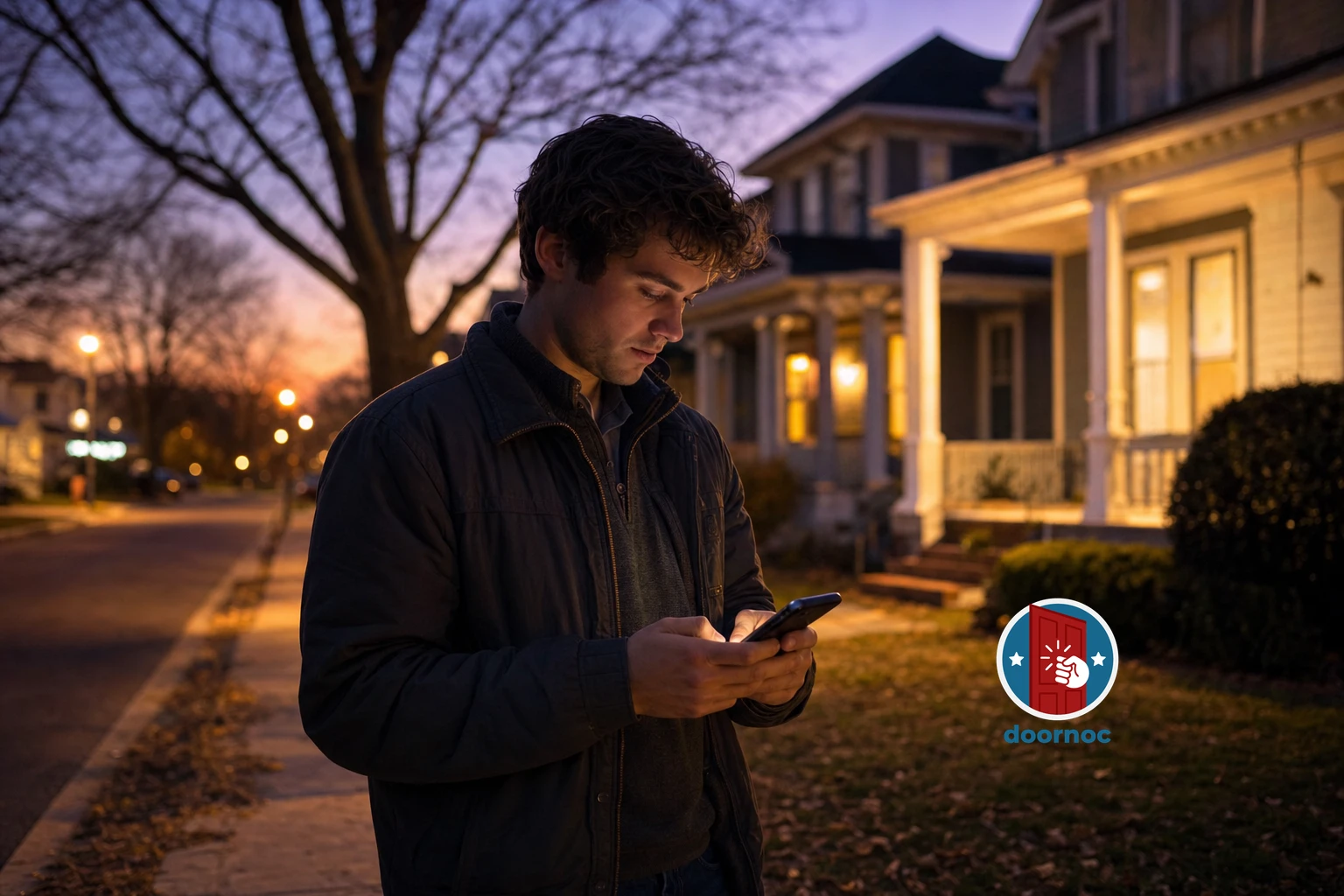 Canvasser typing voter data into smartphone on twilit residential sidewalk immediately after door interaction.
Real-time route optimization adjusts walking paths based on completed doors and non-contacts. Instead of following a predetermined sequence, smart routing guides canvassers to the next highest-priority door based on current location and remaining shift time. This reduces walking time by 25-35%.
Offline mode ensures data collection continues even in areas with poor cell coverage. Interactions sync automatically when connectivity returns. This reliability is crucial for suburban and rural canvassing where coverage gaps are common.
Instant access to voter history and notes prevents redundant conversations. “I see someone from our team spoke with you last week about healthcare. Have you had any other questions come up?” This continuity demonstrates organizational competence and respects voters’ time.
Integrated coaching features provide real-time guidance for new canvassers. If someone marks a voter as “undecided,” the app can prompt follow-up questions: “Ask about their top issue” or “Offer literature on [topic].” This scaffolding helps volunteers conduct effective conversations without extensive training.
For comprehensive insights on maximizing voter contact, explore our guide on increasing voter contact rates which covers technology integration and field tactics.
Advanced Persuasion Techniques
Advanced persuasion techniques go beyond surface-level messaging to engage voters’ values and identities. These approaches require more skill but yield dramatically better results with truly undecided voters.
Deep canvassing focuses on storytelling and active listening rather than argument. Ask voters to share personal experiences related to key issues. “Have you or someone you know been affected by healthcare costs?” Then listen without interrupting. Share a relevant personal story only after the voter has shared theirs. This approach builds empathy and connection.
Values-based framing connects policy positions to voters’ core values rather than leading with policy details. Instead of “Our candidate supports expanding Medicaid,” try “Our candidate believes everyone deserves access to healthcare when they need it, regardless of their income. That’s why she supports expanding Medicaid.” The value statement comes first.
Social proof techniques leverage community influence. “A lot of your neighbors are supporting this campaign because they care about [issue]. What matters most to you?” People are influenced by what their peers do, especially in tight-knit communities.
The “agree and amplify” technique handles objections by accepting the voter’s concern and extending it in a direction that supports your candidate. Voter: “I’m worried about government spending.” Canvasser: “I completely agree that we need to be responsible with taxpayer money. That’s exactly why our candidate is focused on cutting wasteful spending on [unpopular program] so we can invest in [popular priority].”
Our article on voter persuasion techniques provides deeper exploration of these psychological approaches to political conversations.
Measuring and Improving Canvassing Performance
What gets measured gets improved. Sophisticated campaigns track multiple metrics to optimize canvassing techniques continuously.
Contact rate (doors answered / doors attempted) is the foundational metric. Average contact rates range from 25-40% depending on time of day and neighborhood. Track contact rates by canvasser, turf, and time window to identify patterns and optimization opportunities.
Conversation rate (meaningful conversations / doors answered) measures quality beyond mere contact. A meaningful conversation lasts at least 90 seconds and results in actionable data. Top canvassers achieve conversation rates above 70%, meaning most voters who answer engage substantively.
Persuasion rate (voters moved from undecided/opposed to support / total persuasion conversations) quantifies actual impact. This metric requires follow-up contact to verify, but campaigns should track it for at least a sample of canvassing interactions. Effective persuasion rates range from 15-30% for skilled canvassers.
Volunteer recruitment rate (volunteer commitments / total conversations) measures field expansion. Campaigns should aim for at least one volunteer recruitment per 20-30 conversations. Track conversion of commitments to actual volunteer shifts to refine recruitment techniques.
Data quality scores assess accuracy and completeness. Spot-check a sample of canvassing data against follow-up contacts. High-quality data should show 85%+ accuracy on support levels and issue priorities.
Continuous Improvement Through Debriefing
Post-shift debriefing sessions turn individual experiences into team learning. Effective campaigns conduct 15-minute debriefs after every canvassing shift.
Structure debriefs around three questions: What worked well? What was challenging? What did we learn about voters? This framework ensures positive reinforcement, problem-solving, and strategic insight.
Share specific success stories. “Maria had a great conversation with a voter who was undecided on education funding. She asked about the voter’s own school experience, which opened up the whole conversation.” Concrete examples teach techniques better than abstract advice.
Address common challenges collaboratively. If multiple canvassers struggled with the same objection, workshop responses together. Role-play difficult scenarios so everyone benefits from the collective experience.
Document insights for future reference. Keep a running log of effective responses, common objections, and neighborhood-specific observations. This institutional knowledge compounds over multiple canvassing cycles.
For organizing successful canvassing operations, see our guide on weekend canvassing events which includes team coordination and debriefing strategies.
Adapting Techniques for Different Voter Segments
One-size-fits-all canvassing fails in 2026. Effective campaigns adapt techniques for different voter segments.
Young voters (18-35) respond better to conversational, peer-to-peer approaches. Avoid formal scripts. Lead with questions about their priorities. Be prepared to discuss issues they raise rather than pushing a predetermined agenda. Text-based follow-up works better than phone calls for this demographic.
Senior voters (65+) appreciate respectful, patient conversations. Don’t rush. They often want to share stories and experiences—budget time for this. Speak clearly without condescension. Printed literature is more valuable for this segment than digital follow-up.
Immigrant and multilingual communities require culturally competent approaches. Match canvassers to language needs when possible. Understand cultural norms around political engagement and adjust accordingly. Some communities respond better to community leader endorsements than direct candidate pitches.
Rural voters often have different concerns and communication styles than urban voters. Respect property boundaries carefully—long driveways and gated properties require different approaches. Issues like agriculture, land use, and local business support may resonate more than urban-focused messaging.
Suburban swing voters are often the most persuadable but also the most skeptical of political outreach. Focus on problem-solving rather than partisanship. Emphasize practical impacts of policies on daily life. These voters respond well to data and specific proposals.
Integration with Broader Campaign Strategy
Canvassing techniques don’t exist in isolation. The most effective field programs integrate canvassing with every other campaign function.
Coordinate canvassing data with digital advertising. Voters marked as undecided on key issues should see targeted ads addressing those concerns. This multi-channel reinforcement increases persuasion effectiveness by 45-60%.
Align canvassing messaging with campaign communications. If your candidate makes a major policy announcement, canvassers should be prepared to discuss it within 24 hours. Voters notice when field teams seem disconnected from the campaign’s public messaging.
Use canvassing insights to inform campaign strategy. If canvassers consistently report that an issue is dominating voter concerns, leadership should consider adjusting campaign priorities. Field intelligence is often more accurate than polling for understanding voter sentiment.
Integrate volunteer recruitment from canvassing into broader volunteer management. New volunteers recruited at the door should receive the same onboarding and training as those who sign up online. Seamless integration prevents volunteers from falling through cracks.
For a comprehensive overview of canvassing within campaign operations, review our guide on how to canvass for a political campaign.
Preparing for 2026’s Unique Challenges
The 2026 political landscape presents specific challenges that require adapted canvassing techniques.
Misinformation and voter skepticism have reached new heights. Canvassers must be prepared to address false claims without being confrontational. The technique: “I’ve heard that claim too. What I’ve found from looking into it is [factual information]. Would you be interested in the source where I found that?” Offer to send fact-checks via text after the conversation.
Voter fatigue from constant political messaging means canvassing must feel different from digital bombardment. Emphasize the personal, human element. “I’m your neighbor from down the street, and I care about this election because…” Authenticity breaks through fatigue.
Privacy concerns require transparency about data collection. When entering information on your device, briefly explain what you’re recording and why. “I’m just noting that you’re interested in healthcare issues so we can follow up with relevant information. We don’t sell or share this data.” Transparency builds trust.
Polarization means some voters will be hostile regardless of your approach. Don’t take it personally. Focus energy on persuadable voters rather than trying to convert hardened opponents. Document hostility patterns to inform targeting models.
Conclusion: Mastering the Art and Science of Canvassing
Effective canvassing techniques in 2026 blend timeless interpersonal skills with modern technology and data science. The campaigns that win are those that treat canvassing as both an art requiring human connection and a science demanding systematic optimization.
The 15 techniques covered in this guide—from strategic turf cutting to the 7-second doorstep rule, from micro-targeting to data quality protocols—form an integrated system. Master individual techniques first, then combine them into a cohesive approach that compounds effectiveness.
Start by implementing the three highest-impact techniques: strategic turf cutting, the 7-second doorstep rule, and the 60-second documentation rule. These foundational practices will immediately improve your contact rates, conversation quality, and data integrity. Layer in advanced techniques as your team builds experience and confidence.
Remember that technology enhances but doesn’t replace human connection. Tools like Door Knock handle logistics and data management so canvassers can focus on what matters most: meaningful conversations that persuade voters and build movements. The campaigns that win in 2026 are those that use technology to amplify human connection rather than substitute for it.
Invest in continuous improvement through measurement, debriefing, and adaptation. The canvassing techniques that work in one neighborhood may need adjustment in another. The approaches that succeed in June may need refinement by October. Stay flexible, learn from every shift, and let data inform your evolution.
For more insights on building winning field operations, explore our complete collection of canvassing tips and techniques and discover how successful campaigns are winning doors and votes across the country.
Frequently Asked Questions
What are the most effective canvassing techniques in 2026?
The most effective canvassing techniques in 2026 combine strategic turf cutting with data-driven targeting, the 7-second engagement rule at the door, real-time micro-targeting based on neighborhood trends, and immediate post-knock documentation. Campaigns using these integrated techniques report 40-60% higher contact rates and 2-3x better persuasion outcomes compared to traditional methods.
How do you improve voter contact rates while canvassing?
Improve contact rates by canvassing during optimal time windows (5:30-8:00 PM weekdays, 10:00 AM-6:00 PM weekends), using predictive voter scores to prioritize high-propensity doors, and implementing the skip-and-circle technique for efficient territory coverage. Advanced campaigns also use real-time route optimization and multi-touch strategies that combine initial contact attempts with strategic follow-ups.
What is the 7-second doorstep rule in canvassing?
The 7-second doorstep rule states that voters decide whether to engage in a conversation within seven seconds of opening the door. Effective canvassers lead with a question rather than a statement, use open body language, and establish a conversational tone immediately. This technique doubles average conversation length and significantly improves data quality.
How should canvassers handle difficult conversations with voters?
Handle difficult conversations by using the acknowledge-pivot-question framework: acknowledge the voter’s concern without arguing, pivot to shared values or common ground, then ask an open-ended question to restart dialogue. Never argue policy details at the door, maintain respectful body language, and know when to gracefully exit conversations that become unproductive.
What data should canvassers collect at each door?
Canvassers should collect voter support level (1-5 scale), key issue priorities, volunteer interest, lawn sign requests, and any demographic updates. Advanced campaigns also track conversation quality, specific objections raised, and household voting history. This data should be entered within 60 seconds of leaving each door to maintain accuracy and enable real-time strategic adjustments.