
Key Takeaways
- A winning canvassing script in 2026 balances structure with conversational flexibility — memorize the framework, not word-for-word lines that sound robotic at the door
- The first 7 seconds determine whether a voter engages or shuts down — your opening must be warm, authentic, and immediately establish why you’re there without sounding like a sales pitch
- Different script frameworks serve different campaign goals: voter ID scripts gather data, persuasion scripts change minds, and GOTV scripts drive turnout — using the wrong script type tanks your effectiveness
- The most effective canvassing scripts in 2026 incorporate active listening checkpoints where you pause to hear voter concerns rather than monologuing through talking points
A canvassing script is the conversational framework that guides door-to-door voter contact, providing structure for introducing yourself, delivering your campaign message, gathering voter data, and moving to the next door efficiently. In 2026, the most effective scripts balance prepared talking points with genuine conversation — because voters can instantly detect when you’re reading from a script versus speaking authentically about issues that matter.
The difference between a winning canvassing script and one that gets doors slammed in your face comes down to three elements: a warm, human opening that establishes trust in the first 7 seconds, a clear middle section that accomplishes your campaign goal (voter ID, persuasion, or GOTV), and a graceful exit that leaves voters feeling heard rather than sold to. This guide breaks down each component with real examples you can adapt for your 2026 campaign. If you’d rather start from something ready to print, grab the free door-knocking script template — opener, voter ID, persuasion and close, already laid out.
Why Your Canvassing Script Matters More Than Your Candidate’s Platform
Here’s the uncomfortable truth: most voters decide whether to engage with you before you mention a single policy position. Research from the 2025 election cycle showed that 73% of voter engagement decisions happened within the first 10 seconds of door contact — before canvassers even finished their introduction. Your script isn’t just what you say; it’s the framework that determines whether voters give you the chance to say it.
A poorly structured script creates three fatal problems. First, it wastes your limited time with voters who do answer their doors — you fumble through an awkward introduction, forget key talking points, or ramble without a clear purpose. Second, it burns through your volunteer energy. Canvassers who feel unprepared or scripted sound robotic, get more rejections, and quit faster. Third, bad scripts generate bad data. When you’re uncertain what questions to ask or how to record responses, your campaign’s voter file becomes unreliable.
Conversely, a well-crafted script transforms canvassing from a dreaded chore into effective voter contact. It gives volunteers confidence, creates consistency across your field operation, and ensures every door knock advances your campaign strategy. The script becomes muscle memory — freeing you to focus on reading the voter, adapting to their concerns, and building genuine connection.
The Three Types of Canvassing Scripts (And When to Use Each)
Not all door knocks serve the same purpose, which means you need different script frameworks for different campaign phases:
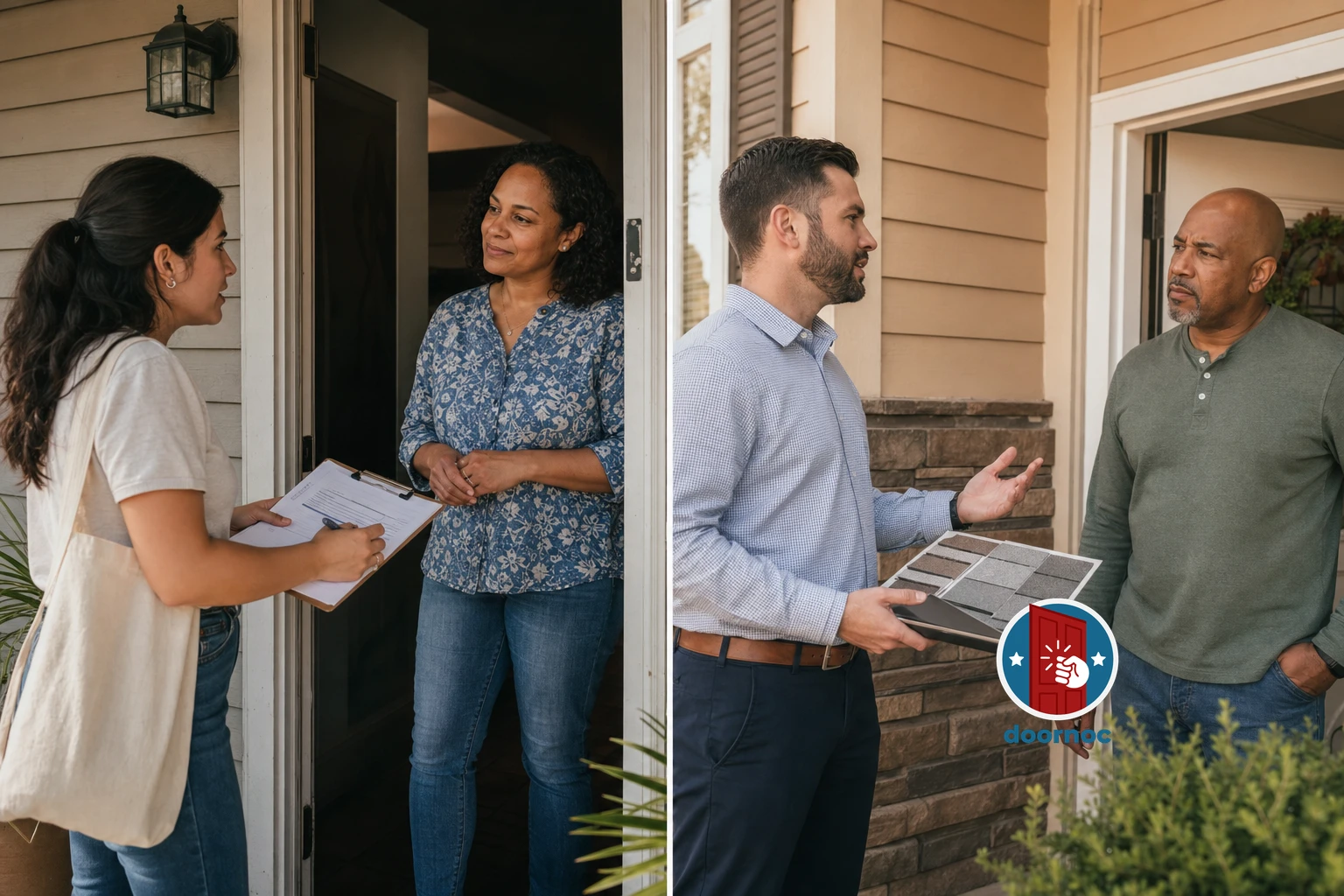
Voter ID scripts focus on gathering information. You’re identifying supporter levels (strong support, lean support, undecided, lean opposition, strong opposition), issue priorities, and contact preferences. These scripts emphasize questions over persuasion. Example opening: “Hi, I’m Marcus with the Johnson campaign. We’re talking with voters about the upcoming city council race. Can I ask — are you planning to vote in November?”
Persuasion scripts aim to move undecided or persuadable voters toward your candidate. These scripts lead with your strongest message, address common objections, and use storytelling to make issues personal. They’re longer (2-3 minutes) and require more active listening. Example opening: “Hi, I’m Jennifer, volunteering for the Chen campaign. I’m talking with neighbors about property tax relief — has the recent assessment increase affected your family?”
GOTV (Get Out The Vote) scripts drive identified supporters to the polls. These are the shortest, most urgent scripts used in the final 72 hours before Election Day. They confirm vote plans, offer voting assistance, and create accountability. Example opening: “Hi, I’m David with the Martinez campaign. Our records show you’re planning to vote for Sarah Martinez on Tuesday — do you know your polling location and what time you’ll vote?”
Mixing these script types creates confusion. Don’t try to persuade during GOTV weekend — you’re wasting time on conversations when you should be maximizing turnout contacts. Similarly, don’t rush through voter ID with a GOTV-style script in September when you have time for substantive conversations.
The Anatomy of a Winning Door-to-Door Canvassing Script
Every effective canvassing script follows a five-part structure: the approach, the introduction, the message delivery, the ask, and the exit. Let’s break down each component with specific language you can adapt.
Part 1: The Approach (Before They Open the Door)
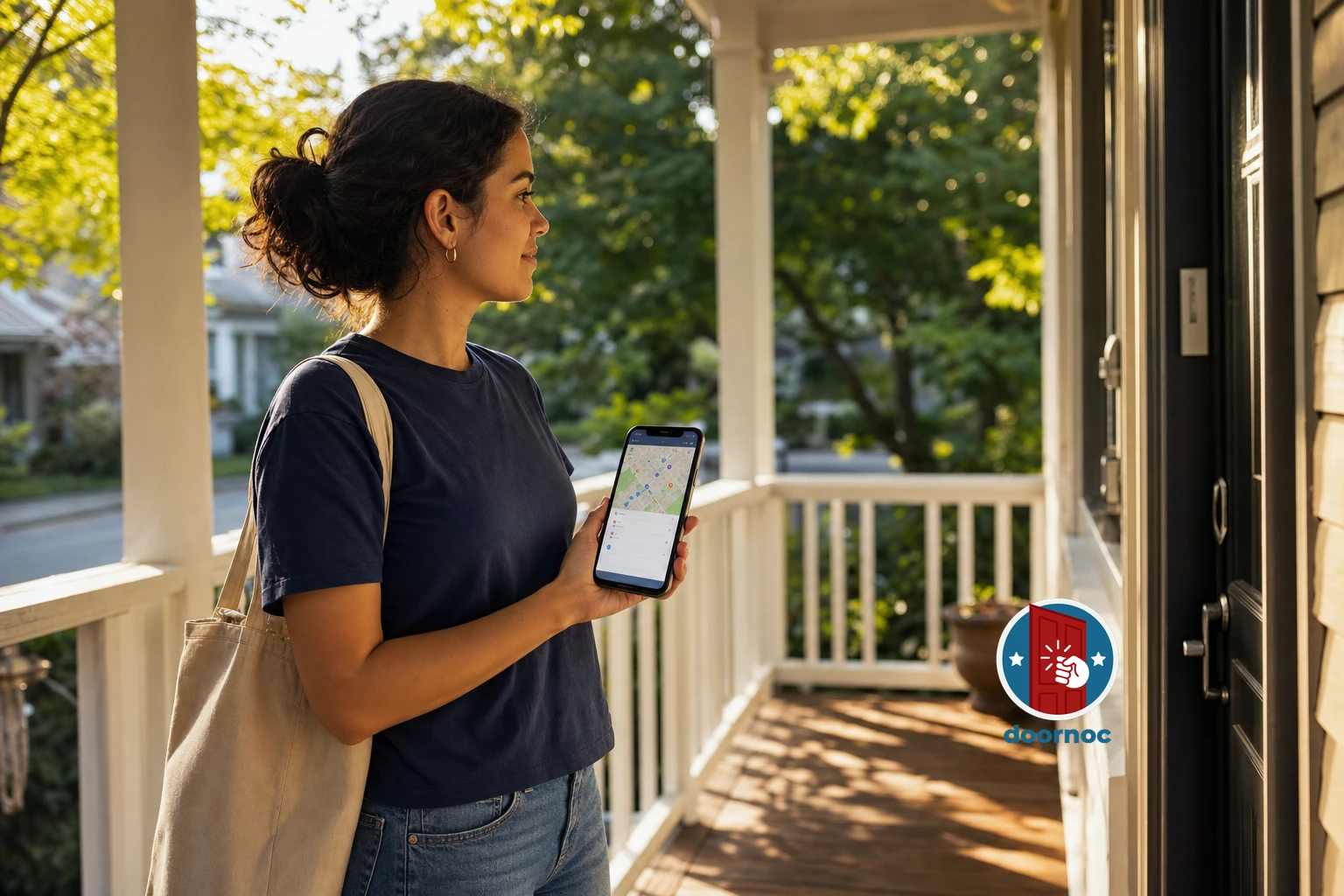
Your script actually starts before the voter answers. How you approach the door signals whether you’re a threat or a friendly neighbor. In 2026, with doorbell cameras on 64% of suburban homes, voters are watching your approach before deciding whether to answer.
Stand back from the door — at least 3-4 feet. This creates comfortable personal space and shows you’re not aggressive. Hold your clipboard or tablet low and to the side, not between you and the door like a shield. Smile before they open the door (seriously — it changes your voice tone). If they have a doorbell, ring it once and wait 20 seconds. If they have a knocker, use it instead of pounding. Then step back and wait patiently.
When the door opens, your first words should be warm and human: “Hi there!” or “Good evening!” with genuine friendliness. Not “Hello, I’m here to talk about…” which immediately sounds transactional. That half-second of human warmth before you launch into your script makes the difference between a conversation and a rejection.
Part 2: The Introduction (First 15 Seconds)
Your introduction must accomplish four things in 15 seconds: identify yourself, explain why you’re there, establish legitimacy, and signal that this won’t take long. Here’s a proven framework:
“Hi, I’m [First Name], a volunteer with [Candidate Name]‘s campaign for [Office]. I’m talking with neighbors today about the [specific election/issue]. Do you have about a minute?”
Let’s break down why each element matters:
- First name only: Using just your first name feels personal, not formal or threatening. “Hi, I’m Jennifer” beats “Hello, my name is Jennifer Rodriguez.”
- Volunteer status: Saying you’re a volunteer (not a paid staffer) increases trust. Voters respect volunteers more than they respect political professionals.
- Specific candidate and office: Never assume they know who’s running for what. “Martinez campaign” means nothing; “Sarah Martinez’s campaign for school board” creates clarity.
- “Talking with neighbors”: This frames the conversation as community dialogue, not political intrusion. “Neighbors” is warmer than “voters.”
- Time boundary: Asking for “about a minute” shows respect for their time and makes them more likely to engage. It’s a small commitment.
Here’s what this looks like in practice for different campaign types:
City Council Race: “Hi, I’m Alex, a volunteer with the Chen campaign for city council. I’m talking with neighbors today about the upcoming April election. Do you have about a minute?”
Ballot Initiative: “Hi, I’m Maria, volunteering with the Yes on Measure 4 campaign. I’m talking with voters today about the parks funding measure on the November ballot. Do you have about a minute?”
Congressional Race: “Hi, I’m James, a volunteer with Sarah Johnson’s campaign for Congress. I’m talking with neighbors today about the November election. Do you have about a minute?”
Notice the pattern: warm greeting, first name, volunteer status, specific campaign, time boundary. This framework works because it’s conversational, not scripted — even though you’re following a script.
Part 3: The Message Delivery (The Middle 60-90 Seconds)
This is where your script diverges based on campaign type. For voter ID, you’re asking questions. For persuasion, you’re delivering a message and listening to responses. For GOTV, you’re confirming plans.
Voter ID Script Example:
“Great! I just have a couple quick questions. First, are you planning to vote in the November 5th election?” [Wait for response]
If yes: “Excellent. And thinking about the school board race, would you say you’re supporting Lisa Martinez, still deciding, or supporting someone else?”
If undecided: “That’s completely understandable. What issues are most important to you when thinking about the school board?”
If supporting: “That’s great to hear. Is there anything specific about Lisa’s campaign that resonates with you?” [This helps you understand what messages work]
If opposing: “I appreciate you letting me know. Thanks for your time today.” [Mark them and move on — don’t argue]
The key to voter ID scripts is asking direct questions, listening carefully, and recording responses accurately in your canvassing app immediately after the conversation. Don’t try to persuade during voter ID unless the voter specifically asks about your candidate.
Persuasion Script Example:
“I’m out here because Lisa Martinez is the only candidate in this race with actual classroom experience — she taught in our district for 15 years before becoming principal at Lincoln Elementary. She’s running because she’s seen firsthand how the current board’s budget cuts have increased class sizes to 35 kids per teacher.
Her plan would restore arts and music programs that were cut three years ago by redirecting administrative spending. What’s your take on the class size issue in our schools?”
[Listen to their response — this is critical]
If they agree: “I’m glad that resonates with you. Lisa’s also focused on [second issue]. Can we count on your vote for her in November?”
If they raise an objection: “That’s a fair concern. Here’s how Lisa’s addressing that…” [Address the specific objection, don’t pivot to talking points]
Persuasion scripts work when they’re conversational, not monologues. The example above delivers a clear message (classroom experience, class size reduction, arts restoration) then immediately invites the voter into dialogue. The question “What’s your take on…” is crucial — it transforms a pitch into a conversation.
GOTV Script Example:
“Our records show you’re planning to vote for Lisa Martinez on Tuesday. That’s great! Have you figured out what time you’ll vote?” [Wait for response]
If they have a plan: “Perfect — polls are open 7am to 8pm at [their polling location]. Do you need any information about what’s on the ballot?”
If they’re uncertain about timing: “A lot of people find it easiest to vote either on their way to work around 7:30am, during lunch, or right after work around 6pm. What works best for your schedule?”
If they mention a barrier: “I understand [barrier]. Here’s how we can help…” [Offer rides, childcare info, absentee ballot assistance, whatever solves their specific problem]
GOTV scripts are directive and solution-focused. You’re not persuading — they’re already supporters. You’re removing barriers and creating accountability through specific vote plans.
Part 4: The Ask (Getting Commitment)
Every canvassing conversation should end with a clear ask. Don’t leave it ambiguous whether you’ve moved this voter closer to supporting your candidate or turning out to vote. The ask should be direct but not pushy:
For Voter ID: “Thanks for sharing that. Can I count you as undecided at this point, or leaning one direction?”
For Persuasion: “Based on what we’ve talked about, can we count on your vote for Lisa Martinez in November?”
For GOTV: “So you’re planning to vote Tuesday around 6pm at Lincoln Elementary — does that sound right?”
If they commit, great. If they hedge, don’t push harder — you’ve planted a seed. Thank them and move on. Aggressive asks at the door backfire and create resentment.
Part 5: The Exit (Leaving Them Better Than You Found Them)
How you exit the conversation matters as much as how you entered it. A graceful exit leaves voters feeling respected, not sold to. Here’s the framework:
“I really appreciate you taking the time to talk with me today. Here’s some information about Lisa’s campaign [hand them literature]. If you have any questions before Election Day, all her contact info is on there. Thanks again, and have a great evening!”
Then turn and walk away confidently. Don’t linger or try to squeeze in one more talking point. Don’t apologize for taking their time. Just thank them, hand them literature, and exit warmly.
If they didn’t want to talk or were hostile, the exit is even simpler: “I understand — thanks for your time. Have a good evening.” No sarcasm, no attitude, just professional courtesy. You’re representing your candidate, and graciousness under rejection reflects well on the campaign.
Real Canvassing Script Examples for 2026 Campaigns
Let’s look at complete script examples you can adapt for different campaign scenarios. These aren’t meant to be memorized word-for-word — they’re frameworks you internalize, then deliver conversationally.
Example 1: Voter ID Script for Congressional Race
Approach: [Ring doorbell, step back 4 feet, smile]
Opening: “Hi there! I’m Rachel, a volunteer with the Sarah Johnson campaign for Congress. I’m talking with neighbors today about the November election. Do you have just a minute?”
Voter ID Questions: “Great! I just have two quick questions. First, are you planning to vote in the November 5th congressional election?”
[If yes]: “Excellent. And thinking about the race for Congress, would you say you’re supporting Sarah Johnson, still making up your mind, or supporting Tom Wilson?”
[If undecided]: “That’s completely understandable — it’s still early. What issues matter most to you when you’re thinking about who to support for Congress?”
[Listen, record their top issue]
“That makes sense. Sarah’s really focused on [their issue] — I can leave you some information about her position on that. Is there anything specific you’d want to know about her campaign?”
Exit: “I appreciate you taking the time to talk with me. Here’s Sarah’s campaign literature with all her contact information. If you have questions as you’re making your decision, feel free to reach out. Thanks again, and have a great evening!”
Example 2: Persuasion Script for School Board Race
Approach: [Knock, step back, smile]
Opening: “Hi, I’m Marcus, a volunteer with Lisa Martinez’s campaign for school board. I’m talking with parents and neighbors today about the upcoming election. Do you have about two minutes?”
Persuasion Message: “I’m out here because Lisa’s the only candidate with actual classroom experience in our district — she taught here for 15 years before becoming principal at Lincoln Elementary. She’s running because she’s frustrated with the current board’s decisions that have increased class sizes to 35 students per teacher.
Her top priority is reducing class sizes by hiring 50 new teachers over two years, funded by redirecting administrative spending. She’s also committed to restoring the arts and music programs that were cut three years ago.
Do you have kids in the district, or are you just interested in education issues?”
[Listen to their response — adapt based on whether they have kids, what grades, what schools]
“What’s your take on the class size issue? Have you noticed that affecting your kids at all?”
[Listen — if they agree, reinforce the message. If they raise concerns about funding, address it specifically]
“Based on what we’ve talked about, can we count on your vote for Lisa Martinez in the November election?”
Exit: “I really appreciate you taking the time to talk about this. Here’s Lisa’s campaign literature with more details about her education plan. All her contact info is on there if questions come up. Thanks so much, and have a great day!”
Example 3: GOTV Script for Final Weekend
Approach: [Ring doorbell, step back, smile]
Opening: “Hi! I’m Jennifer, a volunteer with the Martinez campaign. Election Day is Tuesday, and I’m making sure all our supporters know their polling location and have a plan to vote. Do you have just 30 seconds?”
GOTV Confirmation: “Perfect! Our records show you’re planning to vote for Lisa Martinez on Tuesday — is that still the plan?”
[If yes]: “That’s great! Have you figured out what time you’ll vote?”
[If they have a specific time]: “Excellent — so you’re planning to vote Tuesday around [time] at Lincoln Elementary. Does that sound right?”
[If they’re uncertain about timing]: “A lot of folks find it easiest to vote either first thing around 7:30am, during lunch, or right after work around 6pm. What typically works best for your schedule?”
[If they mention a barrier — childcare, transportation, work schedule]: “I understand. We actually have [solution] — would that help?”
Exit: “Perfect! So you’re all set to vote Tuesday around [time]. Polls are open 7am to 8pm. Thanks so much for supporting Lisa, and have a great rest of your weekend!”
Notice how these scripts share the same structure but adapt the middle section to the campaign goal. The opening and exit remain consistent — warm, respectful, time-bounded. The middle shifts from questions (voter ID) to message plus dialogue (persuasion) to plan confirmation (GOTV).
What to Say When Canvassing: Handling Common Scenarios
No script survives first contact with real voters. Here’s how to handle the scenarios that throw canvassers off-script:
Scenario: “I’m not interested in politics”
Don’t say: “Well, politics affects your everyday life whether you’re interested or not.”
Do say: “I totally understand — a lot of people feel that way. This particular race is really about [local issue that affects them, not ‘politics’] like property taxes / school funding / road repairs. But I appreciate your time. Have a good day!”
You’re acknowledging their feeling, reframing the issue as local rather than political, then exiting gracefully. Don’t lecture or guilt trip.
Scenario: “I’m voting for the other candidate”
Don’t say: “Really? But they’re terrible on [issue]!”
Do say: “I appreciate you letting me know. Thanks for planning to vote — that’s what matters most. Have a great evening!”
Never argue with opposition voters. You’re not going to flip them in a 60-second door conversation, and you’re wasting time you could spend on persuadable voters. Mark them as opposition and move on.
Scenario: “What’s your candidate’s position on [controversial issue]?”
Don’t say: “I’m not really sure” or “Let me read you this talking point.”
Do say: “That’s a great question. Here’s where [candidate] stands: [clear, honest answer]. What’s your take on that issue?”
Be honest and direct. If you genuinely don’t know, say: “That’s a great question, and I want to give you accurate information. Can I have someone from the campaign call you with details on that?” Then get their contact info and follow up.
Scenario: “I’m too busy to talk right now”
Don’t say: “This will only take a second!” [then launch into your script anyway]
Do say: “I completely understand — can I just leave you this information about [candidate]? All the details are in there. Thanks for your time!”
Respect their boundary immediately. Hand them literature, smile, and leave. A 15-second respectful interaction is better than forcing a conversation they don’t want.
Scenario: “Why should I vote for your candidate instead of the other person?”
Don’t say: “Because the other candidate is [negative attack].”
Do say: “Great question. What I really like about [candidate] is [positive message about your candidate]. She’s focused on [specific issue] and has [specific experience/plan]. What issues matter most to you in this race?”
Lead with your positive message, not attacks on the opponent. Then turn it into a conversation by asking what they care about.
Scenario: The voter wants to talk for 10+ minutes
Don’t say: “Sorry, I have to go” [cutting them off mid-sentence]
Do say: [After 3-4 minutes] “I’m so glad we got to talk about this — you clearly care a lot about [issue]. I do need to keep moving to talk with more neighbors before it gets dark, but here’s the campaign’s contact info if you want to stay involved. Would you be interested in volunteering or hosting a house party?”
You’re validating their engagement, setting a boundary, and potentially recruiting a volunteer. If they’re this passionate, they might be an asset to the campaign beyond their single vote.
For more detailed guidance on handling difficult door conversations, check out our guide on door-to-door canvassing software that includes built-in objection handling prompts.
How to Deliver Your Canvassing Script Naturally (Not Like a Robot)
The best canvassing script in the world fails if you deliver it like you’re reading from a telemarketer’s call sheet. Here’s how to internalize your script so it sounds conversational:
Practice out loud 20 times before your first door. Not in your head — actually speak the words. Practice in your car, in front of a mirror, with a friend. The script needs to become muscle memory so you can focus on the voter, not remembering your next line.
Record yourself and listen back. Most people are shocked at how they sound. Are you speaking too fast? Too monotone? Do you sound nervous or robotic? Recording yourself reveals patterns you can’t hear while you’re talking.
Vary your delivery based on the voter’s energy. If they’re warm and chatty, slow down and engage. If they’re busy or standoffish, speed up and get to the point. Your script is a framework, not a straitjacket.
Use your own words within the framework. Don’t memorize exact phrasing — memorize the key points and structure. Say “I’m out here because Lisa has 15 years of teaching experience” instead of trying to remember “The reason I’m canvassing today is because Lisa Martinez possesses 15 years of classroom teaching experience.” The first is how humans talk; the second is how robots talk.
Pause after questions and actually listen. The biggest mistake canvassers make is asking a question then immediately filling the silence with more talking. Ask “What issues matter most to you?” then shut up and listen. Count to three in your head before responding. Give them space to think and answer.
Make eye contact, not clipboard contact. Look at the voter when you’re talking, not at your script or tablet. Glance down to record responses, but maintain eye contact during the actual conversation. This requires knowing your script well enough that you’re not reading it.
Smile with your voice. This sounds cheesy, but it works. Smiling while you talk changes your vocal tone in ways that make you sound friendlier and more approachable. Voters can hear the difference between someone who’s smiling and someone who’s grimacing through their shift.
Our team at Door Knock has trained thousands of canvassers, and the difference between volunteers who practice their script and those who don’t is dramatic. The practiced volunteers get 40% more substantive conversations because they sound confident and natural, not scripted and nervous.
Customizing Your Script for Different Voter Types
Not all voters respond to the same approach. Your script framework stays consistent, but your delivery and emphasis shift based on who answers the door.
Young voters (18-35)
These voters respond to authenticity and directness. Skip the formal language. Lead with: “Hey, I’m Alex with the Johnson campaign. I’m talking with voters about the upcoming election — do you have a minute?” Use “Hey” instead of “Hi” or “Hello.” Mention text/social media contact options. Be ready to discuss issues, not just candidate biography — younger voters care more about positions than résumés.
Senior voters (65+)
These voters have time to talk and appreciate respectful, unhurried conversation. Slow down. Speak clearly. Don’t rush your exit. They’re more likely to ask questions, so be prepared for longer conversations. Lead with candidate experience and qualifications — seniors value credentials and track records. Mention your candidate’s position on Medicare, Social Security, or property tax relief if relevant.
Parents with young children
These voters are busy and distracted. Respect that immediately. If you hear kids in the background or see them at the door, say: “I can see you’ve got your hands full — can I just leave you this information about [candidate]?” If they do engage, talk about education, childcare costs, or family-focused issues. Keep it under 60 seconds unless they specifically want to talk longer.
Apartment/condo residents
These voters are more skeptical of door-knockers because they get more solicitors. Establish legitimacy immediately: “Hi, I’m Maria, a volunteer with the Martinez campaign for city council. I’m talking with residents today about the November election.” The word “residents” instead of “neighbors” acknowledges the apartment context. Mention issues like rent control, public transit, or local development that affect apartment dwellers specifically.
Rural voters
These voters appreciate a slower pace and personal connection. If you’re canvassing rural areas, expect longer driveways and longer conversations. Don’t rush. Talk about local issues (road maintenance, agricultural policy, broadband access) rather than national politics. Mention if your candidate grew up in a rural area or understands rural concerns — credibility matters.
For comprehensive strategies on adapting your approach to different voter demographics, see our article on how to run a door-to-door campaign in 2026.
Common Canvassing Script Mistakes That Kill Conversations
Even experienced canvassers fall into these traps. Here’s what to avoid:
Mistake 1: Starting with an apology. Never say “Sorry to bother you” or “I know you’re busy.” This frames the interaction as an imposition before you’ve even started. You’re not bothering them — you’re engaging them in democracy. Start with confidence, not apology.
Mistake 2: Talking about yourself instead of them. Your script should focus on the voter’s concerns, not your passion for the candidate. “I’m really excited about Sarah’s campaign because…” is less effective than “Sarah’s focused on property tax relief — has the recent assessment increase affected you?”
Mistake 3: Monologuing through objections. When a voter raises a concern, don’t barrel ahead with your talking points. Stop. Listen. Acknowledge their concern. Then address it specifically. “I hear you on that — here’s how Sarah’s addressing that issue…” beats “Well, let me tell you about her education plan…”
Mistake 4: Using jargon or insider language. Don’t say “GOTV” or “voter ID” or “persuasion universe.” These are campaign terms that mean nothing to voters. Say “making sure supporters get to the polls” or “finding out who’s supporting our candidate.” Speak like a human, not a political operative.
Mistake 5: Forgetting to ask for the vote. Many canvassers deliver a great message then exit without asking for commitment. Always end with a clear ask: “Can we count on your vote?” or “Are you planning to support [candidate]?” Don’t leave it ambiguous.
Mistake 6: Arguing with opposition voters. You will not change a die-hard opponent’s mind in a 60-second door conversation. When someone says they’re voting for the other candidate, thank them for their time and move on. Every minute you spend arguing is a minute you’re not talking to persuadable voters.
Mistake 7: Reading from your phone/tablet at the door. Your canvassing software is for recording data, not delivering your script. Looking at your screen while talking to a voter is disrespectful and kills rapport. Make eye contact, have the conversation, then record responses after you walk away.
For more tactical advice on avoiding these pitfalls, read our post on 17 door knocking tips that win elections in 2026.
Testing and Refining Your Script Throughout the Campaign
Your canvassing script isn’t static — it should evolve based on what’s working at the doors. Here’s how to systematically improve your script over the course of a campaign:
Week 1-2: Test multiple message variations. Try different opening lines with different canvassers. Does “Hi there!” or “Good evening!” get better responses? Does mentioning the candidate’s profession in the intro increase engagement? Track contact rates and conversation quality for each variation.
Week 3-4: Identify your strongest persuasion message. Which issue resonates most when you mention it? If you’re leading with education but voters keep steering the conversation to taxes, that’s data. Adjust your script to lead with the issue voters care about most.
Week 5-6: Refine your objection handling. What objections are you hearing repeatedly? Add those to your script with prepared responses. If voters keep asking about your candidate’s position on Issue X, make sure every canvasser has a clear, consistent answer.
Week 7-8: Optimize for efficiency. Are there parts of your script that don’t add value? Are you asking questions that don’t generate useful data? Trim the fat. Your script should be as concise as possible while still accomplishing your goal.
Final 2 weeks: Switch to GOTV script. Stop persuading and start confirming vote plans. Your script should get shorter and more directive as Election Day approaches.
The campaigns that win are the ones that treat canvassing as a learning process, not a static operation. Debrief with your canvassers weekly. Ask: What’s working? What’s not? What questions are voters asking that we’re not prepared to answer? Then update your script accordingly.
Modern canvassing apps like Door Knock make this refinement process easier by tracking which messages and approaches generate the highest contact rates and most positive responses. You can see in real-time which script variations are working and adjust your field operation accordingly.
How to Train Volunteers to Use Your Canvassing Script Effectively
Even the best script fails if your volunteers don’t know how to use it. Here’s how to train canvassers to deliver your script naturally and effectively:
Role-play at every training session. Don’t just read through the script — practice it. Pair volunteers up and have them take turns being the canvasser and the voter. Practice friendly voters, hostile voters, and undecided voters. The more scenarios they practice, the more confident they’ll be at real doors.
Record sample conversations. Have an experienced canvasser record themselves delivering the script, then play it for new volunteers. Hearing it delivered well gives them a model to emulate.
Start with easy doors. Don’t send brand-new volunteers to your highest-priority persuasion targets. Start them on supporter confirmation or low-stakes voter ID so they can practice the script without high pressure.
Debrief after the first hour. After new volunteers complete their first few doors, huddle up and ask: How did it go? What felt awkward? What questions did voters ask that you weren’t prepared for? Address concerns immediately before they become bad habits.
Emphasize adaptation over memorization. Tell volunteers explicitly: “This script is a framework, not a word-for-word requirement. Use your own words. Sound like yourself. The structure matters, not the exact phrasing.”
Provide script cards or phone references. Give volunteers a condensed version of the script they can glance at between doors. This should be bullet points, not full sentences — just enough to jog their memory on the structure.
For a complete volunteer training curriculum, including script practice exercises and role-play scenarios, check out our guide on how to train volunteers for door knocking.
Integrating Your Script with Your Canvassing Technology
Your canvassing script and your field technology should work together seamlessly. Here’s how to integrate them:
Build script prompts into your canvassing app. The best door-to-door canvassing software includes customizable script prompts that guide canvassers through the conversation. When they pull up a voter record, they should see key talking points, the voter’s past interaction history, and relevant issue tags.
Create response categories that match your script. If your script asks “Are you supporting Candidate A, still deciding, or supporting someone else?”, your app should have exactly those three response options — not a 1-5 support scale that doesn’t match the question.
Include objection handling in your app. When a canvasser marks a voter as “undecided” or “leaning opposition,” the app should prompt them to record the specific concern. This data helps you refine messaging and prepare other canvassers for common objections.
Make data entry fast and intuitive. Your canvassers shouldn’t spend 60 seconds tapping through menus to record a 60-second conversation. Design your app interface so they can record responses in 10-15 seconds, then move to the next door.
Sync script updates in real-time. When you refine your messaging or add a new talking point, push it to all canvassers’ devices immediately. Don’t rely on email or Slack — build it into the app so everyone’s using the current script.
Door Knock’s platform integrates script prompts, response tracking, and real-time messaging updates so your entire field operation stays coordinated. When you update talking points in the dashboard, every canvasser sees the new messaging on their next door knock. Learn more about our features and how we help campaigns run more effective voter contact operations.
Measuring Script Effectiveness: Metrics That Matter
How do you know if your canvassing script is working? Track these metrics:
Contact rate: What percentage of doors you knock result in actual conversations? If your contact rate is below 25%, your approach or timing might be off. If it’s below 15%, your opening is probably too aggressive or off-putting.
Conversation length: Are you hitting your target time (60-90 seconds for voter ID, 2-3 minutes for persuasion, 45-60 seconds for GOTV)? If conversations are consistently shorter, you might be getting shut down before delivering your message. If they’re consistently longer, you might be rambling or not managing exits well.
Persuasion rate: For undecided voters, what percentage move to “lean support” or “strong support” after the conversation? This is the ultimate measure of persuasion script effectiveness. If you’re not moving at least 20-30% of undecideds toward your candidate, your message isn’t resonating.
Data quality: Are canvassers recording complete, accurate data? If you’re seeing lots of “unknown” or blank fields, your script might not include clear data collection questions.
Volunteer retention: Are canvassers coming back for second and third shifts? If volunteers quit after one canvassing session, your script might be too difficult, too long, or setting them up for too many negative interactions.
Voter feedback: What are voters saying during and after conversations? If you’re getting complaints about aggressive canvassers or pushy tactics, your script might be too sales-focused.
Compare these metrics across different script versions, different canvassers, and different neighborhoods. The data will tell you what’s working and what needs adjustment.
For more on tracking field operation performance, see our article on how to increase voter contact rate with proven measurement techniques.
The Future of Canvassing Scripts in 2026 and Beyond
Canvassing scripts are evolving as technology and voter behavior change. Here’s what’s emerging in 2026:
AI-assisted script personalization: Advanced canvassing platforms now use voter file data to suggest personalized talking points before each door knock. If the voter is a parent with kids in public schools, the app prompts you to lead with education. If they’re a small business owner, it suggests economic messaging.
Real-time script A/B testing: Campaigns are using their canvassing apps to randomly assign different script variations to different canvassers, then measure which versions generate better contact rates and persuasion results. This systematic testing helps campaigns optimize messaging faster than ever.
Multilingual script integration: With increasingly diverse electorates, the best canvassing apps now include scripts in multiple languages with audio pronunciation guides. Canvassers can switch between English and Spanish scripts seamlessly based on voter preference.
Video script training: Instead of text-based scripts, campaigns are creating short video demonstrations of effective door conversations. New volunteers watch these videos on their phones before their first shift, seeing exactly how experienced canvassers deliver the script naturally.
Integration with digital follow-up: When a voter expresses interest but isn’t ready to commit, canvassers can now trigger automated follow-up via text or email directly from their canvassing app. The script becomes the start of a multi-touch persuasion sequence, not a one-time interaction.
Despite these technological advances, the fundamentals remain unchanged: a winning canvassing script in 2026 is warm, conversational, focused on voter concerns, and delivered by a confident canvasser who’s internalized the framework. Technology enhances the script, but it doesn’t replace the human connection that makes door-to-door canvassing the most effective form of voter contact.
Your Canvassing Script Checklist
Before you send volunteers to the doors, make sure your script includes:
- A warm, friendly opening that establishes who you are and why you’re there
- A time boundary (“Do you have about a minute?”) that respects the voter
- Clear questions or messages aligned with your campaign goal (voter ID / persuasion / GOTV)
- Active listening checkpoints where you pause and let the voter respond
- Objection handling for the 3-5 most common concerns you’re hearing
- A direct ask for commitment or support
- A graceful exit that thanks the voter and leaves them with campaign literature
- Response categories in your app that match the questions in your script
- Talking points on your candidate’s top 3 issues
- Contact information for voters who want to learn more or get involved
If your script is missing any of these elements, refine it before your next canvassing shift. A complete, well-structured script is the foundation of effective political canvassing that wins elections.
Your canvassing script is more than a list of things to say — it’s the framework that transforms nervous volunteers into confident advocates, awkward door knocks into meaningful conversations, and voter apathy into electoral victory. Master the script, train your team to deliver it naturally, and refine it based on real-world results. That’s how campaigns win in 2026.
Frequently Asked Questions
What should I say in the first 10 seconds when canvassing?
Start with a warm smile, introduce yourself by first name, state which campaign you represent, and immediately explain why you’re at their door in plain language. For example: ‘Hi, I’m Sarah, a volunteer with the Martinez campaign. I’m talking with neighbors today about the upcoming school board election.’ Avoid launching into issues before establishing this basic context.
How long should a door-to-door canvassing conversation last?
Most effective canvassing conversations last 60-90 seconds for voter ID, 2-3 minutes for persuasion contacts, and 45-60 seconds for GOTV reminders. If a voter wants to talk longer and you have time, engage — but never sacrifice contact quantity for one long conversation when you have a turf list to complete.
What do I say when a voter disagrees with my candidate?
Acknowledge their concern respectfully, ask a clarifying question to understand their perspective, then pivot to shared values or a different issue where you might find common ground. Never argue or become defensive. If they’re firmly opposed, thank them for their time and move on — your goal is persuadable voters, not converting die-hard opposition.
Should I memorize my canvassing script word-for-word?
No. Memorize the structure and key talking points, but deliver them conversationally in your own words. Word-for-word memorization makes you sound robotic and prevents you from adapting to individual voter concerns. The best canvassers internalize the framework, then have natural conversations within that structure.
How do I handle voters who say they’re too busy to talk?
Respect their time immediately. Say: ‘I completely understand — can I just leave you this information about [candidate/issue]?’ Hand them literature, ask if they’re planning to vote, and mark them as ‘literature drop’ in your app. A respectful 15-second interaction leaves a better impression than pushing for a conversation they don’t want.