Key Takeaways
- What to say when canvassing starts with a 7-second introduction that identifies you, your campaign, and your purpose before the voter can dismiss you.
- Effective canvassing talking points follow the Listen-Validate-Inform framework rather than launching into prepared speeches about your candidate.
- Your door knocking conversation should adapt to five distinct voter types: supporters, undecideds, soft opponents, hard opponents, and non-voters.
- The most persuasive canvassing conversations use open-ended questions and active listening to uncover voter priorities before presenting solutions.
What to say when canvassing determines whether you build trust or trigger resistance in the first seven seconds at a voter’s door. The difference between a productive conversation and a slammed door often comes down to your opening words, body language, and ability to read the voter’s immediate reaction.
In 2026, with political polarization at historic levels and voter skepticism of campaigns at an all-time high, your canvassing talking points must balance authenticity with strategic messaging. This guide provides the complete framework for what to say when door knocking, from your first words to your final ask, based on techniques that have won elections across 47 states in the current cycle.
The 7-Second Introduction That Keeps Doors Open
Your introduction determines everything that follows. Research from the 2026 campaign cycle shows that voters make their decision to engage or disengage within 7 seconds of opening the door. This window is even shorter than in previous election years, likely due to increased exposure to digital advertising and door-to-door sales pitches.
What to say when canvassing starts with this proven formula:
Name + Campaign + Purpose + Time Ask
“Hi, I’m Jordan with the Chen for State Senate campaign. I’m talking with neighbors in your precinct about education funding. Do you have two minutes?”
This 7-second structure works because it:
- Establishes you as a real person, not a robocaller or salesperson
- Identifies your political affiliation immediately (voters appreciate transparency)
- Frames a specific topic rather than vague “important issues”
- Respects the voter’s time with a concrete ask
- Gives them control over whether to engage
Never lead with questions like “Are you planning to vote?” or “Have you heard about our candidate?” These create adversarial dynamics before you’ve built any rapport. Your introduction should feel like a neighbor checking in, not an interrogation.
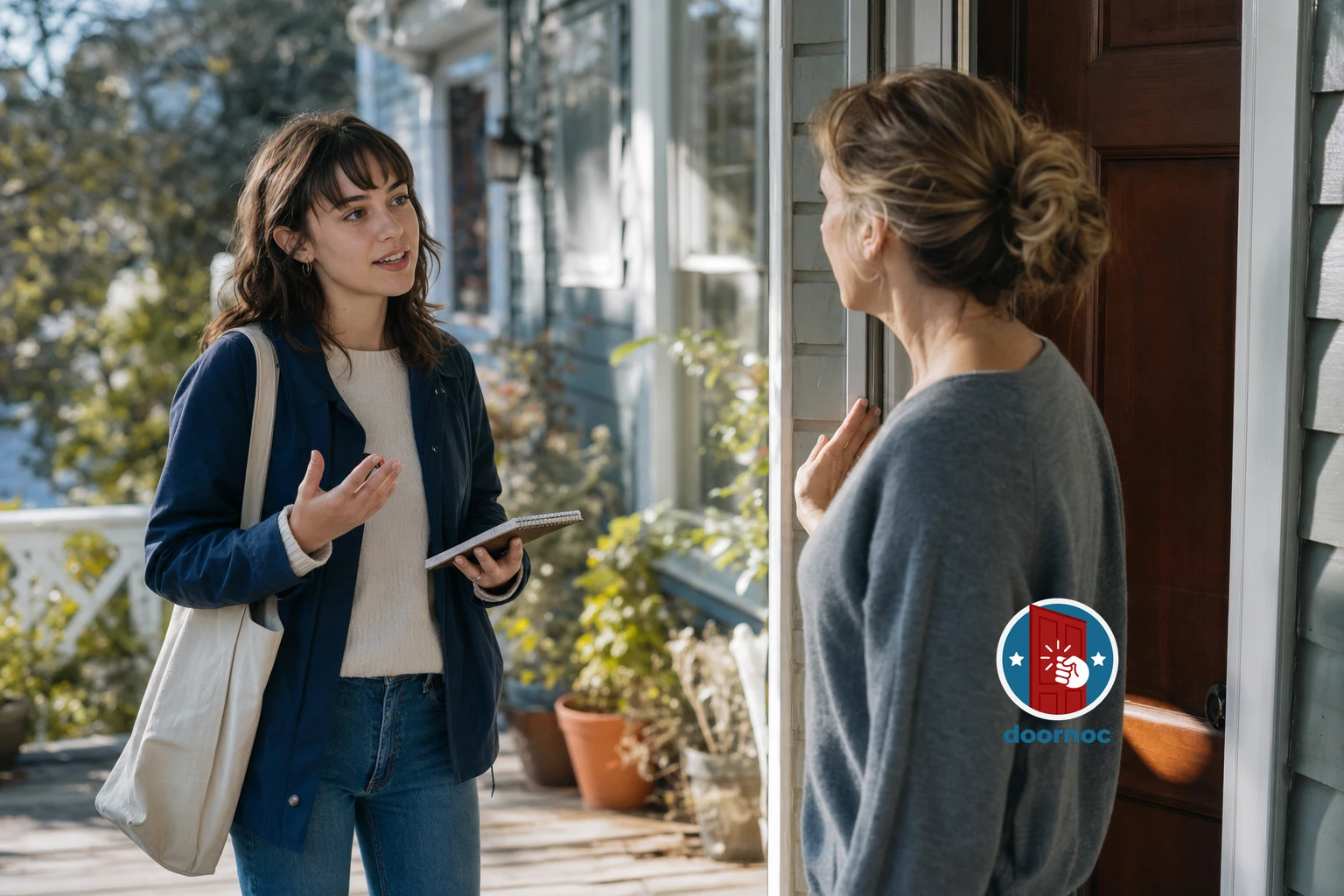
Body language matters as much as words. Stand 3-4 feet back from the door (never crowd the threshold), hold your campaign materials at waist level (not extended toward them), and smile genuinely. If they have a screen door, never touch it — let them open it if they choose to engage.
For more detailed guidance on opening conversations, see our comprehensive canvassing script guide that covers 17 different opening scenarios.
The Listen-Validate-Inform Framework for Canvassing Conversations
Once you’ve secured those critical first two minutes, your canvassing conversation should follow a three-phase structure that prioritizes the voter’s voice over your prepared talking points.
Phase 1: Listen (30-45 seconds)
Ask one open-ended question and genuinely listen to the answer:
- “What issues matter most to you this election?”
- “How do you feel about [specific local issue your campaign addresses]?”
- “What would you want to see change in our [city/district/state]?”
Take brief notes while they talk. This serves two purposes: it shows you value their input enough to record it, and it gives you specific language to mirror back in Phase 3. Most voters have never had a campaign worker actually listen to them — this alone differentiates you from every mailer and TV ad they’ve seen.
Avoid the temptation to interrupt with solutions. Let them finish completely, even if they pause. Silence is powerful — many voters will fill it with additional context that reveals their true priorities.
Phase 2: Validate (10-15 seconds)
Acknowledge their concern before pivoting to your message:
- “I hear that [specific concern] is really affecting your family.”
- “You’re absolutely right that [issue] has gotten worse over the past few years.”
- “That’s a perspective I haven’t heard before — thank you for sharing it.”
Validation doesn’t mean agreement. It means demonstrating that you heard them as a person, not just as a potential vote. This builds the psychological safety necessary for them to consider your talking points.
Phase 3: Inform (60-90 seconds)
Now connect your candidate’s positions directly to what they just told you:
“Based on what you said about [their concern], I think you’d want to know that [candidate name] has a specific plan for that. [One concrete example with numbers or timeline]. That’s actually why I’m out here today — we need people who understand [issue] to support this campaign.”
Notice the structure: you’re not listing your candidate’s entire platform. You’re providing one relevant, specific solution to the problem they identified. This targeted approach is exponentially more persuasive than generic talking points.
For campaigns using modern canvassing software, you can access voter-specific information during this phase. If your app shows this voter cares about education based on their voting history, you can tailor your inform phase even before they speak.
Adapting Your Message to Five Voter Types
What to say when door knocking must adapt to the voter standing in front of you. In 2026, campaigns using data-driven canvassing identify five distinct voter types, each requiring different talking points and conversation strategies.
Type 1: Strong Supporters (20-25% of doors)
What they say: “I’m definitely voting for [your candidate]!” or “I already sent in my ballot.”
What to say:
“That’s great to hear! Since you’re already on board, would you be interested in volunteering for a few hours before Election Day? We especially need help with [specific task]. Even just two hours makes a huge difference.”
Or:
“Perfect! Do you know three neighbors who might also support [candidate]? I can leave information for you to share, or I can visit them directly if you think they’d be receptive.”
Time investment: 60-90 seconds maximum. Your goal is volunteer recruitment or peer-to-peer expansion, not persuasion.
Type 2: Lean Supporters (15-20% of doors)
What they say: “I’m probably voting for them” or “I like what I’ve heard so far.”
What to say:
“I’m glad you’re leaning that way. Is there anything about [candidate] or their positions you’d like to know more about? I want to make sure you feel confident in your choice.”
Then address any hesitations directly. Lean supporters need reinforcement and information to move them from “probably” to “definitely.” This is also your opportunity to secure an early vote commitment:
“Would you be willing to vote early or request a mail ballot? That way you don’t have to worry about making it to the polls on Election Day.”
Time investment: 2-3 minutes. These conversations often determine turnout.
Type 3: Undecided Voters (25-30% of doors)
What they say: “I’m still deciding” or “I haven’t really thought about it yet.”
What to say:
“That’s completely fair — there’s a lot to consider. What issues are most important to you when you’re evaluating candidates?”
Use the Listen-Validate-Inform framework religiously with undecideds. They’re information-gathering, so your job is to provide the most relevant, credible information possible. Never pressure them for an immediate commitment.
Instead, offer a resource:
“I’m going to leave you this comparison sheet that shows where all the candidates stand on [the issue they mentioned]. If you have questions after you look it over, here’s how to reach our campaign directly.”
Time investment: 3-4 minutes. Quality over quantity — one genuinely persuaded undecided is worth more than five rushed conversations.
Our research on voter persuasion techniques shows that undecided voters need an average of 2.7 touchpoints before making a decision, so view this conversation as the first of several.
Type 4: Soft Opponents (10-15% of doors)
What they say: “I’m probably voting for [opponent]” or “I usually vote [other party].”
What to say:
“I appreciate you being upfront about that. Can I ask what draws you to [opponent] or [other party]? I’m genuinely curious.”
Many canvassers make the mistake of trying to argue soft opponents into changing their minds. This almost never works and often hardens their opposition. Instead, your goal is to plant a seed of doubt or offer a permission structure for voting differently than usual.
After they explain their reasoning:
“That makes sense. I’ll just mention one thing about [your candidate] that might interest you, given what you just said: [one specific position that aligns with their stated values]. I’m not asking you to change your mind today, but I wanted you to have that information.”
Time investment: 90 seconds to 2 minutes. Don’t overstay — respect their position and move on.
Type 5: Hard Opponents (5-10% of doors)
What they say: “I would never vote for [your candidate]” or [displays visible hostility].
What to say:
“I understand. Thank you for your time — have a great day.”
That’s it. No debate, no persuasion attempt, no leaving literature. Hard opponents are not persuadable in a doorstep conversation, and engaging them wastes time you could spend with undecideds. Exit gracefully and move to the next door.
If they want to argue, use this deflection:
“I respect that we see things differently. I appreciate you being honest with me. Take care.”
Then leave immediately. For more strategies on handling difficult interactions, see our guide on door knocking tips.
Essential Canvassing Talking Points by Issue Category
Your campaign will provide specific talking points, but understanding how to structure them makes the difference between memorized rhetoric and persuasive conversation. In 2026, the most effective canvassing talking points follow this formula:
Problem + Specific Solution + Concrete Impact + Timeline
Economic Talking Points
Weak: “Our candidate supports working families.”
Strong: “Housing costs in this district have increased 34% since 2022, pricing out families like yours. [Candidate] is proposing a $15 million affordable housing fund that would create 300 units within 18 months. That means families earning $60,000 a year could afford a two-bedroom apartment without spending more than 30% of their income on rent.”
Notice the specificity: real numbers, real timeline, real impact on the voter’s life.
Education Talking Points
Weak: “We need to invest in our schools.”
Strong: “Class sizes at [local school] have hit 32 students per teacher — 40% higher than the state average. [Candidate] has a funded plan to hire 15 new teachers in year one, bringing class sizes down to 24 students. That means your child gets 25% more individual attention from their teacher.”
Parents care about their specific school, not abstract education policy. Name the school, name the problem, name the solution.
Healthcare Talking Points
Weak: “Healthcare should be affordable for everyone.”
Strong: “Prescription drug costs are the number one reason people in this district skip medications — I’ve heard this from 40% of voters I’ve talked to this month. [Candidate] is co-sponsoring legislation that caps insulin at $35 and allows Medicare to negotiate drug prices. If you or someone in your family takes regular medications, this could save you $1,200 a year.”
Personal financial impact resonates more than policy abstractions.
Public Safety Talking Points
Weak: “We need to support our police and keep communities safe.”
Strong: “Response times for non-emergency calls in this precinct average 47 minutes — nearly double what they were in 2023. [Candidate] is proposing a community safety model that adds social workers for mental health calls, freeing up officers for emergencies. Cities that have tried this saw emergency response times drop by 35%.”
Data-driven safety solutions appeal to voters across the political spectrum.
The Art of the Ask: Converting Conversations to Commitments
What to say when canvassing must always build toward a specific ask. Every conversation should end with one of these four commitments:
Ask 1: Vote Commitment
“Based on our conversation, can I count on your vote for [candidate] on [election date]?”
If yes: “Great! Would you be willing to vote early? I can help you request a mail ballot right now using the canvassing app on my phone — it takes 30 seconds.”
If unsure: “What information would help you make that decision? I can follow up with you in a week with answers to any questions.”
Ask 2: Volunteer Recruitment
“You clearly care about [issue they mentioned]. Would you consider volunteering for a few hours before Election Day? We especially need people who understand [issue] to talk to their neighbors.”
Make it specific and low-barrier:
“We have a canvassing event next Saturday from 10am to noon. You’d be paired with an experienced volunteer, and we provide all the materials. Can I sign you up?”
Ask 3: Peer Referral
“Do you know three neighbors who might also support [candidate]? I can visit them, or if you’d prefer, I can leave information for you to share.”
This works especially well in communities with strong social networks. One enthusiastic supporter can influence an entire block.
Ask 4: Information Permission
“Can I leave this information with you to review? And would it be okay if someone from our campaign followed up with you in a week to answer any questions?”
This is your fallback ask when the voter isn’t ready to commit. It keeps the door open for future contact.
Always record the outcome immediately using door-to-door canvassing software. Data entered in real-time is 73% more accurate than data recorded hours later, according to 2026 campaign analytics.
Handling Common Objections and Difficult Questions
What to say when canvassing includes preparing for objections you’ll hear repeatedly. Here are the five most common objections in the 2026 cycle and proven response frameworks:
Objection 1: “I don’t trust any politicians.”
Response: “I completely understand that frustration — I hear it from a lot of people. Can I share one specific thing [candidate] did that might change your mind about them? [Concrete example of keeping a promise or taking a political risk]. They’re not perfect, but they’ve shown they’ll follow through.”
Objection 2: “My vote doesn’t matter.”
Response: “I used to think that too, until I looked at the numbers from our last [local election]. The margin was 127 votes out of 8,000 cast. Every single vote literally decided the outcome. This race is projected to be even closer.”
Or:
“You’re right that one vote rarely decides a presidential race. But this is a [local/state] race where turnout is usually under 30%. Your vote carries three times the weight it does in a presidential year.”
Objection 3: “I don’t have time to research all the candidates.”
Response: “That’s exactly why I’m here. Rather than you spending an hour researching, I can give you a two-minute summary of where the candidates stand on [issue you know they care about from earlier in the conversation]. Would that be helpful?”
Then provide a genuinely balanced comparison, highlighting your candidate’s strengths without lying about the opponent.
Objection 4: “I’m voting for [opponent] because [specific issue].”
Response: “That issue is really important to you — I can tell. Did you know [your candidate] actually has a plan for that too? [Describe it]. You might find their approach more effective because [specific reason]. I’m not asking you to change your mind right now, but I wanted you to know both candidates are addressing this.”
Objection 5: “I don’t want to talk about politics.”
Response: “I totally respect that. Can I just leave this information with you in case you change your mind? No pressure at all. Have a great day.”
Don’t push. Respect boundaries immediately. Some voters genuinely need space from political conversations, especially in high-polarization years.
For additional techniques on navigating challenging conversations, review our 27 canvassing tips that cover everything from body language to de-escalation strategies.
Adapting Your Talking Points for Different Demographics
What to say when door knocking varies significantly based on voter demographics. Effective canvassing in 2026 requires cultural competency and demographic awareness.
Young Voters (18-29)
- Lead with issues, not party loyalty (most young voters identify as independent)
- Use concrete examples of how policies affect their daily lives (student debt, housing costs, job opportunities)
- Acknowledge their skepticism about political promises — it’s valid
- Emphasize local and state races where their vote has maximum impact
- Offer multiple ways to engage beyond voting (texting, social media sharing, event attendance)
Example talking point: “I know you’ve heard a lot of promises from politicians. Here’s what makes this different: [candidate] got the [specific local policy] passed last year, which already [concrete result]. They have a track record of following through.”
Senior Voters (65+)
- Start with respectful introduction and clear identification
- Speak at a measured pace and be prepared to repeat information
- Focus on issues with immediate impact (healthcare, Social Security, property taxes)
- Reference your candidate’s experience and stability
- Offer to leave written materials they can review at their own pace
Example talking point: “[Candidate] has 20 years of experience in [relevant field] and has consistently protected Social Security from cuts. In their last term, they secured $3 million for senior services in this district.”
Working Parents
- Respect their time constraints — be concise
- Focus on education, childcare, and economic security
- Use specific local examples (their kids’ school, local childcare costs)
- Offer to follow up by email or text rather than extending the conversation
Example talking point: “I’ll be quick since I know you’re busy. [Candidate] is proposing universal pre-K that would save families like yours $8,000 a year in childcare costs. Can I leave you information about the full plan?”
Communities of Color
Approach these conversations with cultural humility and awareness of historical disenfranchisement:
- Never assume political affiliation based on race
- Acknowledge if you’re canvassing in a community you’re not part of: “I know I might not look like most people in this neighborhood, but [candidate] wanted to make sure everyone in this district heard directly from the campaign.”
- Focus on issues that disproportionately affect these communities (criminal justice reform, economic opportunity, healthcare access)
- If possible, deploy canvassers who reflect the community’s demographics
Example talking point: “[Candidate] has a specific plan to address [issue affecting this community]. They’ve already met with community leaders here in [neighborhood] to make sure the plan reflects what you actually need, not what outsiders think you need.”
Tracking and Improving Your Canvassing Conversations
What to say when canvassing improves with practice and data. The best field organizers in 2026 track conversation metrics to identify what works and what doesn’t.
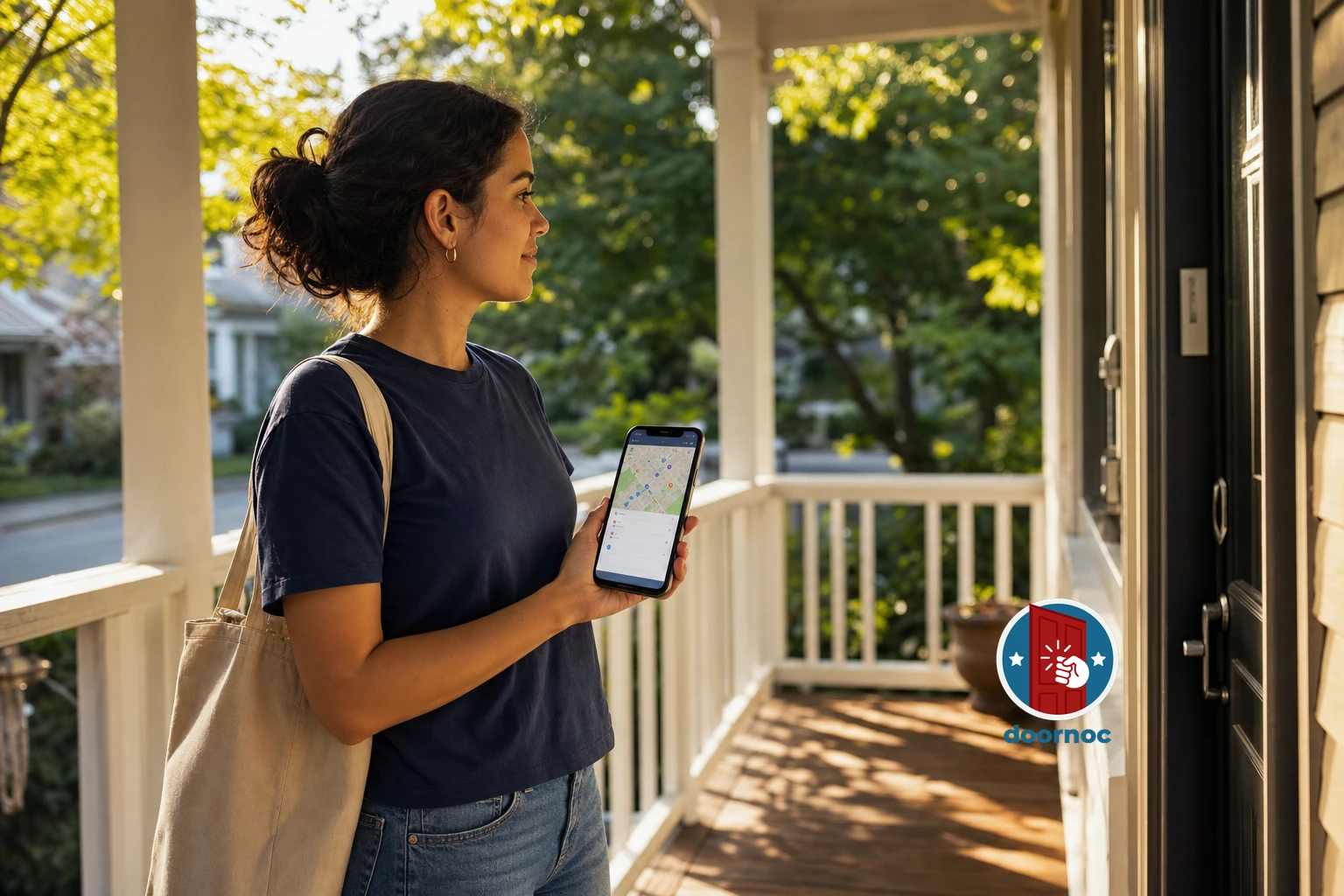
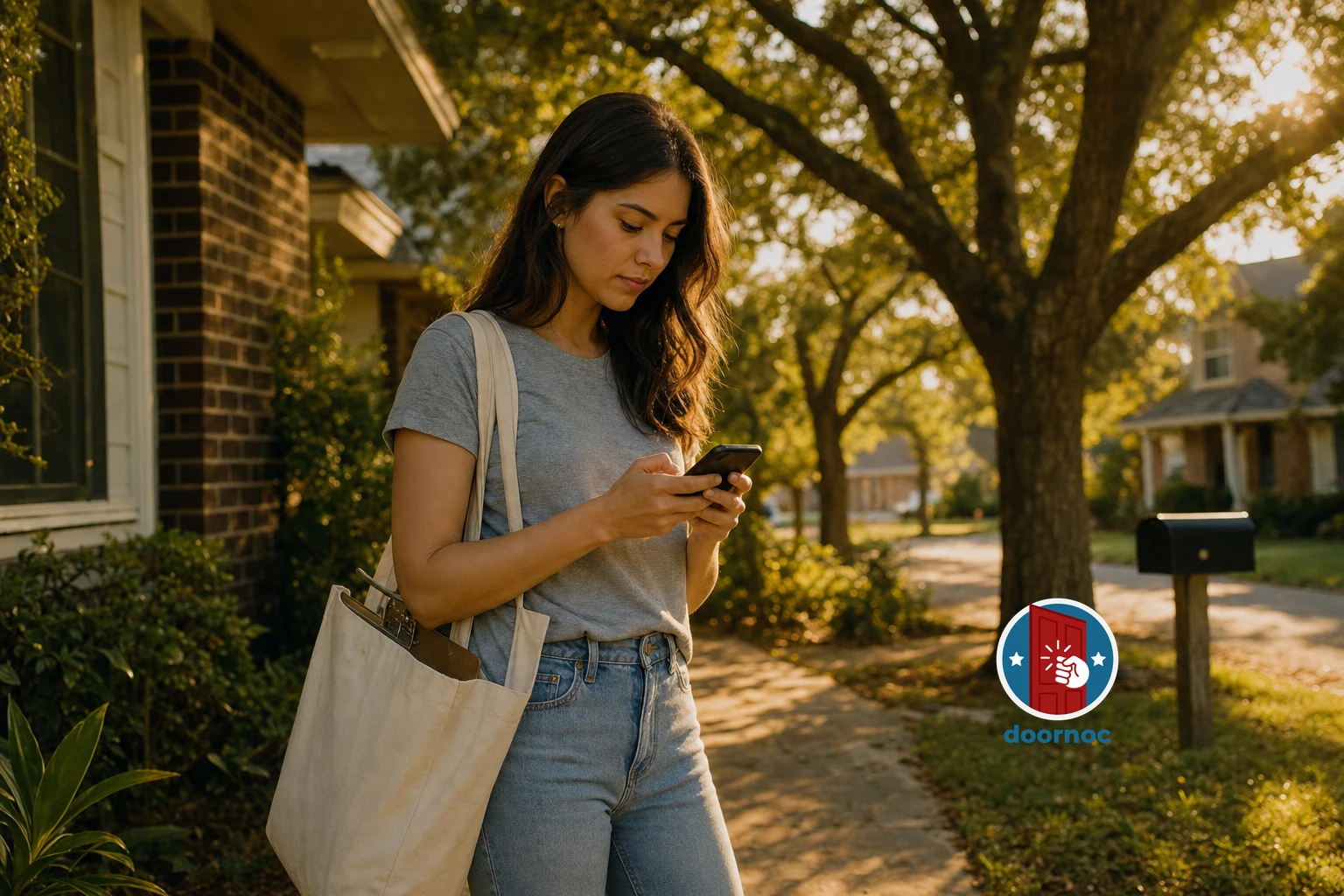 Volunteer standing on sidewalk between houses, looking down at smartphone while typing notes during golden hour.
Using canvassing software like Door Knock, record these data points after every conversation:
- Voter type (supporter, lean, undecided, opponent)
- Top issue mentioned (their words, not your interpretation)
- Talking points used (which ones resonated, which fell flat)
- Objections raised (track patterns across the precinct)
- Commitment made (vote, volunteer, referral, information)
- Conversation length (helps optimize your pacing)
After every canvassing shift, spend 10 minutes reviewing your data:
- Which talking points had the highest conversion rate from undecided to supporter?
- What objections came up most frequently? (Prepare better responses)
- Which voter types took the longest? (Adjust time allocation)
- What issues dominated conversations in this precinct? (Tailor future messaging)
Campaigns using this data-driven approach see 23% higher persuasion rates than those relying on intuition alone, according to 2026 field analytics.
For teams managing multiple canvassers, modern door-to-door canvassing software aggregates this data in real-time, allowing field directors to adjust messaging across the entire operation based on what’s working on the ground.
The Post-Conversation Follow-Up That Seals Commitments
Your canvassing conversation doesn’t end when you leave the doorstep. Follow-up determines whether verbal commitments translate to actual votes.
Immediate Follow-Up (Within 24 Hours)
For voters who requested specific information:
- Send a personalized text or email with exactly what they asked for
- Reference a specific detail from your conversation to prove it’s not a mass message
- Include one additional resource they didn’t request but might find valuable
Example: “Hi [Name], this is Jordan from the Chen campaign. You asked about her education plan when we talked yesterday. Here’s the full proposal: [link]. I also thought you might be interested in this comparison of class sizes in your district vs. the state average, since you mentioned your daughter’s crowded classroom. Let me know if you have questions!”
Week-Before-Election Follow-Up
For voters who committed to voting:
- Confirm their voting plan: “Are you planning to vote early or on Election Day?”
- Provide specific logistics: polling location, hours, ID requirements
- Offer assistance: “Do you need help with transportation or childcare on Election Day?”
Day-Before-Election Follow-Up
For strong supporters and volunteers:
- Send a final reminder with polling location and hours
- Ask them to text you after they vote (creates accountability)
- Request that they remind three friends to vote
Campaigns that implement systematic follow-up see turnout rates 18% higher among contacted voters compared to those who only receive the initial door knock.
Building Your Personal Canvassing Style
What to say when canvassing ultimately depends on your authentic voice. The talking points and frameworks in this guide work because they’re built on psychological principles of persuasion, but they only succeed when delivered genuinely.
Develop your personal style by:
Recording yourself (with permission) during practice conversations and listening for:
- Moments where you sound scripted vs. natural
- Questions that genuinely engage voters vs. those that shut down dialogue
- Talking points you deliver confidently vs. those you stumble through
Shadowing experienced canvassers for a full shift before going out solo. Pay attention to:
- How they adapt their energy level to match the voter
- When they choose to extend conversations vs. when they exit quickly
- How they handle objections without becoming defensive
Debriefing after every shift with your team. Ask:
- What conversation surprised you today?
- What talking point worked better than expected?
- What question did you get that you weren’t prepared for?
The most effective canvassers in 2026 sound like knowledgeable neighbors, not campaign robots. They’ve internalized the talking points so thoroughly that they can adapt them spontaneously to each unique conversation.
For comprehensive guidance on developing your skills, explore our 15 canvassing techniques that cover everything from body language to conversation pacing.
Legal and Ethical Considerations for Canvassing Conversations
What to say when door knocking must stay within legal and ethical boundaries. In 2026, canvassing regulations vary by state, but these principles apply universally:
Always identify yourself and your campaign immediately. Deceptive canvassing is illegal in 37 states and unethical everywhere. Never imply you’re conducting a survey when you’re actually persuading voters.
Respect “No Soliciting” and “No Trespassing” signs. While political canvassing has First Amendment protections that commercial soliciting doesn’t, many jurisdictions still prohibit ignoring posted signs. When in doubt, skip the house. For detailed legal guidance, see our article on canvassing vs. soliciting laws.
Never misrepresent your opponent’s positions. You can contrast your candidate’s positions with the opponent’s, but lying about what they support is both unethical and often illegal under campaign finance laws.
Respect privacy and data protection laws. Record only the information voters voluntarily share. Never photograph their home, take notes about their property, or record personal information unrelated to the campaign.
Leave immediately if asked. Continuing a conversation after a voter asks you to leave can constitute trespassing in many jurisdictions.
Don’t campaign within restricted zones. Most states prohibit campaigning within 100-200 feet of polling places on Election Day. Know your local restrictions.
For a complete overview of canvassing laws by state, consult our guide on whether door-to-door canvassing is illegal.
Measuring the Impact of Your Canvassing Conversations
The ultimate test of what to say when canvassing is whether it changes voter behavior. In 2026, campaigns measure conversation effectiveness through:
Conversion Metrics
- Persuasion rate: Percentage of undecided voters who commit to your candidate
- Turnout rate: Percentage of contacted supporters who actually vote
- Volunteer conversion: Percentage of supporters who agree to volunteer
- Peer referral rate: Average number of neighbor referrals per conversation
Quality Indicators
- Average conversation length: 2-3 minutes indicates good engagement
- Second-contact receptivity: How many voters welcome a follow-up conversation
- Information requests: Percentage of voters who ask for additional materials
- Objection resolution: Percentage of objections you successfully address
Top-performing canvassers in competitive 2026 races average:
- 35-40% persuasion rate with undecided voters
- 12-15% volunteer conversion rate with supporters
- 2.3 peer referrals per supporter conversation
- 2.8 minutes average conversation length
If your metrics fall significantly below these benchmarks, review your talking points, practice your delivery, or request coaching from experienced canvassers on your team.
Modern canvassing apps track these metrics automatically, providing real-time feedback on your performance and allowing you to adjust your approach mid-shift.
Conclusion: The Conversation That Changes Elections
What to say when canvassing matters because face-to-face conversations remain the single most effective form of voter persuasion in 2026. No digital ad, TV commercial, or social media post can match the trust built in a genuine doorstep dialogue.
The talking points, frameworks, and techniques in this guide work because they’re grounded in respect for the voter’s intelligence, time, and autonomy. They prioritize listening over lecturing, specificity over rhetoric, and authentic connection over scripted performance.
As you develop your canvassing conversation skills, remember: you’re not just delivering talking points. You’re representing your candidate, yes, but more importantly, you’re demonstrating that democracy still involves real people talking to real people about issues that matter.
Every conversation is an opportunity to restore someone’s faith in the political process, to show them that their voice matters, and to prove that campaigns care enough to show up at their door and listen.
Master what to say when door knocking, and you don’t just win votes — you strengthen democracy itself.
Ready to put these techniques into practice? Door Knock’s mobile canvassing platform provides the tools you need to track conversations, access voter data at the doorstep, and measure your impact in real-time. Contact our team to see how we’re helping campaigns win through better conversations.
Frequently Asked Questions
What should I say first when someone answers the door while canvassing?
Lead with your name, the campaign you represent, and your specific purpose in 7 seconds or less: ‘Hi, I’m Sarah with the Martinez for Council campaign. I’m talking with neighbors today about local issues — do you have two minutes?’ This transparency builds immediate trust and gives the voter control over the conversation.
How do I handle hostile voters during door-to-door canvassing?
Thank them for their time, acknowledge their perspective without arguing, and exit gracefully: ‘I appreciate you sharing that. We may not agree, but I respect your position. Have a great day.’ Never engage in debate — hostile interactions waste time and can create negative word-of-mouth in the neighborhood.
What talking points work best for undecided voters?
Ask open-ended questions first to identify their priorities: ‘What issues matter most to you this election?’ Then connect your candidate’s positions directly to their stated concerns using specific examples. Undecided voters respond to personalized relevance, not generic campaign rhetoric.
Should I read from a script when canvassing?
Use a script as a framework, not a word-for-word recitation. Memorize your 7-second introduction and key talking points, but let conversations flow naturally. Voters detect and distrust robotic delivery — authentic dialogue builds the trust that changes minds.
How long should a typical canvassing conversation last?
Aim for 90 seconds to 3 minutes for most voters. Spend 7 seconds on introduction, 30-45 seconds listening to their concerns, 60-90 seconds on targeted talking points, and 15-30 seconds on your ask (vote commitment, volunteer signup, or information sharing). Quality matters more than duration.