
Key Takeaways
- Voter persuasion in 2026 requires deep canvassing techniques that prioritize genuine conversation over scripted talking points — campaigns using this approach see 8-12% higher persuasion rates than traditional methods
- The most effective persuasion canvassing focuses on shared values and personal stories rather than policy arguments, with narrative-based conversations producing 3x more attitude change than fact-based appeals
- Deep canvassing conversations average 10-15 minutes per door and require trained volunteers who can practice empathetic listening and non-judgmental dialogue
- Campaigns that combine voter persuasion techniques with real-time data tracking using tools like Door Knock can identify which messages resonate and adjust their approach mid-campaign for maximum impact
Voter persuasion is the art and science of changing minds through direct conversation, personal storytelling, and empathetic engagement. In 2026, as political polarization continues to intensify, effective persuasion techniques have become the difference between winning and losing competitive races. Traditional canvassing methods that rely on scripted talking points and rapid-fire door knocking are being replaced by deep canvassing approaches that prioritize quality conversations over quantity of contacts.
The data is clear: campaigns that master voter persuasion techniques see 8-12% higher conversion rates among undecided voters compared to those using conventional methods. This article will show you exactly how to implement proven persuasion canvassing strategies that win elections, from the psychology of attitude change to the tactical execution of deep canvassing conversations.
What Is Voter Persuasion and Why Does It Matter?
Voter persuasion refers to the strategic effort to change a voter’s opinion about a candidate, issue, or political party through direct communication. Unlike voter mobilization, which focuses on turning out existing supporters, persuasion targets undecided voters and soft opposition — people who haven’t made up their minds or whose support for the other side is weak.
In 2026, persuasion matters more than ever because the pool of truly undecided voters has shrunk. While partisan polarization has reduced the persuadable middle, those remaining swing voters often decide close elections. A campaign that can persuade just 5-7% of undecided voters in a competitive district can shift the outcome.
The challenge is that persuasion is hard. Research from the Analyst Institute shows that traditional persuasion canvassing — where volunteers knock doors with scripted pitches — produces attitude change in only 3-5% of contacted voters. The conversations are too brief, too transactional, and too focused on information delivery rather than genuine engagement.
This is where deep canvassing revolutionizes the field. Deep canvassing is a persuasion technique that uses extended, narrative-based conversations to create lasting attitude change. Instead of delivering a 60-second pitch, canvassers engage voters in 10-15 minute dialogues about their personal experiences, values, and concerns.
The Psychology Behind Effective Voter Persuasion
Understanding why people change their minds is essential to effective persuasion canvassing. The traditional model of persuasion — present facts, make logical arguments, win the debate — fails because it misunderstands how human beings process political information.
Emotions Drive Political Decisions
Neuroscience research consistently shows that political opinions are primarily emotional, not rational. Voters make decisions based on how they feel about candidates and issues, then rationalize those feelings with facts afterward. This means persuasion techniques that target emotions are more effective than those that target logic.
The most successful persuasion conversations in 2026 campaigns share three characteristics:
- They evoke empathy — Canvassers share personal stories that help voters see an issue through someone else’s eyes
- They activate shared values — Rather than arguing about policy details, conversations focus on values both parties agree on (fairness, family, community)
- They create cognitive dissonance — By highlighting contradictions between a voter’s values and their current position, canvassers create psychological tension that motivates attitude change
The Power of Narrative
Stories are the most powerful persuasion tool in your arsenal. When you tell someone a story, their brain synchronizes with yours — a phenomenon neuroscientists call “neural coupling.” This makes narrative-based persuasion dramatically more effective than fact-based persuasion.
A 2025 study by the Yale Program on Climate Change Communication found that voters who heard personal stories about climate impacts were 3x more likely to change their position on environmental policy than voters who received statistical information about carbon emissions. The same principle applies across all political issues.
Your canvassing script should be built around stories, not statistics. Train your canvassers to share their own experiences and invite voters to share theirs. These narrative exchanges create emotional connections that persist long after the conversation ends.
Building Trust Before Persuading
You cannot persuade someone who doesn’t trust you. In an era of widespread political cynicism, establishing credibility is the first step in any persuasion conversation. This is why deep canvassing emphasizes authenticity over polish.
Voters can detect scripted, inauthentic communication instantly. The canvassers who achieve the highest persuasion rates are those who:
- Admit when they don’t know something
- Acknowledge valid points the voter makes
- Share genuine uncertainty about complex issues
- Treat disagreement as an opportunity for dialogue, not a debate to win
This approach to voter contact prioritizes relationship-building over message delivery. It’s slower, but it works.
Deep Canvassing: The Gold Standard for Persuasion
Deep canvassing is a voter persuasion technique developed by the Los Angeles LGBT Center and refined by organizations like the New Conversation Initiative. It has become the gold standard for persuasion campaigns because it produces measurably higher rates of lasting attitude change than any other method.
How Deep Canvassing Works
A deep canvassing conversation follows a structured but flexible framework:
1. Establish rapport (2-3 minutes) — Begin with genuine small talk. Comment on their garden, ask about their day, find common ground. This isn’t filler; it’s the foundation of trust.
2. Ask open-ended questions (3-4 minutes) — Instead of launching into your pitch, ask voters about their experiences and concerns. “What’s most important to you in this election?” or “Have you or anyone you know been affected by [issue]?” Listen actively without interrupting.
3. Share your story (2-3 minutes) — Tell a personal story about why you care about the issue or candidate. Make it specific, emotional, and authentic. Vulnerability builds connection.
4. Invite their story (3-4 minutes) — Ask the voter to share their own experiences related to the issue. “Has anything like that ever happened to you?” This is the heart of deep canvassing — creating space for the voter to process their own thoughts and feelings.
5. Find shared values (2-3 minutes) — Identify values you both hold (family, fairness, opportunity) and connect those values to your candidate or position. “It sounds like we both care deeply about making sure everyone has a fair shot…”
6. Non-judgmental closing — Thank them for their time and honesty. Don’t pressure for commitment. The goal is to plant seeds, not force immediate conversion.
This framework takes practice. New canvassers struggle with the extended silence after asking questions, the temptation to argue when voters disagree, and the patience required to let conversations develop organically.
Training Canvassers for Deep Canvassing
Deep canvassing requires significantly more training than traditional door knocking. Your volunteers need to develop skills that don’t come naturally to most people:
Active listening — Train canvassers to listen for understanding, not for opportunities to respond. Practice reflective listening exercises where volunteers summarize what they heard before responding.
Empathetic engagement — Role-play conversations where volunteers practice responding to hostile or skeptical voters with curiosity rather than defensiveness. The goal is to understand why someone holds their position, not to prove them wrong.
Story development — Help each canvasser craft 2-3 personal stories they can share authentically. These should be real experiences, not manufactured talking points. Practice telling these stories until they feel natural.
Comfort with silence — Deep canvassing conversations have pauses while voters think. Train volunteers to resist the urge to fill every silence. Some of the most powerful persuasion happens in those quiet moments.
Plan for at least 3-4 hours of initial training, plus ongoing coaching and debriefs. The campaigns that invest in this training see persuasion rates 2-3x higher than those that send volunteers out with just a script.
Targeting the Right Voters for Persuasion
Not all voters are equally persuadable. Effective voter persuasion campaigns focus their limited time and resources on the voters most likely to change their minds.
The Persuasion Universe
Your persuasion universe should include:
True independents — Voters with no partisan registration or voting history who genuinely haven’t decided. These are rare but highly persuadable.
Soft partisans — Registered party members who vote inconsistently or split tickets. They have party affiliation but aren’t ideologically committed.
Low-information voters — People who pay minimal attention to politics and have weakly held opinions. They’re persuadable because they haven’t formed strong positions yet.
Issue-motivated voters — Single-issue voters whose top concern aligns with your campaign’s strengths, even if their general partisan lean favors your opponent.
Avoid wasting time on:
Strong partisans — Voters with consistent partisan voting history rarely change their minds through canvassing
High-engagement ideologues — People who follow politics closely and have well-developed political identities are nearly impossible to persuade
Non-voters with no engagement history — Focus persuasion on people likely to vote; mobilization on your base
Using voting history data and voter file modeling, you can identify persuadable voters with reasonable accuracy. Many campaigns use persuasion scores (1-100 scale) to prioritize which doors to knock.
Geographic and Demographic Targeting
In 2026, the most efficient persuasion campaigns layer demographic and geographic targeting on top of individual voter scores:
Swing precincts — Focus on neighborhoods where recent elections were decided by 5% or less. These areas have the highest concentration of persuadable voters.
Demographic sweet spots — Identify demographic groups (suburban women, young professionals, rural moderates) where your candidate has room to grow and opposition support is soft.
High-turnout areas — Prioritize persuasion in precincts with high voter turnout. There’s no point persuading someone who won’t vote.
Modern canvassing software like Door Knock allows you to create walk lists that combine all these targeting criteria, ensuring your canvassers spend their time on the doors that matter most.
Message Development for Persuasion Campaigns
The message you deliver matters as much as how you deliver it. Effective persuasion messages in 2026 share several characteristics:
Lead with Values, Not Policy
Voters don’t think in terms of policy positions; they think in terms of values. Instead of leading with “We need to expand Medicaid,” start with “Everyone deserves access to healthcare when they’re sick.” The policy flows from the value, not the other way around.
Research from the FrameWorks Institute shows that values-based framing increases persuasion effectiveness by 40% compared to policy-first framing. This is because values activate emotional responses and connect to voters’ existing belief systems.
Use Positive Framing
Negative campaigning has its place, but persuasion conversations should emphasize positive reasons to support your candidate, not just reasons to oppose the other side. Voters who are persuaded through positive messaging show more durable attitude change than those persuaded through negative attacks.
A 2025 analysis of persuasion canvassing in Virginia’s gubernatorial race found that conversations focused on what the candidate would do produced 9% persuasion rates, while conversations focused on attacking the opponent produced only 4% rates.
Make It Local and Specific
General statements about national issues don’t resonate as strongly as specific, local examples. Instead of talking about “the economy,” talk about the factory that closed in their neighborhood. Instead of abstract healthcare policy, mention the hospital that’s struggling to stay open.
Your canvassers should be trained on 3-5 local examples that illustrate your key issues. These concrete details make abstract policy tangible and relevant.
Acknowledge Complexity
Voters are suspicious of oversimplified solutions. Acknowledging that issues are complex and that your candidate doesn’t have all the answers builds credibility. “This is a complicated problem, and there’s no perfect solution, but here’s what we can do…” is more persuasive than claiming your candidate will fix everything easily.
This approach also creates space for genuine dialogue. When you acknowledge complexity, voters feel permission to express their own uncertainties and concerns.
Measuring and Optimizing Persuasion Campaigns
What gets measured gets improved. The most successful persuasion campaigns in 2026 use data to continuously refine their approach.
Baseline and Follow-Up Surveys
Before launching persuasion canvassing, conduct baseline polling to measure voters’ current positions. After canvassing, survey both contacted and non-contacted voters to measure attitude change. This allows you to calculate your actual persuasion rate and identify which messages worked.
The gold standard is a randomized controlled trial where you randomly assign similar voters to contacted and control groups, then compare outcomes. This isolates the effect of your canvassing from other factors.
Real-Time Feedback Loops
Modern canvassing apps enable real-time data collection that helps you optimize mid-campaign. Door Knock allows canvassers to record:
- Voter’s initial position (1-5 scale)
- Key concerns mentioned
- Which messages resonated
- Voter’s final position
- Likelihood to vote
This data flows immediately to campaign managers, who can identify patterns: Which messages are working? Which canvassers are most effective? Which neighborhoods are most persuadable?
Campaigns that analyze this data daily and adjust their approach accordingly see 15-20% higher persuasion rates than those that wait until after the campaign to evaluate results.
Tracking Long-Term Attitude Change
True persuasion produces lasting attitude change, not just momentary agreement. The best measurement strategy includes:
Immediate post-conversation surveys — Call or text voters 24-48 hours after canvassing to measure initial attitude change
Medium-term follow-up — Survey again 2-3 weeks later to see if attitude change persisted
Vote validation — After the election, match your contacted voters to vote history to see if persuaded voters actually turned out
This longitudinal approach reveals which persuasion techniques produce durable change versus temporary agreement.
Integrating Persuasion with Your Overall Field Strategy
Persuasion canvassing doesn’t exist in isolation. The most effective campaigns integrate persuasion with mobilization, phone banking, and digital outreach.
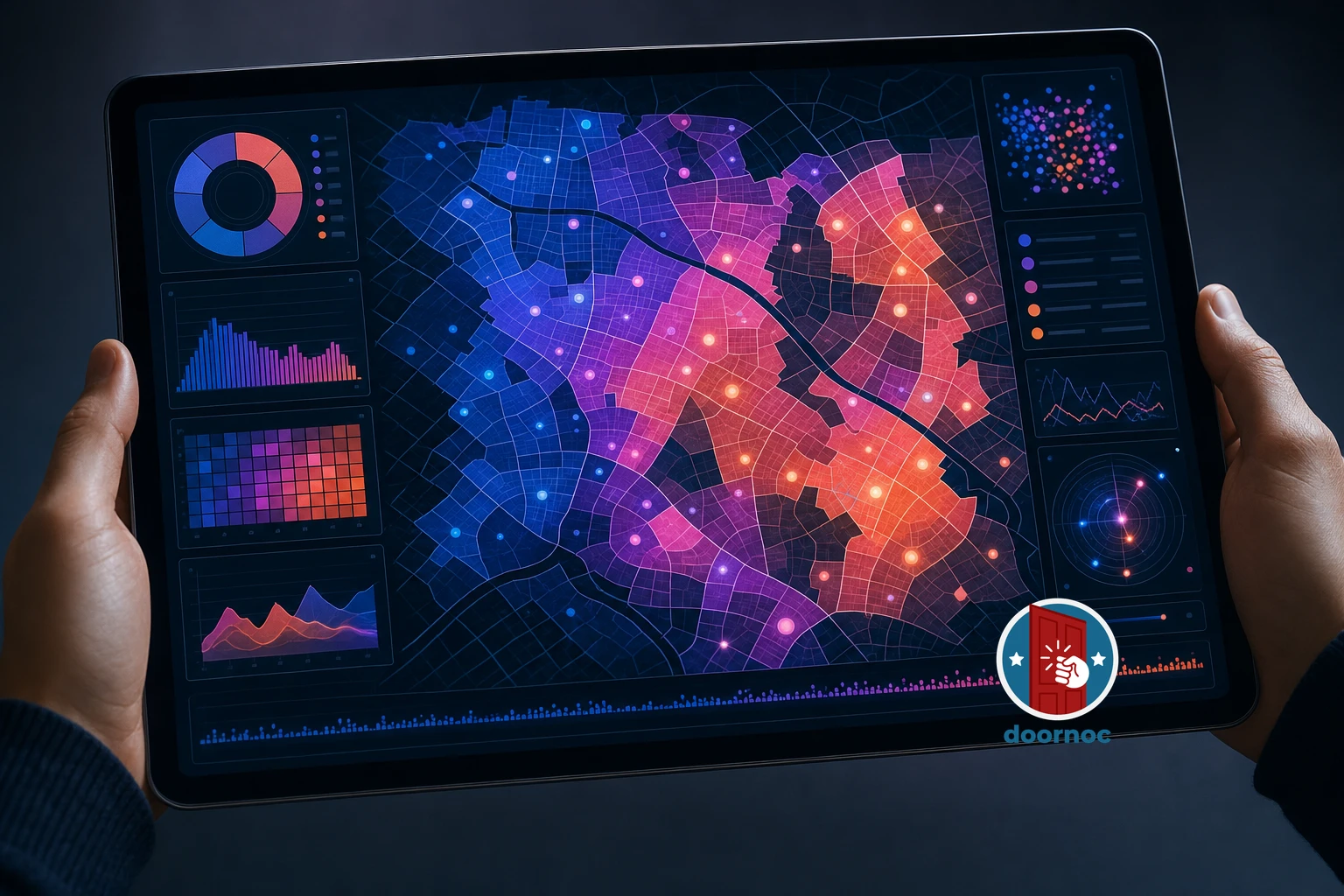 Close view of hands holding tablet showing color-coded voter attitude map with data visualization interface.
The Persuasion-to-Mobilization Pipeline
Once you’ve persuaded a voter, move them into your mobilization universe. Voters you’ve successfully persuaded should receive:
- Follow-up phone calls or texts reinforcing the conversation
- Direct mail that echoes the messages that resonated
- GOTV contacts in the final days before the election
Persuaded voters who receive this follow-up contact vote at rates 12-15% higher than persuaded voters who don’t, according to 2025 research from the Analyst Institute.
Resource Allocation
Persuasion canvassing is expensive. Deep canvassing conversations mean fewer doors knocked per volunteer shift, and the extensive training required increases your upfront costs. Most campaigns can’t afford to do deep canvassing everywhere.
A typical resource allocation for a competitive race:
- 40% of field budget — Base mobilization (turning out your supporters)
- 30% of field budget — Persuasion canvassing in swing precincts
- 20% of field budget — Persuadable voter phone banking
- 10% of field budget — Volunteer recruitment and training
The exact allocation depends on your race dynamics. If you’re the underdog, you need more persuasion. If you’re ahead, focus more on mobilization.
Volunteer Management for Persuasion Programs
Deep canvassing requires your best volunteers. Not everyone has the patience, empathy, and communication skills for 15-minute persuasion conversations. Identify your strongest volunteers and invest in training them as persuasion specialists.
Meanwhile, use your broader volunteer base for mobilization canvassing, which requires less training and can accommodate volunteers who are better at quick, energetic interactions than deep conversations.
Weekend canvassing events are ideal for persuasion work because you can bring together your trained persuasion canvassers, provide on-site coaching, and create a supportive environment for this challenging work.
Common Persuasion Mistakes to Avoid
Even experienced campaigns make mistakes that undermine their persuasion efforts. Here are the most common pitfalls:
Arguing Instead of Listening
The biggest mistake persuasion canvassers make is treating conversations as debates to win. When a voter expresses disagreement, the instinct is to counter with facts and arguments. This activates the voter’s defensive mechanisms and makes persuasion less likely.
Instead, respond to disagreement with curiosity: “That’s interesting — what makes you feel that way?” or “I can understand why you’d think that. Can I share a different perspective?” This keeps the conversation collaborative rather than adversarial.
Rushing the Conversation
Some campaigns try to do “deep canvassing” in 5-minute conversations. It doesn’t work. Genuine attitude change requires time for trust-building, story-sharing, and reflection. If you’re not prepared to invest 10-15 minutes per door, stick with traditional mobilization canvassing.
Targeting the Wrong Voters
Persuasion resources wasted on strong partisans or non-voters is a common mistake. Use data to identify truly persuadable voters and focus exclusively on them. The cost per vote for persuasion canvassing is high enough that you can’t afford to waste contacts.
Neglecting Follow-Up
Persuasion isn’t a one-and-done activity. Voters who are persuaded in a single conversation often revert to their original position without reinforcement. Plan for multiple touches: an initial persuasion conversation, a follow-up phone call, direct mail, and GOTV contact.
Poor Data Tracking
If you’re not recording detailed information about each persuasion conversation, you can’t learn what’s working. Invest in door-to-door canvassing software that makes it easy for canvassers to log conversation details, voter responses, and persuasion outcomes.
Advanced Persuasion Techniques for 2026
As persuasion canvassing has matured, practitioners have developed advanced techniques that push beyond basic deep canvassing:
Relational Organizing for Persuasion
The most persuasive messenger is someone the voter already knows and trusts. Relational organizing — where supporters reach out to their own friends, family, and neighbors — produces persuasion rates 2-3x higher than stranger-to-stranger canvassing.
In 2026, sophisticated campaigns are building relational organizing programs specifically for persuasion. They identify supporters in swing precincts and train them to have persuasion conversations with their own social networks.
This approach combines the emotional power of peer influence with the structured methodology of deep canvassing.
Issue-Specific Persuasion Tracks
Rather than using the same persuasion approach for all voters, advanced campaigns develop issue-specific persuasion tracks. A voter concerned primarily about healthcare receives a different conversation than one focused on education or the economy.
This requires more training and more sophisticated targeting, but it increases relevance and persuasion rates. Your canvassing software should allow you to tag voters by issue priority and provide canvassers with issue-specific talking points and stories.
Video-Enhanced Persuasion
Some 2026 campaigns are experimenting with showing short (60-90 second) videos during persuasion conversations. These videos feature testimonials from voters who changed their minds, creating a model for the persuasion process.
Early results are promising: conversations that include video components show 15-20% higher persuasion rates than conversation-only approaches. The key is that the video supplements the conversation rather than replacing it.
Implementing Voter Persuasion in Your Campaign
Ready to launch a persuasion program? Here’s a step-by-step implementation guide:
Step 1: Identify your persuasion universe — Use voter file data to identify 1,000-5,000 highly persuadable voters in your target precincts. Prioritize voters with high turnout scores and low partisan commitment.
Step 2: Develop your message framework — Create 3-5 core messages built around shared values. Develop personal stories that illustrate each message. Test these messages with focus groups or small-scale canvassing before scaling up.
Step 3: Train your persuasion team — Recruit 10-20 volunteers for intensive persuasion training. Plan for 4+ hours of initial training covering active listening, story-sharing, and the deep canvassing framework. Practice with role-plays until volunteers are comfortable.
Step 4: Launch pilot canvassing — Start with a small pilot (100-200 doors) to test your approach. Collect detailed feedback from canvassers and voters. Adjust your training and messaging based on what you learn.
Step 5: Scale systematically — Once your pilot shows positive results, scale up to your full persuasion universe. Plan for 2-3 canvassing shifts per week over 4-6 weeks. This sustained effort is necessary to reach your full target list.
Step 6: Track and optimize — Use Door Knock or similar canvassing software to track every conversation. Review data weekly and adjust your approach based on what’s working. Share successful techniques across your team.
Step 7: Follow up with persuaded voters — Move successfully persuaded voters into your mobilization program. Ensure they receive multiple additional contacts before election day.
This systematic approach ensures you’re not just doing persuasion canvassing, but doing it effectively and learning continuously.
The Future of Voter Persuasion
As we look ahead in 2026, several trends are reshaping voter persuasion:
AI-assisted message testing — Campaigns are using AI to rapidly test hundreds of message variations and identify which frames and stories resonate most with different voter segments. This allows for more personalized persuasion at scale.
Micro-targeting at the individual level — Advanced data analytics now enable campaigns to predict not just whether someone is persuadable, but which specific messages are most likely to persuade them based on their demographic profile, consumer behavior, and digital footprint.
Integration of digital and field persuasion — The most sophisticated campaigns are coordinating their door-to-door persuasion with targeted digital advertising, creating a surround-sound effect where voters hear consistent messages across multiple channels.
Emphasis on authenticity — As voters become more sophisticated about detecting manipulation, the campaigns that succeed will be those that prioritize genuine, authentic engagement over slick messaging.
The fundamental truth remains unchanged: persuasion happens through human connection. Technology can make persuasion more efficient and targeted, but it can’t replace the power of a real conversation between two people who take the time to understand each other.
Master these voter persuasion techniques, invest in training your team, and use data to continuously improve your approach. The campaigns that do this work well don’t just win elections — they change minds, build movements, and create lasting political change.
Frequently Asked Questions
What is the difference between voter persuasion and voter mobilization?
Voter persuasion aims to change someone’s mind about a candidate or issue, while voter mobilization focuses on turning out supporters who already agree with you. Persuasion targets undecided or soft opposition voters, whereas mobilization targets your base. Most campaigns need both strategies, but persuasion requires significantly more time and resources per voter contact.
How long does a typical deep canvassing conversation take?
Deep canvassing conversations typically last 10-15 minutes per door, compared to 2-3 minutes for traditional canvassing. This extended time allows canvassers to build rapport, share personal stories, and engage in genuine dialogue. While this means fewer doors knocked per shift, research shows these longer conversations produce measurably higher persuasion rates that justify the time investment.
What is the success rate of voter persuasion canvassing?
Well-executed deep canvassing campaigns achieve persuasion rates of 8-12% among contacted voters, meaning roughly 1 in 10 conversations results in measurable attitude change. Traditional persuasion canvassing sees lower rates of 3-5%. Success depends heavily on canvasser training, message quality, and proper voter targeting. These rates represent lasting attitude change, not just momentary agreement.
Can voter persuasion work on highly partisan voters?
Voter persuasion is most effective with undecided voters and soft partisans, not highly committed voters on either side. Research shows that voters with strong partisan identities rarely change their minds through canvassing. The most persuadable audiences are true independents, low-information voters, and those who lean toward one party but aren’t strongly committed. Focus your persuasion efforts on these groups for maximum ROI.
How do you measure the effectiveness of voter persuasion campaigns?
Effective measurement requires baseline polling before canvassing, tracking which voters were contacted, and follow-up surveys or vote history analysis after the campaign. The best approach uses randomized controlled trials where similar voters are split into contacted and non-contacted groups, then compared. Modern canvassing software like Door Knock enables precise tracking of who was contacted and what messages they received, making post-campaign analysis more accurate.