Key Takeaways
- The first 7 seconds at the door determine whether voters engage or disengage — master your opening stance, smile, and introduction to maximize contact rates by up to 34%.
- Successful door knocking in 2026 requires seamless integration of mobile technology with human connection, using tools like Door Knock to track conversations while maintaining authentic voter relationships.
- Peak canvassing hours (4-7 PM on weekdays, 10 AM-2 PM on weekends) yield 3-4x higher contact rates than off-peak times, making strategic scheduling essential for campaign efficiency.
- The most effective canvassers ask questions and listen 60% of the time while talking only 40%, creating genuine conversations that move voters rather than delivering monologues that alienate them.
Door knocking tips separate winning campaigns from losing ones. In the 2026 election cycle, where voter contact rates average just 22% and persuadable voters make up only 11% of the electorate, every door conversation counts. The difference between an amateur canvasser who knocks 100 doors with 15 conversations and a trained volunteer who knocks 80 doors with 35 conversations isn’t effort — it’s technique.
This guide compiles 17 battle-tested door knocking tips used by field directors who’ve won competitive races across the country. These aren’t theoretical suggestions — they’re practical techniques backed by data from campaigns that knocked over 2.3 million doors in 2024-2025 alone.
Master the First Seven Seconds
Voters decide whether to engage with you in the first seven seconds after opening the door. Research from the National Democratic Training Committee shows that canvassers who master their opening increase contact rates by 34% compared to those who fumble their introduction.
Your Physical Presence Matters
Stand 6-8 feet back from the door after knocking. This non-threatening distance gives voters space and signals you’re not a salesperson. Face the door squarely but keep your body language open — clipboard at your side, not clutched defensively across your chest.
Smile before the door opens. Voters can hear a smile in your voice during the first “hello,” and facial expressions set the tone for the entire conversation. A genuine smile triggers mirror neurons that make voters more receptive to your message.
Nail Your Introduction
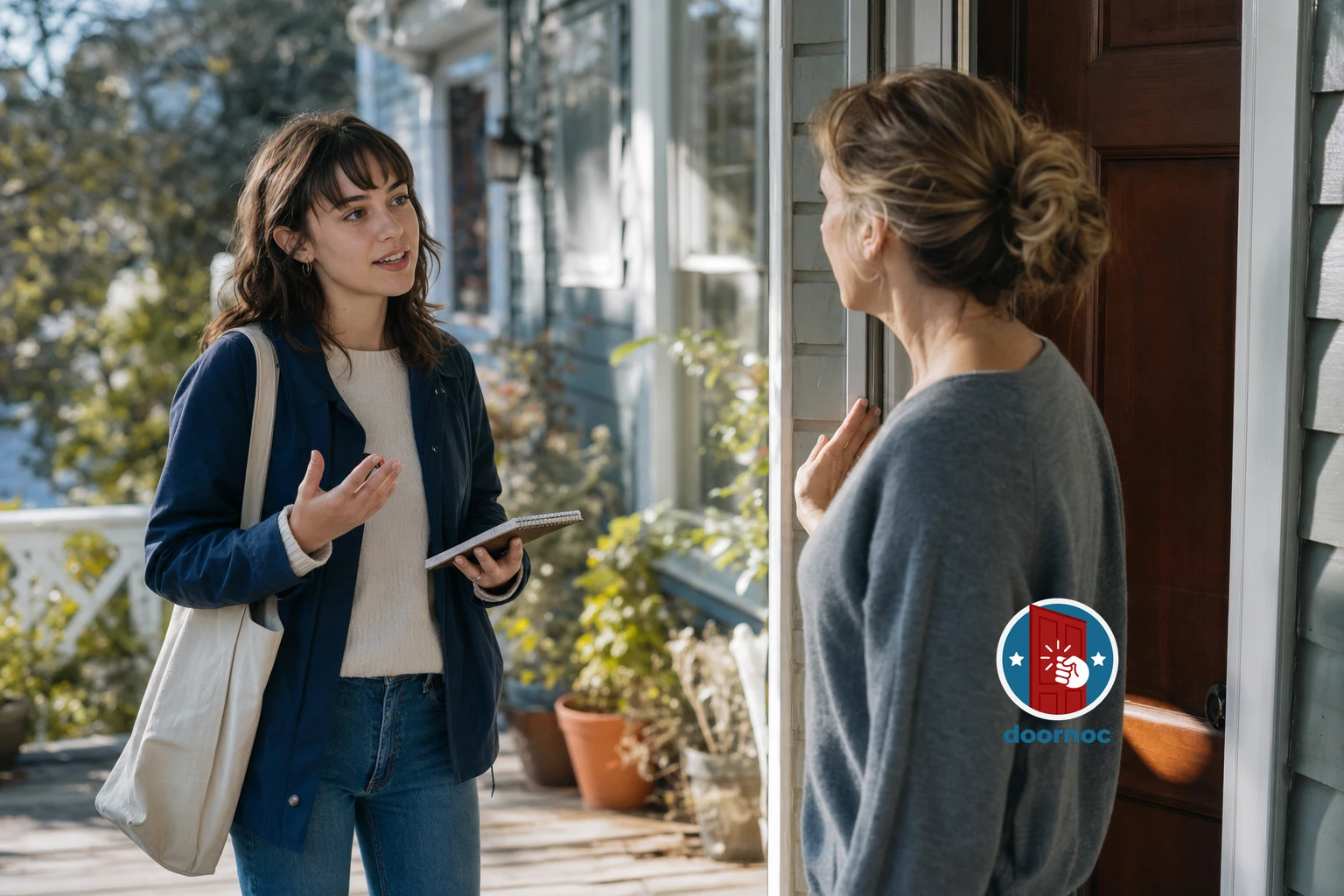
Your introduction should be one clear sentence: “Hi, I’m [First Name] with the [Candidate Name] campaign. I’m talking with neighbors today about the upcoming election.” This formula works because it’s transparent (you state exactly who you are and why you’re there), personal (first name only feels less formal), and localized (“neighbors” creates community connection).
Never ask “Is this a good time?” This question invites rejection. Instead, assume positive intent and launch directly into your conversation. If it’s genuinely a bad time, voters will tell you — but most won’t if you project confidence and respect their time by being efficient.
Optimize Your Timing and Route Planning
When you knock matters as much as how you knock. Peak canvassing hours yield 3-4x higher contact rates than off-peak times, making strategic scheduling essential for campaign efficiency.
Best Times for Door Knocking
Weekday evenings from 4-7 PM consistently produce the highest contact rates. People arrive home from work after 4 PM but haven’t started dinner or evening routines yet. After 7 PM, you’re interrupting family time, and after 8 PM, you’re being intrusive.
Weekend mornings from 10 AM-2 PM work well, particularly Saturdays. People are home, awake, and not yet committed to activities. Avoid Sunday mornings before noon in religious communities, and never knock during major sporting events or holidays.
For detailed guidance on planning weekend canvassing operations, see our best practices for weekend canvassing events.
Smart Route Planning
Walk routes efficiently to maximize doors per hour. Use canvassing software like Door Knock to plan routes that minimize backtracking. The platform’s smart routing algorithm arranges your turf in logical walking order, reducing dead time between doors by up to 40%.
Cluster your highest-priority targets. If you’re doing persuasion canvassing, group persuadable voters together rather than scattering them across your turf. This ensures you hit your most valuable conversations even if you don’t complete your entire packet.
Perfect Your Conversation Technique
The best door knocking tips focus on conversation quality, not script memorization. Voters respond to authentic human connection, not robotic message delivery.
The 60/40 Rule
Listen 60% of the time and talk 40% of the time. This ratio creates genuine conversation rather than one-sided pitches. Ask open-ended questions: “What issues matter most to you this election?” or “What would you like to see change in our community?” Then listen actively to the response.
When voters share concerns, acknowledge them before pivoting to your message. “I hear you on property taxes — that’s something [Candidate] has prioritized in their plan” works better than ignoring their concern to deliver your talking points.
Use the LARA Framework
LARA stands for Listen, Acknowledge, Respond, Ask. This framework structures conversations effectively:
- Listen: Let the voter speak first about their concerns
- Acknowledge: Validate their perspective (“That makes sense” or “I understand why that matters to you”)
- Respond: Connect their concern to your candidate’s position
- Ask: End with a commitment question (“Can we count on your vote?”)
This approach feels conversational rather than scripted and naturally leads to better voter ID data.
Handle Objections Gracefully
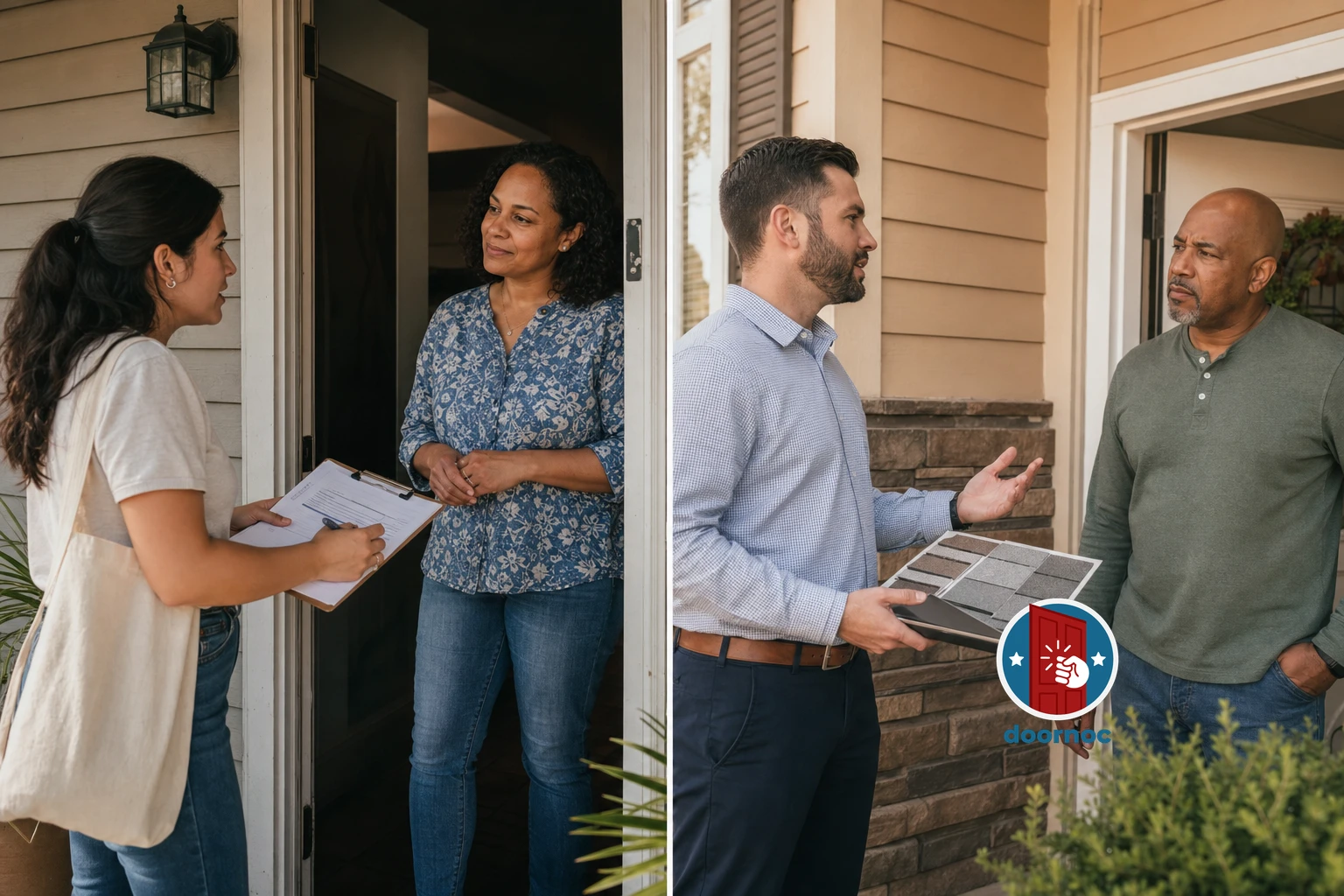
When voters express opposition or skepticism, resist the urge to argue. Arguing at the door wastes time, creates negative word-of-mouth, and never changes minds. Instead, acknowledge their view (“I appreciate you sharing that”), thank them for their time, and move on.
If a voter is undecided but leaning away, plant a seed without pushing: “I understand you’re still thinking it through. If you’d like more information about [specific issue they mentioned], I can leave this with you.” Then exit gracefully.
For more on crafting effective conversation frameworks, read our guide on the art of the perfect door knock script.
Leverage Technology Without Losing the Human Touch
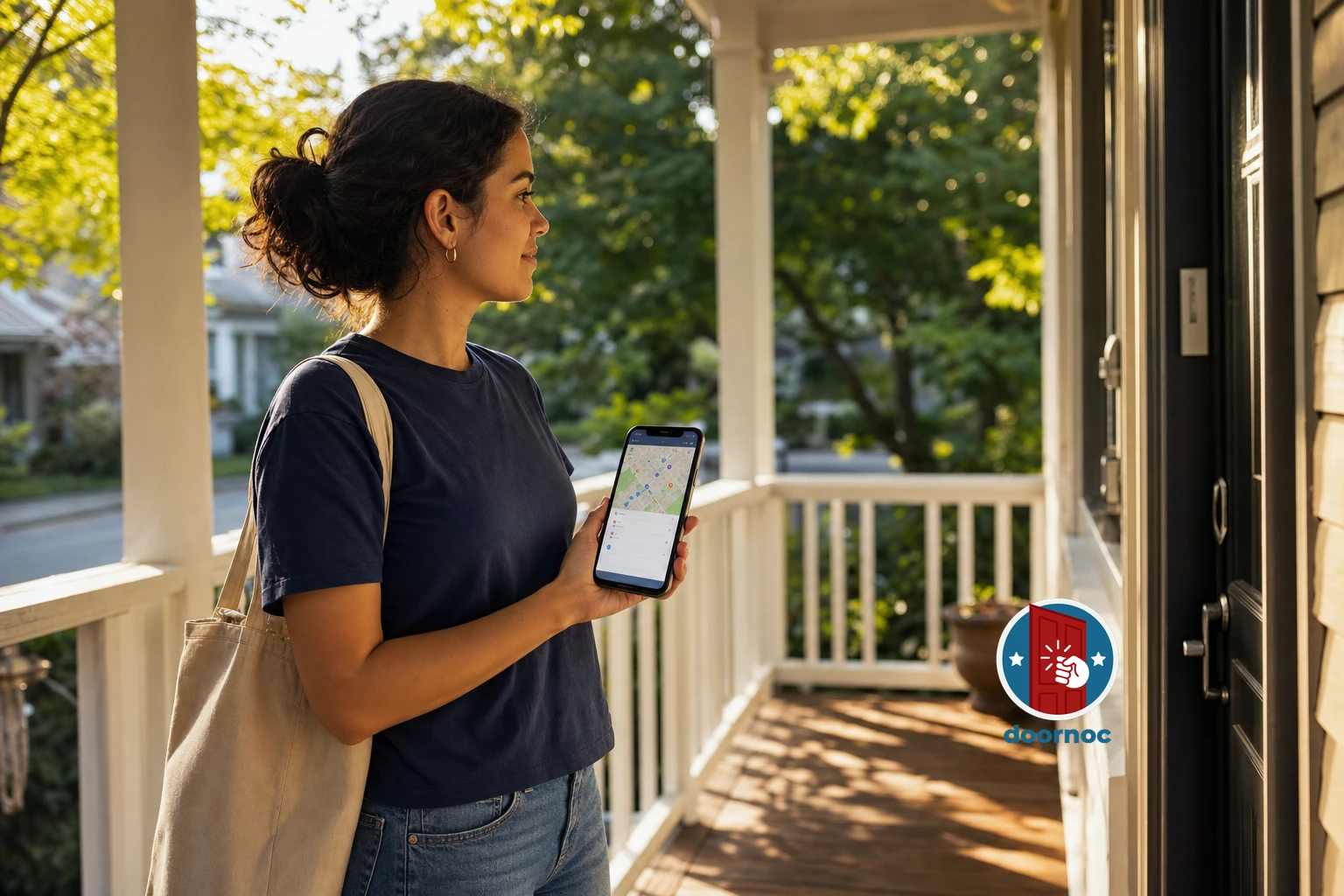
In 2026, successful door knocking requires seamless integration of mobile technology with authentic human connection. The campaigns winning competitive races use door-to-door canvassing software to track data while maintaining genuine voter relationships.
Use Your Canvassing App Efficiently
Don’t fumble with your phone at the door. Learn your app’s interface before you start knocking so you can log responses quickly without breaking eye contact or interrupting conversation flow. Door Knock’s mobile interface is designed for one-handed operation, letting you record voter IDs, issue tags, and follow-up notes in under 10 seconds.
Enable offline mode before entering areas with poor cell service. Nothing kills momentum like losing data because your app couldn’t sync. Modern canvassing apps like Door Knock automatically queue responses offline and sync when you regain connectivity.
Collect Actionable Data
Every conversation should produce usable data for your campaign. At minimum, record:
- Support level (Strong Support, Lean Support, Undecided, Lean Oppose, Strong Oppose)
- Top issue (from a predefined list your campaign prioritizes)
- Volunteer interest (yes/no/maybe)
- Follow-up needed (yes/no, with specific note)
Avoid writing novels in your notes. Brief, actionable tags like “Concerned about schools, wants yard sign, good volunteer prospect” give your campaign everything it needs without slowing you down.
Dress and Present Yourself Professionally
Your appearance communicates credibility before you say a word. Campaigns that enforce dress codes see measurably better contact rates and voter reception.
Campaign Attire Guidelines
Wear campaign-branded shirts or buttons that clearly identify which campaign you represent. This transparency builds trust and eliminates the awkward “Who are you with?” question that derails conversations.
Dress one step above casual. Clean jeans or khakis with a campaign t-shirt or polo works well. Avoid shorts, tank tops, or anything too casual that might signal you’re not taking the work seriously. In upscale neighborhoods, consider business casual.
What to Carry
Bring a professional clipboard or tablet, not crumpled papers in your hand. Carry campaign literature in a clean folder or bag, not loose in your pocket. Have a working pen (test it before you leave) and backup pens in case one dies.
Wear comfortable walking shoes — you’ll cover 3-5 miles in a typical canvassing shift. Blisters and sore feet slow you down and show on your face when voters answer the door.
Train for Common Scenarios
The best door knocking advice prepares you for situations you’ll encounter repeatedly. Practice these scenarios until your responses become automatic.
The “Not Interested” Response
When someone says “I’m not interested” before you finish your introduction, respond with: “I understand — I’ll just leave this information with you in case you’d like to learn more. Have a great day!” This acknowledges their boundary while still accomplishing your literature drop goal.
Never argue with “not interested” voters or try to convince them to talk. Respect their time, maintain your positive demeanor, and move to the next door. Your job is to find supporters and persuadables, not convert everyone.
The Long Talker
Some voters will talk for 20 minutes if you let them. After 3-4 minutes, politely redirect: “I really appreciate you sharing that, and I have several more neighbors to talk with before it gets dark. Can I count on your vote for [Candidate]?” This acknowledges their engagement while protecting your time.
If they continue talking, use physical cues — step back from the door, glance at your clipboard, shift your weight. Most people pick up on these signals and wind down naturally.
The Hostile Voter
Rarely, you’ll encounter voters who are angry or hostile. Stay calm, don’t take it personally, and exit quickly: “I can see you feel strongly about this. Thanks for your time.” Then leave immediately.
Never engage with hostile voters or try to de-escalate confrontations. Your safety matters more than one conversation. Note the address in your app so other canvassers can skip it, and move on.
For comprehensive training approaches, see our guide on how to train volunteers for door knocking.
Maximize Your Contact Rate
Contact rate — the percentage of doors you knock where you have a conversation with a voter — directly correlates with campaign success. Field operations that maintain contact rates above 30% consistently outperform those below 20%.
The Three-Knock Rule
Knock three times, spaced 15-20 seconds apart. The first knock is firm but friendly — loud enough to hear throughout the house but not aggressive. Wait 15 seconds. If no answer, knock again slightly louder. Wait another 15 seconds. Third knock, same volume as the second.
After three knocks with no answer, leave literature and move on. Don’t knock a fourth time — if they didn’t hear three knocks, they’re either not home or choosing not to answer.
Listen for Signs of Life
Before knocking, listen for TV noise, conversation, or movement inside. If you hear people, they’re home — knock confidently. If the house is silent, they might be in a back room or outside. Knock anyway, but don’t be surprised by a no-contact.
Check for cars in the driveway, lights on inside, or other signs of occupancy. These clues help you prioritize which doors to spend more time on when working a large turf.
Strategic Callbacks
If you’re working the same turf multiple times (common in GOTV operations), note no-contact addresses for callback at different times. Someone not home at 5 PM on Tuesday might be home at 11 AM on Saturday. Door Knock’s callback tracking feature automatically flags no-contacts for follow-up at optimal times.
For proven techniques to boost your contact rate, read our article on how to increase voter contact rate.
Work Efficiently in Different Housing Types
Door to door canvassing tips vary by housing density. Suburban single-family homes, urban apartments, and rural properties each require different approaches.
Suburban Single-Family Homes
In suburban neighborhoods, expect to knock 15-25 doors per hour with 8-12 conversations. Walk the sidewalk, not across lawns (unless there’s no sidewalk). Respect “No Soliciting” signs — while political canvassing is legally protected speech in most jurisdictions, ignoring these signs creates negative impressions.
If a home has a gate or fence, knock on the gate rather than entering without permission. Call out “Hello!” to alert residents you’re there, then wait for them to come to the gate.
Urban Apartments and Condos
Apartment canvassing is faster (25-35 doors per hour) but often has lower contact rates due to security systems and intercom barriers. If you can’t access the building, don’t loiter or try to sneak in behind residents — this looks suspicious and can get police called.
When you do gain access, work top to bottom (start on the highest floor and work down) so you’re not exhausted by the time you reach later doors. Knock on apartment doors more gently than house doors — sound carries in apartment buildings, and aggressive knocking disturbs neighbors.
Rural Properties
Rural canvassing is slowest (8-15 doors per hour) due to distances between homes. Call ahead when possible to confirm residents are home before driving long distances. Respect private property signs and never enter gated driveways without permission.
Watch for dogs in rural areas. If you see or hear a dog, wait at the end of the driveway rather than approaching the door. Many rural residents will come out to meet you.
Handle Literature and Materials Properly
How you present campaign materials affects voter perception of your professionalism and your candidate’s credibility.
Literature Drops
When leaving literature at no-contact doors, place it securely where it won’t blow away or get wet. Tuck it in the door handle, under a doormat, or in a screen door — never leave it loose on a porch where wind will scatter it.
Don’t overstuff mailboxes with literature. Federal law prohibits placing materials in mailboxes without postage. Use door hangers or tuck literature in door frames instead.
Yard Sign Distribution
If a voter requests a yard sign, get specific placement instructions: “Where would you like it placed?” This ensures the sign goes in the optimal location and shows you respect their property. Offer to place it immediately if you’re carrying signs, or note the address for your field team to follow up.
Never place yard signs without explicit permission, even at strong supporter homes. Unauthorized sign placement creates conflicts with homeowners associations and can turn supporters into detractors.
Stay Safe and Legal
Door knocking safety protocols protect both canvassers and campaigns from liability and negative incidents.
Canvass in Teams When Possible
Pair canvassers, especially in unfamiliar neighborhoods or during evening hours. Teams provide safety, moral support, and training opportunities (experienced canvassers can mentor new volunteers). If you must canvass alone, tell your field director your route and check in every 2 hours.
Know Your Legal Rights
Political canvassing is protected First Amendment activity in the United States. You have the right to knock on doors, even in gated communities and neighborhoods with “No Soliciting” signs. However, respect private property — if asked to leave, leave immediately and note the address.
Carry a campaign ID or authorization letter from your field director. If questioned by security or police, calmly explain you’re doing political canvassing, show your ID, and comply with reasonable requests.
Weather and Health Considerations
Don’t canvass in dangerous weather. Lightning, extreme heat (above 95°F), or severe cold (below 20°F) puts volunteers at risk for minimal voter contact gain. Reschedule canvass shifts rather than pushing through dangerous conditions.
Stay hydrated — carry a water bottle and drink regularly, especially in hot weather. Take breaks every 90 minutes to rest, hydrate, and review your data. Exhausted canvassers have poor conversations and make data entry mistakes.
Debrief and Improve Continuously
The best campaigns treat every canvass shift as a learning opportunity. Post-shift debriefs turn individual experiences into team-wide improvements.
Immediate Data Review
Before leaving your turf, review your data for completeness. Check that every door has a disposition (contacted, not home, refused, etc.) and that conversations have support levels and issue tags. Incomplete data wastes the time you spent knocking and provides no value to your campaign.
Sync your data immediately while details are fresh. Door Knock’s real-time sync ensures your voter IDs reach the campaign database instantly, enabling same-day follow-up on volunteer prospects or issue-based targeting.
Team Debriefs
Gather your canvassing team after each shift for 15-minute debriefs. Ask three questions:
- What worked well today?
- What challenges did you encounter?
- What would you do differently next time?
These debriefs surface best practices, identify training gaps, and build team cohesion. Field directors who run consistent debriefs see measurably better canvasser retention and performance improvement over time.
Track Your Metrics
Monitor these key performance indicators to measure improvement:
- Contact rate: Conversations divided by doors knocked (target: 30%+)
- Doors per hour: Total doors knocked divided by hours in field (target: 20+ in suburbs)
- Support identification rate: Voters ID’d as supporters divided by conversations (varies by turf)
- Volunteer recruitment rate: Volunteer sign-ups divided by conversations (target: 5-10%)
Campaigns that track metrics and set improvement goals consistently outperform those that canvass without measurement. Use Door Knock’s analytics dashboard to monitor team performance and identify top performers to mentor others.
For strategic context on where door knocking fits in your overall voter contact plan, see our comparison of canvassing vs phone banking.
Build Genuine Relationships
The most important door knocking tip is also the simplest: treat every voter as a human being, not a data point. Campaigns that prioritize authentic connection over mechanical efficiency build stronger supporter networks and generate more word-of-mouth support.
Remember Names and Details
When a voter shares their name, use it during the conversation: “Thanks for talking with me, Maria.” This small personalization makes interactions more memorable for both you and the voter.
If a voter mentions something specific — their daughter’s college plans, their small business, their concern about a local issue — note it in your app. When your campaign follows up later, that detail transforms a generic contact into a personalized relationship.
Be Authentic, Not Scripted
Scripts provide structure, but the best conversations happen when you adapt to each voter’s communication style. Some voters want quick, factual exchanges. Others want to share stories and connect personally. Read the room and adjust accordingly.
Don’t be afraid to admit when you don’t know something: “That’s a great question about the candidate’s position on [issue]. I don’t have that information with me, but I’ll make sure someone from the campaign follows up with you.” Honesty builds more trust than fake expertise.
Follow Through on Commitments
If you promise to send information, have the candidate call, or deliver a yard sign, make sure it happens. Note these commitments clearly in your app and flag them for immediate follow-up. Broken promises turn potential supporters into detractors.
For a comprehensive overview of effective canvassing strategy, read our complete guide to political canvassing in 2026.
Adapt Your Approach for Different Voter Types
Not all voters respond to the same canvassing approach. Effective canvassers read cues and adapt their technique based on voter demographics and engagement levels.
Strong Supporters
When you identify a strong supporter, keep the conversation brief but enthusiastic. Confirm their vote, ask about volunteer interest, offer a yard sign, and move on. Don’t spend 15 minutes preaching to the choir when you have persuadable voters waiting.
Strong supporters are your best volunteer recruitment prospects. If they show enthusiasm, ask directly: “Would you be interested in knocking doors with us? We have a canvass this Saturday morning.” Provide specific next steps rather than vague “we’ll be in touch” promises.
Persuadable Voters
Persuadables deserve your longest conversations. Ask questions to understand their concerns, listen actively to their responses, and connect their priorities to your candidate’s platform. These conversations should feel like genuine exchanges, not sales pitches.
Don’t try to persuade on every issue. Find one or two points of connection and focus there. A voter who cares primarily about education doesn’t need to hear your candidate’s full economic plan — lead with education policy and leave literature that covers other issues.
Low-Information Voters
Some voters know little about the race or candidates. Don’t overwhelm them with information. Provide one clear, memorable message: “[Candidate] is focused on [top issue] and has a plan to [specific outcome].” Leave comprehensive literature they can review later.
Low-information voters often respond well to social proof: “A lot of your neighbors are supporting [Candidate] because of [reason].” This frames your candidate as the community choice rather than asking them to make an independent judgment on complex issues.
Master the Art of the Ask
Every door conversation should end with a clear ask. Canvassers who make direct asks achieve measurably better results than those who end conversations vaguely.
The Vote Ask
For supporters and lean supporters, end with: “Can we count on your vote on [Election Day]?” This confirms their commitment and gives you solid voter ID data. Don’t assume support — ask explicitly and record their answer.
For persuadables, soften the ask: “Based on what we’ve talked about, do you think [Candidate] might earn your vote?” This lower-pressure approach keeps the door open for follow-up without demanding immediate commitment.
The Volunteer Ask
When voters show enthusiasm, ask them to get involved: “We’re knocking doors this Saturday morning. Would you like to join us?” Provide specific details (time, location, what to expect) and get their contact information for follow-up.
Make volunteering easy. Don’t ask for open-ended time commitments. Offer specific, bounded opportunities: “Just two hours on Saturday” or “One phone bank shift this week.” People commit to concrete asks more readily than vague ones.
The Referral Ask
Strong supporters can help you reach their neighbors: “Do you know anyone else on this street who might be interested in supporting [Candidate]?” Referrals from trusted neighbors carry more weight than cold contacts and often lead to higher-quality conversations.
For complete guidance on planning and executing effective field operations, see our step-by-step guide on how to canvass for a political campaign.
Conclusion
These 17 door knocking tips represent the collective wisdom of field organizers who’ve won competitive races by mastering the fundamentals of voter contact. The difference between good canvassing and great canvassing isn’t talent or charisma — it’s technique, preparation, and continuous improvement.
Start with the basics: master your first seven seconds, optimize your timing, and perfect your conversation technique. Then layer in technology, data discipline, and strategic adaptation. Track your metrics, debrief after every shift, and treat each door as an opportunity to build a genuine human connection.
The campaigns that win in 2026 won’t be those that knock the most doors — they’ll be those that have the best conversations at each door they knock. With these door to door canvassing tips and the right tools like Door Knock, your campaign can turn every door into a potential vote, volunteer, and advocate.
Ready to put these tips into practice with technology that makes canvassing easier and more effective? Contact our team to see how Door Knock helps campaigns of all sizes run professional field operations that win elections.
Frequently Asked Questions
What time of day is best for door knocking?
The best times for door knocking are 4-7 PM on weekdays and 10 AM-2 PM on Saturdays. Evening hours catch people after work but before dinner, while late morning weekends find voters at home and more receptive. Avoid knocking before 10 AM or after 8 PM, which voters perceive as intrusive and can damage your campaign’s reputation.
What should I say in the first 10 seconds at the door?
Start with a genuine smile, introduce yourself by first name, state which campaign you represent, and immediately explain why you’re there in one clear sentence. For example: ‘Hi, I’m Sarah with the Martinez campaign. I’m talking with neighbors today about the upcoming election.’ This transparent, friendly approach puts voters at ease and establishes credibility instantly.
How do I handle voters who disagree with my candidate?
Stay calm, listen respectfully, and find common ground rather than arguing. Thank them for their time, acknowledge their perspective with phrases like ‘I understand that’s important to you,’ and politely move on. Never argue at the door — it wastes time, creates negative word-of-mouth, and won’t change minds. Your goal is to identify supporters and persuadables, not convert opponents.
How many doors should a canvasser knock per hour?
An effective canvasser averages 15-25 doors per hour in suburban areas, with 8-12 meaningful voter conversations. In dense urban areas, expect 25-35 doors per hour. Quality matters more than quantity — rushing through doors to hit numbers without genuine conversations produces poor data and doesn’t move voters. Focus on contact rate and conversation quality over raw door counts.
What’s the biggest mistake new canvassers make?
The biggest mistake is talking too much instead of listening. New canvassers often deliver scripted monologues that feel like sales pitches, causing voters to disengage. Successful canvassing is conversational — ask questions, listen to voter concerns, and respond authentically. The 60/40 rule (listen 60%, talk 40%) consistently produces better voter ID data and more persuasive conversations.