
Key Takeaways
- How to canvass effectively requires proper preparation: research your turf, gather materials, and use walk lists with voter data to maximize efficiency and results.
- Successful canvassing follows a proven structure — introduce yourself in 5 seconds, qualify voters quickly, deliver your message concisely, and always ask for commitment.
- Digital canvassing tools like Door Knock reduce planning time by 60% through smart route optimization and enable real-time data collection that improves campaign strategy.
- The most effective canvassers knock 15-20 doors per hour, maintain positive body language, listen more than they talk, and follow up on every meaningful interaction within 48 hours.
What Is Political Canvassing and Why Does It Work?
How to canvass for a political campaign starts with understanding what makes this tactic so effective. Political canvassing is the systematic practice of going door-to-door to engage voters directly in their homes. This grassroots approach remains the most effective voter persuasion method available to campaigns, with research showing that face-to-face conversations increase voter turnout by 7-10% compared to no contact at all.
Canvassing works because it’s personal. When a real person stands at someone’s door representing a candidate, it creates accountability and authenticity that digital ads and phone calls simply cannot match. Voters are 3-4 times more likely to remember your message when delivered in person versus through mail or phone contact.
For campaigns operating with limited budgets, canvassing delivers unmatched return on investment. While television ads cost $1,000-5,000 per persuaded voter, effective canvassing costs as little as $10-30 per persuaded voter when volunteer labor is utilized. This efficiency makes door-to-door outreach the backbone of successful grassroots campaigns at every level.
For a comprehensive overview of modern canvassing techniques and strategies, check out our complete guide to political canvassing.
Before You Start: Essential Canvassing Preparation
Research Your Turf and Target Voters
Successful canvassing begins long before you knock your first door. Your campaign should provide detailed walk lists that identify which doors to knock based on voter data. These lists typically prioritize:
- High-propensity voters who haven’t yet committed to your candidate
- Persuadable independents with voting history but no strong party loyalty
- Low-frequency Democratic/Republican voters who need motivation to turn out
- New registrants in favorable demographics who lack voting history
Study your assigned turf before heading out. Review the neighborhood layout, identify landmarks for navigation, and note any accessibility issues like gated communities or apartment complexes requiring buzzers. Understanding your territory reduces time wasted searching for addresses and increases your doors-per-hour rate.
Modern campaigns use voter file data combined with predictive modeling to score every voter on support likelihood and turnout probability. Your walk list isn’t random—it represents the campaign’s strategic priorities based on data analysis. Respect this targeting by following your list precisely rather than freelancing conversations with every person you encounter.
Gather Your Canvassing Materials
Professional canvassers carry these essential items:
- Walk lists with voter data - Include names, ages, party affiliation, and past voting history
- Campaign literature - Bring 50% more pieces than doors on your list to account for multi-voter households
- Mobile canvassing app - Tools like Door Knock let you track responses, mark voter sentiment, and navigate efficiently
- Clipboard and backup pens - Technology fails; paper doesn’t
- Water and snacks - Canvassing is physical work requiring hydration
- Comfortable, professional shoes - You’ll walk 3-5 miles per canvassing shift
- Campaign identification - Name badge, t-shirt, or credentials establishing your legitimacy
- Candidate business cards - Leave something physical when voters aren’t home
Your smartphone becomes your command center with the right canvassing app. Door Knock’s offline mode ensures you can access voter data and record interactions even in areas with poor cell coverage—a common problem in rural precincts that can otherwise derail your entire shift.
Master the Canvassing Script
Every campaign should provide a tested canvassing script that accomplishes four objectives:
- Identify yourself and your purpose (5 seconds)
- Qualify the voter’s support level (15 seconds)
- Deliver your persuasion message (30-60 seconds)
- Ask for commitment (10 seconds)
Memorize the script’s structure but avoid sounding robotic. Your delivery should feel conversational while hitting key message points consistently. Campaigns test multiple message variations to identify what resonates—your job is to deliver the winning message faithfully.
The script should include clear branching logic: If the voter supports your opponent, politely thank them and move on. If they’re undecided, deploy your persuasion points. If they support your candidate, confirm their voting plan and mark them as a supporter for GOTV efforts.
Practice your script with a partner before canvassing. Role-play different scenarios including hostile voters, confused residents, and enthusiastic supporters. This preparation builds confidence and reduces anxiety when real doors open.
How to Canvassing: The Door-to-Door Process
Step 1: Plan Your Route Strategically
Efficient canvassing requires route optimization that minimizes walking distance while maximizing voter contact. Smart route planning can increase your productivity by 30-40% compared to randomly approaching doors.
Traditional campaigns print paper maps with door sequences, but this approach wastes time deciphering handwritten numbers and backtracking for missed addresses. Modern canvassing platforms like Door Knock use GPS-enabled route optimization that sequences your doors efficiently and recalculates routes in real-time as you mark doors completed.
When planning routes manually, follow these principles:
- Start at one end of the street and work systematically to the other
- Complete one side before crossing to the other side
- Skip houses not on your list rather than knocking every door
- Group apartment complexes together rather than bouncing between buildings
- Save difficult-to-access locations (gated communities, long driveways) for last
Urban canvassing presents unique challenges with apartment buildings. Develop a building strategy: knock systematically floor-by-floor rather than randomly jumping between levels. Many canvassers waste 20-30 minutes navigating confusing apartment layouts—this preparation prevents that inefficiency.
Step 2: Approach the Door Confidently
Your approach sets the tone for the entire interaction. Walk confidently up the pathway, maintain open body language, and prepare your script mentally as you approach.
Knock firmly three times with 2-3 seconds between knocks, or ring the doorbell once. Don’t be timid—residents need to hear you clearly. Wait 20-30 seconds before knocking again or moving to the next house. Many campaigns instruct canvassers to wait only 10-15 seconds, but this doesn’t give residents adequate time to reach the door, especially elderly voters or those in multi-story homes.
Position yourself 5-6 feet back from the door after knocking. Standing too close feels aggressive and makes residents uncomfortable. Angle your body slightly rather than facing the door square-on—this appears less confrontational.
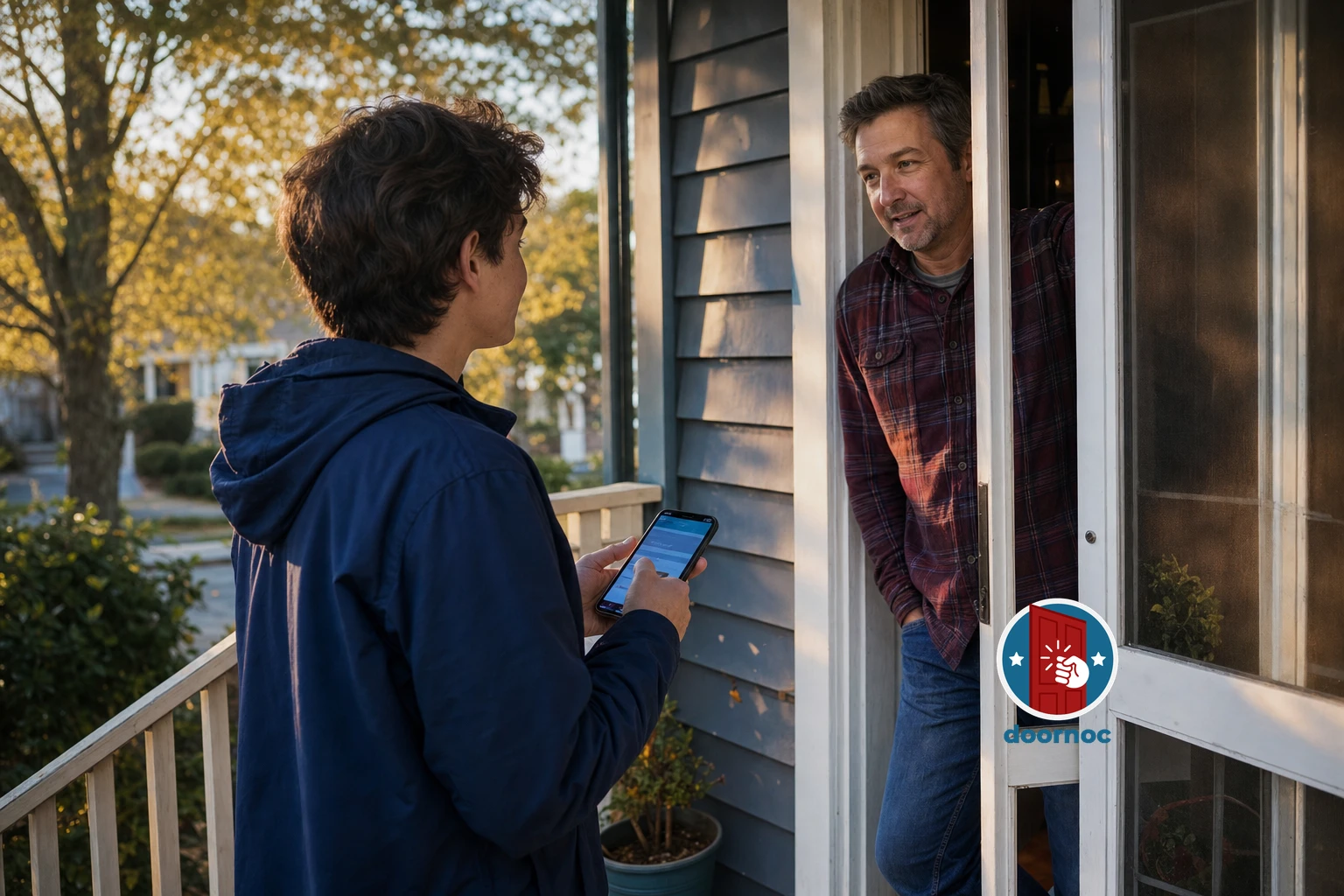
When someone answers, smile genuinely, make eye contact, and begin your introduction immediately. The first five seconds determine whether the resident engages or dismisses you. Your opening should be enthusiastic but not aggressive: “Hi! I’m Sarah with the Johnson campaign. Is Rebecca home?” Using the voter’s first name (from your walk list) personalizes the interaction and confirms you’re at the correct address.
Step 3: Deliver Your Introduction and Qualify the Voter
Your introduction accomplishes three goals: identify yourself, establish legitimacy, and qualify whether you’re speaking with the target voter.
Sample introduction: “Hi! I’m Marcus, and I’m volunteering with Lisa Chen’s campaign for State Senate. I’m talking with neighbors today about the election. Are you planning to vote in November?”
This opening:
- Provides your name (building personal connection)
- Identifies the campaign and candidate clearly
- Establishes you’re a volunteer (not selling anything)
- Asks an easy qualifying question
If the person who answers isn’t the target voter from your list, ask politely if that person is available. “I’m actually hoping to speak with James—is he home?” If James isn’t available, ask when might be a better time to catch him, or offer to leave literature with a message.
Some campaigns instruct canvassers to have full conversations with any adult who answers, even if they’re not the listed voter. This approach works for households where multiple voters live together, but it can waste time in shared housing situations where your target voter has minimal connection with other residents.
Pay attention to the voter’s body language and time constraints. If someone says “I’m actually on my way out,” respect that but ask if you can leave literature and schedule a better callback time. Pushing for a conversation when someone is clearly busy damages your candidate’s reputation.
Step 4: Have the Persuasion Conversation
Once you’ve confirmed you’re speaking with a target voter, transition into the persuasion phase. This represents the core of your canvassing mission.
Effective persuasion conversations follow this structure:
Ask about their priorities: “What issues matter most to you in this election?” This question accomplishes multiple goals—it shows respect for their opinion, provides intelligence about voter concerns, and lets you tailor your message to their priorities.
Listen actively: The most common canvassing mistake is talking too much. Let the voter speak. Nod, maintain eye contact, and ask follow-up questions. Voters who feel heard are exponentially more persuadable than those who feel lectured.
Bridge to your candidate: Connect their stated priorities to your candidate’s positions. “You mentioned healthcare costs are a concern—Lisa has a specific plan to reduce prescription drug prices by allowing Medicare to negotiate directly with pharmaceutical companies. That could save the average senior $1,200 annually.”
Use specific, concrete details: Vague promises don’t persuade. Specific numbers, timelines, and implementation details demonstrate your candidate has real plans rather than empty rhetoric.
Address concerns directly: If the voter expresses skepticism or raises objections, acknowledge their concern rather than dismissing it. “I understand why you’d be skeptical about that promise—here’s specifically how Lisa plans to fund this without raising taxes…”
Tell a story: Data persuades, but stories motivate. Share a brief anecdote about how your candidate’s policies have already helped real people, or explain why you personally volunteer for the campaign. Personal narratives create emotional connections that raw policy discussions cannot.
Keep persuasion conversations to 2-4 minutes maximum. Your goal is quality contact with many voters, not exhaustive discussions with a handful. If someone wants a longer conversation, offer to connect them with the campaign office or invite them to a town hall event.
Step 5: Ask for Commitment and Record the Response
Every canvassing conversation must end with a clear ask. Without this step, you’ve had a pleasant chat but accomplished little for the campaign.
Your ask depends on the voter’s support level:
For supporters: “Can I count on your vote for Lisa on November 5th? And would you be willing to display a yard sign?” Secure their commitment and identify opportunities for deeper engagement.
For undecided voters: “Based on what we’ve discussed about healthcare and education, does Lisa sound like someone you’d consider supporting?” Frame your ask as a low-commitment consideration rather than demanding immediate support.
For opponents: “I appreciate your time. Even though you’re supporting another candidate, I hope you’ll keep an open mind and look at Lisa’s website if you’d like more information.” End politely without arguing.
Immediately record the voter’s response in your canvassing app while still at the door or within sight of the house. This ensures accurate data collection before you forget details. Mark:
- Support level (Strong Support, Lean Support, Undecided, Lean Opponent, Strong Opponent)
- Issue priorities mentioned
- Any specific concerns or questions
- Follow-up needs (requested yard sign, asked about volunteer opportunities)
- Best time to reach them if you need to return
Digital data collection reduces errors by 85% compared to paper lists that must be manually transcribed later. Door Knock’s mobile interface lets you record complex voter responses with a few taps, including custom notes about specific concerns that may inform future contact strategies.
Step 6: Leave Literature and Move to the Next Door
Before leaving, hand the voter campaign literature even if they’re not fully committed. Physical materials serve as reminders after you leave and provide information for voters who want to research further.
If no one answers the door, leave a piece of literature in a visible location (tucked in the door frame, not loose where it might blow away). Some campaigns use door hangers with the candidate’s information and a message like “Sorry we missed you!”
Don’t linger after the conversation ends. Thank the voter for their time, confirm any commitments, and move to your next door. Canvassing is a numbers game—every minute spent unnecessarily reduces your overall productivity.
As you walk to the next house, mentally reset. Don’t let a negative interaction at one door affect your energy and enthusiasm at the next. Each conversation is independent, and voters can sense if you’re carrying frustration or fatigue.
Advanced Canvassing Tips for Maximum Impact
Optimize Your Timing
When you canvass matters as much as how you canvass. Contact rates vary dramatically by time of day and day of week:
Best times:
- Weekday evenings (5:30-8:00 PM): Highest contact rates for working voters
- Saturday mornings (10:00 AM-1:00 PM): Good for families and homeowners
- Sunday afternoons (1:00-5:00 PM): Often effective but may conflict with religious observations
Worst times:
- Weekday mornings/afternoons: Most working voters aren’t home
- Dinner time (6:00-7:00 PM): Interrupting meals creates negative associations
- After 8:00 PM: Many voters consider this intrusive
- Early Sunday mornings: Conflicts with religious services and sleep
Weather affects both canvasser productivity and voter receptiveness. Light rain doesn’t stop dedicated canvassers, but heavy storms require rescheduling. Extremely hot or cold weather reduces contact rates as fewer people answer their doors.
Adjust your approach based on neighborhood demographics. Retiree communities show better weekday afternoon contact rates, while younger, working-class neighborhoods require evening and weekend canvassing.
Master Body Language and Presentation
Non-verbal communication determines how voters perceive you before you speak a single word. Research indicates that 55% of communication effectiveness comes from body language, 38% from tone of voice, and only 7% from actual words spoken.
Positive body language:
- Stand with open posture (arms at sides, not crossed)
- Maintain comfortable eye contact (not staring)
- Smile genuinely when introducing yourself
- Keep your voice calm and enthusiastic, not aggressive
- Mirror the voter’s energy level (match their pace and volume)
- Nod while they speak to show active listening
Appearance matters:
- Dress business-casual (not too formal, but neat and clean)
- Wear campaign identification clearly visible
- Avoid controversial clothing items (political statements beyond your candidate)
- Keep hair neat and minimize distracting accessories
- Don’t eat, drink, or smoke while canvassing
Your appearance signals respect for voters and professionalism of the campaign. Sloppy presentation suggests a disorganized campaign that doesn’t deserve voter trust.
Handle Difficult Situations Professionally
Not every door interaction goes smoothly. Prepare for these common challenges:
Hostile voters: Stay calm, thank them for their time, and leave immediately. Never argue or try to “win” the conversation. Your safety and the campaign’s reputation outweigh any single voter.
Guard dogs: If a dog seems aggressive, don’t approach the door. Mark the address as “Do Not Knock - Aggressive Dog” in your canvassing app. No voter contact is worth a dog bite.
Language barriers: If you encounter a voter who doesn’t speak English fluently, apologize politely and ask if there’s someone else in the household who can translate. Many campaigns provide multi-language literature for diverse communities.
Voters with disabilities: If someone has hearing difficulties, speak clearly and slowly. Offer to provide written materials they can review. If they have mobility challenges and need time reaching the door, be patient.
“No Soliciting” signs: Political canvassing is typically exempt from solicitation ordinances because it’s protected First Amendment activity, not commercial solicitation. However, respect individual preferences—if a sign says “No Political Canvassing” specifically, skip that house.
Gated communities: Many campaigns face access challenges in gated neighborhoods. Some options: ask supporters inside the community to grant you entry, wait near the entrance for residents entering/exiting who might let you in, or schedule appointments with individual voters who can add you to the guest list.
Use Technology to Amplify Your Efficiency
Modern canvassing tools transform field operations from chaotic paper-based efforts into data-driven precision operations. Campaigns using mobile canvassing apps report 40-60% efficiency gains compared to traditional clipboard-and-paper approaches.
Door Knock’s platform provides several efficiency multipliers:
Smart route optimization: The app sequences your doors to minimize walking distance and backtracking. This feature alone increases most canvassers’ doors-per-hour rate by 20-30%.
Offline functionality: Rural and suburban areas often have spotty cell coverage. Door Knock’s offline mode downloads voter data and maps before you start, ensuring you can access information and record responses without connectivity.
Real-time data sync: When you mark a door, that information immediately updates the campaign’s central database (once you’re back in coverage). This prevents duplicate contact and allows campaign managers to monitor progress remotely.
Integrated navigation: No more fumbling with separate GPS apps while consulting paper lists. Door Knock provides turn-by-turn directions to each door automatically.
Response templates: Common responses (Strong Support, Lean Support, Undecided, etc.) can be marked with single taps, while unusual situations allow custom notes.
Campaigns that implement digital canvassing tools report 85% fewer data entry errors and save an average of 2-3 hours weekly on administrative work per canvasser. This efficiency allows volunteers to focus on conversations instead of paperwork.
Explore how Door Knock’s features can streamline your campaign’s field operations and increase volunteer productivity.
After the Canvass: Follow-Up and Data Management
Review Your Results Immediately
After completing your canvassing shift, spend 15-20 minutes reviewing your results before leaving the field. This immediate debrief catches errors and captures insights while details are fresh.
Check your data for:
- Incomplete entries (doors marked contacted but no support level recorded)
- Inconsistent responses (voter marked as “Strong Opponent” but also “Interested in yard sign”)
- Follow-up tasks you promised voters (“I’ll have someone call you about volunteering”)
- Doors you couldn’t access that need rescheduling
If using paper lists, transcribe your notes into the campaign’s database immediately—ideally before leaving your canvassing area. Waiting until later increases transcription errors and may result in lost lists.
Make note of any unusual patterns you observed: neighborhoods with higher-than-expected opposition, issues that multiple voters raised, or areas where door access was particularly difficult. This intelligence helps the campaign refine future targeting.
Communicate Critical Intelligence
Some information you gather requires immediate escalation to campaign leadership:
- Undecided voters requesting personal candidate contact (high-value targets)
- Local influencers expressing interest (community leaders, clergy, business owners)
- Organized opposition activities (opponent canvassers, hostile coordinators)
- Misinformation spreading in the community (allows rapid response)
- Volunteer recruitment opportunities (supporters willing to help)
Don’t wait for the weekly volunteer meeting to share time-sensitive intelligence. Text or call your field director immediately with information that affects campaign strategy.
Track Your Personal Metrics
Successful canvassers monitor their own performance metrics to identify improvement opportunities:
- Doors per hour: Track your productivity over time
- Contact rate: Percentage of doors where you spoke with target voter
- Persuasion rate: Percentage of undecided voters who moved toward support
- Average conversation length: Are you efficient or spending too long per door?
Your contact rate depends partly on factors beyond your control (time of day, neighborhood characteristics), but it also reflects your approach technique. Canvassers who improve their approach positioning and timing often see contact rates increase 10-15 percentage points.
Most campaigns set productivity targets: 15-20 doors per hour with a 30-40% contact rate represents solid performance. If you’re falling short, request feedback from experienced canvassers or your field director on technique improvements.
Building Your Canvassing Skills Over Time
Canvassing is a learned skill that improves dramatically with practice. First-time canvassers often feel anxious and awkward—this is completely normal. Most people don’t enjoy approaching strangers’ homes uninvited.
Your first shift will feel overwhelming. By your third shift, you’ll have developed rhythm and confidence. By your tenth shift, you’ll navigate most situations instinctively.
Progressive skill development:
Shifts 1-3: Focus on following your script accurately and completing your assigned doors. Don’t worry about perfect conversations—just get comfortable with the basic process.
Shifts 4-7: Begin adapting your script to different voter types. Practice active listening and bridging to your candidate’s message naturally rather than robotically reciting talking points.
Shifts 8-12: Work on efficiency. Track your doors-per-hour rate and identify time wasters. Experiment with different approach techniques and door-knocking patterns.
Shifts 13+: You’re now an experienced canvasser. Focus on training newer volunteers, handling complex persuasion conversations, and identifying strategic intelligence for the campaign.
Many campaigns pair new canvassers with experienced veterans for the first 1-2 shifts. This mentorship accelerates learning and provides real-time feedback that prevents bad habits from forming.
Video record yourself practicing your script (with permission). Most people are surprised by their own body language and vocal patterns. This self-awareness drives rapid improvement.
Common Canvassing Mistakes to Avoid
Even experienced canvassers fall into these traps:
Talking too much: Canvassing isn’t about delivering speeches—it’s about having conversations. Let voters talk at least 40% of the time.
Skipping the ask: Many volunteers feel uncomfortable directly asking for support. Without this ask, you’ve wasted the entire conversation.
Arguing with opponents: You will never convert a hostile voter through argument. Thank them and move to the next door.
Cherry-picking easy doors: Following your assigned list matters. Don’t skip difficult-to-access houses because they’re inconvenient.
Poor data hygiene: Recording inaccurate information is worse than recording nothing. If you’re unsure of a voter’s response, mark them as “Unknown” rather than guessing.
Ignoring safety: Canvassing involves walking in unfamiliar neighborhoods, often during evening hours. Stay aware of your surroundings, avoid isolated areas after dark, and immediately leave any situation that feels unsafe.
Forgetting to follow up: When voters request yard signs, volunteer information, or specific policy details, ensure the campaign follows through. Broken promises damage credibility.
Burning out volunteers: Canvassing is physically and emotionally demanding. Effective field directors schedule manageable shifts (2-3 hours) rather than marathon sessions that exhaust volunteers and prevent their return.
Integration with Broader Campaign Strategy
Canvassing doesn’t exist in isolation—it’s one component of an integrated voter contact strategy. The most effective campaigns layer multiple touchpoints:
- Initial mail introduces your candidate to the household
- Digital ads build name recognition and message awareness
- Canvassing provides personal contact and gathers voter intelligence
- Phone banking follows up on canvassing conversations and reaches lower-priority targets
- Text messaging delivers reminders about early voting and Election Day
- Final mail reinforces your message in the days before voting
Your canvassing data feeds the entire system. Voters identified as strong supporters through canvassing get removed from expensive persuasion mail but added to GOTV reminder lists. Undecided voters flagged during canvassing might receive a personal phone call from the candidate.
This integration requires excellent data management—another reason why digital canvassing tools outperform paper systems. Real-time data sync means the entire campaign operates from current information rather than week-old lists.
Large campaigns employ data analytics to close the loop: they track which canvassing messages correlate with highest persuasion rates, then refine scripts for remaining shifts. This continuous improvement approach maximizes return on volunteer labor.
Scaling Canvassing Operations
Growing a canvassing program from 5 volunteers to 50 requires operational infrastructure:
Volunteer recruitment: Build a pipeline through social media recruitment, volunteer nights, and asking current volunteers for referrals.
Training systems: Develop standardized training that quickly onboards new volunteers. Consider creating video training modules that volunteers can review before their first shift.
Staging locations: Large-scale canvassing requires organizing staging locations where volunteers receive lists, materials, and final instructions before deploying.
Team structure: Organize volunteers into teams with experienced team leaders who provide support and answer questions during shifts.
Recognition programs: Canvassing is hard work. Recognize top performers with public thank-yous, campaign events, and opportunities to meet the candidate.
Retention focus: Recruiting new volunteers is 5x harder than retaining existing ones. Check in personally with volunteers after shifts, address concerns quickly, and create social connections among volunteers.
Campaigns using Door Knock for volunteer management report 35% higher volunteer retention compared to campaigns using manual coordination. The platform’s team features, real-time progress tracking, and automated route assignment reduce organizer workload while improving volunteer experience.
Measuring Canvassing ROI
How do you know if your canvassing program is working? Track these metrics:
Volume metrics:
- Total doors knocked
- Contact rate (conversations / doors knocked)
- Doors per volunteer hour
Quality metrics:
- Persuasion rate (undecided voters moved to support)
- Identification rate (voters successfully categorized by support level)
- Volunteer recruitment (new volunteers recruited through canvassing)
Strategic metrics:
- GOTV efficiency (percentage of identified supporters who actually vote)
- Cost per persuaded voter
- Cost per additional vote generated
The gold standard measurement is experimental: randomly assign some targeted voters to receive canvassing while a control group receives no contact, then compare turnout rates. This approach requires sophisticated campaign infrastructure but provides definitive ROI data.
Realistic expectations: Effective canvassing increases turnout among contacted voters by 7-10 percentage points and persuades 5-15% of genuinely undecided voters. These might seem like modest numbers, but in competitive races, they determine winners.
A campaign that effectively contacts 20,000 voters through canvassing might generate 1,000-1,500 additional votes compared to no contact. In races decided by hundreds of votes, this margin is decisive.
Your Canvassing Checklist
Before every canvassing shift, verify you have:
- Walk list loaded in canvassing app or printed on paper
- Phone fully charged with offline maps downloaded
- Campaign literature (50% more than your door count)
- Water and snacks
- Comfortable shoes
- Campaign identification visible
- Script reviewed and practiced
- Emergency contact information
- Knowledge of bathroom locations along your route
- Backup battery pack for phone
After every shift:
- All data synced to campaign database
- Follow-up tasks communicated to field director
- Critical intelligence escalated immediately
- Personal metrics logged for self-improvement
- Equipment returned to campaign office
Mastering how to canvass effectively transforms campaign outcomes. The skills you develop—persuasive communication, resilience, strategic thinking, and interpersonal connection—extend far beyond politics into every aspect of life.
Thousands of successful campaigns have proven that door-to-door canvassing remains the most cost-effective persuasion tool available. With proper preparation, the right tools, and consistent execution, your canvassing program can become the decisive factor in your election.
Frequently Asked Questions
What should I bring when canvassing for a political campaign?
Bring campaign literature, a clipboard with walk lists, a pen, comfortable walking shoes, water, and a mobile canvassing app loaded with voter data. Your phone should be fully charged with offline maps available. Include a name badge identifying yourself with the campaign and always carry the candidate’s business cards or flyers.
How many doors should you knock per hour when canvassing?
Experienced canvassers typically knock 15-20 doors per hour in suburban areas and 12-15 in rural settings. Your actual rate depends on door spacing, conversation length, and whether you’re attempting contact or having longer persuasion conversations. Quality conversations matter more than raw numbers.
What time of day is best for political canvassing?
The best canvassing times are weekday evenings (5:30-8:00 PM) and weekend mornings (10:00 AM-1:00 PM) or afternoons (1:00-5:00 PM). Avoid dinner time (6:00-7:00 PM) and early mornings before 10 AM on weekends. Evening canvassing typically yields higher contact rates with working voters.
How do you handle hostile voters while canvassing?
Stay calm, thank them for their time, and leave immediately without arguing. Never escalate or take hostility personally—it’s rarely about you. Mark their response in your canvassing app so the campaign doesn’t waste resources contacting them again. Your safety and the campaign’s reputation are more important than any single conversation.
What’s the difference between canvassing and door knocking?
These terms are functionally identical—both refer to door-to-door voter contact. ‘Canvassing’ is the broader term used in political organizing, while ‘door knocking’ is more colloquial. Both involve walking predetermined routes to contact voters at their homes, gather data, and persuade undecided voters.