Key Takeaways
- Door to door campaigns remain the most effective voter contact method in 2026, delivering 9-12% higher turnout than digital-only strategies when executed properly
- Successful campaigns require three core systems: smart territory mapping, real-time data capture, and volunteer retention programs that reduce turnover by 40%
- Modern canvassing platforms like Door Knock reduce planning time by 65% through AI-powered route optimization and offline-first mobile apps
- The optimal door-to-door operation contacts each target voter 3-4 times across the campaign cycle, with the final touch occurring 48-72 hours before Election Day
Door to door campaigns deliver results that no other voter contact method can match. In 2026, face-to-face conversations at voters’ doorsteps remain the gold standard for persuasion, turnout, and building the grassroots energy that wins competitive elections. While digital advertising and text banking have their place, nothing replaces the personal connection of a neighbor asking for your vote.
Running a successful door to door political campaign requires more than enthusiasm and clipboards. You need systematic planning, efficient technology, volunteer management skills, and data-driven decision-making. This guide walks you through every component of building a door to door operation that maximizes voter contact while respecting your team’s time and your campaign’s budget.
What Makes Door to Door Campaigns Effective in 2026?
Door to door canvassing works because it leverages fundamental human psychology. When someone takes the time to visit your home, look you in the eye, and have a genuine conversation, you pay attention. This personal investment creates persuasion effects that persist through Election Day and beyond.
Research consistently shows that door to door contact increases voter turnout by 9-12 percentage points compared to no contact. That advantage holds across demographic groups, though the effect is strongest among low-propensity voters who rarely respond to digital outreach or phone calls. A well-executed door to door campaign reaches voters that other methods miss entirely.
The persuasion advantage is equally compelling. Voters contacted through door to door canvassing are 3-5 percentage points more likely to support your candidate than those reached only by phone. The difference comes from conversation quality. Phone banking allows easy hang-ups and distracted multitasking. Door conversations demand presence and create social pressure to engage respectfully.
Modern campaigns also benefit from technological advances that didn’t exist a decade ago. Mobile canvassing software now handles route optimization, real-time data sync, and offline functionality that keeps volunteers productive even in areas with poor cell coverage. These tools transform door to door operations from logistical nightmares into streamlined voter contact machines.
The Three Pillars of Modern Door to Door Operations
Successful door to door campaigns in 2026 rest on three foundational systems. First, you need intelligent territory management that ensures volunteers knock the right doors in the right sequence. Second, you require real-time data capture that feeds voter responses back into your targeting models immediately. Third, you must build volunteer retention programs that keep canvassers engaged week after week.
Campaigns that excel at all three pillars contact 40-60% more voters per volunteer hour than those using outdated paper-based systems. The efficiency gains compound over a multi-month campaign cycle, often making the difference between victory and defeat in close races.
How to Plan Your Door to Door Campaign Territory
Territory planning determines whether your volunteers spend their time knocking productive doors or wandering inefficiently through neighborhoods where your candidate has no chance. Start by defining your target universe based on voter file data, then organize that universe into manageable geographic units.
Your target universe should include three categories of voters. High-priority persuasion targets are registered voters with moderate support scores who could swing either way. Base turnout targets are strong supporters with low vote history who need motivation to cast ballots. Volunteer prospects are highly engaged voters who might join your field team if asked personally.
Most competitive campaigns target 60-75% of registered voters in their district, excluding strong opponents and extremely low-propensity voters who won’t turn out regardless of contact. This targeting discipline prevents wasted volunteer hours on unwinnable or unnecessary conversations.
Creating Walkable Turf Cuts
Once you’ve identified target voters, divide your territory into turf cuts of 150-250 doors each. These geographic units should be walkable in 2-3 hours by an average volunteer, allowing completion in a single canvassing shift. Turf boundaries should follow natural features like major roads or parks that volunteers can easily identify.
Avoid creating turfs that require excessive backtracking or car moves between clusters of houses. The best turf cuts flow logically from one street to the next, minimizing walk time between doors. In suburban areas, this often means following alphabetical street patterns or subdivision layouts. In urban areas, focus on continuous blocks within safe, well-lit neighborhoods.
Modern door-to-door canvassing software automates most of this process. Platforms like Door Knock use AI-powered algorithms to generate optimized turf cuts that balance door count, geographic compactness, and target voter density. What once took field directors days of manual map work now happens in minutes.
Prioritizing High-Value Doors
Not all doors in your target universe deserve equal attention. Prioritize your canvassing schedule based on voter scores, contact history, and strategic importance. High-value doors include undecided voters in high-turnout precincts, strong supporters who need vote-by-mail applications, and volunteer prospects with organizing potential.
Create a tiered contact plan that ensures your most important voters receive multiple touches throughout the campaign. Tier 1 voters should receive 3-4 contacts including at least two door knocks. Tier 2 voters get 2-3 contacts with one guaranteed door visit. Tier 3 voters receive a single contact, often during the final Get Out The Vote push.
This prioritization strategy maximizes the persuasion and turnout impact of your finite volunteer hours. You can learn more about strategic planning in our guide on how to organize a door-to-door canvassing campaign.
Building and Training Your Canvassing Team
Your door to door campaign succeeds or fails based on volunteer quality and retention. Recruiting enthusiastic supporters is the first step, but converting them into effective canvassers requires structured training, ongoing support, and recognition programs that prevent burnout.
Start recruiting volunteers at least 8-10 weeks before your first canvass. Host recruitment house parties where supporters can invite friends, post on social media with specific asks and time commitments, and personally invite high-propensity volunteers identified during early door knocking. The personal ask remains the most effective recruitment method in 2026.
Set clear expectations during recruitment. Tell volunteers exactly how long shifts last (usually 2-3 hours), what they’ll be doing (walking neighborhoods and having brief conversations), and what support they’ll receive (training, scripts, technology, and a team leader). Transparency prevents early dropouts from volunteers who expected something different.
Conducting Effective Canvasser Training
Every volunteer needs training before their first door knock, even those with prior campaign experience. A quality training session covers five essential components: campaign message and talking points, door approach and conversation flow, handling objections and difficult voters, using your canvassing technology, and safety protocols.
Role-playing exercises are non-negotiable. Have volunteers practice introducing themselves, delivering your campaign’s core message, and recording responses on their phones or tablets. Pair experienced canvassers with newcomers for these drills. The repetition builds muscle memory that prevents freezing during actual door conversations.
Your canvassing script should be conversational, not robotic. Train volunteers to use the script as a framework while adapting to each voter’s concerns and communication style. The best canvassers sound natural because they’ve internalized the message rather than memorizing exact words.
Dedicate significant training time to your canvassing app. Walk volunteers through launching the app, selecting their turf, navigating to the first door, recording voter responses, and syncing data. Have them complete practice entries for fictional voters. Technology confusion is the leading cause of data quality problems in door to door campaigns.
Managing Volunteers in the Field
Field organization requires team leaders who coordinate canvassing shifts, troubleshoot problems, and keep volunteers motivated. Recruit one team leader for every 6-8 active canvassers. These leaders should be your most reliable, experienced volunteers who understand both the campaign message and the operational details.
Team leaders arrive 30 minutes before each canvassing shift to prepare materials, test technology, and greet arriving volunteers. They conduct brief pre-shift huddles that review talking points, assign turfs, and share success stories from previous canvasses. Post-shift debriefs allow volunteers to share experiences, ask questions, and celebrate achievements.
Implement a buddy system where new volunteers always canvass with experienced partners for their first 2-3 shifts. This mentorship accelerates skill development and prevents the isolation that causes early dropouts. Experienced volunteers enjoy the teaching role, while newcomers gain confidence faster than they would working alone.
Optimizing Your Door Knocking Routes
Route efficiency determines how many voters your volunteers contact per hour. Poor routes waste time on excessive walking between doors, backtracking through already-covered areas, and dead ends that require doubling back. Smart route planning can increase productivity by 30-40% without volunteers working any harder.
The traditional approach of walking every street in sequential order rarely produces optimal routes. Instead, use route optimization algorithms that calculate the shortest path through your target doors while minimizing backtracking. These algorithms account for one-way streets, walking speed, and natural barriers that affect travel time.
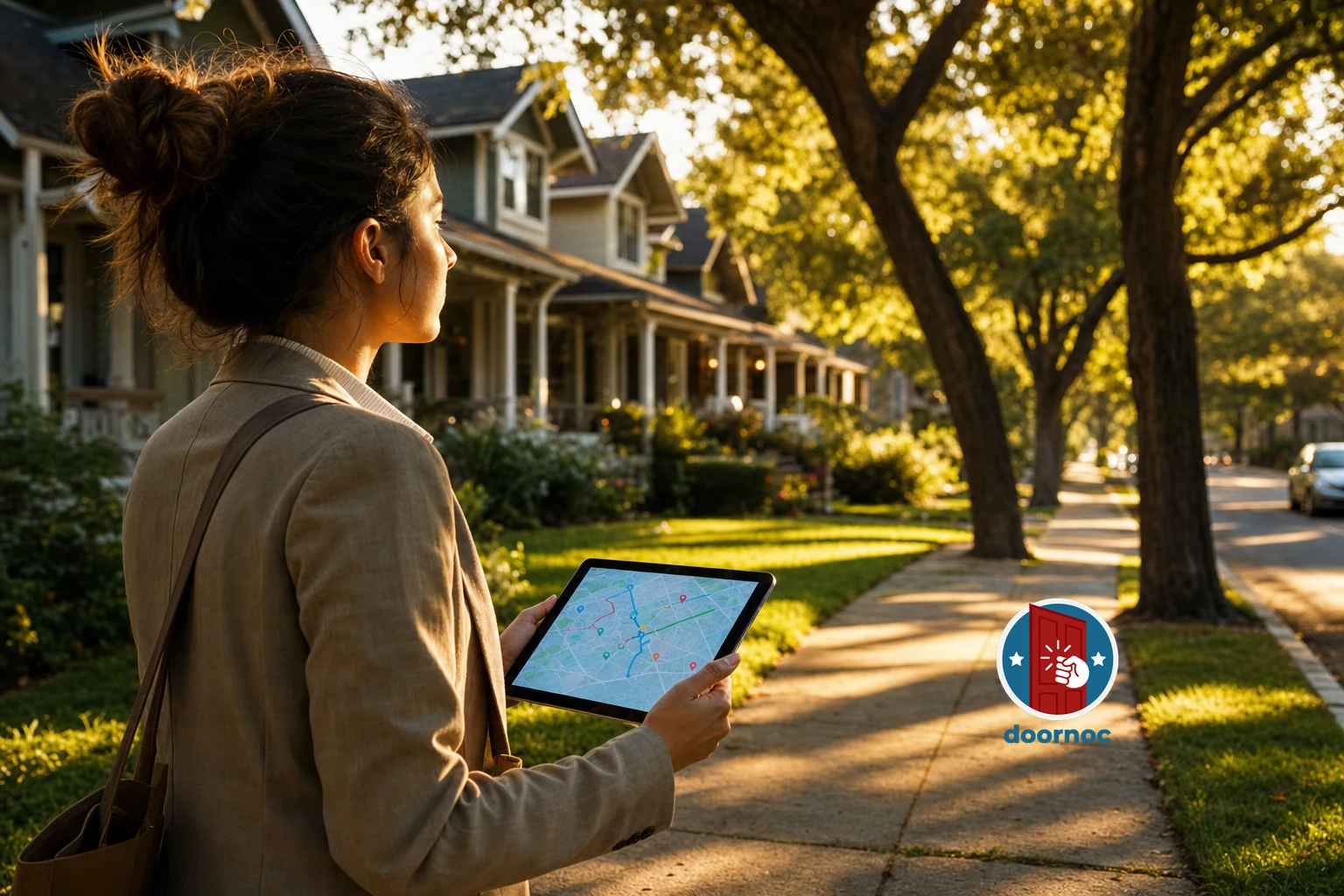
Door Knock’s route planning feature automatically generates optimized walking paths through each turf. The app sequences doors to minimize total walking distance while respecting logical neighborhood flow. Volunteers simply follow the highlighted route on their phone’s map, eliminating the mental overhead of constant navigation decisions.
Adapting Routes Based on Contact Rates
Your initial routes should prioritize efficiency, but adjust based on real-world contact rates. If a particular neighborhood consistently shows low contact rates during evening canvasses, shift those doors to weekend morning shifts when residents are more likely to be home. Track contact rates by turf and time slot to identify these patterns.
Some campaigns use a “two-pass” system where volunteers make quick first passes through neighborhoods to identify which voters are home, then return for longer conversations with available voters. This approach works well in low-density suburban areas where walking between houses takes significant time. It’s less effective in dense urban neighborhoods where doors are close together.
Weather significantly impacts optimal routes. Rain makes voters less receptive and volunteers less productive. Have backup plans for inclement weather, including phone banking shifts or volunteer training sessions. Don’t force volunteers to canvass in dangerous conditions—it damages retention and produces poor-quality voter contacts. For more route planning strategies, check out our guide on how to plan efficient canvassing routes.
Capturing and Using Canvassing Data
Data separates modern door to door campaigns from the clipboard-and-paper operations of previous decades. Every voter conversation generates valuable information about support levels, issue priorities, volunteer potential, and contact preferences. Capturing this data accurately and using it strategically multiplies the impact of every door knock.
Your canvassing platform should allow volunteers to record at minimum five data points at each door: contact result (conversation, not home, refused, etc.), support level (strong support to strong oppose), top issue concerns, volunteer interest, and vote-by-mail or early voting interest. Additional fields for phone numbers, email addresses, and specific asks strengthen your follow-up capabilities.
Data quality depends on making entry fast and intuitive. The best canvassing app designs use large touch targets, predictive text, and minimal required fields. If recording a voter response takes more than 15-20 seconds, volunteers will skip data entry or enter incomplete information. Simplicity drives compliance.
Real-Time Data Sync and Offline Functionality
Data becomes useful only when it reaches your voter file and targeting models. Real-time sync ensures that voter responses recorded at 6:15pm are available to your analytics team by 6:16pm. This immediate feedback allows rapid response to emerging issues, identification of volunteer prospects for same-day recruitment, and accurate progress tracking.
However, real-time sync requires reliable internet connectivity, which many canvassing neighborhoods lack. Your platform must function fully offline, storing data locally and syncing automatically when connectivity returns. Volunteers shouldn’t worry about whether their data is saving—the technology should handle this invisibly.
Door Knock solves this challenge with offline-first architecture. All voter data, maps, and scripts download to volunteers’ phones before they start canvassing. They record responses offline throughout their shift, then sync everything when they return to their car or home WiFi. No data loss, no connectivity anxiety, no manual upload steps.
Analyzing Canvassing Results
Raw canvassing data means nothing without analysis. Track key metrics including doors knocked per volunteer hour, contact rate percentage, support level distribution, and volunteer retention rates. Compare these metrics across turfs, time slots, and volunteer teams to identify patterns and opportunities.
Contact rates reveal which neighborhoods and time slots produce the most voter conversations. If Saturday morning canvasses in Precinct 12 consistently achieve 55% contact rates while Tuesday evening shifts in Precinct 7 reach only 30%, adjust your schedule accordingly. Concentrate volunteer hours when and where they’ll reach the most voters.
Support level trends show whether your persuasion efforts are working. If undecided voters in a key demographic are shifting toward support after door contacts, you’re executing effectively. If they’re moving toward opposition, you need to revise your message or targeting. Track these trends weekly to catch problems early.
Managing the Full Campaign Cycle
Door to door campaigns evolve through distinct phases from launch to Election Day. Each phase requires different priorities, messaging, and operational tactics. Understanding this progression helps you allocate resources effectively and avoid common timing mistakes.
The early phase (8-12 weeks out) focuses on volunteer recruitment, persuasion of undecided voters, and identification of supporter intensity. Your message emphasizes candidate introduction and issue positioning. Conversations can be longer and more exploratory since you’re building relationships rather than closing votes.
The middle phase (4-8 weeks out) shifts toward persuasion and volunteer prospect recruitment. You’ve identified most undecided voters and now focus on moving them toward support. Your message sharpens around 2-3 core issues that resonate with swing voters. You also recruit volunteers from supporters contacted earlier, building your team for the final push.
The Final Push: GOTV Operations
The Get Out The Vote phase (final 2 weeks) abandons persuasion almost entirely. You focus exclusively on turning out identified supporters, particularly low-propensity voters who need extra motivation. Your message simplifies to “our candidate needs your vote” and “here’s how to vote early/by mail/on Election Day.”
GOTV door knocking requires different turf cutting than persuasion canvassing. You target only identified supporters, often creating turfs of 100-150 doors that volunteers can complete quickly. The goal is maximum touches across your supporter universe, not long conversations. Brief, energetic contacts work better than extended discussions.
The final 72 hours before Election Day are critical. Focus your door knocking on low-propensity supporters who haven’t voted early. Use real-time turnout data to identify which supporters still need contact. Some campaigns knock doors on Election Day itself, though this requires careful coordination to avoid bothering voters who’ve already cast ballots. Learn more about timing decisions in our article on when to use canvassing instead of phone banking.
Technology That Powers Modern Door to Door Campaigns
The right technology stack transforms door to door operations from logistical nightmares into efficient voter contact machines. In 2026, successful campaigns use integrated platforms that handle route planning, data capture, volunteer management, and analytics in a single system.
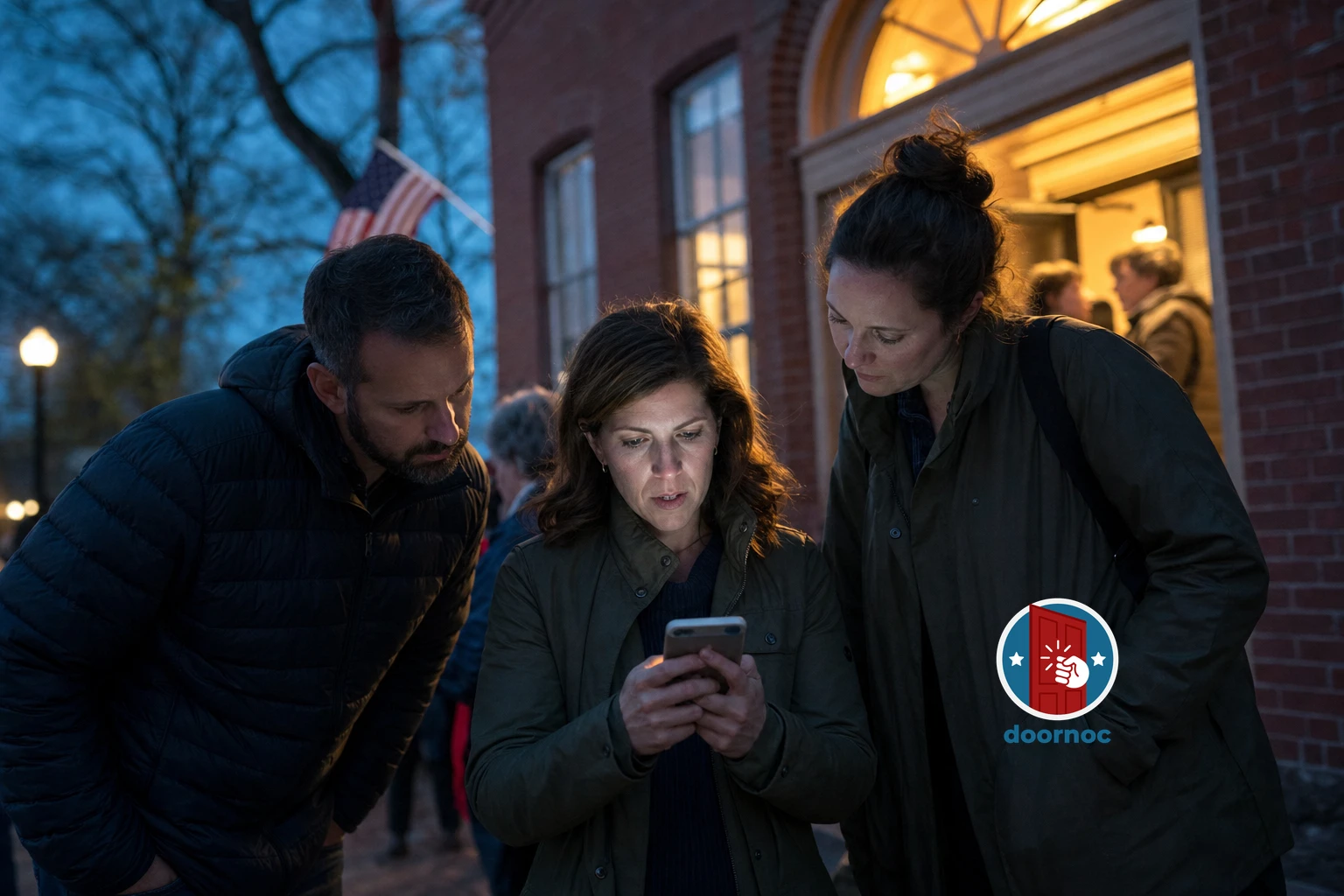 Team leader reviewing turnout data on phone outside polling place at dusk with volunteers gathered around her
Your canvassing platform should meet five non-negotiable requirements. First, mobile-first design optimized for smartphones since that’s what volunteers carry. Second, offline functionality that works without internet connectivity. Third, real-time data sync when connectivity is available. Fourth, intuitive interface that requires minimal training. Fifth, integration with your voter file and CRM system.
Door Knock delivers all five requirements in a platform built specifically for political campaigns. The mobile app works seamlessly offline, syncing data automatically when volunteers have connectivity. Route optimization reduces planning time by 65% while increasing doors knocked per hour by 30-40%. Team management features let field directors track progress, communicate with volunteers, and adjust strategy in real-time.
Choosing Between Canvassing Platforms
Multiple canvassing platforms compete in 2026, each with different strengths and weaknesses. Evaluate options based on your campaign’s specific needs, budget, and technical sophistication. Key comparison factors include pricing structure, feature set, user interface quality, customer support responsiveness, and integration capabilities.
Some platforms charge per user per month, while others use per-contact pricing or flat campaign fees. Calculate total cost based on your expected volunteer count and voter universe size. A platform with higher per-user fees might cost less overall if it increases volunteer productivity significantly.
User experience matters enormously. A feature-rich platform that volunteers find confusing will produce poor data quality and high dropout rates. Request demo accounts and have actual volunteers (not just staff) test the interface before committing. The best platform is the one your team will actually use consistently. For a detailed comparison, read our analysis of DoorNoc vs Pulsar.
Measuring Success and Optimizing Performance
Data-driven campaigns continuously measure performance and adjust tactics based on results. Establish clear metrics before your first canvass, track them consistently, and use the insights to optimize volunteer deployment, messaging, and targeting.
The most important operational metrics are doors knocked per volunteer hour, contact rate percentage, and volunteer retention rate. Doors knocked per hour measures overall efficiency—are volunteers actually reaching voters or spending too much time walking and navigating? Target 15-25 doors per hour in suburban areas, 25-40 in dense urban neighborhoods.
Contact rate percentage shows what portion of knocked doors result in actual voter conversations. Strong contact rates range from 35-45% during weekday evenings to 45-55% on weekend mornings. Rates below 30% indicate poor timing, wrong neighborhoods, or bad targeting. Adjust your schedule and turf selection accordingly.
Tracking Persuasion and Turnout Impact
Operational efficiency means nothing if you’re not moving voters. Track persuasion metrics by comparing support levels before and after contact. If your door to door program is effective, you should see undecided voters shifting toward support and weak supporters becoming strong supporters.
Run periodic surveys of contacted versus non-contacted voters in your target universe. The support differential between these groups reveals your persuasion impact. In competitive races, contacted voters should show 3-5 percentage points higher support than similar non-contacted voters.
Turnout impact is harder to measure during the campaign but becomes clear after Election Day. Compare turnout rates among contacted versus non-contacted supporters in your voter file. Effective door to door programs increase supporter turnout by 7-10 percentage points. This turnout boost often determines election outcomes in close races.
Common Mistakes and How to Avoid Them
Even experienced campaigns make predictable mistakes that undermine door to door effectiveness. Learning from these common errors saves time, money, and volunteer morale.
The biggest mistake is starting too late. Door to door programs need 8-12 weeks to recruit volunteers, build systems, and complete multiple contact passes through your target universe. Campaigns that start canvassing 4 weeks before Election Day lack time for persuasion and can only execute basic GOTV. Start early or don’t bother—rushed door knocking produces poor results.
Poor volunteer training is the second major error. Sending untrained volunteers to knock doors creates bad voter experiences, low data quality, and high volunteer dropout. Every canvasser needs proper training before their first shift, regardless of prior campaign experience. Budget time and resources for quality training programs.
Data Quality and Follow-Through Problems
Many campaigns collect extensive canvassing data but fail to use it strategically. Voter responses that never reach your targeting models or inform follow-up contacts represent wasted volunteer effort. Ensure your data pipeline flows smoothly from canvasser phones to voter file to action items.
Incomplete or inaccurate data entry undermines everything. If volunteers mark every door as “not home” to avoid recording actual responses, your campaign operates blind. Enforce data quality through spot checks, team leader reviews, and volunteer accountability. Make data entry easy enough that compliance is the path of least resistance.
Failing to follow up with volunteer prospects and undecided voters is another common mistake. When a supporter expresses interest in volunteering, someone should contact them within 24-48 hours with specific opportunities. When an undecided voter asks for more information, send it immediately while the conversation is fresh. Speed matters in converting interest into action.
Integrating Door to Door with Your Broader Campaign
Door to door canvassing works best as part of an integrated voter contact strategy, not as a standalone tactic. Coordinate your field program with digital advertising, phone banking, direct mail, and earned media to create multiple touchpoints that reinforce your message.
Use digital advertising to warm up neighborhoods before canvassing. Voters who’ve seen your candidate’s ads online are more receptive when volunteers knock. Target geographic areas with digital campaigns 1-2 weeks before your canvassing schedule reaches those neighborhoods.
Follow up door contacts with phone calls and text messages. A voter who has a positive door conversation but receives no additional contact may forget the interaction by Election Day. Plan 2-3 follow-up touches through different channels to reinforce the initial door contact.
Coordinating with Field Organizers
Large campaigns employ dedicated field organizers who manage door to door operations full-time. These staff members recruit and train volunteers, plan canvassing schedules, analyze data, and troubleshoot problems. They’re the operational backbone of successful field programs.
Field organizers need clear authority and adequate resources. They should control volunteer deployment decisions, turf cutting, and daily operational tactics. Campaign managers and candidates should set strategic priorities but trust field organizers to execute the details.
Regular coordination meetings between field organizers, communications staff, and campaign leadership ensure everyone works toward the same goals. Weekly meetings should review canvassing results, adjust messaging based on voter feedback, and reallocate resources to high-priority areas. This coordination prevents siloed operations where the field team and communications team work at cross purposes.
Preparing for Election Day
All your door to door work culminates on Election Day. The final 24 hours require precise coordination to turn out every identified supporter who hasn’t voted early. Your Election Day operation should feel like a well-rehearsed performance, not improvisation.
Build your Election Day plan around real-time turnout tracking. As supporters vote, remove them from your contact lists so volunteers don’t waste time on completed voters. Focus all energy on identified supporters who haven’t voted yet. This requires integration between your poll monitoring system and canvassing platform.
Deploy volunteers to high-priority precincts where races are closest and your supporter density is highest. Some campaigns assign volunteers to specific polling locations where they can monitor turnout and immediately knock doors of nearby supporters who haven’t appeared. This hyperlocal targeting maximizes impact during the crucial final hours.
The Final Door Knock
The last door knock of your campaign should happen 2-4 hours before polls close. This gives supporters time to vote after your reminder while maintaining urgency. Focus exclusively on low-propensity supporters who need maximum motivation. High-propensity supporters will vote without additional contact.
Keep Election Day door contacts brief and energetic. Your message is simple: “Our candidate needs your vote today. Polls close at [time]. Here’s your polling location.” Hand voters a polling location card with a map. Answer questions quickly and move to the next door.
Some voters will need rides to the polls. Have a ride coordination system ready to dispatch drivers immediately when volunteers identify transportation needs. Every vote matters, and the supporter who needs a ride is often the low-propensity voter whose participation determines election outcomes.
Building a Sustainable Field Program
The most successful campaigns build field programs that sustain volunteer energy across months of work. This requires intentional culture-building, recognition systems, and community that makes volunteering enjoyable rather than a chore.
Create social bonds among volunteers through regular events beyond canvassing. Host post-canvass socials where volunteers can relax and share stories. Organize phone banking parties with food and music. Build a team identity that volunteers feel proud to join.
Recognize top performers publicly and often. Track individual volunteer statistics (doors knocked, volunteer recruits, shifts completed) and celebrate achievements. Some campaigns create friendly competition between teams or geographic areas. Leaderboards and achievement badges tap into volunteers’ natural competitiveness.
Preventing Volunteer Burnout
Burnout destroys field programs. Watch for warning signs including decreased attendance, negative attitudes, and complaints about campaign leadership. Address burnout proactively through manageable expectations, adequate support, and genuine appreciation.
Never guilt-trip volunteers about insufficient commitment. They’re donating their time—be grateful for whatever they can give. Volunteers who feel pressured rather than appreciated will disappear. Build a culture where any contribution is valued and volunteers feel empowered to set their own boundaries.
Provide clear paths for volunteers to increase or decrease involvement as their circumstances change. Someone who canvassed every week in August might need to scale back in September due to work or family obligations. Make that transition easy and judgment-free. They’ll return when they can, and they’ll recruit friends because they had a positive experience.
Your door to door campaign represents the heart of grassroots politics—neighbors talking to neighbors about issues that matter. When executed with strategic planning, efficient technology, and genuine respect for volunteers, these conversations change minds, turn out voters, and win elections. The work is hard, the hours are long, but the impact is undeniable. Start building your field program today, and watch your campaign’s ground game become its greatest strength.
Frequently Asked Questions
How effective is door to door campaigning in 2026?
Door to door campaigning remains the most effective voter contact method in 2026, increasing voter turnout by 9-12% compared to no contact and outperforming phone banking by 3-5 percentage points. Face-to-face conversations create stronger persuasion effects that persist through Election Day, particularly with low-propensity voters who respond poorly to digital outreach.
How many doors should a canvasser knock per hour?
An experienced canvasser averages 15-25 doors per hour in suburban areas and 25-40 doors per hour in dense urban neighborhoods in 2026. New volunteers typically start at 10-15 doors per hour but improve rapidly with proper training. Route density, conversation length, and walking distance between doors significantly impact these numbers.
What is the best time of day for door to door canvassing?
The highest contact rates occur during weekend mornings (10am-1pm) and weekday evenings (5pm-8pm) in 2026. Saturday mornings deliver 45-55% contact rates, while weekday evenings reach 35-45%. Avoid canvassing during meal times (6-7pm) and after 8pm to respect voter privacy and maximize receptiveness.
How do you track data from door to door campaigns?
Modern campaigns use mobile canvassing apps that sync voter responses in real-time to central databases. Canvassers record support levels, issue priorities, volunteer prospects, and contact attempts directly on their phones. This data feeds into voter files, allowing campaigns to refine targeting, measure persuasion effects, and plan follow-up contacts efficiently.
How many volunteers do you need for a door to door campaign?
Calculate volunteer needs by dividing total target doors by average productivity (20 doors/hour) and available canvassing hours. A competitive state legislative race targeting 15,000 doors over 12 weeks needs approximately 25-30 active weekly volunteers. Account for 30-40% volunteer attrition by recruiting continuously throughout the campaign cycle.