Key Takeaways
- Efficient canvassing routes can increase door knocks by 40-60% compared to unplanned routes, with top campaigns achieving 25-35 doors per hour in suburban areas.
- Geographic clustering and logical sequencing reduce walking time between doors by up to 50%, allowing volunteers to spend more time on actual voter conversations.
- Mobile canvassing apps with GPS-optimized routing eliminate backtracking and provide real-time route adjustments based on completed contacts and no-answers.
- Proper territory planning considers voter density, geography, volunteer capacity, and historical contact rates to maximize field team productivity and voter reach.
How to plan efficient canvassing routes is the single most important skill that separates high-performing field campaigns from those that waste volunteer hours and miss voter contact goals. In 2026, with tighter election margins and more competitive races at every level, route optimization isn’t optional—it’s essential for campaign success.
Efficient route planning can increase your door knocks per hour by 40-60%, reduce volunteer burnout, and ensure your field team contacts the right voters at the right time. This guide provides actionable strategies for planning canvassing routes that maximize voter contact while minimizing wasted time and effort.
Why Route Planning Makes or Breaks Your Field Campaign
Poor route planning is the hidden productivity killer in political campaigns. When volunteers receive unoptimized walk lists, they spend more time walking between doors than actually talking to voters. The numbers tell the story:
- Unplanned routes: 12-18 doors per hour, high volunteer frustration, frequent dropouts
- Basic planned routes: 20-25 doors per hour, moderate efficiency
- Optimized routes: 25-35 doors per hour, higher volunteer retention, better data quality
The difference between the lowest and highest efficiency represents a 100%+ increase in voter contacts with the same volunteer hours. For a campaign with 50 volunteers each working 3-hour shifts, optimized routing means reaching an additional 1,500-2,000 voters per weekend.
Route optimization also directly impacts volunteer experience. Volunteers who spend their Saturday walking in circles or backtracking through neighborhoods are less likely to return. Those who receive well-planned routes with clear progression and achievable goals report higher satisfaction and commit to additional shifts.
Understanding the Core Principles of Route Efficiency
Effective canvassing route planning rests on three fundamental principles that apply regardless of your campaign size or geographic area.
 A volunteer engages in a meaningful one-on-one conversation with a voter at their doorstep.
Geographic Clustering
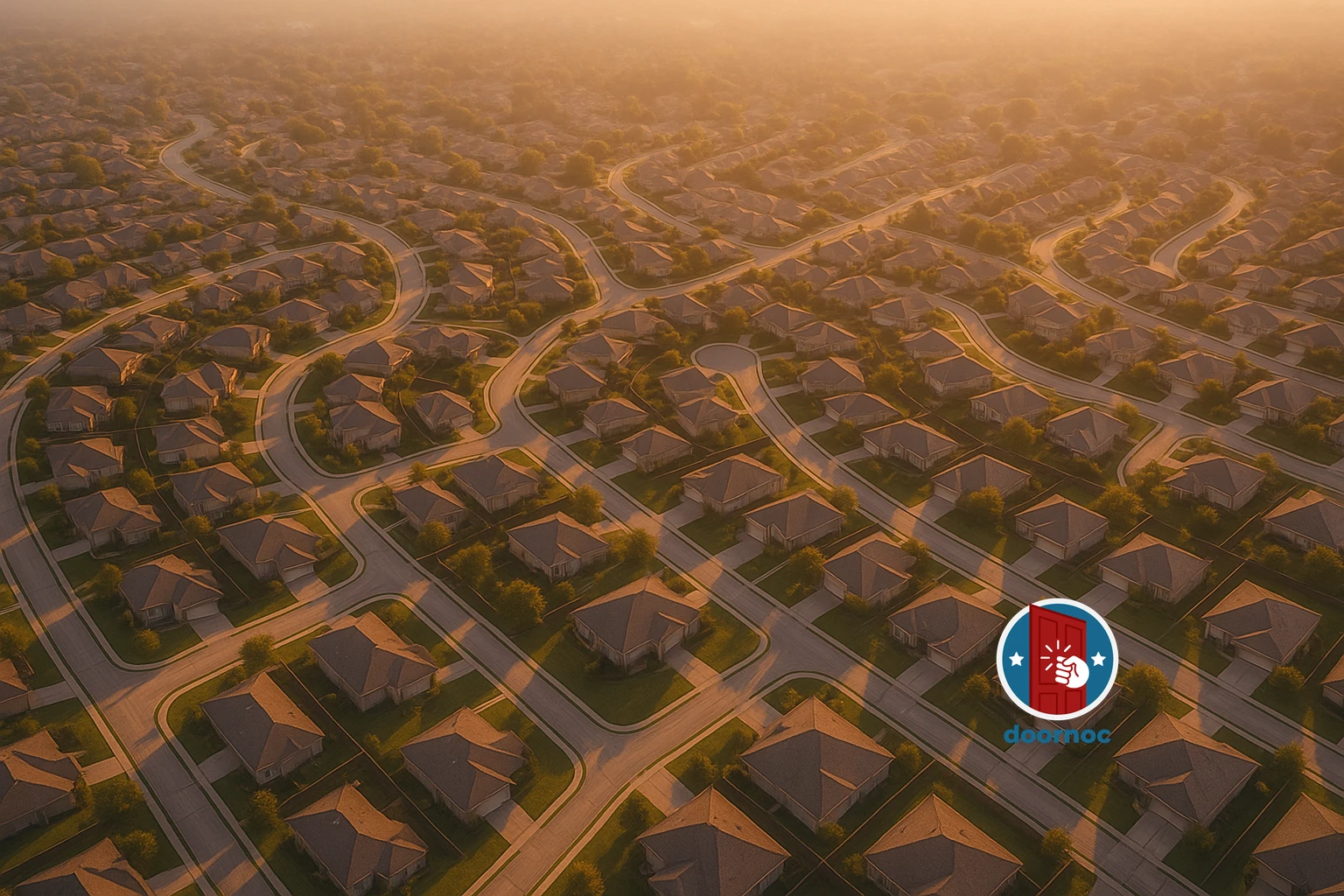
Geographic clustering means grouping voters who live near each other into the same route. This principle reduces walking time between doors and creates natural, walkable territories.
In practice, you want to minimize the distance between consecutive addresses on your walk list. A voter living three blocks away shouldn’t appear immediately after a voter on the current street. Instead, complete an entire street or block before moving to the next geographic cluster.
Modern campaigns use GIS mapping tools to visualize voter clusters and identify natural geographic boundaries. Streets, parks, highways, and other landmarks help define territory edges that volunteers can easily understand and navigate.
Logical Sequencing
Sequencing determines the order in which you visit clustered addresses. Poor sequencing forces canvassers to zigzag through neighborhoods or retrace their steps. Optimal sequencing creates a logical flow that feels natural and intuitive.
The most efficient sequences typically follow these patterns:
- One side, then the other: Complete all addresses on one side of a street, then return on the opposite side
- Clockwise/counterclockwise loops: Create circular routes that return canvassers to their starting point
- Progressive distance: Start closest to the staging area and work outward (or vice versa)
For suburban neighborhoods with cul-de-sacs and winding streets, the “complete each street before moving to the next” approach works best. In grid-pattern urban areas, rectangular loops that minimize left turns (which take longer) optimize time.
Realistic Capacity Planning
Capacity planning matches territory size to available volunteer time and expected contact rates. A territory that’s too large leaves doors unvisited. One that’s too small wastes volunteer potential.
Calculate realistic capacity using this formula:
Territory Size = (Available Hours × Expected Doors Per Hour) ÷ (1 ÷ Expected Contact Rate)
For example, a 3-hour shift with an expected rate of 25 doors per hour and a 35% contact rate would yield:
3 hours × 25 doors/hour = 75 attempted contacts 75 ÷ 0.35 = approximately 215 total doors in territory
This ensures volunteers have enough targets to fill their shift even with typical not-at-home rates.
Step-by-Step Process for Planning Efficient Routes
Follow this systematic approach to create optimized canvassing routes for your campaign.
Step 1: Define Your Target Universe
Start by identifying exactly which voters you need to contact. Your target universe might include:
- Persuasion targets (undecided voters, weak supporters)
- GOTV targets (strong supporters who need turnout reminders)
- Issue-specific audiences (voters concerned about particular policy areas)
- New registrants or newly moved voters
Export this list from your voter database with complete address information, including apartment numbers, cross-streets, and any special instructions. The more accurate your initial data, the better your routes will perform.
In 2026, most campaigns integrate their voter file with their canvassing platform to ensure real-time data accuracy. Learn more about mobile canvassing app capabilities that streamline this process.
Step 2: Analyze Geographic Distribution
Map your target voters to visualize their distribution. This reveals:
- High-density clusters: Areas with many targets close together (priority for canvassing)
- Scattered targets: Individual voters far from clusters (often deprioritized or reached by phone)
- Natural boundaries: Geographic features that define logical territory borders
- Access challenges: Gated communities, large properties, or difficult-to-reach areas
Use your mapping analysis to make strategic decisions. A single voter living 2 miles from any cluster might be better reached through phone banking or mail. Conversely, an apartment building with 40 target voters deserves dedicated attention.
Step 3: Create Compact, Contiguous Territories
Divide your target universe into territories that are:
- Compact: Minimize the geographic area to reduce walking time
- Contiguous: Avoid territories with gaps or disconnected sections
- Balanced: Aim for similar numbers of doors across territories
- Clearly bounded: Use streets, landmarks, or natural features as borders
A well-designed territory allows a volunteer to park once and walk the entire route without driving to multiple locations. The ideal territory shape is roughly circular or square, not elongated or irregular.
For campaigns managing multiple territories, consider creating a turf-cutting strategy that divides your entire campaign area into non-overlapping sections. This prevents duplicate contacts and ensures comprehensive coverage. Our guide on organizing door-to-door canvassing campaigns covers territory management in detail.
Step 4: Optimize Address Sequencing
Once you’ve defined territories, sequence the addresses within each territory for maximum efficiency. Modern mobile canvassing platforms automate this process using routing algorithms, but understanding the principles helps you verify and adjust routes.
Key sequencing strategies include:
Street-by-street progression: Complete all targeted addresses on one street before moving to the next. This is intuitive for volunteers and minimizes backtracking.
Odd-even optimization: In some neighborhoods, completing all odd-numbered addresses on one pass and even-numbered addresses on the return creates the most efficient loop.
Proximity-based ordering: Always move to the nearest unvisited address, creating a naturally efficient path. GPS-enabled apps excel at this approach.
Time-of-day considerations: Sequence routes so volunteers reach apartment buildings during peak at-home hours (typically 5-7 PM on weekdays, 10 AM-6 PM on weekends).
For complex territories with mixed housing types, consider creating micro-routes within the larger territory. Group single-family homes separately from apartments, then sequence each group optimally.
Step 5: Account for Real-World Factors
Theoretically perfect routes often need adjustments for practical realities:
- Topography: Avoid routes that require excessive hill climbing or create safety concerns
- Parking availability: Identify safe, legal parking spots near route start points
- Lighting: For evening canvassing, prioritize well-lit streets and avoid isolated areas
- Pet policies: Note addresses with aggressive dogs or no-soliciting signs
- Building access: Include instructions for gated communities, apartment buzzers, or locked buildings
Create route maps that include these details. A simple note like “Park at community center, start on Oak Street” saves volunteers time and confusion.
Step 6: Test and Refine Routes
Before deploying routes to your full volunteer team, test them with experienced canvassers. Have them walk the route and provide feedback on:
- Actual time required vs. estimated time
- Confusing turns or unclear transitions
- Unexpected obstacles (construction, closed streets, etc.)
- Suggested improvements to sequencing
Use this feedback to refine routes before scaling to the full team. What looks efficient on a map may have practical issues that only emerge in the field.
Advanced Route Optimization Techniques for 2026
Beyond basic route planning, sophisticated campaigns employ advanced techniques that further increase efficiency.
Dynamic Route Adjustment
Static routes planned days in advance can’t account for real-time conditions. Dynamic routing adjusts routes based on:
- Completed contacts: Skip already-contacted voters and redistribute remaining targets
- Not-at-home patterns: Identify addresses with repeated no-answers and adjust priority
- Volunteer pace: Expand or contract territories based on individual volunteer speed
- Weather conditions: Reroute around severe weather or adjust for temperature impacts on at-home rates
Mobile canvassing platforms with GPS tracking enable dynamic routing by monitoring volunteer progress in real-time. When a volunteer completes their assigned territory early, the system can automatically add nearby unassigned doors or suggest a return visit to earlier no-answers.
Multi-Pass Strategies
High-value territories often benefit from multiple canvassing passes:
First pass: Initial contact attempt during prime hours (weekend afternoons, weekday evenings)
Second pass: Return to not-at-homes during different time windows
Third pass: Final GOTV contact in the 72 hours before Election Day
Plan multi-pass routes that vary approach patterns. If the first pass went clockwise starting at 2 PM, the second pass might go counterclockwise starting at 6 PM. This increases the likelihood of finding people home.
For more on maximizing contact rates across multiple attempts, see our article on increasing door knock completion rates.
Volunteer Skill-Based Routing
Not all volunteers canvass at the same pace or handle all situations equally well. Assign routes based on volunteer capabilities:
- New volunteers: Smaller territories in easy-to-navigate neighborhoods with high contact rates
- Experienced canvassers: Larger territories, challenging geography, or persuasion-heavy areas
- Bilingual volunteers: Territories with high concentrations of non-English speakers
- Local residents: Routes in their own neighborhoods where they have familiarity and credibility
This matching process increases both efficiency and effectiveness. A nervous first-time canvasser performs better with a manageable 50-door route in a friendly neighborhood than a 100-door route in an unfamiliar area.
Integration with Voter Contact History
Your canvassing routes should integrate with your campaign’s complete voter contact history. Before creating routes, review:
- Previous canvassing attempts and outcomes
- Phone banking contact history
- Direct mail delivery dates
- Digital ad targeting
This prevents redundant contacts (“Someone from your campaign was just here yesterday”) and enables coordinated multi-channel outreach. For example, you might prioritize canvassing voters who engaged with your digital ads but haven’t had in-person contact.
Technology Solutions for Route Planning
While manual route planning using spreadsheets and printed maps is possible, modern campaigns benefit enormously from technology solutions.
Mobile Canvassing Apps with Built-In Routing
Mobile canvassing platforms like Door Knock include GPS-optimized routing as a core feature. These apps:
- Automatically sequence addresses for minimal walking distance
- Provide turn-by-turn navigation between doors
- Adjust routes in real-time based on completed contacts
- Sync data instantly so campaign managers see live progress
- Work offline in areas with poor cell coverage
The routing algorithms in modern apps consider factors human planners might miss, such as one-way streets, pedestrian-only paths, and optimal crossing points for busy roads.
Campaigns using mobile apps with intelligent routing report 30-50% increases in doors knocked per volunteer hour compared to paper walk lists. The apps also reduce volunteer confusion and frustration, leading to higher retention rates.
GIS and Mapping Software
For campaigns that need custom route planning beyond standard app capabilities, GIS (Geographic Information Systems) software provides powerful tools:
- QGIS: Free, open-source mapping platform with routing plugins
- ArcGIS: Professional-grade GIS with advanced spatial analysis
- Google My Maps: Simple, accessible tool for basic route visualization
These platforms allow you to layer multiple data sources (voter files, demographic data, past election results) to create sophisticated targeting and routing strategies.
Optimization Algorithms
Some advanced campaigns use vehicle routing problem (VRP) algorithms to create mathematically optimal routes. These algorithms solve the “traveling salesman problem” for canvassing, finding the shortest possible path that visits all target addresses.
While overkill for most campaigns, VRP optimization makes sense for:
- Very large territories with thousands of doors
- Complex urban environments with one-way streets and limited access points
- Campaigns with strict time constraints and must maximize every minute
Several commercial canvassing platforms incorporate VRP algorithms into their routing engines, providing this optimization automatically.
Common Route Planning Mistakes to Avoid
Even experienced campaign managers make route planning errors that undermine field efficiency.
Mistake 1: Ignoring Volunteer Input
Campaign staff who plan routes from an office without field experience often create theoretically efficient but practically problematic routes. Volunteers who walk the neighborhoods know which streets have aggressive dogs, which apartment buildings have locked lobbies, and which areas feel unsafe after dark.
Create a feedback loop where volunteers can report route issues and suggest improvements. The best route planners are often experienced canvassers who understand ground-level realities.
Mistake 2: Over-Optimizing for Distance
The shortest walking distance isn’t always the most efficient route. A route that saves 0.2 miles but requires crossing a busy highway twice or navigating a confusing apartment complex might actually take longer.
Optimize for total time, not just distance. Factor in crossing time at intersections, building access delays, and navigation complexity.
Mistake 3: Creating Territories That Are Too Large
Ambitious campaigns sometimes create 150-200 door territories for 3-hour shifts, assuming high productivity rates. When volunteers can’t complete their routes, it creates several problems:
- Incomplete coverage of target universe
- Volunteer frustration and reduced retention
- Pressure to rush conversations, reducing quality
- Inaccurate data from skipped addresses
Size territories conservatively, especially for new volunteers. It’s better to have volunteers finish early and request additional doors than to leave routes incomplete.
Mistake 4: Neglecting Return Visits
Many campaigns treat not-at-homes as permanent misses rather than opportunities for follow-up. Proper route planning includes strategies for returning to no-answer addresses during different time windows.
Create “callback routes” that group not-at-homes from previous canvassing sessions. These routes often have higher contact rates because you’re targeting people who were previously unavailable during your standard canvassing hours.
Mistake 5: Failing to Update Routes
Voter files change constantly. People move, new voters register, and contact preferences update. Routes planned weeks in advance may include outdated addresses or miss new registrants.
Refresh your routes weekly (at minimum) to incorporate voter file updates. This is automatic with integrated mobile canvassing platforms but requires manual work with static walk lists.
For troubleshooting common canvassing data issues, review our guide on fixing campaign data synchronization problems.
Measuring and Improving Route Efficiency
Effective route planning requires continuous measurement and improvement throughout your campaign.
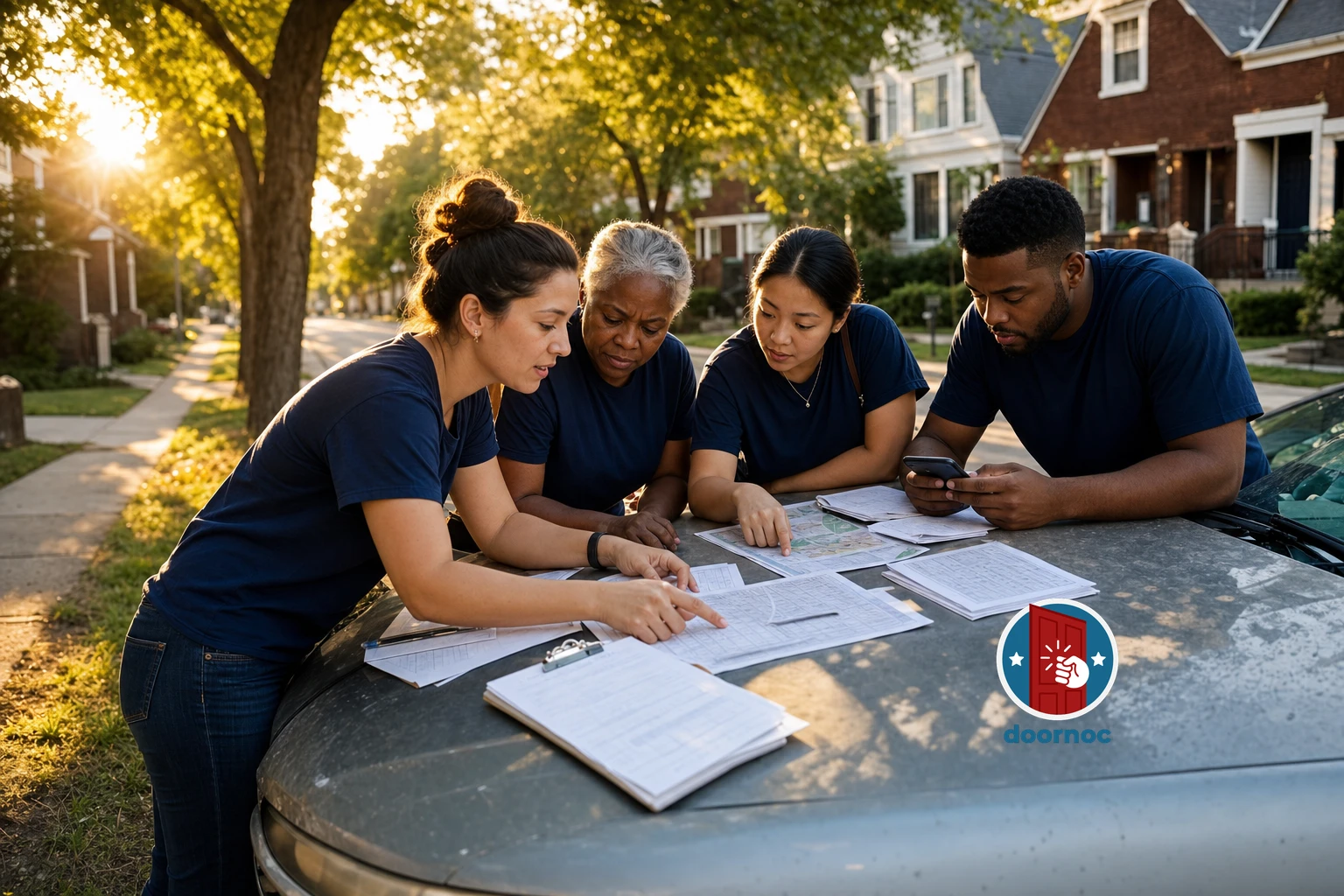
 Campaign team members coordinate their canvassing strategy during a pre-shift briefing.
Key Metrics to Track
Monitor these metrics to assess route efficiency:
- Doors per hour: Total attempted contacts divided by total canvassing time
- Contact rate: Percentage of doors where you speak with someone
- Route completion rate: Percentage of assigned routes fully completed
- Walking time vs. talking time: Ratio of time between doors to time in conversations
- Volunteer satisfaction scores: Self-reported ratings of route quality and clarity
Track these metrics by territory, volunteer, and time period. This reveals patterns like “Saturday morning routes in the Riverside neighborhood consistently underperform” that guide route improvements.
A/B Testing Routes
For high-priority territories, test different routing approaches:
- Test A: Clockwise loop starting from the north
- Test B: Counterclockwise loop starting from the south
Compare completion rates, doors per hour, and volunteer feedback to identify the superior approach. Apply winning strategies to similar territories.
Benchmarking Against Best Practices
Compare your performance against industry benchmarks:
- Suburban single-family homes: 20-30 doors per hour
- Urban apartments: 30-40 doors per hour
- Rural areas: 15-25 doors per hour
- Contact rates: 30-40% on first attempt, 20-30% on callbacks
If your metrics fall significantly below these ranges, investigate route planning issues, volunteer training gaps, or data quality problems.
Route Planning for Different Campaign Contexts
Route optimization strategies vary based on campaign type, geography, and timeline.
Local vs. Statewide Campaigns
Local campaigns with concentrated geographic areas can create highly optimized routes with intimate neighborhood knowledge. Volunteers often live in the canvassing area and can provide detailed input on route planning.
Statewide campaigns must standardize route planning processes across diverse geographies. Create region-specific templates (urban, suburban, rural) rather than one-size-fits-all approaches.
Primary vs. General Elections
Primary elections typically target smaller, more dispersed voter universes (registered party members, high-propensity voters). Routes may cover larger geographic areas with more distance between doors.
General elections allow denser routes because the target universe expands to all registered voters or all likely voters. This enables more efficient geographic clustering.
Early Voting vs. GOTV
Early voting canvassing often focuses on persuasion and voter education, allowing for longer conversations and lower doors-per-hour expectations. Routes can be smaller with more time allocated per contact.
GOTV canvassing in the final 72 hours prioritizes volume. Routes should maximize doors per hour with brief, high-energy contacts focused solely on turnout.
Our comprehensive guide to political canvassing in 2026 covers these contextual differences in detail.
Building a Route Planning Workflow for Your Campaign
Successful campaigns institutionalize route planning as a regular workflow, not a one-time task.
Weekly Route Planning Cycle
Monday: Review previous week’s canvassing data and volunteer feedback
Tuesday: Update voter file with new registrations and contact history
Wednesday: Create and optimize routes for upcoming weekend
Thursday: Assign routes to confirmed volunteers and send preview materials
Friday: Final route adjustments based on volunteer confirmations and weather forecast
Weekend: Execute canvassing with real-time route monitoring
Sunday evening: Debrief with volunteers and collect route feedback
This cycle ensures routes stay current and incorporate continuous learning.
Role Assignment
Clarify who handles each aspect of route planning:
- Field director: Overall route strategy and territory allocation
- Data director: Voter file management and target universe definition
- Volunteer coordinator: Route assignment based on volunteer skills and availability
- Regional organizers: Local route optimization and volunteer feedback collection
Clear role definition prevents gaps and duplicated effort.
Documentation and Training
Create standard operating procedures for route planning that new staff can follow. Document:
- Step-by-step route creation process
- Software tools and login credentials
- Territory naming conventions
- Route assignment procedures
- Troubleshooting common issues
Train all field staff on route planning basics, even if they’re not primarily responsible for it. This creates redundancy and ensures consistent quality.
For comprehensive volunteer training strategies, see our guide on training volunteers for door knocking.
The Future of Canvassing Route Optimization
Route planning technology continues to evolve rapidly. Emerging trends for 2026 and beyond include:
AI-Powered Predictive Routing
Machine learning algorithms analyze historical contact data to predict optimal canvassing times for specific addresses. The system learns that “voters at 123 Main Street are most likely home on Saturday afternoons” and prioritizes those time windows.
Predictive routing also identifies which voters are most likely to be persuaded by in-person contact versus other channels, helping campaigns allocate canvassing resources to highest-value targets.
Real-Time Crowd-Sourced Data
Modern canvassing apps allow volunteers to report real-time conditions (“Gate code for this complex is 1234” or “This street has construction, use alternate route”). This crowd-sourced intelligence automatically updates routes for subsequent volunteers.
Integration with Smart Home Data
Some campaigns experiment with integrating smart home data (with appropriate privacy protections) to identify when residents are actually home, enabling precision timing for canvassing visits.
Autonomous Route Rebalancing
Advanced platforms automatically rebalance routes across volunteers based on real-time progress. If one volunteer is moving quickly and another slowly, the system redistributes remaining doors to balance workload and ensure complete coverage.
These technologies promise to push canvassing efficiency even higher, potentially reaching 40-50 doors per hour in optimal conditions.
Implementing Efficient Routes with Door Knock
Door Knock provides comprehensive route planning and optimization features designed specifically for political campaigns. The platform combines GPS-optimized routing with real-time progress tracking and offline functionality.
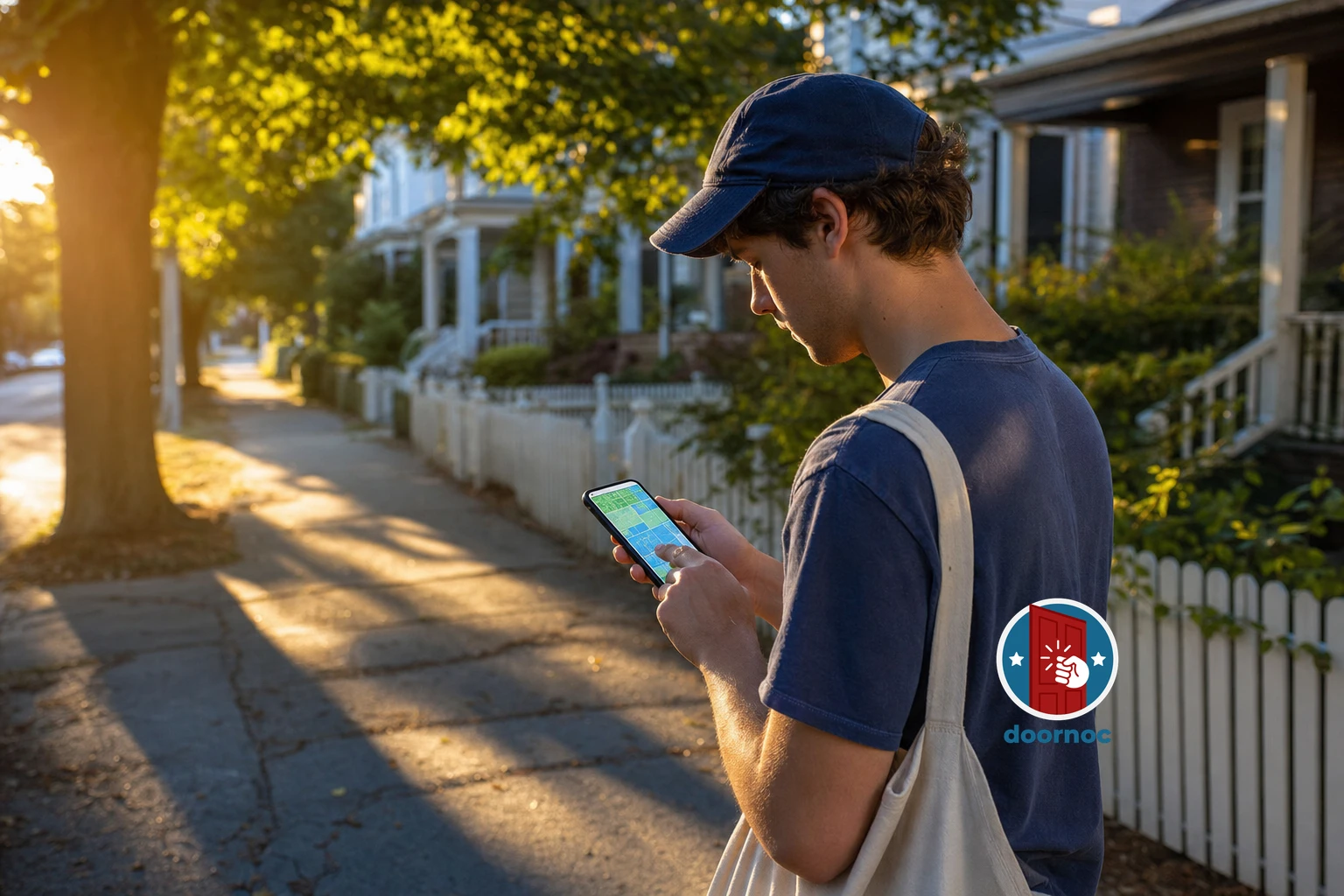
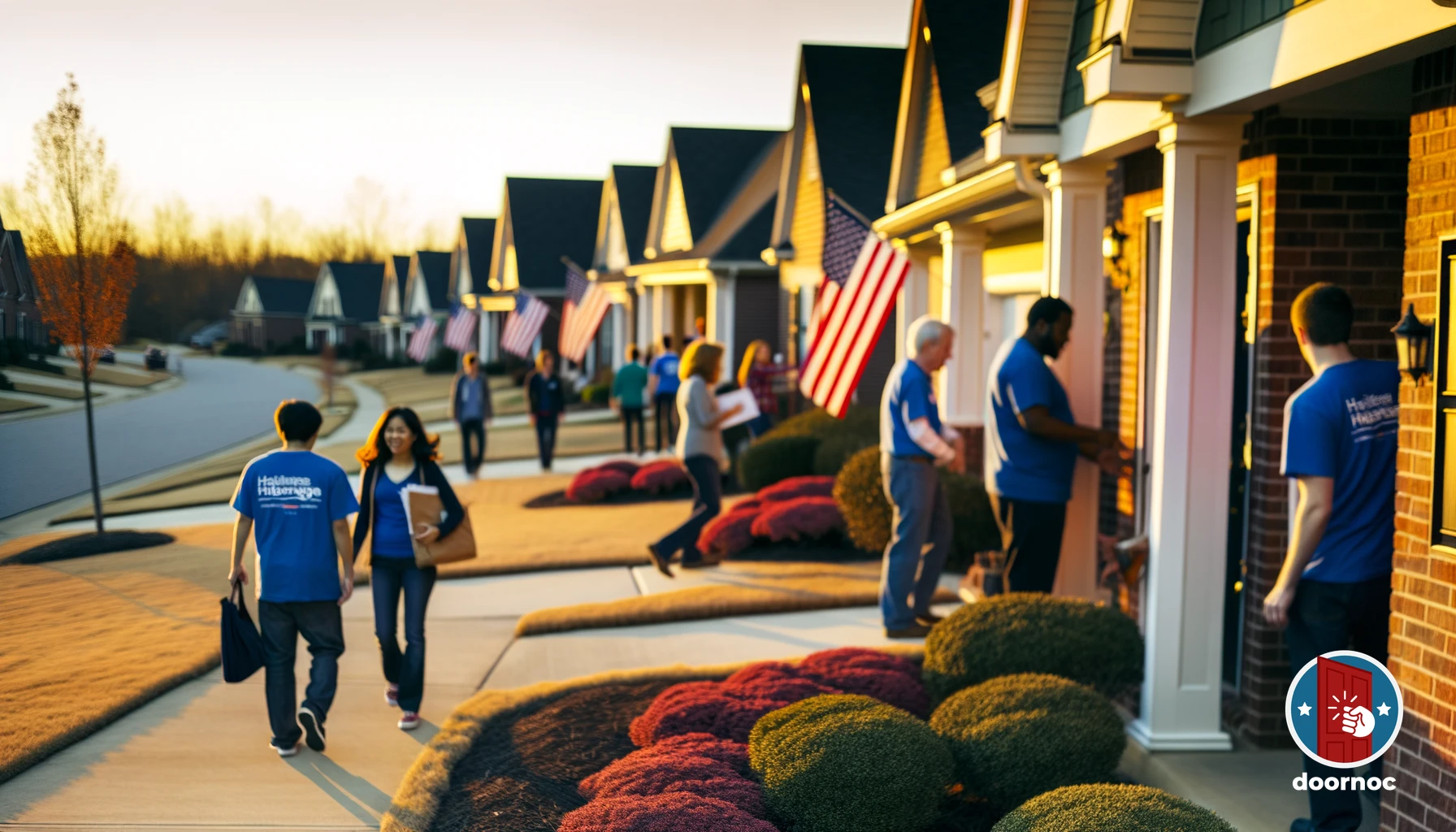 Volunteers spread across the neighborhood, bringing civic engagement to every doorstep.
Key route planning features include:
- Automatic route optimization: AI-powered algorithms sequence addresses for minimal walking distance
- Turn-by-turn navigation: GPS guidance between doors eliminates confusion
- Real-time route adjustment: System adapts routes based on completed contacts and volunteer pace
- Offline mode: Routes work without cell coverage, essential for rural canvassing
- Team dashboards: Campaign managers monitor route progress across all volunteers simultaneously
Campaigns using Door Knock’s intelligent routing report significant efficiency gains. One state legislative campaign increased their doors-per-hour rate from 18 to 28 after switching from paper walk lists to Door Knock’s optimized mobile routes.
The platform also integrates with major voter databases, ensuring routes always reflect current voter file data. Learn more about Door Knock’s features or explore our pricing plans to find the right solution for your campaign size.
Taking Action: Your Route Planning Checklist
Ready to implement efficient route planning for your campaign? Use this checklist to get started:
Before your first canvassing day:
- Define your target voter universe and export accurate address data
- Map voter distribution to identify high-density clusters
- Create territories sized appropriately for available volunteer time
- Sequence addresses within territories for logical flow
- Test routes with experienced canvassers and collect feedback
- Prepare route maps with parking locations and special instructions
During your campaign:
- Track doors-per-hour and contact rates by territory and volunteer
- Collect volunteer feedback on route quality after each shift
- Update routes weekly to incorporate voter file changes
- Create callback routes for not-at-home addresses
- Adjust territory sizes based on actual volunteer performance
Continuous improvement:
- Analyze which routes and territories perform best
- A/B test different routing approaches in similar neighborhoods
- Document successful strategies for future campaigns
- Train new volunteers on route navigation and time management
- Invest in mobile canvassing technology to automate optimization
Efficient route planning isn’t a one-time task—it’s an ongoing process of measurement, learning, and refinement. Campaigns that prioritize route optimization gain a significant competitive advantage in the field, reaching more voters with fewer resources.
By implementing the strategies in this guide, you’ll transform your canvassing operation from a logistical challenge into a precision voter contact machine. Your volunteers will appreciate the clear, manageable routes. Your campaign will appreciate the increased productivity. And most importantly, more voters will receive the personal contact that drives electoral success.
For more strategies on maximizing your field operation’s effectiveness, explore our complete guide to best practices for door-to-door canvassing and learn how to choose the best voter contact methods for your campaign.
Frequently Asked Questions
What is the most efficient way to plan a canvassing route?
The most efficient way to plan a canvassing route is to use geographic clustering combined with logical sequencing. Group voters by proximity, create compact territories, and sequence addresses to minimize backtracking. Modern mobile canvassing apps automate this process using GPS optimization algorithms that can increase contact rates by 40-60% compared to manual planning.
How many doors should a canvasser knock per hour?
A well-trained canvasser should knock 20-30 doors per hour in suburban areas, 15-25 in rural areas, and 30-40 in dense urban environments. These rates assume optimized routes, experienced volunteers, and realistic conversation times. Campaigns using mobile route planning tools consistently achieve the higher end of these ranges.
Should I plan canvassing routes by street or by voter list?
Plan routes by voter list first, then optimize geographically. Start with your targeted voter universe (persuasion targets, GOTV list, etc.), then use mapping tools to create efficient walking paths that minimize travel time. This approach ensures you contact the right voters while maximizing efficiency through smart sequencing.
How do you handle apartments and multi-unit buildings in canvassing routes?
Cluster all apartment units together and canvass them sequentially floor-by-floor or building-by-building. Multi-unit buildings can dramatically increase contact rates (50-80 doors per hour) when properly sequenced. Assign experienced canvassers to apartment territories and provide building access strategies in advance.
What’s the ideal size for a canvassing territory?
An ideal canvassing territory contains 60-100 targeted doors for a 2-3 hour canvassing shift. This accounts for contact rates (typically 30-40%), conversation time, and walking between doors. Territories should be compact and contiguous to minimize travel time, with clear boundaries that volunteers can easily understand.