Key Takeaways
- Effective GOTV begins 72 hours before Election Day, with early vote programs starting 14-21 days out to maximize turnout among committed supporters
- Data-driven voter universes increase efficiency by 40% — prioritize high-propensity supporters who need a nudge rather than wasting resources on unlikely voters
- Multi-touch contact strategies (phone + text + door) deliver 8-12% higher turnout than single-method approaches, with door-to-door remaining the most effective final contact
- Real-time tracking and rapid response systems allow campaigns to identify and fix turnout gaps on Election Day, when 60% of your GOTV impact happens
How to get out the vote is the most critical question facing every campaign in the final weeks before Election Day. Your GOTV (Get Out The Vote) operation determines whether your months of organizing, fundraising, and persuasion translate into actual votes cast. In 2026, successful campaigns are using data-driven voter universes, multi-touch contact strategies, and real-time tracking to achieve turnout rates 8-12 percentage points higher than campaigns relying on traditional methods.
GOTV refers to the systematic effort to ensure your identified supporters actually cast their ballots. Unlike persuasion efforts that change minds, GOTV focuses on mobilizing voters who already support you but may not vote without a reminder and encouragement. This distinction matters because effective GOTV strategies target different voters using different messages than your persuasion program.
What Makes a GOTV Plan Effective in 2026?
The most effective GOTV strategies in 2026 share three core elements: precise voter targeting, multi-channel contact sequences, and real-time performance tracking. Campaigns that master these elements consistently achieve 15-20% higher turnout among their target universe than those using generic voter contact.
Your voter universe is the foundation of effective GOTV. This targeted list should include identified supporters (1s and 2s on your voter contact scale) and high-propensity voters who lean your direction but haven’t committed. Building this universe requires combining your voter contact data with commercial voter files that include turnout history, demographic modeling, and early vote tracking.
Data-driven targeting increases efficiency by 40% compared to broad-based contact. Instead of knocking every door in a precinct, you focus resources on the 25-35% of voters most likely to respond to GOTV contact. This precision allows smaller campaigns to compete with better-funded opponents by maximizing impact per volunteer hour.
Multi-touch contact strategies deliver significantly higher turnout than single-method approaches. Voters who receive phone calls, text messages, and a door knock in the final 72 hours vote at rates 8-12 percentage points higher than those contacted through only one channel. The key is coordinating these touches so they feel like a cohesive reminder rather than harassment.
Building Your GOTV Voter Universe
Your GOTV universe should represent 25-35% of registered voters in your district — the supporters and leaners most likely to vote with encouragement. Start by pulling every voter you’ve identified as a 1 (strong support) or 2 (lean support) through canvassing, phone banking, or digital contact. These are your base turnout targets.
Next, layer in propensity modeling from your voter file. High-propensity voters (those who vote in 80%+ of elections) need minimal contact — a single reminder often suffices. Medium-propensity voters (40-80% turnout history) are your sweet spot for intensive GOTV because they vote sometimes but need encouragement. Low-propensity voters (under 40% turnout) rarely respond to GOTV unless you have strong personal connections.
Segment your universe by voting method: early vote, mail ballot, and Election Day voters require different contact strategies. Early voters need contact 14-21 days before Election Day when early voting opens. Mail ballot voters need earlier contact to request ballots, then follow-up to ensure they return them. Election Day voters receive intensive contact in the final 72 hours.
Remove voters who have already cast ballots from your active contact lists daily. In 2026, most states provide voter file updates showing who voted early or returned mail ballots. Continuing to contact voters who already voted wastes resources and annoys supporters. Real-time voter file integration through canvassing software allows you to update your universe automatically.
Prioritizing Your GOTV Universe
Within your universe, create priority tiers that guide volunteer deployment. Tier 1 includes strong supporters (1s) with medium propensity scores — these voters support you but need a nudge to vote. Tier 2 includes leaners (2s) with high propensity — they’ll probably vote anyway, but you want to ensure they do. Tier 3 includes strong supporters with high propensity — these voters need minimal contact.
This prioritization ensures you’re not wasting volunteer hours on voters who will vote regardless while missing persuadable voters who need more attention. Campaigns that fail to prioritize often achieve lower turnout among their base while over-contacting reliable voters who would have voted anyway.
Geographic clustering matters for door-to-door efficiency. Group your priority voters by precinct and create walk packets that minimize travel time between doors. A volunteer who can knock 30 doors per hour in a clustered route versus 15 doors per hour in a scattered route doubles your campaign’s effective capacity. Door Knock’s smart route planning automatically clusters voters and optimizes walking routes.
How to Structure Your GOTV Timeline
Effective GOTV operates in two distinct phases: early vote mobilization and Election Day operations. The early vote phase begins 14-21 days before Election Day (when early voting opens in most states) and focuses on banking votes from your most reliable supporters. The Election Day phase starts 72 hours out and intensifies until polls close.
Early vote GOTV should target 40-50% of your total universe — the voters most likely to vote early based on past behavior. Contact these voters with specific information about early voting locations, hours, and what to bring. Your message should emphasize the convenience of voting early and avoiding Election Day lines. Follow up with voters who haven’t voted early as Election Day approaches.
Mail ballot programs require the longest timeline. Begin ballot request contact 45-60 days before Election Day, then track which voters requested ballots. Once ballots are mailed (typically 30-40 days out), shift to ballot return reminders. The final week before Election Day, intensively contact voters who received ballots but haven’t returned them — this “ballot chase” often determines close elections.
The 72-hour GOTV window is when most campaigns make or break their turnout goals. This period requires all-hands-on-deck volunteer mobilization focusing on door-to-door contact. Phone calls and texts support the door operation but shouldn’t replace it — door-to-door contact in the final 72 hours increases turnout by 7-10 percentage points, far exceeding other methods.
Day-by-Day GOTV Schedule
72 Hours Out (Friday before Tuesday Election): Launch intensive phone banking to your full universe. Confirm poll locations and voting plans. Begin door-to-door contact in high-priority precincts. Send first GOTV text message with poll location and hours.
48 Hours Out (Saturday): Peak door-to-door day with maximum volunteer deployment. Knock every Tier 1 voter. Second phone call to voters not reached on Friday. Follow-up text to voters who engaged with previous messages.
24 Hours Out (Monday): Final door-to-door push focusing on voters not contacted over the weekend. Intensive phone banking to remaining universe. Final text message with poll hours and “bring a friend” messaging. Deploy literature drops to voters not reached by other methods.
Election Day: Real-time tracking of who has voted. Redeploy volunteers to precincts falling behind turnout targets. Knock doors of Tier 1 voters who haven’t voted by 2 PM. Final phone calls to all remaining universe members between 4-7 PM (peak effectiveness window).
Multi-Touch Contact Strategies That Work
The most effective GOTV programs layer multiple contact methods in coordinated sequences. A typical high-impact sequence includes: initial phone call 5-7 days out, text message 3 days out, door knock 1-2 days out, and final text on Election Day morning. This sequence ensures voters receive your message through their preferred channel while reinforcing the importance of voting.
Phone banking effectiveness peaks when callers have personal connections to voters. Relational organizing — where volunteers call their own friends, family, and neighbors — achieves 15-20% higher turnout than stranger-to-stranger calls. If you’re using traditional phone banking, prioritize quality conversations over call volume. A two-minute conversation about voting plans outperforms ten rushed 20-second calls. Learn more about effective phone banking strategies that increase voter turnout.
Text messaging works best for logistical information and quick reminders. Send texts with specific poll locations, hours, and what to bring. Include a link to a sample ballot so voters can review races before arriving. Avoid long persuasive texts — voters ignore them. Keep messages under 160 characters and include only essential information.
Door-to-door contact remains the gold standard for GOTV because it’s the hardest to ignore and enables genuine conversation. Canvassers should focus on confirming voting plans rather than lengthy persuasion. Ask: “Do you know where your polling place is? What time are you planning to vote? Do you need a ride?” These concrete questions increase turnout by helping voters form implementation intentions. Our guide on door-to-door canvassing tips covers effective conversation techniques.
Coordinating Multi-Channel Contact
Coordination prevents contact fatigue while maximizing impact. Your phone, text, and door teams need shared visibility into who has been contacted through which channels. Without coordination, voters receive duplicate messages that feel like spam rather than helpful reminders.
Use a unified contact management system that tracks all touches in real-time. When a canvasser marks a voter as contacted, that voter should be removed from evening phone banking lists. When a voter responds to a text saying they already voted, they should be removed from all active contact lists immediately. The canvassing app provides real-time contact syncing across all volunteer teams.
Space your contacts appropriately. Voters should receive touches 2-3 days apart, not multiple contacts in a single day. The exception is Election Day itself, when morning text + afternoon door knock + evening phone call is acceptable because time is running out. Before Election Day, respect voters’ time and attention.
Leveraging Early Vote and Vote by Mail
Early vote programs allow you to bank supporters before Election Day, reducing the pressure on your Election Day operation and freeing resources to focus on harder-to-turn-out voters. In states with robust early voting, 60-70% of total votes are cast before Election Day — making early vote GOTV essential.
Target early vote contact to voters with high early vote propensity based on past behavior. If a voter has voted early in the last three elections, they’re likely to do so again. Contact these voters as soon as early voting opens with specific information about locations and hours. Many campaigns see their highest early vote turnout in the first 2-3 days when enthusiasm is highest.
Vote by mail requires more intensive tracking and follow-up. First, identify voters who typically vote by mail and ensure they request ballots. Second, track ballot status (requested, mailed, returned) through daily voter file updates. Third, contact voters who received ballots but haven’t returned them with increasingly urgent reminders.
Ballot chase operations in the final week before Election Day often determine close races. Focus on voters who requested and received mail ballots but haven’t returned them. These voters intended to vote (they requested a ballot) but need encouragement to complete the process. Door-to-door contact works best for ballot chase — offer to wait while they fill out their ballot and provide a ride to a drop box.
Early Vote Turnout Tracking
Monitor early vote turnout by precinct and demographic group daily. Compare actual turnout to your targets and identify underperforming areas early enough to correct. If young voters are voting early at lower rates than expected, deploy targeted social media and text messaging to that demographic. If a specific precinct is lagging, send door-to-door teams there.
Celebrate early vote milestones publicly to build momentum. When you hit 25%, 50%, or 75% of your early vote goal, share it on social media and with volunteers. This creates social proof that encourages more supporters to vote early. Just ensure you’re not declaring victory prematurely — early vote success doesn’t guarantee Election Day turnout.
Election Day Operations and Real-Time Tracking
Election Day operations require military-level precision and real-time decision-making. Your goal is to identify which of your supporters have voted and immediately redeploy resources to contact those who haven’t. Campaigns with strong Election Day operations can increase turnout by 3-5 percentage points compared to those without real-time tracking.
Establish precinct captains in every high-priority precinct who monitor turnout throughout the day. These captains receive hourly voter file updates showing who has voted and compare actual turnout to targets. When a precinct falls behind, the captain requests additional volunteers from headquarters. This rapid response prevents you from discovering turnout problems after polls close when it’s too late.
Divide Election Day into three phases: morning (6 AM-12 PM), afternoon (12 PM-5 PM), and evening (5 PM-close). Morning contact focuses on voters who typically vote before work. Afternoon is your planning and redeployment phase — analyze morning turnout and redirect volunteers. Evening is your final push to low-propensity voters who haven’t voted yet.
Poll monitoring serves two purposes: legal protection and turnout intelligence. Station volunteers at high-priority precincts to observe for voter suppression or irregularities. These same volunteers can conduct “knock and drag” operations — when they see supporters leaving without voting (long lines, forgot ID), they help solve the problem and get them back in line.
Using Technology for Real-Time GOTV
Modern GOTV operations rely on technology to track contacts and turnout in real-time. Paper walk lists and phone banks can’t provide the visibility needed to make rapid decisions on Election Day. Door-to-door canvassing software enables volunteers to log contacts instantly, allowing headquarters to see which voters have been reached and which still need contact.
Voter file integration is critical for Election Day success. As voters cast ballots, their status updates in the voter file (usually with a 1-2 hour delay). Your canvassing system should sync with these updates so volunteers aren’t knocking doors of voters who already voted. This integration prevents wasted effort and voter annoyance.
Mobile apps enable field teams to work offline when cell service is spotty, then sync data when connectivity returns. This ensures contact data isn’t lost and allows volunteers to work in rural areas or buildings with poor reception. Look for apps with robust offline functionality and automatic background syncing.
Volunteer Recruitment and Management for GOTV
GOTV success depends on recruiting and deploying enough volunteers to execute your contact plan. Most campaigns need 1 volunteer per 100 target voters for effective GOTV — a campaign targeting 10,000 voters needs 100 active volunteers across the GOTV period. Recruitment should begin 4-6 weeks before Election Day to allow time for training.
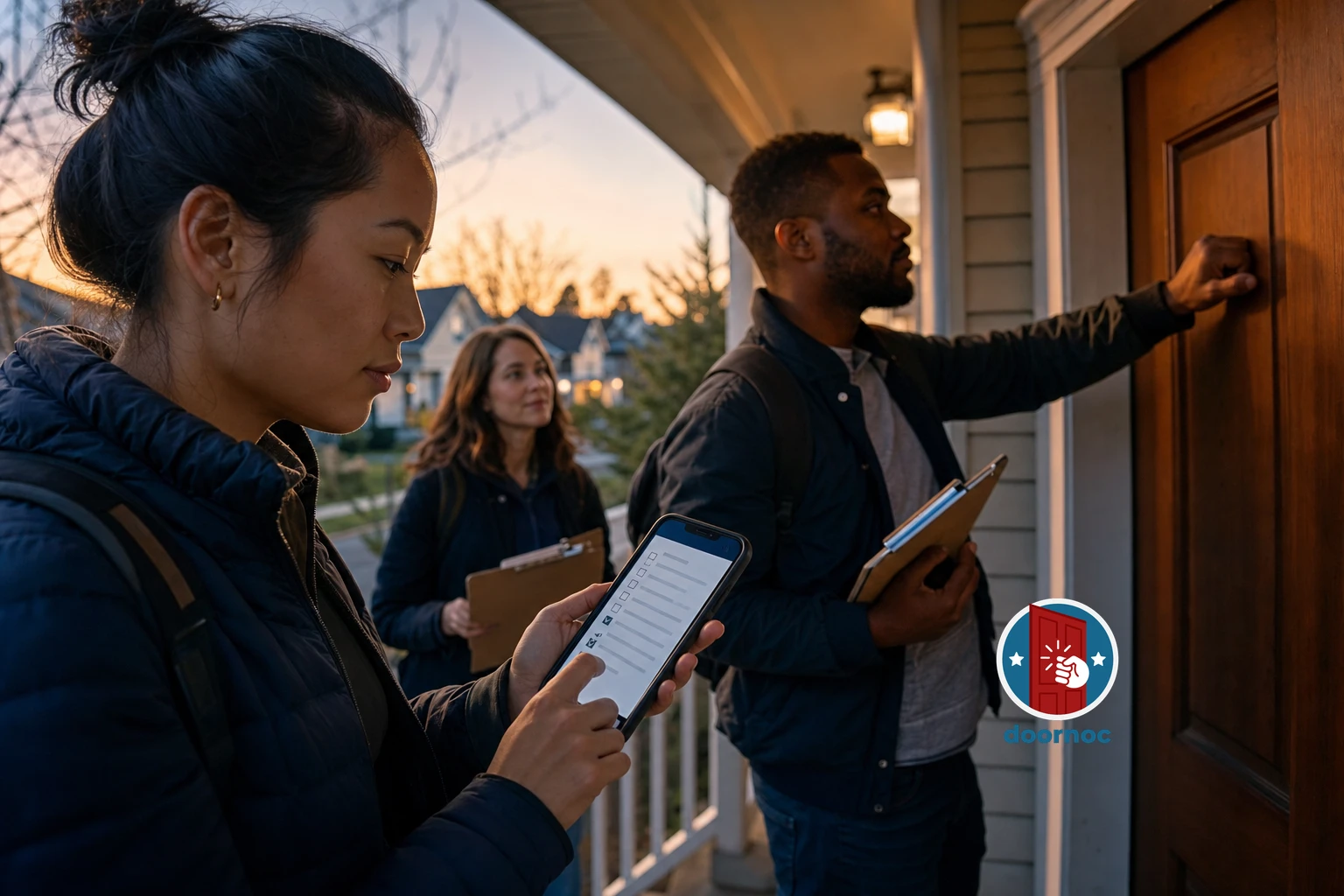 Three volunteers collaborating on a residential porch at dusk, one using a mobile voter contact app while another knocks on door.
Recruit volunteers through multiple channels: your existing supporter list, social media, coalition partners, and volunteer recruitment events. Emphasize that GOTV volunteering is time-limited (just a few days) and highly impactful — many people who won’t volunteer for months will commit to a weekend of door-knocking.
Train volunteers on your specific GOTV approach: what to say at doors, how to use your canvassing app, and how to handle common questions. Training should be hands-on and include role-playing door conversations. Volunteers who feel prepared are more likely to show up and stay engaged throughout their shift. Review our complete guide to political canvassing for training best practices.
Schedule volunteers in 3-4 hour shifts rather than all-day commitments. Most people can sustain quality door-to-door contact for 3-4 hours before fatigue reduces effectiveness. Shorter shifts also make volunteering more accessible to people with work or family commitments. Provide clear shift times, meeting locations, and what to bring.
Managing Volunteers on Election Day
Election Day volunteer management requires a staging location where volunteers check in, receive assignments, and return for new assignments. This location should have WiFi for data syncing, space for briefings, and proximity to your highest-priority precincts. Many campaigns use campaign offices, union halls, or supporters’ homes.
Create a volunteer check-in system that tracks who’s working when and where. This prevents volunteers from being double-assigned and ensures you can contact them if you need to redirect them to a different precinct. Simple Google Sheets work for small campaigns; larger operations need dedicated volunteer management software.
Provide regular updates and encouragement throughout the day. Text volunteers with turnout progress: “We’re at 45% of our goal — keep knocking!” This builds momentum and prevents volunteers from losing energy in the afternoon lull. Celebrate successes: “Precinct 14 just hit 100% of target — great work team!”
Measuring GOTV Effectiveness
Measure GOTV effectiveness by comparing actual turnout among contacted voters versus uncontacted voters in your universe. If contacted voters turned out at 65% and uncontacted voters at 55%, your GOTV operation increased turnout by 10 percentage points — a massive impact. This analysis requires tracking which voters you contacted through which methods.
Calculate your contact rate (percentage of universe successfully contacted) and conversion rate (percentage of contacted voters who voted). High-performing campaigns achieve 70-80% contact rates and 65-75% conversion rates. If your contact rate is low, you didn’t deploy enough volunteers. If your conversion rate is low, your targeting or messaging needs improvement.
Analyze performance by precinct, demographic group, and contact method. Which precincts exceeded targets? Which fell short? Did door-to-door contact outperform phone banking? Did young voters respond better to texts than calls? These insights inform your strategy for the next election.
Track cost per vote to evaluate efficiency. Calculate total GOTV spending (staff time, technology, literature, etc.) divided by the number of votes you turned out above baseline. Competitive campaigns achieve $15-30 per incremental vote turned out. If your cost per vote is significantly higher, examine whether you’re targeting the right voters or using the most effective methods.
Post-Election GOTV Analysis
Conduct a thorough post-election analysis within two weeks while the campaign is fresh in everyone’s mind. Interview precinct captains, volunteer coordinators, and field staff about what worked and what didn’t. Review your contact data to identify patterns in successful and unsuccessful precincts.
Document your GOTV plan, results, and lessons learned for future campaigns. Too many campaigns reinvent the wheel each cycle because they didn’t preserve institutional knowledge. Create a GOTV playbook that includes your voter universe criteria, contact scripts, volunteer training materials, and performance benchmarks.
Advanced GOTV Tactics for 2026
Vote tripling is an emerging tactic where you ask supporters to commit to ensuring three specific friends or family members vote. This leverages social pressure and personal relationships to increase turnout beyond your direct contact capacity. Voters who make vote tripling commitments achieve 15-20% higher turnout among their three friends than those friends would achieve otherwise.
Implement vote tripling by asking supporters during canvassing: “Can you commit to making sure three friends vote? Who are they?” Collect names and contact information, then follow up to confirm the supporter contacted their three friends. This creates accountability and extends your campaign’s reach through trusted messengers.
Ride-to-polls programs remove transportation barriers for supporters who want to vote but lack reliable transportation. Partner with rideshare companies for discounted rides to polls, recruit volunteers with cars, or organize van shuttles from senior centers and college campuses. Transportation programs are especially effective in low-income communities and among elderly voters.
Poll watching and voter protection require separate volunteer teams monitoring for voter suppression, intimidation, or irregularities. These volunteers need legal training and clear escalation procedures for problems. While poll watching doesn’t directly increase turnout, it ensures your supporters can vote when they arrive at polls.
Integrating Relational Organizing into GOTV
Relational organizing — mobilizing supporters to contact their own networks — multiplies your campaign’s capacity beyond traditional volunteer recruitment. Instead of recruiting 100 volunteers to knock strangers’ doors, recruit 50 volunteers to each contact 20 friends, family, and neighbors. This achieves the same contact volume with higher conversion rates because personal relationships drive turnout.
Launch relational organizing 4-6 weeks before Election Day, not during the final GOTV push. Supporters need time to have multiple conversations with their networks, building from early awareness to final GOTV. Provide supporters with tools to track their contacts and talking points for conversations. Learn more about relational organizing strategies.
Combine relational organizing with traditional GOTV by having relational organizers focus on their networks while traditional volunteers contact the broader universe. This creates a two-tier contact strategy where high-value voters receive personal contact from friends while the rest of your universe receives traditional canvassing and phone banking.
Common GOTV Mistakes to Avoid
The biggest GOTV mistake is starting too late. Campaigns that begin GOTV planning in the final week achieve 20-30% lower turnout than those that plan 4-6 weeks ahead. Early planning allows time to build your voter universe, recruit volunteers, and test your technology before the high-pressure final days.
Over-contacting reliable voters while under-contacting medium-propensity supporters wastes resources. Many campaigns feel good about high contact rates among voters who would vote anyway, while missing persuadable voters who need encouragement. Prioritize your universe correctly and track contact rates by priority tier.
Ignoring early vote and vote-by-mail opportunities leaves votes on the table. In states where 60-70% of votes are cast before Election Day, campaigns that focus exclusively on Election Day turnout lose. Build early vote into your GOTV plan from the beginning, not as an afterthought.
Failing to track real-time performance prevents you from correcting problems while there’s still time. Campaigns that wait until after polls close to analyze turnout can’t deploy additional volunteers to underperforming precincts. Establish hourly reporting on Election Day and rapid redeployment protocols.
Neglecting volunteer appreciation leads to burnout and reduces volunteer retention for future campaigns. Thank volunteers personally, provide food and drinks, and celebrate successes. The volunteers who knock doors in the final days are your most valuable campaign assets — treat them accordingly.
Building Your GOTV Plan for the Next Election
Start building your GOTV plan by defining your turnout goals by precinct and demographic group. How many total votes do you need to win? What’s your expected baseline turnout without GOTV? How many additional votes must your GOTV operation produce? These numbers drive your volunteer recruitment and resource allocation.
Build your voter universe using the criteria outlined earlier: identified supporters, propensity modeling, and voting method segmentation. Clean your universe by removing deceased voters, people who moved, and voters who have already voted. A clean universe increases efficiency and prevents embarrassing contacts.
Develop your contact plan specifying which voters receive which contacts when. Map out your phone banking, texting, and door-to-door schedules. Calculate how many volunteer hours you need to execute the plan, then recruit enough volunteers to meet that target with a 20% buffer for no-shows.
Test your technology and processes before GOTV begins. Conduct a practice canvassing session with your app to identify bugs or usability issues. Run a test phone bank to ensure your calling system works and volunteers can access scripts. Fix problems during testing, not on Election Day.
How to get out the vote successfully requires meticulous planning, data-driven targeting, and flawless execution in the final days before Election Day. The campaigns that win close elections are those that turn out 3-5% more of their supporters through superior GOTV operations. Start planning early, build a precise voter universe, deploy multi-touch contact strategies, and track performance in real-time. Your GOTV operation is where months of campaigning either pay off or fall short — make it count.
Frequently Asked Questions
What is the most effective GOTV strategy in 2026?
The most effective GOTV strategy combines early vote mobilization starting 14-21 days before Election Day with intensive door-to-door canvassing in the final 72 hours. Data shows multi-touch contact (phone, text, and door) targeting high-propensity supporters delivers 8-12% higher turnout than single-method approaches.
When should a GOTV campaign start?
Your GOTV program should launch in two phases: early vote mobilization begins 14-21 days before Election Day, while intensive Election Day GOTV starts 72 hours out. This phased approach allows you to bank votes early and focus final resources on high-impact door-to-door contact.
How much does door-to-door canvassing increase voter turnout?
Quality door-to-door canvassing increases voter turnout by 7-10 percentage points among contacted voters, making it the most effective voter contact method. The impact is highest when canvassers have personal conversations rather than dropping literature, and when contact occurs within 72 hours of Election Day.
What is a voter universe and why does it matter for GOTV?
A voter universe is your targeted list of voters to contact during GOTV — typically supporters and persuadable voters with high propensity to vote. Building a data-driven universe increases efficiency by 40% by focusing resources on voters most likely to turn out with a reminder, rather than wasting time on unlikely voters.
How do you track GOTV progress on Election Day?
Track GOTV progress using real-time voter file updates that show who has voted, combined with mobile canvassing apps that log door contacts instantly. This allows you to identify turnout gaps by precinct and redeploy volunteers to areas falling behind your targets throughout Election Day.