
Volunteers are logged in. The list is clean enough. Scripts are loaded. A field director watches the dashboard, and the number that matters still won’t move. Live conversations per hour stay soft, callbacks pile up, and the canvass team gets vague data that can’t drive a same-day route change.
That’s the moment when phone bank software stops being a procurement line item and becomes an operations decision. Teams don’t lose calling time because they forgot to buy a dialer. They lose it because the dialer can’t be tuned well, can’t keep abandonment under control, or can’t pass disposition data into the rest of the campaign without manual cleanup.
A campaign rarely needs more calling features. It needs better control over pacing, clearer compliance guardrails, and cleaner handoff into voter-file and canvass workflows. A platform that places more calls but produces weak survey data can slow the field program. A platform that protects compliance but forces callers into slow manual steps can waste scarce volunteer hours. The right choice sits in the middle. It turns available callers into actual conversations and usable follow-up.
The useful comparison isn’t feature count. It’s whether the system helps managers answer three operational questions in real time:
- Throughput: How aggressively can the program dial without wasting agent time?
- Risk: Where is the abandon ceiling, and how visible is it to the person managing the shift?
- Data flow: When a voter asks for a yard sign, needs chase follow-up, or signals persuasion movement, where does that record go next?
Introduction Why Your Phone Bank Software Choice Decides Live Conversations
A GOTV night usually exposes every weakness in a calling stack. The campaign adds volunteers for a final push, some work from home, some from a staging office, and everyone expects the system to carry the load. If connects lag, the problem often isn’t script quality first. It’s software behavior. Pacing is too timid. Or too aggressive. Or the dashboard hides the one control the manager needs when abandonment starts creeping.
The difference shows up fast on a live shift. One team spends half the hour waiting between calls and arguing over whether to speed up. Another team moves calls steadily, monitors the connected rate, and tightens pacing before compliance risk turns into a scramble. Both teams may have the same list quality. They don’t have the same operational control.
The comparison that matters
Early in the buying process, campaigns often compare phone bank software the way they compare office software. They scan checklists. Browser access, scripts, surveys, tags, exports. Those matter, but they don’t decide whether a Tuesday night shift produces enough live conversations to move a target universe.
This is the more practical lens:
| Evaluation Area | What to Check | Why It Matters on Live Calls |
|---|---|---|
| Pacing controls | Dial ratio settings, real-time adjustment, visibility into connected rate | Determines whether agents spend shifts talking or waiting |
| Abandon protection | Current abandon rate, maximum allowed abandon rate, alerts or hard ceilings | Prevents throughput gains from turning into compliance problems |
| Agent workflow | Call disposition speed, note-taking flow, branch logic in scripts | Protects rep-hour efficiency and data quality |
| List handling | Import quality, segmentation, dedupe, callback handling | Reduces dead time and repeat errors |
| Data handoff | Sync to canvass, voter-file updates, follow-up tagging | Turns calls into field action instead of isolated call logs |
| Remote access | Browser-based login, easy volunteer setup | Keeps distributed teams usable without technical friction |
A fast dialer that produces dirty follow-up data usually shifts work downstream to field and data staff. That’s not efficiency. It’s deferred cleanup.
What a campaign is really buying
A campaign buying phone bank software is buying control over rep time. It’s also buying a compliance posture. The software decides how quickly callers move from one record to the next, how visible risk signals are during a shift, and whether call outcomes can inform canvass decisions while there’s still time to act.
That’s why a good dialer decision often starts with one hard question: what should happen to the next voter after the call ends? If the campaign can answer that clearly, software choices get easier.
What Phone Bank Software Does Today and How Cloud Changed It
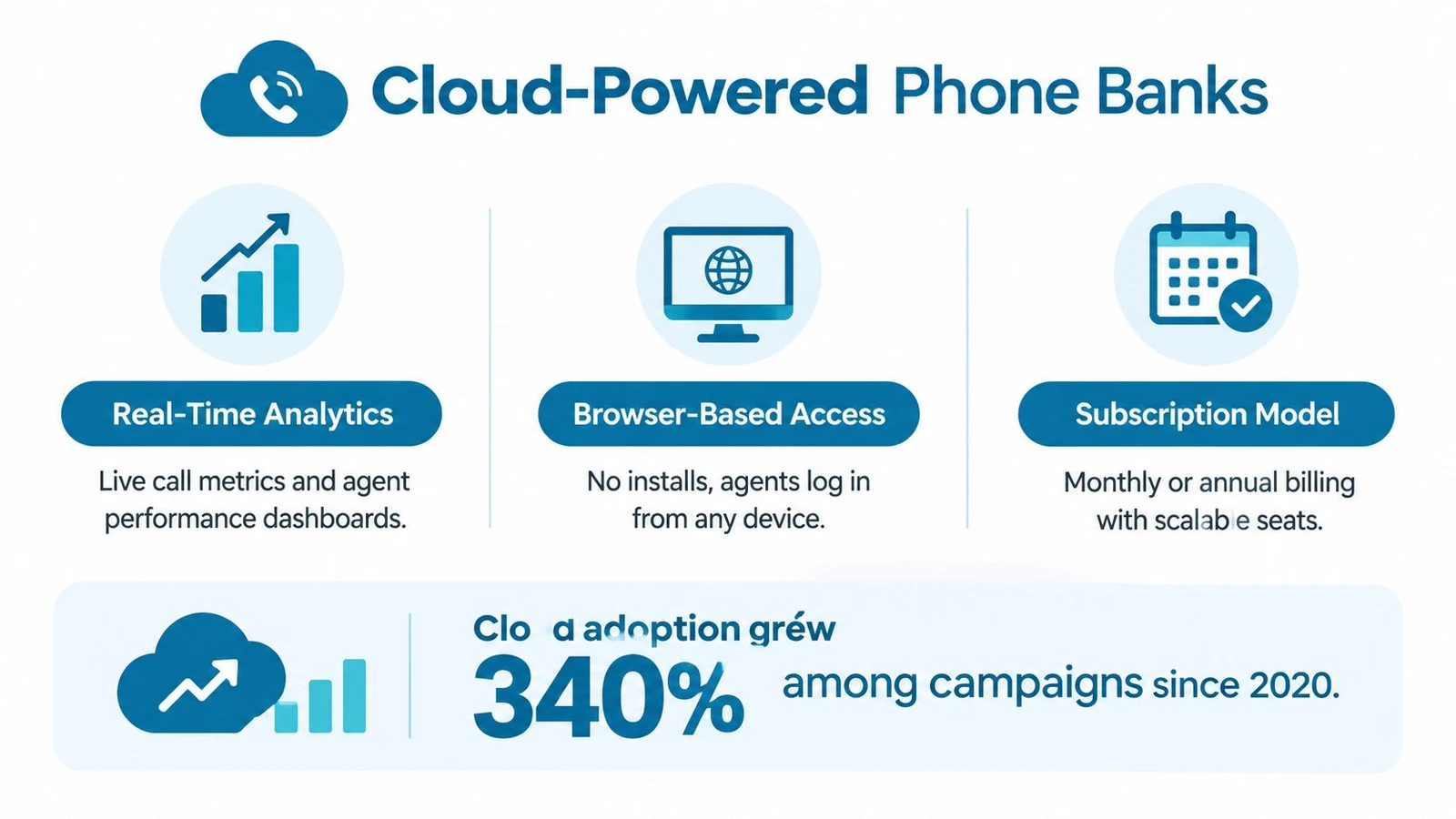
Modern phone bank software isn’t just a digital list and a call button. It’s a browser-based operating layer for outbound calling. Callers log in remotely, managers watch live metrics, scripts branch based on responses, and supervisors can change campaign settings without rebuilding the whole system.
Cloud delivery changed the category because it changed access, setup, and replacement behavior. One industry report says cloud-based solutions were used by 62% of companies globally in 2025, up from 40% in 2022, while another market report found cloud accounted for 74.24% of the contact-center software market in 2025 (contact-center cloud adoption figures). For campaigns, advocacy groups, and outreach teams, that shift matters because phone bank software now tends to arrive as a subscription service with remote access and real-time analytics instead of on-premise infrastructure.
What a modern platform usually includes
A current phone bank setup usually combines several functions in one workflow:
- Calling interface: Agents need a clean screen for the script, voter details, disposition buttons, and note entry.
- Supervisor controls: Managers need live views into caller status, queue behavior, and campaign pacing.
- Survey capture: Response codes and branch logic should convert conversations into structured field data.
- List operations: Imports, segmentation, callback queues, and suppression handling keep the program moving.
- Reporting layer: Shift leads need enough live reporting to reassign callers before the night is over.
Those modules share the same underlying idea. The software isn’t there to place calls in isolation. It’s there to coordinate people, lists, and call outcomes at speed.
Why cloud changed campaign operations
Cloud delivery made remote volunteer calling normal. A campaign no longer has to centralize every caller in one physical room to get common scripts and shared reporting. That changes staffing flexibility, but it also raises the bar for admin simplicity. If volunteers can’t log in quickly from a browser, cloud access alone doesn’t help much.
The broader market signals support why vendors have built in this direction. One forecast estimates the cloud-based contact-center market will grow from USD 32.65 billion in 2025 to USD 116.33 billion by 2031 at a 23.6% CAGR, while another projects cloud call center software at USD 25.9 billion in 2025 reaching USD 118.9 billion by 2034 at an 18.5% CAGR. A separate projection places the global contact-center-as-a-service market at USD 7.08 billion in 2025, rising to USD 30.15 billion by 2034 (contact-center market projections).
Operational takeaway: Cloud didn’t just change hosting. It changed buyer expectations. Teams now expect fast setup, distributed access, subscription pricing, and dashboards that update during the shift, not after it.
For campaigns, that means the default question is no longer whether software can handle calls. It’s whether the cloud workflow is good enough to support volatile staffing and same-day field decisions.
Detailed Comparison of Dialer Types Dashboard Controls and Integrations
The biggest mistake in software selection is treating all dialers as interchangeable. They aren’t. Each dialer type trades throughput against control, and that trade affects staffing, compliance exposure, and data quality.
Phone Bank Dialer Comparison by Control and Risk
| Dialer Type | Pacing Control | Best For | Compliance Risk |
|---|---|---|---|
| Manual | Caller initiates each call | Small programs, training, high-sensitivity conversations | Lowest, because agents control call launch directly |
| Preview | System presents next contact before call | Persuasion calls, donor outreach, higher-context scripts | Lower, because callers can prepare before connecting |
| Power | System places calls in sequence for available agents | Volunteer shifts that need steadier throughput | Moderate, depends on pacing settings and list quality |
| Predictive | System uses automated pacing to keep agents continuously engaged | High-volume programs where idle time is costly | Highest, because aggressive pacing can push abandon risk |
Manual and preview dialing usually protect conversation quality. They give callers time to review history, notes, or a branching script before the line connects. That works well when the campaign wants precision. It’s slower when the problem is too much dead air between attempts.
Power and predictive dialing usually improve throughput. The risk is that speed becomes the headline while compliance becomes an afterthought.
The dashboard controls that actually matter
Phone bank software dashboards are commonly evaluated using minimum, maximum, and actual dial ratios, plus current and maximum allowed abandon rates and current connected rate, because those measures reveal pacing efficiency and compliance risk in live outbound workflows.
That framework is more useful than a generic feature list because it maps directly to manager decisions during a shift.
- Dial ratio visibility: If the system shows only aggregate calls placed, the manager can’t tune pacing well. Minimum, maximum, and actual dial ratios give context for whether the platform is under-driving or overshooting.
- Abandon rate ceiling: A campaign needs the current rate and the maximum allowed rate in the same view. Without both, the team is managing blind.
- Connected rate: This helps separate list quality problems from pacing problems. If connects are weak, changing scripts won’t fix it mid-shift.
The best dashboard isn’t the one with the most charts. It’s the one that lets a shift lead make one pacing change with confidence.
Integrations decide whether calls become action
A phone bank doesn’t end when the voter hangs up. That’s where many software evaluations fall short. Campaigns should ask what happens to four common outcomes: supporter ID, persuasion movement, callback request, and field follow-up.
A strong integration profile should cover:
- Voter-file sync: Structured survey responses need to map cleanly back to voter records.
- Canvass handoff: Contacts that need a door follow-up should move into route planning without CSV repair.
- Constituent workflow support: Non-electoral outreach often needs phone notes attached to longer histories.
- List feedback loops: Bad numbers, wrong contacts, and moved voters should suppress future waste.
Matching dialer type to the work
Predictive dialing can make sense when the campaign has a large target universe, enough trained callers, and clear tolerance boundaries for pacing. Manual or preview remains the safer fit when the value of each call is high and the script depends on context.
The campaign shouldn’t ask, “Which dialer is fastest?” It should ask, “Which dialer preserves the value of the conversation while keeping enough volume to matter?”
How to Benchmark Performance Compliance and AI Hybrid Options
A software demo is only useful if the campaign brings a scorecard. Otherwise the team gets shown polished screens and leaves without a way to judge whether the system can support a real shift.
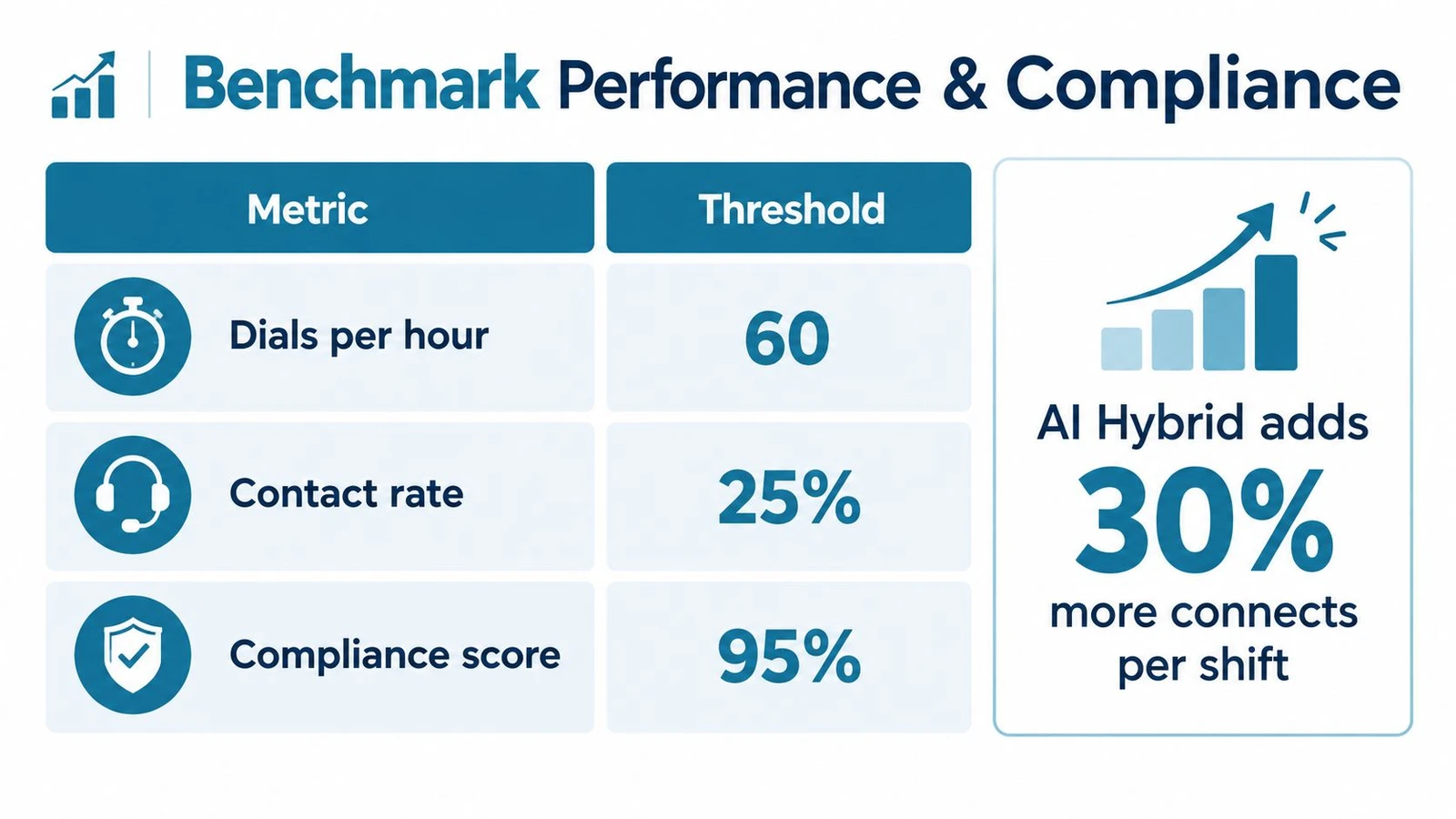
Industry KPI frameworks for outbound calling provide a practical benchmark: dials per hour above 220 is typically considered excellent, contact rate above 16% is excellent, abandon rate below 3% is excellent, and service level above 85% is top-tier. For political phone banking, those thresholds are useful because they force the conversation away from vague claims and toward observable output.
A practical benchmark checklist
When evaluating phone bank software, teams should test whether a platform can support these questions:
- Can callers sustain enough dials per hour without losing disposition accuracy? Fast calling isn’t useful if notes and survey codes degrade.
- Does contact rate stay healthy once real lists are loaded? Demo environments can hide list friction.
- Can the manager keep abandon rate in a strong band while still pushing volume? Dashboard controls become real.
- Does service level stay visible enough to flag bottlenecks during the shift?
Campaigns looking at channel mix may also find value in this discussion of contact-rate differences between canvassing and phone banking, especially when deciding where marginal staff time should go.
Compliance questions that belong in every demo
Political phone bank software often gets marketed around dialer types, but campaigns need practical guardrails. Independent 2026 coverage highlights the importance of consent rules, DNC checks, abandoned-call handling, and local calling-hour enforcement, noting that compliance depends on whether calls go to cell phones, landlines, or are automated, and that local-time calling windows are commonly enforced at 8 AM to 9 PM.
A campaign should ask for direct answers to these operational questions:
- Consent handling: How does the system treat records that require different outreach rules?
- DNC suppression: Is suppression automatic, and how visible is it to admins?
- Abandoned-call handling: What happens the moment pacing creates an abandoned-call event?
- Local time enforcement: Can the system prevent calls outside allowed windows without relying on caller judgment?
Compliance rule: If a manager can’t explain how the software prevents a bad call before launch, the campaign is depending on volunteer discipline instead of system control.
Where AI hybrid calling fits and where it doesn’t
Recent 2026 coverage notes that campaigns are experimenting with AI voice agents that can conduct conversations at scale, while other guidance still emphasizes live volunteer calls for persuasion and turnout.
That points to a useful distinction. AI or hybrid systems may help in narrow, repetitive stages of outreach, especially where the script is simple and the data ask is structured. Human callers still fit better where trust, nuance, or persuasion quality matters. The key issue isn’t whether AI exists. It’s whether the campaign can define which conversation steps benefit from automation without compromising voter trust or muddying the record.
Use Cases That Match Phone Bank Software to Campaign Reality
A campaign rarely needs the “most advanced” phone bank software. It needs the setup that matches staffing reality, universe quality, and the next action after the call.
Small local race with volunteer-heavy shifts
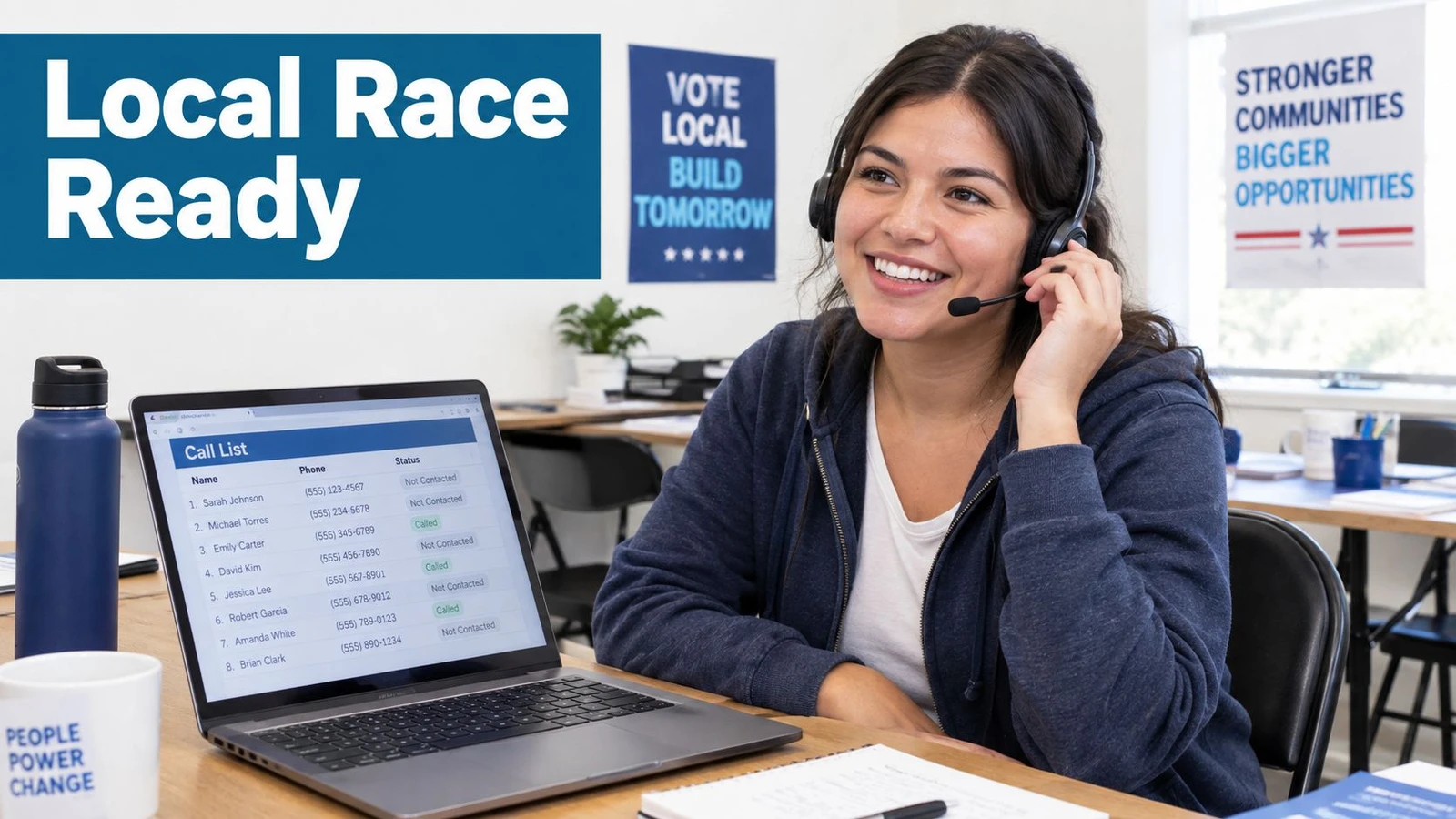
A local race often has irregular caller attendance, limited training time, and scripts that need a human tone. In that environment, manual or preview-style workflows usually fit better than aggressive automation. The campaign is often trying to preserve data quality while keeping onboarding simple enough for first-time volunteers.
The follow-up burden matters here. If a supporter wants a yard sign or asks for an absentee reminder, that record needs to move cleanly into a field queue. Teams deciding whether that handoff should happen by phone or at the door may benefit from this comparison of canvassing versus phone banking for voter contact.
Distributed advocacy or issue program
An advocacy program may run callers across different locations and schedules. Browser access matters more, and admin simplicity starts to matter almost as much as dial speed. The right system is usually one that keeps remote volunteers productive without requiring technical support for every login issue.
In these programs, a stable callback workflow often beats raw aggression. Callbacks are part of relationship building, not just queue cleanup.
High-volume GOTV operation
A turnout push is where power or predictive approaches become more attractive. The script is tighter. The ask is simpler. The cost of caller idle time rises because the campaign is racing the clock.
This setup still needs discipline. High-volume doesn’t mean uncontrolled. It means the campaign needs visible pacing controls, hard abandon awareness, and supervisors who can adjust during the shift instead of reviewing mistakes later.
A GOTV dialer should be judged by whether it converts available callers into more live voter contacts before polls close, not by whether it can generate impressive call-attempt totals.
Data-team-led persuasion program
Some persuasion programs treat each phone call as one signal in a larger targeting loop. The phone bank isn’t isolated. It feeds canvass universes, mail suppression, volunteer recontact plans, and candidate follow-up.
That environment rewards software that treats survey outcomes as structured data rather than just notes. A field-first option like doornoc fits this kind of program when the campaign needs mobile canvassing, offline collection, route planning, list upload, and a direct handoff from sourced voter lists into field execution without manual CSV shuffling. The value here isn’t a faster call screen by itself. It’s a tighter connection between call results and next-day field action.
Implementing Your Phone Bank and Connecting It to Canvass Data
Implementation usually fails in quiet ways. The dialer launches. Calls happen. Then follow-up breaks because list IDs don’t map cleanly, survey responses are inconsistent, or field staff get exports too late to use them.
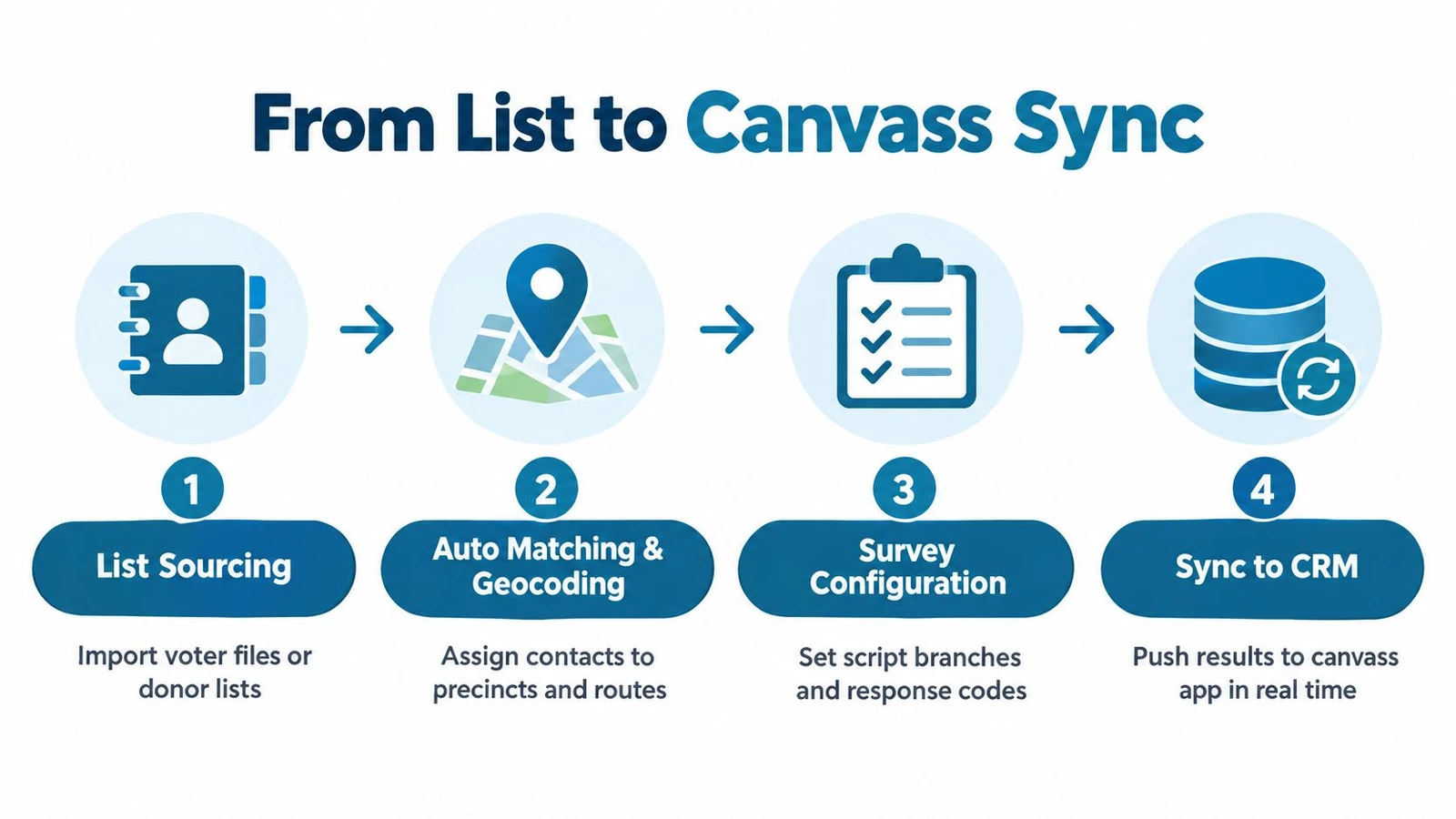
A stronger rollout starts by defining the data path before the first call. Which lists enter the system, how records are matched, which survey codes trigger field action, and where results sync after disposition should all be decided before volunteer training.
A rollout sequence that prevents data silos
- Start with list sourcing. Import voter files, supporter universes, or outreach lists in a format the team can audit. The campaign should know which records are primary targets, callbacks, and suppressions before loading callers.
- Match and geocode early. Automatic voter matching and geocoding matter because phone conversations often create door follow-up tasks. Those records need location context if the canvass team will act on them quickly.
- Configure surveys for action. Every major response should map to a usable disposition. “Undecided,” “needs absentee chase,” and “not home but supportive household” shouldn’t sit as free-text notes if the field team needs them tomorrow.
- Sync continuously. The useful setup pushes results into the canvass workflow quickly enough for same-day reallocation.
What field teams need after the call
Phone results should create clear downstream actions:
- Door follow-up universes: Supporters not fully locked in can move to canvass.
- Route planning inputs: Geocoded records help turn call outcomes into workable turfs.
- Offline continuity: Field teams still need access when service drops.
- Live oversight: Managers need enough dashboard visibility to shift callers or walkers the same day.
When campaign data starts lagging between phone and field, this guide on fixing campaign data sync issues fast is a useful operational reference.
The workflow standard to aim for
The cleanest implementation is one where phone and canvass teams don’t need separate cleanup days. A caller logs a result, the record is matched, the geography is known, and the next contact method is obvious. That’s the standard. If the software can’t support it natively, the campaign should assume the field team will absorb the complexity later.
Recommendation Which Phone Bank Software to Choose and When
The right phone bank software choice depends less on feature abundance and more on operational fit.
A campaign should choose manual or preview-heavy workflows when each conversation carries high context, volunteers need more control, and compliance sensitivity outweighs raw speed. That’s common in persuasion, donor contact, local races, and programs where poor note quality creates downstream confusion.
A campaign should choose power-style dialing when the goal is steadier volume without giving up all manager control. This is often the most balanced setup for programs that need more throughput but still want clear oversight into pacing and dispositions.
A campaign should choose predictive approaches only when three conditions are met. The target universe is large enough, supervisor capacity is strong enough to monitor pacing live, and compliance controls are visible enough to trust during peak volume.
The faster dialer isn’t automatically the better dialer. The better dialer is the one the campaign can manage under pressure.
Integration should break ties. When a campaign’s real bottleneck is the handoff from calls to canvass, voter-file updates, or route creation, software that keeps that data path clean will usually outperform a nominally faster dialer that creates reconciliation work later.
Cloud subscription delivery also changes the buying logic. Because browser access and remote onboarding are now standard expectations in the category, campaigns should pay close attention to admin simplicity, seat flexibility, and how quickly a distributed team can get live without technical friction.
The most reliable buying question is simple: what setup will produce the most usable live conversations per rep hour without creating compliance exposure or dirty follow-up data? The campaign that answers that usually buys the right system.
Campaigns that want phone and field programs working from the same operational picture should look closely at what doornoc offers. Its mobile canvassing tools, route planning, voter data services, and automatic sync workflows fit the exact problem this article focused on: turning call outcomes into usable field action without extra spreadsheet cleanup.
Looking for a tool to run this? doornoc’s canvassing software bundles voter data, automatic turf cutting, the mobile app, and live reporting in one platform.