A field team usually notices the app problem before headquarters does. The shift starts on time, but one volunteer gets a turf that looks short on paper and turns into a maze of dead ends. Another loses signal halfway through an apartment-heavy precinct and starts writing notes offline in a separate app. By the time the canvass ends, the organizer still can’t tell which routes were completed, which contacts were logged cleanly, and which conversations will need cleanup before follow-up.
That’s why a political canvassing app isn’t just a convenience anymore. It sits in the middle of field execution. It affects how turfs are cut, how volunteers move, how fast data returns, and how much staff time gets burned fixing preventable messes after the shift.
The hard part is that more features don’t always produce better field results. Some campaigns need integrated routing, offline-first sync, and live oversight because they’re moving lots of people through uneven geography. Others just need a reliable mobile list, simple survey capture, and a clean handoff back into the voter file. The wrong choice creates drag. The right one disappears into the operation and lets the field team move.
Introduction Why Your Canvassing App Choice Shapes Field Results
On a real canvassing day, software either saves a shift or wastes it.
A campaign manager opens the dashboard an hour before launch and sees three common risks at once. One turf is oversized because it was split by list count instead of walking effort. A rainstorm is moving through part of the district, which means volunteers will bunch toward the easier neighborhoods. Several of the best persuasion precincts also have weak cellular coverage, so any app that assumes steady service will break at the exact moment the team needs it most.
That set of problems is no longer unusual. A comparative study of data-driven campaigning across six advanced democracies found that political parties in every case were adopting mobile canvassing applications, and that the main effect was operational rather than transformational. The apps mainly improved canvassing by removing time-consuming manual data input, and the same study found that these tools were already embedded in established workflows rather than treated as experimental add-ons, according to the Open Rights Group report on election canvassing apps.
That finding matters because it resets the buying question. The issue isn’t whether a campaign should use a mobile canvassing system. The issue is which layer of software complexity improves field efficiency.
Campaigns evaluating a platform usually end up weighing five things:
- Routing quality: Can staff generate walkable, balanced turfs without hours of manual cleanup?
- Offline reliability: Will volunteers still capture conversations accurately in weak-signal areas?
- Analytics: Can organizers spot stalled routes and redeploy people the same day?
- Integrations and data flow: Does the app fit into the campaign’s list, survey, and reporting workflow?
- Cost structure: Is the campaign paying for complexity it won’t use?
The strongest buying decisions come from operational discipline, not feature envy. Teams that need a practical starting point can review why mobile-first canvassing apps are essential, then pressure-test whether those capabilities match the actual field plan.
A canvassing app should reduce staff intervention during a shift. If it creates more supervision, more cleanup, or more route repair, it’s adding software complexity instead of field capacity.
What a Political Canvassing App Does Today
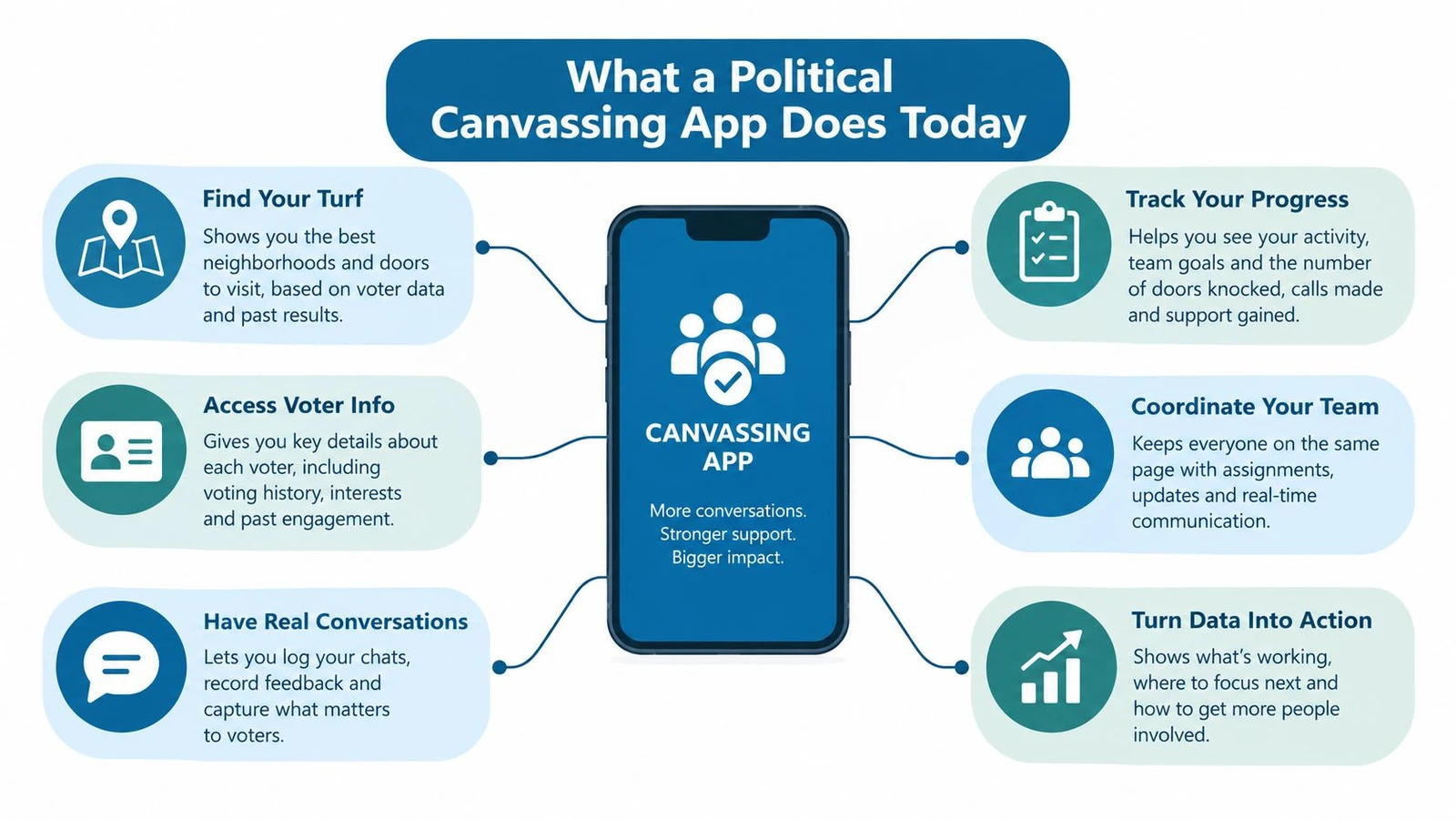
A modern political canvassing app does more than replace clipboards. It sits between the voter list, the turf plan, the volunteer’s phone, and the reporting loop back to headquarters.
The old model was linear. Staff exported lists, cut turfs manually, printed packets, sent people out, then spent the night re-entering data and correcting handwriting. The modern model is cyclical. Staff prepare data, assign routes digitally, collect responses in the field, sync them back, and adjust the next shift with fresher information.
The baseline capabilities that matter
A usable field platform now tends to combine several functions in one workflow:
- Mobile walk lists: Volunteers need a clear sequence of doors, not just a map with pins.
- Interaction logging: Survey answers, notes, and contact outcomes need to be captured at the door.
- Route management: Organizers need a way to assign and monitor coverage without building everything by hand.
- Offline capture and later sync: The app should keep working when coverage drops.
- Reporting back to staff: The field team needs near-current visibility into what’s complete, what’s lagging, and what needs reassignment.
Those aren’t luxury features. They’re the baseline for a field operation that wants cleaner data and less administrative drag.
Why this has become standard field infrastructure
The most useful insight from the broader adoption trend is that campaigns aren’t treating these apps as side tools anymore. They’re using them as a standard operational layer. That shift changes how buyers should evaluate software. The right comparison isn’t “digital versus paper.” It’s “basic mobile logging versus integrated field operations.”
An app earns its place when it handles the parts of canvassing that routinely break under pressure:
Good field software doesn’t just record contacts. It preserves momentum between assignment, conversation, and follow-up.
That’s also where many buyers overcorrect. Once a platform adds route generation, dashboards, map tools, exports, permissions, and list workflows, every feature starts to sound essential. In practice, only some of those capabilities improve real field performance for a given campaign. The rest may only increase setup time, training load, and failure points.
So the current definition of a political canvassing app is broader than a mobile door-knocking tool. It’s a field operations system. But the useful question isn’t how many boxes it checks. It’s whether those boxes solve the frictions this campaign faces.
How to Compare Political Canvassing Apps on Five Criteria
Most campaigns don’t need a longer feature list. They need a clearer way to test what changes the pace and quality of field work.
The table below works as a practical screen. It keeps the evaluation tied to operational outcomes instead of product language.
| Evaluation Criterion | What to Test | Why It Matters for Field Efficiency |
|---|---|---|
| Routing quality | Build sample turfs from a real precinct mix and inspect walkability, route balance, and boundary logic | Poor routing wastes volunteer energy before a conversation even starts |
| Offline reliability | Enter notes, survey responses, and status updates with no signal, then verify sync later | Field programs break when the app assumes continuous connectivity |
| Analytics and reporting | Monitor live or near-current route completion, contact outcomes, and team activity during a test shift | Staff can only reassign walkers quickly if visibility exists during the canvass |
| Integrations and data workflow | Import lists, match records, configure surveys, and export outcomes without manual patchwork | Every extra handoff creates delay and increases data errors |
| Pricing and scalability | Check what changes as users, campaigns, records, and support needs grow | Some campaigns need simplicity now and room to scale later |
Routing quality
Campaign staff should test routing with the ugliest part of the map, not the easiest. That means split precincts, cul-de-sacs, apartment clusters, rivers, rail lines, and roads that look connected on a static map but aren’t practical on foot.
A route generator is useful when it reduces hand-editing and produces balanced effort. It becomes a liability when staff still have to recut every turf manually.
Offline reliability
This is the criterion that polite demos tend to hide.
One field-management guide argued that political canvassing apps should support fully local capture of voter profiles, notes, and survey responses, then synchronize later, because a substantial share of canvassing happens in low-connectivity areas. That same analysis cited an estimate that 38% of canvassing happens where cellular service is unreliable and recommended testing realistic load sizes, such as 500 voter profiles rather than 50, to confirm that access, recording, navigation, and sync work end to end, according to the field software guide on offline canvassing reliability.
Practical rule: If the app hasn’t been tested offline with a real voter list size, the campaign doesn’t yet know whether it works in the field.
Analytics and reporting
Campaigns should ask a simple question. Can the field director tell, during the shift, which routes are moving and which ones are stalling?
Delayed reporting is often acceptable for very small volunteer programs. It becomes expensive once multiple launch sites, layered universes, or same-day reassignments enter the picture.
Integrations and data workflow
A platform should fit the campaign’s list and reporting flow with minimal manual repair. If staff members are repeatedly exporting, reformatting, checking IDs, and reconciling mismatches, the software is shifting work rather than removing it.
Pricing and scalability
A small local race may only need a lightweight setup for a short cycle. A larger coordinated effort may need broader permissions, more campaigns, stronger support, and custom data pipelines. Pricing should be assessed against expected operational complexity, not against a hypothetical future program.
Detailed Comparison of Routing Offline Analytics and Integrations
The primary divide in this market isn’t old versus new. It’s field efficiency versus field complexity.
Some campaigns gain a lot from integrated routing, live monitoring, and tighter data flow. Others end up carrying a heavier setup burden for features that won’t materially improve their contact program. The key is knowing where each capability changes output at the door.
Routing only matters if it fixes uneven effort
Manual turf cutting still gives staff control, especially in districts with unusual local knowledge, but it consumes organizer time and often produces inconsistent route sizes. Integrated routing is useful when it does three things well: respects roads and barriers, balances walking effort, and produces assignments quickly enough to matter on a live campaign schedule.
Polygon-based geography tools help when the campaign needs custom coverage areas, not just standard administrative boundaries. That’s valuable for targeted persuasion zones, newly developing neighborhoods, or constituent programs that don’t map cleanly onto election units.
What doesn’t help is decorative routing. If staff still need to redraw boundaries after every batch, or if volunteers keep reporting that “short” turfs took the whole shift, the feature exists on paper but not in operations.
Better routing doesn’t impress a field director because it looks sophisticated. It matters because it reduces variance between volunteers and makes shift planning more predictable.
Offline-first is a requirement in the wrong district and a nice-to-have in the right one
A lot of app comparisons underrate this because office testing happens on strong Wi-Fi. The field doesn’t.
An offline-first design changes the day in two ways. First, volunteers keep moving instead of improvising around signal loss. Second, data returns in one clean stream later, instead of being reconstructed from screenshots, paper notes, and memory. In low-connectivity precincts, that’s not a convenience. It’s the difference between a completed shift and a corrupted one.
Campaigns working mostly in dense, well-covered neighborhoods might tolerate a simpler setup. Campaigns working mixed geography usually can’t. That’s one reason the all-in-one category is drawing attention. Recent industry coverage points to a shift from simple door-knocking apps toward broader field systems with live monitoring, route optimization, and tighter data workflows. The same coverage notes a major canvassing organization replacing a long-standing standard app with a newer all-in-one solution ahead of the 2026 midterms, while current product pages across the category emphasize live tracking, offline collection, and integrated voter databases. It also highlights the unresolved buyer question: which of these additions improve field outcomes versus adding complexity. That matters in a market projected to grow from about US$458 million in 2025 to US$883 million by 2034, according to the industry coverage on new canvassing technology and market growth.
Analytics are only valuable when staff can act on them
A live dashboard sounds impressive, but its value depends on staffing behavior.
If the campaign has organizers who actively monitor route completion and can redirect volunteers mid-shift, live analytics can improve coverage discipline. If the campaign runs one launch, a small team, and a short shift, delayed reporting may be enough. The feature isn’t good or bad. It’s only useful if someone will use it to make decisions during field hours. Teams weighing that trade-off can look at why live canvassing data matters in active field operations.
Integrations should eliminate repair work
The strongest data workflow is the one staff barely notices. Lists enter cleanly. Surveys map correctly. Responses return to the campaign’s system without repeated human intervention.
One practical example is doornoc, which combines mobile canvassing, route planning, offline data collection, real-time tracking, list upload, and integration with MailVotes for voter data handoff. For campaigns deciding between a simple mobile logger and a broader field workflow, that kind of integrated setup is most useful when staff are currently losing time to manual turf cutting, fragmented list imports, and same-day reporting gaps.
Implementation From List Upload to Live Canvassing
A campaign can buy the right app and still have a bad launch. Most failures happen in setup, not in procurement.
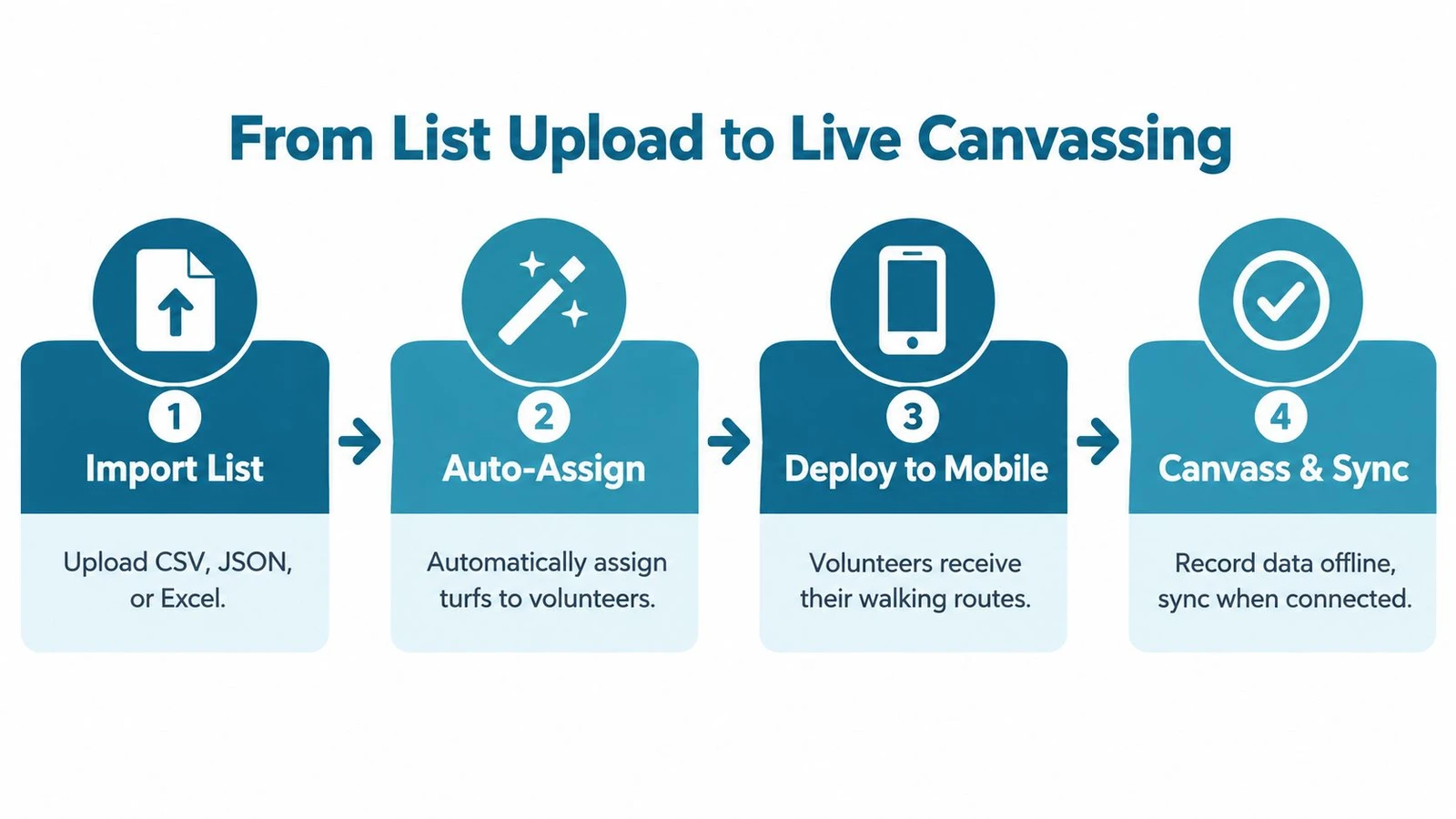
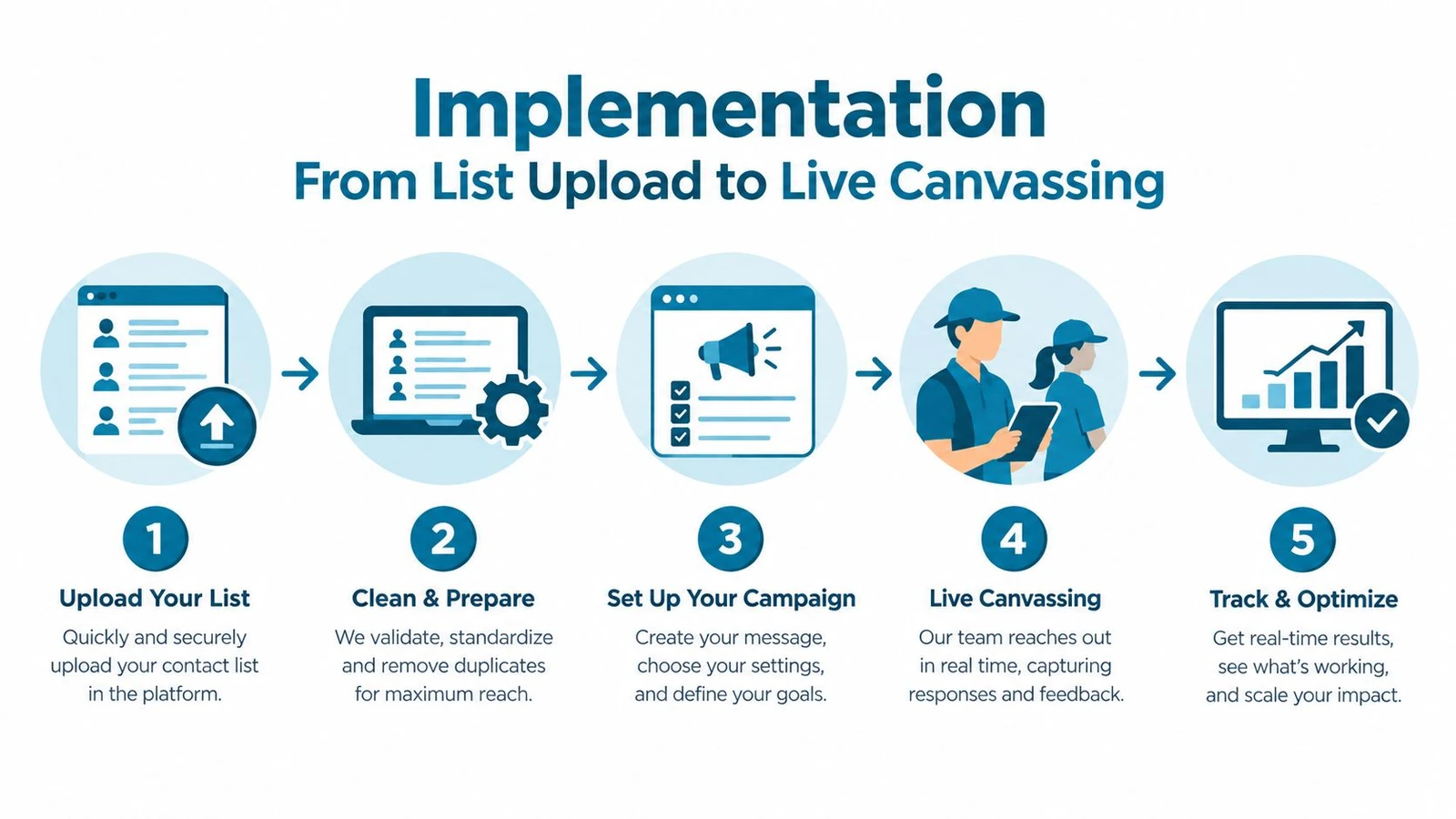
The smooth implementation path starts with a disciplined handoff from list to route to mobile device. It doesn’t start with volunteer training slides or a dashboard screenshot. If the input data is messy, the assignment logic is unclear, or offline behavior hasn’t been tested, the rest of the rollout will inherit those flaws.
Step one begins with list hygiene
Import the universe in the format the platform supports, then verify matching, address quality, and map placement before a single volunteer is invited. A campaign using uploaded files should confirm that records align cleanly and that the geography reflects where canvassers will walk. Teams using direct handoff from a voter data source should verify that fewer manual steps are being created, not just hidden.
A practical starting point is a controlled upload through doornoc’s voter file upload workflow, then a test run on one real turf before scaling the full program.
Build the field layer before the training layer
Once the list is stable, staff should configure surveys, route logic, permissions, and assignment rules. Many teams rush here. They focus on the volunteer-facing app and skip the organizer-facing structure that determines whether the shift is manageable.
A reliable implementation usually includes:
- Survey design that matches the script: Volunteers shouldn’t have to translate a conversation into a confusing form.
- Turf generation that reflects shift reality: Routes should be sized for actual walking conditions, not idealized map density.
- Role setup for staff and volunteers: Everyone should see what they need, and no more.
- A pilot assignment: One precinct is enough to expose whether navigation, note capture, and sync hold together.
Test under field conditions, not office conditions
This is the step campaigns underinvest in. They test with strong signal, tiny sample data, and experienced staff. Then the first volunteer launch becomes the beta.
A better approach is to test with realistic list loads, weak connectivity, and mixed user skill. Staff should verify that access, recording, navigation, and synchronization all work from start to finish. They should also test what happens when a user pauses mid-route, reopens the app later, and tries to continue without service.
Launch readiness isn’t “the app opened on a phone.” Launch readiness is “the data survived a messy shift and came back usable.”
Treat live monitoring as an operational tool
Once volunteers are out, staff should use the reporting layer to reallocate people while the shift is still underway. If one route is finished early and another is lagging, the system should make that visible quickly enough for reassignment to matter. That’s where implementation turns into field control.
Use Cases by Campaign Size and Team Type
The same political canvassing app can feel oversized for one campaign and underspecified for another. Fit depends less on ideology or ballot level than on team structure, data habits, and field geography.
Local races with lean staff
A city council or school board campaign often has one staff lead, a candidate who canvasses personally, and volunteers who join in bursts. This team usually benefits from a simpler setup with fast onboarding, clean mobile walk lists, and straightforward survey capture.
The risk here is overbuying. A configurable field stack can become another thing the campaign has to manage. If staff don’t have time to monitor live operations or maintain custom data flows, simplicity often produces better execution.
Mid-scale campaigns running repeat shifts
A larger local or legislative campaign usually starts to feel the pain of manual route planning. The team may have multiple launch points, recurring volunteer nights, and a universe large enough that delayed cleanup becomes a staffing problem.
Integrated routing and real-time visibility begin to pay off. Balanced turfs reduce the number of “that route was impossible” complaints. A live reporting view helps staff move extra walkers before the canvass ends. Offline capture becomes more important as the map widens into mixed-density precincts.
Data-heavy operations
Some campaigns have staff who care as much about the return flow of information as the act of knocking itself. They need structured imports, dependable exports, integration hooks, and the ability to join canvass results back into broader reporting.
For these teams, the mobile experience still matters, but the bigger issue is workflow continuity. If the app captures solid data at the door but forces manual reconciliation later, it hasn’t solved the operational problem.
The right tool for an analytics-oriented team is the one that preserves data integrity without creating a separate mini-operation just to manage the app.
Advocacy and constituent contact programs
Not every field program is a voter persuasion or turnout effort. Some teams are contacting constituents, gathering issue responses, or running neighborhood outreach that doesn’t fit a classic election universe.
These teams often need flexible geography, customizable scripts, and a way to capture conversations outside a standard voter-contact frame. That can make features like polygon-based routing or constituent-focused intelligence more relevant than election-specific reporting habits.
Volunteer-led grassroots programs
A volunteer-heavy operation needs a forgiving user experience. If new canvassers can’t understand the route, can’t log a result quickly, or can’t recover when signal drops, the program will shed capacity at the field edge. In those environments, reliability often matters more than sophistication.
Recommendation Choosing the Right Political Canvassing App for Your Campaign
The best buying decision is usually narrower than the product demo suggests.
A campaign should choose the least complex system that still solves its real field constraints. If the operation is small, geography is straightforward, and staff don’t need active shift monitoring, a simpler mobile canvassing setup is often enough. The campaign mainly needs dependable walk lists, clean data capture, and an easy return path for results.
If the campaign is running repeated shifts across uneven terrain, managing multiple teams, or struggling with turf balance and reporting lag, it should lean toward a broader field operations system. In that environment, integrated routing, offline-first sync, and live visibility aren’t decorative features. They reduce staff intervention during the day and reduce cleanup at night.
A practical selection path
- Starter-level need: Choose a lightweight system when the team is small, the universe is manageable, and rapid onboarding matters more than deep workflow control.
- Pro-level need: Choose stronger routing and reporting when volunteer volume is growing and uneven turfs are slowing shifts down.
- Campaign or enterprise need: Choose broader integration and scaling options when the field program connects to larger data pipelines, multiple users, and repeated launch cycles.
- Data-cost sensitivity: Consider per-record voter data pricing when the campaign wants to avoid carrying a subscription structure that exceeds actual list usage.
The most durable decision also accounts for governance, not just features.
Privacy and data handling should be treated as operating requirements, not legal afterthoughts.
Nonpartisan support matters for campaigns and organizations that don’t fit neatly into one shared ecosystem or standard workflow.
Before purchase, staff should run one final validation list:
- Use a real district slice: Test the hardest geography, not the easiest.
- Force an offline scenario: Confirm that notes and survey responses persist without signal.
- Check the organizer workflow: Make sure assignment, monitoring, and export don’t require workaround labor.
- Match the platform to actual staffing: A feature only has value if someone on the team will use it during field hours.
- Review the scaling path: Confirm what changes when users, campaigns, support needs, or data volume increase.
A political canvassing app should make the field plan easier to execute than it was on paper. If it doesn’t do that, the campaign isn’t buying efficiency. It’s buying a new kind of friction.
doornoc offers a political canvassing platform built around the operational issues this article focused on: route planning, offline-first mobile canvassing, live field visibility, and voter data workflows. Campaigns that want to test whether an integrated setup fits their field program can review the product and workflow options at doornoc.
Looking for a tool to run this? doornoc’s canvassing software bundles voter data, automatic turf cutting, the mobile app, and live reporting in one platform.