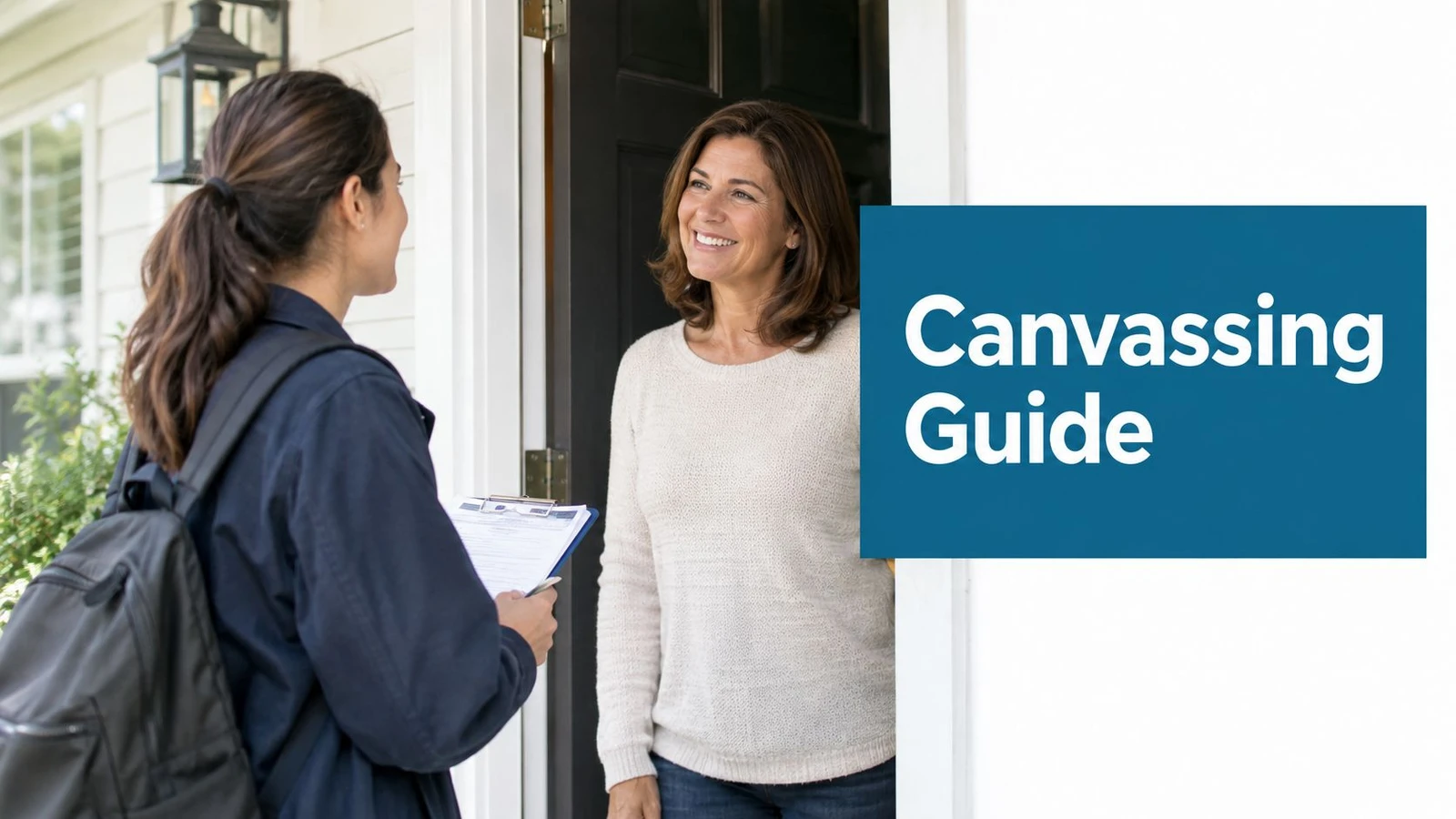
A campaign manager stands in a parking lot on a Saturday morning with clipboards, water, snacks, and a group of volunteers who are ready to help. The mood is good. The walk packets look neat. The script sounds solid when read out loud.
Then the hard part starts.
One route has apartment buildings nobody can enter. Another sends volunteers across busy roads for only a few houses at a time. Some voters are home and willing to talk. Many aren’t. By the end of the shift, the team may have knocked plenty of doors and still feel unsure whether the effort really moved votes.
That’s the reality of door to door canvassing today. It still matters because face-to-face contact gives campaigns something digital outreach often can’t. It creates a short, human moment where a voter can ask a question, signal support, raise a concern, or make a plan. But strong canvassing isn’t just about having a good script or enough volunteers. It’s about whether a campaign can turn volunteer time into actual conversations.
That’s the piece many new organizers miss. They think the main question is, “What should canvassers say?” A field director usually has to ask a different question first: “How many real voter contacts can this team create per shift, in this neighborhood, under these conditions?”
For a school board race, that might mean targeting high-density blocks where volunteers can move quickly. For a congressional campaign, it may mean dividing a large turf carefully so experienced canvassers handle harder areas and newer volunteers get straightforward routes. In both cases, success isn’t the stack of walk sheets at launch. Success is clean contact data, useful follow-up, and a field plan that respects time.
Introduction to Door to Door Canvassing Today
A weekend canvass often looks simple from the outside. Volunteers gather, receive a short training, and head out to knock doors. On paper, it seems like a straightforward exercise in effort. More doors should mean more impact.
In practice, campaigns learn fast that door to door canvassing is a contact operation, not just a walking operation.
A volunteer can work hard all afternoon and still lose time to bad route design, inaccessible buildings, duplicate records, or long stretches between houses. Another volunteer with a tighter route and better targeting may have fewer total knocks but far more useful conversations. That’s why field teams have to think beyond activity and focus on efficiency.
Who Canvassing Helps
Door to door canvassing serves different goals depending on the campaign stage and ballot level.
- Local candidates: A city council or school board campaign often uses doors to build name recognition and learn which neighborhood issues come up repeatedly.
- Larger field programs: Statewide or congressional teams often use doors to identify supporters early, then return later with turnout messages.
- Volunteer coordinators: Canvassing shifts also help campaigns recruit. A voter who has a positive conversation at the door may later become a donor, host, or volunteer.
The common thread is simple. A person at the door can respond in real time. That makes the interaction more useful than one-way communication.
What Success Looks Like
Many first-time organizers judge a canvass by one number alone: doors knocked. That’s understandable, but incomplete.
A better scorecard includes questions like these:
| What to watch | Why it matters |
|---|---|
| Contact quality | A brief but real conversation is more valuable than a rushed script drop. |
| Route density | Denser turf reduces wasted walking and helps volunteers sustain momentum. |
| Accurate logging | Clean records decide who gets a follow-up and who gets removed from later passes. |
| Volunteer confidence | A first shift that feels organized makes return participation more likely. |
Good field programs don’t confuse motion with progress. They organize for contact, learning, and follow-up.
When campaigns treat canvassing as a system instead of a single event, decisions get sharper. Scripts improve. Turf improves. Training improves. Most of all, expectations become realistic.
What Door to Door Canvassing Really Means
Door to door canvassing is structured face-to-face outreach at a person’s home. A campaign sends trained people to specific households, asks a short set of questions or delivers a focused message, then records what happened for later action.
That sounds basic. The deeper meaning is what matters.
A billboard talks at everyone the same way. A doorstep conversation works more like a neighborly exchange. The canvasser can listen, adjust, answer, and ask for one clear next step. That difference is why campaigns keep returning to the door even when they already have email, text, and mail programs.
The Three Main Jobs at the Door
Not every canvass has the same purpose. New organizers often blend everything together and end up with cluttered conversations.
A cleaner way to think about it is to separate the work into three jobs:
-
Identification The campaign is trying to learn something. Is this voter supportive, undecided, opposed, moved, or unreachable? Identification canvassing improves targeting for later outreach.
-
Persuasion The campaign is trying to shift a voter’s view or strengthen a weak preference. This takes listening, not just reciting lines.
-
Get out the vote The campaign is trying to turn existing support into actual turnout. That usually means making voting feel more immediate, personal, and concrete.
A volunteer who understands which of those jobs applies at a given door will sound calmer and more natural. A volunteer who tries to do all three at once often sounds mechanical.
Practical rule: One door should have one primary objective. If the campaign wants everything from every conversation, the canvasser usually gets less.
Why Face-to-Face Contact Feels Different
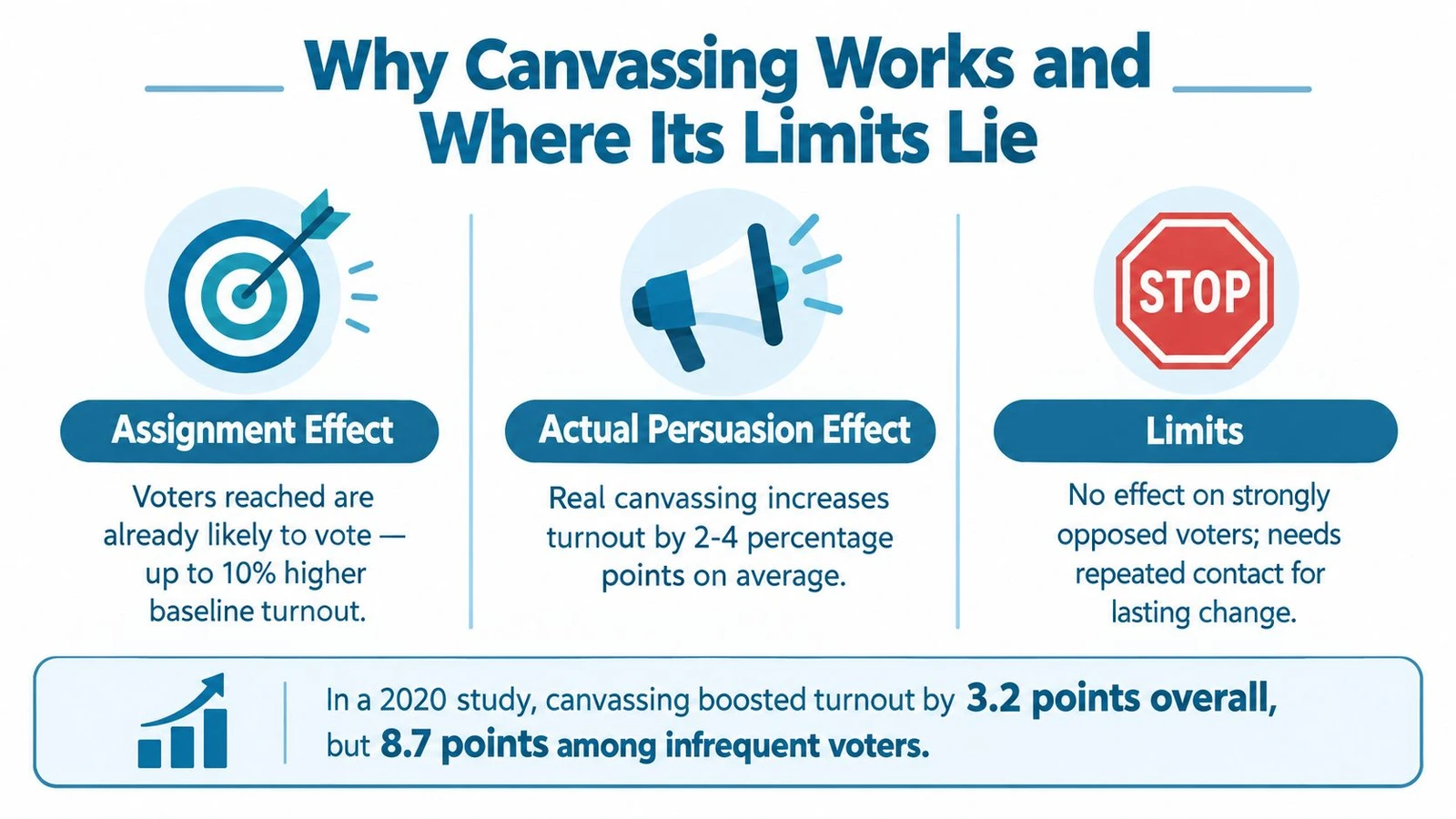
Researchers have found that door-to-door canvassing has some of the largest causal effects among voter-contact methods, with randomized field experiments and meta-analyses reporting turnout increases of roughly 5 to 10 percentage points per successful contact. Classic studies found about a 6-point lift, and others reported 7 to 10 points in treatment-on-the-treated estimates. The same body of research points to the mechanism: direct social pressure plus personalization in a live interaction, which helps explain why the effect is larger than mail or noninteractive outreach in many settings, as described in the national field experiments on voter turnout.
That finding can be translated into plain language. People respond when another person takes the time to show up, make eye contact, and ask for action directly.
What Gets Logged and Why
The doorstep conversation isn’t finished when the voter closes the door. It’s finished when the canvasser records the outcome accurately.
A strong record usually captures:
- Whether contact happened
- How the voter responded
- What issue or concern came up
- Whether follow-up is needed
Without that step, canvassing turns into stories. With it, canvassing becomes an operating system for the campaign.
Why Canvassing Works and Where Its Limits Lie
A field team can knock 1,000 doors and still underperform a smaller team that knocks 400. The difference is usually not passion or even script quality. It is contact efficiency.
One landmark New Haven field experiment makes that point clearly. Turnout was 44.6% in the control group, 46.9% in the canvassed treatment group, and 59.2% among those contacted. The same study reported a 31.7% contact rate, which is why organizers need to separate a voter who was assigned to a canvass list from a voter who opened the door and had a conversation, as shown in the New Haven turnout experiment.
That is the math new organizers need to learn early. A good message only has a chance to work after contact happens.
Assignment Is Only the First Step
A canvass universe is a map of possible conversations, not actual conversations.
A campaign pulls a list. Volunteers walk the route. Some homes are empty. Some buildings are hard to enter. Some voters answer but do not want to talk. A smaller group has a real exchange. Each step trims the final result, like a funnel that narrows at every stage.
That is why field directors watch more than doors knocked. They care about doors knocked per hour, contact rate, and whether those contacts happen in the right universe. If those numbers are weak, the campaign may have a turf problem before it has a persuasion problem.
Contact Rate Changes the Value of Every Hour
Canvassing works best when organizers treat it like resource allocation, not just message delivery.
Research from Europe and the United Kingdom shows how much practical constraints shape results. One UK get-out-the-vote experiment reported a 28% successful contact rate, while a European meta-study found contact rates of 24%, 35.9%, and 45.5% in different settings, alongside an intention-to-treat turnout effect of 3.6 percentage points for non-partisan canvassing, according to the European canvassing meta-study.
For a manager, that means this: one extra point of contact rate can matter as much as a better script, and sometimes more. A compact route with many answerers can produce more turnout impact than a polished message delivered across scattered, low-contact turf.
Marginal return becomes practical. Early canvass shifts often hit the easiest, densest doors first. Later shifts may require longer walks, more unanswered doors, or harder access. At some point, each additional volunteer hour buys less real contact. Strong programs notice that point and adjust, instead of assuming every added knock has the same value.
Where Canvassing Reaches Its Limits
Door knocking is powerful, but it is not magic. It performs differently depending on the setting.
- Geography changes efficiency: Dense, walkable neighborhoods usually produce more conversations per hour than spread-out areas with long gaps between homes.
- Access changes reach: Apartments, gated complexes, and controlled-entry buildings can sharply reduce actual voter contact.
- Voting mode changes response: Research noted earlier on canvassing paired with follow-up texting suggests in-person visits and leaflets may help more with in-person voters than with households that vote by mail.
- Country and electoral context change results: The European evidence above is a useful reminder that findings from one system do not transfer neatly into another.
The practical lesson is simple. The question is not whether canvassing can work. The question is whether this campaign can create enough useful contact, in the right places, at a cost that still makes sense.
Teams that understand that limit make better choices. They build tighter routes, target doors with higher expected contact, and stop judging field success by activity alone.
How a High Quality Canvassing Program Runs
A quality canvassing program feels smooth to volunteers because somebody behind the scenes made dozens of careful decisions. Good field work is built before the first knock.
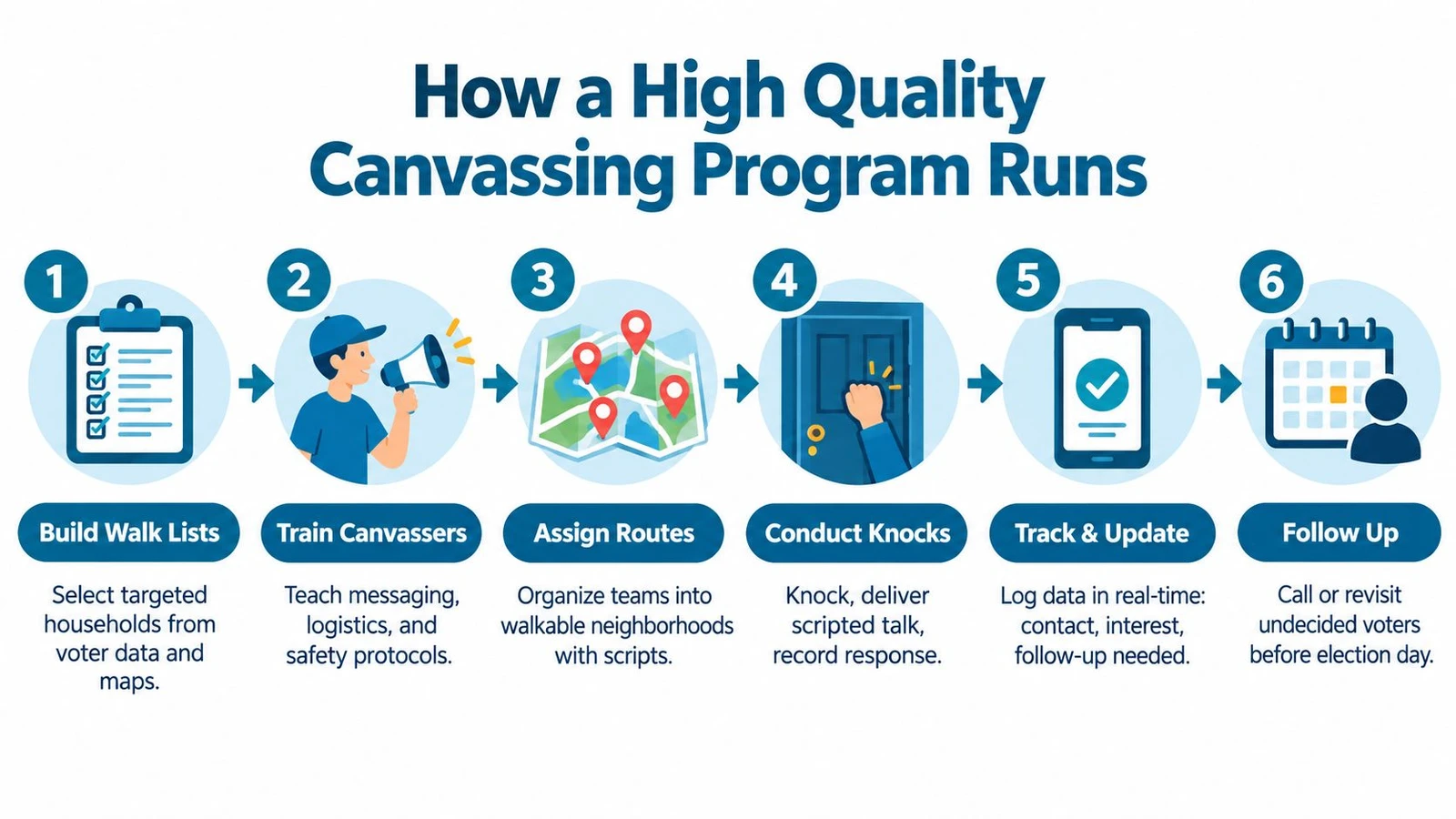
The workflow starts with turf. If the turf is sloppy, everything downstream suffers. Volunteers get tired faster, skip hard-to-find doors, and return with weaker data.
Start With Walkable Turf
Operational guidance drawn from campaign field practice estimates that an experienced volunteer can knock about 20 doors per hour, and that roughly one committed voter may be generated per 14 doors knocked, according to the canvassing operations benchmark summary. Those figures aren’t a promise for every campaign. They are a reminder that route density and wasted travel time shape what each volunteer hour can produce.
That’s why strong turf usually follows a few simple rules:
- Keep routes compact: Volunteers should spend more time at doors than crossing roads or hunting addresses.
- Balance effort: A route for a first-timer should not look the same as a route for a veteran canvasser.
- Respect natural boundaries: Roads, rail lines, rivers, and large barriers change how long a “short” route really takes.
Train for the Door, Not Just the Script
A volunteer briefing should prepare people for the moment a real person opens the door.
Useful prep often includes:
- A quick explanation of the goal for that shift.
- A short role-play with one friendly voter and one skeptical voter.
- Clear instructions for what to log after each interaction.
- A simple rule for ending a conversation politely when needed.
That kind of training lowers hesitation. People perform better when they know what success looks like in the first thirty seconds.
For teams that need help keeping volunteers organized and returning for future shifts, this guide on building and motivating a volunteer canvassing team is useful background reading.
Capture Data While the Memory Is Fresh
The best time to log a result is immediately after the interaction. Waiting until the end of the block invites mistakes.
A clean workflow usually looks like this:
| Stage | What the team does |
|---|---|
| Before launch | Builds the list, cuts routes, sets the survey, assigns shifts |
| At the door | Introduces the campaign, asks the key question, makes the ask |
| Right after | Logs result, notes stance, flags follow-up |
| Back at staging | Reviews turf quality, checks completion, updates next pass |
Short feedback loops matter. If multiple volunteers report bad apartment access or confusing route shapes, the field lead should fix that before the next shift, not after a week of repeated frustration.
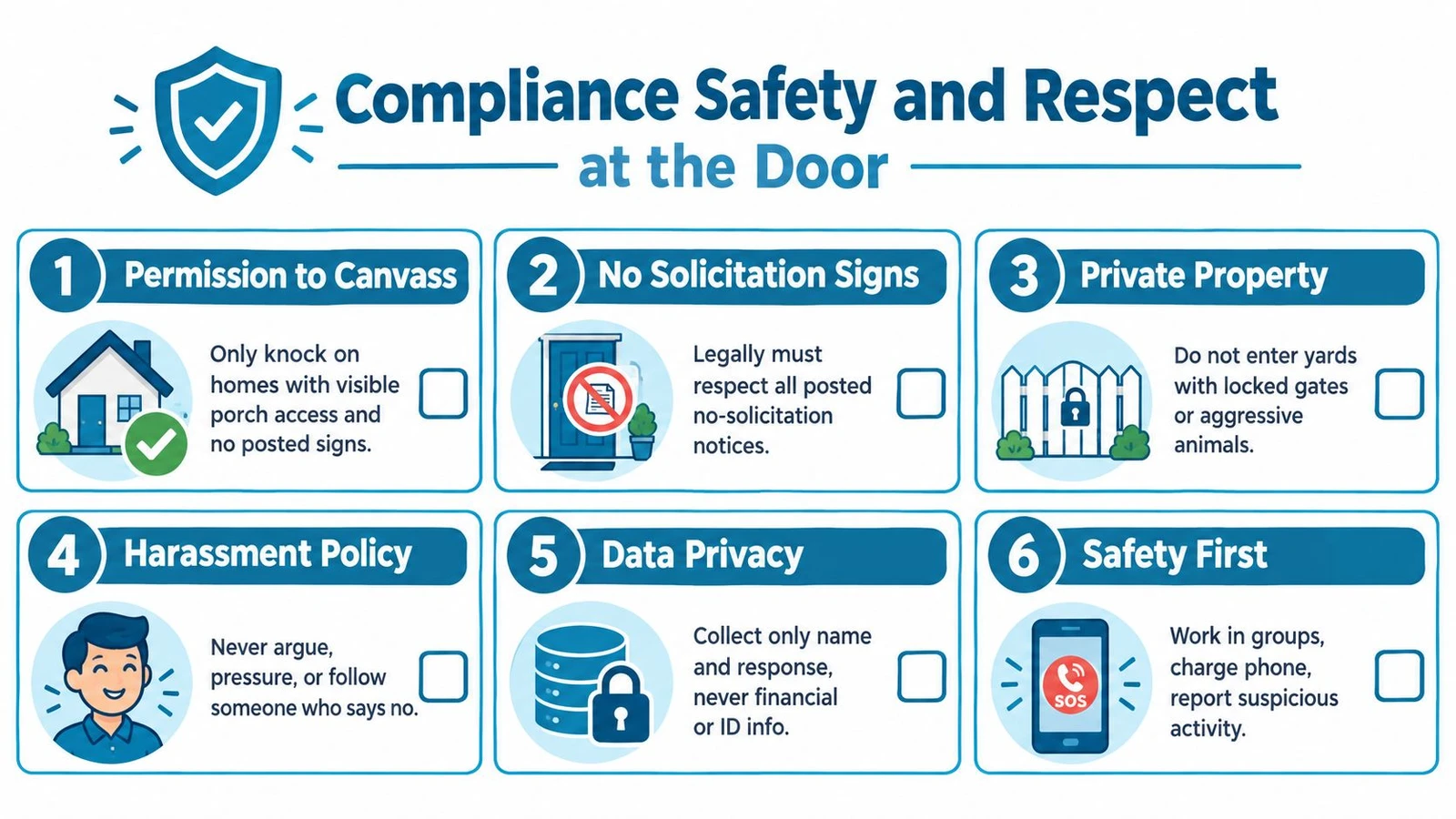
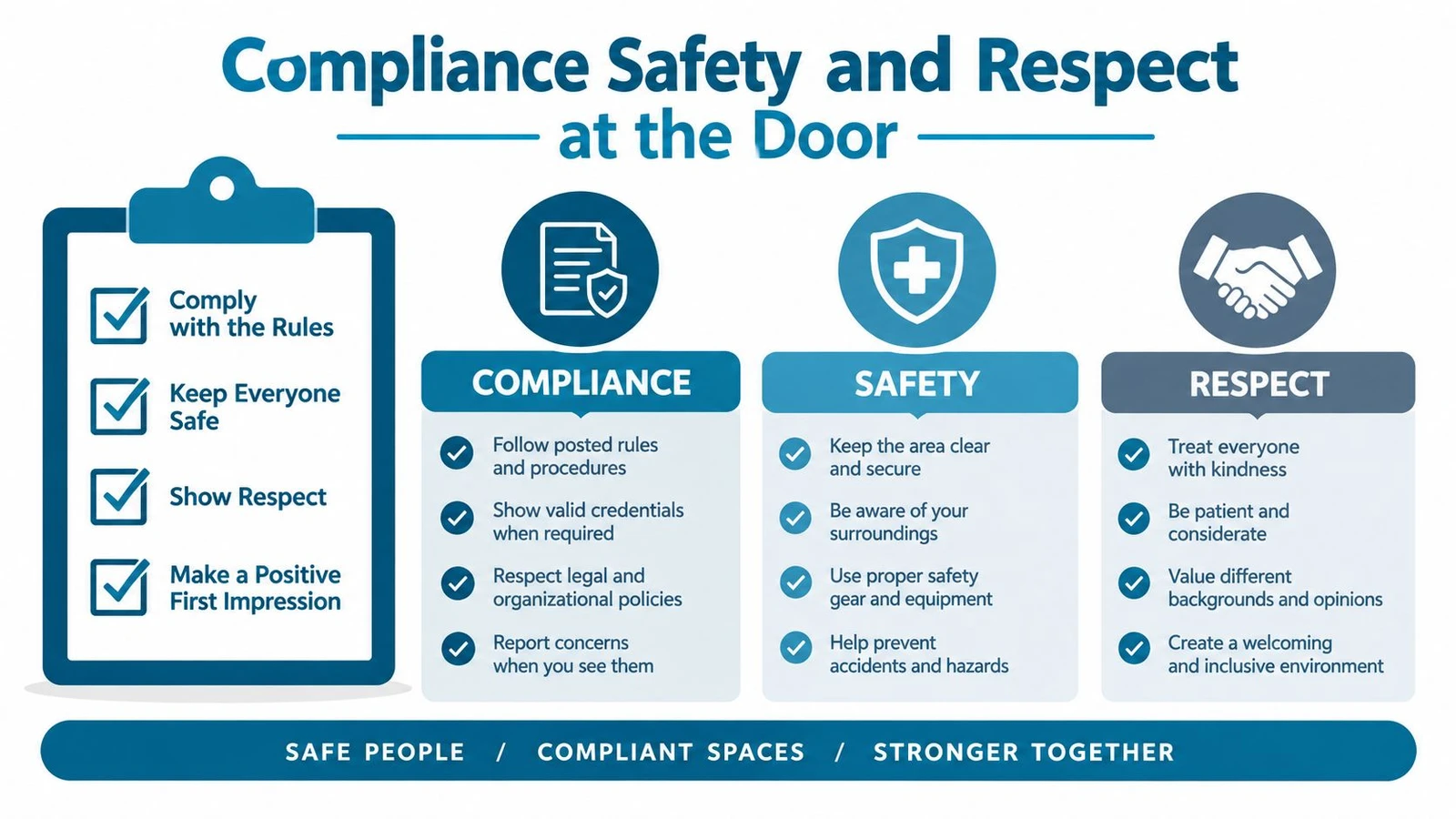
Compliance Safety and Respect at the Door
A canvassing program can be efficient and still be careless. That’s not a successful field program. The work has to be lawful, ethical, and respectful at the same time.
Residents notice the difference quickly. So do volunteers. A campaign that trains people to respect boundaries usually gets cleaner interactions and better morale.
Compliant Practice Versus Risky Practice
Some field decisions are easy to compare side by side.
| Safer practice | Risky practice |
|---|---|
| Skipping homes with clear warning signs or restricted access | Entering spaces that signal no entry or ignoring posted instructions |
| Leaving immediately when asked | Trying to salvage the conversation after a resident says no |
| Logging only campaign-relevant response data | Collecting personal information the campaign doesn’t need |
| Marking uncertain outcomes honestly | Guessing, inflating support, or cleaning data to look better |
The point isn’t bureaucracy. The point is trust. A resident who feels pressured may remember that longer than any campaign message.
What to Teach Volunteers
Volunteers don’t need a law school lecture. They need a few durable habits.
- Read the property cues: If access is blocked, locked, or clearly restricted, don’t push past it.
- Honor refusal immediately: A polite exit is the right exit.
- Protect privacy: Record only the information the campaign is trained to collect.
- Report concerns fast: If a location feels unsafe, the canvasser should leave and notify the field lead.
Respect at the door isn’t just manners. It’s operational discipline that protects voters, volunteers, and the campaign.
Apartments and Limited Access
Many teams get frustrated. Apartment universes can look efficient on a map and still produce poor real-world access.
When entry is limited, the campaign usually has choices. It can re-time the visit, assign experienced canvassers, use alternative contact methods for that segment, or deprioritize buildings with chronically low access. The key is to make that decision consciously rather than letting volunteers discover the problem one locked entrance at a time.
Accurate logging matters here too. If a building is inaccessible, the record should say that clearly. Otherwise the same bad door gets recycled into future turf and keeps wasting volunteer time.
How Canvassing Apps and Tools Support Field Teams
Field technology doesn’t replace the human conversation. It supports it. The goal is simple: fewer avoidable mistakes before the door, fewer lost records after the door, and better visibility during the shift.
That matters most when the team is moving fast. Paper can work, but paper makes it harder to rebalance routes, monitor progress, or clean up data problems in real time.
What Useful Field Tools Actually Solve
A solid canvassing setup should help with a few practical problems:
- Weak connectivity: Offline capture matters because canvassers often work in areas with poor service.
- Messy routing: Volunteers need clear walking paths, not just a pile of addresses.
- Data lag: Organizers need to know what’s happening while the shift is still underway.
- Bad handoffs: The list used for targeting should connect cleanly to the list used in the field.
A campaign that fixes those issues usually gets more consistent results from the same volunteer pool.
Features That Matter in the Real World
Some capabilities sound minor until a team runs a busy weekend launch.
For example, walking mode helps volunteers move through a route in the order that makes sense on the ground. Automatic sync helps preserve records when a phone reconnects later. Real-time dashboards help field leads spot incomplete routes or stalled teams before the day ends.
A platform such as doornoc combines a mobile door-knocking app with route planning, offline data capture, real-time tracking, and voter data handoff through MailVotes. For campaigns evaluating field software generally, this overview of essential offline canvassing app features for 2026 elections gives a practical checklist for what to look for.
Why Better Tools Change the Metric That Matters
The benefit of tools isn’t that they feel modern. It’s that they help campaigns protect contact efficiency.
When route generation is balanced, volunteers spend less time wandering. When the dashboard updates live, managers can move people to stronger turf. When interaction logging is simple, fewer records get lost or guessed at later.
That’s the shift worth noticing. The campaign stops treating canvassing as a blunt labor exercise and starts treating it as a managed contact system.
Putting Canvassing Into Practice and Measuring What Matters
Door to door canvassing is worth the investment when a campaign can answer three questions clearly. Who is being targeted? How likely is real contact? What result would justify the staff time and volunteer energy?
That framework keeps teams from chasing vanity metrics. A giant door count can feel productive and still produce little if the contact rate is weak, the turf is thin, or the universe isn’t right for a door program.
Better Metrics Than Doors Knocked
The most useful field managers look past raw activity and watch a tighter set of indicators.
- Contact rate: How often does an attempted door become a real conversation?
- Contacts per hour: Is the route design helping volunteers use time well?
- Conversion from contact to action: Are supporters being identified, persuaded, or moved toward turnout?
- Follow-up value: Did the data collected at the door improve the next step?
For teams building that reporting discipline, this guide on how to track canvassing data effectively with metrics that win lays out a practical measurement approach.
Marginal Return Matters
Many campaigns assume that adding more touches will always produce more turnout. The evidence suggests caution.
A 2026 randomized test of texting as a complement to canvassing found small differences overall. In the combined sample, turnout was 50.0% in the canvass-only control group versus 51.1%, 51.8%, and 50.3% across three text treatments, with the study noting the differences were small and not strong enough for firm statistical conclusions. The same source also discussed a 2024 large-scale canvassing study in which residents receiving up to 10 attempts voted at a rate 1.20 times that of residents receiving no knocks, which raises real questions about saturation and diminishing returns, as reported in the research on one text after the knock.
That’s a useful closing lesson for organizers. More effort isn’t automatically better effort. The campaign has to ask whether the next contact adds enough value to justify the cost.
A mature field program measures the next volunteer hour by expected contact value, not by how busy the staging location looks.
The strongest teams learn this early. They improve turf before adding shifts. They clean data before expanding the universe. They review contact patterns the same day, not weeks later. That’s how canvassing moves from tradition to disciplined execution.
Campaigns that want cleaner turf, offline-ready door knocking, live progress tracking, and smoother voter data handoffs can use doornoc to support the field work described here. It’s built for teams that need route planning, mobile canvassing, and campaign operations tools in one place, whether they’re running a local race or a larger field program.
Looking for a tool to run this? doornoc’s canvassing software bundles voter data, automatic turf cutting, the mobile app, and live reporting in one platform.