
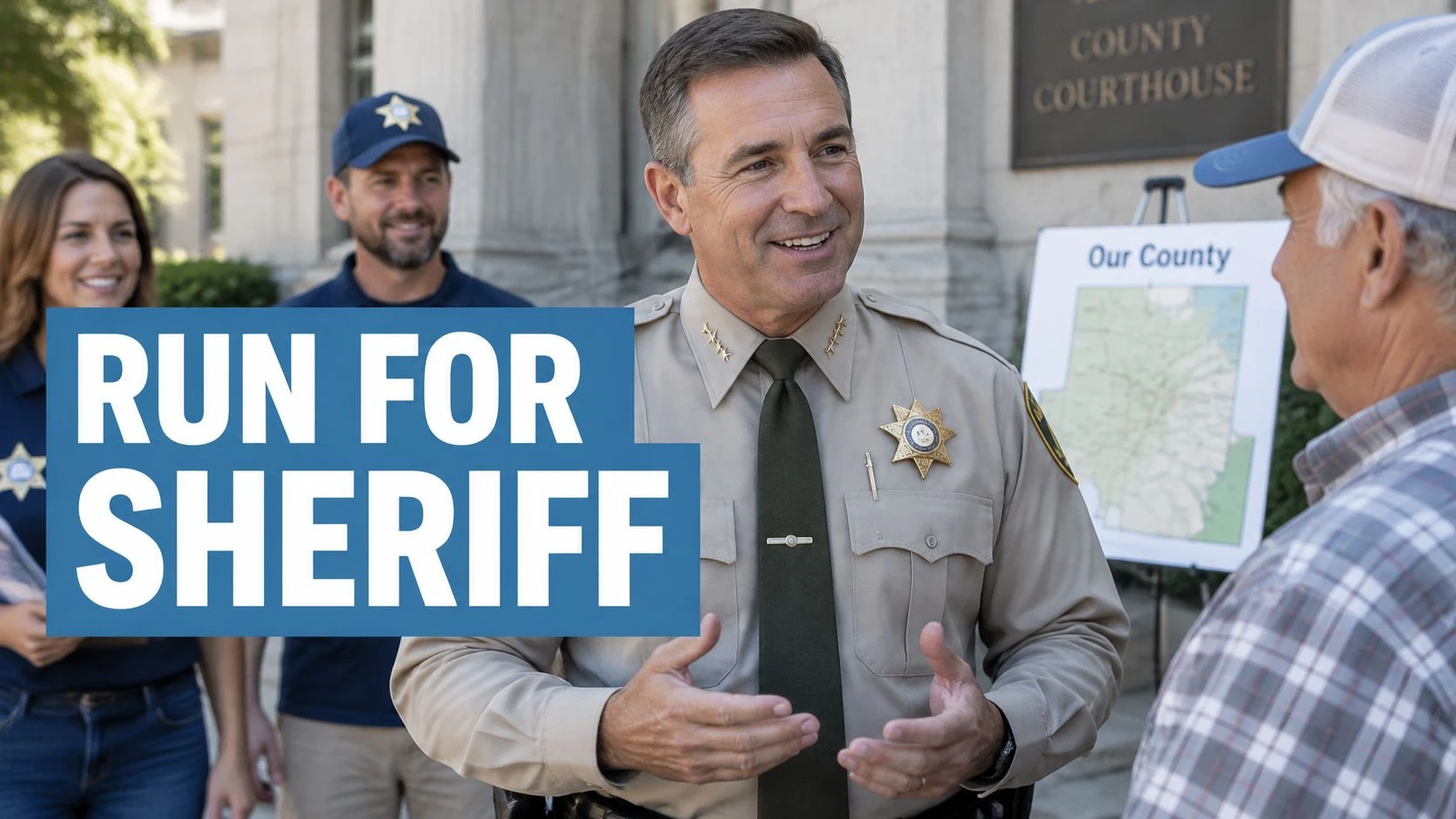
Most popular advice on running for sheriff starts with message, logo and launch event. That’s backwards. A sheriff campaign can end before a voter hears a word if the candidate can’t prove eligibility, can’t file on time or promises fixes the office doesn’t control. Compliance planning comes first, then the vote math, then persuasion.
That order matters because the sheriff isn’t an appointed police chief with a tidy job description. It’s an elected county office covering patrol, detention, courts and civil process, and its scale changes sharply by county. Candidates who sort the legal gates and the operational limits early can spend money with purpose. Candidates who don’t often build a polished campaign around a candidacy that was never secure.
Who Can Run for Sheriff and What Each State Requires
A law-enforcement résumé does not establish eligibility. State law may require a particular license, education level, service history, residency period or combination of qualifications, and county population can affect the rules. Check the requirements before treating a sheriff campaign as viable.
Texas illustrates how specific the test can be: the Texas Secretary of State qualifications guide lists a high-school diploma or equivalent plus an active permanent peace-officer license, or specified federal-investigator or military credentials. California and Oklahoma also set detailed education and experience requirements. The exact combination matters, so match each qualification to documents you can provide.
Eligibility Requirements Differ by State
Sheriff eligibility requirements by state
| State or county | Core requirements | Watch-out |
|---|---|---|
| Texas | High-school diploma or equivalent plus an active permanent peace-officer license, or specified federal-investigator or military credentials | Certification must be active, not just past employment |
| Oklahoma | County residency, voter registration, high-school education and four years of full-time certified peace-officer service | Proof of qualification is presented when the declaration is filed |
| California | Several education-and-experience combinations, from an advanced peace-officer certificate to four years of experience plus a high-school diploma | Choose the combination that can be fully documented |
| Nevada (counties of 30,000 or more) | Five consecutive years of qualifying peace or law-enforcement service, plus age, elector, residency and certification rules | Experience must be continuous and qualifying |
| Washington | U.S. citizenship and at least 25 years old | Confirm any added certification or experience rules before filing |
County size can change the eligibility test. Under the Nevada sheriff statute, candidates in counties with populations of 30,000 or more must meet a five-consecutive-year qualifying service requirement, along with age, elector, residency and certification requirements. Apply the rule for the county where you plan to run, not a neighboring county.
Treat every qualification as a document requirement. A lapsed license, non-qualifying job title or education credential that does not match the statutory combination can block a filing, even when a candidate has substantial law-enforcement experience.
The Trap That Catches Experienced Candidates
Experience can look persuasive on a résumé and still fail the legal test. States may specify active certification, recent service, rank, certificate level or a defined pairing of education and experience. Corrections, federal, military and private-security work may qualify under one rule but not another. Where a waiver is available, expect to document the basis for it.
Before making eligibility a campaign assumption, work through the records:
- Read the statute and current candidate materials. Check the rules that apply to the election cycle and county.
- List each requirement separately. Include residency, registration, education, certification and qualifying service.
- Match proof to each requirement. Identify the certificate, diploma or service record that supports each claim.
- Mark unresolved gaps. Separate items that can be addressed before filing from those that may prevent qualification.
- Ask the filing authority for clarification. Get an answer before building the campaign around an uncertain interpretation.
A candidate’s credible promises depend partly on understanding the office and the legal path to hold it. Resolve eligibility questions before public commitments make a setback harder to manage.
How to File Your Candidacy Step by Step
Filing isn’t a single form handed over on the last day. It’s a sequence of deadlines, proofs and registrations, and the earliest deadline is often the one that decides whether the campaign exists. A candidate who treats the general-election date as the main calendar anchor is already planning from the wrong end.
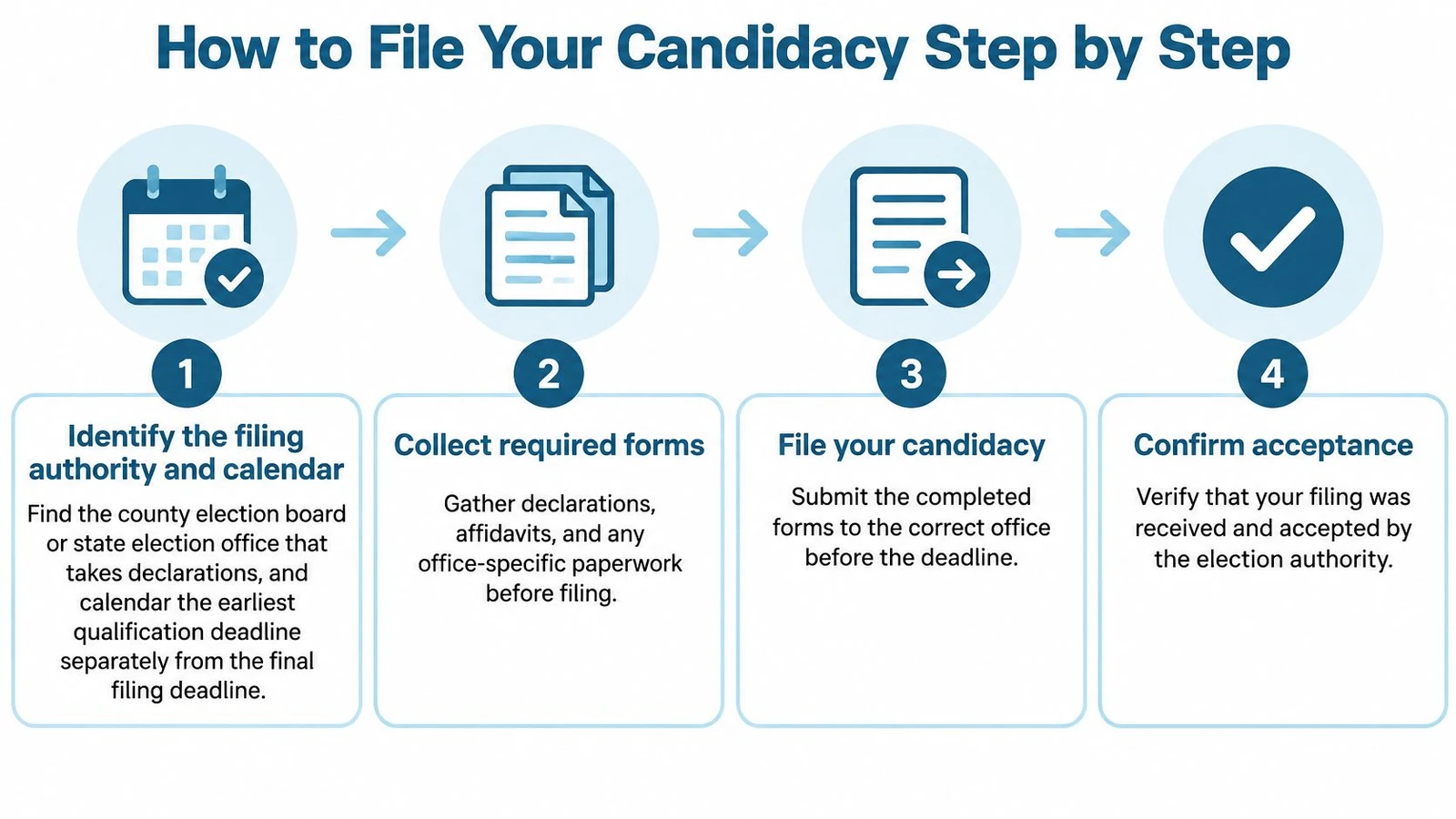
Seven Filing Steps in Order
-
Identify the filing authority and calendar. Find whether the county election board, county clerk or state election office accepts declarations for sheriff. Calendar the earliest qualification deadline separately from the final filing deadline and the general election, because certificates or background steps may be due earlier. A political campaign timeline helps keep those separate tracks visible.
-
Get the official candidate packet for the current cycle. Forms, fees and instructions change between election years. Download or collect the packet directly from the filing authority and check the cycle year on every page.
-
Build a requirement checklist. Include residency, voter registration, education, certification, experience, fingerprints where required, petitions, fees, financial disclosure and every filing deadline. Assign one person to own the checklist and update it when the election office answers a question.
-
Gather proof before announcing. Don’t assume qualification documents can be supplied after the declaration. The Oklahoma county sheriff filing packet says a candidate must present proof of peace-officer qualification when filing the declaration of candidacy with the county election board. Utah similarly requires, at the time of filing, a certificate from the Peace Officer Standards and Training Division confirming training and certification standards, or an applicable waiver, have been met.
-
Submit the declaration with every attachment. File the declaration form, qualification certificates, financial-disclosure forms and any petition signatures together. Pay the filing fee where applicable, keep stamped copies and retain the submission receipt.
-
Register the campaign committee and confirm reporting. Committee registration and campaign-finance reporting dates vary by jurisdiction, so confirm them with the correct authority before money moves. Put reporting deadlines on the same master calendar as filing dates, with a named treasurer or compliance owner.
-
Get written confirmation of acceptance. Ask the county clerk or state election authority to confirm in writing that the candidacy has been accepted. A verbal “looks fine” at the counter isn’t a record the campaign can rely on if a challenge arrives later.
Endorsements don’t cure a deficient filing. They’re persuasion assets, and they belong after the legal path is confirmed.
Where Filings Go Wrong
Most failures are mundane. A certificate is expired. A residency document shows the wrong address. A petition page is missing a required heading. A financial-disclosure form is filed with the wrong office. None of these problems reflects voter support, yet any one can consume the week the campaign planned to spend launching.
The safeguard is separation of records. Keep legal compliance records, receipts and certificates in a dedicated file controlled by the compliance owner, not mixed into field notes or endorsement letters. When a question arises, the campaign should be able to produce the exact document submitted, the date it was submitted and the office that accepted it within minutes.
What the Sheriff Controls and Where Authority Ends
A sheriff campaign can win attention with patrol promises and still overlook the work that consumes much of the office’s time and resources. Jail operations, courthouse security and civil process carry staffing demands and legal exposure that voters should weigh alongside policing.
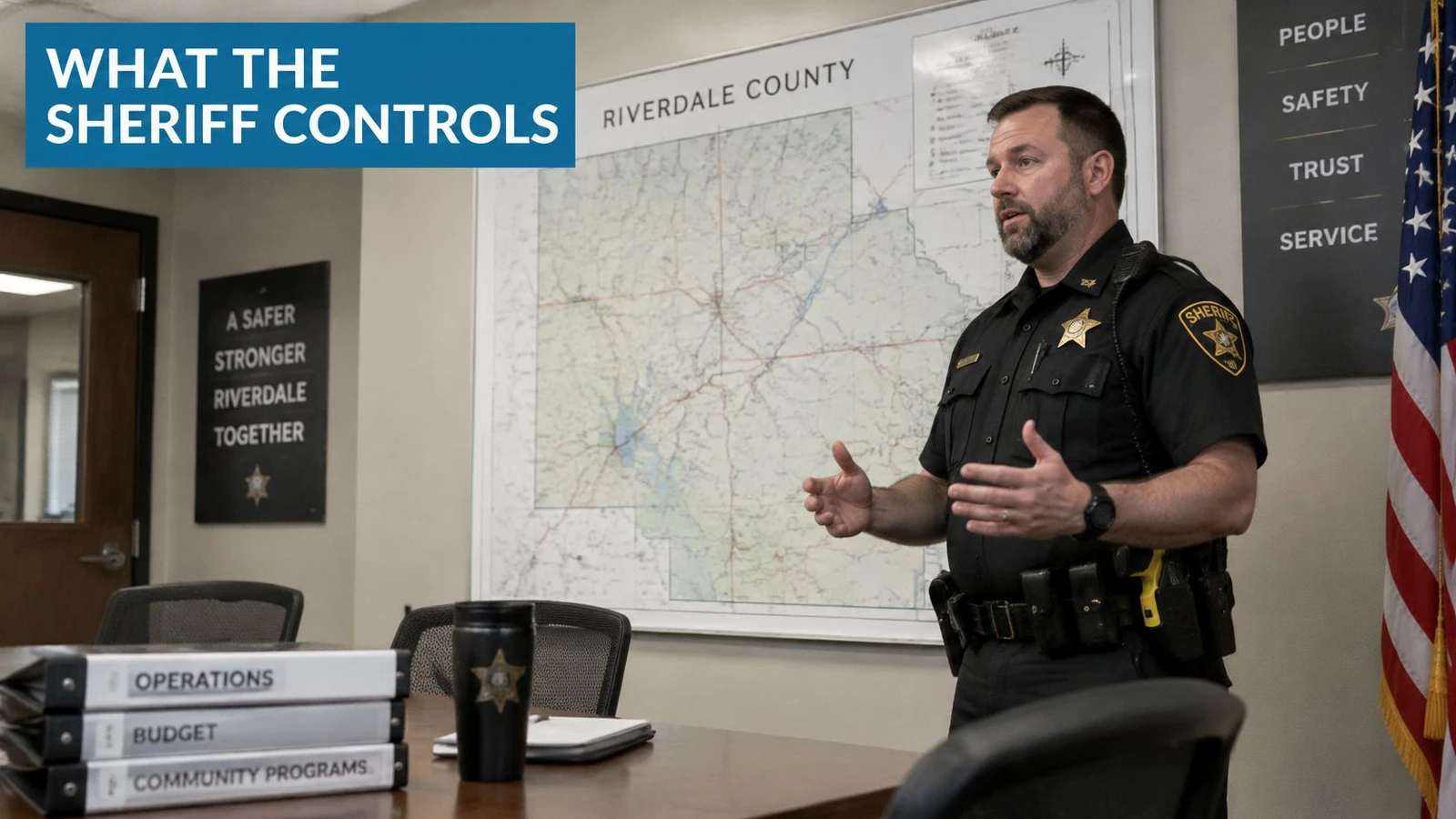
The SAGE Journals study of sheriffs describes responsibilities that can extend beyond ordinary municipal policing. They may include county jails, prisoner transport, court security, civil-process service, court orders and property seizures, as well as policing. Detention staffing, medical and mental-health emergencies, transport logistics, liability and service of legal process are core operational responsibilities.
Scale Changes the Job
The Bureau of Justice Statistics report on sheriff’s offices counted approximately 3,012 sheriff’s offices in 2016 among 15,322 general-purpose law-enforcement agencies, about 20% of all such agencies. Those offices employed roughly 173,000 full-time sworn officers, equal to 25% of the nation’s 701,000 full-time sworn officers.
The same Bureau of Justice Statistics report found that 2,684 offices, or 89%, employed fewer than 100 full-time sworn personnel, with a median of 16 officers; 328 offices employed 100 or more. A rural office may have a handful of deputies and a modest jail. A metropolitan office may include hundreds of employees, specialized units and a detention system with complex staffing and service demands.
Electoral Accountability Has Limits
The Bureau of Justice Statistics data on elected sheriffs show that more than 99% of the nation’s sheriffs are elected. Voters can hold the winner publicly accountable, while budgets, jurisdiction and shared responsibilities shape what the office can deliver.
- County budget: Commissioners or other governing bodies typically control appropriations. Staffing promises depend on funded positions.
- Municipal boundaries: City police departments handle much of the service inside incorporated areas, even when voters look to the sheriff for countywide answers.
- Prosecution and courts: Prosecutors decide charges; courts control dockets, orders and sentencing.
- Shared jail arrangements: Detention capacity, medical contracts and transport duties may depend on facilities and agreements the sheriff did not create.
Organize a credible platform around four tracks: jail and courthouse operations, neighborhood law enforcement, civil-process work and interagency coordination. For each, distinguish what the sheriff can change directly, what requires county funding and what depends on partner agencies. That makes promises more precise and gives voters a fair basis for comparison. A patrol-only platform leaves major operational responsibilities unaddressed.
Build a Budget Around the Votes You Need
A sheriff campaign budget shouldn’t start with a round spending target copied from another county. It starts with the win threshold, the number of votes needed to win under expected turnout. Every literature order, canvass shift and media purchase should trace back to that number.
Estimate turnout for the relevant election, whether that’s a primary, a general election or both. Then define the persuasion universe, the voters who must be contacted to reach the threshold with a margin above the bare minimum. A plain guide to how much it costs to run for local office is useful background, but the county’s own turnout and geography must set the final figures.
The One-Page Plan
Before detailed line items, write one page that names:
- Vote goal: The votes needed to win, plus the safety margin the campaign wants.
- Persuasion universe: The households and voters who’ll receive repeated contact.
- Budget envelope: The total the campaign can realistically raise and spend.
- Money and compliance owner: The person responsible for approvals, records and reporting dates.
The approach in a guide to running for office with no experience ties that one-page logic to a countywide threshold rather than a generic target. For a sheriff race, the next step is conversion: how many target households must be contacted, how many shifts are available and what each meaningful contact costs once travel, printing and labor are included.
Budget lines for a countywide sheriff race
| Budget line | What it covers | Metric it drives |
|---|---|---|
| Voter file and targeting | Filtered voter lists by party, turnout history and precinct | Target households in the universe |
| Printed literature and signs | Mailers, door pieces and yard signs | Pieces per contacted household |
| Paid canvass labor | Crew shifts across the county | Doors attempted per shift |
| Travel and vehicles | Mileage between rural turf and municipal areas | Cost per meaningful conversation |
| Digital and media | Paid ads and social posts, if used | Persuasion voters reached per dollar |
| Fundraising and compliance | Committee setup, finance reports and legal review | Filing deadlines met |
| Contingency reserve | Money held back for late-race needs | Reserve remaining entering the final stretch |
County Geography Changes the Cost Mix
Rural counties spread the same number of voters over long drives, so travel can rival paid labor and a cheap door piece becomes expensive to deliver. Large counties usually shift spending toward voter data, more shifts and broader media because personal coverage of every neighborhood isn’t realistic. Neither pattern is more serious than the other. The question is whether the budget matches the territory.
A budget line without a metric is just a hope. Tie each dollar to households contacted, shifts staffed or deadlines met.
Hold a contingency reserve for late-race needs such as replacement signs, added shifts in weak precincts or a final literature drop. Spending the full envelope early feels decisive but leaves no answer when field data shows a coverage gap. Finally, confirm campaign-finance reporting dates and committee-registration rules with the election authority before funds move. A budget that wins the field plan but misses a disclosure deadline creates a compliance story the campaign doesn’t need.
Organize the Countywide Field Operation
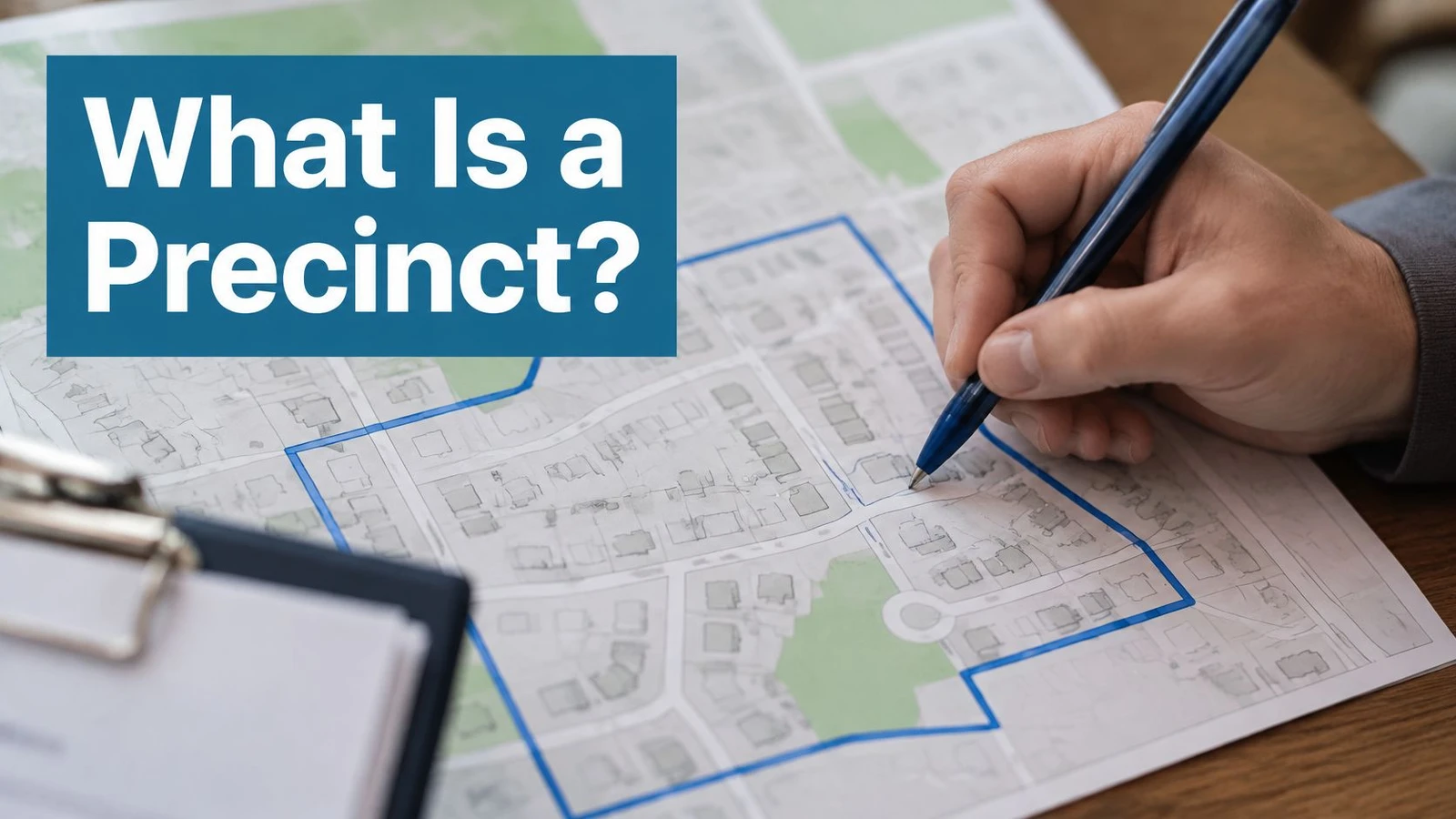
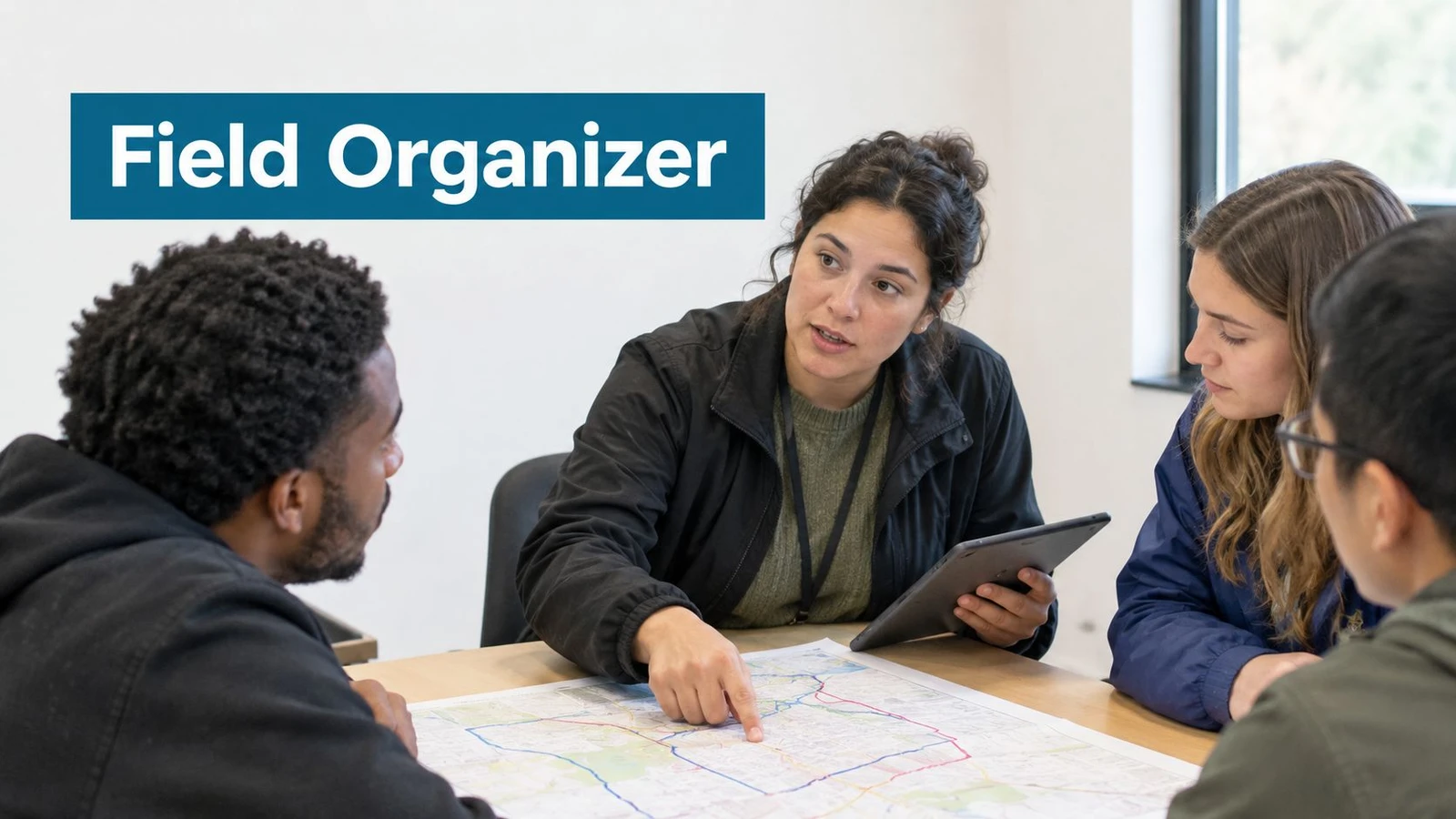
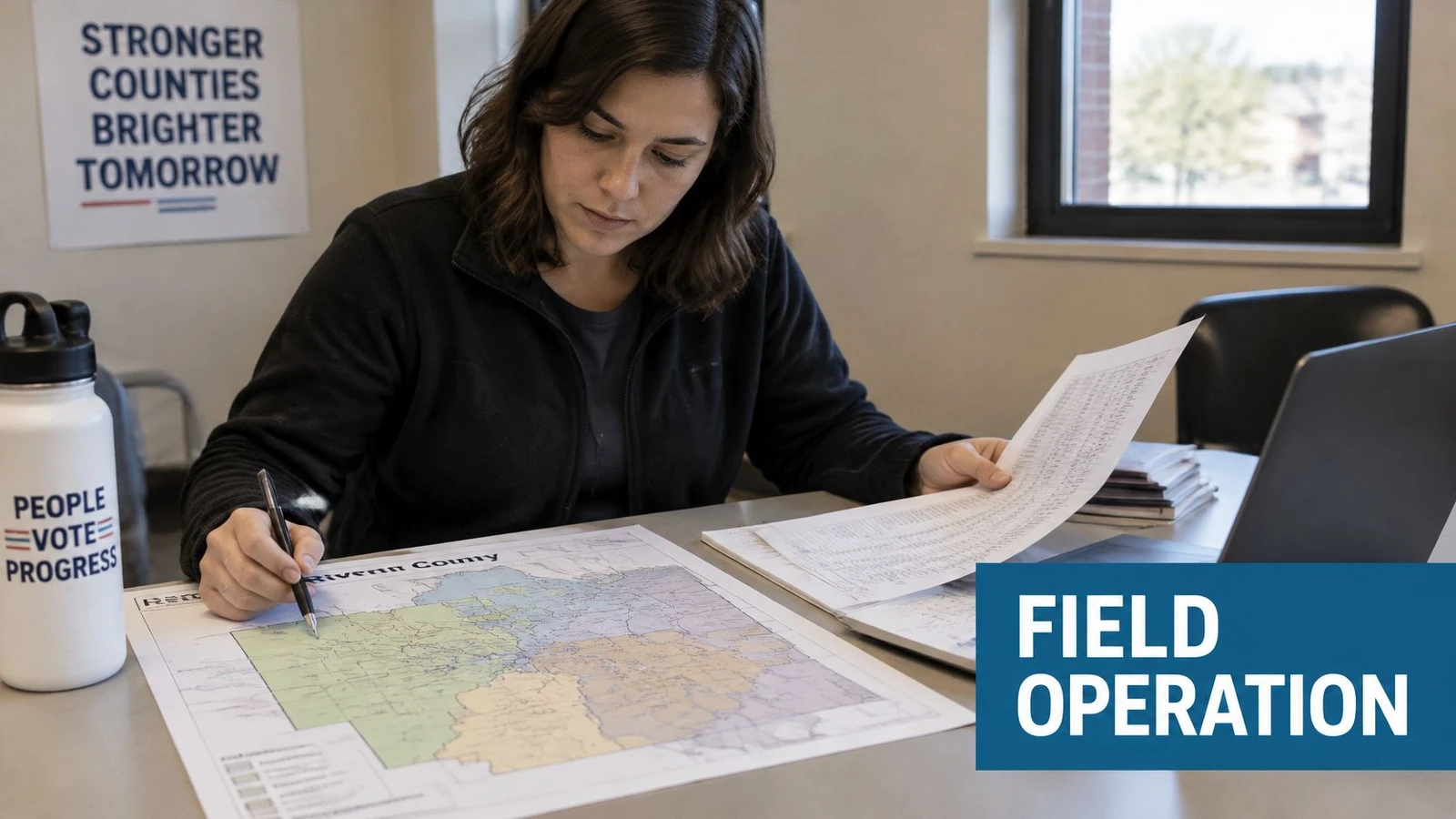
Countywide field plans break down when every neighborhood gets the same treatment. Municipal blocks, unincorporated communities and rural roads differ in voter density, travel time and contact rates. Set clear territories, assign each one to a person or crew, and track whether the campaign is reaching its target voters.
Define the Universe Before Cutting Turf
First decide whom the campaign needs to reach: likely voters, primary voters or all registered voters. Then organize the list by geography, turnout history and known support where legally available, and set priority precincts. The sequence in this guide to building a political field organization in 2026 is useful: define the target universe before assigning routes, or crews may spend time on easy-to-reach doors instead of priority voters.
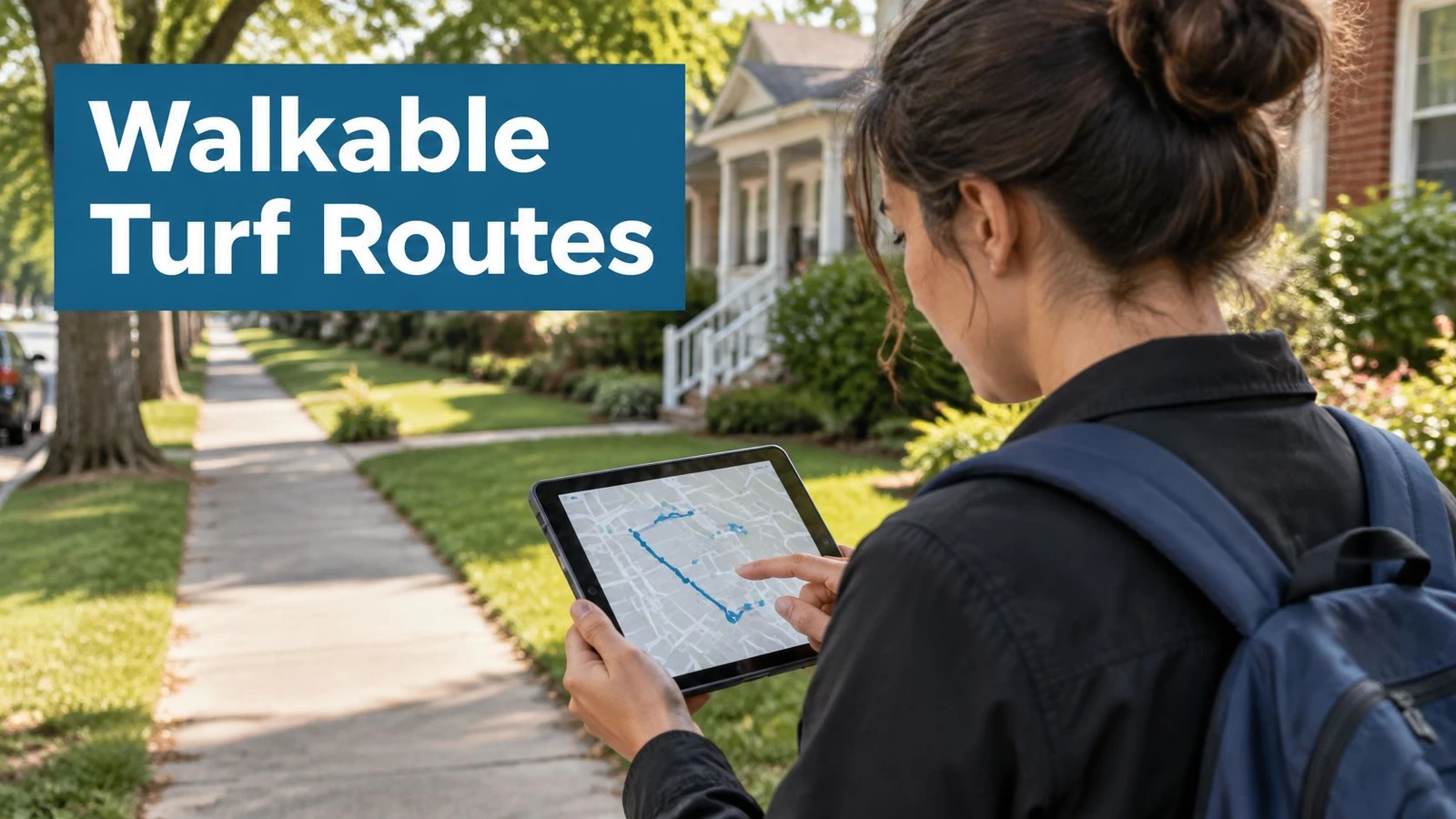
Divide that universe into territories that a canvasser or small crew can cover, then assign each route to a named owner. Auto Turf splits the universe into walkable areas along the street network, sized by walking time, so each area can be worked by a small crew over several shifts. Routes can also be created by drawing a shape, uploading a voter list or importing a MailVotes list, then assigning each route to one or more team members.
Plan repeat visits for areas with low contact rates or voters who need a follow-up conversation. Match visibility materials to the same geographic priorities. If vehicle visibility is part of the plan, compare custom bumper sticker materials for durability and finish before placing a large order.
Record Contacts the Same Way Every Time
Use the same contact outcomes across every crew: contact made, not home, refusal, moved, inaccessible, support level and follow-up needed. Consistent entries make reports comparable and help the campaign distinguish attempted doors from conversations and identified supporters.
Reconcile canvass records daily against the voter-file version used for targeting. Imported files are snapshots, so outdated addresses and duplicate households can skew results if crews continue working from old exports. Reviewing records promptly also helps resolve missing outcomes while the shift is still fresh.
Track three rates, not just attempts:
- Contact rate: Meaningful conversations divided by doors attempted.
- Support conversion: Supporters identified divided by meaningful conversations.
- Coverage: Unique target households contacted divided by target households.
Compare crews with their turf and contact conditions in mind, and check a sample of records for duplicates or implausible entries. A crew covering sparse rural routes may make fewer attempts yet reach a larger share of its target households than a crew in dense blocks. Add issue-coded notes on jail operations, response times, civil process or courthouse concerns, and set a documented follow-up procedure.
A high attempt count can coexist with low contact, poor records and few identified supporters.
A brief conversation does not establish a voter’s support, and a refusal does not necessarily indicate opposition. Reliable contact records help the campaign focus later outreach on voters whose views and follow-up needs are known. For a sheriff candidate, the field plan should also show whether communities across the county are hearing a credible account of the office’s responsibilities.
Line Up Endorsements Before You Announce
Endorsements should be lined up before the public announcement, but they shouldn’t be announced before the filing path is secure. That distinction matters. Private commitments can be gathered while documents are assembled. Public endorsement stories should wait until qualification certificates and the filing receipt are in hand.
Who to Ask and What to Request
Build a county list of supporters local voters recognize. Depending on relationships and local rules, that may include a retiring sheriff, deputy or employee groups, the county party and community leaders from both municipalities and rural areas. Breadth across the county matters because a sheriff serves voters who may never attend the same civic events.
Ask each person for one concrete deliverable rather than vague support:
- A quoted statement: Short, specific and tied to a duty the sheriff holds.
- A joint stop: A community meeting, business visit or neighborhood walk where the endorser is visibly present.
- A fundraising introduction: A named host or donor conversation, recorded with permission.
- A canvassing shift: Direct help in the endorser’s own community, assigned to a named turf team.
Record every answer, including refusals and conditions. A supporter willing to be listed privately isn’t automatically willing to appear in an ad, and a group endorsement may require a vote or questionnaire. Treat the process with the same care as a filing checklist.
Admins, consultants, managers, canvassers and volunteers can be invited by email, with volunteers seeing only assigned routes. That structure helps convert endorsers into field capacity without giving every supporter access to the full campaign file. The planning steps at how to run for office cover general campaign setup, while the election authority remains the source for sheriff deadlines and proof.
Tie Every Quote to Real Authority
Weak endorsements praise character in general terms. Stronger endorsements name jail staffing, courthouse security, civil process, prisoner transport or interagency coordination and explain why the candidate is prepared for that work. They avoid crediting the candidate with municipal policing outcomes or prosecutorial decisions the sheriff doesn’t control.
Keep endorsement letters and event notes with the persuasion plan, separate from election-board compliance records. Mixing the two files invites confusion about what’s a legal document and what’s campaign material. This week, the practical task is simple: finish the endorsement list, rank the asks by local recognition and make the first three requests with a specific deliverable attached.
Frequently Asked Questions
Can anyone run for sheriff?
Eligibility depends on the state. Use the state-by-state requirements table above to check the rules for your county before building a campaign around your candidacy.
Do you need police experience to run for sheriff?
Not always. Some states require qualifying peace-officer service or a specified combination of education and experience. Check whether your certification and work history meet the state’s exact requirements.
How much does it cost to run for sheriff?
Start with the budget lines that grow with countywide coverage: voter contact, printed materials, and the people needed to reach voters across the county. A filing fee or petition requirement is a separate cost, so confirm the amount with the election authority and include it in the budget before setting a spending target.
When is the filing deadline for sheriff?
The deadline varies by state and election cycle. Confirm the date with the election authority for the specific race, then leave time to resolve any filing problems before the deadline.
For countywide canvassing, doornoc can turn selected voters into walk routes using Auto Turf, which divides a voter universe into canvassing areas along the street network. Teams can record door-to-door results in the browser-based app. For a sheriff campaign, match the field plan to the county’s actual geography and the office’s responsibilities.
Looking for a tool to run this? doornoc’s canvassing software bundles voter data, automatic turf cutting, the mobile app, and live reporting in one platform.