Your field director just sent a résumé and a weekend dashboard that reads 1,400 doors knocked. The volunteer count looks healthy. You still cannot say how many voters had a real conversation, which streets were skipped, or whether the notes on a canvasser’s phone are allowed to stay there.
That gap is the field organizer job. It is not a cheerleading post for people who enjoy knocking doors. It is a measurement and allocation job: who walks, which addresses they get, and whether the record of each contact is true. A manager who hires for energy and then scores the hire on doors will get busy shifts and thin results. The standard below is what to hand a new hire, and what to use when you review them.
What a Field Organizer Does on a Campaign
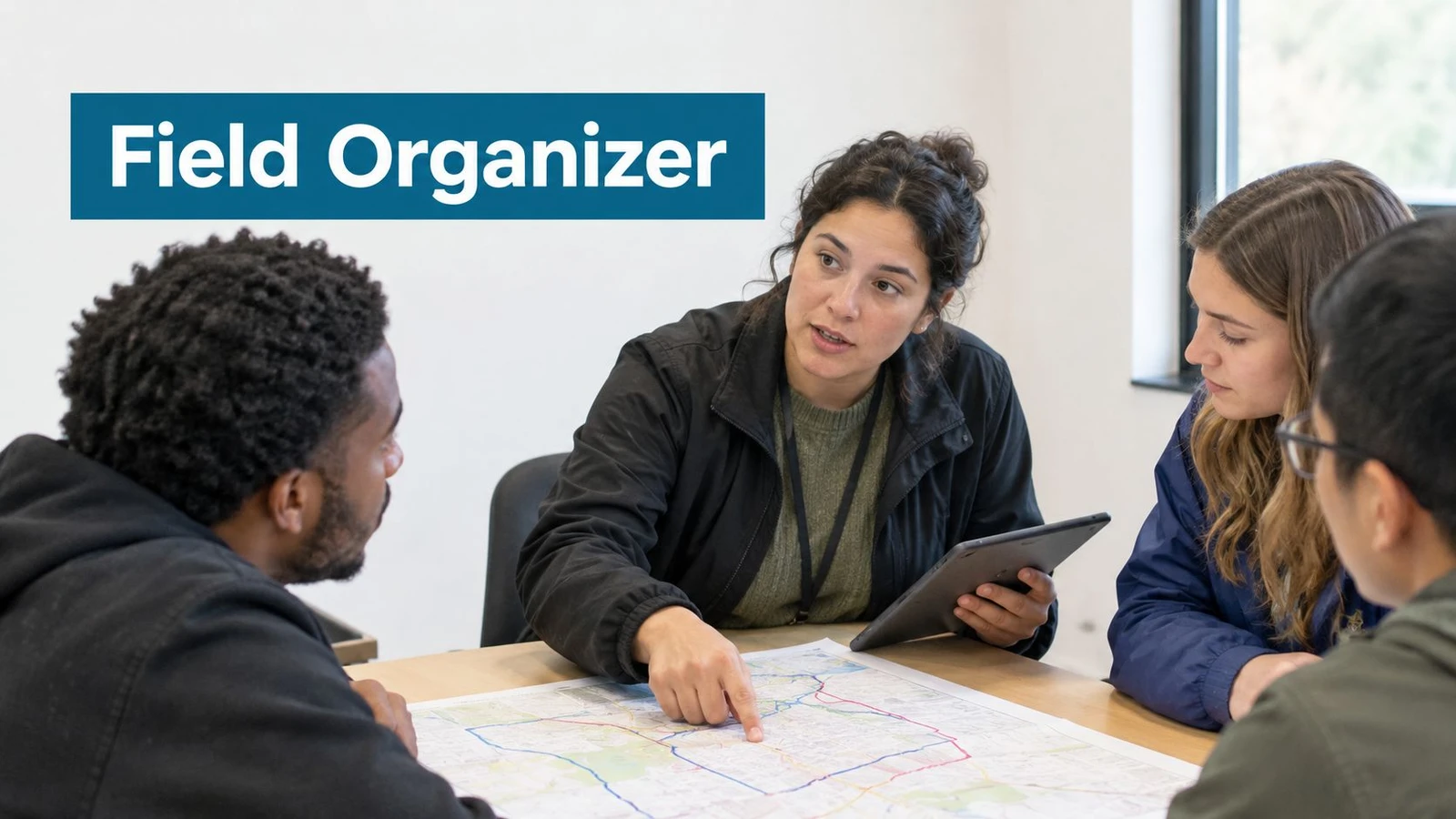
A field organizer turns a campaign’s voter-contact plan into coordinated work on the ground. The role manages people, turf, and data: recruiting and scheduling canvassers, assigning walk lists, balancing routes, and keeping contact records usable. The measure of output is coverage with auditable records, so managers can see which voters were reached and where follow-up is needed.
On a Saturday morning, volunteers arrive at a community center ready to canvass. The organizer confirms routes are assigned, pairs new canvassers with experienced walkers, and checks that returned packets or phones are logged. During the shift, the organizer monitors progress and moves unworked addresses when staffing or route conditions change. The candidate sets the public message; the organizer makes sure the field operation carries it out and records what happened.
Campaigns shifted heavily toward broadcast, cable, and later streaming advertising beginning in the 1960s, while volunteer canvassing lost ground, as Political Marketer’s account of the modern campaign team describes. Field organizing later regained a place in campaign work because local teams can turn voter lists into personal contact. The Obama campaign mobilized approximately 2.2 million volunteers, with local citizens organizing their neighborhoods before Election Day, as described in the same account.
Large-scale canvassing brings practical management demands. A 2024 study in Political Science Quarterly, discussed in Political Marketer’s account of the modern campaign team, identifies recruitment, retention, supervision, neighborhood targeting, performance goals, contact timing, and detailed voter records as central challenges. Organizers address those demands by assigning work, checking contact quality, and maintaining records that can support follow-up. Their place alongside field directors and team leads is shown in this political canvassing team hierarchy.
Core Responsibilities Across the Campaign Calendar
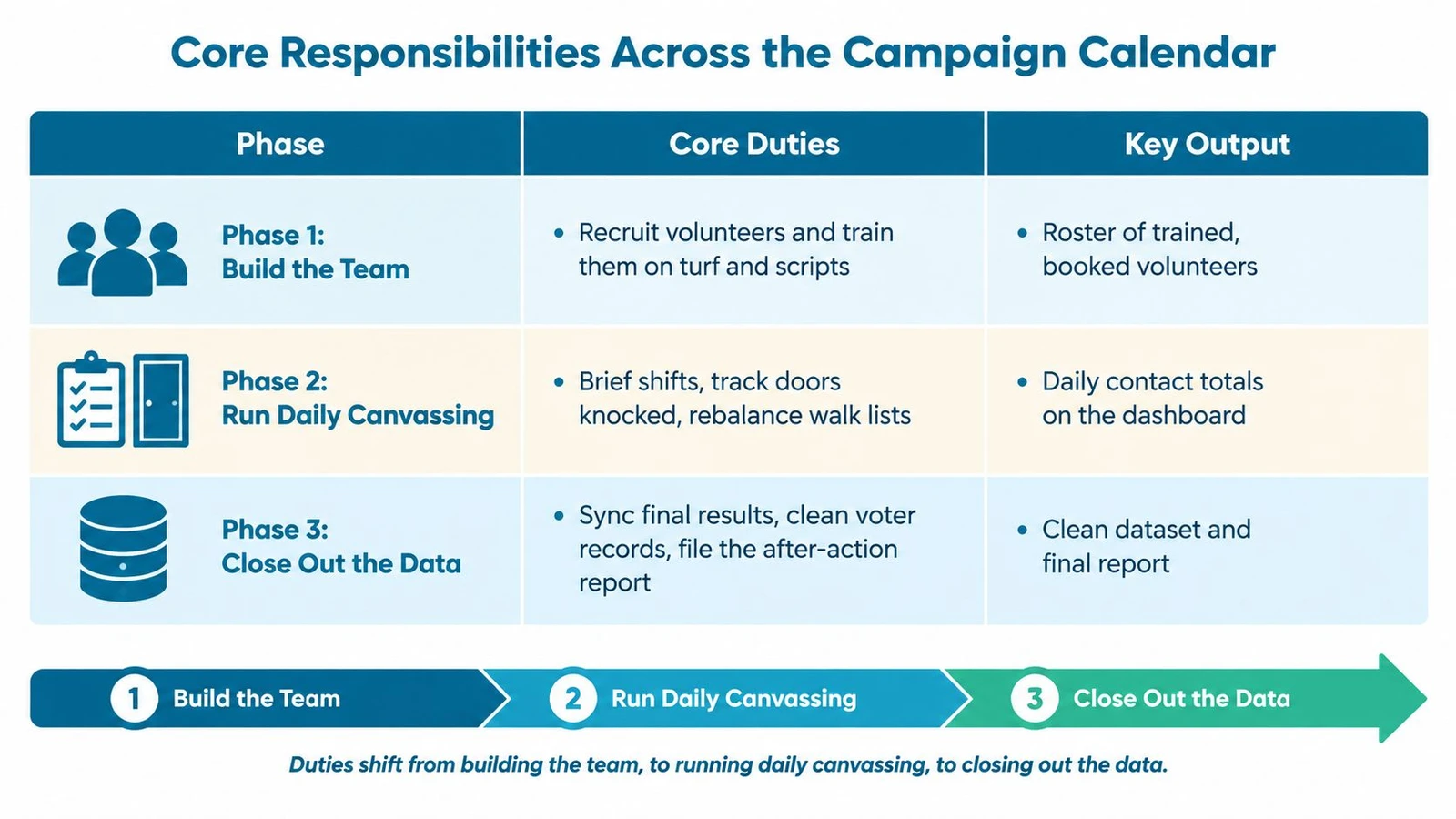
Duties move with the calendar. A complete job description names the phase, the work, and the artifact you can check. If a posting only says “manage volunteers and knock doors,” it is missing the close-out.
| Phase | Core Duties | Main Output |
|---|---|---|
| Recruit and plan | Recruit core volunteers, build turf map and walk lists, configure survey and lists | Team roster and turf plan |
| Build | Train team leaders, run weekly volunteer shifts, set contact goals per turf | Weekly volunteer schedule and goals |
| Peak canvass | Run daily shifts, reassign unworked addresses, track contact rate by route | Daily progress report |
| Election week | Monitor live progress, cover no-shows, close out routes | Same-day reallocation log |
| After election | Review contact records, thank volunteers, apply data retention rules | Final field report and archived data |
Why the work changes
Early weeks buy capacity. A roster without a turf map leaves trained people standing around. A turf map without a configured survey produces conversations you cannot compare later. During the build, team leaders take the first shifts so the organizer is not the only person who can open a staging location.
Peak canvass is allocation under time pressure. Daily shifts, unfinished addresses, and contact rate by route matter more than a motivational huddle. Election week is the same job with less slack. No-shows get covered from a written backup list, and a route is closed only when the last address is attempted or deliberately released.
Small campaigns still need every row
On a city council or school board race, one person often owns several phases in the same week. The table does not shrink. It becomes a checklist of what cannot be dropped when the organizer is also cutting turf at night. The after-election row is the one local campaigns skip, and it is the one that decides whether next cycle starts from clean records or from a pile of notes nobody can explain.
Practical rule: If a job description has no artifact for planning, for a live shift, and for close-out, it is not finished.
How to Run a Field Organizer’s Daily and Weekly Workflow
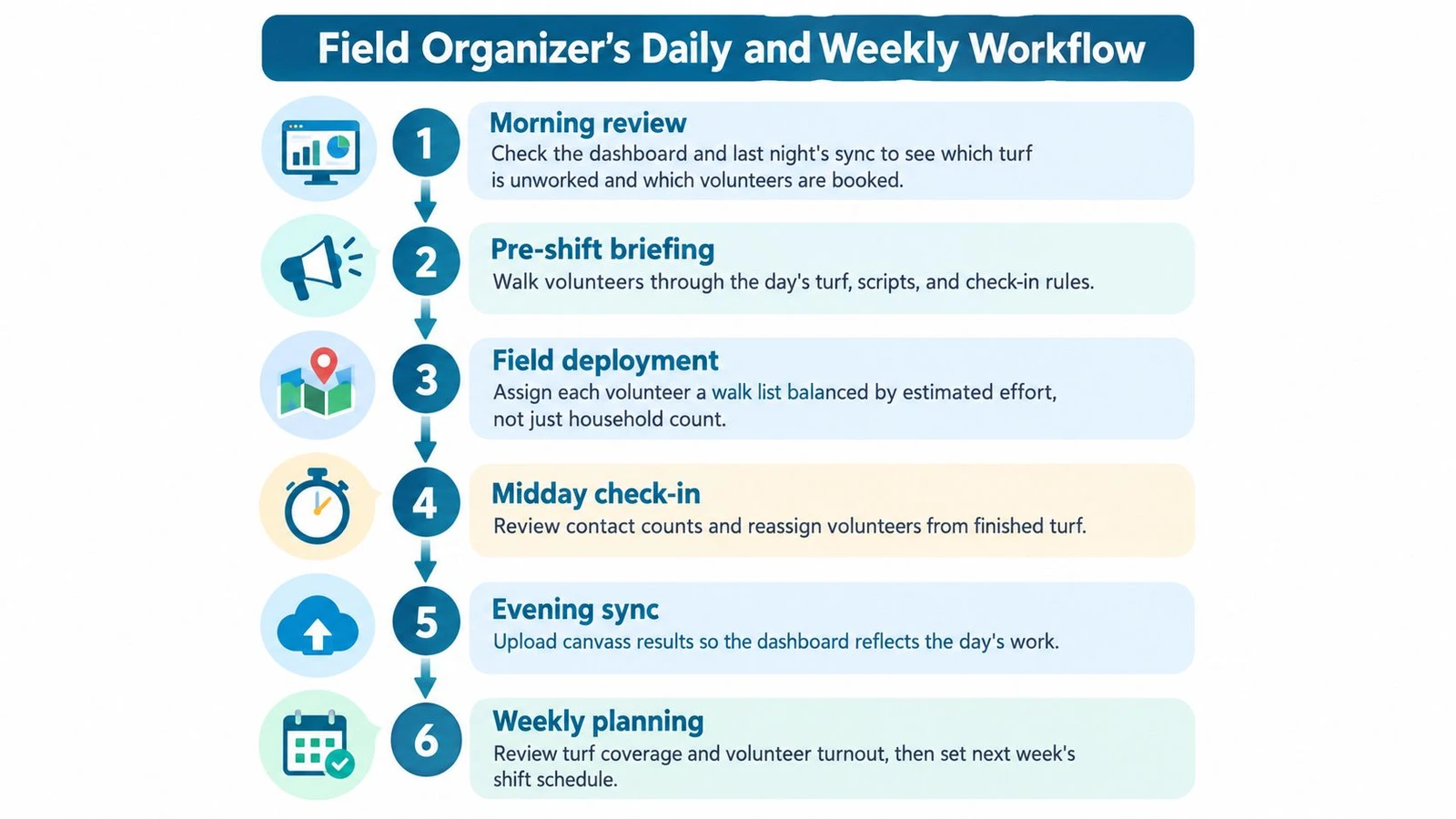
The daily workflow is a control loop: confirm what happened, set up the shift, adjust routes while canvassers are out, and close the records before the next team starts.
The shift loop
-
Morning review. Check the dashboard and the previous night’s sync before the team arrives. Start from confirmed records of unworked turf and the day’s roster, not yesterday’s group text. A verbal report that a turf is finished can conceal canvassers whose phones never uploaded.
-
Pre-shift briefing. Review the script, survey questions, and reporting rules. Check that devices are charged and offline maps are loaded. A missed device check can leave a pair in a dead zone without a working map or a paper backup.
-
Dispatch. Assign routes by walk time and density, then pair new canvassers with experienced ones. Assign by walk time: a long grid and a set of stairs are different shifts even at 40 doors each. Door count alone does not show how much ground a team can cover.
-
Mid-shift check. Review progress every 60 to 90 minutes, answer field questions, and flag streets producing few contacts. Check early enough to move a team or revise a route while there is still time to use the shift well.
-
Same-day adjustment. Reassign unfinished addresses to another team or the next shift while canvassers are still out. Record what remains open and why. Otherwise, those addresses can sit until the weekend, even as the voter file changes.
-
Close-out. Confirm that every device has synced, compare verified contacts with the shift goal, and record safety or data incidents that night. Missing syncs can lead to duplicate knocks and inaccurate productivity counts.
-
Weekly rhythm. Reset turf priorities, hold brief one-to-one check-ins, and send the field director a summary based on verified contacts rather than volunteer hours. The summary should show which routes produced usable conversations and which need a change in timing or assignment.
When a route lies to you
A rail line split one neighborhood in half last spring. The map showed 80 doors and a 90-minute walk, but canvassers reached the tracks, doubled back, and returned with far fewer conversations than the door count suggested. A mid-shift review gives the organizer time to move the far side to a new pair entering from the other street. Record the original route as a routing failure, not a poor canvasser shift, so the next assignment reflects the access problem.
A low number on one street is a clue. It is not, by itself, a verdict on the canvasser.
Skills and Metrics That Show a Strong Organizer
A full shift can still produce few verified contacts. Strong organizers retain volunteers, schedule shifts carefully, supervise teams, keep doorstep records accurate, and choose walkable turf. They also communicate clearly when a staging site or route plan breaks down. These skills help managers allocate people and time based on results, not activity alone.
A randomized New Haven experiment involving approximately 30,000 registered voters found that personal canvassing raised turnout. After adjusting for incomplete compliance, the estimated effect of an actual personal contact was approximately 6–7 percentage points, according to the Proceedings of the National Academy of Sciences. Attempts do not count as that treatment. A dashboard that reports only doors knocked can overstate performance when few residents answer. Accurate doorstep records matter too: missing entries can lead to duplicate visits and distort end-of-day counts.
Read the metrics together
| Metric | What It Reveals | How to Read It |
|---|---|---|
| Attempts | Door-knocking activity | Necessary, but overstates performance when read alone |
| Answered doors | Whether someone was home to engage | Low values may point to timing or address quality |
| Completed conversations | Real interactions with voters | Core output for persuasion and turnout |
| Contact rate | Completed conversations per assigned address | Compare by route, shift, and canvasser |
| Completed-script rate | Share of contacts that received the full script | Read separately from contact rate to assess script delivery |
| Volunteer retention | Share of volunteers returning for the next shift | Indicates whether the team can sustain capacity in the final weeks |
Interpret the measures together. High attempts with few answered doors point to timing or address problems. High completed conversations paired with weak retention suggest that the shift may be difficult to repeat, leaving less capacity for the final weeks. Compare results by route, shift, and canvasser before reallocating people. A campaign analytics dashboard is useful when attempts, contacts, completed conversations, and script delivery remain distinct.
Running the Operation with Modern Canvassing Tools
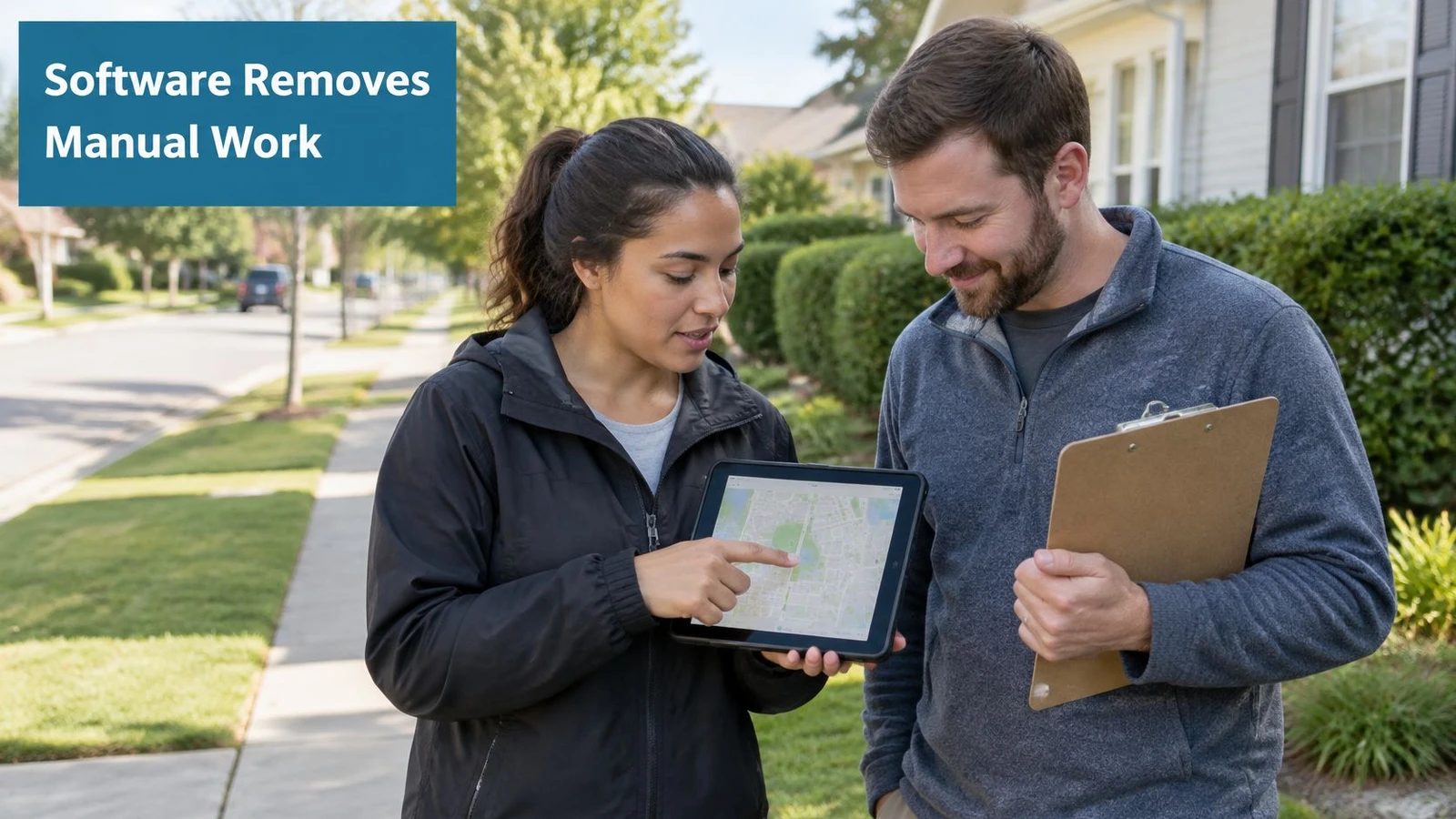
A field team can finish its assigned doors and still leave the campaign short on verified voter contacts. Organizers need routes and live records that show where canvassers are working, what they recorded, and where effort should shift before the next shift.
A UK field experiment recorded a 28% successful canvass contact rate. A separate door-to-door study reported that 37.7% of addresses received some contact, while 23.9% received the full treatment script, according to the European Journal of Political Research. These figures describe different studies and outcomes, so they should not be treated as a single forecast. For staffing, estimate expected contacts from local turnout patterns, shift timing, and the share of answered doors likely to complete the script. Assigning the same number of addresses does not guarantee comparable conversations.
| Field Problem | What to Look For | doornoc Feature |
|---|---|---|
| Uneven walk lists | Turf balanced by effort, not only address count | Auto Turf with balanced, effort-labeled routes |
| Rail, river, or road barriers | Routing that follows real streets | Auto Turf boundaries on main roads, rail lines and rivers (OpenStreetMap data) |
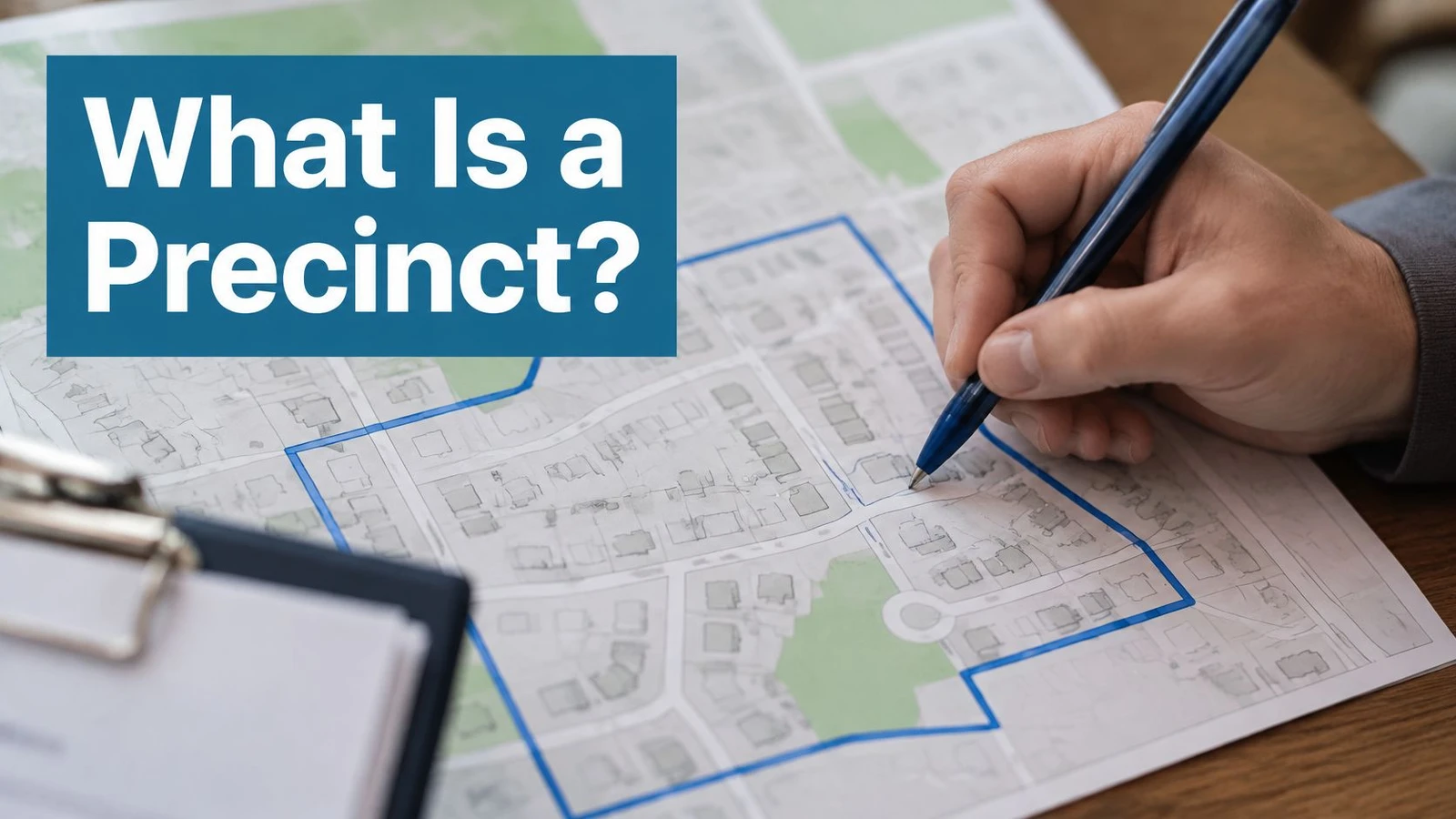
| Irregular precinct boundaries | Custom geography drawn by hand | Polygon Route matches voters inside a drawn boundary |
| Connectivity dead zones | Capture that works offline and syncs later | Offline mode with automatic sync on reconnect |
| Late discovery of underperformance | Live route completion and team activity | Route status plus a live map of each route’s canvassers |
| Error-prone voter files | Automatic matching and geocoding | List Upload for CSV, JSON, and Excel with matching |
| Manual data handoffs | Direct connection between voter data and field app | MailVotes to doornoc handoff without CSV exports |
Use live route data to adjust the shift
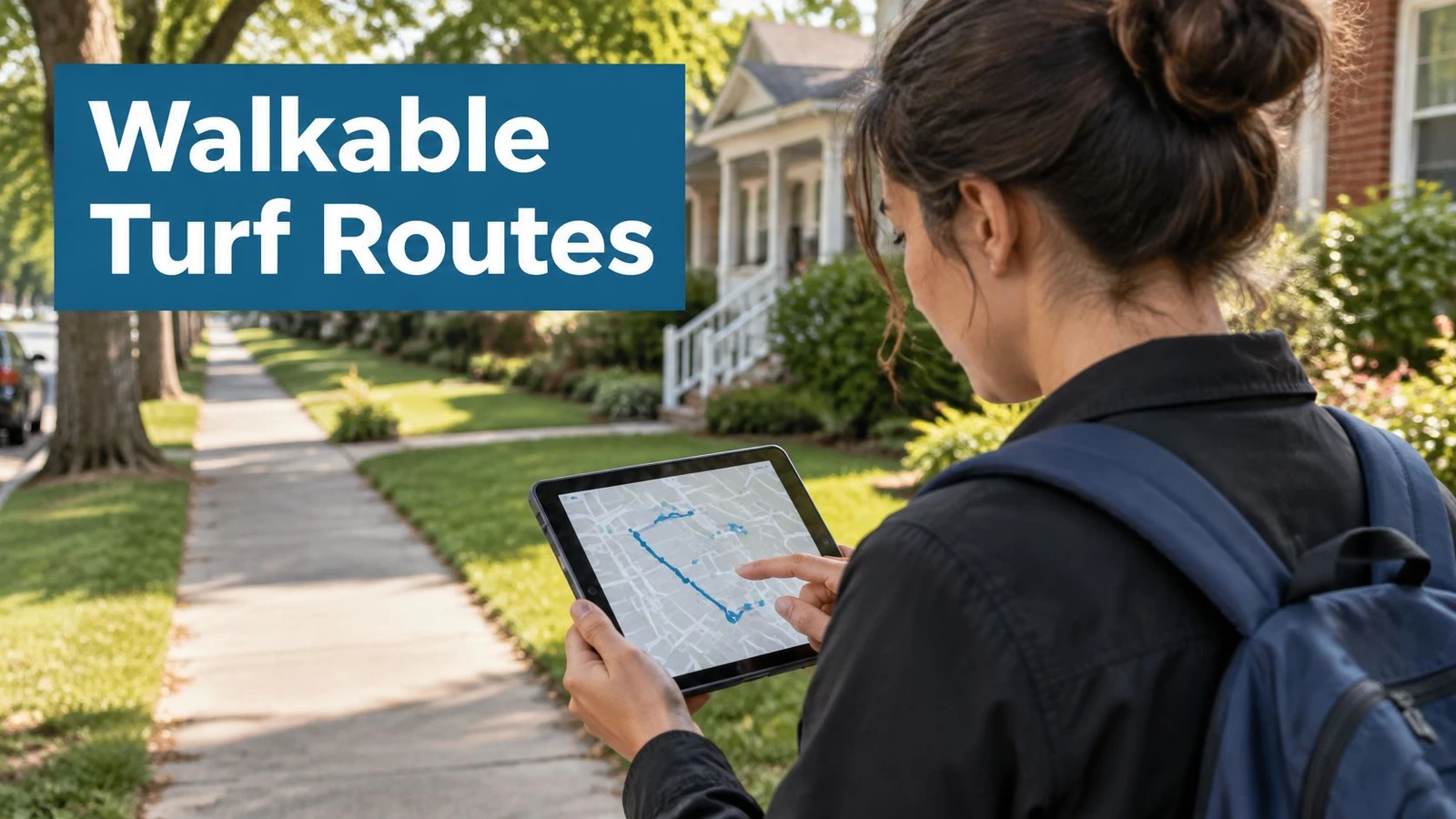
A route that falls behind needs a diagnosis before reassignment. Check whether low progress comes from a difficult street layout, poor access, or a shift that is not moving as expected. Auto Turf can keep turf boundaries on barriers such as rail lines and rivers, while Polygon Route lets organizers draw a boundary when precinct lines do not match walkable turf.
When the signal drops, offline logging preserves outcomes, notes, timestamps, and issue tags for automatic sync once connectivity returns. That gives the organizer a more complete record for reviewing work and reallocating canvassers during the same shift. It also limits data gaps that can distort the picture of field activity.
A canvassing app for campaign teams should fit the operation’s route design, connectivity, and data handoff needs. Compare those capabilities with the campaign’s current workflow before choosing a tool.
Doorstep Data Privacy Rules for Organizers
Field data is sensitive. Written rules come before the first knock, and the organizer checks them the way they check a charged phone.
Before the shift
- Collect the minimum. Record only what the survey uses. If the script does not ask it, it does not go in the note.
- Name the retention date. Write what may appear in free-text notes, how long the file is kept, and the day it is deleted.
- Lock the access. A canvasser sees only that shift’s turf and fields. Screens lock. Shared logins are not allowed.
- Vet the vendors. Confirm where each voter record goes, which outside parties receive it, and whether location is collected at all.
During and after the shift
Give every canvasser a short doorstep disclosure: what is written down, why, how the voter opts out, and whether answers feed any profile. After the shift, incidents follow a written path with one named contact and a clock for reporting. The weekly review includes a privacy check next to contacts made. Undisclosed profiling can sharpen a list and still cost trust and future participation. Better targeting is not automatically better organizing.
Decide Whether Door-Knocking Earns Its Place in Your Plan
More doors do not automatically mean more votes. A 2025 study of a UK Get Out the Vote field experiment found that party leaflets increased turnout by 4.3 percentage points while canvassing produced only a 0.6-point additional effect, according to Political Science Research and Methods via EconPapers. That result does not make canvassing useless. It shows the extra effect can be modest and tied to context. A local campaign with a short bench cannot assume a large contact program is the best use of the people it has.
Pick the outcome before the channel
Write the outcome first: turnout, persuasion, issue learning, volunteer retention, or constituent service. Completed doors are activity, not an outcome. Then match a channel.
- Leaflet drop when the need is broad awareness and the volunteer pool cannot support repeat conversations.
- Phone program when the list is large, the geography is spread out, and a short ask is enough.
- Digital reminder when the voter is already identified and the job is a time and a polling place.
- Targeted visit when a subgroup needs a real conversation, an accessibility check, or a relationship you expect to use again.
Decide with cost per meaningful contact, completion rate by geography, repeat-contact effect, volunteer retention, and subgroup reach. Before you hire, put the outcome, the metric, and the channel mix on one page. After two weeks of contact data, keep the mix or change it. Two quiet weeks are enough to see whether the doors are earning their place.
Hiring and Onboarding a Field Organizer
Hire for supervision and records, and screen out applicants who only promise energy. The job is measured in verified contacts and clean data, so interview for dispatch judgment, close-out discipline, and daily governance of doorstep records.
What to require
- Prior canvass or volunteer management, even on a small race.
- Comfort with spreadsheets and a live dashboard, including the habit of separating attempts from conversations.
- A reference from a previous campaign who can speak to close-out, not only to enthusiasm.
- Evenings, weekends, and long shifts accepted in writing.
- Judgment on safety and doorstep conduct, including when to end a conversation.
For a wider read on screening operators rather than charismatic applicants, the hiring insights from Hire Sense are a useful companion to a campaign-specific exercise.
A turf test, then 30 days
Hand the candidate a 100-address turf and ask how they would staff two canvassers across one week. Score the answer on realistic contact, walk time, pairing, and what they do with unfinished doors. An answer that promises a conversation at nearly every address fails the test. Strong answers cut the turf to shift length, plan revisits, and protect data quality.
A 2025 Open Rights Group investigation of UK party canvassing apps found concerns involving third-party data sharing, location tracking, insecure credentials, and insufficient transparency. The report characterized election canvassing data shared with third parties as potentially large-scale processing of special-category data, which implies documented impact assessments. Treat that as a hiring standard. The new organizer finishes the doorstep privacy rules before shift one.
Week one is a shadow shift plus the app, offline mode, and the survey. Week two, they lead a shift with a senior partner watching dispatch and the mid-shift check. Weeks three and four, they own a turf and file the first weekly goal report. A one-tap knock form and simple team invites shorten the ramp for new volunteers. They do not replace that supervised month.
doornoc gives campaign teams route planning, offline door logging, and a live view of which turf is finished, which lets the organizer assign shifts from completion rates and conversation yield. If you are about to hire or reset a canvass, start with the turf and the contact record rather than another stack of walk sheets. See how the workflow fits your race at doornoc.
Looking for a tool to run this? doornoc’s canvassing software bundles voter data, automatic turf cutting, the mobile app, and live reporting in one platform.