Key Takeaways
- A winning field organization in 2026 requires a clear four-tier hierarchy: Field Director → Regional Field Directors → Field Organizers → Precinct Captains, with defined responsibilities at each level.
- The 1:15:75 staffing ratio (1 paid organizer per 15 volunteer leaders per 75 active volunteers) provides optimal management capacity while maintaining personal accountability.
- Modern field organizations integrate digital tools with traditional door-to-door contact, using platforms like DoorNoc to track real-time voter contact rates and adjust deployment strategies hourly.
- Successful campaigns build field infrastructure 6-9 months before Election Day, focusing first on volunteer recruitment pipelines rather than immediate voter contact.
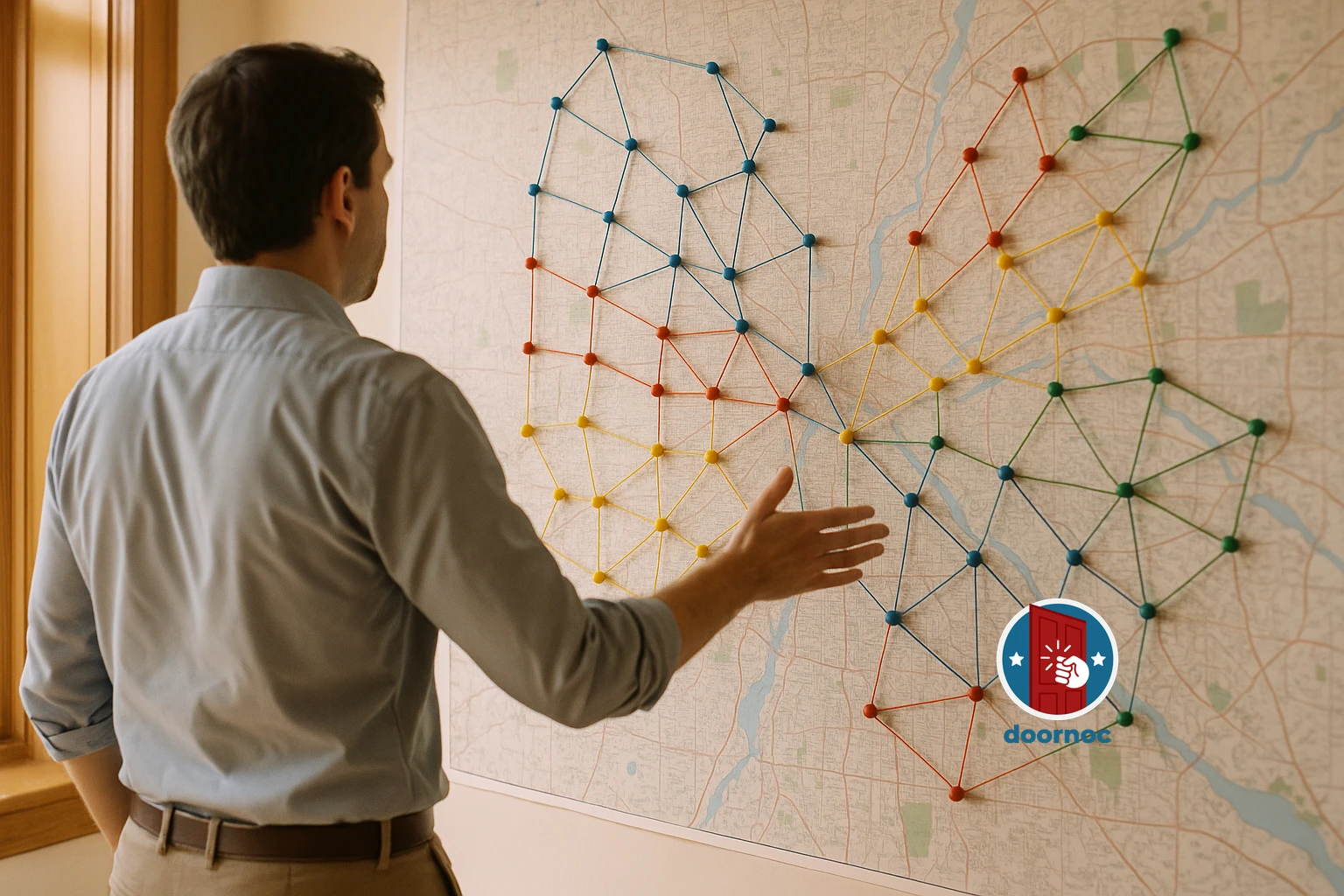
How to build a political field organization in 2026 starts with understanding that your field operation is the most critical component of winning campaigns. While digital advertising and social media generate awareness, field organizations convert awareness into votes through direct, personal contact. In competitive races across the United States in 2026, campaigns with superior field infrastructure are outperforming opponents with larger budgets but weaker ground games by 3-7 percentage points.
A political field organization is the structured network of staff and volunteers who execute your voter contact strategy through door-to-door canvassing, phone banking, voter registration drives, and get-out-the-vote efforts. The difference between winning and losing often comes down to which campaign built a more effective field operation.
What Makes a Field Organization Effective in 2026?
The modern field organization combines traditional grassroots organizing principles with data-driven deployment strategies and real-time performance tracking. Three fundamental elements separate winning field operations from ineffective ones:
Clear hierarchical structure with defined responsibilities. Every person in your field organization—from the field director to first-time volunteers—must know exactly what they’re responsible for, who they report to, and what success looks like in their role. Ambiguity kills field operations.
Data integration at every level. In 2026, successful campaigns use platforms like DoorNoc to track voter contact in real-time, allowing field directors to identify underperforming territories and redeploy resources within hours rather than days. The campaigns still using paper walk lists and weekly data entry are losing.
Scalable volunteer recruitment pipelines. Your field organization’s capacity is limited by your ability to recruit, train, and retain volunteers. The most effective campaigns in 2026 treat volunteer recruitment as a continuous process, not a one-time event, maintaining a steady flow of new volunteers to replace inevitable attrition.
According to data from competitive 2026 congressional races, campaigns that implemented all three elements achieved an average voter contact rate of 47 doors per volunteer per shift, compared to 23 doors per shift for campaigns using traditional methods without integrated technology.
The Four-Tier Organizational Structure
Successful field organizations follow a four-tier hierarchy that balances span of control with personal accountability. This structure scales from local city council races to statewide campaigns.
Tier 1: Field Director
The field director owns the entire ground game strategy and execution. This role requires someone who can think strategically about resource allocation while maintaining operational discipline in day-to-day execution.
Core field director responsibilities include:
- Developing the overall voter contact strategy and setting weekly/daily contact goals
- Managing the field budget and making resource allocation decisions
- Hiring, training, and managing regional field directors and field organizers
- Analyzing performance data and adjusting deployment strategies
- Coordinating with the campaign manager on integration between field, communications, and fundraising
- Building relationships with local party organizations, allied groups, and volunteer leaders
Your field director should start 6-9 months before Election Day for competitive races. For local campaigns with smaller budgets, the campaign manager often serves as field director, but this dual role becomes unsustainable once you exceed 50 active volunteers.
The most effective field directors in 2026 spend 60% of their time on strategy and resource allocation, 25% on staff management and training, and only 15% on direct voter contact. If your field director is regularly knocking doors themselves, your organizational structure has failed.
Tier 2: Regional Field Directors
Regional field directors (RFDs) manage specific geographic areas, typically representing 20,000-40,000 target voters in statewide campaigns or entire municipalities in local races. The number of RFDs depends on your geographic scope and target voter universe.
A competitive congressional campaign typically deploys 2-4 regional field directors, each managing 3-5 field organizers. Statewide campaigns may have 8-12 RFDs depending on state size and competitive geography.
Regional field director responsibilities:
- Translating the overall field strategy into territory-specific plans
- Managing and coaching field organizers in their region
- Conducting weekly performance reviews and adjusting deployment based on data
- Building relationships with local elected officials, community leaders, and volunteer networks
- Identifying and recruiting high-capacity volunteer leaders (future precinct captains)
- Troubleshooting operational issues and removing barriers to organizer success
The best RFDs are promoted from successful field organizer positions. They understand ground-level execution challenges because they’ve lived them, but they can also think strategically about territory-wide resource allocation.
Tier 3: Field Organizers
Field organizers are the workhorses of your field operation. They recruit volunteers, manage canvassing operations, and hit daily voter contact targets in specific turfs (typically 5,000-10,000 target voters).
For a competitive campaign, plan to hire 1 field organizer per 7,500 target voters in your highest-priority areas. A congressional campaign might deploy 8-15 field organizers depending on district competitiveness and geography.
Field organizer core responsibilities:
- Recruiting and training volunteers through phone calls, one-on-ones, and canvass trainings
- Organizing and leading 3-5 canvassing shifts per week
- Maintaining a roster of 15-25 active volunteers and 3-5 volunteer team leaders
- Tracking and reporting daily voter contact numbers
- Cutting turf assignments and managing canvasser deployment using tools like DoorNoc’s auto-turf feature
- Conducting quality control on voter contact data
- Identifying and developing volunteer leaders for precinct captain roles
Field organizers should spend 50% of their time on volunteer recruitment and management, 30% on direct canvassing operations, and 20% on data management and reporting. The campaigns that win are those where organizers focus on building volunteer capacity rather than doing all the work themselves.
Tier 4: Precinct Captains and Volunteer Team Leaders
Precinct captains are volunteer leaders who take ownership of specific precincts or neighborhoods. They’re the force multipliers that allow your field organization to scale beyond what paid staff can accomplish alone.
A well-developed field organization maintains a 1:15:75 ratio—1 paid field organizer managing 15 precinct captains who each lead 5 active volunteers. This structure allows a single organizer to coordinate the work of 75+ volunteers.
Precinct captain responsibilities:
- Leading weekly canvassing shifts in their assigned precinct
- Recruiting friends, neighbors, and community members to volunteer
- Serving as the local campaign ambassador and relationship-builder
- Tracking voter contact progress in their precinct
- Reporting problems and opportunities to their field organizer
- Taking ownership of GOTV operations in their precinct during the final 72 hours
Identify potential precinct captains early—they’re your most reliable volunteers who show up consistently, bring friends, and demonstrate leadership qualities. Invest in developing these relationships through one-on-one meetings, special trainings, and recognition.
Many campaigns make the mistake of treating all volunteers the same. The most effective field organizations in 2026 create a clear leadership pathway: volunteer → team leader → precinct captain → future field organizer.
Building Your Volunteer Recruitment Pipeline
Your field organization’s capacity is directly limited by your ability to recruit and retain volunteers. The campaigns that build sustainable volunteer pipelines starting 6+ months before Election Day consistently outperform those that try to recruit volunteers in the final weeks.
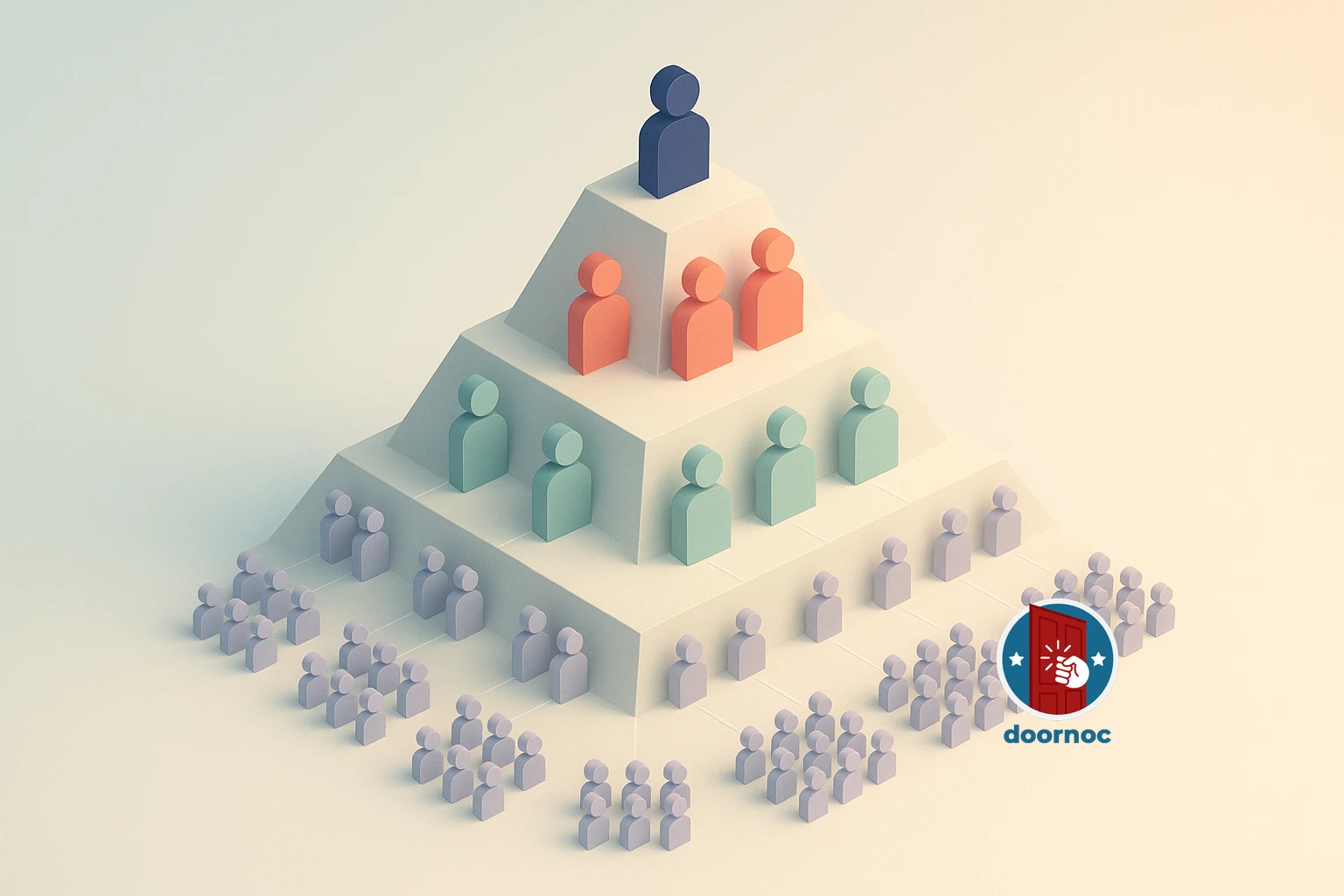 Isometric illustration of a four-tier organizational pyramid with geometric human figures in pastel colors showing hierarchical campaign structure.
The Volunteer Recruitment Funnel
Think of volunteer recruitment as a funnel with four stages:
1. Awareness (Top of Funnel). People learn about your campaign and opportunities to get involved through email lists, social media, events, and personal invitations. Goal: Generate 10x more awareness contacts than you need active volunteers.
2. Interest (Middle of Funnel). Interested people sign up for volunteer shifts, attend informational meetings, or respond to recruitment calls. Goal: Convert 30-40% of awareness contacts to expressed interest.
3. First Action (Conversion Point). People attend their first canvassing shift, phone bank, or volunteer event. This is the critical conversion moment. Goal: Get 50-60% of interested people to take first action within 7 days of expressing interest.
4. Retention (Bottom of Funnel). First-time volunteers return for additional shifts and become regular contributors. Goal: Retain 40-50% of first-time volunteers for at least 3 additional shifts.
If you need 100 active volunteers on your final GOTV weekend, work backward: you need 200 people to take first action, 400 to express interest, and 4,000 awareness contacts. Start building that pipeline now.
Recruitment Tactics That Work in 2026
The most effective volunteer recruitment in 2026 combines digital outreach with personal relationship-building:
Personal recruitment (highest conversion). Field organizers and existing volunteers directly invite friends, family, neighbors, and community members. Personal asks convert at 40-60% compared to 2-5% for mass email. Make personal recruitment your primary strategy.
Community organizing. Build relationships with local organizations, faith communities, unions, and activist groups who share your values. A single relationship with a community leader can yield 10-20 committed volunteers.
Digital recruitment. Use email, social media, and campaign website sign-ups to capture interest, but always follow up with personal contact within 24-48 hours. The campaigns that win are those that treat digital recruitment as lead generation, not volunteer activation.
Visibility events. Organize campaign events, rallies, and community gatherings that allow interested people to meet the candidate and connect with other volunteers. These events convert interested people into committed activists.
Volunteer-to-volunteer recruitment. Your best recruiters are existing volunteers. Implement a “bring a friend” program where volunteers get recognition for recruiting others. Some campaigns offer small incentives (campaign swag, special candidate time) for volunteers who recruit 3+ friends.
For detailed strategies on organizing effective canvassing teams, see our guide on how to organize door-to-door canvassing teams.
Developing Your Voter Contact Strategy
Your field organization exists to execute a voter contact strategy that persuades and mobilizes your target voters. In 2026, winning campaigns use a multi-touch contact strategy that combines door-to-door canvassing with phone banking, text messaging, and digital advertising.
Calculating Your Voter Contact Goals
Start by defining your target voter universe—the specific voters you need to persuade or mobilize to win. Then calculate the number of contacts needed:
For persuasion targets: Plan for 3-5 quality contacts per voter (combination of doors, phones, mail, and digital). Research from 2026 competitive races shows that voters who receive 4+ contacts are 2.3x more likely to support your candidate than those receiving 1-2 contacts.
For base mobilization: Plan for 5-7 contacts with your core supporters to ensure turnout. High-propensity voters need fewer touches; low-propensity supporters require more frequent contact.
For GOTV (final 72 hours): Plan to contact every target voter at least once, preferably twice, in the final three days before Election Day.
Example calculation for a local campaign:
- Target universe: 12,000 voters
- Persuasion targets: 4,000 voters × 4 contacts = 16,000 contacts
- Base mobilization: 8,000 voters × 6 contacts = 48,000 contacts
- GOTV: 12,000 voters × 2 contacts = 24,000 contacts
- Total needed: 88,000 voter contacts
Now work backward to determine staffing and volunteer needs. If each volunteer averages 40 doors per 3-hour shift, you need 2,200 volunteer shifts. Spread over 20 weeks, that’s 110 shifts per week, or 15-16 shifts per day if you’re canvassing 7 days per week.
Door-to-Door Canvassing: Your Highest-Impact Tactic
Despite the growth of digital organizing, door-to-door canvassing remains the highest-impact voter contact method in 2026. Voters contacted at the door are 3-4x more likely to support your candidate than those reached only through mail or digital advertising.
Effective door-to-door operations require:
Smart turf cutting. Divide your target universe into manageable canvassing routes that volunteers can complete in 2-3 hours. Modern platforms like DoorNoc automatically generate optimized routes based on volunteer capacity and target voter density, eliminating the hours field organizers used to spend manually cutting turf.
Quality training. Every canvasser needs training on message delivery, handling objections, and using your canvassing technology. Invest 30-45 minutes training new volunteers before their first shift. For comprehensive training approaches, see our guide on how to train canvassers for political campaigns.
Real-time data capture. Canvassers should record voter responses immediately using mobile apps, not paper lists. This allows field directors to track progress in real-time and identify problems before they become catastrophic.
Safety protocols. Establish clear safety guidelines for canvassers, including buddy systems, check-in procedures, and de-escalation training. For detailed safety protocols, review our guide on how to handle difficult voters while canvassing.
Performance tracking. Monitor key metrics like doors knocked per hour, contact rate (conversations vs. not-homes), and conversion rate (supporters vs. undecided/opposed). Use this data to coach volunteers and adjust deployment.
The most effective canvassing operations in 2026 achieve contact rates of 35-45% (meaning they have conversations with 35-45% of doors knocked) and knock 40-50 doors per volunteer per 3-hour shift. If your numbers are significantly below this, you have either poor turf cutting, inadequate training, or volunteers who aren’t following the plan.
Integrating Phone Banking and Digital Contact
While door-to-door canvassing is your highest-impact tactic, phone banking and digital contact allow you to reach voters who are never home, live in difficult-to-canvass areas, or require additional touches.
Phone banking works best for:
- Reaching voters in rural areas where door-to-door is inefficient
- Conducting voter ID before canvassing to prioritize targets
- Following up with voters who weren’t home during canvassing
- GOTV calls in the final 72 hours to confirm turnout plans
Plan for phone bankers to complete 30-40 calls per hour with a 15-25% contact rate. That means 6-10 conversations per hour per volunteer.
Peer-to-peer texting provides a middle ground between the personal touch of phone calls and the scale of mass communication. Texting works well for:
- Volunteer recruitment and shift reminders
- Quick voter ID surveys
- GOTV reminders and polling location information
- Following up with voters who requested more information
The key to effective texting in 2026 is personalization. Generic mass texts get ignored or marked as spam. Texts that reference specific voter concerns or previous interactions generate 4-5x higher response rates.
Technology and Tools for Field Operations
Your field organization’s effectiveness in 2026 depends heavily on the technology you use to manage volunteers, track voter contact, and analyze performance. The campaigns still using spreadsheets and paper walk lists are losing to opponents using integrated field management platforms.
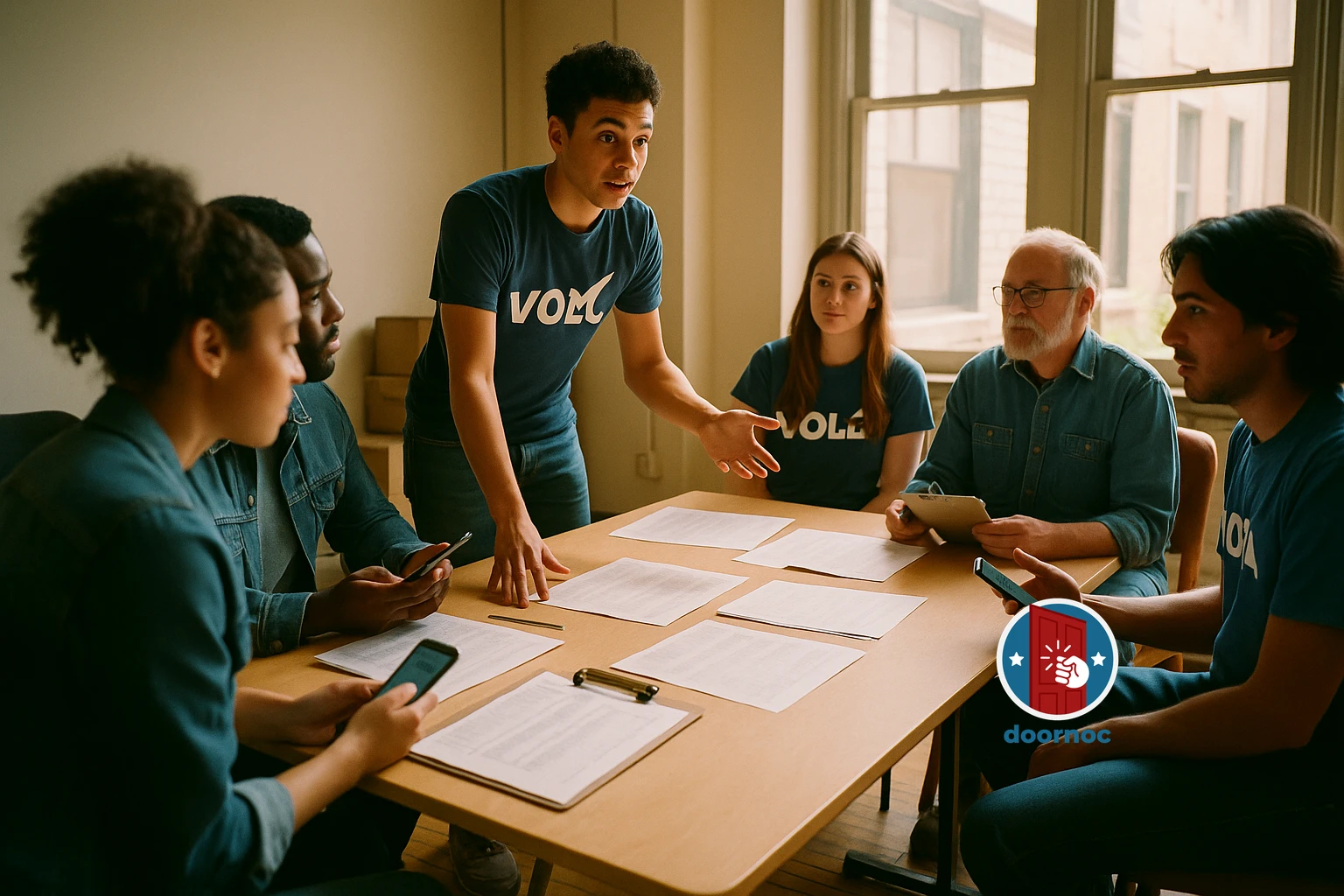 Volunteers seated around a table receiving training from a standing field organizer in a sunlit campaign office.
Essential Technology Stack
A modern field operation requires these core technology components:
Canvassing platform. This is your mission-critical tool. You need a mobile-first platform that allows canvassers to access walk lists, navigate routes, record voter responses, and sync data in real-time. DoorNoc provides all of these capabilities with offline functionality for areas with poor cell coverage.
Key features to require:
- Mobile-optimized interface for iOS and Android
- Offline mode for data collection without connectivity
- Real-time data syncing when connectivity is available
- GPS tracking to verify doors knocked
- Custom survey questions for voter ID
- Integration with voter file data
Voter file and targeting database. You need access to a regularly updated voter file with contact information, voting history, and demographic data. Most campaigns purchase voter file access through their state party or vendors like NGP VAN, EveryAction, or PDI.
Volunteer management system. Track volunteer contact information, shift sign-ups, attendance history, and performance metrics. Some campaigns use dedicated tools like Mobilize or Action Network; others manage this through their canvassing platform or CRM.
Communication tools. You need reliable ways to communicate with volunteers about shift opportunities, campaign updates, and last-minute changes. Most campaigns use a combination of email (Mailchimp, Action Network), text messaging (Hustle, ThruText), and Slack/Discord for team coordination.
Analytics and reporting. Field directors need dashboards showing real-time progress toward voter contact goals, volunteer performance metrics, and territory-by-territory breakdowns. The best platforms provide this natively; others require exporting data to Google Sheets or Tableau.
For a detailed comparison of canvassing platforms, see our analysis of DoorNoc vs Pulsar (Campaign Sidekick).
Data Management and Quality Control
Your field data is only valuable if it’s accurate. Implement these quality control processes:
Daily data review. Field organizers should review all canvassing data within 24 hours of collection, looking for obvious errors, incomplete responses, or suspicious patterns (like a canvasser who recorded 100 doors in an hour).
Spot checks and ride-alongs. Regional field directors should regularly accompany canvassers on routes to verify they’re following protocols and recording data accurately. Plan for at least one ride-along per canvasser per month.
GPS verification. Use GPS tracking features to verify that canvassers actually visited the doors they claim to have knocked. This prevents data fraud and identifies canvassers who are skipping difficult doors.
Duplicate detection. Implement systems to flag when the same voter is contacted multiple times within a short period. While some duplication is inevitable, excessive duplication wastes volunteer time and annoys voters.
Response validation. Set up automatic flags for suspicious data patterns, like a canvasser who records 90% support when the precinct historically votes 60% for the other party.
Campaigns that implement rigorous data quality controls maintain 95%+ data accuracy compared to 70-80% for campaigns with loose standards. That difference translates directly into more effective targeting and higher win rates.
Scaling Your Field Organization Over Time
Field organizations don’t appear overnight. You need to build capacity progressively, starting with infrastructure and leadership development, then scaling up volunteer recruitment and voter contact as you approach Election Day.
Timeline for Building Field Infrastructure
9-6 months before Election Day: Foundation Phase
- Hire field director
- Develop overall field strategy and contact goals
- Begin recruiting regional field directors
- Establish technology stack and data systems
- Build relationships with local party organizations and allied groups
- Create volunteer recruitment materials and training curricula
6-4 months out: Leadership Development Phase
- Hire field organizers for priority territories
- Launch volunteer recruitment pipeline
- Identify and recruit potential precinct captains
- Begin limited voter contact (primarily voter ID to refine targeting)
- Conduct initial volunteer trainings
- Test and refine technology systems
4-2 months out: Scaling Phase
- Expand field organizer team to full capacity
- Ramp up volunteer recruitment aggressively
- Launch sustained voter contact operations
- Develop precinct captain network
- Implement weekly performance reviews and coaching
- Refine messaging based on voter feedback
2 months-Election Day: Peak Operations Phase
- Maximize volunteer deployment and voter contact
- Conduct daily performance tracking and rapid adjustments
- Focus on high-value persuasion and mobilization contacts
- Prepare GOTV operation infrastructure
- Train volunteers on Election Day roles
Final 72 hours: GOTV Phase
- Execute intensive door-to-door and phone GOTV
- Deploy precinct captains to lead neighborhood efforts
- Provide polling location and ballot information
- Offer rides to polls and solve voter problems
- Track real-time turnout and redeploy resources
Campaigns that follow this timeline build field organizations with 3-4x more volunteer capacity than those that wait until the final months to invest in field infrastructure.
Managing and Motivating Your Field Team
Your field organization is only as strong as the people who comprise it. Effective field management in 2026 requires creating a culture of accountability, recognition, and continuous improvement.
Setting Clear Expectations and Goals
Every member of your field team—from field director to first-time volunteer—should have clear, measurable goals:
Field organizers: Daily/weekly voter contact targets (e.g., 300 doors knocked per week), volunteer recruitment goals (e.g., recruit 5 new volunteers per week), and volunteer retention metrics (e.g., 50% of volunteers return for 3+ shifts).
Precinct captains: Weekly canvassing shifts led, volunteers recruited, and precinct completion percentage.
Volunteers: Doors knocked per shift, attendance consistency, and recruitment of additional volunteers.
Make these goals visible through leaderboards, weekly reports, and team meetings. The campaigns that win are those where everyone knows the score and feels personal accountability for hitting targets.
Recognition and Motivation
Field organizing is hard work with long hours and frequent rejection. Sustaining volunteer energy requires intentional recognition and motivation:
Public recognition. Celebrate top performers in team meetings, on social media, and through campaign communications. People volunteer partly for social recognition—give it to them.
Personal appreciation. Field directors and organizers should personally thank high-performing volunteers through calls, handwritten notes, or one-on-one meetings. A personal thank-you from the candidate is even more powerful.
Peer community. Create opportunities for volunteers to build friendships with each other through social events, team competitions, and online communities. Volunteers who have friends on the campaign are 3x more likely to stay engaged.
Progress visibility. Show volunteers how their work contributes to winning. Share stories of voters they persuaded, display progress toward contact goals, and connect individual efforts to campaign success.
Leadership opportunities. Give your best volunteers opportunities to lead shifts, train others, and take on more responsibility. The volunteer-to-leader pipeline keeps people engaged and builds your future field staff.
Coaching and Performance Management
Not every volunteer or field organizer will perform at the level you need. Implement structured coaching and performance management:
Weekly one-on-ones. Field directors should meet weekly with regional field directors; RFDs should meet weekly with field organizers. Use these meetings to review performance data, identify barriers, and problem-solve together.
Performance improvement plans. When staff members consistently miss targets, create written performance improvement plans with specific goals and timelines. This protects the campaign legally and creates accountability.
Rapid replacement. If someone isn’t working out after a reasonable coaching period, replace them quickly. Every day you keep an underperforming field organizer is a day you’re not hitting your voter contact goals. Political campaigns don’t have time for lengthy performance management processes.
Promote from within. Your best field organizers often come from your volunteer ranks. Create a clear pathway for volunteers to become paid staff, and actively recruit your top performers.
Measuring Field Organization Success
You can’t improve what you don’t measure. Implement these key performance indicators (KPIs) to track field organization effectiveness:
 Close-up of a hand holding a smartphone displaying a colorful analytics dashboard with graphs, heat maps, and animated metrics.
Core Metrics to Track Daily
Voter contact rate. Total doors knocked, phone calls completed, and texts sent. Compare actual to goal daily and adjust deployment to stay on track.
Contact quality. Percentage of doors knocked that result in conversations (target: 35-45%). Low contact rates indicate poor turf cutting or volunteers knocking at the wrong times.
Volunteer deployment. Number of volunteers deployed per shift and average doors knocked per volunteer (target: 40-50 per 3-hour shift). This measures both recruitment success and volunteer productivity.
Conversion rate. Percentage of contacted voters who commit to supporting your candidate (varies by race competitiveness, but track trends over time). Declining conversion rates may indicate message problems or volunteer quality issues.
Data quality. Percentage of canvass responses with complete information and no obvious errors (target: 95%+).
Weekly Performance Reviews
Conduct weekly performance reviews with your field team, examining:
- Progress toward overall voter contact goals (are you on pace to hit your targets?)
- Territory-by-territory performance (which areas are ahead/behind?)
- Volunteer recruitment and retention trends (is your pipeline growing or shrinking?)
- Individual field organizer performance (who’s hitting targets and who needs coaching?)
- Data quality and technology issues (are systems working as intended?)
Use these reviews to make rapid adjustments. If a territory is falling behind, redeploy resources. If volunteer retention is dropping, investigate why and fix the problem. The campaigns that win are those that identify and solve problems within days, not weeks.
Technology-Enabled Performance Tracking
Modern canvassing platforms like DoorNoc provide real-time dashboards showing all these metrics automatically. Field directors can see live updates on doors knocked, volunteer deployment, and territory progress without waiting for end-of-day reports.
This real-time visibility allows for hour-by-hour adjustments. If you notice at 2pm that a particular turf is falling behind, you can text additional volunteers to join that shift. If a canvasser’s contact rate is unusually low, you can call them immediately to troubleshoot.
Campaigns using real-time tracking tools achieve 15-25% higher voter contact rates than those relying on daily or weekly reporting.
Common Field Organization Mistakes to Avoid
Even experienced campaigns make these common mistakes that undermine field effectiveness:
Starting too late. Campaigns that wait until 2-3 months before Election Day to build field infrastructure never catch up to opponents who started earlier. Begin building 6-9 months out.
Hiring inexperienced field directors. Your field director is your most important hire. Don’t give this role to someone who’s never run a field operation before, no matter how enthusiastic they are.
Treating all voters equally. Not all voter contacts are equally valuable. Focus your best volunteers and most experienced canvassers on your highest-priority persuasion and mobilization targets.
Neglecting volunteer retention. Many campaigns obsess over recruiting new volunteers while ignoring the volunteers they already have. It’s 5x easier to get an existing volunteer to return than to recruit a new one.
Poor data hygiene. Garbage data leads to garbage targeting. Implement quality control processes from day one.
Micromanaging field organizers. Give organizers clear goals and autonomy to achieve them. Field directors who micromanage every decision create bottlenecks and demoralize staff.
Ignoring technology. The campaigns still using paper walk lists in 2026 are losing. Invest in modern tools that make your team more efficient.
Failing to integrate field with other campaign functions. Your field operation shouldn’t exist in isolation. Coordinate with communications (what messages are working?), fundraising (can you recruit donors as volunteers?), and digital (how can you amplify field stories online?).
Building Field Organizations for Different Campaign Types
The specific structure and scale of your field organization varies based on campaign type:
 Diverse volunteers dispersing from a parking lot at golden hour, walking in different directions with campaign materials.
Local Campaigns (City Council, School Board, State Legislature)
- Field director: Often the campaign manager wearing multiple hats
- Paid staff: 0-2 field organizers depending on budget
- Volunteer structure: 10-30 active volunteers, 3-5 team leaders
- Focus: Highly targeted door-to-door in specific precincts, heavy reliance on candidate doing doors
- Timeline: 3-6 months of active field operations
Congressional Campaigns
- Field director: Full-time dedicated role starting 6-9 months out
- Paid staff: 2-4 regional field directors, 8-15 field organizers
- Volunteer structure: 200-500 active volunteers, 30-50 precinct captains
- Focus: District-wide door-to-door and phone banking, significant GOTV operation
- Timeline: 9-12 months of infrastructure building and operations
Statewide Campaigns (Governor, Senate)
- Field director: Senior staff role starting 12-18 months out
- Paid staff: 8-15 regional field directors, 40-100 field organizers
- Volunteer structure: 2,000-10,000 active volunteers, 200-500 precinct captains
- Focus: Multi-region coordination, heavy investment in volunteer leadership development
- Timeline: 18-24 months of progressive scaling
Regardless of campaign size, the fundamental principles remain the same: clear hierarchy, measurable goals, data-driven decision-making, and relentless focus on volunteer recruitment and retention.
Your Field Organization is Your Competitive Advantage
In an era where digital advertising costs continue to rise and voter attention becomes increasingly fragmented, your field organization represents your most sustainable competitive advantage. Opponents can match your TV spending or social media presence, but they can’t quickly replicate a well-built field operation with deep community relationships and hundreds of trained volunteers.
The campaigns that win in 2026 are those that invest early in field infrastructure, use modern technology to maximize efficiency, and create cultures where volunteers feel valued and connected to the mission. Start building your field organization today, and you’ll have the capacity to execute a winning ground game when it matters most.
For more detailed guidance on specific aspects of field operations, explore our resources on organizing canvassing campaigns, increasing voter contact rates, and targeting swing voters. And when you’re ready to equip your field team with the technology they need to win, explore DoorNoc’s features or contact our team to discuss your campaign’s specific needs.
Frequently Asked Questions
What is a political field organization?
A political field organization is the structured network of staff and volunteers responsible for direct voter contact activities like door-to-door canvassing, phone banking, and voter registration. It functions as the campaign’s ground game, converting strategic plans into face-to-face conversations with voters.
How many field organizers do I need for a campaign?
For local campaigns, plan for 1 field organizer per 5,000-7,500 target voters. Statewide campaigns typically deploy 1 organizer per 10,000-15,000 voters in priority areas. The key metric is maintaining a 1:15 ratio between paid organizers and volunteer team leaders.
When should I start building my field organization?
Begin building your field organization 6-9 months before Election Day for competitive races. Start with leadership recruitment and volunteer pipeline development, then scale up voter contact operations 3-4 months out. Early infrastructure investment yields 3-4x more volunteer capacity by peak season.
What’s the difference between a field organizer and a field director?
A field director oversees the entire field operation, setting strategy, managing budgets, and coordinating regional teams. Field organizers execute that strategy in specific territories, recruiting volunteers, managing canvassing operations, and hitting daily voter contact targets. Directors plan; organizers implement.
How do I track field organization performance in 2026?
Track five core metrics: voter contact rate (doors knocked per volunteer hour), volunteer retention rate, conversion rate (conversations to commitments), volunteer recruitment velocity, and cost-per-contact. Modern platforms like DoorNoc provide real-time dashboards showing these metrics by team, territory, and time period.