
You can be smart, connected, and serious about your community, and still feel stuck before the first filing deadline. Maybe the urge to run came from watching a bad local decision land on your neighborhood, or from being the person everyone calls when something needs fixing. That’s a real starting point, but it isn’t a campaign yet.
The mistake most first-time candidates make is treating the run as a personality test. It isn’t. How to run for office with no experience is an operational question, and the campaigns that win usually turn community credibility into a measurable system: a ballot-safe filing process, a realistic vote goal, a donor list, a volunteer bench, a door program, and a message that gets tested in the field.
Why Most First-Time Candidates Actually Lose
The usual failure mode is simple. A person announces first, then starts asking basic questions like where to file, who to pay, what the deadline is, and how many voters are in the race. By then, the campaign is already behind, because enthusiasm is not the same thing as infrastructure.
That’s the wrong way to think about inexperience. The historical baseline shows why. From the 1980s through the mid-2010s, nearly three-quarters of newly elected U.S. House members had already held elected office, but in the 2016 to 2020 period, only about half of House freshmen had prior officeholding experience, according to the Federal Election Commission’s congressional tables (FEC congressional candidate data). In plain English, newcomers can win, but they still need substitute signals of competence.
Experience is not the point, proof is
A first-time candidate doesn’t beat a seasoned opponent by insisting on authenticity. The candidate wins by proving readiness in public. That proof can come from visible community work, issue leadership, fundraising discipline, volunteer organization, and direct voter contact.
Practical rule: voters forgive a short résumé faster than they forgive a sloppy operation.
The better mental model is resource gap, not identity gap. A new candidate needs to close the credibility distance with action that people can see and measure. That means a contact universe, a calendar, a finance system, and a field plan that converts name recognition into actual support.
A useful place to start is the local civic ladder. A newcomer who wants a political foothold can first build issue visibility, then precinct credibility, then voter contact discipline. A good primer on that first step is how to get politically involved, because the first campaign usually grows out of work already being done in the community.
Eligibility, Filing, and Pre-Announcement Compliance
The first job is getting the candidacy legally alive. Before any public announcement, verify residency, voter registration, minimum age, filing windows, fees or petition signatures, committee registration, financial disclosures, and reporting dates. Those rules change by jurisdiction, so use the correct filing authority and election calendar, not a secondhand summary.
Washington’s candidate guidance requires certain candidates to file registration and personal-finance forms within two weeks of becoming a candidate, while local candidates in Texas generally file with their local filing authority rather than the state ethics commission (Texas Ethics Commission guidance). Age and residency rules can disqualify a candidacy before it starts, so verify them against the filing authority’s own guidance. The United Nations reports that 69% of countries restrict young people from running even when they can vote, and the average minimum candidacy age worldwide is 22.5, more than four years above the average voting age (UN youth report).
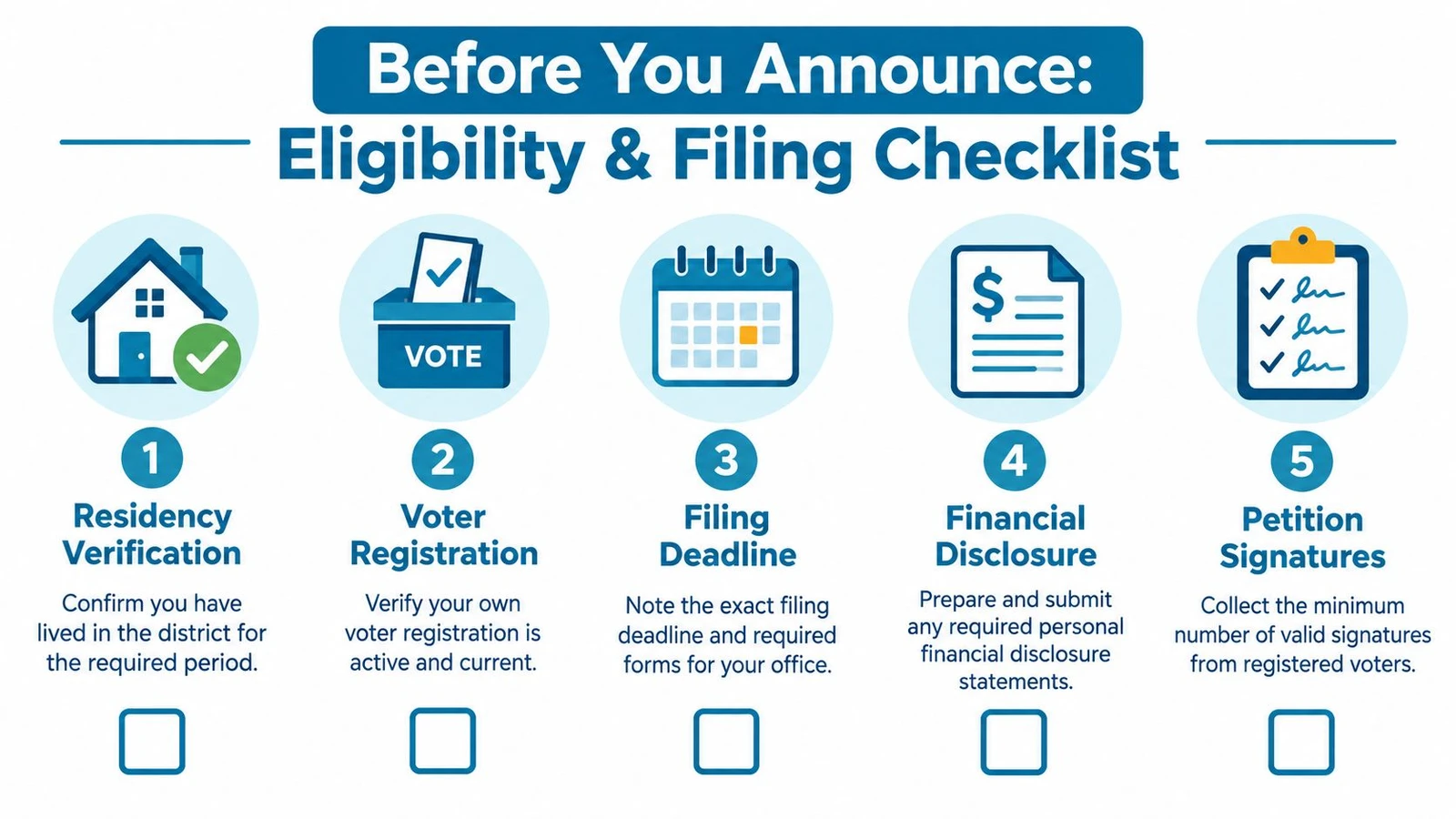
The pre-filing checklist that prevents dumb mistakes
Use this in order, not randomly.
- Confirm eligibility: residency, age, and voter registration need to be current.
- Identify the filing authority: state, county, city, party, or local election office.
- Map the deadlines: filing windows, fees, petition requirements, and disclosure dates.
- Set up compliance: committee registration, bank account, treasurer, and reporting rhythm.
- Ask when candidacy begins: exploratory chatter and official candidacy can trigger different rules.
A polished announcement means nothing if the campaign never gets on the ballot.
Procedural mistakes can keep a credible candidate off the ballot before campaigning even begins.
For a full planning pass on the office-selection side, the tactical win-number work is covered in how to calculate your campaign win number.
Building Your Minimum Viable Campaign Plan
The smartest first campaign looks like a small business launch with a ballot target. It has a budget, a customer list, a schedule, and a way to measure whether the operation is working. That’s exactly why a planning discipline like content planning strategy for small businesses translates well here, because the discipline is the same, even if the product is a vote.
Start with the office, not the ego. A city council race, school board race, or state legislative race each has a different geography, a different contact universe, and a different money ceiling. Then define a vote goal using prior turnout and precinct-level results, so the campaign has a number to chase instead of a feeling.
Write a one-page plan, not a fantasy platform
The one-page plan should name four things: the win threshold, the persuasion universe, the budget envelope, and the people responsible for money and compliance. That’s enough to keep the campaign honest without drowning it in slides.
A first-time candidate also needs to decide how the path to the ballot changes the whole operating model. The choice isn’t ideological, it’s structural.
| Path | Fundraising Access | Endorsement Path | Voter Contact Intensity | Best Fit For |
|---|---|---|---|---|
| Party nomination | Usually higher | Party gatekeepers matter more | High | Candidates who can work inside a party process |
| Independent run | Usually narrower | Fewer institutional validators | Very high | Candidates with strong local name recognition |
| Nonpartisan local race | Mixed | Community credibility matters most | Moderate to high | School board, city, and special-district races |
Research summarized by Brookings found that roughly 70% to 80% of congressional primary candidates from 1990 through 2016 were amateurs, meaning they had never held elective office (Brookings summary via FEC-linked research). So, yes, entering the race without officeholding experience is normal. Winning still depends on structure.
Set four campaign-health metrics on day one, and review them every week: cash on hand, burn rate, volunteer retention, and verified supporter coverage of the win number. Those numbers tell the truth faster than enthusiasm does.
Fundraising Basics for a First-Time Candidate
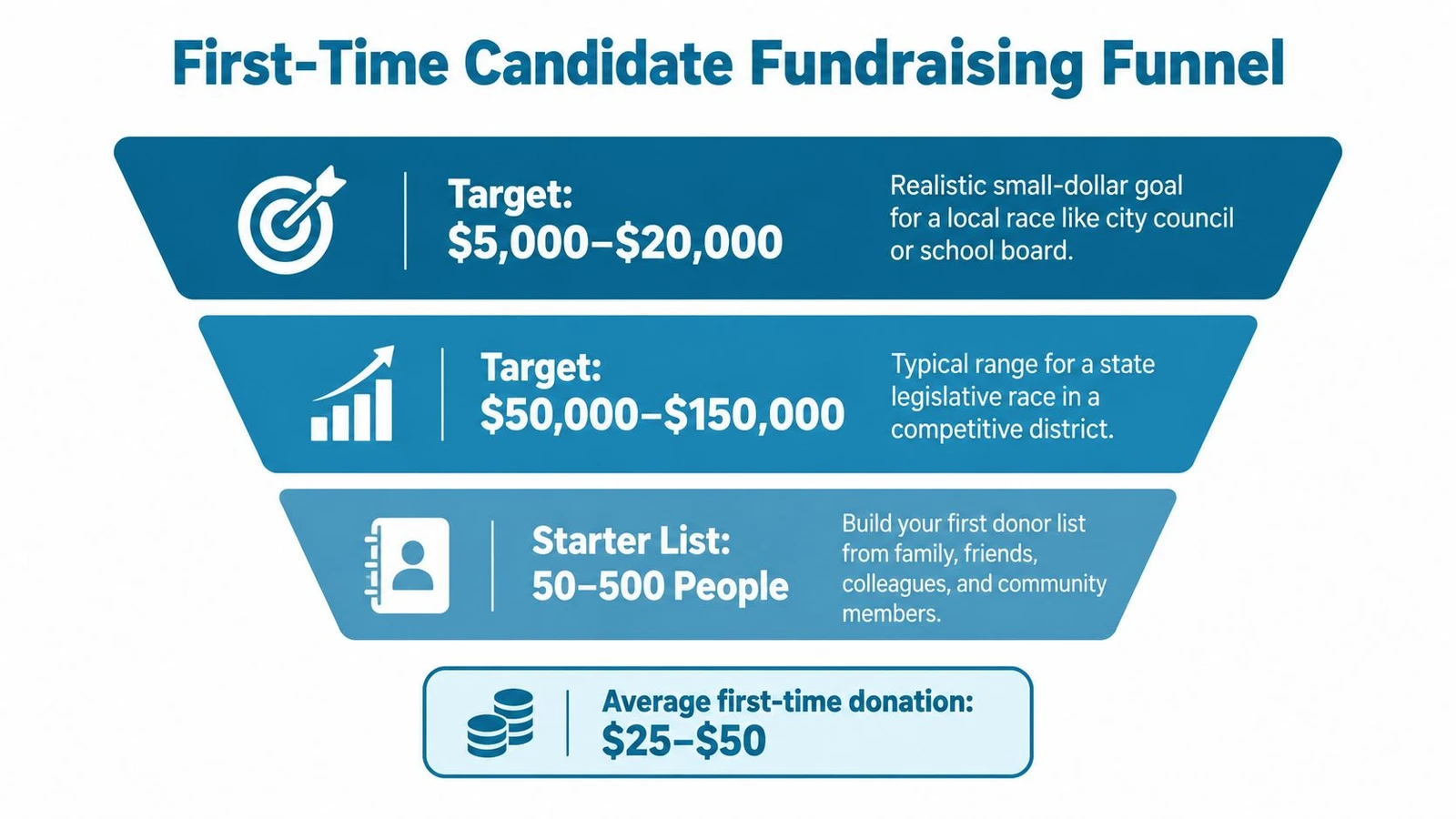
A first-time candidate does not need a fake fundraising voice. The campaign needs a donor list, a clear ask, and a reporting system that does not break. Start with people who already know the candidate’s work, then move outward to colleagues, community allies, and issue supporters.
Build the donor universe before the first serious ask. Begin with family, close friends, coworkers, former clients, neighbors, alumni, and community contacts who have already seen the candidate solve problems. Early small-dollar checks create proof that the campaign exists and can draw support. That is what opens the next ring of the network.
Use a ladder, not one ask for everyone
The ask should rise with evidence.
- Friends and family first: small checks at the beginning, while the campaign is still proving itself.
- Community leaders next: larger asks after the committee, message, and filing structure are in place.
- Institutional donors later: bigger checks only after the campaign has visible traction and disciplined reporting.
That sequence matters because first-time candidates often think they need approval from a handful of powerful people. They do not. They need a growing list of people willing to back a campaign that looks capable of finishing the race.
The structural disadvantage is real, especially when party systems favor familiar insiders. The UN youth report says 9 in 10 people globally see discouraging aspects of entering politics, including perceptions that politics is dishonest, bureaucratic, or complicated, and it also notes that nomination fees can deter young candidates. The report’s Canadian candidate findings also show first-time women were less likely than men to receive nominations in competitive ridings in 2025, 20.3% versus 24.2%. Those numbers describe access, not worth.
Compliance is not separate from fundraising. Every contribution needs to be reconciled to an original record, in-kind support must be classified correctly, and the treasurer has to own the reporting calendar. A disciplined finance file tells donors the campaign is serious.
Clean reporting isn’t a chore you postpone until after the campaigning. It’s part of the credibility the campaign is selling.
For grassroots ideas that fit a newcomer budget, the practical examples in grassroots fundraising ideas that win campaigns are a useful companion.
Messaging, Outreach, and Testing What Actually Persuades
A first-time candidate usually talks too much before learning what moves people. That wastes time. Pick one local problem, own it, and test a short explanation in real conversations until you know whether it lands.
Keep the message narrow and useful. A 30-second version should work for introductions, and a 90-second version should work at the door. Both need the same local problem, the same constituency, and the same reason this candidate can handle it.
Test the message in small batches
Start with a handful of conversations, not a full broadcast. Record three things every time: what issue the voter cares about, whether the reaction is support, skepticism, or hostility, and which part of the pitch caused it. Then tighten the language based on what people say.
Face-to-face canvassing can raise turnout under the right conditions, and a relational-organizing experiment found a 13.2-percentage-point turnout increase when voters were contacted by a friend rather than a stranger. That is the point. Conversations matter more than slogans while the candidate is still building trust.
Sort precincts by support level, not just by geography. Put likely supporters, persuadable voters, and hard opponents into separate buckets, then move time and money toward the first two groups. That shows where persuasion is happening instead of counting doors like the number itself means anything.
Contact volume is not the outcome, supporter conversion is.
The message has one job: make it easy for a voter to say, “This person gets my problem.” If that does not happen, the copy needs work, not more polish.
Volunteers, Door-Knocking, and Choosing a Canvassing Stack
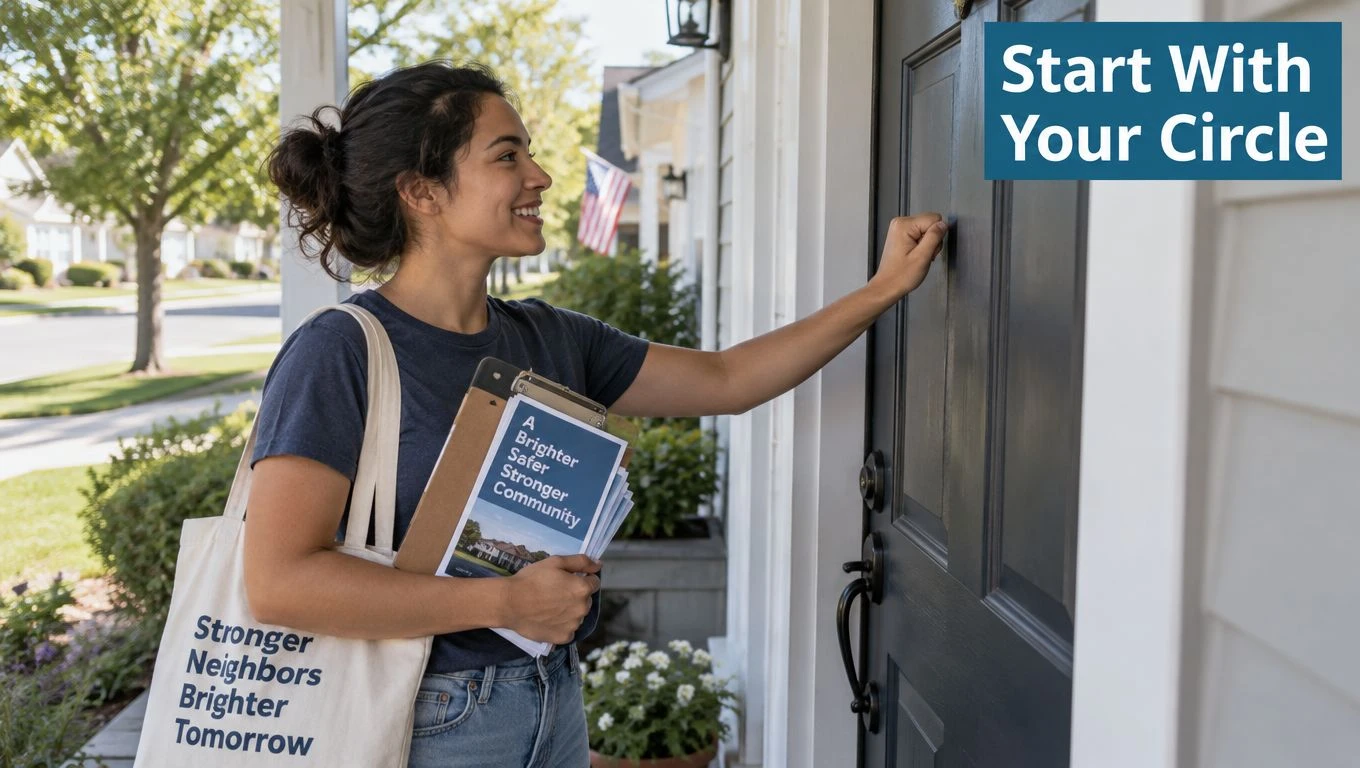
Volunteer programs fail when they start with recruitment instead of setup. The first move is to pull people from concentric circles, starting with the candidate’s own network, then community groups, then open sign-ups from the campaign site. That sequence gives the campaign the best chance of getting reliable help before it asks strangers for time.
The onboarding should be short. A volunteer should be able to learn the script, the turf, and the survey in under an hour. If training takes half a day, the program is too heavy for a first campaign.
What the operation actually needs
The field stack should do four things without drama.
- Capture data offline: doors don’t always have signal, so the app has to store responses locally and sync later.
- Cut routes intelligently: walk lists should be balanced and road-aware, not dumped together by ZIP code.
- Show live progress: managers need to see what got completed while the shift is still happening.
- Connect to voter lists: manual CSV chaos kills time and creates errors.
A tool can be useful if it reduces turf-cutting, prevents duplicate work, and keeps the volunteer experience simple. One option that fits those requirements is doornoc, which supports mobile canvassing with offline data collection, route generation, a real-time dashboard, and MailVotes integration for voter lists. Its tiered plans also let a campaign scale logins and campaigns as the team grows.
A campaign should not overbuy software before it has a field plan. Manual walk lists are fine for a tiny volunteer push. Generic spreadsheets break down fast once the team gets bigger or the routes get messier. A dedicated canvassing platform makes sense when the candidate needs repeatable route creation, offline capture, and same-day visibility.
| Approach | Setup Time | Offline Support | Route Planning | Team Scalability |
|---|---|---|---|---|
| Manual walk lists | Low | No | Basic | Weak |
| Spreadsheet workflow | Medium | Limited | Clunky | Limited |
| Dedicated canvassing platform | Higher upfront, lower after setup | Yes | Strong | Strong |
A related operational idea shows up in event workflows too. When a campaign wants fast, shareable volunteer content or field photos, a clean AI photo platform for events can support the communications side without changing the field operation itself.
Compliance, Reporting, and Your First 90 Days
The campaign’s boring work is the work that keeps it alive. Every contribution and expenditure has to be reconciled to source records, in-kind support needs the right classification, and reporting deadlines can’t be missed. The candidate who treats compliance as optional usually pays for that mistake later, in money, time, or both.
The right habit is a weekly postmortem. Look at the four campaign-health benchmarks from the planning stage, then stop activities that fail the threshold the campaign set in advance. That includes volunteer work that doesn’t retain people, fundraising tactics that cost too much per supporter, and outreach that doesn’t create confirmed supporters.
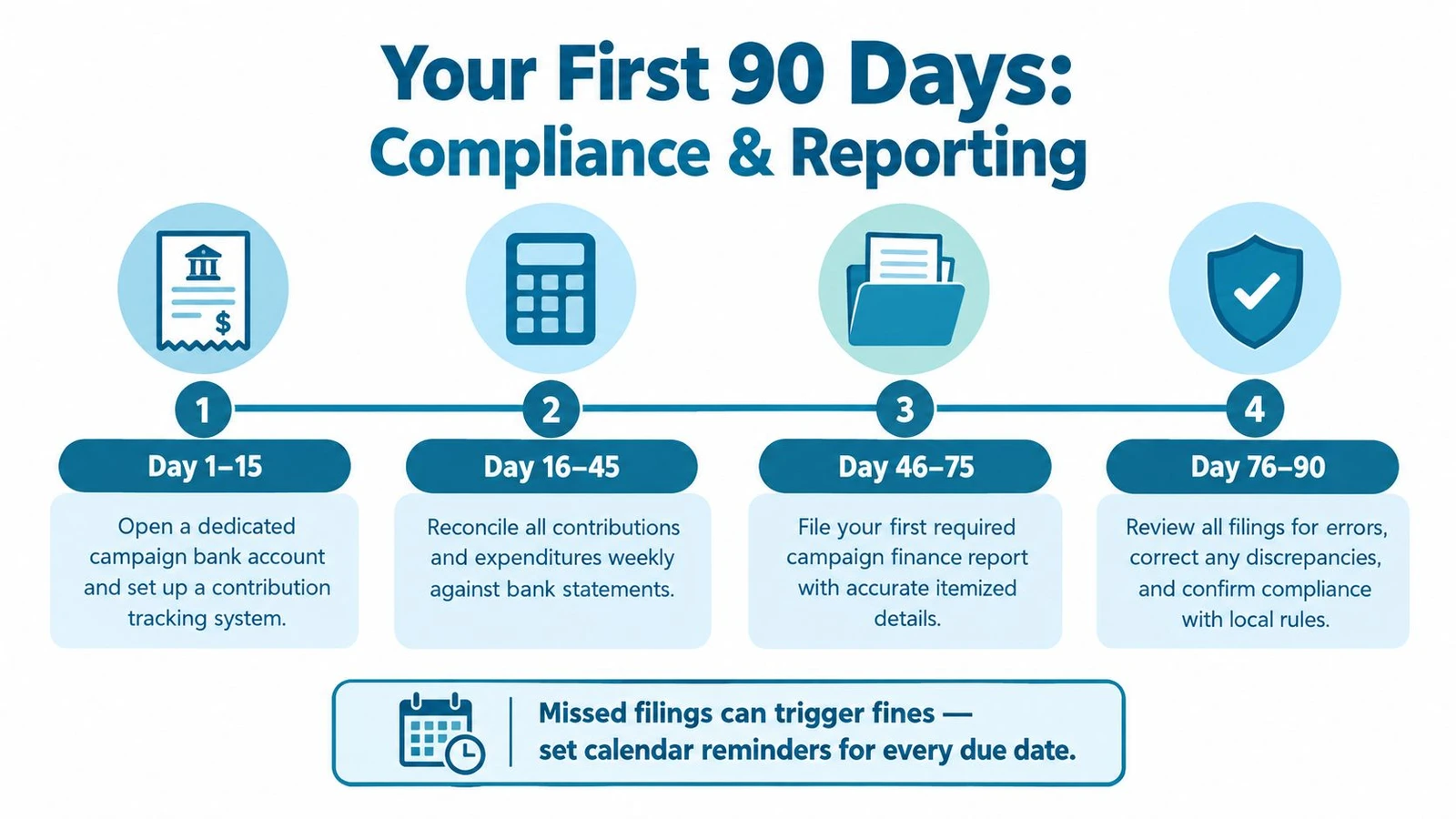
A 30-60-90 day operating checklist
- Days 1 to 30: verify eligibility, register the committee, build the contact universe, and recruit the minimum viable staff.
- Days 31 to 60: launch fundraising, draft and test the message, and onboard the first volunteers.
- Days 61 to 90: run the first canvassing shifts, integrate the canvassing platform, and publish transparent progress numbers.
The point of the first 90 days is not to look busy. It’s to become measurable. A campaign that can show progress, process, and compliance is already acting more like a credible contender than most first-timers.
A first campaign is a measurable organizing project, not a résumé contest.
The next serious step is field depth and data discipline. A candidate who wants to go further should study advanced door programs, voter targeting, and route management before scaling up. For that kind of field operation, doornoc provides a canvassing system built around route planning, offline data capture, voter lists, and live progress tracking, which is exactly the sort of structure a new campaign needs when it stops being hypothetical and starts counting doors.
Looking for a tool to run this? doornoc’s canvassing software bundles voter data, automatic turf cutting, the mobile app, and live reporting in one platform.