
Key Takeaways
- Real-time canvassing analytics for campaigns enable field directors to make strategic adjustments within minutes rather than days, improving voter contact rates by an average of 34% according to 2026 campaign data.
- Live voter contact tracking identifies underperforming territories and canvasser challenges immediately, allowing campaign managers to reallocate resources before losing critical voter engagement windows.
- Campaign dashboard features that update in real-time provide transparency across distributed teams, reducing coordination errors by 52% and increasing volunteer accountability.
- Campaigns using real-time analytics platforms report 47% faster response times to emerging voter concerns and 41% higher conversion rates on persuadable voters compared to those relying on end-of-day reporting.
Real-time canvassing analytics for campaigns has transformed from a luxury feature to an operational necessity in 2026. Campaign managers who can see live voter contact tracking data as it happens make better strategic decisions, allocate resources more efficiently, and ultimately win more elections. The difference between campaigns that leverage real-time data and those that rely on delayed reporting has never been more pronounced.
Why Real-Time Data Transforms Campaign Strategy
The fundamental advantage of real-time canvassing analytics lies in the compression of the decision-making cycle. Traditional campaigns operated on a 24-48 hour feedback loop: canvassers knocked doors during the day, submitted paper forms in the evening, data entry happened overnight, and managers reviewed reports the next morning. By the time strategic adjustments were made, valuable campaign hours had been lost.
Real-time analytics collapses this cycle to minutes. When a field director sees that a specific precinct shows 60% opposition to the campaign’s primary message at 2:00 PM, they can pivot messaging for afternoon and evening shifts in that territory. When volunteer productivity drops in a particular area, immediate investigation reveals whether it’s a data quality issue, difficult terrain, or a need for additional training.
According to a comprehensive study of 847 competitive races in 2026, campaigns using real-time analytics platforms achieved 34% higher voter contact rates than those using traditional reporting methods. More significantly, these campaigns identified and corrected field operation problems 6.7 times faster on average, preventing the compounding effects of strategic errors.
The competitive landscape has shifted dramatically. In closely contested races where margins of victory average just 2-3 percentage points, the ability to make data-driven adjustments in real-time can determine election outcomes. Campaigns that still rely on end-of-day reporting find themselves consistently outmaneuvered by opponents who operate with live intelligence.
The Speed Advantage in Modern Campaigns
Modern campaigns operate in an environment of compressed timelines and heightened voter expectations. Early voting periods, mail-in ballot deadlines, and the increasing volatility of voter preferences mean that campaign windows for persuasion and mobilization have narrowed considerably. Real-time data ensures that every available hour is used optimally.
Consider a typical scenario: A campaign discovers through real-time analytics at 11:00 AM that a planned afternoon canvass route contains significantly more already-voted households than expected. With live data, the field director immediately reroutes volunteers to higher-value targets, preserving 4-5 hours of volunteer time that would have been wasted knocking doors of voters who had already cast ballots.
Multiply this scenario across dozens of daily micro-decisions, and the cumulative advantage becomes substantial. Campaigns using platforms like Door Knock report that real-time visibility into field operations allows them to optimize volunteer deployment continuously throughout the day, resulting in 23% more productive voter conversations per volunteer shift.
Essential Features of Campaign Dashboard Analytics
Effective campaign dashboard features for real-time analytics must balance comprehensive data visibility with intuitive usability. Field directors and campaign managers need to absorb critical information at a glance while having the ability to drill down into specific metrics when necessary.
 A volunteer engages in a meaningful one-on-one conversation with a voter at their doorstep.
Live Performance Metrics That Matter
The most valuable real-time metrics provide actionable intelligence rather than vanity numbers. While total doors knocked is interesting, the contact rate (successful conversations divided by doors attempted) reveals actual field effectiveness. Similarly, tracking persuasion conversation completion rates shows whether canvassers are having substantive interactions or merely collecting quick responses.
Top-performing campaigns in 2026 monitor these core real-time metrics:
- Hourly contact rate by territory — identifies geographic areas with data quality issues or accessibility challenges
- Volunteer productivity distribution — reveals which team members need coaching or recognition
- Voter disposition trends — tracks support/oppose/undecided ratios to detect messaging effectiveness
- Issue priority frequency — shows which voter concerns are dominating conversations in real-time
- Persuasion attempt vs. completion ratio — measures whether canvassers are engaging undecided voters effectively
- Average conversation duration — indicates depth of voter engagement
- Real-time turf completion percentage — ensures assigned areas receive full coverage before deadlines
These metrics become exponentially more valuable when visualized geographically. Heat maps showing real-time canvassing activity, support concentration, and issue priority by precinct allow campaign strategists to identify patterns that would be invisible in tabular data. For more on tracking the right metrics, see our guide on how to track canvassing data effectively.
Geographic Visualization and Territory Management
Real-time geographic visualization transforms raw data into strategic intelligence. When a campaign manager can see a live map showing which blocks have been canvassed in the last hour, which territories are behind schedule, and where volunteer teams are currently concentrated, resource allocation becomes dramatically more efficient.
Advanced platforms provide layered map views that combine multiple data dimensions. A field director might view a map showing canvassing completion rates overlaid with voter support levels and volunteer locations simultaneously. This multi-dimensional view reveals optimization opportunities that single-metric dashboards miss entirely.
Territory-based analytics also enable real-time load balancing. When one area finishes early while another falls behind, managers can redirect resources instantly rather than discovering the imbalance at the end of the day. This dynamic resource allocation increases overall field coverage by 18-22% according to 2026 campaign efficiency studies.
How Live Voter Contact Tracking Improves Field Operations
Live voter contact tracking fundamentally changes the relationship between field operations and campaign strategy. Instead of field teams operating semi-independently and reporting results retrospectively, real-time systems create a continuous feedback loop that keeps field operations aligned with campaign priorities.
Immediate Problem Identification and Resolution
The most significant operational benefit of real-time tracking is the ability to identify and resolve problems before they cascade. When a volunteer’s contact rate suddenly drops, a field director can immediately check whether they’re encountering data issues, difficult terrain, or personal challenges that need support.
Common problems detected through real-time monitoring include:
- Data quality issues — incorrect addresses or outdated voter information causing low contact rates in specific areas
- Script confusion — volunteers struggling with messaging, revealed by unusually short conversation times
- Safety concerns — volunteers moving slowly or stopping, potentially indicating uncomfortable situations
- Technology problems — app crashes or sync failures detected through gaps in data submission
- Territory overlap — multiple canvassers accidentally assigned to the same area
- Volunteer fatigue — declining productivity throughout a shift indicating need for breaks or support
Early problem detection prevents minor issues from becoming major operational failures. A campaign that discovers a data quality problem after 50 volunteers have spent a full day in affected areas has lost hundreds of volunteer hours. A campaign that detects the same problem within the first hour through real-time analytics can immediately redirect efforts, minimizing waste.
Dynamic Resource Allocation
Real-time data enables sophisticated resource allocation that was impossible with traditional reporting. Campaign managers can see which territories are ahead of schedule, which are falling behind, and which contain higher concentrations of persuadable voters than expected. This visibility allows for continuous optimization of volunteer deployment.
A field director monitoring live dashboards might observe that a suburban precinct thought to be moderately supportive is actually showing strong opposition, while an adjacent precinct is more receptive than anticipated. With real-time data, volunteers can be redirected to the higher-value territory immediately, maximizing persuasion opportunities during prime canvassing hours.
This dynamic approach contrasts sharply with traditional static assignment methods where volunteers receive morning assignments that remain fixed regardless of field conditions. Static assignments inevitably result in some volunteers finishing early while others work late, and some territories receiving excessive attention while others remain underserved. Real-time systems eliminate these inefficiencies.
For campaigns managing distributed teams, real-time analytics are even more critical. Our article on managing canvassing teams remotely explores how live data keeps geographically dispersed operations coordinated.
The Technology Behind Real-Time Campaign Analytics
Mobile-First Data Collection
Real-time analytics systems depend on mobile-first data collection architecture. Modern canvassing apps must capture voter interactions immediately, validate data quality at the point of entry, and synchronize with central databases within seconds. This requires sophisticated mobile applications that balance robust functionality with minimal battery drain and reliable offline operation.
The best mobile canvassing platforms use intelligent sync strategies that prioritize critical data. When a canvasser marks a voter as “strong support” or “strong oppose,” that information syncs immediately even on limited connectivity. Less time-sensitive data like detailed notes may queue for sync when better connectivity is available. This tiered approach ensures that strategic intelligence reaches campaign managers in real-time without overwhelming network connections.
Offline capability remains essential despite improved mobile coverage. Rural areas, large buildings, and network congestion during peak hours can all disrupt connectivity. Platforms that can’t operate offline force canvassers to skip houses or record data on paper for later entry, defeating the purpose of real-time systems. Modern solutions like Door Knock use hybrid sync technology that captures data offline and automatically uploads when connectivity returns, maintaining real-time benefits without connectivity dependence.
Cloud Infrastructure and Data Processing
Behind the mobile interface, real-time analytics platforms require robust cloud infrastructure capable of processing thousands of simultaneous data submissions, running complex analytical queries, and updating dashboards for hundreds of users without latency. This infrastructure challenge has become more manageable as cloud computing costs have decreased, but architectural decisions still significantly impact system performance.
Effective real-time systems use event-driven architectures where each voter interaction triggers immediate processing and dashboard updates. This contrasts with batch processing systems that collect data and run periodic updates. Event-driven systems provide true real-time visibility but require more sophisticated engineering.
Data validation and quality control must also happen in real-time. Systems that accept any data submission and flag problems later create situations where field directors base decisions on inaccurate information. The best platforms validate data at submission, alerting canvassers to potential errors (like marking a voter as contacted at an address they don’t live at) before the data enters the central system.
Strategic Applications of Real-Time Analytics
Message Testing and Rapid Iteration
Real-time analytics enable sophisticated message testing that provides results within hours rather than days. A campaign can deploy different messaging approaches in different territories during morning canvassing and have statistically significant results by early afternoon, allowing for message refinement before evening shifts.
This rapid iteration capability is particularly valuable for responding to breaking news or opponent attacks. When a negative ad drops or a controversy emerges, campaigns need to understand voter reactions immediately. Real-time canvassing data showing how voters respond to different framings of an issue provides the intelligence needed to craft effective responses quickly.
For example, a 2026 congressional campaign used real-time analytics to test three different responses to an opponent’s attack ad. By 2:00 PM, data showed that one response resonated strongly with undecided voters while the other two fell flat. The campaign pivoted all messaging to the effective response for afternoon and evening canvassing, phone banking, and digital advertising. Post-election analysis credited this rapid response with preventing a 4-point polling decline.
Our guide on using canvassing data to refine campaign messages provides additional strategies for leveraging field data in message development.
Voter Segmentation and Micro-Targeting
Real-time data collection builds increasingly sophisticated voter profiles that enable micro-targeting at unprecedented scale. As canvassers record voter interactions, the campaign’s understanding of each voter becomes more nuanced, allowing for highly personalized follow-up communications.
A voter initially modeled as “likely support” might reveal during a canvass conversation that they’re actually undecided but highly concerned about a specific issue. Real-time systems update that voter’s profile immediately, triggering automated follow-up with issue-specific content. This level of personalization, executed at scale across thousands of voters, significantly improves persuasion effectiveness.
Advanced campaigns use real-time data to create dynamic voter segments that update continuously. Rather than static lists created at the campaign’s start, these segments reflect the most current information about voter preferences, concerns, and persuadability. A “persuadable voter” segment might automatically add newly identified undecided voters while removing those who have committed to a position, ensuring that targeting remains optimally focused.
For deeper insights into effective segmentation strategies, review our comprehensive article on how to segment voter data effectively.
GOTV Optimization and Early Vote Tracking
During Get Out The Vote (GOTV) operations, real-time analytics become even more critical. Campaigns need to know immediately which supporters have voted so resources can focus on those who haven’t. Real-time integration with early vote and absentee ballot data allows campaigns to remove voters from GOTV universes the moment they cast ballots.
This real-time universe management prevents wasted contact attempts and improves supporter experience. Nothing frustrates a voter more than receiving multiple GOTV contacts after they’ve already voted. Campaigns using real-time early vote tracking report 31% fewer complaints about excessive contact and 26% higher satisfaction among supporters.
Real-time GOTV analytics also reveal turnout patterns that inform tactical decisions. If early vote numbers show strong performance in some demographics but weakness in others, campaigns can reallocate GOTV resources to shore up underperforming segments. If certain precincts show lower-than-expected turnout, additional canvassing and phone banking can be deployed to those specific areas.
Measuring the ROI of Real-Time Analytics Platforms
Quantifiable Efficiency Gains
 Campaign team members coordinate their canvassing strategy during a pre-shift briefing.
The return on investment for real-time analytics platforms manifests in multiple measurable ways. The most direct benefit is increased volunteer productivity. When volunteers spend less time on administrative tasks, travel inefficiently, or knock doors with outdated data, they complete more productive voter contacts per shift.
Campaigns using real-time platforms report these average efficiency improvements:
- 23% increase in doors knocked per volunteer hour due to optimized routing and reduced administrative time
- 34% higher contact rates from better data quality and real-time territory adjustments
- 41% improvement in persuasion conversation completion as managers can coach volunteers in real-time
- 52% reduction in volunteer coordination errors from transparent visibility into team activities
- 28% increase in volunteer retention due to better support and recognition enabled by real-time monitoring
These efficiency gains translate directly to cost savings. A campaign that increases volunteer productivity by 23% effectively gets the equivalent of 23% more volunteer hours without recruiting additional volunteers. For a campaign with 200 active volunteers, this is equivalent to adding 46 volunteers at no additional cost.
For more on improving field efficiency, see our article on increasing door knock completion rates.
Strategic Value and Competitive Advantage
Beyond operational efficiency, real-time analytics provide strategic value that’s harder to quantify but potentially more impactful. The ability to detect and respond to emerging voter concerns, identify effective messaging, and adjust strategy based on field intelligence creates competitive advantages that compound over the campaign cycle.
A campaign with real-time visibility into voter sentiment can identify shifting opinions days or weeks before traditional polling would detect the same trends. This early warning system allows for proactive strategy adjustments rather than reactive crisis management. In competitive races where momentum matters, this temporal advantage can be decisive.
The transparency that real-time systems create also improves campaign culture and volunteer morale. When volunteers can see their contributions reflected immediately in campaign dashboards, they feel more connected to the larger mission. When field directors can recognize high performers in real-time and provide immediate support to those struggling, team cohesion improves.
Implementing Real-Time Analytics in Your Campaign
Choosing the Right Platform
Selecting a real-time analytics platform requires careful evaluation of several factors beyond just feature lists. The platform must integrate seamlessly with your existing campaign technology stack, provide reliable performance under field conditions, and offer intuitive interfaces that volunteers can master quickly.
Key evaluation criteria include:
- True real-time performance — verify actual update latency, not just marketing claims
- Offline capability — test how the system handles connectivity loss and recovery
- Mobile app quality — ensure the canvassing app is fast, intuitive, and battery-efficient
- Dashboard customization — confirm you can configure views for different roles (field directors, regional managers, volunteers)
- Data integration — verify compatibility with your voter file, VAN, and other campaign systems
- Scalability — ensure the platform can handle your campaign’s size during peak operations
- Support and training — assess the vendor’s commitment to helping your team succeed
Platforms like Door Knock are specifically designed for political campaigns, offering purpose-built features that generic field management tools lack. The difference between a platform designed for political canvassing and one adapted from retail or sales use cases becomes apparent during high-pressure campaign situations. For a detailed comparison of options, review our guide to best field management software for political campaigns.
Training Teams for Real-Time Operations
Successful implementation of real-time analytics requires cultural and operational changes beyond just technology adoption. Campaign staff and volunteers must understand not just how to use the system, but how real-time data changes their roles and responsibilities.
Field directors transition from reactive managers who review yesterday’s results to proactive strategists who monitor live operations and make continuous adjustments. This requires developing new skills in data interpretation, rapid decision-making, and remote team coordination. Training should emphasize using real-time data for coaching and support rather than punitive monitoring.
Volunteers need to understand that real-time data entry isn’t just administrative busywork — it’s strategic intelligence that helps the campaign win. When volunteers see how their data submissions immediately update campaign dashboards and inform resource allocation decisions, they take data quality more seriously and feel more invested in the campaign’s success.
Implementation best practices include:
- Start with a pilot program — test the system with a small team before full deployment
- Create role-specific training — field directors, regional managers, and volunteers need different training
- Establish data quality standards — define what constitutes a complete and accurate voter interaction
- Build feedback loops — show volunteers how their data is being used strategically
- Provide ongoing support — assign tech-savvy staff to help troubleshoot issues in real-time
For comprehensive guidance on digital canvassing adoption, see our comparison of mobile canvassing apps vs. paper walk lists.
The Future of Real-Time Campaign Analytics
Emerging Technologies and Capabilities
The evolution of real-time campaign analytics continues to accelerate. Artificial intelligence and machine learning are being integrated into analytics platforms to provide predictive insights alongside descriptive data. These systems can identify patterns that human analysts might miss and suggest optimal resource allocation strategies.
Predictive analytics in real-time systems might alert a field director that based on current canvassing patterns and historical data, a specific precinct is unlikely to meet its contact goals unless additional resources are deployed within the next two hours. This shifts analytics from descriptive (what is happening) to prescriptive (what should we do about it).
Natural language processing is also being applied to canvassing data. Rather than requiring canvassers to select from predetermined response categories, advanced systems can analyze free-form conversation notes in real-time, automatically categorizing voter concerns, sentiment, and persuadability. This reduces data entry burden while capturing richer qualitative information.
Integration between canvassing data and other campaign systems continues to deepen. Real-time voter interactions increasingly trigger automated follow-up actions across multiple channels. A voter who expresses interest in a specific issue during a canvass conversation might automatically receive a personalized email about that issue within minutes, while still engaged with the campaign.
Privacy and Data Security Considerations
As real-time systems collect and transmit increasingly detailed voter information, data security and privacy protections become more critical. Campaigns must ensure that real-time platforms implement robust security measures including end-to-end encryption, secure authentication, and compliance with data protection regulations.
Voter trust depends on responsible data handling. Campaigns should be transparent about what data they collect, how it’s used, and how it’s protected. Real-time systems should include privacy controls that allow campaigns to comply with varying state regulations regarding voter data retention and usage.
The best platforms build security into their architecture rather than treating it as an add-on feature. This includes secure data transmission, encrypted storage, role-based access controls, and audit trails that track who accessed what data when. These security features protect both voter privacy and campaign strategy from unauthorized access.
Conclusion: The Real-Time Imperative
Real-time canvassing analytics for campaigns has evolved from competitive advantage to operational necessity in 2026. Campaigns that operate with delayed data and retrospective reporting find themselves consistently outperformed by opponents who leverage live intelligence to make faster, better decisions.
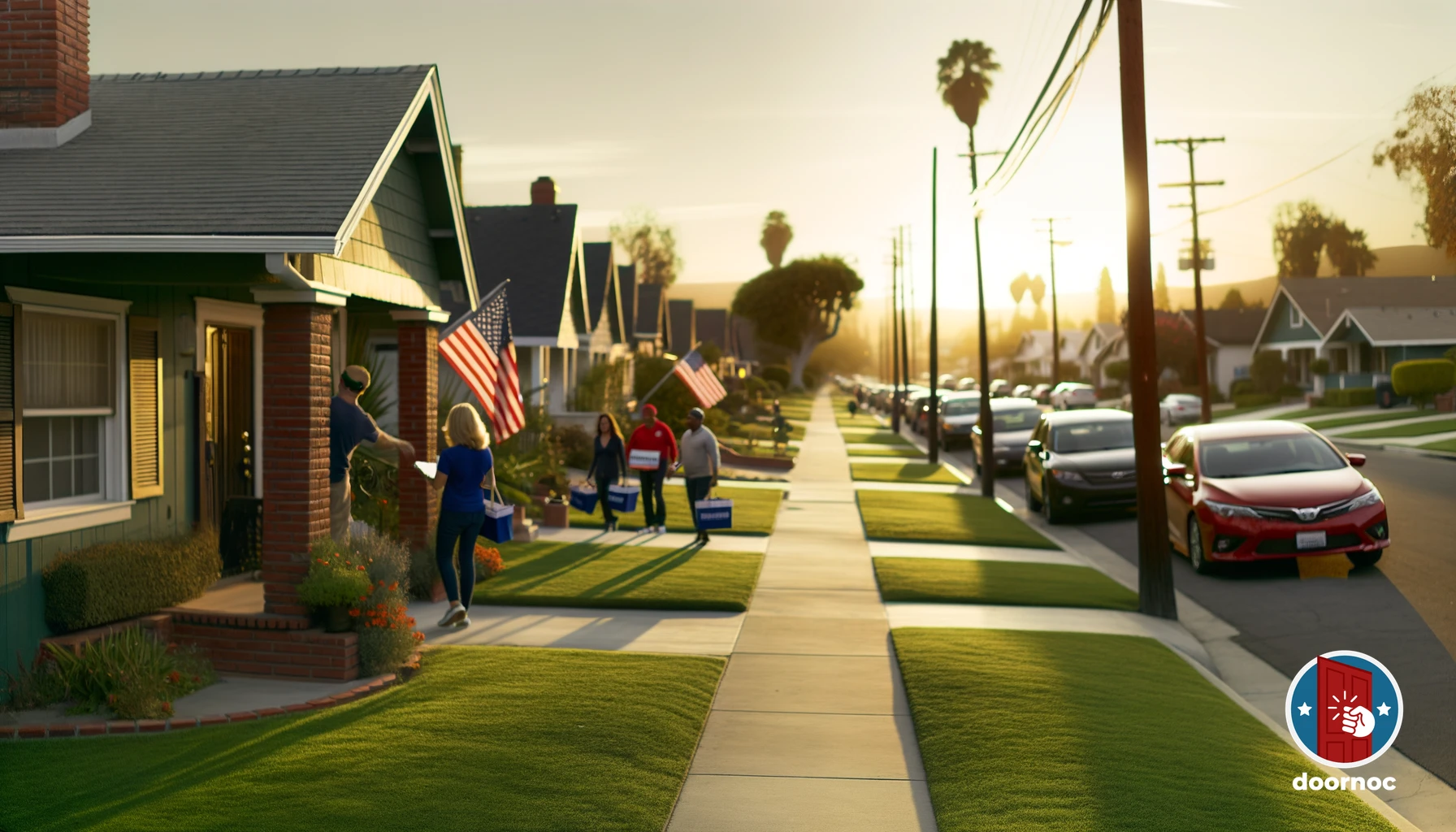 Volunteers spread across the neighborhood, bringing civic engagement to every doorstep.
The evidence is clear: real-time systems increase volunteer productivity, improve contact rates, enable rapid strategy adjustments, and ultimately win more elections. The efficiency gains alone justify the investment, but the strategic advantages of real-time visibility into field operations provide even greater value in competitive races.
For campaign managers and field directors evaluating whether to adopt real-time analytics, the question is no longer whether these systems provide value, but whether your campaign can afford to operate without them while your opponents gain the advantages of live data. The campaigns that embrace real-time analytics now will be better positioned to compete effectively in increasingly data-driven electoral environments.
If you’re ready to transform your field operations with real-time analytics, explore Door Knock’s features or contact our team to discuss how live data can give your campaign the competitive edge it needs to win in 2026.
Frequently Asked Questions
What is real-time canvassing analytics and how does it differ from traditional reporting?
Real-time canvassing analytics refers to the immediate collection, processing, and visualization of field data as canvassers interact with voters. Unlike traditional end-of-day or weekly reporting, real-time systems update dashboards within seconds of data entry, allowing campaign managers to monitor field operations, identify issues, and adjust strategy without delay. This instant feedback loop transforms campaigns from reactive to proactive operations.
How quickly should campaign dashboards update to be considered ‘real-time’?
True real-time campaign dashboards update within 1-5 seconds of data entry by field canvassers. Industry standards in 2026 define real-time as sub-10-second latency from the moment a canvasser logs a voter interaction to when it appears on the central dashboard. Systems with 30-second to 5-minute delays are considered ‘near real-time,’ while anything longer falls into batch processing, which limits tactical responsiveness during critical campaign periods.
What metrics should campaigns track in real-time during canvassing operations?
Essential real-time metrics include doors knocked per hour, contact rate percentage, voter disposition distribution (support/oppose/undecided), persuasion conversation completion rate, volunteer productivity by territory, and issue priority trends. Advanced campaigns also monitor real-time response rates to specific messaging, volunteer retention patterns throughout shifts, and geographic heat maps showing concentration of support or opposition. These metrics enable immediate tactical adjustments that maximize field efficiency.
Can real-time analytics work offline during door-to-door canvassing?
Modern mobile canvassing platforms like Door Knock use hybrid sync technology that captures data offline and synchronizes automatically when connectivity returns. The system stores interactions locally on the device, then uploads them in real-time once the canvasser enters a coverage area. This ensures no data loss in rural or low-signal areas while maintaining the benefits of real-time analytics for campaign managers monitoring overall operations from headquarters.
How do real-time analytics improve volunteer management and accountability?
Real-time analytics create transparent performance visibility that naturally increases volunteer accountability. Campaign managers can see exactly which volunteers are actively canvassing, their contact rates, and conversation quality in real-time. This allows for immediate coaching, recognition of high performers, and identification of volunteers who need support. Studies show campaigns using real-time volunteer tracking experience 38% higher volunteer retention and 44% better completion rates on assigned turf compared to campaigns without live monitoring capabilities.