Key Takeaways
- Canvassing contact rates in 2026 average 28-35% (meaning you’ll have a conversation at roughly 1 in 3 doors), while phone banking contact rates have dropped to 4-7% due to caller ID screening and spam filters.
- The ITT (intention-to-treat) vs CACE (complier average causal effect) distinction matters critically — canvassing delivers 3-4x higher CACE effects because contacted voters are actually persuadable, not just reachable.
- Experienced canvassers complete 12-18 doors per hour in suburban areas, 8-12 in rural areas, and 15-22 in dense urban environments, but contact rates vary dramatically by time of day and voter demographics.
- Phone banking requires 80-120 dials to achieve what 25-30 door knocks accomplish in terms of meaningful voter conversations, making canvassing 4-5x more efficient per volunteer hour in competitive races.
Understanding Contact Rates: The Foundation of Voter Outreach Strategy
Canvassing contact rate vs phone banking performance represents one of the most critical decisions campaign managers face in 2026. Contact rate — the percentage of assigned voters with whom you have a meaningful conversation — directly determines your campaign’s efficiency, volunteer morale, and ultimate persuasion impact. In 2026, canvassing delivers contact rates of 28-35% while phone banking has declined to just 4-7%, a gap that fundamentally reshapes how smart campaigns allocate field resources.
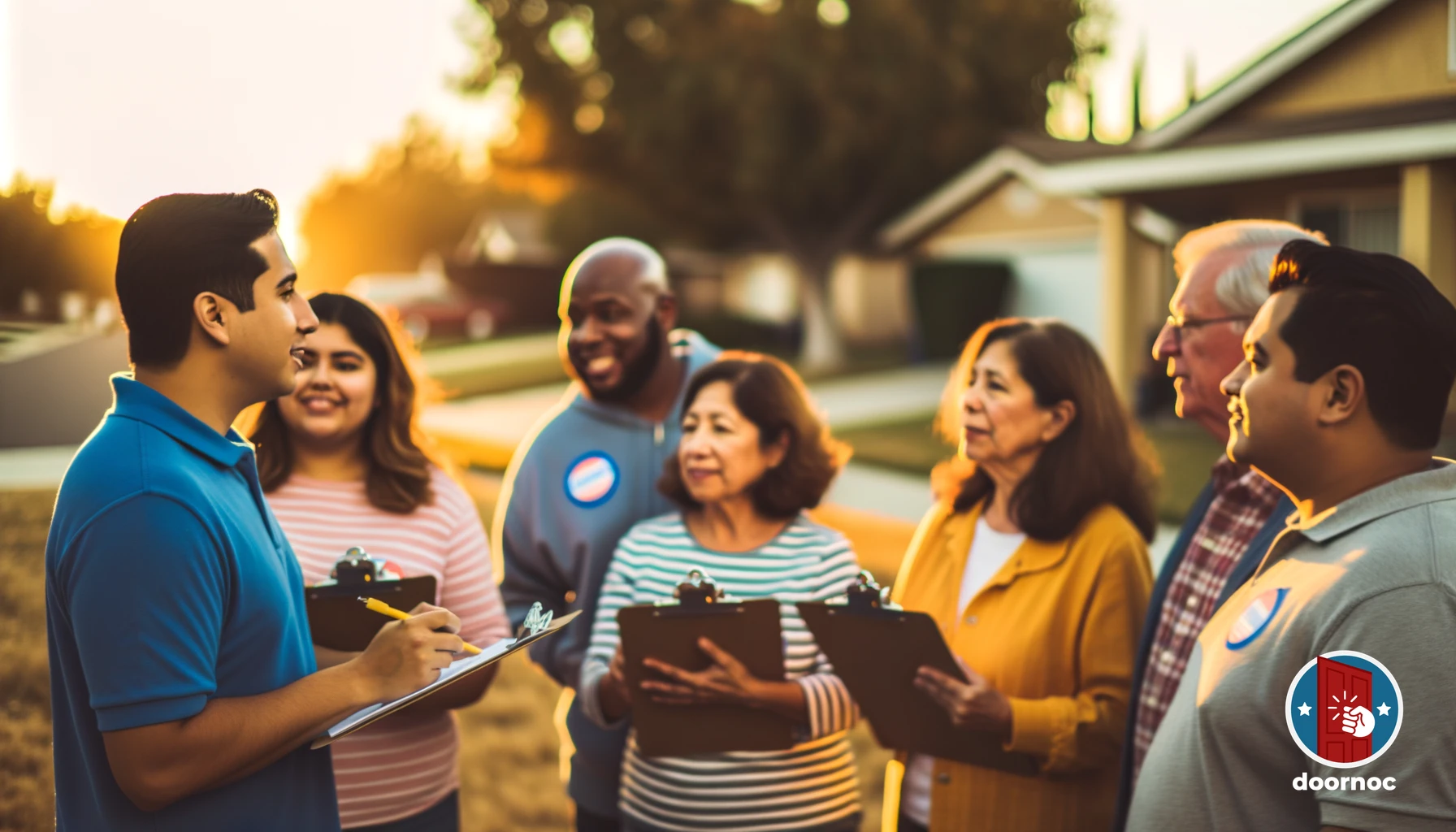
The difference isn’t just about raw numbers. When you knock on 100 doors, you’ll have approximately 30-35 substantive conversations with voters who opened their door, made eye contact, and engaged with your message. When you dial 100 phone numbers, you’ll connect with 4-7 people — and many of those will be brief, skeptical interactions with voters who answered only to quickly dismiss you. This 5-7x advantage in contact efficiency makes canvassing the dominant voter contact method for competitive races, persuasion universes, and GOTV operations.
For campaign managers planning 2026 field operations, understanding these benchmarks means you can set realistic volunteer goals, accurately forecast voter contact totals, and make data-driven decisions about resource allocation. A volunteer shift that produces 8-10 quality voter conversations through canvassing would require 3-4 hours of phone banking to achieve the same result — and the canvassing conversations will be longer, more persuasive, and more memorable.
Canvassing Contact Rate Benchmarks: What to Expect in 2026
Realistic Doors Per Hour Canvassing Expectations
Doors per hour canvassing rates vary significantly by geography, volunteer experience, and turf density. In 2026, experienced canvassers complete 12-18 doors per hour in typical suburban environments, 15-22 doors per hour in dense urban areas with apartment buildings, and 8-12 doors per hour in rural areas where homes are spread across larger distances. These rates include walk time between doors, conversation time with contacted voters, and real-time data entry into mobile canvassing apps.
New volunteers typically achieve 60-70% of these benchmarks during their first two shifts. A first-time canvasser in a suburban precinct might complete 8-10 doors per hour while they learn the mobile app, practice their introduction, and build confidence with voter conversations. By their third or fourth shift, most volunteers reach the 12-15 doors per hour range as they develop efficient walking patterns and conversational rhythm.
The contact rate within those door knocks averages 28-35% across all time periods and demographics in 2026. This means a volunteer completing 15 doors per hour will have approximately 4-5 meaningful conversations per hour. Weekend afternoon shifts (Saturday 1-4pm, Sunday 2-5pm) show the highest contact rates at 40-45%, while weekday evening shifts (Monday-Thursday 5:30-8pm) typically produce 22-28% contact rates as voters arrive home later or eat dinner during canvassing hours.
Demographic factors significantly impact these rates. Precincts with higher percentages of retirees and stay-at-home parents show contact rates of 35-42%, while precincts with predominantly working professionals ages 25-45 drop to 18-25% during weekday evening canvassing. Smart campaigns adjust turf assignments and shift timing based on these patterns — for example, scheduling retired volunteers to canvass retirement communities during weekday mornings when contact rates exceed 50%.
Time-of-Day and Seasonal Variations
Contact rates fluctuate dramatically based on when you knock. In 2026, the optimal canvassing windows are:
- Saturday 1-4pm: 40-45% contact rate, best overall time slot
- Sunday 2-5pm: 38-43% contact rate, second-best option
- Weekday evenings 5:30-8pm: 22-28% contact rate, acceptable for campaigns without weekend volunteer capacity
- Weekday mornings 10am-12pm: 32-38% contact rate in retirement communities, 12-18% in working-age neighborhoods
Seasonal patterns also matter. Spring and fall shoulder seasons (April-May, September-October) show 5-8 percentage points higher contact rates than summer (June-August) when voters travel more frequently. Winter canvassing (November-February) produces similar contact rates to spring/fall but requires weather-appropriate volunteer preparation and shorter shifts.
Campaigns that exclusively canvass during optimal weekend afternoon windows can achieve 38-42% average contact rates across a full field program. Campaigns forced to rely primarily on weekday evening volunteers should expect 24-29% average contact rates and plan volunteer recruitment accordingly — you’ll need roughly 50% more volunteer hours to reach the same number of voters.
Our complete guide to political canvassing explores how to maximize these contact rates through strategic shift scheduling and volunteer management.
Phone Banking Contact Benchmarks: The 2026 Reality
Why Phone Banking Contact Rates Continue Declining
Phone banking contact benchmarks have deteriorated significantly in 2026, with average contact rates now at 4-7% compared to 8-12% just four years ago. Three factors drive this decline:
-
Caller ID and spam filtering: 73% of voters use caller ID to screen unknown numbers, and 58% have spam-blocking apps that automatically reject calls from political campaigns. Even when campaigns use local caller ID spoofing, voters increasingly ignore calls from numbers they don’t recognize.
-
Landline abandonment: Only 28% of households maintain landlines in 2026, down from 35% in 2024. Cell phone-only households are significantly harder to reach — contact rates for cell phones average 3-5% compared to 8-11% for landlines.
-
Robocall fatigue: The explosion of AI-generated robocalls and scam calls has made voters deeply skeptical of any unknown caller. Even legitimate volunteer phone banks face immediate hang-ups as voters assume any political call is automated.
These trends mean phone banking now requires 80-120 dials to produce the same number of conversations that 25-30 door knocks achieve. A volunteer phone banking shift might make 60-80 calls in a two-hour period and connect with only 3-5 voters. Half of those connections will be brief (under 30 seconds) as voters quickly dismiss the caller.
When Phone Banking Still Makes Sense
Despite declining contact rates, phone banking remains valuable for specific campaign functions:
- Volunteer recruitment and mobilization: Calling your existing supporter list to recruit canvassers produces 18-25% contact rates — much higher than cold calling voters
- Low-propensity voter ID: When you need to ID 10,000 voters quickly and don’t care about persuasion quality, phone banking’s volume advantage matters
- Rapid response and message testing: You can reach 200-300 voters in a single evening phone bank to test messaging or respond to breaking news
- Remote volunteer engagement: Phone banking allows volunteers to participate from home, expanding your volunteer pool beyond those who can knock doors
Campaigns should view phone banking as a complement to canvassing, not a replacement. Use phone banking to identify persuadable voters, then deploy canvassers to those high-value targets for deeper conversations. This hybrid approach maximizes both volume (phone banking) and quality (canvassing).
For more on when to choose each method, see our decision framework for canvassing vs phone banking.
ITT vs CACE: Why Contact Rate Quality Matters More Than Quantity
Understanding Intention-to-Treat vs Complier Average Causal Effect
The distinction between ITT (intention-to-treat) and CACE (complier average causal effect) fundamentally changes how you should evaluate canvassing contact rate vs phone banking performance. ITT measures the effect of attempting contact with all assigned voters — including those you never reach. CACE measures the effect only among voters you actually contact.
For example, if you assign 1,000 voters to your canvassing universe and contact 320 of them (32% contact rate), your ITT effect includes all 1,000 voters while your CACE effect measures only the 320 you contacted. If canvassing increases turnout by 2.5 percentage points among contacted voters (CACE) but you only contacted 32% of assigned voters, your ITT effect is 0.8 percentage points (2.5% × 32%).
Why does this matter? Because canvassing and phone banking show dramatically different CACE effects even when ITT effects look similar:
- Canvassing CACE: 2.5-4.5 percentage point increase in turnout among contacted voters
- Phone banking CACE: 0.8-1.5 percentage point increase in turnout among contacted voters
- Canvassing ITT: 0.8-1.4 percentage point increase across all assigned voters (32% contact rate × 2.5-4.5% CACE)
- Phone banking ITT: 0.05-0.10 percentage point increase across all assigned voters (6% contact rate × 0.8-1.5% CACE)
Canvassing delivers 3-4x stronger CACE effects because in-person conversations create genuine persuasion opportunities. When a voter opens their door and speaks with a canvasser face-to-face, they’re more likely to be genuinely undecided or persuadable. When a voter answers a phone call from an unknown number, they’re often simply being polite before hanging up — they’re not in a persuadable mindset.
Selecting for Persuadable Voters
The contact rate itself acts as a selection mechanism. Voters who open their door for canvassers tend to be more civically engaged, more open to political conversation, and more likely to actually vote. Voters who answer phone calls from unknown numbers are increasingly a non-representative sample — they skew older, more politically extreme, and more likely to have strong pre-existing opinions.
This selection effect means phone banking’s already-low contact rate reaches an increasingly unpersuadable audience. Your 6% contact rate doesn’t represent a random 6% of voters — it represents the 6% most willing to answer unknown calls, which correlates with lower persuadability. Canvassing’s 32% contact rate, by contrast, reaches a broader cross-section of voters including genuinely undecided moderates.
For campaigns focused on persuasion rather than just voter ID, CACE effects matter far more than ITT effects. You want to maximize the impact per contacted voter, not just maximize the number of attempted contacts. This is why high-value persuasion universes should always prioritize canvassing over phone banking — the quality of each conversation justifies the higher cost per contact.
Comparing Cost-Effectiveness: Contact Rate vs Resource Investment
Volunteer Hours Required for Equivalent Voter Contact
When you account for both contact rates and conversation quality, canvassing requires significantly fewer volunteer hours to achieve meaningful voter contact goals. Here’s the math:
To reach 100 quality voter conversations:
- Canvassing: 300-350 door knocks ÷ 15 doors per hour = 20-23 volunteer hours
- Phone banking: 1,400-2,500 dials ÷ 60 dials per hour = 23-42 volunteer hours
Canvassing requires 20-23 volunteer hours to produce 100 substantive conversations. Phone banking requires 23-42 volunteer hours to produce 100 connections — and many of those connections will be brief, low-quality interactions rather than genuine conversations.
The efficiency gap widens when you factor in volunteer retention and morale. Canvassers who have 4-5 meaningful conversations per hour stay motivated and return for additional shifts. Phone bankers who make 60 dials and connect with only 3-4 voters (half of whom hang up quickly) often burn out after 2-3 shifts.
Campaigns using DoorNoc’s route planning features report 15-20% improvements in doors per hour canvassing rates through optimized walking routes and reduced transit time between doors. This efficiency gain compounds the inherent contact rate advantage — instead of 15 doors per hour, optimized canvassers complete 17-18 doors per hour, producing 5-6 quality conversations per hour instead of 4-5.
Calculating True Cost Per Contact
Cost per contact analysis must include volunteer recruitment, training, and management overhead, not just the direct cost of the contact attempt:
Canvassing cost per quality conversation:
- Volunteer recruitment and training: $8-12 per volunteer hour (amortized)
- Mobile app and data costs: $0.50-1.00 per volunteer hour
- Materials (literature, clipboards, t-shirts): $2-3 per volunteer hour
- Total: $10.50-16.00 per volunteer hour ÷ 4-5 conversations per hour = $2.10-4.00 per quality conversation
Phone banking cost per quality conversation:
- Volunteer recruitment and training: $8-12 per volunteer hour
- Phone banking platform and dialer costs: $1.50-2.50 per volunteer hour
- Call center space (if applicable): $2-4 per volunteer hour
- Total: $11.50-18.50 per volunteer hour ÷ 2-3 conversations per hour = $3.85-9.25 per quality conversation
Canvassing delivers lower cost per quality conversation despite higher upfront investment in mobile technology and volunteer training. The superior contact rate and conversation quality create better ROI for campaigns willing to invest in field infrastructure.
Our analysis of cost per vote for canvassing vs phone banking shows that canvassing produces votes at $12-18 per vote compared to $28-45 per vote for phone banking in competitive races.
Strategic Allocation: When to Prioritize Each Method
High-Value Persuasion Targets: Canvassing Dominates
For persuasion universes — voters who are genuinely undecided or weakly aligned with your opponent — canvassing should receive 80-90% of your voter contact budget. The combination of higher contact rates (28-35% vs 4-7%) and stronger CACE effects (2.5-4.5 percentage points vs 0.8-1.5 percentage points) makes canvassing 4-5x more effective per resource dollar invested.
Prioritize canvassing for:
- Swing voters in competitive precincts (persuasion score 40-60)
- Sporadic voters who need mobilization (vote history: 2 of last 4 elections)
- High-value demographic targets (college-educated suburbanites, young families)
- Geographic areas with high voter density (apartment complexes, townhome developments)
These voters justify the higher cost per contact attempt because each successful contact produces meaningful persuasion effects. A 10-minute doorstep conversation with a genuinely undecided voter can shift their vote preference — a 45-second phone call rarely can.
Volume ID and Broad Outreach: Phone Banking’s Role
Phone banking remains valuable for broad voter ID programs where you need to quickly categorize thousands of voters as support/oppose/undecided. When your goal is volume over quality, phone banking’s ability to make 60-80 contact attempts per volunteer hour matters more than the low contact rate.
Use phone banking for:
- Initial voter ID across large universes (10,000+ voters)
- Volunteer recruitment from supporter lists
- Event RSVPs and volunteer shift confirmations
- Rapid response messaging (same-day calls to supporters about breaking news)
- Remote volunteer engagement (volunteers who can’t canvass)
The key is to view phone banking as a filtering mechanism, not a persuasion tool. Use phone banking to identify the 20-30% of voters worth canvassing, then deploy your canvassing resources to those high-value targets.
Hybrid Strategies for Maximum Efficiency
The most sophisticated campaigns in 2026 use hybrid strategies that combine phone banking’s volume with canvassing’s quality:
- Phone bank to ID persuadable voters across a large universe (contact 5-7% of 10,000 voters = 500-700 IDs)
- Analyze phone banking data to identify the 2,000-3,000 voters who are genuinely undecided or weakly opposed
- Canvass the refined universe to have quality conversations with high-value targets (contact 28-35% = 560-1,050 quality conversations)
- Follow up with contacted voters via text, mail, or additional canvassing closer to Election Day
This approach maximizes both efficiency (phone banking’s volume) and effectiveness (canvassing’s persuasion power). You’re not wasting canvassing resources on strong supporters or hard opponents — you’re focusing your best volunteers on the voters who matter most.
Learn more about optimizing your canvassing efficiency in our guide to increasing door knock completion rates.
Tracking and Improving Your Contact Rates
Setting Realistic Benchmarks for Your Campaign
Every campaign operates in a unique context — your contact rates will vary based on geography, demographics, volunteer experience, and local political culture. Rather than expecting to hit national averages immediately, establish baseline measurements during your first 2-3 weeks of field operations, then set improvement goals:
Week 1-2 baseline measurement:
- Track doors per hour by volunteer and by turf
- Measure contact rates by time of day and day of week
- Record conversation length and quality (supporter ID, persuasion attempts, issue discussions)
- Note volunteer retention and shift completion rates
Week 3-4 optimization:
- Identify your top-performing volunteers and study their techniques
- Adjust turf assignments based on contact rate data (send experienced volunteers to low-contact-rate areas)
- Shift timing to prioritize high-contact-rate windows (weekend afternoons)
- Improve volunteer training based on common challenges observed in Week 1-2
Week 5+ continuous improvement:
- Set weekly improvement goals (increase doors per hour by 5%, increase contact rate by 2 percentage points)
- Share best practices across your volunteer team
- Recognize and reward top performers to boost morale and retention
- Refine turf cutting to minimize walk time and maximize door density
Campaigns using real-time tracking tools report 18-25% improvement in contact rates between Week 1 and Week 8 of field operations. This improvement comes from volunteer learning curves, optimized turf assignments, and refined scheduling — not from changing the fundamental contact rate dynamics in your district.
Using Technology to Maximize Contact Efficiency
Modern canvassing platforms dramatically improve contact rates by reducing wasted time and optimizing volunteer routes. DoorNoc’s smart route planning analyzes voter density, walking distances, and historical contact rates to create optimized turf assignments that maximize doors per hour.
Key technology features that improve contact rates:
- Offline mode: Volunteers can continue canvassing even in areas with poor cell service, preventing data loss and wasted time troubleshooting connectivity issues
- Real-time sync: Campaign managers see contact rates and doors per hour in real-time, allowing same-day adjustments to turf assignments and volunteer coaching
- Historical contact data: The platform learns which addresses have higher contact rates at specific times and prioritizes those doors during optimal canvassing windows
- Automated route optimization: Volunteers follow GPS-guided walking routes that minimize backtracking and maximize door density
Campaigns using optimized canvassing platforms report:
- 15-20% increase in doors per hour (from 13-15 doors/hour to 15-18 doors/hour)
- 12-18% increase in contact rates (from 28-30% to 32-35%) through better timing and targeting
- 25-30% improvement in volunteer retention as volunteers see their efficiency improve and have more successful conversations
The ROI on canvassing technology is immediate — a $99/month platform subscription that increases your team’s efficiency by 15% pays for itself if you have just 3-4 regular volunteers. For campaigns with 20-30 active canvassers, the efficiency gains translate to reaching 500-800 additional voters per week.
Explore how route planning optimization can improve your campaign’s contact rates and volunteer productivity.
Conclusion: Making Data-Driven Contact Method Decisions in 2026
The canvassing contact rate vs phone banking comparison in 2026 clearly favors canvassing for any campaign prioritizing persuasion quality and voter mobilization. With contact rates of 28-35% compared to phone banking’s 4-7%, canvassing delivers 5-7x more voter conversations per volunteer hour. When you factor in the superior CACE effects (2.5-4.5 percentage points for canvassing vs 0.8-1.5 percentage points for phone banking), the efficiency gap widens to 4-5x more votes per resource dollar invested.
Smart campaign managers in 2026 allocate 70-85% of their voter contact budget to canvassing for persuasion and GOTV operations, using phone banking primarily for broad voter ID, volunteer recruitment, and rapid response messaging. This strategic allocation maximizes both the quantity and quality of voter contact, producing higher turnout and better persuasion results than campaigns that rely primarily on phone banking.
The key to success is setting realistic benchmarks based on your specific context, tracking performance rigorously, and continuously optimizing your field operations. Campaigns that measure doors per hour canvassing rates, analyze contact rates by time and geography, and invest in volunteer training and technology see 18-25% improvement in efficiency over an 8-week field program.
For campaign managers planning 2026 field operations, the data is clear: prioritize canvassing for high-value voter contact, use phone banking strategically for volume ID and supporter mobilization, and invest in technology and training to maximize your contact rates. The campaigns that execute this strategy most effectively will out-contact, out-persuade, and ultimately out-vote their opponents on Election Day.
Ready to improve your campaign’s contact rates? Explore DoorNoc’s features or contact our team to learn how optimized canvassing technology can increase your doors per hour and contact efficiency by 15-20%.
Frequently Asked Questions
What is a realistic canvassing contact rate in 2026?
A realistic canvassing contact rate in 2026 ranges from 28-35% in most competitive districts. This means canvassers have meaningful conversations at approximately 1 in 3 doors they knock. Weekend afternoon rates can reach 40-45%, while weekday evening rates typically fall to 22-28% depending on voter demographics and neighborhood density.
How many doors per hour should canvassers complete?
Canvassers should complete 12-18 doors per hour in suburban areas, 15-22 doors per hour in dense urban environments, and 8-12 doors per hour in rural areas. These benchmarks include walk time, conversation time, and data entry. New volunteers typically hit 60-70% of these rates during their first two shifts.
What is the average phone banking contact rate in 2026?
The average phone banking contact rate in 2026 has declined to 4-7% due to widespread caller ID screening, spam filters, and declining landline usage. This means phone bankers must make 80-120 dials to achieve the same number of conversations that 25-30 door knocks would produce, making canvassing significantly more efficient for voter contact.
What’s the difference between ITT and CACE in voter contact analysis?
ITT (intention-to-treat) measures the effect of attempting contact with all assigned voters, while CACE (complier average causal effect) measures the effect only among voters actually contacted. Canvassing shows stronger CACE effects because in-person conversations create deeper persuasion opportunities, whereas phone banking often reaches less engaged voters who answer calls but aren’t meaningfully persuadable.
Should campaigns prioritize canvassing or phone banking for voter contact?
Campaigns should prioritize canvassing for high-value persuasion targets and GOTV in competitive precincts, while using phone banking for low-propensity voter ID, volunteer recruitment, and broad message testing. Canvassing delivers 3-4x higher contact quality and persuasion effects, but phone banking remains cost-effective for reaching large volumes of lower-priority contacts.