Key Takeaways
- The first 7 seconds at the door determine whether voters engage or dismiss you — master your opening stance, smile, and introduction to build instant rapport.
- Effective door to door canvassing in 2026 requires balancing persuasion with data collection, using mobile apps to capture voter sentiment while maintaining authentic conversation.
- Your body language communicates more than your script — stand at a 45-degree angle, maintain 4-6 feet of distance, and never block the doorway to create psychological safety.
- The best canvassers treat objections as opportunities, using the “feel-felt-found” framework to acknowledge concerns without arguing or becoming defensive.
Door to door canvassing remains the most effective voter contact method in 2026, but success depends entirely on what happens in those critical 30-120 seconds at each doorstep. Your ability to build instant rapport, handle objections gracefully, and collect accurate data while maintaining authentic human connection determines whether your canvassing operation moves numbers or wastes volunteer hours.
This guide provides battle-tested door to door canvassing tips that transform nervous first-time volunteers into confident field organizers who consistently hit contact goals and persuade undecided voters.
What Makes a Perfect Doorstep Interaction in 2026?
A perfect doorstep interaction accomplishes three objectives simultaneously: it builds positive voter sentiment toward your candidate or cause, collects accurate data for targeting future contacts, and respects the voter’s time and boundaries. In 2026, with voters increasingly skeptical of political outreach and protective of their personal space, mastering this balance is non-negotiable.
The interaction begins before you knock. Your approach to the house, your body language as you wait, and your facial expression in those first seconds all communicate whether you’re a threat or a friendly neighbor. Voters make snap judgments about trustworthiness in under 7 seconds — faster than you can deliver your opening line.
Successful canvassers in 2026 understand that door to door canvassing is fundamentally about human psychology, not script recitation. You’re asking someone to open their door to a stranger and discuss topics many consider private. Everything about your presence must signal safety, respect, and genuine interest in their perspective.
The First 7 Seconds: Your Opening Stance and Introduction
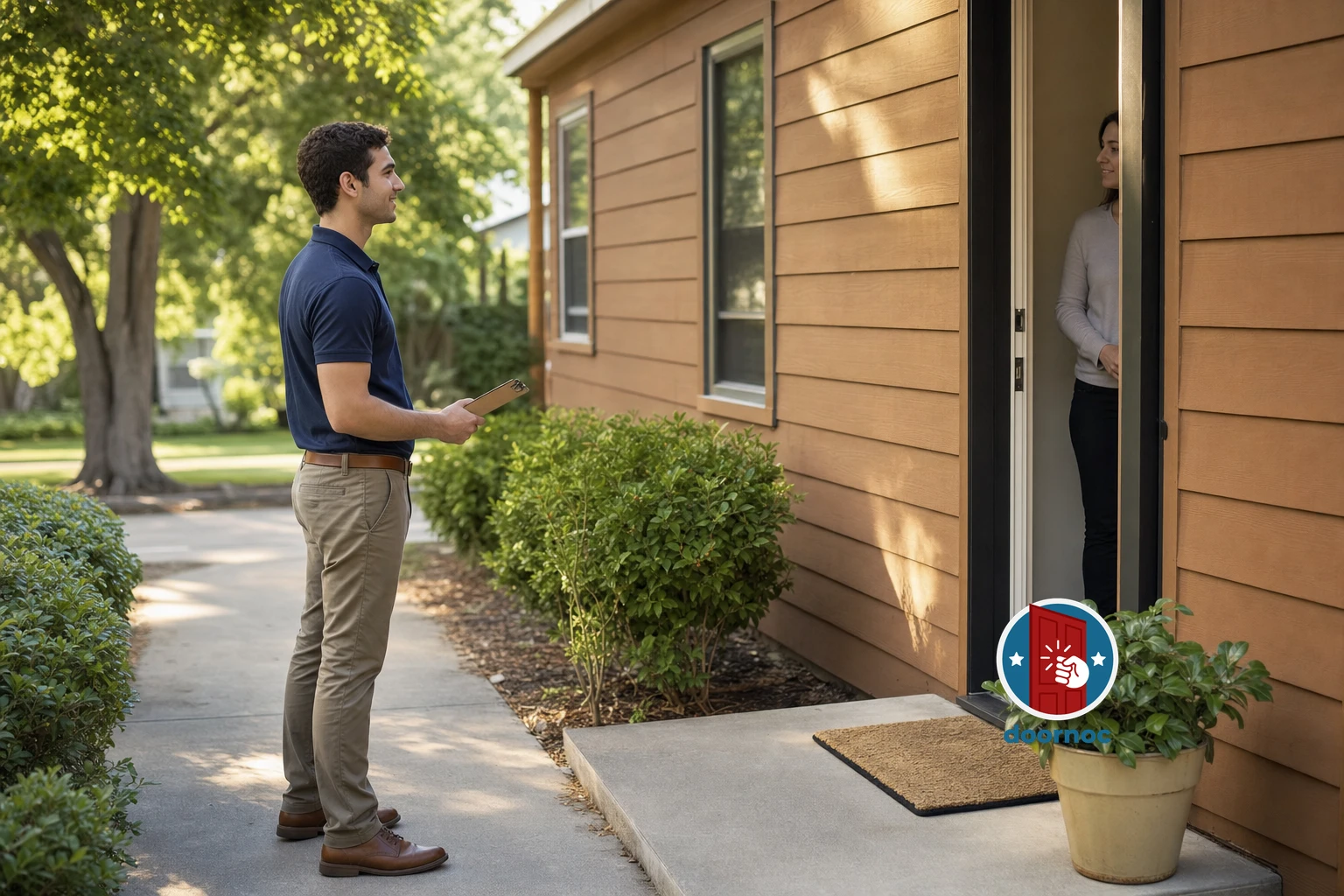
When the door opens, your physical positioning matters more than your opening words. Stand 4-6 feet back from the door threshold — never on the doorstep itself. Position your body at a 45-degree angle to the door rather than facing it head-on. This stance is psychologically non-threatening because you’re not blocking their space or creating a confrontational face-to-face position.
Hold your clipboard, tablet, or phone at waist level, not up near your chest where it creates a barrier between you and the voter. Your other hand should be visible and relaxed at your side — never in your pocket, which can appear suspicious or too casual.
Smile genuinely before they fully open the door. Not a forced campaign smile, but the natural expression you’d use greeting a neighbor. Your smile should reach your eyes. Voters can instantly detect fake friendliness, and it destroys trust before you’ve said a word.
Your opening line should include three elements in this exact order: your name, your affiliation, and a friendly question that invites dialogue rather than triggering defensive reactions. Here’s the framework:
“Hi, I’m [Your Name] with [Campaign/Organization]. How are you doing today?”
Wait for their response. Actually listen to what they say. If they say “fine” in a clipped tone, they’re signaling limited interest — adjust your approach accordingly. If they engage warmly, you have more latitude for conversation.
Never launch immediately into your script. The question “How are you doing today?” isn’t filler — it’s a psychological pattern interrupt that shifts the interaction from “stranger at my door” to “neighbor checking in.” Those extra 3 seconds of human connection dramatically increase your contact rate.
Common Opening Mistakes That Kill Engagement
The fastest way to get a door closed in your face is to start with “Do you have a minute to talk about…” This immediately frames the interaction as a favor you’re asking, putting the voter in a position to say no. You’re also telegraphing that you want something from them rather than offering value.
Avoid opening with “I’m not selling anything” or “Don’t worry, I’m not here to ask for money.” These defensive statements plant ideas that weren’t there and make you sound untrustworthy. If you’re legitimately not selling anything, your introduction will make that clear without explicitly stating it.
Never apologize for knocking. Phrases like “Sorry to bother you” or “I know you’re busy” undermine your confidence and suggest you don’t believe your message is worth their time. If you don’t value the conversation, neither will they.
Body Language That Builds Trust at the Doorstep
Your physical presence communicates volumes before you speak a word. In 2026, with heightened awareness of personal space and safety, your body language can make or break voter receptivity. Understanding and implementing these non-verbal cues separates effective canvassers from those who struggle to make contact.
Maintain appropriate eye contact — approximately 60-70% of the time during conversation. Constant staring feels aggressive, while avoiding eye contact suggests dishonesty or discomfort. Look at the voter when they’re speaking, glance down at your materials when transitioning between topics, and re-establish eye contact when making key points.
Keep your hands visible and use open palm gestures when emphasizing points. Closed fists, pointing fingers, or hands hidden behind your back or in pockets trigger subconscious distrust. When holding canvassing software on a tablet or phone, hold it at waist level where both you and the voter can see the screen if needed.
Your posture should be relaxed but engaged. Stand with weight evenly distributed on both feet, shoulders back but not rigid. Leaning forward slightly shows interest, but too much lean invades personal space. Crossing your arms or shifting weight from foot to foot signals discomfort or impatience.
Respect the door threshold as a psychological boundary. Never step onto the doorstep unless explicitly invited, and never attempt to enter the home. If a voter steps outside to talk, maintain that 4-6 foot distance and position yourself so they’re not trapped between you and their door.
Mirror the voter’s energy level without being obvious about it. If they’re speaking quietly, lower your volume slightly. If they’re animated and expressive, you can match that energy. This subconscious mirroring builds rapport by making the voter feel understood and comfortable.
Reading Voter Body Language for Better Conversations
Pay attention to signals that indicate engagement or desire to end the conversation. Arms crossed over chest, body angled away from you, or eyes darting toward the interior of the house all suggest they want to wrap up. Respect these signals by getting to your key question quickly or offering to leave literature.
Positive signals include the voter stepping outside to talk, asking follow-up questions, or physically leaning toward you during conversation. These voters are engaged — invest more time in persuasion and relationship building.
If a voter keeps their hand on the door or only opens it partially, they’re signaling caution. Don’t take it personally. Deliver your introduction, ask your qualifying question, and be prepared to thank them and move on if they’re not interested in deeper conversation.
Crafting Your Canvassing Script for Natural Delivery
The best canvassing script in 2026 sounds nothing like a script. It’s a flexible framework that guides conversation while allowing for authentic human interaction. Voters can instantly detect when you’re reading memorized lines, and it destroys the personal connection that makes door to door canvassing effective.
Your script should have three distinct sections: the introduction (already covered), the qualifying question that determines how to proceed, and the persuasion or data collection conversation based on their response. Each section should be memorized as concepts and key phrases rather than word-for-word recitation.
The qualifying question identifies whether this voter is worth deeper engagement. For persuasion canvassing, ask: “Can I ask if you’re planning to support [Candidate] in November?” For voter ID, ask: “Have you had a chance to think about the election in November?” The voter’s response determines your next move.
If they’re undecided or soft opposition, transition to your persuasion talking points. If they’re strong support, thank them, confirm their voting plan, and ask if they’d like a yard sign or to volunteer. If they’re hard opposition, thank them politely and move on — don’t waste time arguing.
Persuasion Talking Points That Actually Work
Effective persuasion in 2026 focuses on local impact and personal stories, not national talking points voters have already heard a hundred times. Your strongest arguments connect your candidate’s positions to the specific concerns of the neighborhood you’re canvassing.
Use the “bridge” technique to transition from their concern to your message: “You mentioned you’re worried about [issue]. That’s exactly why [Candidate] has proposed [specific policy].” This shows you’re listening and responding to their actual priorities rather than delivering a canned speech.
Share one brief personal story or local example that illustrates your point. “My neighbor on Oak Street told me her property taxes went up 15% last year. [Candidate’s] plan would cap increases at 3% annually.” Specific, local examples are infinitely more persuasive than abstract policy promises.
Keep each talking point to 2-3 sentences maximum. Voters tune out long explanations. Make your point, check for understanding with a question like “Does that make sense?” or “Is that something that would matter to you?”, and let them respond.
Handling the “I’m Not Political” Voter
When voters say they’re not political or don’t follow elections, resist the urge to lecture them about civic duty. Instead, acknowledge their position and connect to non-political values: “I totally understand — a lot of people feel that way. But this election will determine [local impact like school funding, road repairs, property taxes]. Even if you don’t follow politics, that affects you directly.”
This reframes voting as a practical decision about their daily life rather than a political statement. It’s one of the most effective door to door tips for engaging low-propensity voters who might otherwise dismiss you immediately.
Managing Difficult Conversations and Objections
Even with perfect technique, you’ll encounter hostile, dismissive, or argumentative voters. How you handle difficult voters determines whether these interactions derail your confidence or become learning opportunities that sharpen your skills.
The “feel-felt-found” framework is your most powerful tool for handling objections without arguing. When a voter raises a concern, respond with: “I understand how you feel. A lot of people felt the same way until they found out [new information that addresses the concern].”
This validates their emotion, shows they’re not alone in their concern, and introduces new information without saying “you’re wrong.” For example: “I understand how you feel about the tax proposal. A lot of people felt the same way until they found out it only applies to commercial properties over $5 million, not residential homes.”
Never argue with voters or try to prove them wrong. Your goal is to plant seeds and collect data, not win debates. If a voter is hostile or aggressive, use the broken record technique: calmly repeat “I appreciate your perspective” or “I understand we disagree” until you can politely disengage.
When to Walk Away
Some conversations aren’t worth having. If a voter becomes verbally abusive, threatens you, or shows signs of intoxication or mental distress, thank them and leave immediately. Your safety is more important than any data point.
Mark these addresses in your canvassing software as “do not contact” so other volunteers don’t encounter the same situation. Good field directors want this information to protect their teams.
If a voter wants to debate for 20 minutes, politely set a boundary: “I’d love to continue this conversation, but I have a lot of neighbors to visit today. Can I leave you some information to review?” Respectful time management is professional, not rude.
Data Collection: Capturing Accurate Information While Maintaining Flow
In 2026, effective door to door canvassing requires seamless integration of data collection with natural conversation. Voters notice when you’re more focused on your tablet than on them, and it kills rapport. The best canvassers make data entry feel invisible.
Use mobile canvassing apps that allow one-handed operation and quick tap selections rather than typing lengthy notes. DoorNoc’s interface is specifically designed for this — you can mark voter support level, note key issues, and flag follow-up needs with just a few taps while maintaining eye contact.
Develop a rhythm where you ask a question, listen to the response, make brief eye contact while tapping your selection, then ask the follow-up question. This creates natural pauses in conversation rather than awkward silences while you type.
Never try to hide what you’re recording. If a voter asks what you’re writing, be transparent: “I’m just noting that you’re planning to vote and that education funding is your top priority, so we can follow up with more information on that issue.” Transparency builds trust.
What Data Actually Matters
In every conversation, prioritize collecting three pieces of information: voter support level (strong support, lean support, undecided, lean opposition, strong opposition), top issue or concern, and likelihood to vote. Everything else is secondary.
Support level determines future contact strategy. Top issue enables targeted follow-up with relevant information. Likelihood to vote helps identify who needs GOTV contacts versus who will definitely turn out.
Avoid the temptation to collect unnecessary data just because your app has fields for it. Every extra question extends the conversation and risks annoying the voter. If your script doesn’t require knowing their phone number or email, don’t ask for it.
Accuracy matters more than volume. One accurately coded conversation is worth five rushed contacts with wrong information. If you’re unsure of a voter’s position, code them as undecided rather than guessing. Bad data leads to bad targeting and wasted resources.
Time Management and Daily Contact Goals
Successful canvassing in 2026 requires balancing quality conversations with sufficient volume to meet campaign goals. The average canvasser should complete 15-20 contacts per hour in suburban neighborhoods, 25-30 per hour in dense urban areas, and 10-15 per hour in rural settings.
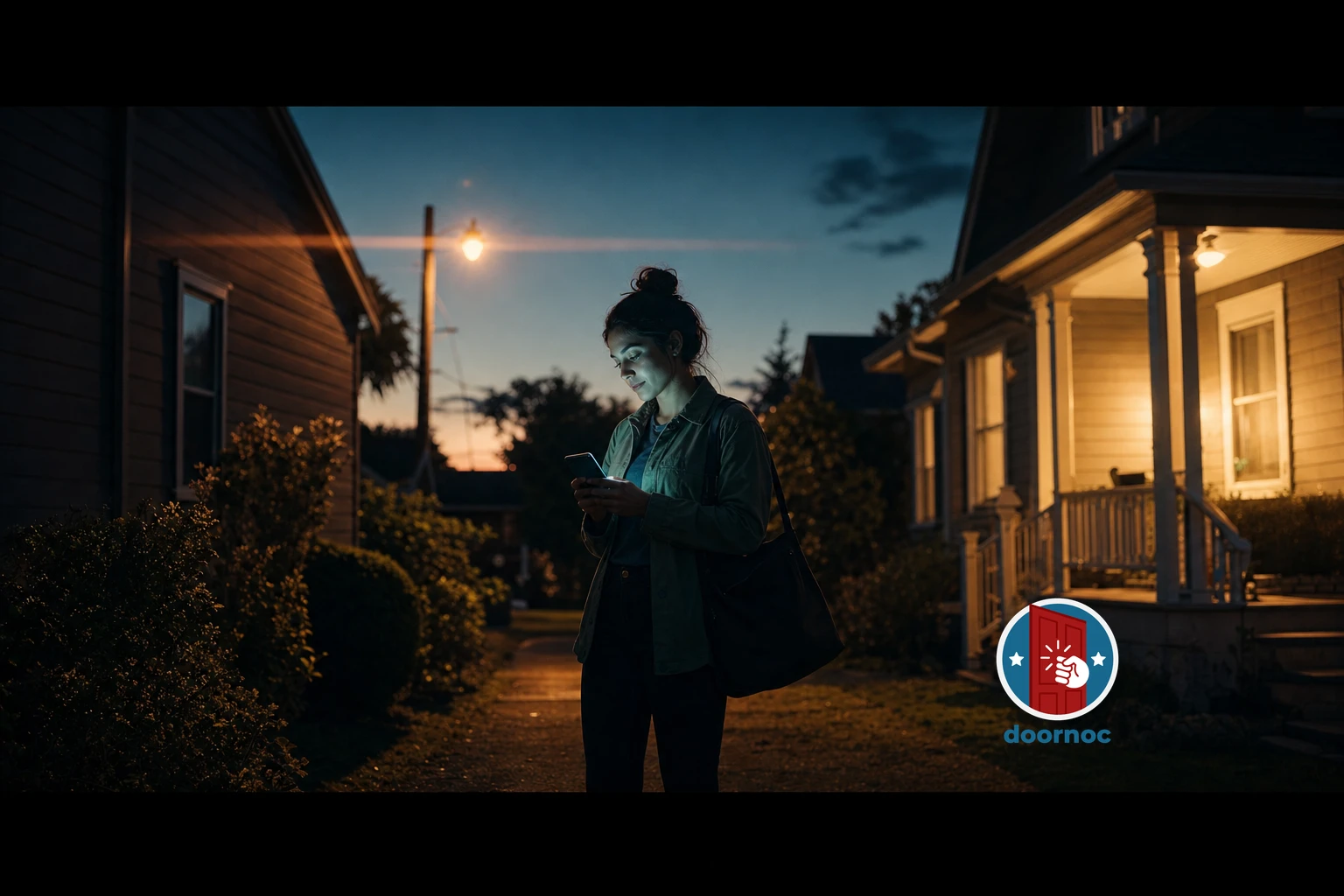 Field organizer reviewing data on smartphone between houses at dusk with cinematic street lamp lighting.
These numbers assume you’re knocking every door on your turf, not just targeted voters. Your actual contact rate (conversations versus knocks) will typically be 25-35% depending on time of day and neighborhood demographics.
Set hourly checkpoints to monitor your pace. If you’re falling behind, identify the bottleneck. Are you spending too long at each door? Getting lost between addresses? Taking too many breaks? Planning efficient canvassing routes eliminates wasted walking time between doors.
Use DoorNoc’s auto-turf cutting feature to ensure your routes are geographically logical and balanced for your available time. The app calculates optimal door order and estimates completion time based on historical data from your area.
Peak Contact Hours and Strategic Timing
The best door to door canvassing hours in 2026 remain consistent with historical patterns: weekday evenings from 4:00-7:30 PM and weekend mornings from 10:00 AM-1:00 PM, plus weekend afternoons from 2:00-5:00 PM. These windows maximize the probability of finding voters home and receptive.
Avoid canvassing before 10:00 AM on weekends (people sleep in), during typical dinner hours (5:30-6:30 PM on weekdays), or after 8:00 PM any day (feels intrusive). Respect these boundaries even if your campaign is desperate for contacts.
Weather affects contact rates significantly. Canvass in light rain with proper gear, but reschedule for heavy rain or extreme heat. Voters won’t answer doors in bad weather, and you’ll burn out volunteers for minimal return.
Training and Supporting Your Canvassing Team
Even with perfect individual technique, your canvassing operation only succeeds if you can replicate these skills across your entire volunteer team. Effective training in 2026 combines hands-on practice with ongoing coaching and real-time feedback.
Your initial training should include three components: a 15-minute overview of goals and messaging, 20 minutes of role-playing actual door scenarios, and 30 minutes of supervised field practice where new volunteers knock with experienced canvassers observing.
Role-playing is non-negotiable. Volunteers need to practice the actual words coming out of their mouths before they knock their first door. Have them practice introducing themselves, asking qualifying questions, and handling at least three common objections.
Pair new volunteers with experienced canvassers for their first turf. The experienced volunteer should knock the first 3-5 doors while the new volunteer observes, then reverse roles with the experienced volunteer providing immediate feedback after each conversation.
Real-Time Coaching for Rapid Improvement
The fastest skill development happens through immediate feedback. When you observe a volunteer struggling with a particular aspect — maybe they’re talking too fast, not listening, or getting defensive with objections — pull them aside after that door for a 60-second coaching conversation.
Use the “I noticed… I suggest… Try it” framework: “I noticed you started arguing when they brought up taxes. I suggest using the feel-felt-found technique instead. Try it at the next door and see how it works.”
Celebrate wins publicly. When a volunteer has a breakthrough conversation or successfully persuades an undecided voter, share it with the whole team. This builds confidence and shows everyone what success looks like.
Track individual volunteer metrics in your canvassing software and use the data for personalized coaching. If someone has a low contact rate, they might need route planning help. If they have lots of contacts but low persuasion numbers, they need script refinement.
Integrating Technology Without Losing the Human Touch
The paradox of modern canvassing is that technology enables better voter contact while simultaneously threatening to make interactions feel robotic and transactional. The best canvassers in 2026 use tools like DoorNoc to enhance rather than replace human connection.
Your mobile device should feel like a tool that frees you to focus on the voter, not a screen that distracts from conversation. This requires choosing canvassing software with intuitive interfaces that don’t require constant attention.
Practice entering data while maintaining eye contact. Develop muscle memory for common tap sequences so you can mark support levels and note issues without looking at your screen. This takes repetition but dramatically improves conversation flow.
Use your device to add value to conversations. If a voter asks about a specific policy, pull up the relevant fact sheet on your tablet and show them. If they mention a local issue, mark it in real-time so your campaign can follow up with targeted information.
Never let technology slow you down. If your app crashes, your internet connection fails, or your battery dies, you should be able to continue canvassing with paper backups. Technology is a tool, not a crutch.
Offline Mode and Backup Systems
DoorNoc’s offline mode ensures you can continue collecting data even in areas with poor cell coverage. The app stores all your turf data locally and syncs when you return to connectivity. This is essential for rural canvassing or neighborhoods with spotty service.
Always carry paper backups: printed walk lists, blank contact sheets, and extra literature. Technology fails at the worst possible moments. The ability to seamlessly switch to paper and continue canvassing separates professional operations from amateur ones.
Measuring Success Beyond Contact Numbers
Raw contact numbers tell an incomplete story. A canvasser who completes 100 rushed, low-quality conversations where voters feel dismissed is less valuable than one who completes 60 substantive interactions that actually move opinions.
Track persuasion rate (percentage of undecided voters moved to support), data accuracy (how often follow-up contacts confirm the information you collected), and volunteer retention (whether people come back for a second shift). These metrics reveal true operational effectiveness.
Compare your persuasion rates across different neighborhoods, times of day, and volunteer skill levels. This data shows you where to focus resources. If Saturday morning canvassing in Precinct 12 consistently produces 40% persuasion rates while weeknight canvassing in Precinct 8 yields 15%, adjust your deployment accordingly.
Survey voters who were contacted to measure long-term impact. Did they remember the conversation? Did it influence their vote? Would they describe the interaction positively? This qualitative feedback is harder to collect but reveals whether your canvassing actually works.
Advanced Techniques for Experienced Canvassers
Once you’ve mastered the fundamentals, these advanced door to door tips will elevate your effectiveness:
Strategic listening means identifying the specific words and phrases voters use to describe their concerns, then incorporating that exact language into your response. If a voter says they’re “worried” about something, use “worried” in your reply rather than substituting “concerned.” This subconscious mirroring makes voters feel deeply heard.
Issue pivoting allows you to acknowledge a voter’s concern about an issue where your candidate is weak, then redirect to a related issue where your candidate is strong. “I hear your concern about [weak issue]. What’s your take on [related strong issue]?” This doesn’t ignore their priority but expands the conversation.
Commitment escalation gradually increases the ask as voters show interest. Start with “Are you planning to vote?” then “Can we count on your support?” then “Would you be willing to put up a yard sign?” then “Do you know anyone else who might support [Candidate]?” Each yes builds momentum toward deeper engagement.
Neighborhood intelligence means noting patterns across multiple conversations in the same area. If five consecutive voters mention the same local concern, that’s valuable data for campaign messaging. Report these trends to your field director immediately.
Master these techniques and you’ll become the canvasser other volunteers want to learn from, the one field directors deploy to the toughest turfs, and the one who consistently moves numbers when others struggle.
Building a Sustainable Canvassing Practice
Door to door canvassing is physically and emotionally demanding work. Maintaining peak performance requires intentional self-care and realistic pacing. The best canvassers in 2026 treat it like an athletic endeavor — they train, they recover, and they build sustainable habits.
Wear comfortable, supportive shoes designed for walking. You’ll cover 5-8 miles in a typical 3-hour shift. Cheap shoes lead to blisters, fatigue, and early burnout. Invest in quality footwear.
Stay hydrated and carry snacks. Dehydration and low blood sugar destroy your ability to think clearly and engage warmly. Keep water and protein bars in your car or bag.
Take strategic breaks. Every 45-60 minutes, find a shaded spot or return to your car for a 5-minute rest. Use this time to review your data, adjust your route, and reset mentally.
Debrief difficult conversations with your team. Don’t internalize hostility or let one bad interaction ruin your day. Talk through what happened, learn from it, and move on.
Celebrate small wins. Every persuaded voter, every good conversation, every completed turf is progress toward your goal. Acknowledge your effort and impact.
The campaigns that win in 2026 are built on thousands of these individual doorstep conversations, executed with skill, empathy, and strategic precision. Master the techniques in this guide, practice them relentlessly, and you’ll become the kind of canvasser who doesn’t just collect data — you change minds and move elections.
Frequently Asked Questions
What should I say in the first 10 seconds of a door knock?
Lead with your name, the campaign or organization you represent, and a friendly question: “Hi, I’m Sarah with the Johnson campaign. How are you doing today?” This creates a conversational tone rather than launching into a sales pitch. Wait for their response before proceeding with your script.
How do I handle voters who say they’re too busy to talk?
Respect their time immediately: “I completely understand — I’ll be quick.” Then ask one qualifying question: “Can I just confirm you’re planning to vote in November?” This shows respect while still collecting valuable data. If they’re still resistant, thank them and move on rather than pushing.
What’s the ideal distance to stand from someone’s door?
Stand 4-6 feet back from the door threshold, positioning yourself at a 45-degree angle rather than directly facing the door. This creates psychological safety by giving the voter space and showing you’re not trying to enter their home. Never stand on the doorstep itself or block their exit path.
How long should a typical door conversation last?
Aim for 2-3 minutes for persuasion conversations and 60-90 seconds for ID-only contacts. Quality matters more than length — a focused 90-second conversation where you listen actively and record accurate data beats a rambling 5-minute chat that yields no actionable information.
Should I canvass in the rain or extreme weather?
Light rain is manageable with proper gear, but avoid canvassing in heavy rain, extreme heat above 95°F, or severe weather warnings. Voters won’t answer doors in bad conditions, and you risk volunteer safety. Reschedule those turfs for better weather or shift to phone banking instead.