


Running for Congress is usually sold as a speech problem. It isn’t. The gatekeepers are compliance, capitalization, and the ability to build a field operation that can reach voters before money and time run out.
That starts with the size of the arena. The U.S. House has 435 voting seats, and the Senate has 100 seats, so every cycle is a dense, recurring contest with strict deadlines and shifting turnout patterns that can change the entire map Brookings. It also starts with the law, because a campaign doesn’t really begin when a candidate announces. It begins when the filing threshold is crossed and the paperwork clock starts.
First-time candidates usually underestimate how much of the work happens before the first yard sign. They chase messaging before they’ve checked ballot access, they underestimate the cash needed to look credible, and they assume public attention can compensate for weak organization. That’s backwards. A serious bid has to clear legal eligibility, file correctly, raise enough to function, and build a field plan that fits the district and the opponent.
Practical rule: if the campaign can’t survive compliance and capitalization, better messaging won’t save it.
This guide is for the candidate who wants the candid version, not the motivational version. It covers who can run, how filing works, how to think about money and staffing, what field execution looks like when it’s done right, and how to decide whether the race is worth launching at all.
Eligibility Filing and Getting on the Ballot
A congressional run starts with eligibility and paperwork, not speeches. A House candidate must be at least 25 years old and a U.S. citizen for at least 7 years. A Senate candidate must be at least 30 years old and a citizen for at least 9 years. The Constitution also requires the candidate to be an inhabitant of the state they want to represent when elected FEC.
The filing trigger comes earlier than first-time candidates expect
Federal election rules add the line that turns a private idea into a legal campaign. Once a person raises or spends more than $5,000 in connection with the race, they become a candidate and must file a Statement of Candidacy within 15 days. That can happen before the race feels real in public. A few donor calls, a website, and early paid outreach can push the campaign into reporting territory fast.
The smart move is to build the filing calendar before the first check is written. Know the date of the first fundraising event, the date the committee is formed, and the date the Statement of Candidacy is due. That paperwork is not glamorous, but a missed filing creates avoidable risk and drains attention at the wrong time.
Ballot access is state by state, not one-size-fits-all
The federal filing threshold does not get a candidate on the ballot by itself. State rules still control petition deadlines, filing fees, and, in some places, the mechanics of special-election refiling. A candidate can be legally eligible and still lose ballot access by missing a local deadline or submitting incomplete paperwork. The common mistake is treating the federal filing as the whole job.
A campaign should keep a compliance calendar, a document checklist, and a second set of eyes on every deadline. The work is dull, but it is cheaper than being kept off the ballot.
A simple readiness checklist helps prevent self-inflicted errors:
- Confirm eligibility early. Verify age, citizenship, and inhabitancy before raising money.
- Track the $5,000 line. Treat it as a real filing trigger, not a rough estimate.
- Map every deadline. State petition dates, fees, and special-election requirements belong in one calendar.
- File each cycle. Even incumbents must file a new Statement of Candidacy each cycle.
- Keep backup copies. Every form, receipt, and submission confirmation should be stored where the campaign can find it fast.
For a practical filing framework and race-launch checklist, the candidate can use this campaign launch resource as a planning aid. The point is simple. Make sure the race is legally viable before staff time and donor money start disappearing into a campaign that cannot even appear on the ballot.
Fundraising Strategy and Spending Smart Against Incumbents
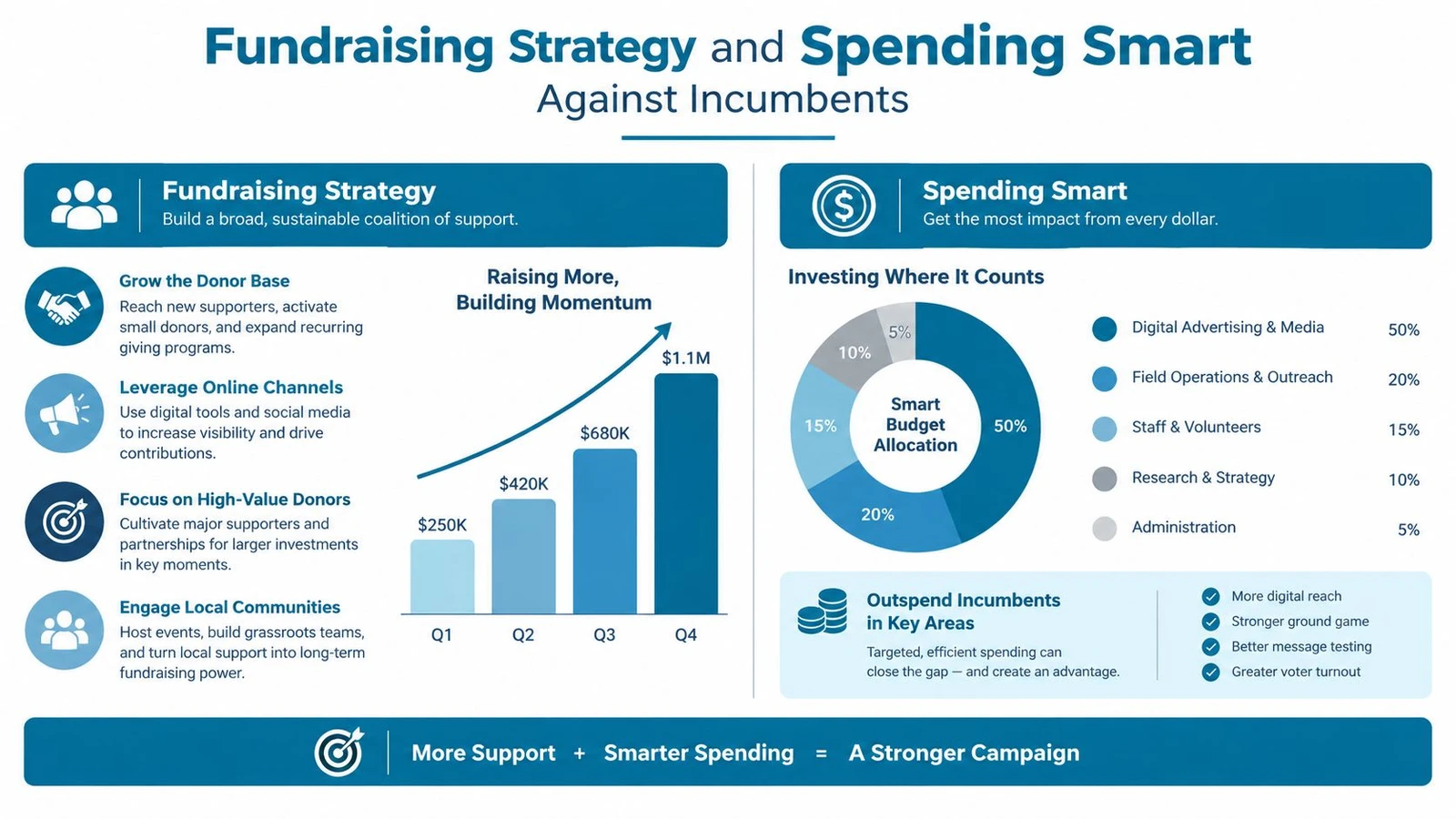
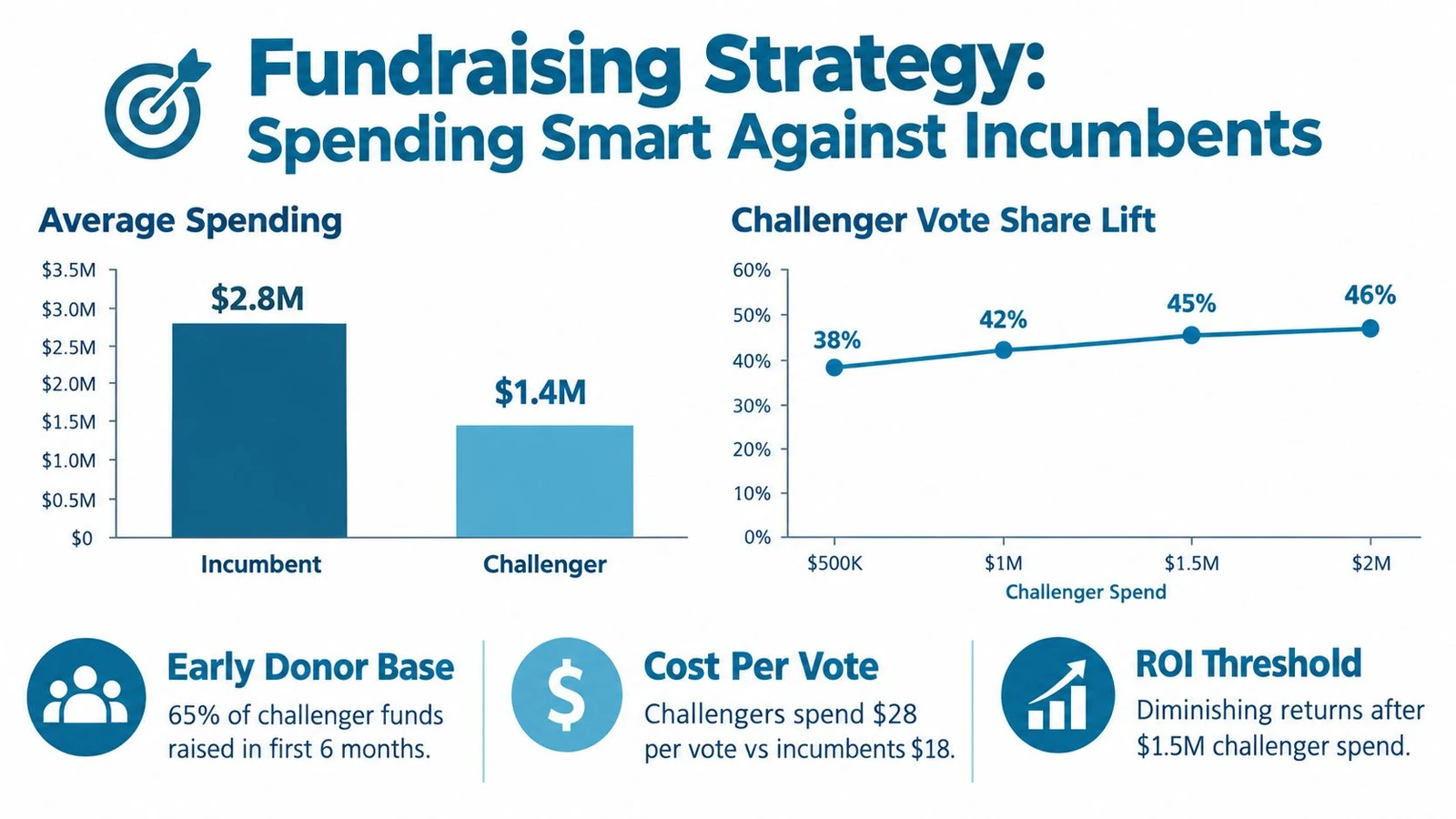
Money in a congressional race does more than pay bills. It determines how many voters you can reach, how often you can reach them, and whether your campaign looks like a serious alternative. Incumbents and challengers do not spend the same way, and the gap matters from the first month of the race.
Spend to create contact, not to decorate the race
Research on House contests shows challenger vote share and win frequency rise with spending up to roughly $800,000 in inflation-adjusted 2002 dollars, while heavy incumbent spending can signal vulnerability or a defensive posture University of Michigan Press. That is the first trade-off to understand. A challenger can waste a lot of money on broad visibility before the field operation is ready, and that cash rarely comes back as votes.
Open seats are usually cheaper than incumbent-challenger races, which changes the whole budgeting problem. House open-seat contests average about $1.8M versus $2.5M for incumbent-challenger races, and Senate open seats average about $11.5M versus $21.5M. A first-time candidate needs a budget that fits the seat type and the opponent, not a wish list built on impressions.
The spending sequence matters more than the headline total
Top-spending House candidates have won about 92% of races since 2000. That does not mean money alone decides the race. It means campaigns that can raise and spend at scale usually have the operation to match, and that edge is hard to catch once the race is underway.
Budget discipline wins early. The first dollars should buy contact capacity and message clarity, not vanity.
A campaign also needs to watch for diminishing returns. Once the electorate has heard the core message and the field can no longer absorb more money efficiently, another broad ad buy often weakens the budget instead of improving vote share. For a challenger, the job is to make the next dollar reach the right voter, not to make the campaign look busy.
A practical budget frame is straightforward:
- Target identification first. Define the persuadable universe before scaling spending.
- Message testing second. Use early testing to avoid paying for the wrong narrative.
- Field capacity third. Fund the people and systems that create actual voter contact.
- Media last, not first. Use paid reach to reinforce what the field already proved.
The fundraising side needs the same discipline. Use this fundraising planning guide to pressure-test projections, ask where the money will go, and cut anything that buys image without building voter contact. In congressional races, capitalization decides whether the campaign can compete at all.
Building Your Campaign Team and Infrastructure
A congressional campaign doesn’t fail because the candidate gave a weak speech at the launch. It fails because the team was assembled in the wrong order, the work was unclear, or the reporting systems were too thin to catch problems early. The best campaigns treat staffing as an operating system, not a collection of personalities.
Hire for control points, not just titles
The core roles are predictable. A campaign manager keeps the whole operation aligned. A finance director drives fundraising. A field director owns voter contact. A communications lead manages message discipline and press response. Those four roles cover the basic mechanics of a serious bid.
After that, the campaign adds capacity only when the work justifies it. Compliance counsel becomes more useful as filing complexity increases. A data director matters once targeting and reporting volumes are too large for ad hoc handling. A volunteer coordinator becomes critical when the campaign relies on recurring shifts instead of paid canvassers alone.
Lean race and well-funded race need different setups
A lean challenger campaign needs fewer layers and more discipline. That usually means one person handling several functions, with a hard line on weekly goals, donor follow-up, and field output. A well-funded open-seat race can afford specialization earlier, but it still needs clear ownership so no one assumes someone else is watching compliance, turnout, or data integrity.
Rule of thumb: if two people are responsible for the same task, the task usually gets done twice as slowly.
Infrastructure should match the map. The campaign needs voter file access, a donor-management process, a canvassing system that records interactions cleanly, and a dashboard that shows whether the field is moving. Without that visibility, the candidate hears anecdotes while the campaign misses patterns.
A usable dashboard should answer four questions every day:
- Who was contacted?
- Which turf was completed?
- What responses came back?
- Where does the campaign need to reallocate people tomorrow?
One option for campaigns that want canvassing, voter data, and route planning in one stack is doornoc, which supports mobile door knocking, offline capture, route planning, live progress tracking, and voter-list workflows. The value isn’t the branding, it’s the reduction in handoffs. Fewer handoffs usually means fewer errors, and fewer errors usually means better field discipline.
The infrastructure lesson is plain. A congressional bid that can’t measure what it’s doing cannot improve fast enough to beat a better-organized opponent.
Field Operations Voter Contact and Canvassing That Scales
The field operation is where campaign theory becomes votes. A district can be full of interested voters, but if the canvass list is badly cut, the routes are inefficient, or the results aren’t synced quickly, the campaign wastes the most expensive thing it has, human time.
A good canvass day starts before anyone leaves the office
The strongest field teams don’t begin with shoes on sidewalks. They begin with a clean voter universe, a route plan that respects geography, and a clear assignment for each shift. When route design is sloppy, volunteers waste energy crossing the same blocks, and captains spend the afternoon fixing avoidable problems instead of gathering useful data.
A representative day looks like this. The field lead cuts turf by priority, balances the routes so the most promising doors are concentrated, and pushes the packets to canvassers before the first doors open. Walkers record responses offline when connectivity drops, then sync once they’re back online so the campaign can review results the same day.
Contact quality matters more than raw walking volume
The wrong instinct is to treat every door the same. The better instinct is to prioritize persuadable voters, likely supporters who need turnout nudges, and parts of the district where the campaign can still shape the race. That’s where route efficiency and data discipline matter. Every accurate interaction record improves the next shift’s targeting.
The field team should measure completion, contact rate, and issue flags every night. If the same problem repeats for three days, it’s not a volunteer problem, it’s a management problem.
Manual CSV workflows can work in a pinch, but they slow down handoffs and raise the chance of mismatched records. Integrated voter data sourcing and automatic geocoding reduce wasted walks and help the campaign reassign people while the day is still active. That matters more in close races, where a small improvement in contact efficiency can change who gets another knock, another call, or another follow-up.
Door-to-door work is still the backbone for many congressional campaigns, but it shouldn’t stand alone. Phones work when the campaign needs scale fast. Relational organizing helps when the candidate’s supporters already have strong local networks. The best teams mix methods instead of pretending one channel can do everything.
For a deeper field playbook on route planning and turnout workflows, the campaign can consult this canvassing guide. The lesson is simple. Field operations win when they are organized, measurable, and ruthless about reusing data the same day it’s collected.
Staying Compliant and Deciding If You Should Run
A congressional bid should start with a harder question than, “Can the candidate message well?” It should start with, “Can this campaign clear compliance, raise enough money to function, and survive the personal cost of staying in the race?” Those are the filters. They eliminate more would-be candidates than ideology ever does.
The cost of running now goes beyond money
The hardest part of running is filing, fundraising, and staying safe while doing both. Recent reporting on candidate recruitment points to harassment, family strain, and burnout as active deterrents, and a 2026 Brookings analysis found 56 House retirement announcements by mid-Congress, the highest level in more than 30 years Courier Newsroom. Incumbents still dominate their own money race, with one analysis showing they capture about 94% of primary fundraising and 80% of general-election fundraising for their seat OpenSecrets.
That combination changes the decision. A candidate is not just asking whether the district can be persuaded. The campaign has to check whether the household, the staff, and the bank account can take the pressure long enough to build something credible.
A real go-no-go check should be brutally honest
Before launch, the campaign should answer five questions:
- Can the candidate file correctly and on time?
- Is there enough capital to build a real field and compliance operation?
- Is the district open enough for a challenger, or is the bench too deep?
- Can the household tolerate the schedule, scrutiny, and risk?
- Is there a clear path to ballot access and voter contact, not just attention?
If any of those answers are shaky, the race needs more preparation, not more optimism. Filing mistakes, weak reporting, and underfunded operations end campaigns fast. The best campaigns do not confuse ambition with readiness.
A serious bid is not the one that announces first. It is the one that can still function after the first hard month.
The strongest candidates treat launch as a commitment to process. They file cleanly, raise with discipline, staff with intent, and build a field system before they promise a miracle. That is how a campaign earns the right to compete.
If a congressional bid is being evaluated seriously, doornoc can help by bringing voter data, route planning, offline canvassing, and live field reporting into one workflow. Running for Congress is won or lost in execution, not in slogans. Visit doornoc to see how a campaign can tighten compliance, field operations, and volunteer follow-through before launch.
Looking for a tool to run this? doornoc’s canvassing software bundles voter data, automatic turf cutting, the mobile app, and live reporting in one platform.