
Key Takeaways
- Field organizers in 2026 earn between $42,000-$68,000 annually depending on campaign size, with regional organizers commanding $58,000-$85,000 for managing multiple territories.
- The core field organizer responsibilities include recruiting and training volunteers, executing canvassing operations, managing voter data, and hitting weekly contact goals that average 800-1,200 voter touches per organizer.
- Modern field organizers spend 60% of their time on direct voter contact and volunteer management, 25% on data entry and analysis, and 15% on strategic planning and reporting.
- Regional organizers differ from field organizers by managing 3-8 field staff members, overseeing entire counties or congressional districts, and focusing on strategic resource allocation rather than direct voter contact.
Field organizer roles and responsibilities have evolved significantly in 2026, yet many campaigns still struggle to define what these critical positions actually entail. A field organizer is a campaign staff member responsible for executing grassroots voter contact operations within a specific geographic territory, managing volunteers, and serving as the direct link between campaign strategy and on-the-ground implementation. In 2026’s data-driven political landscape, field organizers blend traditional door-knocking with sophisticated mobile technology and real-time analytics.
This guide breaks down exactly what field organizers do, how much they earn, what skills they need, and how the role differs from regional and other organizing positions.
What Does a Field Organizer Actually Do Day-to-Day?
Field organizer duties center on one primary objective: maximizing quality voter contacts within an assigned turf. Unlike field directors who develop strategy or regional organizers who manage multiple territories, field organizers execute the tactical ground game that determines election outcomes.
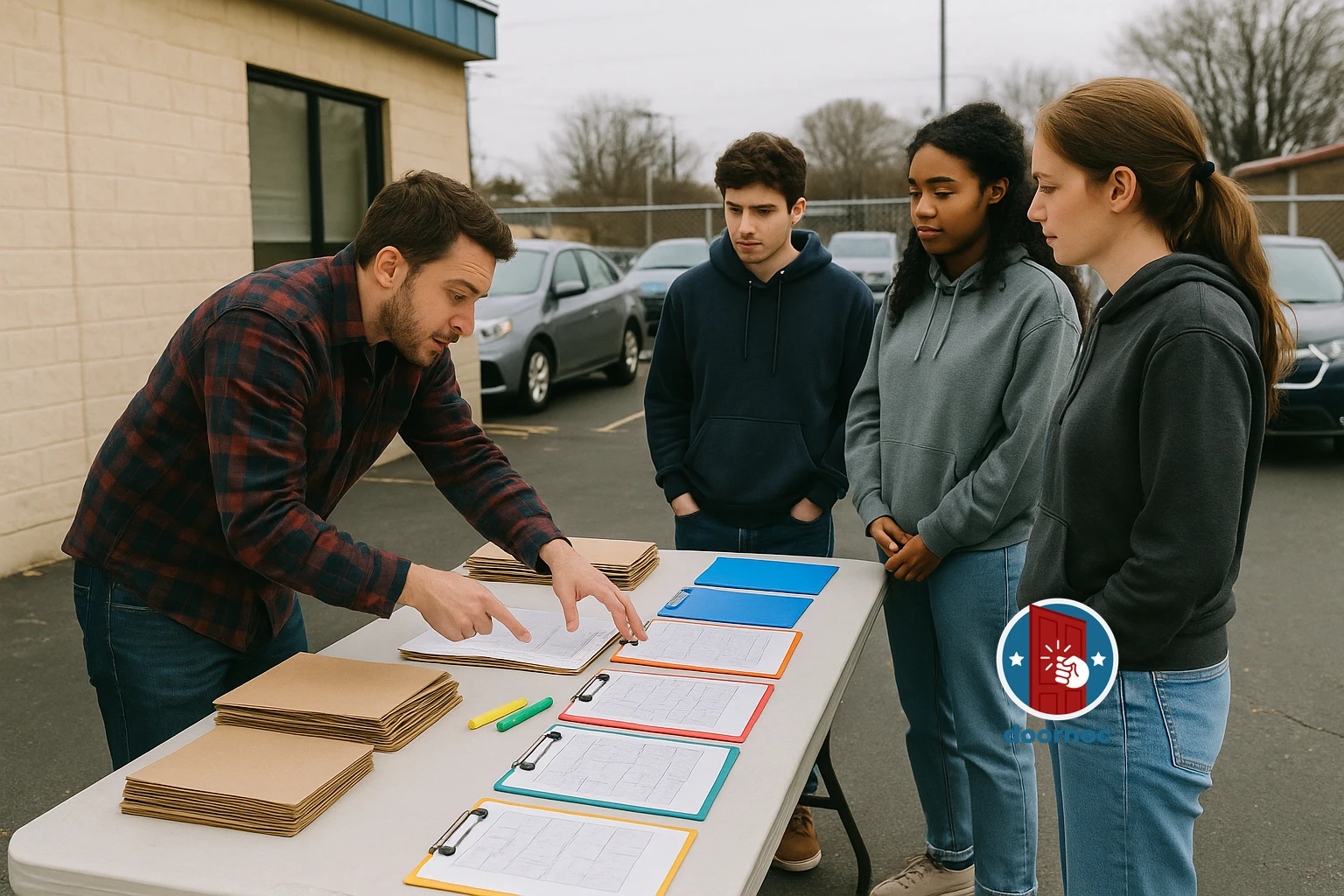
A typical field organizer’s day in 2026 starts at 10:00 AM and ends around 10:00 PM during peak campaign season. The morning hours focus on volunteer recruitment calls, data review, and preparing materials for afternoon canvassing shifts. Between 1:00-5:00 PM, organizers conduct volunteer training sessions, often in campaign office parking lots or coffee shops, teaching new canvassers how to use mobile apps, deliver the campaign message, and handle difficult voter interactions.
The evening shift from 5:00-9:00 PM represents prime canvassing time. Field organizers either lead canvassing teams directly or manage multiple teams deployed across their turf. Using platforms like DoorNoc, they monitor real-time progress, troubleshoot issues, and ensure volunteers complete their assigned routes. After canvassing ends, organizers spend 45-90 minutes syncing data, following up with volunteers, and reporting results to their regional organizer or field director.
The weekend schedule intensifies. Saturday and Sunday typically involve 8-12 hours of continuous voter contact through door-knocking, phone banking, and community events. Field organizers in 2026 are expected to personally complete 40-60 door knocks per shift when not actively supervising volunteers, maintaining their direct connection to voter sentiment.
Core Responsibilities Breakdown
Field organizer responsibilities break down into eight distinct categories, each consuming specific portions of their work week:
Volunteer Recruitment (20% of time): Field organizers make 50-100 recruitment calls daily, reaching out to supporters identified through campaign data, community organizations, and personal networks. In 2026, successful organizers use multi-channel approaches, combining phone calls with text messages, social media outreach, and in-person asks at community events. The goal is maintaining a pipeline of 25-50 active volunteers who can be deployed for various activities.
Volunteer Training and Management (15% of time): Once recruited, volunteers need ongoing training and motivation. Field organizers conduct 2-3 formal training sessions weekly, covering canvassing techniques, script delivery, safety protocols, and technology use. They also provide one-on-one coaching, address concerns, and recognize top performers. Managing volunteer personalities, conflicts, and burnout represents one of the most challenging aspects of the role.
Direct Voter Contact (25% of time): Field organizers don’t just manage others—they knock doors themselves. This serves multiple purposes: modeling best practices, maintaining personal voter contact, filling gaps when volunteers cancel, and gathering firsthand intelligence about voter sentiment. Experienced organizers in 2026 average 15-20 doors per hour using optimized routes and mobile canvassing tools.
Data Management and Reporting (20% of time): Every voter interaction must be recorded, synced, and analyzed. Field organizers review daily contact reports, identify trends, flag issues for the field director, and ensure data quality. They spend 60-90 minutes daily in mobile canvassing platforms updating voter files, managing walk lists, and tracking volunteer performance metrics.
Event Coordination (10% of time): Field organizers plan and execute community events, volunteer appreciation gatherings, and voter registration drives. This includes venue coordination, material preparation, volunteer recruitment for event staffing, and follow-up with attendees.
Strategic Planning (5% of time): While field directors handle overall strategy, field organizers contribute tactical insights from their turf. They participate in weekly strategy calls, propose targeting adjustments based on canvassing results, and identify opportunities for expanded outreach.
Administrative Tasks (5% of time): The unglamorous but necessary work includes managing office supplies, coordinating vehicle usage, processing volunteer reimbursements, and maintaining accurate records for compliance purposes.
This time allocation shifts during campaign phases. Early in the cycle, recruitment and training dominate. In the final 72 hours before Election Day, 90% of time focuses on direct voter contact and volunteer coordination.
Field Organizer Salary and Compensation in 2026
Field organizer salary expectations have increased moderately in 2026, reflecting both inflation and the growing professionalization of campaign work. Understanding compensation structures helps both job seekers and campaign managers set realistic expectations.
The median field organizer salary in 2026 sits at $52,000 annually for full-cycle positions on statewide campaigns. However, this figure varies significantly based on several factors:
Campaign Type and Budget: Presidential campaigns and well-funded Senate races offer $55,000-$68,000 for experienced field organizers, with some competitive positions reaching $72,000 in high-cost-of-living areas. Congressional campaigns typically pay $42,000-$52,000, while local and state legislative races offer $38,000-$48,000. Issue advocacy campaigns and non-profit organizing positions range from $45,000-$58,000.
Geographic Location: Field organizers in major metropolitan areas earn 15-25% more than those in rural regions. A field organizer in Philadelphia or Phoenix might earn $58,000, while the same role in rural Pennsylvania or Arizona pays $46,000. This differential partially accounts for housing costs but doesn’t always fully compensate for the gap.
Experience Level: Entry-level organizers with no previous campaign experience start at $38,000-$42,000. Those with one complete campaign cycle command $45,000-$52,000. Organizers with 2-3 cycles and proven track records can negotiate $55,000-$65,000, especially if they bring specialized skills like Spanish fluency or data analytics expertise.
Campaign Phase: Many campaigns hire organizers on staggered schedules. Early hires (12-18 months before Election Day) receive full salaries. Organizers brought on 6-8 months out might receive prorated compensation. Final sprint hires (last 2-3 months) sometimes work as contractors at daily or weekly rates of $200-$350 per day.
Benefits and Additional Compensation
Beyond base salary, field organizer compensation packages in 2026 typically include:
- Health insurance: 85% of statewide and federal campaigns now offer health benefits, up from 62% in 2024
- Housing stipends: Campaigns often provide $800-$1,500 monthly for organizers relocated to their turf
- Vehicle allowances: $400-$600 monthly for organizers using personal vehicles, or campaign-provided vehicles
- Phone and technology: Campaign-issued smartphones and laptops, plus $50-75 monthly stipends
- Per diem: $25-40 daily for meals during long shifts, though this varies widely
Notably absent from most field organizer packages: retirement benefits, paid time off (beyond major holidays), and overtime pay. The exempt status of campaign workers means 60-70 hour weeks during peak season don’t generate additional compensation.
Regional Organizer Salary Comparison
Regional organizers—who manage multiple field organizers and larger territories—earn significantly more. The typical regional organizer salary in 2026 ranges from $58,000-$85,000, with presidential campaigns and competitive Senate races paying at the higher end. This 30-40% premium over field organizer salaries reflects the increased responsibility, required experience, and management duties.
For campaigns considering how to structure their field operations and budget accordingly, understanding these compensation benchmarks is essential for competitive hiring. For more on building effective field teams, see our complete guide to building a political field organization.
Essential Skills for Field Organizers in 2026
Grassroots organizer skills have expanded beyond traditional people management to include technical proficiency and data literacy. The most effective field organizers in 2026 master both interpersonal and technological competencies.
People Skills and Emotional Intelligence
Volunteer Recruitment and Motivation: The ability to inspire strangers to donate their time represents the foundational field organizer skill. This requires identifying what motivates different personality types—some volunteers respond to competitive metrics, others to community connection, still others to direct candidate interaction. Successful organizers in 2026 tailor their recruitment pitch to individual motivations rather than using generic appeals.
Conflict Resolution: Managing 30-50 volunteers inevitably generates interpersonal conflicts. Field organizers must mediate disputes, address complaints diplomatically, and maintain team cohesion under pressure. This includes handling difficult conversations about underperformance, managing volunteers who overstep boundaries, and navigating the political dynamics within volunteer teams.
Public Speaking and Training Delivery: Field organizers conduct multiple training sessions weekly, often for audiences ranging from college students to retirees. Effective trainers adapt their communication style to different learning preferences, use storytelling to illustrate concepts, and create safe environments for questions and practice.
Cultural Competency: Campaigns in 2026 require organizers who can work effectively across racial, ethnic, generational, and socioeconomic lines. This means understanding community-specific communication norms, recognizing implicit biases, and building authentic relationships rather than transactional ones. Bilingual organizers who speak Spanish, Mandarin, Vietnamese, or Arabic command premium salaries and expanded responsibilities.
Technical and Data Skills
Mobile Canvassing Platform Proficiency: Field organizers must master platforms like DoorNoc, training volunteers on features like auto turf cutting and offline data collection. This includes troubleshooting technical issues in the field, optimizing route planning, and leveraging real-time analytics to adjust deployment strategies.
Data Management and Analysis: Every field organizer works with voter databases daily, pulling walk lists, updating contact results, and identifying high-value targets. Basic SQL knowledge, spreadsheet proficiency, and understanding of voter file architecture have become standard expectations. Organizers who can identify trends in contact data and propose targeting adjustments based on statistical analysis stand out for advancement.
Digital Communication Tools: Field organizers coordinate operations through Slack, manage volunteer schedules via Google Calendar, recruit through social media, and send mass communications via platforms like Mobilize. Comfort with technology and quick learning of new tools is essential.
Strategic and Organizational Skills
Time Management Under Pressure: Field organizers juggle competing priorities constantly—a volunteer cancellation, a data sync error, and a last-minute event request might all occur within 30 minutes. Effective organizers triage ruthlessly, delegate when possible, and maintain focus on high-impact activities even amid chaos.
Strategic Thinking: While field directors set overall strategy, field organizers make tactical decisions daily. Which doors to prioritize when time is limited? How to reallocate volunteers when one turf exceeds goals while another falls short? When to escalate issues versus solving them independently? These judgment calls directly impact campaign outcomes.
Resilience and Stress Management: Campaign work involves long hours, frequent rejection, high stakes, and intense pressure. Field organizers who thrive develop coping mechanisms for stress, maintain perspective during setbacks, and sustain motivation through the inevitable mid-campaign slumps. The ability to bounce back from a discouraging day and motivate others despite personal exhaustion separates successful organizers from those who burn out.
For practical application of these skills, our guide on how to organize a door-to-door canvassing campaign provides step-by-step frameworks field organizers use daily.
Regional Organizer vs Field Organizer: Key Differences
Understanding the distinction between regional organizer and field organizer roles is crucial for both career planning and campaign structure design. While the titles sound similar, the positions differ significantly in scope, responsibilities, and required experience.
Scope and Territory Management
Field organizers typically manage 1-3 precincts or a defined neighborhood within a city, representing 3,000-8,000 voters. Their focus remains intensely local—they know their turf intimately, recognize regular voters by name, and understand block-level voting patterns.
Regional organizers oversee entire counties, congressional districts, or multi-county regions encompassing 50,000-200,000 voters. Rather than managing individual precincts, they coordinate 3-8 field organizers, ensuring consistent execution across multiple turfs. A regional organizer in suburban Philadelphia might manage field organizers in Delaware County, Montgomery County, and Chester County simultaneously.
Responsibilities and Daily Work
The field organizer’s day centers on direct execution: recruiting volunteers, training canvassers, knocking doors, and entering data. They spend 60-70% of their time on direct voter contact and volunteer management.
Regional organizers focus on coordination and strategy. Their typical day includes:
- Morning: Review overnight data from all turfs, identify underperforming areas, adjust resource allocation
- Midday: One-on-one check-ins with field organizers, problem-solving operational issues, strategic planning with field director
- Afternoon: Attend high-level meetings, coordinate cross-turf initiatives, manage relationships with local elected officials and stakeholder groups
- Evening: Spot-check canvassing operations across multiple turfs, provide real-time coaching to field organizers, compile regional reports
Regional organizers rarely knock doors themselves except for high-profile events or when demonstrating techniques. Their value lies in strategic oversight, not direct voter contact.
Management Responsibilities
Field organizers manage volunteers—typically 25-50 active volunteers who they recruit, train, and deploy. This involves peer-to-peer relationship building and motivational leadership.
Regional organizers manage paid staff—the 3-8 field organizers in their region plus any organizing fellows or interns. This requires different skills: performance management, difficult conversations about underperformance, hiring and firing decisions, and professional development. Regional organizers conduct weekly one-on-ones with each field organizer, set individual goals, and provide structured feedback.
Experience and Compensation
Field organizer positions are often entry points into campaign work. Many field organizers are recent college graduates or career changers with limited political experience. One complete campaign cycle as a field organizer is typical before advancement.
Regional organizers typically have 2-4 campaign cycles of experience, demonstrated success in meeting contact goals, and proven management ability. The position requires political judgment that comes only from experiencing multiple campaign phases and challenges.
This experience gap reflects in compensation. As noted earlier, regional organizers earn $58,000-$85,000 compared to field organizers’ $42,000-$68,000—a 30-40% premium.
Decision-Making Authority
Field organizers make tactical decisions within their turf: which doors to prioritize today, how to deploy volunteers across walk packets, when to shift from doors to phones due to weather. They operate within parameters set by regional organizers and field directors.
Regional organizers make strategic decisions affecting multiple turfs: reallocating field organizers between counties, shifting budget between regions, determining which communities receive targeted outreach, and setting regional contact goals. They participate in campaign-wide strategy discussions and influence resource allocation.
Career Trajectory
The typical progression is: Field Organizer → Regional Organizer → Deputy Field Director → Field Director. Some organizers specialize, becoming voter protection directors, coalitions directors, or digital organizing directors instead of climbing the traditional field hierarchy.
Understanding these distinctions helps campaigns structure their field operations effectively and helps organizers plan career development. For more on building comprehensive field teams, see our guide on managing canvassing teams remotely, which covers coordination strategies relevant to both field and regional organizers.
What Campaign Organizer Duties Look Like Across Different Campaign Types
Campaign organizer duties vary significantly based on the type of race, campaign budget, and electoral context. A field organizer on a presidential campaign operates differently than one on a city council race, even though core responsibilities overlap.
Presidential and Statewide Campaigns
Presidential and competitive Senate campaigns offer the most structured field organizer experience. These campaigns feature:
- Large field teams: 50-200+ field organizers statewide, creating clear hierarchies and specialization
- Extensive resources: Robust data infrastructure, professional training programs, dedicated tech support
- Defined territories: Precise turf assignments based on sophisticated targeting models
- Specialization opportunities: Organizers might focus exclusively on youth outreach, Spanish-language communities, or rural voters
- Intensive timelines: 12-18 month campaign cycles with distinct phases
Field organizers on these campaigns benefit from institutional support but face intense pressure and high expectations. Weekly contact goals of 1,000-1,500 voter touches are standard, and underperformance leads to quick reassignment or termination.
Congressional Campaigns
Congressional campaigns represent the middle ground—large enough for professional field operations but small enough that organizers wear multiple hats:
- Medium-sized teams: 5-15 field organizers depending on district competitiveness
- Broader responsibilities: Organizers might manage field operations, coordinate with coalitions, and handle some communications tasks
- Less specialized data: Campaigns use voter file data but might lack sophisticated modeling
- Closer candidate access: Field organizers often interact directly with the candidate, unlike presidential campaigns
- Flexible tactics: More room for creative grassroots tactics and local experimentation
Congressional field organizers develop versatility that serves them well in future campaigns. They learn to improvise with limited resources while maintaining professional standards.
State Legislative and Local Campaigns
State house, city council, and county-level campaigns often employ 1-3 field organizers (if any paid staff at all):
- Minimal hierarchy: Field organizers report directly to the campaign manager or candidate
- Maximum versatility: Organizers handle field, data, coalitions, and sometimes communications
- Volunteer-dependent: Success relies heavily on recruiting and empowering volunteer leaders
- Resource constraints: Limited budget for technology, materials, or stipends
- Relationship-driven: Personal networks and community ties matter more than sophisticated data
Field organizers on local campaigns gain entrepreneurial skills and learn to achieve results with minimal resources. The experience builds resilience and creative problem-solving abilities.
Issue Advocacy and Non-Profit Organizing
Issue campaigns (ballot initiatives, advocacy organizations) feature different rhythms:
- Longer timelines: 18-24 month campaigns are common for major ballot initiatives
- Community integration: Organizers build deeper relationships within communities rather than extracting volunteer hours
- Multiple campaign cycles: Non-profit organizers might work year-round across multiple electoral and advocacy campaigns
- Different metrics: Success measured by community leadership development, not just voter contacts
- Varied tactics: More emphasis on community events, coalition building, and earned media
Organizers who start in issue advocacy often bring valuable community organizing skills to electoral campaigns but must adapt to the faster pace and harder deadlines of candidate races.
How Technology Has Changed Field Organizer Work in 2026
Field organizer roles and responsibilities have been fundamentally reshaped by mobile technology and data analytics over the past decade. The 2026 field organizer operates in a dramatically different environment than their 2016 counterpart.
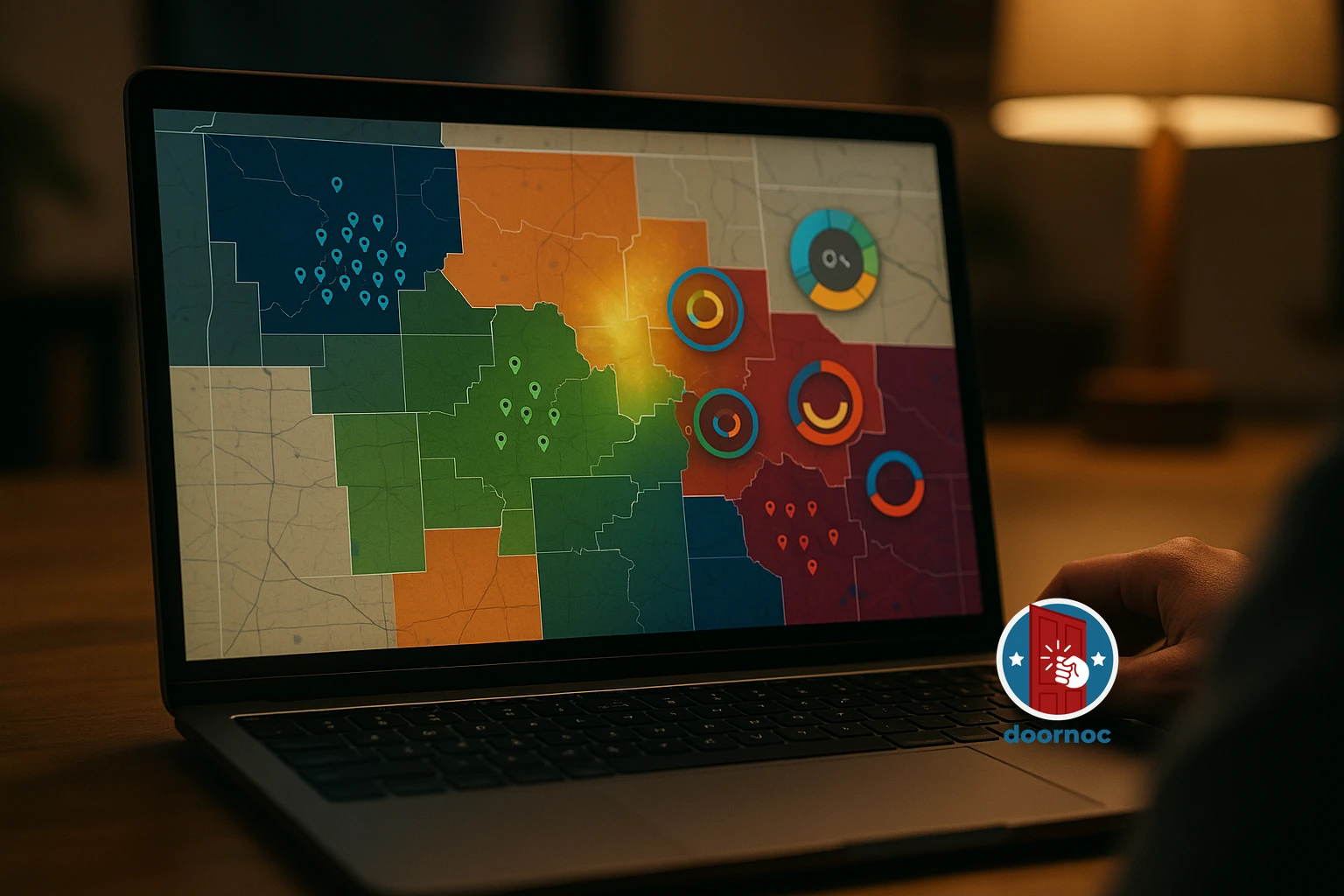 Regional organizer’s laptop displaying color-coded county field map with deployment data visualizations.
Mobile-First Operations
The shift to mobile canvassing platforms represents the most visible change. Field organizers in 2026 no longer print walk lists, carry clipboards, or return to offices for data entry. Instead, they use smartphones and tablets for every aspect of field operations.
Platforms like DoorNoc enable field organizers to:
- Assign and modify turf assignments in real-time based on volunteer availability
- Monitor canvassing progress through live dashboards showing doors knocked, contacts made, and volunteer locations
- Communicate instantly with dispersed canvassing teams through in-app messaging
- Adjust routes on the fly when volunteers finish early or encounter obstacles
- Sync data automatically, eliminating the evening data entry sessions that once consumed 90+ minutes
This mobile-first approach increases efficiency but also raises expectations. Field organizers in 2026 are expected to respond to issues immediately, adjust strategies based on real-time data, and maintain constant communication with both volunteers and supervisors.
Data-Driven Decision Making
Field organizers now access sophisticated analytics that were once available only to senior campaign staff. They review dashboards showing:
- Contact rates by time of day, day of week, and canvasser
- Persuasion effectiveness across different message frames
- Volunteer retention and productivity metrics
- Comparative performance across turfs and regions
- Predictive scores indicating which voters to prioritize
This data access empowers field organizers to make evidence-based tactical decisions. Rather than relying on intuition about which doors to knock, they consult propensity scores. Instead of guessing which volunteers to deploy where, they review productivity data.
However, this data abundance also creates pressure. Field organizers must explain underperformance with specificity, justify resource requests with metrics, and continuously optimize based on analytics. The job has become more analytical and less purely relational.
Remote Management Capabilities
The pandemic-era shift to remote work has permanently changed field organizing. While door-knocking returned to pre-2020 levels, the infrastructure for remote management persists. Field organizers in 2026 coordinate geographically dispersed volunteers who might never visit a physical campaign office.
This requires new skills in virtual training, remote motivation, and digital community building. Field organizers conduct training via Zoom, manage volunteer teams through Slack channels, and build relationships without in-person interaction. For detailed strategies, see our guide on managing canvassing teams remotely.
Integration Challenges
The proliferation of campaign technology creates integration challenges. Field organizers in 2026 might use:
- A mobile canvassing app for door-knocking
- A separate phone banking platform
- A volunteer management system
- A mass texting tool
- A social media scheduling platform
- A voter database interface
Managing multiple platforms, ensuring data flows correctly between systems, and training volunteers on various tools consumes significant time. Campaigns that invest in integrated platforms or consolidated tech stacks reduce this burden.
The Enduring Importance of Human Connection
Despite technological transformation, the core of field organizing remains unchanged: building relationships and inspiring action. Technology enhances efficiency but doesn’t replace the human connection that motivates volunteers and persuades voters.
The most effective field organizers in 2026 use technology as a tool while maintaining focus on interpersonal skills. They leverage mobile canvassing platforms to knock more doors efficiently, then rely on emotional intelligence and communication skills to convert those contacts into votes.
Career Path and Advancement for Field Organizers
Field organizing offers a clear career ladder with multiple advancement paths. Understanding the trajectory helps organizers set goals and campaigns develop talent pipelines.
Entry to Mid-Level Progression
Most organizers start as entry-level field organizers on local or congressional campaigns. After successfully completing one campaign cycle—demonstrating the ability to recruit volunteers, meet contact goals, and manage data—they advance to:
Experienced Field Organizer: Second or third campaign with increased responsibilities, higher salary ($48,000-$58,000), and potentially more challenging turf assignments. These organizers mentor newer staff and take on special projects.
Regional Organizer: After 2-3 successful cycles, strong performers advance to regional organizer roles ($58,000-$85,000), managing multiple field organizers and larger territories. This represents the first true management position in the field hierarchy.
Organizing Director (Small Campaigns): On congressional or local campaigns, experienced organizers might become the organizing director—the senior field staff member responsible for all grassroots operations. This role combines field execution with strategic planning.
Senior Field Leadership
Organizers who excel at regional level and demonstrate strategic thinking advance to:
Deputy Field Director: On statewide campaigns, deputy field directors manage large teams of regional and field organizers, oversee specific geographic regions (like “Southern Region” or “Suburban Collar Counties”), and contribute to statewide field strategy. Compensation ranges from $75,000-$95,000.
Field Director: The senior-most field position, field directors design and execute the entire grassroots strategy, manage budgets of $500,000-$5,000,000+, supervise teams of 20-200+ staff, and report directly to the campaign manager. Field directors on competitive statewide races earn $95,000-$140,000. This role requires 4-6+ campaign cycles of experience and proven success managing large-scale operations.
Alternative Specializations
Not all organizers follow the traditional field hierarchy. Alternative career paths include:
Voter Protection Director: Organizers with legal knowledge or interest in election administration might specialize in voter protection, managing poll monitoring programs and voter assistance hotlines.
Coalitions Director: Organizers with strong community ties might focus on coalition building, serving as liaisons to specific demographic or interest groups.
Digital Organizing Director: Tech-savvy organizers increasingly move into digital organizing, managing online volunteer communities, distributed organizing programs, and social media mobilization.
Training Director: Experienced organizers sometimes specialize in staff development, creating and delivering training programs for field staff across multiple campaigns.
Political Director: Some organizers transition from field to political operations, managing endorsements, stakeholder relationships, and coalition partnerships.
Beyond Campaigns
Organizing skills transfer to numerous career paths outside electoral politics:
- Non-profit advocacy: Issue organizations hire campaign organizers to build grassroots movements
- Labor organizing: Unions value campaign organizing experience for membership mobilization
- Corporate community relations: Companies hire organizers for stakeholder engagement and community outreach
- Political consulting: Experienced organizers launch consulting firms advising campaigns on field strategy
- Elected office: Many organizers eventually run for office themselves, leveraging their grassroots skills
Skills Development for Advancement
Organizers who advance most quickly focus on developing:
- Management skills: Learning to coach, provide feedback, and hold staff accountable
- Strategic thinking: Moving beyond tactical execution to understand broader campaign strategy
- Budget management: Understanding how to allocate resources efficiently
- Data analytics: Developing sophisticated data skills beyond basic voter file management
- Political relationships: Building networks with party officials, elected leaders, and campaign professionals
Many successful organizers supplement campaign experience with formal education—graduate degrees in public policy, political management, or data science—though practical campaign experience typically matters more than credentials.
Measuring Field Organizer Performance in 2026
Campaigns evaluate field organizer performance through both quantitative metrics and qualitative assessments. Understanding these evaluation criteria helps organizers focus efforts on high-impact activities.
Quantitative Performance Metrics
Voter Contact Goals: The primary metric for field organizer performance is weekly voter contacts. Typical 2026 benchmarks include:
- 800-1,200 total voter contacts per week (doors, phones, texts combined)
- 400-600 door knocks per week
- 200-400 phone contacts per week
- 60-80% contact rate on assigned doors (reaching someone at home)
These numbers scale based on turf density, volunteer availability, and campaign phase. Final 72-hour goals often triple normal weekly targets.
Volunteer Recruitment and Retention: Field organizers are assessed on:
- Number of active volunteers (target: 25-50)
- Volunteer retention rate (target: 60%+ month-over-month)
- New volunteer recruitment (target: 5-10 new volunteers weekly)
- Volunteer productivity (average doors knocked per volunteer per shift)
Campaigns track these metrics through volunteer management systems, measuring both quantity and quality of volunteer engagement.
Data Quality: Every contact matters only if accurately recorded. Field organizers are evaluated on:
- Data completion rate (target: 95%+ of contacts have full information)
- Same-day data entry (target: 100% of contacts synced within 24 hours)
- Data accuracy (spot-checks of recorded information)
- Duplicate contact rate (target: <5%)
Poor data quality undermines the entire field operation, making this a critical performance area.
Event Execution: For organizers responsible for events:
- Event attendance vs. goals
- Volunteer recruitment from events
- Follow-up contact rate with event attendees
Qualitative Performance Factors
Leadership and Team Management: Regional organizers and field directors assess:
- Volunteer satisfaction and morale
- Conflict resolution effectiveness
- Training quality and volunteer preparedness
- Team culture and inclusivity
- Ability to motivate during challenging periods
Strategic Contribution: Beyond execution, strong organizers:
- Provide valuable intelligence from voter conversations
- Propose tactical adjustments based on field observations
- Identify emerging issues or opportunities
- Demonstrate political judgment in resource allocation
Professionalism and Reliability: Basic but essential factors include:
- Consistent attendance and punctuality
- Responsiveness to supervisor communication
- Adherence to campaign policies and protocols
- Representation of campaign values in community interactions
Performance Improvement and Coaching
Effective campaigns provide regular feedback and coaching rather than waiting for formal reviews. Weekly one-on-ones between field organizers and regional organizers should cover:
- Progress toward quantitative goals
- Challenges and obstacles
- Resource needs
- Professional development opportunities
Organizers falling short of goals receive specific improvement plans with clear benchmarks and timelines. Those consistently exceeding goals earn expanded responsibilities, salary increases (when budgets allow), or advancement opportunities.
Preparing for a Field Organizer Role: What Candidates Should Know
Prospective field organizers should enter the role with realistic expectations and specific preparation. The job offers incredible learning opportunities but demands significant sacrifices.
What to Expect
Work-Life Balance: Field organizing during campaign season means 60-70 hour weeks, evening and weekend work, and minimal personal time. Campaigns typically provide one day off per week (often Monday), but expect to be “on call” even during off hours. This pace is sustainable for 6-12 months but challenging long-term.
Emotional Challenges: Field organizing involves frequent rejection, high-pressure deadlines, and the stress of working toward a binary outcome (winning or losing). Organizers must develop resilience and maintain motivation despite discouraging moments.
Financial Considerations: While salaries have improved, field organizing rarely offers financial security. Most positions are temporary (campaign cycle only), lack retirement benefits, and pay less than comparable private sector jobs. Organizers motivated primarily by money should consider other careers.
Career Development: For those passionate about politics and social change, field organizing provides unmatched experience. You’ll develop leadership skills, build extensive networks, and gain practical knowledge of democratic participation. Many political leaders, elected officials, and senior campaign staff began as field organizers.
How to Prepare
Gain Relevant Experience: Before applying for paid field organizer positions:
- Volunteer on local campaigns to understand field operations
- Take on leadership roles in student organizations or community groups
- Develop public speaking skills through presentations or teaching
- Practice data management using spreadsheets and databases
Build Technical Skills: Familiarize yourself with:
- Basic voter file concepts and campaign databases
- Mobile canvassing apps (many offer demo modes)
- Project management and communication tools (Slack, Asana, Google Workspace)
- Social media platforms for recruitment and communication
Develop Political Knowledge: Read extensively about:
- Current political issues and policy debates
- Electoral strategy and campaign history
- Community organizing theory and practice
- The specific issues and context of campaigns you’re targeting
Network Strategically: Connect with:
- Alumni from your school who work in politics
- State and local party officials
- Campaign managers and field directors
- Political organizations aligned with your values
Many field organizer positions are filled through personal networks before being publicly posted. Building relationships increases your chances of landing competitive roles.
The Application and Interview Process
Field organizer applications typically require:
- Resume highlighting relevant experience (organizing, leadership, data skills)
- Cover letter explaining your political motivations and campaign interest
- References from previous supervisors or community leaders
- Sometimes a writing sample or strategic plan
Interviews assess both competency and cultural fit. Expect questions about:
- Your motivation for campaign work and political values
- Experience managing volunteers or leading teams
- How you handle conflict and difficult personalities
- Your approach to meeting ambitious goals with limited resources
- Availability and willingness to relocate
Demonstrate specific knowledge about the campaign, candidate, and district. Generic applications rarely succeed.
Setting Yourself Up for Success
Once hired, new field organizers should:
- Absorb training intensively—ask questions and take detailed notes
- Build relationships with experienced organizers who can mentor you
- Over-communicate with supervisors about challenges and progress
- Prioritize volunteer relationships—your success depends on their engagement
- Maintain detailed records of your work for future job applications
- Set boundaries to prevent complete burnout
- Remember that every campaign, win or lose, provides valuable learning
Field organizing represents one of the most challenging and rewarding entry points into political careers. Those who excel at the role develop skills that serve them throughout their professional lives, whether they remain in politics or pursue other paths.
For campaigns looking to build effective field teams and for organizers seeking to understand the full scope of field operations, exploring best practices in field management software provides additional context on the tools and systems that support modern field organizing work.
Conclusion
Field organizer roles and responsibilities in 2026 blend traditional grassroots organizing with sophisticated technology and data analytics. These positions serve as the backbone of successful campaigns, translating strategic vision into direct voter contact and community engagement. Whether you’re a campaign manager building a field team, a prospective organizer considering the career, or a political professional seeking to understand field operations, recognizing the scope and complexity of field organizing work is essential.
The role demands long hours, emotional resilience, and constant adaptation, but offers unparalleled opportunities for political impact and professional development. As campaigns continue evolving with new technologies and changing voter behaviors, field organizers who master both interpersonal skills and technical proficiency will remain indispensable to electoral success.
For campaigns ready to empower their field teams with modern tools, DoorNoc’s mobile canvassing platform provides the infrastructure field organizers need to recruit volunteers, execute efficient canvassing operations, and track progress in real-time. Contact our team to learn how we support field organizers in achieving their voter contact goals and building winning campaigns.
Frequently Asked Questions
What is the average field organizer salary in 2026?
Field organizers in 2026 earn between $42,000-$68,000 annually, with the median salary around $52,000 for statewide campaigns. Congressional and local campaigns typically pay $38,000-$48,000, while presidential campaigns and well-funded Senate races offer $55,000-$68,000. Regional organizers earn significantly more at $58,000-$85,000 depending on experience and campaign budget.
What are the main responsibilities of a field organizer?
Field organizers recruit and train volunteers, plan and execute canvassing operations, manage voter contact data, coordinate phone banking, organize community events, and report progress to field directors. They typically manage 25-50 active volunteers and are responsible for meeting weekly voter contact goals of 800-1,200 touches in their assigned turf.
What’s the difference between a field organizer and a regional organizer?
Field organizers focus on direct voter contact and volunteer management within a specific turf (usually 1-3 precincts). Regional organizers manage 3-8 field organizers across entire counties or congressional districts, focusing on strategic planning, resource allocation, and coordinating multi-turf operations. Regional organizers typically have 2-4 campaign cycles of experience and earn 30-40% more.
What skills do you need to become a field organizer?
Essential field organizer skills include volunteer recruitment and motivation, public speaking, data management, conflict resolution, time management under pressure, and proficiency with mobile canvassing platforms. Successful organizers also need resilience, cultural competency, basic political knowledge, and the ability to work 60-70 hour weeks during campaign peaks.
How do you advance from field organizer to field director?
The typical career path progresses from field organizer (1-2 cycles) to regional organizer (2-3 cycles) to deputy field director (3-4 cycles) to field director (4+ cycles). Advancement requires consistently meeting contact goals, developing strong volunteer networks, demonstrating data proficiency, and building relationships with campaign leadership. Many organizers also pursue specialized roles in digital organizing or voter protection.