A shift starts in twenty minutes, the walk list is longer than the daylight left, and half the volunteers have never knocked a door. That gap between a good intention and a finished turf is where most field programs succeed or fail. Block walking done well isn’t a pile of addresses and a pep talk. It’s a measurable operation with a defined goal, a walkable route, a clear script, and data that shows what happened at each door.
What Block Walking Means in a Modern Campaign
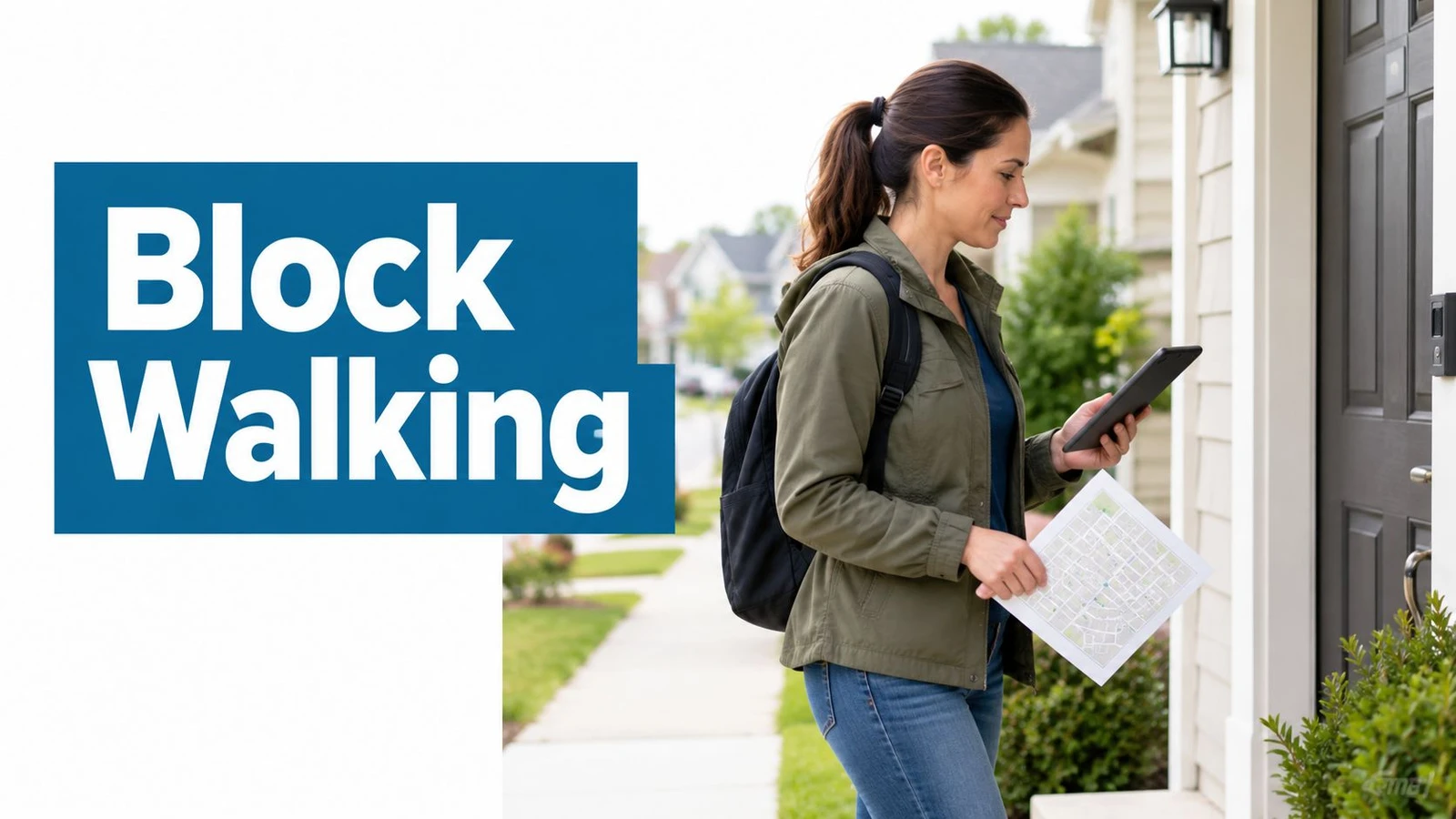
A volunteer steps off a porch, marks not home on a phone, checks the map, and walks to the next flagged house on the block. The clipboard still appears on some shifts. More often, a tablet or phone carries the voter list, the route, and the survey questions. That small loop, knock, talk or leave literature, log the result, move on, is block walking.
The term describes systematic door-to-door voter contact in an assigned geography. Campaigns assign a bounded turf, give canvassers a targeted list inside it, and expect every address to receive a recorded attempt. The goal changes by phase. A walk might identify supporters, persuade undecided voters, register eligible residents, remind supporters to vote, or listen for local concerns that shape later messaging.
How Block Walking Differs From Other Contact
Direct mail reaches a mailbox without confirming that anyone read it. Phone banking produces fast conversations, but callers can’t see a moved household, a gated building, or a voter who needs help in person. Digital outreach scales cheaply and targets precisely, yet it rarely creates the social presence of a neighbor at the door. Block walking trades scale for personal contact and ground truth.
That ground truth has value beyond persuasion. Canvassers learn that an apartment has a locked entry, a listed voter moved, or a household prefers another language. Those observations clean the list for every later program. Mail and phones then work from better data instead of repeating the same errors.
A walk that produces conversations but no usable data helps one afternoon. A walk that produces clean dispositions helps the rest of the cycle.
A Tactic and an Operating System
Treating block walking as only a tactic leads to thin results. Mature programs treat it as a system that links routing, scripts, training, and measurement. Turf size determines whether volunteers finish. Script design determines whether the conversation matches the goal. Logging rules determine whether managers can tell a coverage problem from a conversation problem.
The system view also sets honest expectations. Many doors won’t open. Some voters will refuse politely and quickly. A smaller share will talk, and those conversations carry the program. Planning for that funnel, rather than pretending every knock becomes a discussion, is what separates a professional canvass from an afternoon of hopeful walking.
The Evidence Behind Personal Voter Contact
Campaign folklore long claimed that face-to-face contact moved voters, but folklore couldn’t separate the canvass effect from the fact that motivated neighborhoods already voted at higher rates. Randomized field experiments fixed that problem by assigning comparable voters to contact or no contact. The research base now stretches back roughly a century, and its central finding is durable. Personal visits can raise turnout. The size of the gain depends heavily on who gets reached and how results get counted.
What the New Haven Experiment Showed
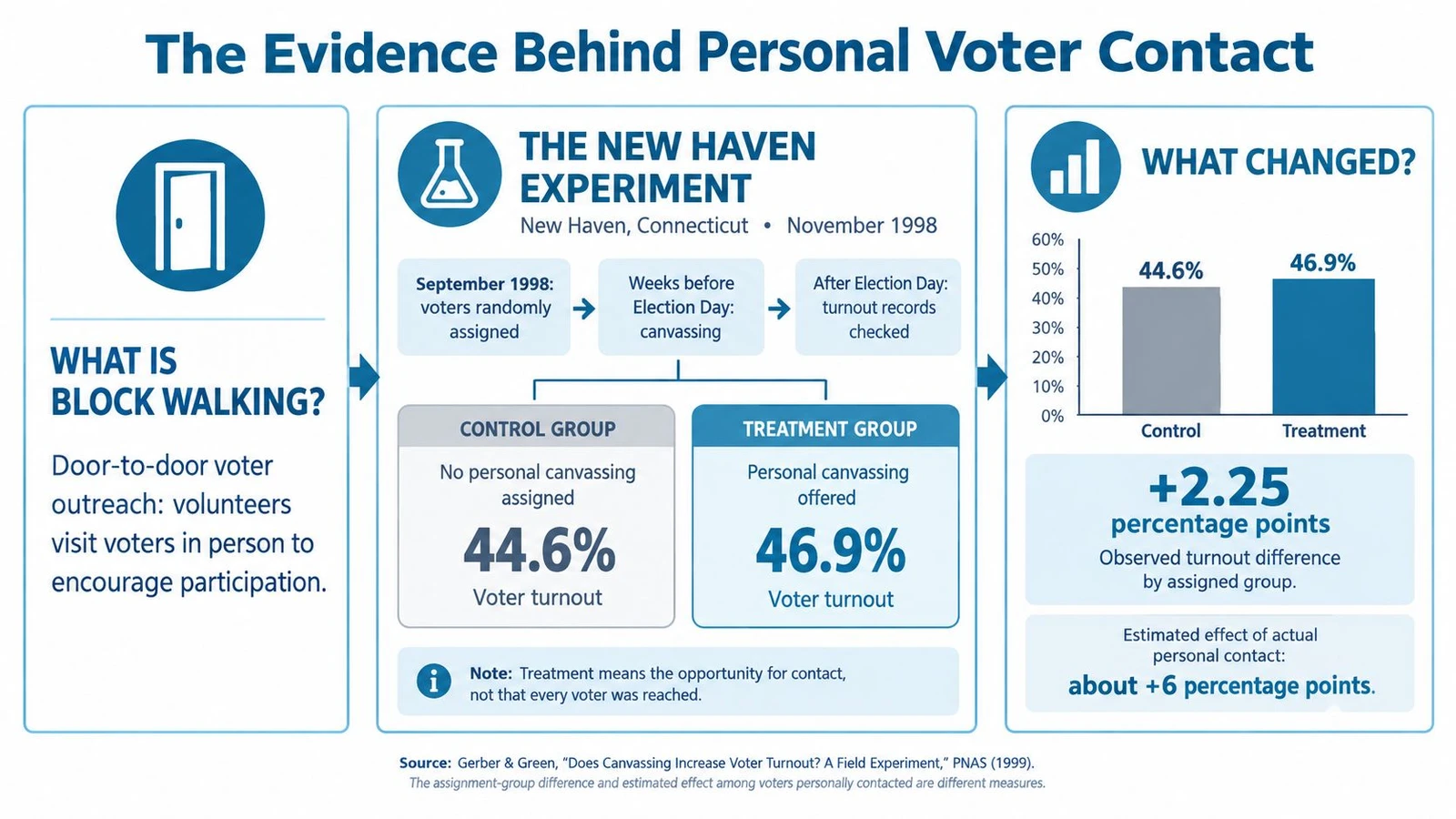
Before the November 1998 election, Alan Gerber and Donald Green randomly assigned registered voters in New Haven to personal canvassing, direct mail, or no mobilization contact. The New Haven randomized field experiment on canvassing and mail found canvassing produced an approximately 6-percentage-point increase in turnout relative to the control group. Reported voting reached 59.19% in the canvassed treatment group, against 44.63% for the control group in the same results presentation. The canvass contact rate was 35.60%, a reminder that assignment and actual contact are different things.
Earlier work points the same direction, with humbler tools. Harold Gosnell’s randomized block-level studies in Chicago found mailed reminders increased turnout by 1 percentage point in the 1924 presidential election and by 9 percentage points in the 1925 municipal election, as summarized in the New Haven study linked above. Mail helped. Personal contact helped more consistently, and later comparisons of door knocking versus phone banking effectiveness build on that distinction.
Why the Counting Method Changes the Answer
Multi-city evidence adds a necessary caveat. Randomized nonpartisan experiments before the November 6, 2001 elections ran in Bridgeport, Columbus, Detroit, Minneapolis, Raleigh, and St. Paul. The handbook synthesis of those six-city mobilization experiments reports turnout rising from approximately 44% in control groups to 53% among contacted voters in the strongest headline comparison. Under the more conservative intent-to-treat framework, which counts everyone assigned including people never reached, the average effect was 2.1 percentage points.
That distinction should govern field math. A strong effect among contacted voters doesn’t multiply across every printed address. Broader reviews commonly place well-executed personal visits at roughly 6 to 10 percentage points among reachable or contacted voters, per the synthesis cited above. Block walking works, but only at the rate the operation reaches people.
Types of Walks and When to Use Each
Field programs stumble when one script gets used for every purpose. A voter who already supports the candidate doesn’t need a persuasion pitch. An undecided voter doesn’t need a lecture about polling hours. Matching the walk type to the segment and the week protects the scarcest resource in any campaign, which is a completed doorstep conversation.
Matching Walk Types to Campaign Goals
| Walk Type | Primary Goal | Target Voter | Script Focus | Best Timing |
|---|---|---|---|---|
| Persuasion | Move undecided voters | Persuadable, low-information voters | Issue contrast and candidate story | Mid-cycle, well before voting starts |
| Turnout | Get supporters to vote | Supporters with inconsistent voting history | Vote plan, deadlines, polling place | Early voting through Election Day |
| Registration | Enroll eligible non-voters | Unregistered residents, recent movers | Eligibility, deadlines, form help | Early cycle, before registration closes |
| Constituent service | Capture casework and concerns | Current constituents of an incumbent | Listening, issue intake, follow-up consent | Outside peak campaign windows |
Persuasion and Turnout Walks
Persuasion walks reward patience and issue fluency. The canvasser asks what matters locally, connects one or two candidate positions to that answer, and leaves room for disagreement. Experienced volunteers suit these turfs because the conversation can’t be rushed. Turnout walks run in the opposite register. They’re short, friendly, and concrete, built around when and where the supporter plans to vote. Speed matters more than depth, and the script should end with a specific commitment rather than a vague promise.
Registration and Constituent Service Walks
Registration walks target places, not just names. Apartment complexes, campuses, and new developments often hold eligible residents who don’t appear cleanly on voter lists. The script is procedural and helpful, focused on deadlines and required information, with careful handling of any personal details collected. Constituent-service walks serve incumbents between campaigns. The volunteer listens, logs a pothole, benefits issue, or agency problem, and makes sure the office follows up.
Mixing these goals on one turf muddles training and measurement. One goal per walk keeps the script teachable and the results interpretable.
Planning Turfs, Shifts, and Volunteer Briefings
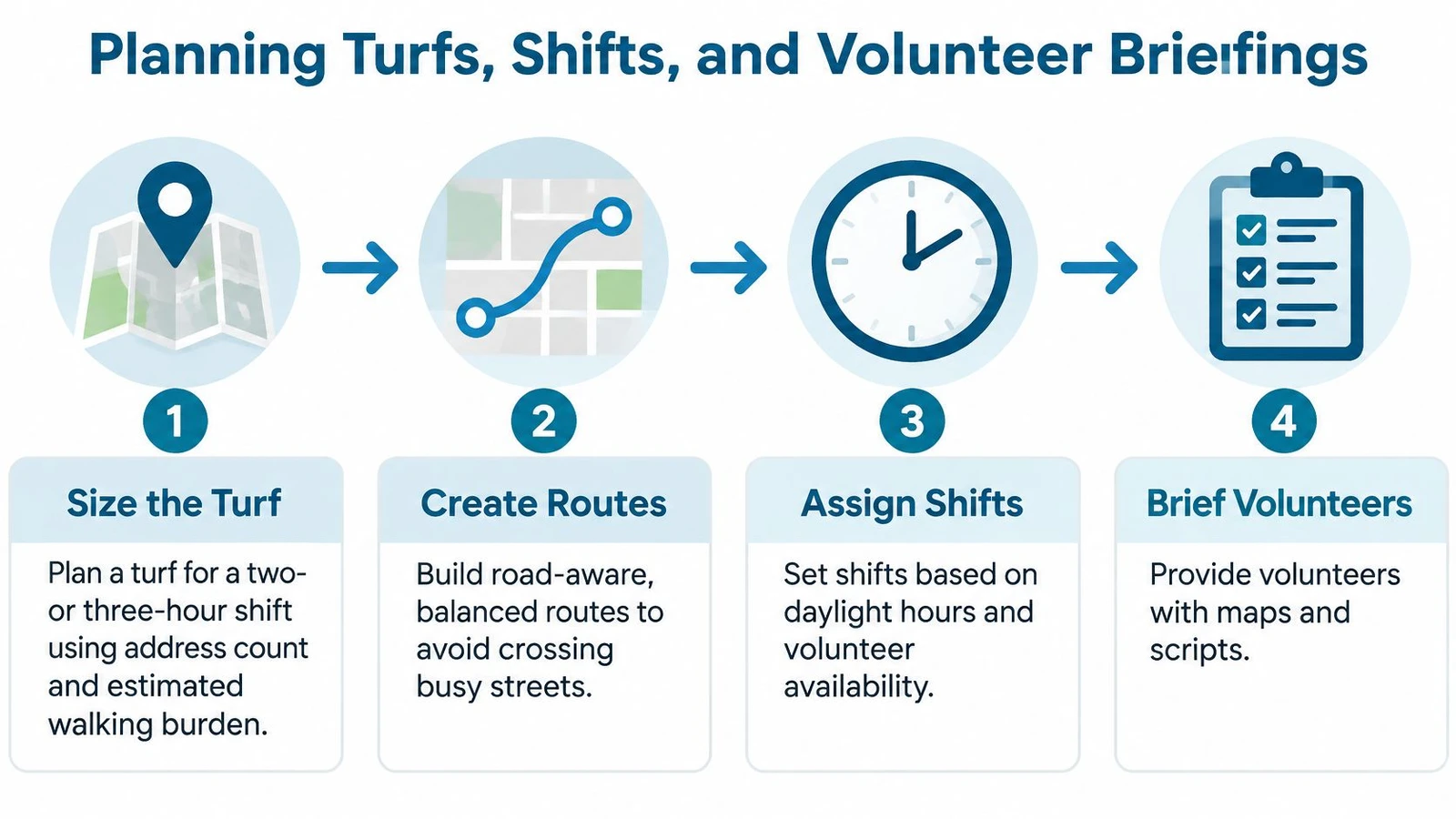
Good turf design decides a shift before anyone knocks. A turf that’s too large produces rushed attempts and unfinished blocks. A turf that’s too small sends volunteers home early while nearby targets go untouched. Sizing starts with two inputs used together, address count and estimated walking burden. A compact grid of single-family homes moves faster than the same address count spread along rural roads or scattered across apartment buildings.
Building a Walkable Turf
Road-aware routes outperform simple clusters of map pins. Pins ignore rivers, highways, rail lines, and dead ends, all of which add silent minutes to a shift. Balanced routes also matter for morale. When one pair finishes in an hour and another pair is still walking at dusk, volunteers notice, and the next shift’s attendance suffers. Practical guidance on route planning that maximizes voter contact treats balance as a retention tool, not just an efficiency gain. The underlying habit resembles backcountry navigation fundamentals, since walkers who read terrain before moving waste less energy backtracking.
Shift structure should fit a two- or three-hour block of actual walking. Daylight, heat, and neighborhood routines shape the start time more than staff convenience does. Evening walks catch working voters at home. Weekend mornings catch a different slice of the same turf.
Briefing So Volunteers Can Succeed
A strong briefing covers four things in plain language.
- The goal: State whether the walk is persuasion, turnout, registration, or listening, in one sentence.
- The script: Practice the opening line out loud, since the first seconds decide whether a door stays open.
- The logging rules: Define exactly what counts as an attempt, a refusal, and a completed contact.
- The logistics: Set the meeting point, end time, buddy pairs, and a contact number for problems.
Pairing a first-timer with an experienced canvasser does more than train. It steadies pace, models polite exits, and keeps data capture consistent. Volunteers who understand the goal and trust the route finish turfs. Volunteers who feel lost improvise, and improvisation shows up later as messy data.
Data Capture and Metrics That Actually Matter
Most field arguments come from measuring one number and guessing about the rest. A manager sees few completed conversations and blames the script. The likely problem might be unfinished routes, bad timing, or apartment access. Separating the funnel ends the guessing. Four metrics, logged distinctly, diagnose nearly every weak shift.
- Addresses assigned: The full workload cut into the turf.
- Doors attempted: Addresses where a canvasser knocked.
- Doors answered: Attempts where a person came to the door.
- Completed contacts: Conversations where the survey or script finished.
Contact Rates Set the Realistic Ceiling
Low contact rates aren’t a sign of lazy volunteers. They’re the normal condition of door-to-door work. In a randomized UK get-out-the-vote experiment, only 28% of assigned households produced a successful canvass contact, and other European experiments reported rates from roughly 22% to 60%, according to the UK field experiment on leaflets and canvass visits. Capacity planning should therefore start from attempted doors, not hoped-for conversations. Benchmarks also need local calibration, since a precinct’s first shift says more about its contact rate than a number imported from another market.
The New Haven evidence shows why the funnel matters for impact claims. Turnout among treatment-group voters contacted exceeded 59%, compared with 40% among assigned voters who weren’t contacted, as reported in the Proceedings of the National Academy of Sciences summary of the experiment. Reporting only completed conversations overstates program-wide effect. Reporting attempts alongside completions keeps expectations honest.
Dispositions and Reattempt Queues
Each attempt needs a disposition, such as not home, refused, supporter, undecided, moved, language barrier, or accessibility need. Those codes turn one shift’s misses into the next shift’s plan. A reattempt queue treats a missed door as unfinished business rather than a dead end, scheduling a second visit at a different time. A refusal, by contrast, closes the door for that walk type.
A live view of the funnel lets managers reallocate during the shift, sending a finished pair to an untouched block instead of discovering the gap at debrief. Detailed practice for tracking canvassing data with metrics that drive decisions follows the same logic. The goal isn’t more numbers. It’s numbers that tell a manager what to fix before the next shift.
Targeting Trade-offs and the Equity Question
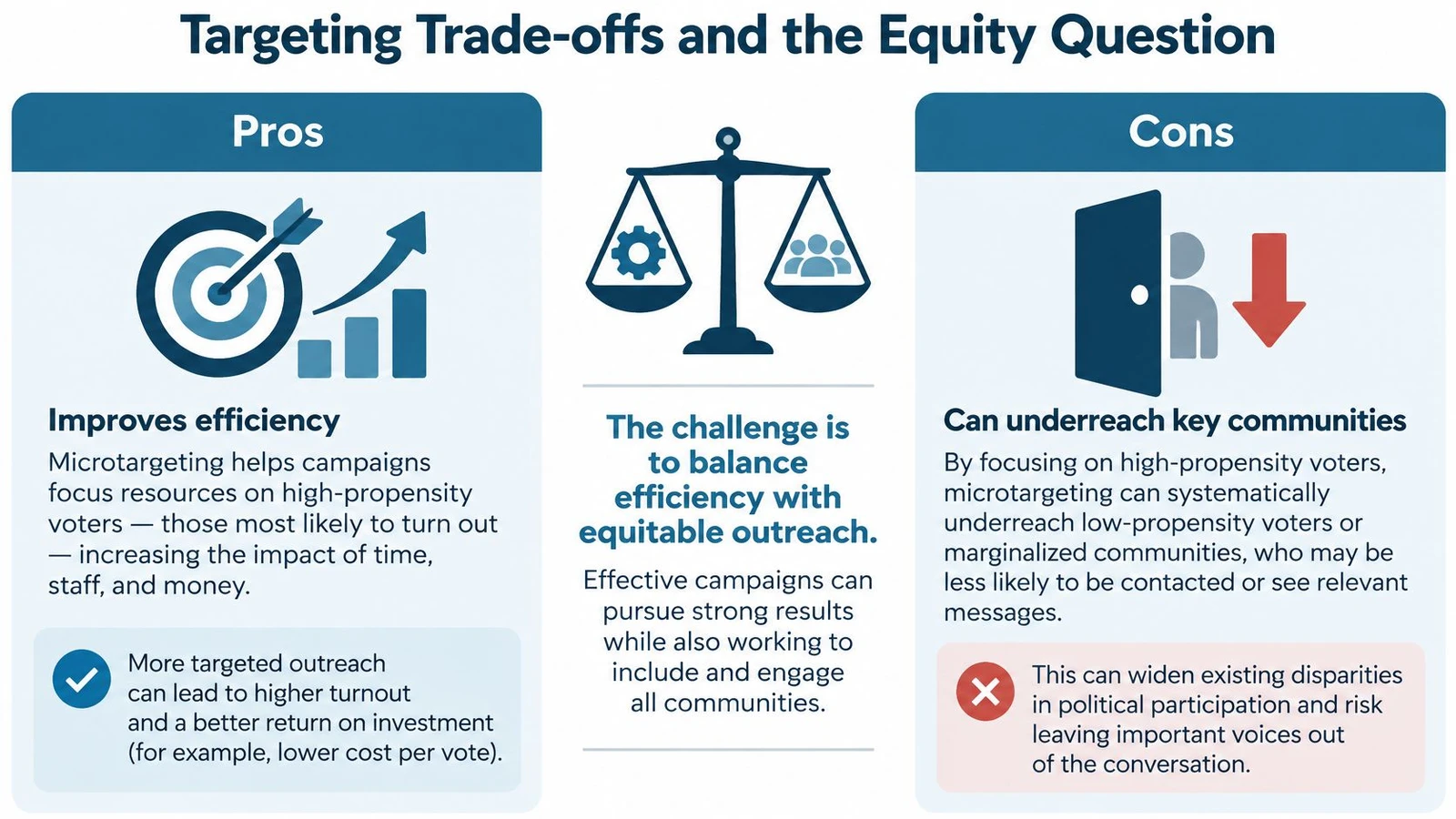
Targeting promises efficiency, and the promise is partly real. Models that rank voters by likelihood to answer the door or to vote can cut wasted steps. The risk hides inside the same ranking. A model optimized only for easy contact will route around renters, shift workers, apartment dwellers, rural residents, people with disabilities, and language minorities, precisely because those voters are harder to reach at the door.
What the Contact Evidence Implies
Excluding hard-to-reach voters carries a democratic cost, not just an ethical one. Contact itself appears to matter substantially for participation. Afrobarometer’s 2025 report found that contacted respondents had roughly a one-third increase in the odds of voting, with a predicted probability of 0.82 among contacted respondents versus 0.60 among those not contacted, as cited in International IDEA’s publication on digital microtargeting. Parties tended to contact people already more likely to vote, per the same source. A targeting strategy that follows that instinct widens the participation gap while congratulating itself on efficiency.
Effects also vary by context, which argues against blind extrapolation. A 2025 analysis of a UK field experiment found leaflets increased turnout by 4.3 percentage points while canvass visits added only 0.6 points, according to the Political Science Research and Methods article record. Block walking isn’t automatically the strongest tool everywhere. Precinct-level testing beats imported assumptions.
Practical Guardrails for Responsible Targeting
Responsible programs pair model scores with coverage checks. Managers review which neighborhoods and housing types received attempts, not just completions, and set minimum coverage rules for underreached areas. Voters who can’t answer a door get an alternative channel, such as a phone call or text, rather than silent removal from the universe.
Data discipline belongs in the same conversation. Recording a language preference helps the next volunteer. Recording sensitive inferences creates risk without helping anyone. Teams handling voter data across jurisdictions can browse the 2026 compliance guide for a structured view of data protection obligations, then adapt retention rules to campaign policy and local law. Short retention, limited access, and clear purpose keep targeting a field tool rather than a surveillance habit.
Safety, Access, and Legal Ground Rules
Volunteers give a campaign their time and their physical presence in unfamiliar neighborhoods. Protecting that trust is operational, not decorative. Programs that treat safety as a footnote lose volunteers after the first uncomfortable door, even when nothing serious happens.
Canvasser Safety in Practice
The buddy system is the foundation. Pairs walk together or stay within sight on opposite sides of a street, and nobody enters a home. Shifts run in daylight where possible, with a hard end time that doesn’t drift because a turf is unfinished. Volunteers carry identification, keep a charged phone, and know the field lead’s number before leaving the staging point.
De-escalation deserves rehearsal time. A short, polite exit line handles most tense doors, since canvassers never win an argument on a porch. Any door that feels unsafe gets skipped without debate, and the volunteer logs it so the next team doesn’t repeat the visit. Weather rules matter too, covering heat, lightning, and poor air quality, with authority to cancel resting on a named person rather than group hesitation.
Field rule: No turf is worth a volunteer feeling unsafe. Skipped doors can be revisited. Lost trust can’t.
Access and Legal Basics
Accessibility starts with listening at the door. A voter who can’t come to the door easily may prefer a call, a text, or mailed information in a larger format. Language needs get logged respectfully and matched with a bilingual volunteer on the reattempt rather than handled through gestures. Apartment buildings require patience and permission, since forced entry into secured buildings ends programs and creates complaints.
Legal rules vary by jurisdiction, so campaigns verify local solicitation ordinances, do-not-knock expectations, and any Election Day buffer zones around polling places before the first shift. Political canvassing often receives different treatment from commercial soliciting, but assumptions are a poor substitute for checking. Follow-up by phone or text triggers its own obligations, and a TCPA compliance checklist helps teams separate permitted voter contact from risky automated outreach. Personal information captured at the door should stay minimal, secured, and used only for the stated campaign purpose.
How doornoc Streamlines a Block-Walking Program
The operational problems described so far share a pattern. Turf cutting eats staff time, contact data arrives late or incomplete, and managers can’t see a shift while it can still be fixed. doornoc addresses those points as one connected workflow rather than separate chores. Auto Turf generates balanced, road-aware routes sized for a shift, while Polygon Route builds turfs from custom geographies such as a school district boundary or council ward.
Data sourcing follows the same integrated approach. The MailVotes integration moves targeted voter lists into walk routes without CSV exports, and list upload with geocoding handles voters from other sources. Canvassers work in an offline-first mobile app, so logging continues in low-connectivity areas and syncs when service returns. Managers watch attempts, answers, and completions on a real-time dashboard, which makes same-day reallocation practical instead of theoretical.
Preparation tools support the conversation itself. Voter and constituent intelligence briefs give volunteers cited background before a door opens, turning a cold knock into an informed introduction. Tiered plans scale the same workflow from a school-board race to a congressional field program, so process doesn’t need rebuilding as the team grows.
A field-ready sequence ties it together.
- Define the goal: Pick one walk type per turf.
- Build the turf: Balance address count against walking burden.
- Brief the team: Cover script, safety, and logging rules.
- Log the funnel: Record every attempt and disposition.
- Review and adjust: Reallocate during the shift, not after it.
Block walking earns its keep when routes are walkable, every attempt is logged, and managers can act on live data instead of end-of-night summaries. doornoc brings balanced turf building, offline door knocking, and real-time field tracking into one platform built for exactly that work. Visit the site to set up a campaign, cut the first turf, and send a team out with a plan that holds up at the door.
Looking for a tool to run this? doornoc’s canvassing software bundles voter data, automatic turf cutting, the mobile app, and live reporting in one platform.