

The volunteer signup page is open beside a crowded calendar. A prospective volunteer cares about the election, but the practical questions remain unanswered: whether experience matters, whether evenings are available, and whether signing up means surrendering every weekend. The sensible next move isn’t a bigger commitment. It’s finding a defined assignment with a clear finish time and someone responsible for helping.
Why Most People Want to Volunteer but Never Start
The hardest part of deciding to volunteer for a campaign often happens before anyone meets a field organizer. A parent waits until the household schedule settles. A newcomer assumes campaign staff only want experienced political people. Someone else follows every campaign update but never receives a direct invitation.
Those obstacles deserve practical answers, not a lecture about civic responsibility. Work or family obligations affect 47% of U.S. adults, 43% say they haven’t been invited or encouraged, and 42% are unsure how to participate or don’t know enough about the issues, according to the Gallup–Kettering report on participation barriers.
Treat the hesitation as a logistics problem
A prospective volunteer doesn’t need to resolve every political question before contacting a campaign. The useful starting point is narrower: identify a campaign worth supporting, describe the available time, and ask which beginner assignment fits.
For someone unfamiliar with organized volunteering, Litter Caterpillars’ steps to start volunteering offers a general starting resource. Someone still choosing between electoral work and other civic activities can consult this guide to getting politically involved.
The first commitment should answer practical questions:
- Campaign fit: Does the candidate or cause merit the volunteer’s time and public association?
- Role fit: Can the assignment accommodate the person’s schedule, mobility, and comfort with conversation?
- Starting point: Is there a named coordinator, an orientation, and an actual shift?
- Sustainable pace: Could the volunteer repeat the commitment without neglecting work, care responsibilities, or rest?
Practical rule: A first shift should be a bounded experiment, not an open-ended promise.
The campaign should explain what happens after signup. A volunteer shouldn’t have to decipher unexplained acronyms, guess where to park, or chase several staff members for an assignment.
Interest is enough to begin a conversation. Reliability comes later, after both sides know what they’re agreeing to. A campaign that treats reasonable questions as a lack of dedication is making the decision easier: another opportunity deserves consideration.
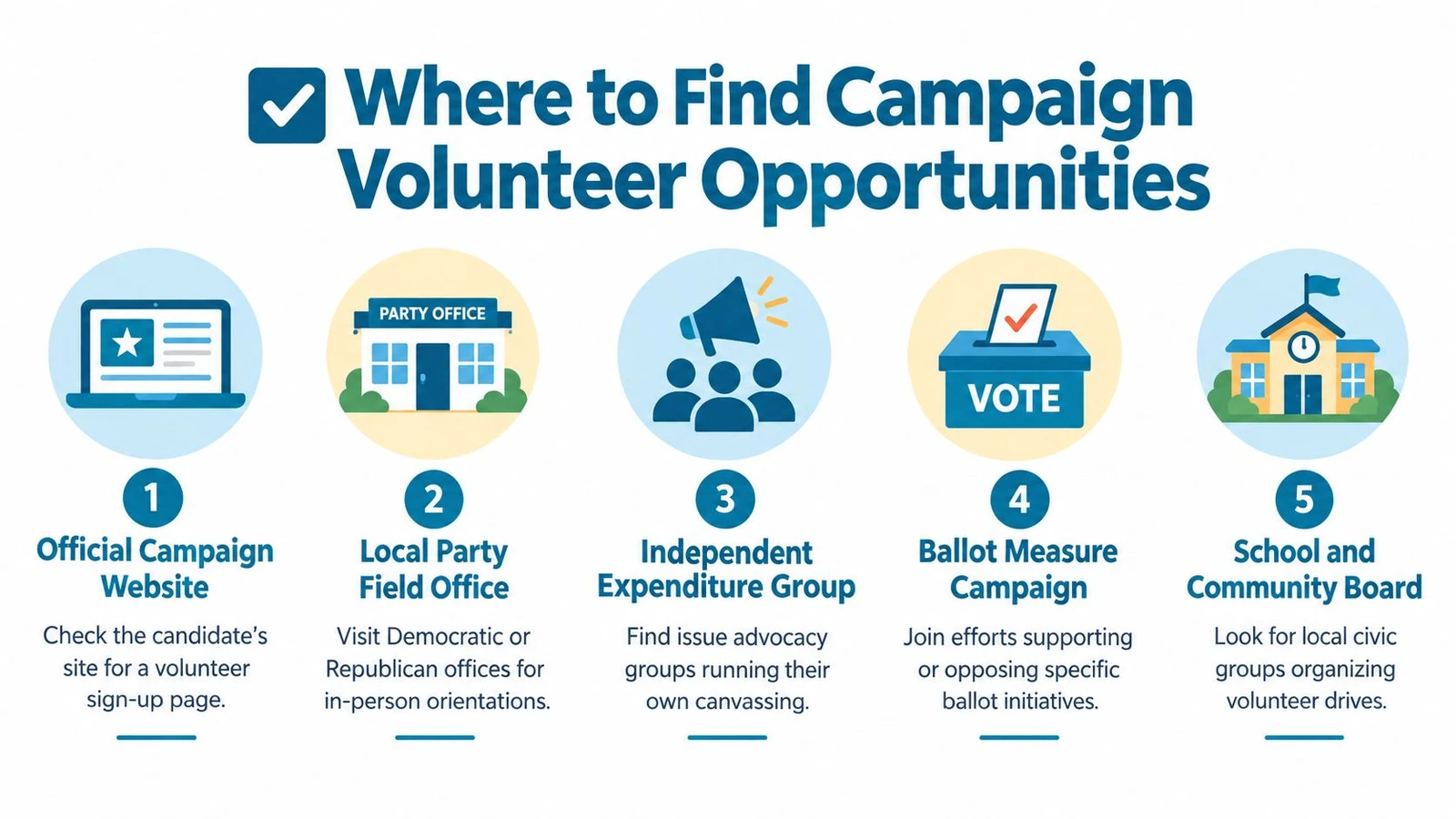
Where to Find Campaign Volunteer Opportunities
Start with the organization responsible for the work, not an anonymous recruitment post. An official campaign signup page provides a place to express interest, but the next conversation matters more than the form.
A prospective volunteer should compare opportunities by time, location, task, and supervision. An exciting candidate isn’t automatically running a well-organized volunteer program.
Look beyond the most visible race
Several search routes deserve attention:
- Official candidate websites: Look for volunteer registration, upcoming events, and a field organizer’s contact details.
- Local party offices: Ask Democratic or Republican organizers about orientations and nearby assignments matching the volunteer’s preferences.
- Independent expenditure and issue groups: Ask which organization supervises the activity and whose message volunteers will deliver. Campaign affiliation shouldn’t be assumed.
- Ballot measure campaigns: Search for organizations supporting or opposing the specific proposal that matters to the volunteer.
- School board and community networks: Ask local organizers about electoral opportunities. For nonpartisan civic work, confirm the organization’s scope rather than assuming it supports candidates.
Filter before committing
A useful inquiry names the available window, preferred location, and relevant skill. Someone seeking remote administrative work should say that directly rather than accepting a canvassing assignment and hoping it changes.
Before confirming, the volunteer should request a clear role description and ask who handles training, scheduling, and problems during a shift. For voter-contact work, the coordinator should explain how authorized contact lists are provided and how volunteers receive access without circulating files through personal accounts.
Safety expectations deserve the same attention as the candidate’s talking points. Vague duties, unexplained demands for personal information, and pressure to pay for training are reasons to pause.
A small operation needn’t have elaborate systems to pass this test. It does need a person who can explain the assignment, acknowledge limitations, and follow through. A prompt, concrete answer is more useful than an impressive recruitment pitch.
Choosing a Role That Fits Your Life
The right role is the one a volunteer can perform consistently, not the one that sounds most impressive. Door knocking isn’t a test of political seriousness, and remote work isn’t a consolation prize.
A volunteer who enjoys short conversations may prefer canvassing to a crowded campaign event. Someone comfortable speaking but unable to travel may prefer phonebanking. A meticulous person who dislikes unsolicited conversations may contribute more through record review or event logistics.
Comparing the Four Main Volunteer Roles
The time descriptions below are planning categories, not universal shift lengths. Each campaign should confirm the actual commitment before a volunteer accepts.
| Role | Typical time commitment | Best for | Main challenge |
|---|---|---|---|
| Canvassing | A scheduled block with travel and debrief time | People comfortable walking or using an accessible route and meeting residents | Physical effort, weather, and unanswered doors |
| Phonebanking | An organized calling session, sometimes remote | Volunteers who prefer voice conversations without travel | Repetition, unanswered calls, and staying conversational |
| Textbanking | A scheduled messaging session with active supervision | People comfortable reading carefully and using approved written replies | Handling ambiguity and following messaging procedures |
| Remote or office support | A defined task or recurring work window | Detail-oriented volunteers, translators, hosts, and logistics helpers | Unclear ownership or tasks without a concrete handoff |
Phonebanking deserves serious consideration. In a Michigan gubernatorial-election experiment comparing volunteer calls and door hangers, volunteer calls increased turnout by 3.2 percentage points, compared with 1.2 percentage points for door hangers. Those historical results aren’t a guarantee for another campaign, but they’re a reason not to dismiss telephone work.
Match the assignment to the constraint
For a narrow opening in the calendar, the strongest request is a self-contained task with a stated endpoint. That might mean reviewing an assigned batch of records or completing a supervised remote session, provided the campaign offers that arrangement.
An available evening may suit an organized phonebank. A larger open block may accommodate canvassing, including travel and the return handoff. Translation should go to someone with the appropriate language competence and campaign guidance, not just whoever happens to be available.
The volunteer should also name accessibility needs before accepting a role. Step-free meeting space, seated work, accessible software, language support, and transportation arrangements are questions for the coordinator, not details to discover at arrival.
Choose around actual constraints. Guilt is a poor scheduling system.
Signing Up and Getting Through Onboarding
A signup form isn’t a shift reservation. The volunteer should leave onboarding with a confirmed assignment, a coordinator’s name, and a clear way to get help.
The recommended sequence is straightforward: submit interest, receive a response, attend the kickoff, complete the required preparation, and confirm the assignment. If the campaign uses training modules or an availability survey, those should lead to a specific next action rather than an indefinite mailing list.

Give the coordinator useful information
A volunteer should provide accurate contact details and realistic availability. Language skills, relevant experience, transportation limits, and accommodation requests help a coordinator make a workable assignment.
Sensitive information deserves a purpose check. If a form requests something unexpected, the applicant should ask why it’s necessary and how it will be handled.
Campaign organizers reviewing their welcome messages can consult Listava’s resource on how to onboard email group members. For campaign onboarding, the recommendation is concrete: the welcome message should name the meeting place, preparation requirements, supervisor, and cancellation procedure.
Test access before departure
The volunteer shouldn’t arrive with an untested login and assume someone can fix everything at launch. Preparation should include:
- Calendar confirmation: Save the shift, travel arrangements, location, and coordinator’s contact details immediately.
- Account access: Accept the campaign invitation and confirm that the assigned materials open correctly.
- Field preparation: If an app is required, download the assigned route and check the relevant walking settings.
- Offline rehearsal: Ask the trainer how offline capture works, how pending submissions appear, and how successful synchronization is confirmed.
- Script practice: Read the opening aloud and rehearse an unfamiliar question with the trainer.
A short role-play is worth more than scrolling through a presentation. The volunteer should practice identifying the campaign, making the requested ask, recording the response, and ending the interaction politely.
Onboarding is complete when the person can explain the assignment back to the coordinator. Attendance alone doesn’t establish readiness.
What Your First Shift Actually Looks Like
A useful first canvassing shift begins at the staging location, not at a stranger’s door. The newcomer checks in, meets the team lead, and reviews the assigned area before leaving.
For a beginner, the recommended setup includes an experienced partner or readily available lead. The team reviews the script, the walk list, the outcome buttons, and the procedure for asking a question from the field.

From arrival to the first conversation
At the door, the volunteer follows the campaign-approved introduction, identifies the organization, and states the purpose without launching into a speech. The resident gets room to answer. The volunteer listens, makes the appropriate request, and closes without prolonging an unwanted conversation.
An unanswered door isn’t evidence of poor performance. A review of canvassing effects and contact rates gives a practical contact-rate benchmark of 25–30%, so beginners shouldn’t expect every assigned address to produce a conversation.
After each attempt, the volunteer records what happened. Not home, declined, undecided, and requested follow-up are different outcomes. An uncertain response belongs in an available unknown category, not in a guessed supporter classification.
For additional preparation, the campaign can share this step-by-step guide to political canvassing.
An accurate record of an unsuccessful contact is more useful than an invented successful conversation.
Bring the basics and finish the handoff
The field checklist should stay practical:
- Comfortable footwear and suitable clothing: Choose for the route and forecast rather than a campaign photograph.
- Water and a snack: Bring what’s needed for the agreed assignment.
- Charged phone and backup power: Open the app before departure and keep the coordinator’s contact accessible.
- Assigned materials: Carry only the literature and equipment approved for that shift.
At a phonebank, the equivalent preparation happens at a calling station or approved remote setup. The volunteer checks the dialing instructions, practices the opening, records call outcomes, and refers unfamiliar questions instead of improvising policy.
The debrief closes the assignment. Volunteers flag incomplete work, uncertain records, and promised follow-up so the coordinator can act on them. Awkward delivery is normal for a beginner; an unresolved handoff shouldn’t become routine.
Staying Safe and Staying Legal in the Field
No contact target justifies an unsafe encounter. A volunteer should know the departure rule, the escalation contact, and the check-in procedure before leaving the staging location.
Legal requirements vary by jurisdiction and activity. Campaign staff should provide applicable instructions rather than leaving volunteers to infer the rules from a script. This overview of door-to-door canvassing laws and rights can support preparation, but local questions still require campaign review.
Leave first and report from safety
A volunteer shouldn’t debate a resident’s demand to leave, enter a location where access is unwelcome, or continue through a threatening situation. Aggressive animals, dangerous weather, and health symptoms also justify stopping.
- Leave the contact: End the interaction when someone refuses, becomes hostile, or makes access unsafe.
- Escalate the problem: Notify the supervisor about threats, injuries, repeated access issues, or exposed personal information.
- End the shift when necessary: Reach a safe location and contact emergency services when immediate danger warrants it.
Communication equipment should fit the assignment. For a different volunteer setting, Mobile Systems Limited’s account allows organizers to see how coastguard headsets were fitted. The campaign-specific recommendation is to test communication arrangements under actual field conditions rather than assume a group message will always be sufficient.
Protect the person behind the record
Volunteers should follow campaign suppression instructions, including applicable do-not-knock and do-not-call procedures. They shouldn’t misrepresent their identity, promise services the campaign cannot provide, or continue contact after a clear refusal.
Data minimization means recording only information needed for the authorized task. Personal speculation, unrelated household details, screenshots of voter records, and exports to private storage don’t belong in routine volunteer work.
Offline capture requires particular care. Synchronization does not establish that a device retains no local information. The coordinator should explain device locking, access removal, lost-phone reporting, and the handling of downloaded records.
These precautions belong in the operating plan, not an informal warning at departure. Research on managing large-scale grassroots canvassing identifies supervision, recordkeeping, recruitment, and performance measurement as substantial challenges. Volunteer enthusiasm doesn’t replace trained oversight.
Staying Engaged and Leveling Up
A reliable volunteer isn’t the person who accepts every request. It’s the person who makes realistic commitments, communicates changes, and completes the agreed handoff.
After the first shift, the volunteer should evaluate the assignment rather than immediately expanding it. The useful questions concern energy, clarity, support, and whether the task fits ordinary life. A role that works only during an unusually quiet week probably needs adjustment.
Build a cadence before adding responsibility
The next commitment should be specific enough to schedule and modest enough to repeat. Campaign coordinators should accept boundaries without turning every declined request into a loyalty test.
Retention deserves attention to the experience itself. Research on local canvassing and volunteer deployment highlights enjoyment, belonging, appreciation, and a positive atmosphere as retention considerations, alongside stronger turnout effects when canvassers worked in their own neighborhoods.
That supports a practical progression:
- Repeat the workable assignment: Establish familiarity before taking responsibility for other volunteers.
- Request local placement: Where appropriate, ask about neighborhood work while respecting privacy and operational boundaries.
- Choose a development task: Consider route leadership, phonebank training, or data-quality review according to demonstrated strengths.
- Help a newcomer: Explain the procedure, model accurate reporting, and make space for questions without pretending to know every answer.
Judge progress without demanding constant affirmation
Slow shifts and political losses require perspective. A volunteer controls preparation, conduct, and record accuracy, not every resident’s response or the final election result.
Evidence that personal contact can matter shouldn’t become a promise that each conversation changes a vote. A regression-discontinuity analysis of neighbor-to-neighbor presidential-election mobilization estimated a turnout increase of approximately 9 percentage points among contacted voters. That result supports taking the work seriously, not treating every disappointing shift as personal failure.
Sustainable participation requires useful work, decent supervision, and permission to have a life outside the campaign.
Someone ready to volunteer for a campaign needs a confirmed next step, not unlimited availability. The strongest progression is an appropriate assignment, honest feedback, a repeatable commitment, and responsibility earned through practice.
For campaigns organizing that progression, doornoc offers a mobile canvassing app with route planning, offline interaction logging, automatic synchronization, and real-time team progress tools. Campaign managers and volunteer coordinators can visit the platform to assess how those capabilities fit their route assignments, first-shift preparation, and post-shift review.
Looking for a tool to run this? doornoc’s canvassing software bundles voter data, automatic turf cutting, the mobile app, and live reporting in one platform.