

The captain roster looks complete, but the next canvass still has unclaimed routes, unanswered volunteer messages, and voter records waiting for cleanup. The field director has filled a position without establishing who owns the work. A precinct captain’s name on a spreadsheet isn’t the same as a precinct that runs.
The useful distinction is operational: a captain needs a defined territory, clear decision rights, and observable deliverables. Campaign managers can recruit for those responsibilities, train against them, and evaluate performance without confusing a familiar neighborhood face with an effective field manager.
Why the Precinct Captain Job Has Changed
A captain accepts the title, attends an organizing meeting, and promises to bring neighbors. Then the first difficult handoff arrives: the volunteer coordinator expects a confirmed roster, the data team expects completed contact records, and the captain assumes headquarters handles both. Nobody has refused the work. Nobody clearly owns it.
That’s a management problem, not a motivation problem. The appointment should come with an operating agreement that defines what the captain can decide, what staff must supply, and what constitutes a completed assignment.
From neighborhood position to accountable operation
The role has deep organizational roots. A 1940 survey counted 127,245 political precincts and described captains as the people responsible for political organization within them; selection varied between elections, party caucuses, and appointments, according to the historical survey of precinct organization. The title described a broad function rather than a nationally uniform office.
Modern field management should preserve that local responsibility without treating the title as sufficient preparation. A captain needs more than enthusiasm and a neighborhood address.
- Authority: Permission to assign available volunteers and flag work that exceeds local capacity.
- Deliverables: A staffing plan, completed shift records, and documented unresolved issues.
- Support: A staff contact who can resolve data, messaging, and personnel questions.
- Boundaries: Explicit limits on promises, spending, and decisions reserved for campaign leadership.
A captain should own a manageable operation, not become the default recipient of every unfinished campaign task.
Digital records can make assignments and completion visible, but visibility alone doesn’t establish accountability. Staff still need to review exceptions and respond when captains request help. The practical standard is whether another organizer could understand the precinct’s status without reconstructing it from private messages.
What a Precinct Captain Actually Does
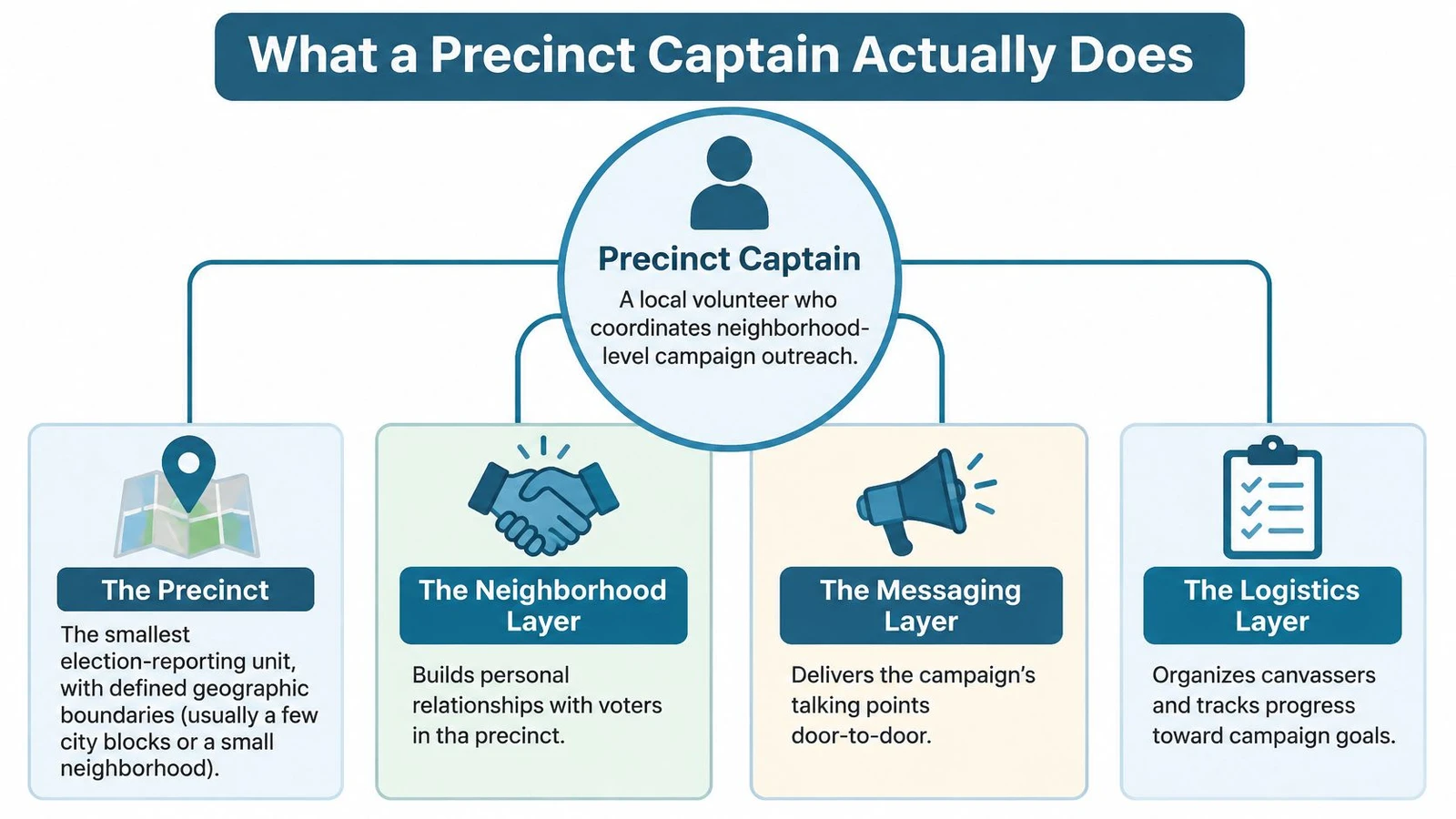
A precinct captain connects a political organization with voters in a defined geographic area. Typical responsibilities include recruiting volunteers, conducting voter contact, helping with registration outreach, distributing campaign information, and organizing turnout activity, as summarized in the overview of precinct-captain responsibilities.
A precinct captain translates campaign priorities into organized neighborhood work and returns usable information from that work to campaign staff.
Geography gives the assignment a boundary. Precincts are commonly the smallest units for reporting official election results, which makes them useful organizing territories, although campaign staff should verify local boundaries and reporting arrangements before building assignments.
The responsibilities beneath the title
The neighborhood messenger listens and communicates. That includes delivering approved campaign positions, recognizing recurring concerns, and passing questions upward without inventing an answer. Familiarity helps only when the captain remains accurate and respectful.
The volunteer manager turns availability into assignments. A willing canvasser still needs a meeting location, an appropriate route, a working login, and someone who answers when access problems arise. The captain should know which responsibilities can be delegated and which require staff approval.
The field-data steward protects the usefulness of the contact record. An attempted door, a completed conversation, and a stated voting intention are different events. Treating them as interchangeable makes later planning unreliable.
For campaigns writing role descriptions, Fluidwave on high-performance teams is a relevant companion resource for thinking through responsibilities and handoffs. The campaign-specific application is straightforward:
- Campaign staff set targeting, messaging, and reporting standards.
- The captain organizes execution within the assigned territory.
- Canvassers complete assignments and record what happened.
A captain isn’t automatically a campaign spokesperson, election official, or neighborhood caseworker. Staff should state those exclusions during appointment, not after a voter receives a promise the campaign can’t fulfill. Clear scope makes the role easier to explain to recruits and easier to support when work becomes complicated.
Daily, Weekly, and Cycle-Level Responsibilities
The most useful captain calendar follows the work rather than filling every evening. A canvassing day requires preparation and reconciliation; a non-canvassing day may require only volunteer follow-up or resolving an outstanding assignment.
A repeatable operating rhythm
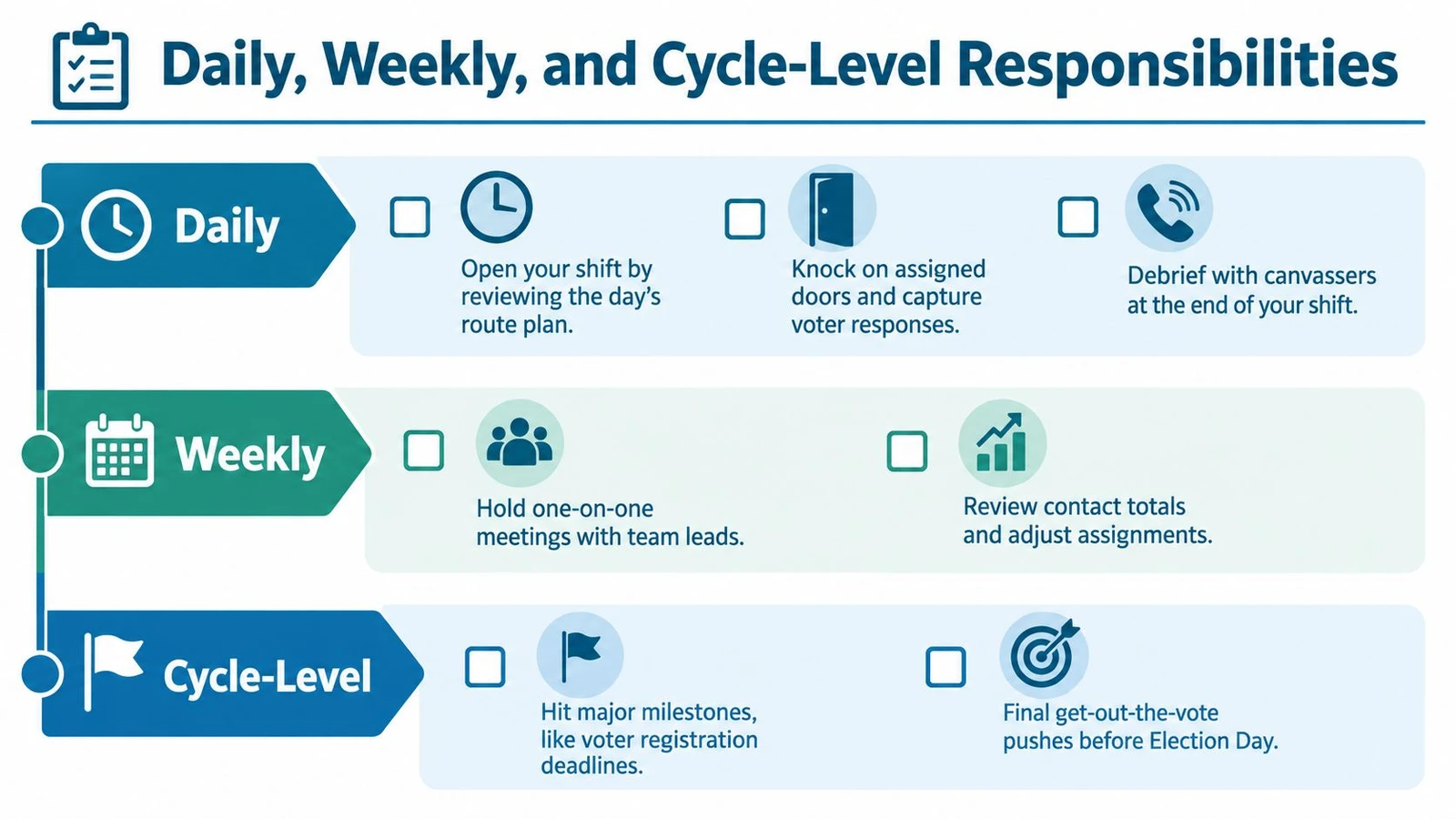
Before a shift, the captain checks staffing against available routes, confirms the current survey, and identifies access concerns. The artifact is a shift packet: assignment roster, route references, meeting details, and escalation contact. Preparation should continue until volunteers can start without waiting for basic instructions.
During the shift, the captain handles exceptions rather than narrating every movement. A locked entrance, unusable assignment, or volunteer departure requires attention. Routine progress doesn’t require a stream of check-in messages.
After the shift, the captain reviews incomplete work and unresolved voter questions. The artifact is a shift report distinguishing completed assignments, recoverable problems, and issues requiring staff action.
A sample weekly schedule
| Work period | Captain’s focus | Concrete artifact |
|---|---|---|
| Early week | Review unfinished work and speak with team leads | Updated exception log |
| Midweek | Confirm volunteer availability and prepare assignments | Staffing roster and route plan |
| Before canvassing | Check materials, permissions, and meeting arrangements | Ready-to-use shift packet |
| After canvassing | Debrief and identify follow-up | Completed shift report |
Time should follow the bottleneck. If volunteers regularly arrive unprepared, the captain should spend more preparation time on confirmation and instructions. If assignments stall after launch, the priority becomes troubleshooting rather than another recruitment message.
At the cycle level, staff should supply a milestone calendar covering registration outreach, applicable absentee or early-voting activity, and Election Day preparation. The captain converts each milestone into a local readiness check rather than relying on memory.
- Registration work: Maintain a referral log with unresolved questions assigned to staff.
- Voting-information work: Keep approved materials current and withdraw outdated versions.
- Final mobilization: Confirm coverage, backup leadership, and the process for escalating problems.
A calendar is useful only when each task produces something another team member can inspect. “Worked on turnout” isn’t a handoff. An updated assignment roster is.
Recruiting and Training a Precinct Captain
The strongest recruiting prospect isn’t necessarily the loudest volunteer or the person with the longest neighborhood contact list. Campaign staff should look for someone who follows through, communicates limits early, and can correct a teammate without creating unnecessary conflict.
Recruiting can begin with dependable canvassers, volunteers who already coordinate others, and neighborhood contacts willing to learn campaign procedures. Interest is only the opening signal. The selection process should test whether the candidate understands the actual assignment.
Use a responsibility-based recruiting conversation
A recruiter can explain the offer plainly: the role involves preparing local shifts, supporting volunteers, and closing out records, with staff retaining control of targeting and message changes. The conversation should establish available capacity, preferred responsibilities, and support needs before discussing the title.
Useful prompts include:
- Reliability: Ask how the candidate handles commitments that become impossible to keep.
- Judgment: Present a volunteer disagreement and ask what should be escalated.
- Coachability: Observe whether the candidate applies feedback during a practice assignment.
- Capacity: Identify competing obligations and a realistic backup arrangement.
A persuasive recruiting conversation isn’t enough. A candidate should demonstrate the work on a limited assignment before receiving broader responsibility.
Train through observed work
Start with a supported route and a clear evaluation standard. The trainer should observe preparation, voter interaction, record quality, and closeout, then expand responsibility only when the candidate can explain decisions and recover from ordinary mistakes.
A reusable canvass prompt card can keep practice focused:
Opening: Name, campaign affiliation, and purpose.
Conversation: Approved question, attentive listening, and an accurate response.
Close: Relevant next step, thanks, and a factual contact record.
The guide to training canvassers for political campaigns can support a shared onboarding process rather than leaving every captain to improvise instruction.
Training sign-off should cover data handling, accessibility, language-support requests, safe access, and escalation procedures. Staff should assess these through scenarios, not attendance alone.
A practical progression moves from observed canvassing to running a supported shift, then to managing the precinct with scheduled review. Promotion should follow demonstrated readiness. A predetermined calendar shouldn’t override evidence that the candidate still needs help with basic assignments or volunteer supervision.
Coordinating Canvass Teams and Field Tools
A route handoff begins before anyone opens a mobile app. The captain needs a clear answer to a basic question: does the assignment contain the intended voters, within the intended territory, using the intended survey?
Campaign staff should maintain an authoritative voter list and document its selection criteria. Separate copies exchanged through messages make it difficult to determine whether volunteers are working from current instructions.
Prepare the assignment, then test the handoff
A field platform can help with route generation, custom boundaries, list matching, and assignment tracking. Those capabilities still need operational checks.
- List preparation: Review automatic voter matches and unresolved addresses before assignment.
- Route creation: Use one-click generation for a starting plan, then inspect road boundaries and practical access.
- Custom geography: Use polygon routes where needed, but verify that drawn boundaries match the intended territory.
- Volunteer assignment: Balance expected effort, not just the apparent length of a household list.
The field-operations software guide provides a useful starting point for evaluating those capabilities against a campaign’s workflow.
The interface below illustrates the kind of workspace a captain should inspect before volunteers leave.

Close the loop after deployment
Offline-first capture matters when connectivity is unreliable. Before departure, the captain should verify that assignments are available on the device and that volunteers understand how to recognize pending synchronization.
A live dashboard shouldn’t be treated as complete while devices remain offline. The captain should reconcile device status before interpreting missing activity as an unfinished route or an absent volunteer.
Communication needs a separate agreement. HubEngage frontline communication guides offer a relevant resource for considering how distributed teams receive instructions. For campaign operations, routine updates, urgent safety issues, and voter questions should have clearly distinguished channels.
Handoff rule: An assignment isn’t closed merely because a volunteer has returned. Its records, exceptions, and remaining work must have an owner.
After synchronization, compare assigned work with recorded dispositions. Check for accidental duplicate assignments, missing responses, and locations requiring another approach. Preserve useful notes without converting every volunteer comment into permanent voter information.
The trade-off is between speed and verification. Automated routing can reduce preparation work, but a captain still needs to inspect entrances, barriers, and unusual geography. Software should reduce repetitive handling, not remove the review that prevents an unusable shift.
KPIs, Measurement, and Incremental Impact
Execution metrics show whether work happened. Impact estimates address whether that work changed an outcome. A captain can be held directly responsible for assignment readiness and record completeness, but not for every voter’s availability or decision.
A precinct is commonly the smallest geographic unit with reported election results. Research discussing precinct-level evaluation also identifies ecological bias, spillovers, uneven treatment intensity, and confounding as important limitations, as outlined in this analysis of community organizing and turnout.
Captain KPIs Across the Cycle
| Cycle Phase | Activity Metric | Outcome Metric | Unit of Analysis |
|---|---|---|---|
| Recruitment and preparation | Confirmed volunteers completing preparation | Volunteers returning for assigned work | Volunteer |
| Voter identification | Attempts and completed conversations | Recorded support among contacted voters | Contact or voter |
| Registration outreach | Referrals and completed follow-ups | Registration status where verifiable | Eligible individual |
| Turnout operation | Completed mobilization contacts | Validated turnout | Voter, analyzed within precinct |
| Post-election evaluation | Delivered work by assigned area | Difference against a comparison group | Precinct or randomized unit |
Define denominators before comparing captains. A contact rate based on attempted doors answers a different question from completion against assigned voters. Recorded support among people who answered the door doesn’t establish support across the whole precinct.
Estimate the additional effect
Where feasible, staff should assign comparable precincts to a captain-led intervention or a holdout condition before outreach starts. Record assignment, baseline characteristics, previous contact, and delivered treatment, including activity that crosses boundaries.
Before-and-after comparisons can describe change, but they can’t isolate the captain’s contribution from candidate strength, spending, or neighborhood differences. Confidence intervals should accompany estimated effects so staff can distinguish a promising result from a precise conclusion.
In a youth-mobilization experiment involving volunteer precinct captains, turnout was about 17% in the treatment group and 16% in the control group, according to the election-day mobilization study. That result doesn’t justify a universal captain-effect claim.
For staff deciding how closely to supervise, measure team performance without micromanaging offers a relevant management resource. Review exceptions and agreed deliverables rather than treating constant observation as evaluation.
A campaign analytics dashboard should preserve the distinction between activity and outcomes. It should also expose missing data. An attractive completion chart can’t establish causality, and precinct-level totals can’t reveal which individual voters changed behavior.
Ethics, Privacy, and the Neighborhood Contact Line
Neighborhood trust doesn’t grant permission to collect unlimited information or imply official authority. A captain may recognize a resident and still need to disclose the campaign connection before beginning a political conversation.
The historical boundary matters. Political-machine captains combined neighborhood assistance with efforts to secure loyalty, a relationship described in this account of political machines and precinct brokerage. A modern campaign should reject any suggestion that assistance depends on political support.
A practical captain code
Public precinct-captain responsibilities describe the outreach assignment. Campaign leadership should pair those duties with explicit limits:
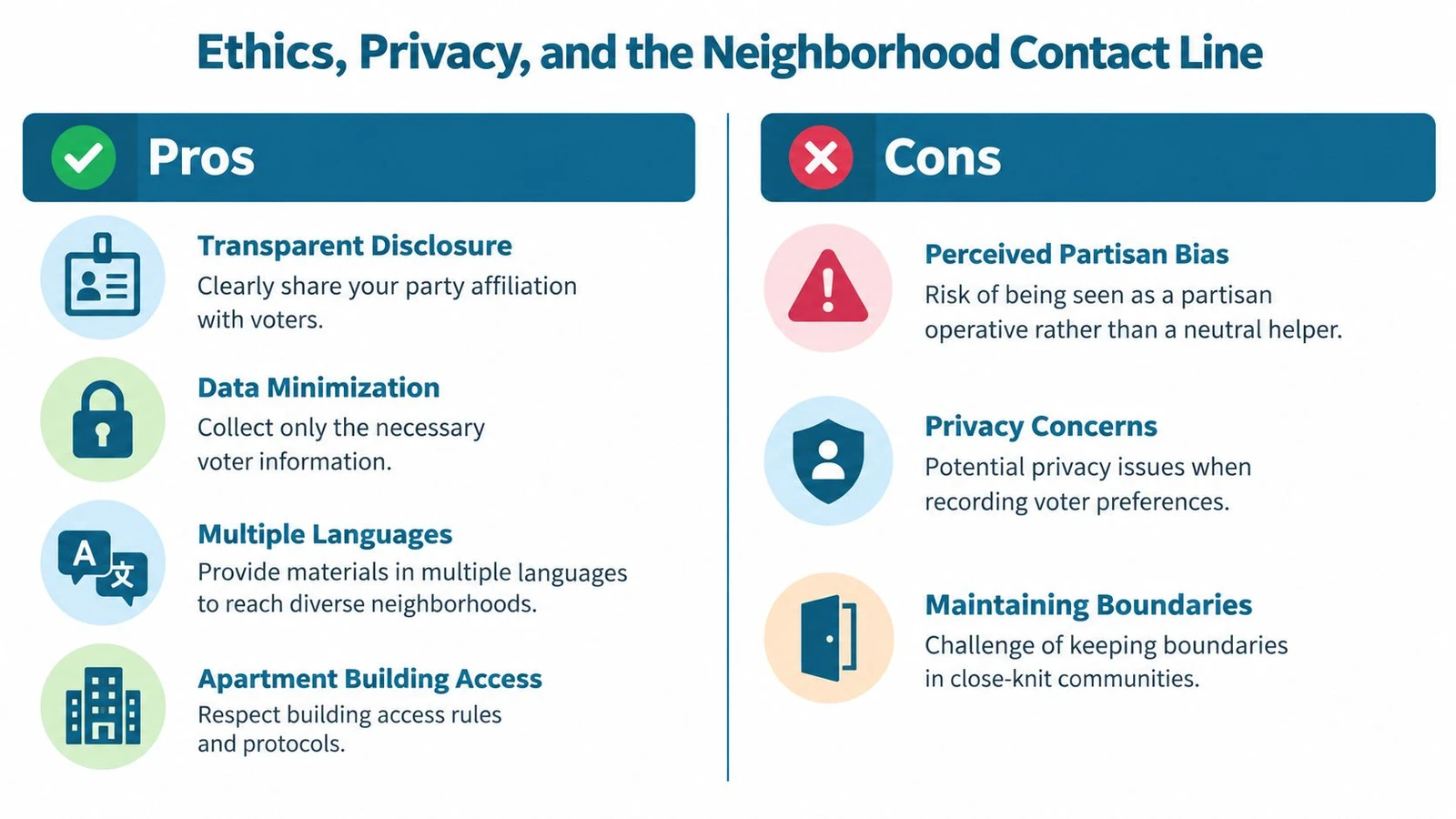
- Disclose affiliation: Identify the campaign or party without suggesting the contact is official election administration.
- Minimize records: Capture necessary, approved information rather than speculative judgments or sensitive personal detail.
- Respect refusal: End unwanted conversations and apply the campaign’s suppression procedures.
- Provide accessible options: Escalate requests for language assistance or alternative formats.
- Respect property access: Follow building rules and never pressure residents to admit canvassers.
- Separate help from persuasion: Never condition assistance on support, registration, or a promise to vote.
Resolve gray areas without improvising
A voter’s question about eligibility, ballot status, or a disputed election procedure should go to the appropriate official election authority. The captain can help locate that channel without claiming authority to decide the issue.
A resident’s housing, benefits, or legal concern also requires restraint. The captain shouldn’t place the full account in a political contact record or promise a government response. Staff should provide an approved referral process and document only the follow-up needed.
Opposition isn’t misconduct, and familiarity isn’t consent. Captains should protect those distinctions even when campaign pressure increases.
Retention, Troubleshooting, and a Final Captain Checklist
A captain who becomes unresponsive may be overwhelmed, unclear about authority, or tired of requesting help that never arrives. Treating every missed commitment as an enthusiasm problem prevents staff from finding the actual failure.
Retention should begin with a manageable assignment and dependable staff support. Recognition matters, but it can’t compensate for permanently absorbing vacant roles or being expected to remain available throughout every evening.
Diagnose before replacing
Use the point of failure to decide the response.
- Empty shifts: Check whether volunteers explicitly confirmed. Unanswered invitations aren’t staffing.
- Weak conversations: Observe an interaction and coach the specific problem, whether it’s a rushed opening, inaccurate explanation, or poor listening.
- Incomplete records: Check usability and training before assuming carelessness.
- Repeated overload: Reduce scope, delegate administrative work, or arrange temporary coverage.
- Persistent disagreement: Clarify decision rights and document the agreed resolution.
A captain who can’t continue should have a dignified off-ramp. Campaign staff should recover assignment records, transfer appropriate access, and identify outstanding commitments without leaving the departing volunteer responsible indefinitely.
Morning-of-canvass checklist
The captain’s printable checklist should confirm readiness rather than reproduce the training manual.
- Purpose confirmed: The shift objective and approved survey are current.
- People confirmed: Expected volunteers, lead coverage, and backup contact are recorded.
- Assignments checked: Routes are available and obvious access problems have been reviewed.
- Devices ready: Volunteers can access their work and understand pending synchronization.
- Materials current: Literature and voting information match staff-approved versions.
- Support available: Safety, accessibility, and voter-question escalation contacts are reachable.
- Closeout arranged: Volunteers know where to return and how unresolved work will be handed over.
Staff should review the checklist with new captains and let experienced captains report exceptions. The aim isn’t a daily performance ritual. It’s a precinct operation that remains understandable and supported when plans change.
doornoc offers mobile canvassing, route planning, offline interaction capture, and precinct-level reporting to support a captain’s daily operation. Campaign teams can visit doornoc to evaluate how those capabilities fit an upcoming canvass, from volunteer assignment through shift reconciliation.
Looking for a tool to run this? doornoc’s canvassing software bundles voter data, automatic turf cutting, the mobile app, and live reporting in one platform.