You just clicked a canvassing posting because the headline looked simple, the pay looked possible, and the schedule looked flexible. Then the questions started piling up. Is this a real job, what kind of pay structure is buried underneath the headline rate, and are you being hired as a worker or as a contractor?
Political canvassing jobs are where campaigns test whether a person can turn a conversation at a front door into useful voter contact. The work is part sales, part logistics, and part discipline. The people who do it well are usually the ones who show up prepared, log everything, and care more about completed conversations than raw door counts.
What Political Canvassing Jobs Actually Involve
On day one, a new canvasser usually starts with a briefing, not a clipboard and a smile. A manager hands over turf, reviews the script, explains the target audience, and expects the canvasser to use a phone or app to move through the route and record what happens at each door. By the end of the shift, the work isn’t just knocking. It’s the debrief, the data entry, and the questions about what voters said, what objections came up, and which addresses were dead ends.
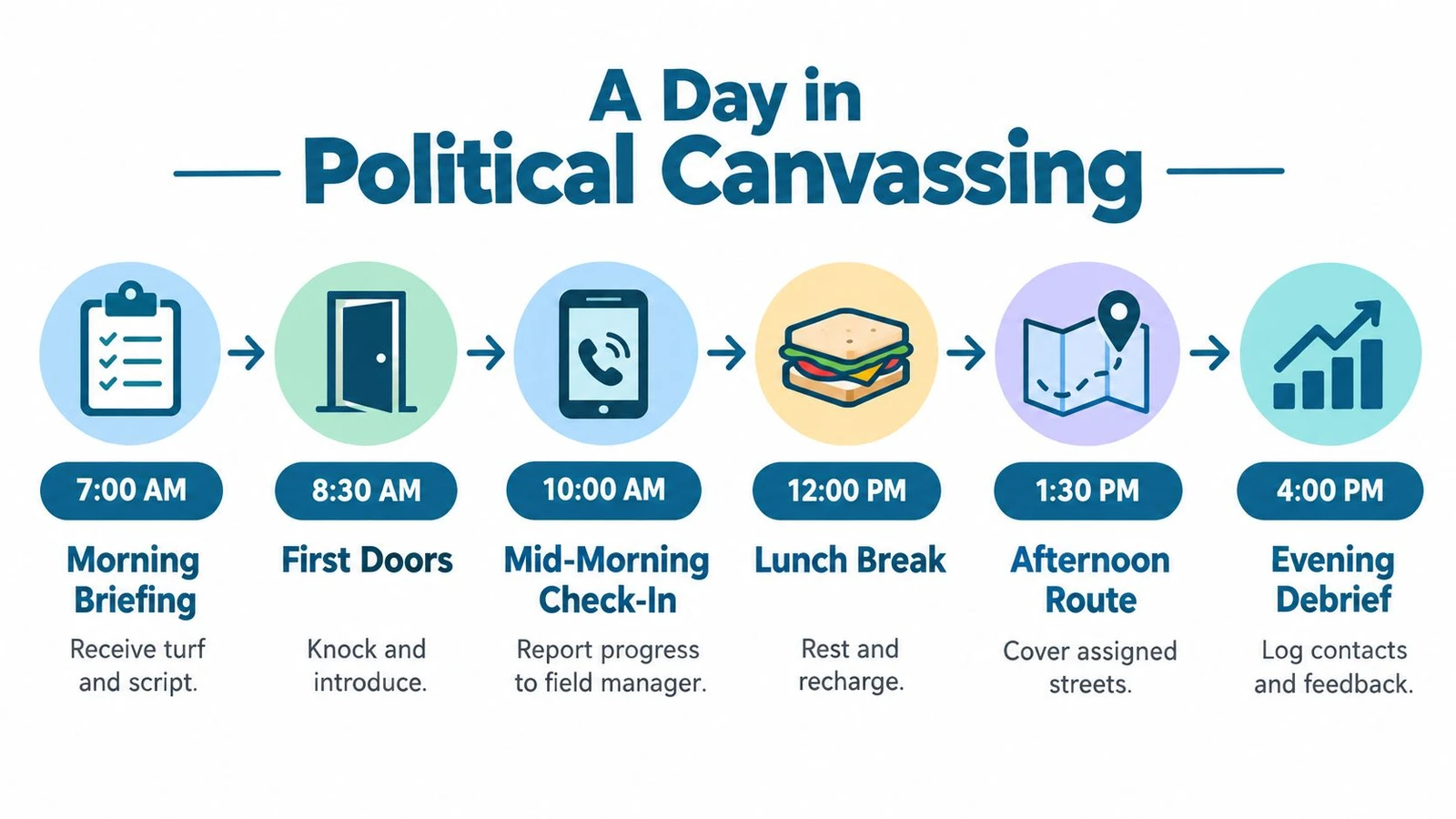
A canvassing shift has a clear rhythm. The morning is for assignment, the middle of the day is for movement and conversations, and the end of the day is for reporting and cleanup. That rhythm exists because campaigns hire canvassers to create personal contact, and randomized field experiments have repeatedly shown that face-to-face contact can move turnout. In the New Haven experiment, personal canvassing increased turnout by about 6 percentage points; telephone calls did not show a measurable effect, and direct mail only nudged turnout slightly PNAS study on voter mobilization.
Practical rule: A canvasser is not paid to be charming at random. A canvasser is paid to reach people, start a real conversation, and capture the result accurately.
That’s why the job feels more operational than glamorous. A polite “not interested” is not the same as a completed conversation, and a completed conversation is not the same as a completed persuasion. The job rewards patience, clear speaking, and the ability to keep moving after a rejection.
For résumé purposes, the safest description is straightforward. Use language like field outreach, voter contact, data entry, route execution, and scripted persuasion. If the work included reporting to a field lead, handling follow-up, or recording voter responses, say so plainly. If a hiring manager wants proof you can do the job, that language matters more than saying you “worked events.”
If a candidate wants a cleaner way to present that experience later, a useful resource is turn LinkedIn profile into resume, especially when canvassing work needs to be reframed as organizing, operations, or customer-facing field experience.
Types of Canvassing Roles You Can Apply For
Canvassing is not one job title. It’s a ladder, and the rung matters. Entry-level field work is about execution. Mid-level roles add supervision, and senior roles shift toward staffing, reporting, and performance management. Someone applying blind to every listing usually wastes time because the role may be entry-level, part-time, seasonal, or already one step above base canvassing.
The roles worth knowing
| Role | Core duties | Who hires | Experience |
|---|---|---|---|
| Canvasser | Knock doors, deliver the script, record outcomes, follow the route | Campaigns, issue groups, ballot measures | Entry-level or prior volunteer work |
| Team Lead | Coach a small group, check data quality, solve field problems fast | Campaigns, consultancies, advocacy programs | Prior canvassing, leadership, strong reliability |
| Volunteer Coordinator | Recruit and schedule volunteers, keep turnout steady, troubleshoot attendance | Party committees, local campaigns, advocacy groups | Organizing or community outreach background |
| Field Organizer | Manage outreach, coach staff, set field goals, report to directors | Campaigns and larger committees | Field experience plus management potential |
| Canvass Director | Oversee turf, staffing, quality control, and daily production | Larger campaigns, consulting firms, ballot operations | Proven field management |
| Data or QA Lead | Audit records, monitor contact quality, catch bad entries | Data-heavy campaigns and large field programs | Organizing plus systems discipline |
The entry-level canvasser role is the most common starting point. It usually asks for reliability, decent communication, and comfort with rejection. The team lead role is where campaigns start paying for judgment, not just footwork. That means fewer excuses, more coordination, and more pressure when the numbers dip.
Straight answer: If a posting says it needs someone to manage others, that’s not a starter role. It’s a leadership role with field expectations attached.
The career path is real, but it isn’t automatic. A strong canvasser who logs clean data, solves small problems, and keeps morale up can move into team leadership. From there, field organizing and regional management become realistic if the person can handle people, numbers, and pressure at the same time.
For a deeper look at how organizing responsibilities differ from pure canvassing, field organizer roles and responsibilities maps the transition clearly. That distinction matters because a lot of applicants apply for the wrong title and then wonder why the job feels heavier than expected.
The basic rule is simple. If the ad talks about doors, scripts, and direct voter contact, it’s canvassing. If it talks about staffing, coaching, and numbers, it’s management. Apply to the title that matches the work you can do now.
Where to Find Listings That Are Worth Applying To
Serious openings usually show up where campaigns are already operating, not where random job boards recycle stale postings. The best places to look are official campaign career pages, party committee portals, state-level coordinated campaign hubs, ballot-initiative committees, advocacy organizations, and hiring networks used by field staff. Those listings tend to be clearer about who is hiring, where the work happens, and when the start date begins.
The smarter hiring move in campaigns is speed. A manager spots a reliable person, sends a text, and fills the slot before a public posting gets wide attention. That means cold applicants should not just refresh listings. They should email, call, and ask for the field manager or hiring lead directly, especially when a campaign is in the middle of a compressed election window.
Use a hard filter before applying. If a listing doesn’t name the employer, the pay basis, the location, the start date, and the supervisor contact, it’s not clean enough to trust yet. If a post dodges those basics, there’s probably more it isn’t saying.
A useful checklist for any opening looks like this:
- Employer identity: The listing should say who is paying the worker.
- Pay basis: Hourly, salary, piece rate, or contractor status should be obvious.
- Location: The turf, office, or region should be named.
- Start date: Campaign work moves fast, so timing matters.
- Supervisor contact: There should be a real person or clear hiring channel.
- References to role duties: A credible post should explain whether the job is door-knocking, team leading, or coordination.
One more rule helps a lot. Don’t get trapped by recycled aggregator pages with the same vague ad repeated under different headlines. Those listings often strip out the details that matter and leave applicants guessing about the actual employer.
Pay Schedules and What You Will Actually Take Home
Headline pay is where job seekers get fooled. The number looks fine until unpaid travel, weather delays, training, and inconsistent contact rates eat into the day. Political organizations as a whole are also seasonal, with average employment of about 8,900 workers annually from 2001 through 2014, and weekly wages in the industry have ranged from $687 to $1,047 since the 2008 election BLS employment patterns in political organizations. That doesn’t describe every canvasser directly, but it’s a useful sanity check for campaign labor.
The four pay structures that actually show up
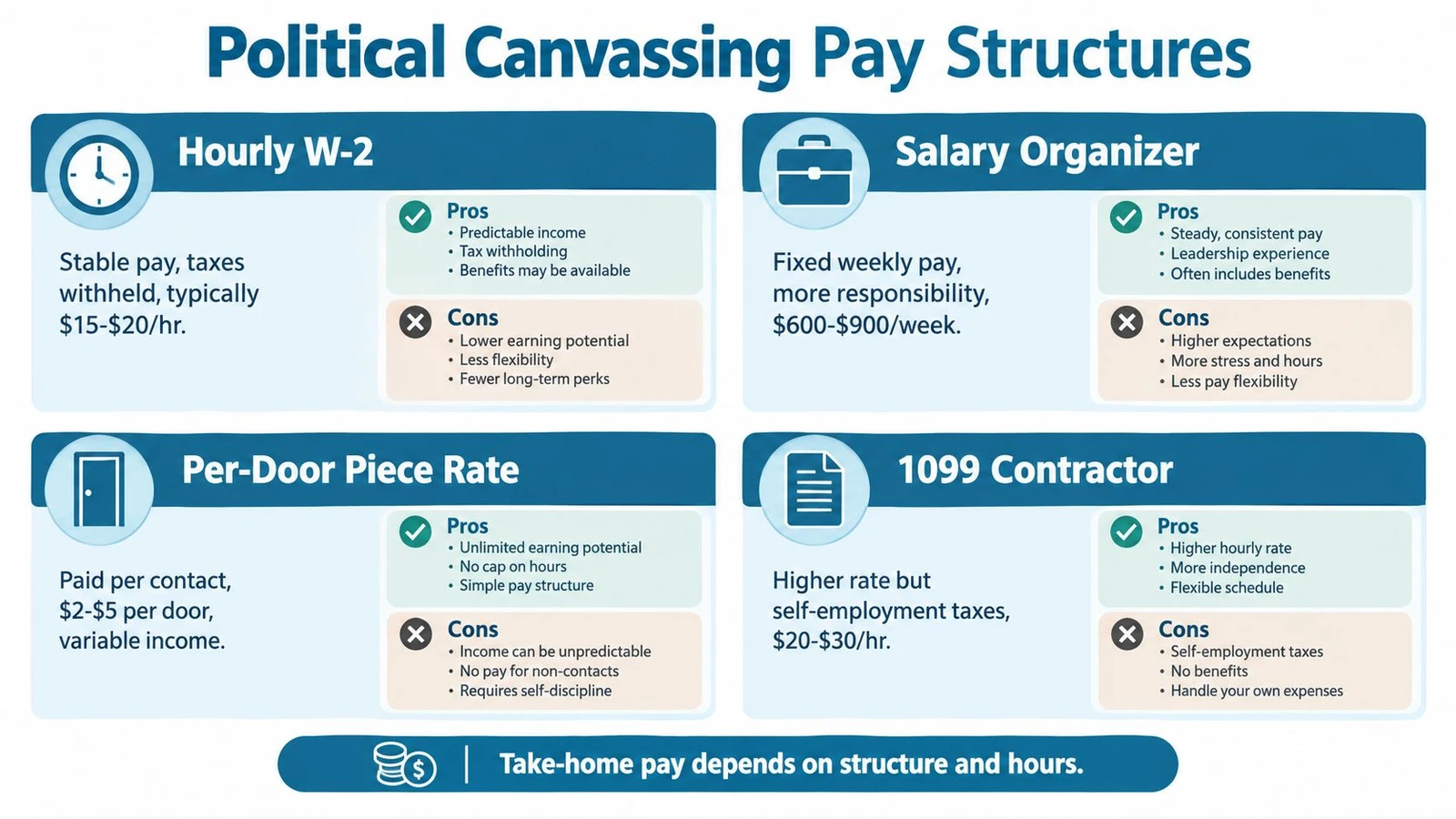
Hourly W-2 work is the cleanest for most job seekers. Taxes are withheld, the pay is predictable, and the employer is more likely to be responsible for training and labor compliance. Salary organizer roles are different. They often trade hourly clarity for broader responsibility, longer days, and more pressure to keep the field moving.
Piece-rate arrangements are where the math gets messy. One recent listing promised $1,200 to $2,000 per week while paying $1.75 per door plus a $0.25 gas stipend. Another listing advertised $20 to $21 per hour with bonuses, overtime, sick pay, and paid training. Those are not equivalent offers, even if the headlines look close example listing with piece-rate pay and example listing with hourly pay and benefits.
Good question to ask: Is the number based on doors attempted, doors completed, or conversations verified? Those are not the same thing, and the difference changes take-home pay fast.
The contractor route can look attractive on paper, but it often pushes more risk onto the worker. If the employer won’t clearly explain taxes, mileage, training time, or cancellation policy, that’s a warning sign. The worker should also ask whether bonuses are guaranteed or discretionary, because that detail often changes the actual wage more than the headline rate does.
Ask every employer these questions before signing:
- What is the pay basis?
- Is training paid?
- Is mileage reimbursed?
- What happens if a shift is canceled early?
- Are overtime rules being followed?
- Is workers’ compensation provided?
- Are bonuses guaranteed or conditional?
The short version is this. A clean hourly job with clear rules usually beats a flashy rate with vague math.
Training and Legal Basics Every Canvasser Should Know
Good canvassing training is specific. It covers the script, objections, hostile reactions, how to log data, and what to do when a conversation turns awkward or unsafe. If onboarding is just “read this sheet and go knock,” the campaign is underpreparing people and probably undermanaging the field.
A serious manager should expect new hires to practice the opening lines, handle refusals, and role-play uncertain interactions before going out alone. Safety procedures matter too, especially when teams are working after dark or in unfamiliar neighborhoods. If training skips de-escalation or data hygiene, that’s not a small omission. It’s a sign the operation is rushing.
For managers trying to build a stronger program, how to train canvassers for political campaigns in 2026 covers the structure that a professional field operation should already have in place. A good training program doesn’t just explain the script. It makes sure people can use it without creating avoidable problems in the field.
The legal basics are equally blunt. Workers should know whether they need to follow local solicitation rules, private-property restrictions, or no-knock guidance. They should also know how the campaign handles do-not-contact lists, harassment policies, and classification status. Misclassification is one of the fastest ways for a “flexible” job to become a bad one.
A clean onboarding should answer these questions before the first shift:
- Permits and access: Does the campaign have any local requirements for canvassing?
- Property rules: What happens at gated buildings, posted doors, or restricted spaces?
- Contact lists: How are do-not-knock and sensitive households handled?
- Conduct rules: What behavior is banned, and who handles complaints?
- Worker status: Is the role W-2 or 1099, and what does that mean in practice?
Campaigns that recruit fast still need to train well. There’s no excuse for sending people into the field without clear rules, because bad training creates bad data, bad interactions, and bad retention.
How Contact Quality Determines Your Success on the Doors
Door counts look impressive and often mean very little. What matters is whether the canvasser reached someone, because research keeps showing that contact rates vary widely. Across six U.S. local-election sites, household contact rates ranged from 14% to 45%, and the average intervention effect was 2.1 percentage points study of canvassing contact and turnout. That spread is the story. The same route, in the same program, can perform very differently depending on execution.
What high-quality contact actually looks like
Good canvassers don’t just walk fast. They work the route with timing in mind. They know when people are more likely to be home, they make the opening line short, and they record outcomes carefully so the campaign can separate attempts from real contact. That distinction matters because the strongest effects come from actual conversations, not just door attempts.
There’s another trap here. One unanswered knock is not proof that nobody is home. Reattempt rules should be scheduled around local availability, not treated as permanent non-contact. If a campaign keeps repeating the same mistake, it’s not getting a better result, it’s just burning labor on the same dead end.
Field rule: Route completion is not the score. Verified contact is the score.
A disciplined team watches attempts per address, unique addresses reached, completed conversations, and script completion separately. That’s the only way to tell whether a route is producing or just creating activity. Reports that only show total doors knocked are easy to inflate and hard to trust.
This is why many campaigns rely on mobile canvassing software with route planning, offline capture, and automatic sync. doornoc is one such platform, because it combines route generation, door outcomes, and live reporting for field teams. The point isn’t the brand name, it’s the workflow. If the app can’t separate attempts from conversations, the data will lie to the manager.
For a sharper comparison of what contact rate means in practice, canvassing contact rate vs phone banking 2026 benchmarks is the kind of operational reading that helps a canvasser think like a field lead. The bottom line is simple. Better contact quality beats louder activity every time.
Your First 30 Days on the Job and How to Stand Out
The first month decides whether a canvasser becomes dependable or forgettable. Week one is about showing up on time, finishing routes, and learning the script without drama. Week two is about improving accuracy. Week three is about helping the team. Week four is about proving the person can be trusted with more responsibility.
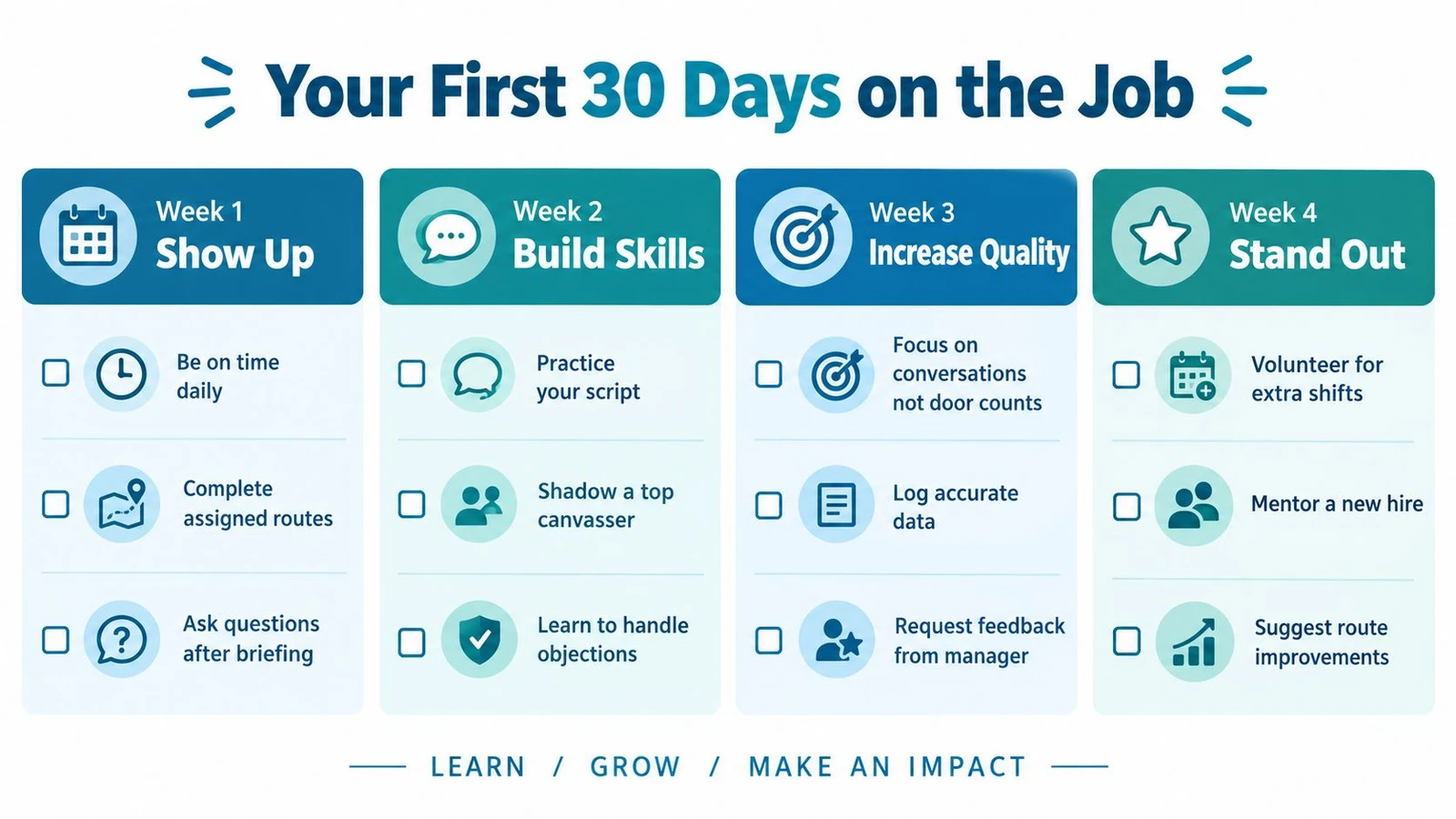
The first test is reliability. A canvasser who arrives late, misses a route, or leaves without checking in creates problems that ripple through the whole field team. A canvasser who shows up, listens, and asks clear questions becomes useful fast.
By week two, the focus should shift from volume to quality. That means logging attempts accurately, following up on not-homes, and getting better at the first 10 seconds of a conversation. The best workers don’t treat objections as personal. They treat them as part of the job.
The smartest move in week three is to help the operation run smoother. Flag bad addresses, note patterns in voter responses, and tell the lead when a route is weak. A person who improves the system becomes harder to replace than a person who only completes assignments.
For interview prep, interview preparation strategies can help a candidate present canvassing experience without sounding vague or inflated. That matters because hiring managers notice who can explain their work clearly and who just repeats buzzwords.
By week four, the person should know whether the job fits. If the contact rates are collapsing, the script is weak, or safety issues keep getting brushed off, that’s not a training problem anymore. That’s a management problem. A decent employer fixes it quickly. A bad one shrugs and keeps pushing bodies through the doors.
Best practice: Ask for feedback before asking for more shifts. The worker who learns fast and communicates clearly gets trusted faster than the one who only asks for hours.
If a campaign wants better field execution, cleaner data, and routes that make sense before the first door is knocked, doornoc gives teams a way to plan turf, capture outcomes offline, and see what’s happening while the shift is still live. A serious canvasser should care about that kind of workflow because the job lives or dies on contact quality, not hype.
Looking for a tool to run this? doornoc’s canvassing software bundles voter data, automatic turf cutting, the mobile app, and live reporting in one platform.