The campaign is in week one, the candidate wants the lawn signs out fast, and the field office already has too many jobs competing for the same volunteers. That’s exactly when political campaign yard signs either become a disciplined field asset or drift into a box-moving exercise that looks busy and changes nothing.
Why Political Campaign Yard Signs Still Belong in a Modern Field Plan
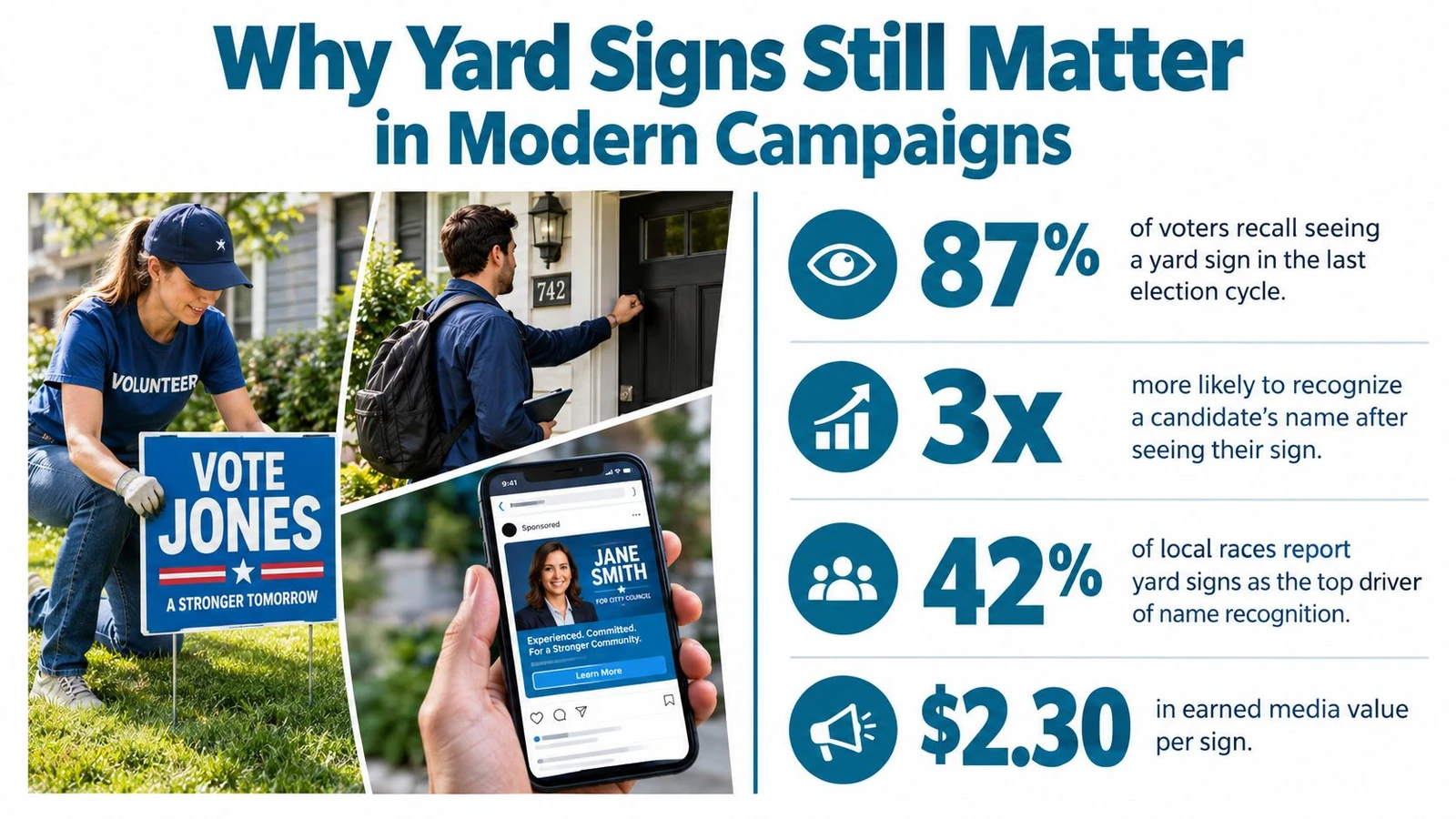
A yard sign program works when the field team treats it like an assigned task, not a decoration order. Signs create public proof of support, give volunteers something visible to place on targeted blocks, and reinforce the same neighborhoods where canvassing, phone work, and voter contacts are already happening. That makes them useful in local races and larger contests alike, even if their direct persuasion effect stays limited.
The history explains why the format still feels practical. Early campaign signage dates to the 1824 Adams campaign, expanded in 1828, and became more standardized in the 1920s as campaign advertising took on a more consistent visual form. The compact modern sign then grew with suburban lawns from the 1960s onward, which is why the format still fits the way people encounter politics on residential streets IFS on election yard signs.
Practical rule: use signs as a visibility layer, not as a substitute for persuasion, turnout work, or direct voter contact.
The strongest evidence points the same way. A pooled set of four randomized field experiments found that signs increased the advertised candidate’s vote share by 1.7 percentage points on average. The same study found no direct lift in total votes cast, estimating 7.2 votes with a standard error of 9.5 votes Yale ISPS study. That is a small but real effect, which is enough to justify signs as part of a field plan, not as a turnout machine.
The adjacent-precinct spillover estimate of 1.5 percentage points matters for placement. Concentrating signs where voters already see civic activity can extend the effect beyond the exact house that hosts the sign, so the field team should think in blocks, routes, and neighborhood clusters instead of dropping signs wherever a supporter happens to offer a lawn Yale ISPS study.
Budgeting follows from that. Put signs where repeated exposure matters, keep them tied to canvass turf, and do not treat them as a replacement for voter contact. If the race turns on a few points, signs can help on the margin. If the campaign needs turnout, the money belongs in field work first.
Before ordering, compare corrugated plastic, aluminum, and frame kits against your install-and-retrieval cycle. The best fit depends on how fast volunteers can place them, how long they need to stay up, and how much wear the program can absorb, so it helps to browse campaign merchandise options with those field constraints in mind.
Designing Signs That Earn the Spot
A sign has seconds to work. It needs to read from a moving car, hold up in bad weather, and stay legible on a cluttered block. If it looks fine on a desk but not at the curb, it is too busy.
Build the sign around one readable message
The best sign usually carries the candidate’s name, office, and one short support line if there is room. Anything extra steals attention from the main read. A commuter should understand it before the car passes the house.
Field rule: if a supporter cannot read the sign quickly from the road, the design is trying to do too much.
Message framing matters when the campaign is asking for a sign commitment. Field experiments on sign commitments found that hometown appeals beat partisan appeals overall, with an odds ratio of 1.69 and a 95% confidence interval of 1.01 to 2.04, and one Republican municipal setting produced an even stronger estimated odds ratio of 2.14 with a 95% confidence interval of 1.06 to 4.33 Taylor & Francis study. That points to locally grounded copy, not ideological clutter, when the goal is getting the sign into the yard.
The visual system should stay consistent across every version. Use the same font family, the same photo treatment if you include a candidate image, and the same color logic across sizes. The aim is not variety. The aim is instant recognition across blocks, routes, and intersections.
For a slogan check before anything goes to print, use great political campaign slogans as a practical writing reference.
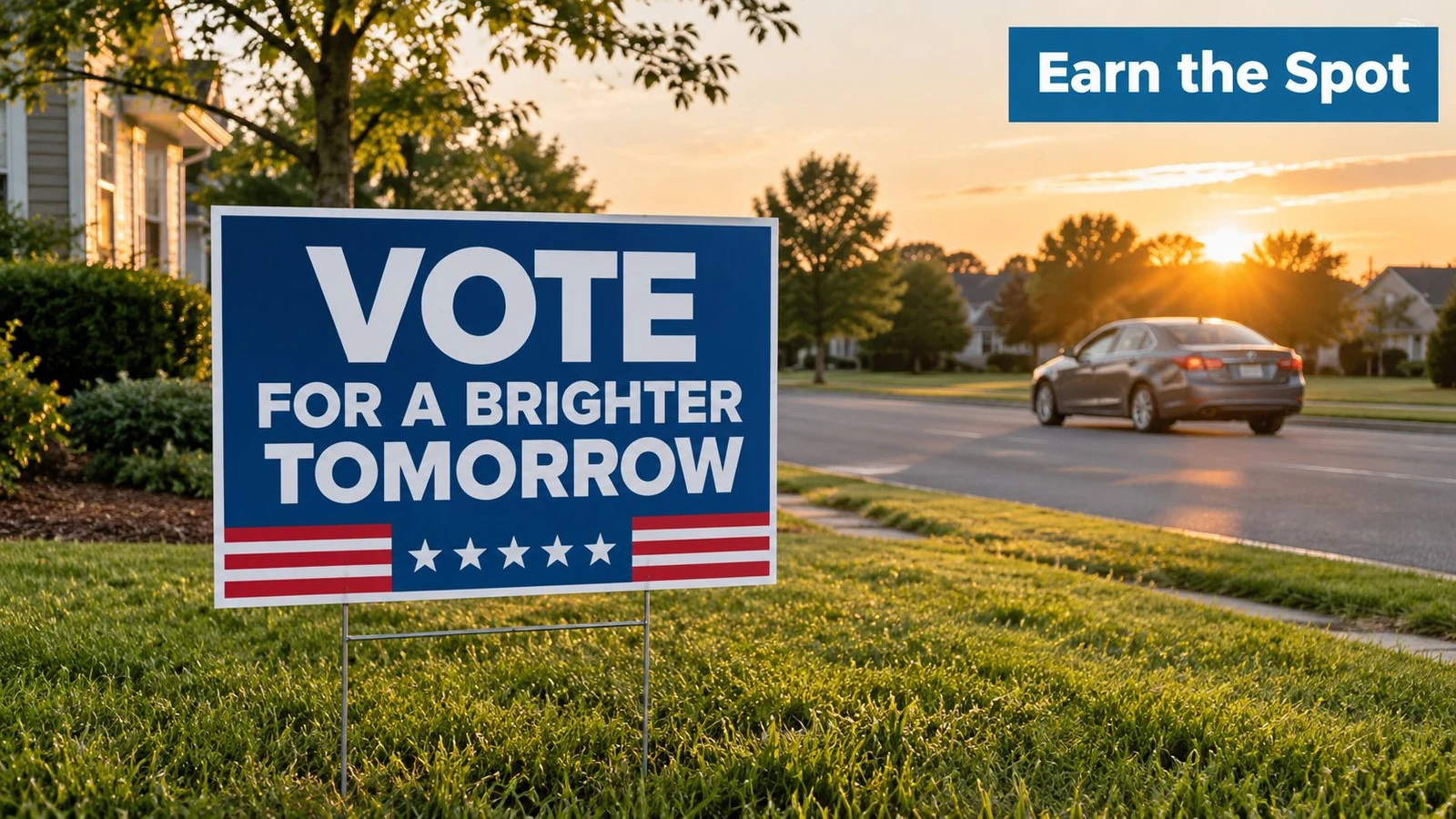
Material choice should match the use case. Coroplast is the usual workhorse for short campaigns and easy replacement. Aluminum makes more sense when weather resistance and reuse matter more than unit cost. Reusable frames help when the campaign expects multiple install and retrieval cycles, because the frame cost spreads across more than one round of use. Decals and window formats follow the same legibility rules, and a Bernie decal for your vehicle shows how a single name and a high-contrast layout can carry at speed.
Legal, Compliance, and Placement Rules
A yard sign crew can create avoidable trouble fast if volunteers treat every lawn, verge, and corner lot the same. Private property requires permission. Public right-of-way rules vary by jurisdiction, and a bad install can turn into a removal request, a complaint, or extra staff time spent cleaning up after a volunteer guessed wrong. The legal call comes before the visibility call.
Start with permission, not convenience
The safest operating rule is simple. Place signs only where the campaign has clear permission or a clearly lawful right to place them. Volunteers should know the difference between a supporter’s front yard, an easement strip, a public verge, and property controlled by a homeowners’ association or another private entity.
Compliance rule: no written or recorded permission, no sign.
The ask should be direct and privacy-aware. Research on neighborhood clustering shows that households are more likely to display a candidate’s sign when nearby households already do so, and that only 23% of surveyed respondents agreed signs influence voting, while 33% were neutral Oxford academic chapter. That means the request is about placement and consent, not pressure, and it should respect people who do not want their political preferences visible to neighbors.
Campaigns also need to work from local rules, not assumptions. State and city ordinances can set sign size, setback requirements, posting windows before and after Election Day, and removal deadlines. A volunteer may know the candidate, but if they do not know the ordinance, they can create risk the campaign has to unwind later.
Use a simple compliance checklist
- Confirm property type: determine whether the location is private land, an easement, or a public area before any install.
- Record permission: capture who approved the placement, when they approved it, and whether they want removal after the election.
- Check local rules: verify size, setback, and time limits before the first drop goes out.
- Respect refusals: if a household declines, log the refusal and move on without argument.
- Track removals: note the required removal date and assign a retrieval owner early.
For volunteers writing install scripts or turnout-facing copy, political campaign advertisement guidance gives a useful baseline for keeping language clear and compliant.
The practical payoff is trust. A campaign that treats placement as a consent process, not a scavenger hunt, keeps supporters comfortable and reduces conflicts with neighbors, landlords, and property managers.
Production, Inventory, and Logistics
A sign operation fails most often in the middle, not at the printer. The design is approved, the boxes arrive, and then nobody can tell which signs belong to which turf, who signed them out, or where the missing stack went. The fix is a basic logistics chain that starts before order day and ends only after retrieval.
Build the supply chain before the first delivery
Vendor selection should happen on quality, turnaround, and shipping reliability, not on the lowest quote alone. Files need to be print-ready, labeled clearly, and archived so the campaign can reorder without rebuilding the artwork from scratch. Once the order is placed, the logistics lead should already have staging labels for precinct, route, or neighborhood.
Operational rule: every box should have a destination before it reaches the office floor.
Storage matters too. Boxes should stay dry, off the ground, and out of direct weather exposure, especially if the campaign expects to reuse frames or retrieve signs after early voting. If the campaign is using reusable hardware, the budget should treat it as inventory, not as a one-time expense.
For a practical framework on tracking stock, handling losses, and keeping counts clean, a useful reference is optimize inventory and cut costs. The principles translate well to sign storage, even when the political use case is different.
Put the inventory on a checkout rhythm
A clean inventory process usually needs just three records.
- Incoming count: record how many signs arrive by size and design variant.
- Field checkout: note which volunteer or driver took which bundle, and for which route.
- Return count: reconcile what came back, what was installed, and what still needs retrieval.
That rhythm prevents a common failure mode, where one person thinks the signs were deployed and another person thinks they were lost. It also gives the campaign a reliable picture of how many signs made it into the field.
For operational planning, a simple timeline works well. Order the signs early enough to avoid rush stress, receive and label them as soon as they arrive, stage them by turf, and schedule first installation only after the route map is final. By the time the canvass team heads out, the inventory lead should know exactly what is on hand and what still needs to be printed.
Integrating Yard Signs with Canvassing and Voter Data
Signs work better when they’re treated as a field-data product, not a side project. When a canvasser asks for a sign at the door, that request should land in the same system that holds supporter notes, route assignments, and follow-up tasks. Otherwise, the campaign ends up with one spreadsheet for doors and another one for the lawn.
Turn the ask into a trackable field action
The simplest workflow is to capture the sign request at the door, tag the household as a supporter record, and mark whether the sign was promised, delivered, installed, or declined. That lets the campaign separate intent from fulfillment, which matters because a commitment isn’t the same thing as a finished placement.
For route planning and real-time oversight, a canvassing platform can use turf generation, polygon boundaries, and live dashboards to assign sign drops alongside door work. doornoc, for example, supports route planning, offline field capture, and a campaign guidance flow that records sign placement so neighborhood coverage can be tracked within the same operation.
Data hygiene rule: sign requests, refusals, and removals belong in the supporter record, not in a volunteer notebook.
Keep the sign map inside the field plan
A deployment map should show where signs are requested, where they were installed, and where retrieval is still pending. That way, the same routes that carry canvassers can also carry a small signage crew, and the campaign can see whether the best-supported blocks are getting visible coverage.
The internal logic is simple. If a household requests a sign, that household probably belongs in a follow-up universe later. If it refuses, the campaign should respect the refusal and avoid future ask friction. If the sign comes down early, the field team should know whether it was removed by request, by weather, or by mistake.
For campaigns that already use data-driven persuasion and contact plans, a practical discussion of how sign records should feed back into the broader voter model is available through how to use canvassing data to refine campaign message. The point is not to turn yard signs into a separate analytics island, but to let them strengthen the same field file that powers the rest of the operation.
Mapping Placement for Maximum Visibility
A good sign map starts with judgment, not guesswork. Before a single bundle leaves the office, rank each block by traffic visibility, corner exposure, household density, and whether the neighborhood has already shown sign support. The goal is simple: place signs where repeated exposure is likely, not where drop-off is easiest.
Score the neighborhood before you install
Some streets do better because cars move slowly enough for a sign to be read. Others do better because they sit at intersections or already have visible supporters nearby. Rank each candidate location by what a passerby can see, then decide whether it deserves one of the signs you have in inventory.
The social clustering evidence points in the same direction. In the Oxford chapter cited earlier, a dataset covering 57,583 observations across four elections and three research sites found that 6.3% of households displayed signs for more than one candidate, and households were more likely to display a candidate’s sign when nearby households displayed that same candidate’s sign. That pattern shows that yard signs move through neighborhoods as social signals as well as persuasion tools.
Placement principle: dense clusters can signal momentum, but only if households have actually consented to be part of that display.
Timing matters too. Signs installed too early can fade into the background before early voting starts. Signs installed too late miss part of the persuasion window. The deployment window deserves the same care as door-knocking and mail drops.
Use a two-person field crew
A two-person crew keeps the operation moving. One person handles the stop, the conversation, and the consent check. The other handles the physical install, traffic awareness, and box management. That split prevents one volunteer from trying to solicit and install at the same time.
Handle common objections plainly and without pressure.
- Not now: record a later follow-up only if the household asks for one.
- No sign on the lawn: ask whether another visible placement works, then stop if the answer is still no.
- Privacy concern: thank the household and log a refusal immediately.
- Already have another sign: note the preference and do not argue over visibility.
Every install should be logged on the spot, with the location, the sign count, and the consent status captured in the field. That keeps the record clean and makes later retrieval less confusing.
Safety still matters. Keep installers clear of aggressive pets, avoid bad weather, and respect property boundaries even when the sign is meant for a visible spot near the curb. A crew that moves carefully causes less damage, earns more trust, and leaves fewer retrieval problems behind.
Retrieval, Reuse, and Closing the Loop
The last pass is where many campaigns get sloppy. Signs go out, the route looks full, and the team moves on, but retrieval is part of the field operation. It protects relationships, recovers inventory, and shows which placements were completed.
Start with the install record. Retrieval works best when it follows the same file that recorded the original placement, because that is the cleanest way to match signs to houses and to honor any promised removal date.
Treat problem cases separately. A sign lost in bad weather is not the same as a sign a resident wants taken down, and a sign that was never installed should not be filed as recovered. Clean records keep the next cycle from starting with bad assumptions.
Close the record, not just the route
- Check fulfillment: confirm which requested signs were installed.
- Log retrieval status: mark each sign returned, removed, lost, or kept for reuse.
- Note household preference: store removal requests and future refusals in the supporter file.
- Inspect reusable pieces: separate frames and hardware that can be used again.
- Write the after-action note: capture what worked on the route, not just what went out.
The feedback loop matters because a sign program only has value if the campaign can judge whether it did what it was supposed to do. As noted earlier, the measured effect is on vote share, not turnout, so the right standard is fulfillment, visibility in treated areas, and movement on the metric the signs were meant to influence. Count boxes if you want, but count the field result first.
A clean sign operation leaves a record the next field director can use immediately. It shows where supporters were willing to display, which neighborhoods responded best, and where a request never turned into a placement. That is how a yard-sign program stops being a pile of plastic and becomes usable campaign intelligence.
Looking for a tool to run this? doornoc’s canvassing software bundles voter data, automatic turf cutting, the mobile app, and live reporting in one platform.