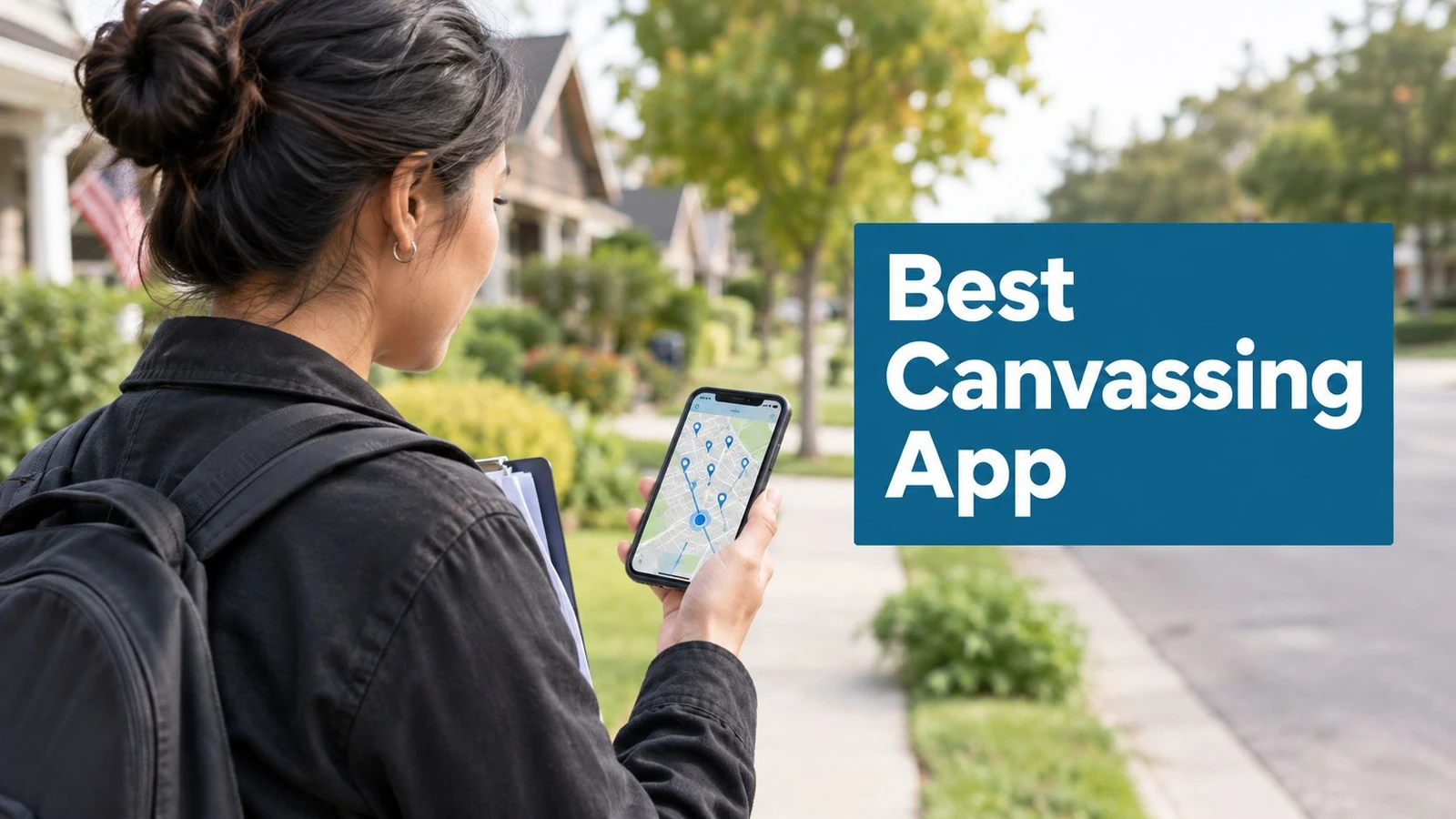
Personal door-to-door contact can increase voter turnout by roughly 6 to 7 percentage points, making the best canvassing app the one that helps campaigns create more successful, well-recorded conversations, not the one with the longest feature list. The platform should improve targeting, routing, offline capture, supervision, and privacy without adding friction for volunteers.
That distinction matters because field software sits between an assigned voter universe and an actual interaction. A map can look polished while routes waste walking time, a dashboard can show activity while no-contact outcomes disappear, and a sync process can appear reliable while rural or dense urban work is lost when connectivity drops.
The operational question is simple: does the app help convert planned doors into meaningful, measurable contact?
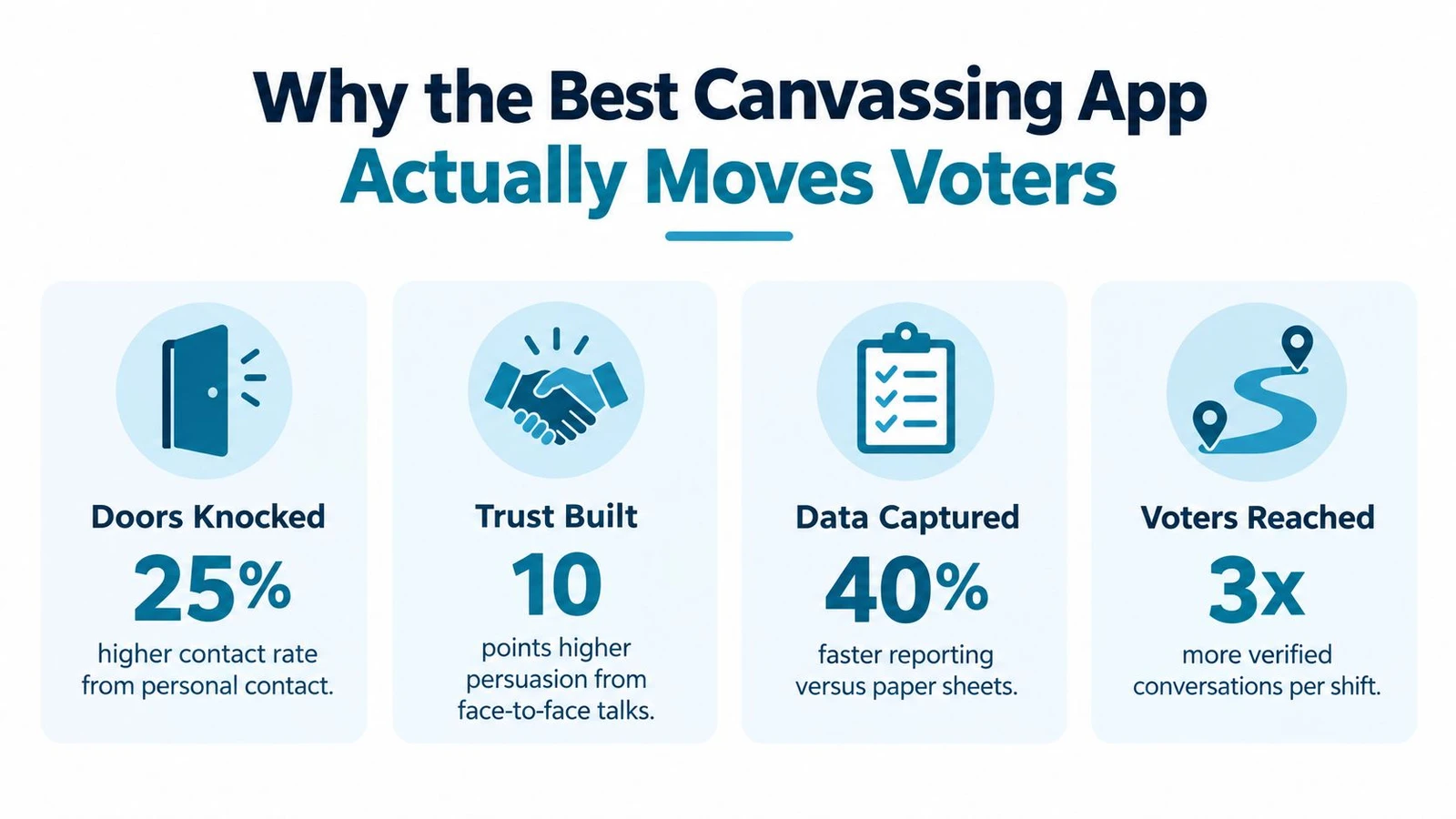
Why the Best Canvassing App Actually Moves Voters
A foundational randomized field experiment published in the Proceedings of the National Academy of Sciences studied registered voters in New Haven, Connecticut, before the November 1998 election. The control group recorded a 44.63% turnout rate, while the assigned canvassing group recorded 46.88%, an intention-to-treat difference of 2.25 percentage points. Among people who were contacted, turnout reached 59.19%. Because only 35.60% of the treatment group was successfully contacted, the researchers estimated a causal turnout increase of 6.33 percentage points, with a standard error of ±2.27 percentage points, statistically significant at the 0.01 level. The study concluded that successful personal canvassing raises the probability of voting by approximately 6 to 7 percentage points. These figures come from the PNAS field experiment on personal canvassing and turnout.
That evidence changes how campaign teams should evaluate software. The app doesn’t create persuasion by itself. It helps determine whether volunteers reach the right households, find them efficiently, record what happened accurately, and return for follow-up when the first attempt produces no conversation.
Contact is the conversion point
The study’s treatment and contact results reveal an operational truth: assigning doors isn’t the same as reaching voters. A campaign can distribute a large list and still underperform if addresses are inaccurate, routes are fragmented, volunteers spend too much time walking, or the app fails to preserve outcomes.
A strong platform therefore supports the complete chain:
- Targeting: The voter universe should be defined clearly enough that volunteers aren’t sent to irrelevant or duplicate addresses.
- Routing: Turf should be practical to walk, with household assignments that don’t create unnecessary deadhead travel.
- Conversation capture: Volunteers should record support, uncertainty, refusal, issue notes, and follow-up needs immediately.
- Supervision: Field directors should see unfinished work and redirect teams while a shift is still active.
- Governance: Campaigns should know who can view, edit, export, retain, and delete sensitive records.
The best canvassing app is consequently an operational control system. It reduces the distance between campaign intent and field execution.
Scale makes reliability more important
The 2024 U.S. presidential election illustrates the size of the environment in which many campaign systems operate. The U.S. Census Bureau reported approximately 174 million registered citizens, representing 73.6% of the citizen voting-age population, and approximately 154 million voters, representing 65.3%, in its 2024 voting and registration tables. The release also reported turnout of 63.7% among men and 66.9% among women. Those figures are documented in the U.S. Census Bureau’s 2024 voting and registration release.
A local campaign may work with a compact universe, while a statewide or congressional operation may coordinate geographically distributed teams. Both need the same basic discipline: reliable list handling, offline data entry, route visibility, and synchronized reporting. The difference is the consequence of failure. At larger scale, small workflow defects multiply across precincts, shifts, and volunteer groups.
Campaign managers should therefore judge software by how it behaves under field pressure. The useful test isn’t whether the interface looks modern. It’s whether the system preserves the evidence needed to improve the next shift.
For more background on the practical mechanics of face-to-face outreach, campaign teams can consult this guide to door-to-door canvassing, then translate its field process into measurable app requirements.
What Field Metrics Actually Matter in a Canvassing App
A canvassing platform should be evaluated through a small set of operational measures. These measures reveal whether volunteers are reaching people, whether managers can correct execution problems, and whether recorded data is trustworthy enough to guide follow-up.
Contact rate needs geographic context
Published evidence shows that successful contact rates can be low and can vary substantially by geography. One UK randomized field experiment reported a 28% successful canvass contact rate, while a broader European review described contact rates around 36% in one study and substantial cross-country variation. The review’s precision-weighted estimate of canvassing’s causal effect was approximately 2.54 percentage points, with uncertainty across studies. Those findings are available in the UK field experiment and European evidence review.
A campaign-wide average hides the reason behind a weak result. A route with many vacant properties has a different problem from a route with poor address quality. A volunteer working a difficult apartment complex has a different operating context from a volunteer walking detached homes.
The app should preserve:
- Successful contacts, including conversation duration or outcome where appropriate.
- Attempted no-contact records, rather than treating them as missing data.
- Refusal and do-not-return codes, handled with care and clear access controls.
- Revisit eligibility, so follow-up work doesn’t depend on memory.
- Timestamps and location confidence, allowing supervisors to identify unusual patterns.
- Breakdowns by route, volunteer, precinct, shift, and voter segment.
Practical rule: A contact rate becomes useful only when the campaign can explain where it came from and what action should follow.
Route quality affects conversations
Balanced turf isn’t merely a convenience feature. Routes should reduce unnecessary walking while keeping households together and avoiding inaccessible boundaries. Teams should test route generation against practical measures such as median walking distance per contact, doors completed during the planned shift, and unfinished high-priority clusters.
Real-time monitoring matters because field conditions change. A supervisor may need to move a volunteer from a completed area to a nearby unfinished cluster, or identify that a route is too difficult for the assigned shift. The app should make that decision visible without forcing staff to wait for end-of-day spreadsheets.
Campaign teams can use this framework to build a more disciplined canvasser performance metrics system. The central principle is to measure activity and field conditions together, not to treat completed checkboxes as proof of engagement.
Quality is separate from volume
Higher outreach volume doesn’t automatically mean stronger engagement. NBC News reported in August 2025 that a Higher Ground Labs report described declining voter engagement despite record-scale outreach through texting, phone calls, and door-to-door contact. A separate 2025 field test found that relational messages from people recipients personally knew increased turnout by 8.6 percentage points among conservative audiences. That reporting is covered by NBC News on campaign outreach and engagement.
The implication for app buyers is important. Platforms should help campaigns record commitment strength, issue concerns, follow-up completion, and relationship context where lawful and appropriate. A system that reports only doors attempted may encourage a race for volume while obscuring whether conversations improved voter confidence or readiness to participate.
Core Features to Compare Before Choosing a Canvassing Platform
Feature lists become useful only when each capability is tied to a field consequence. Offline mode, routing, list management, and dashboards should be assessed as parts of one workflow, because a failure in one area can weaken the value of the others.
| Feature Area | What to Evaluate | Operational Impact |
|---|---|---|
| Offline data capture | Whether volunteers can save every required response without signal and synchronize automatically later | Prevents connectivity gaps from removing rural, dense-urban, or indoor-building observations |
| Route generation | Whether routes respect roads, natural barriers, walking conditions, household groupings, and custom boundaries | Reduces wasted movement and makes shift assignments more comparable |
| Voter list handling | Supported upload formats, duplicate controls, address matching, geocoding, and field validation | Limits mismatches and gives volunteers usable records at the door |
| Interaction logging | Custom outcomes, refusal codes, revisit status, notes, timestamps, and location confidence | Converts conversations and no-contact attempts into actionable follow-up data |
| Live supervision | Route completion, team activity, unfinished priority areas, and exportable reporting | Lets field directors reallocate people during an active shift |
| Permissions and retention | Role-based access, audit trails, device-loss controls, deletion settings, and vendor documentation | Reduces unnecessary exposure of voter and volunteer information |
Offline capture should preserve meaning
An offline-first workflow isn’t just a screen that opens without service. It should retain the full interaction form, including no-contact outcomes, refusals, notes, and revisit decisions. If a volunteer can save only a generic completion marker, the campaign loses the distinctions that determine what happens next.
Automatic synchronization should also make conflict handling understandable. Staff need to know whether a later update overwrites an earlier one, creates a review item, or preserves both entries. The most reliable test is a field exercise in which volunteers lose connectivity, complete several records, reconnect, and verify the resulting dashboard and exports.
Routing needs a field test
Auto-generated turf can save preparation time, but automation doesn’t guarantee useful walking. Campaign teams should inspect whether the system splits households, crosses barriers, sends volunteers into inaccessible areas, or produces uneven workloads.
Custom geography tools matter when a campaign must work inside a neighborhood association, precinct boundary, municipal area, or other locally defined polygon. The comparison should focus on route completion and contact opportunities, not only on whether a map can draw shapes.
Data handling determines downstream value
List upload is valuable only if matching and geocoding produce records that volunteers can trust. Teams should examine duplicate handling, address confidence, custom fields, export structure, and whether the system preserves a stable record identity across updates.
Dashboards should separate activity metrics from outcome signals. Doors attempted, route completion, and volunteer hours describe execution. Support level, commitment strength, follow-up completion, and later participation describe results. Neither group replaces the other.
How doornoc Compares to Typical Canvassing Apps
A sensible comparison begins with workflow maturity rather than brand recognition. Some campaigns need a lightweight form for a small volunteer group. Others need synchronized lists, route balancing, offline capture, live supervision, and a controlled data pipeline across multiple areas.
Small local teams
A local campaign may prioritize fast setup and low volunteer training overhead. The useful question is whether a coordinator can upload or define a target universe, create practical routes, invite volunteers, and review outcomes without stitching together separate mapping, spreadsheet, and reporting processes.
A simple form can be adequate when the field program is limited and the campaign doesn’t need live reallocation. It becomes restrictive when supervisors must distinguish completed work from no-contact attempts or prepare repeat visits from recorded voter responses.
Growing operations
As a campaign adds volunteers or territories, route balance becomes more important. Uneven assignments can produce misleading comparisons, with one volunteer receiving a compact route and another receiving scattered addresses or difficult access conditions.
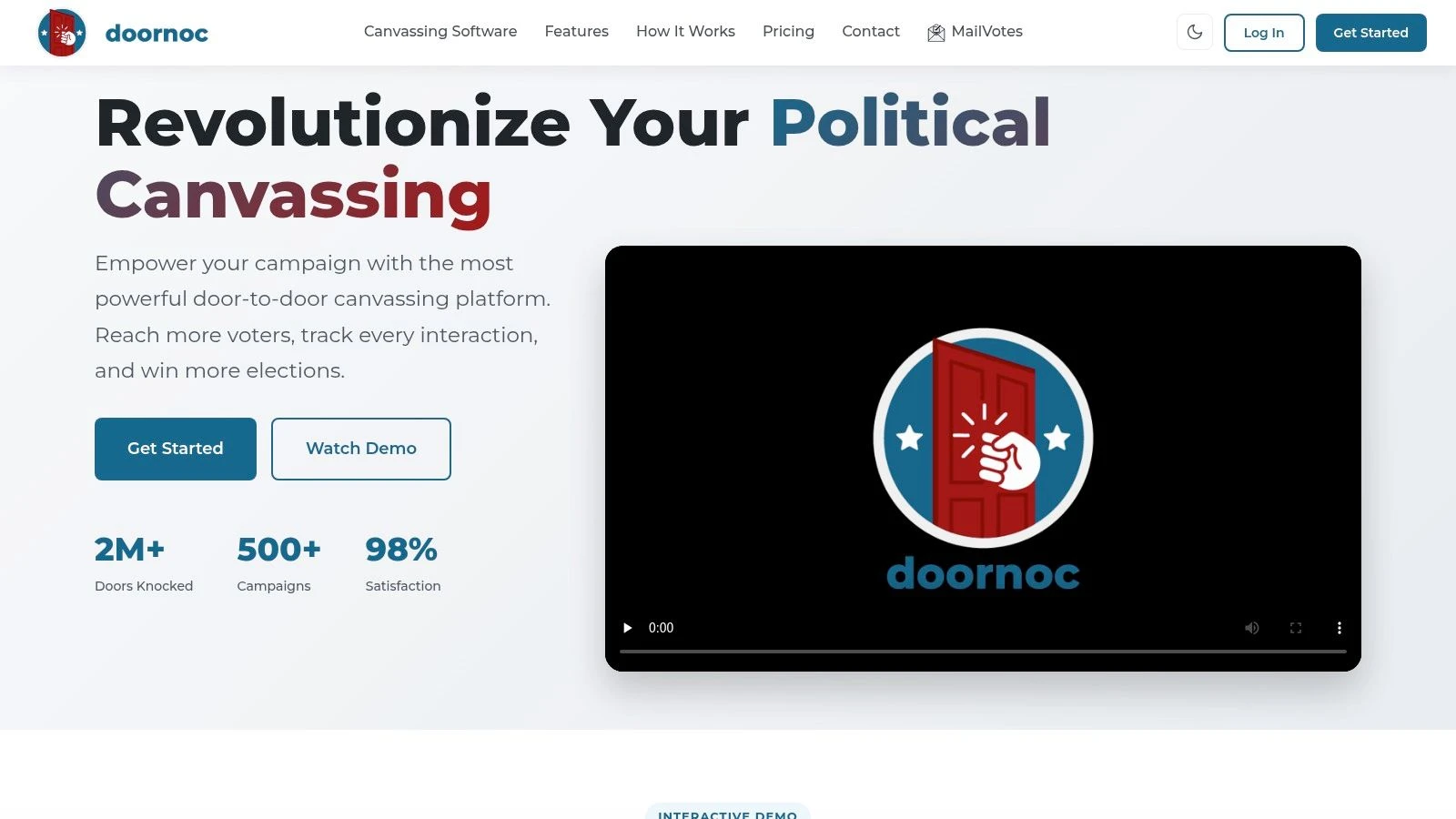
doornoc combines a mobile canvassing workflow with offline data capture, walking mode, interaction logging, automatic synchronization, route generation, live dashboards, list upload, and voter data services. Its Auto Turf capability creates balanced, road-bounded routes, while Polygon Route supports custom geographies. MailVotes can provide targeted voter lists and hand them into the workflow without requiring manual CSV exports. These capabilities describe the platform’s stated product offering, not a guaranteed turnout result.
Larger and more distributed teams
A larger operation needs more than volunteer access. It needs permission controls, consistent survey definitions, route visibility, reliable synchronization, exports or integrations, and reporting that remains interpretable across campaigns.
Typical alternatives fall into two broad categories. Lightweight tools reduce setup demands but may require separate systems for data sourcing, turf construction, and reporting. Enterprise-heavy systems can support complex integrations but may impose administrative overhead that small and mid-sized campaigns don’t need. The right choice depends on whether the campaign’s bottleneck is volunteer simplicity, data integration, field supervision, or governance.
A fuller comparison of canvassing platforms and workflow differences can help campaign teams frame that decision around operating model rather than interface preference. The key test is whether the platform reduces handoffs between list preparation, route assignment, field activity, and follow-up.
Data sourcing changes the setup burden
Manual exports introduce another point where records can be mismatched, duplicated, or delayed. A connected voter data workflow can reduce those handoffs, but it still requires clear permissioning and review procedures.
Campaigns should ask how voter lists are sourced, what filters are available, how records are matched, and how changes propagate into active routes. A nonpartisan operating model can also matter for organizations working across local, statewide, or congressional contests and for groups that need consent-based outreach practices.
Scalability isn’t just a larger login count. It includes campaign separation, support, custom integrations, data controls, and the ability to maintain consistent reporting as field teams expand. Tiered plans can make sense when a campaign’s operational complexity grows, but buyers should confirm which limits affect active field work before selecting a plan.
Decision Criteria for Picking the Right Canvassing App
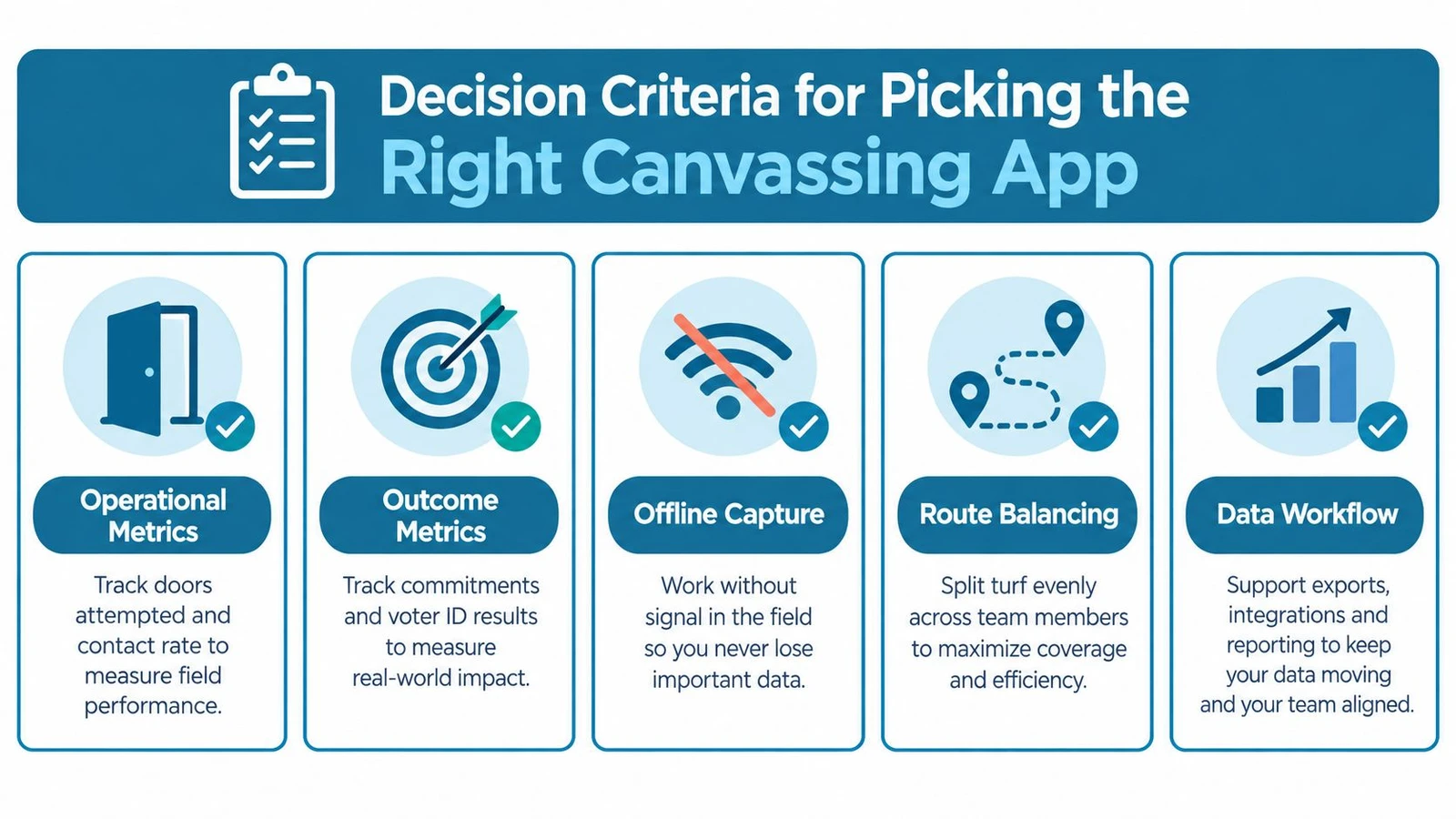
A campaign should choose an app by testing its decision chain, not by counting features. The chain starts with a door assignment, continues through an attempted or successful contact, and ends with a follow-up action that someone can execute.
Separate activity from outcomes
Activity metrics show whether the field operation ran:
- Doors attempted: The assigned universe converted into actual visits.
- Contact rate: The share of attempts that produced a successful conversation.
- Route completion: The portion of assigned work completed within the planned shift.
- Volunteer activity: Participation and pace by team, route, and time period.
Outcome metrics show whether the interaction created a useful next step:
- Support or persuasion status: The voter’s recorded position, using definitions the campaign has trained volunteers to apply consistently.
- Commitment strength: Whether the voter expressed a concrete intention to participate or support.
- Follow-up completion: Whether promised information, a return visit, or mobilization action occurred.
- Issue and relationship context: Notes that help a future conversation become more relevant rather than repetitive.
A dashboard that displays only activity can reward fast logging. A stronger system helps managers connect contact quality to later actions without claiming that every recorded interaction caused a turnout result.
Treat privacy as an operating test
Privacy should be tested across the full data lifecycle. The campaign needs answers about collection, offline storage, synchronization, volunteer access, exports, retention, deletion, and breach response.
The 2025 Open Rights Group report recommends that canvassing organizations publish data-protection policies and voter privacy or consent forms. Its report on voter privacy and election canvassing apps frames transparency as an operational requirement, not merely a legal footnote.
A practical buyer checklist includes:
- Data minimization: Volunteers see only what the conversation requires.
- Role-based permissions: Coordinators, canvassers, analysts, and administrators have different access.
- Offline protection: Lost devices don’t expose unprotected voter records.
- Auditability: The campaign can identify access, edits, exports, and deletions.
- Retention controls: Records don’t remain indefinitely without a defined purpose.
- Vendor clarity: Subprocessors, incident procedures, and data return or deletion terms are documented.
Run a controlled field trial
A useful pilot uses representative routes and real volunteer conditions. It should include weak connectivity, mixed housing types, a no-contact revisit, a refusal, a custom note, and a supervisor reallocation during the shift.
Before requesting a demonstration, campaign managers can use understanding comparative analysis to define the criteria and weighting that matter to their own operation. The exercise prevents a visually impressive feature from outweighing a basic requirement such as reliable offline synchronization.
The evaluation should record where friction occurs:
- How long does route assignment take?
- Can a new volunteer understand the next action without staff intervention?
- Does the app preserve every required outcome offline?
- Can a supervisor distinguish incomplete work from no-contact work?
- Can the campaign export a clean, interpretable record?
- Can an administrator explain who may access sensitive fields?
The best canvassing app is the one that performs consistently under these tests. A demo proves possibility. A field trial reveals operational reality.
Choosing a Canvassing App That Improves Field Results
The strongest selection decision begins with the campaign’s bottleneck. A small local race may need simple onboarding, reliable route assignments, and clear interaction logging. A statewide operation may need distributed supervision, synchronized data, custom geographies, integrations, and formal access controls. A congressional campaign may need both, because local field conditions can vary sharply across one district.
Feature density shouldn’t determine the purchase. Contact quality, route balance, offline reliability, data integrity, and privacy transparency matter because each one affects whether assigned voters become recorded conversations and useful follow-up opportunities.
A final evaluation can use five questions:
- Can the app improve successful contact, not just door completion?
- Can supervisors see and correct uneven field execution during a shift?
- Can volunteers preserve complete records without connectivity?
- Can campaign managers distinguish activity from meaningful outcomes?
- Can the organization explain how sensitive data is accessed, retained, and removed?
The answer should come from a representative pilot, not a sales presentation. Campaign teams should test the platform with real route conditions, deliberately include offline work, review the resulting records, and ask staff to explain what action each outcome triggers.
The best canvassing app is therefore a measurement choice. It should make the campaign better at turning limited volunteer time into accurate, respectful, and strategically useful conversations. That standard protects teams from buying technical novelty while leaving the field problems unchanged.
doornoc combines mobile door-knocking, route planning, offline interaction logging, live campaign monitoring, and voter data workflows for campaigns operating from local races through congressional contests. Campaign teams can review the platform at doornoc and evaluate it against the field metrics, outcome measures, and privacy questions that matter to their operation.
Looking for a tool to run this? doornoc’s canvassing software bundles voter data, automatic turf cutting, the mobile app, and live reporting in one platform.