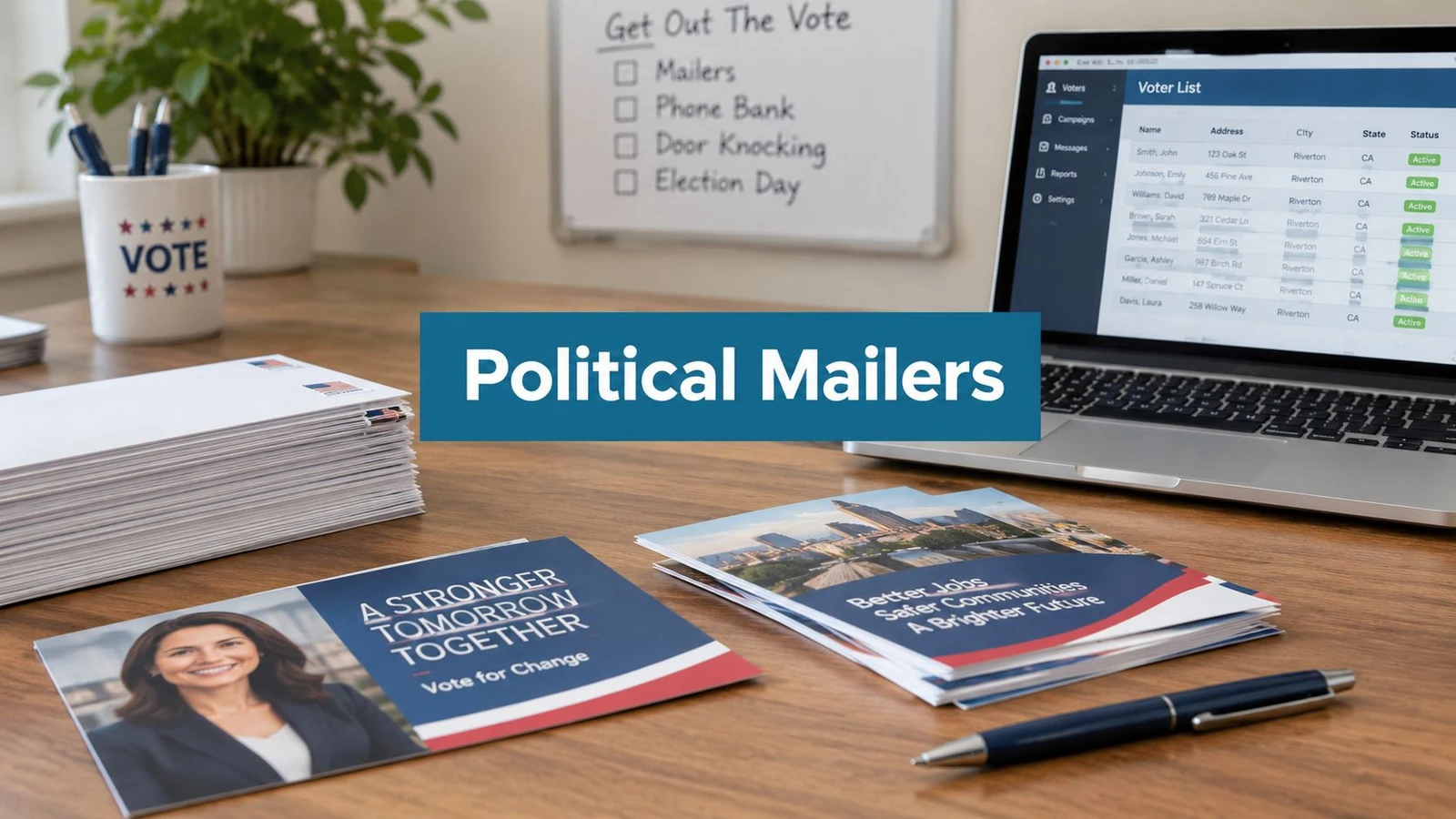
In 1906, the Liberal Party’s central Publication Department distributed at least 25 million leaflets and books to an electorate of just over 7 million people, more than three printed items per eligible voter, as Mark Pack’s account of the 1910 and 2010 campaigns records. That volume wasn’t a poster buy. It was a field system: arguments printed in one place and carried to doors by people who could talk.
Campaign literature still works that way. Treat each piece as tracked field infrastructure, not a print product. It has a format, a legal line, a route, and a point where another copy stops helping.
What Campaign Literature Is and Why It Still Matters
Campaign literature is any printed or printable material a campaign produces to inform, persuade, or mobilize voters. A door hanger, a sample ballot, a palm card, and a volunteer script all qualify.
It isn’t broadcast advertising. Literature is handed, dropped, or mailed by people, and it usually ties to a visit, a conversation, or a follow-up. It’s the campaign’s printed handshake. The canvasser leaves, and the object stays on the kitchen counter.
Central shops and local carriers are older than any app. Parties printed policy arguments in bulk so local activists didn’t have to invent a new case at every stoop. Saturation mattered even when nobody could count who read the sheet.
Three jobs still justify the spend:
- Inform with facts a voter can check.
- Remind them of dates, places, and eligibility.
- Equip volunteers with the same arguments.
A piece that doesn’t do one of those jobs is inventory. The rest of this guide treats every sheet as a decision with a format, a legal duty, and a result you can measure.
Types of Campaign Literature and When to Use Each
The Library of Congress radical pamphlet collection holds approximately 3,500 pamphlets, flyers, and related items from political organizations, mostly from 1870 to 1985. “Literature” has always meant more than one mail piece. Pick the format by the job, then by who will hold it.
| Format | Best use | Typical audience | Production notes |
|---|---|---|---|
| Door hanger | Announce a canvass visit, a date, or a candidate’s arrival | Households already reached on foot | Heavy cardstock, cheap per door, hangs on a knob |
| Palm card | Carry a contrast and contact details into a conversation | Voters met at the door or at events | Pocket size, a lasting handout after the visit |
| Postcard mailer | Repeat one date, location, or issue | Targeted lists pulled from voter files | Priced per piece plus postage, longer lead time |
| Sample ballot mailer | Show endorsements and recommended choices across races | Voters in several contests | Dense layout, highest disclaimer and accuracy risk |
| Flyer or leaflet | Promote an event or recruit volunteers | Crowds, public spaces, and volunteers | One-sided sheet, quick to print in short runs |
| Issue booklet | Explain a platform or ballot measure in depth | Engaged voters, press, and volunteers | Multi-page, higher design and print cost |
| Volunteer packet | Scripts, walk instructions, and FAQs | Canvassers and team captains | Internal material, reprint with every change |
How the rows should drive the order
A door hanger marks a household the walk already reached. It announces a visit or a date. It doesn’t try to win a multi-race argument in a hallway.
A palm card rides inside a conversation and often outlasts it. Contrast, office, and a way to call back belong there. A postcard repeats one date, one place, or one issue to a file-built list. Postage and lead time are the true cost, not the card stock.
A sample ballot is the densest public piece and the riskiest. Every name, office, and recommendation has to match the ballot. An issue booklet is for readers who asked for depth. A volunteer packet is internal. Reprint it the day the script changes, or walkers will carry yesterday’s answer.
The two formats people misuse
Teams mail a full sample ballot when a postcard would carry the one date that matters. They also hand a booklet to someone who will give a palm card ten seconds. Trim size is a production choice, and US and international flyer formats are a useful check before the printer locks a die. Yard graphics are a different channel. Political campaign yard signs stay on a lawn. Literature has to travel with a person.
Practical rule: The job chooses the format, not the leftover print budget.
Legal Requirements to Check Before You Print
This is operational guidance, not legal advice. Rules change with the office, the state, and whether the candidate authorized the piece. A school board palm card with no committee name in the footer fails before it reaches a door.
| Requirement | Applies to | What it means in practice |
|---|---|---|
| Paid-for-by disclaimer | Printed material that supports or opposes a candidate, party, or measure | Name the committee that paid, in clear and conspicuous type |
| Authorization statement | Material the candidate approved | Include an “Authorized by” line where the office requires it |
| Federal public-communication rules | Federal candidate and committee printed ads | Follow FEC disclaimer rules for placement and size |
| State and local disclosure | State, county, city, and school board races, ballot measures | Check state rules on committee names, treasurer contact, and measure committees |
| Accuracy of voting information | Sample ballots, dates, polling places, deadlines | Verify against the official election office before print, errors can carry penalties |
| Coordination and in-kind support | Literature paid with party or PAC money | Track contributions and coordination limits before ordering |
| Canvass conduct | Door drops and handouts | Honor no-soliciting signs and local rules for public property and permits |
| Record keeping | Every approved version and print run | Keep proofs, invoices, and disclaimer checks on file for audits |
Disclaimer and authorization first
The paid-for-by line covers nearly every public piece. Name the committee that paid, in type a reader can see without hunting. Tiny gray type in a photo credit doesn’t meet “clear and conspicuous.”
Where the candidate approved the copy, add the authorization statement the office requires. Federal public communications add placement and size rules under Federal Election Commission regulations. City, county, school board, and ballot-measure committees follow state and local disclosure, often including a treasurer contact. Confirm the exact wording with the state election office and campaign counsel before the proof is signed.
Facts, money, and the file
Voting information is a separate risk. A wrong election date, deadline, or polling place can draw penalties and will burn trust faster than a weak slogan. Match sample ballots to the official election office, not to last cycle’s file.
If a party or PAC pays, log that support before the printer invoice. Coordination limits and in-kind reporting sit on that order, not on a later cleanup. On the doors, honor no-soliciting signs and local permit rules for tables on public property.
Keep every approved proof, the disclaimer check, and the print invoice. Audits ask for the version that shipped, not the one in the design folder.
Writing and Design Practices That Get Read
A door hanger often gets only a few seconds of attention. Put the main message first: a date, a question, or one clear ask. A slogan should make sense on its own and leave room for the information a voter needs to act.
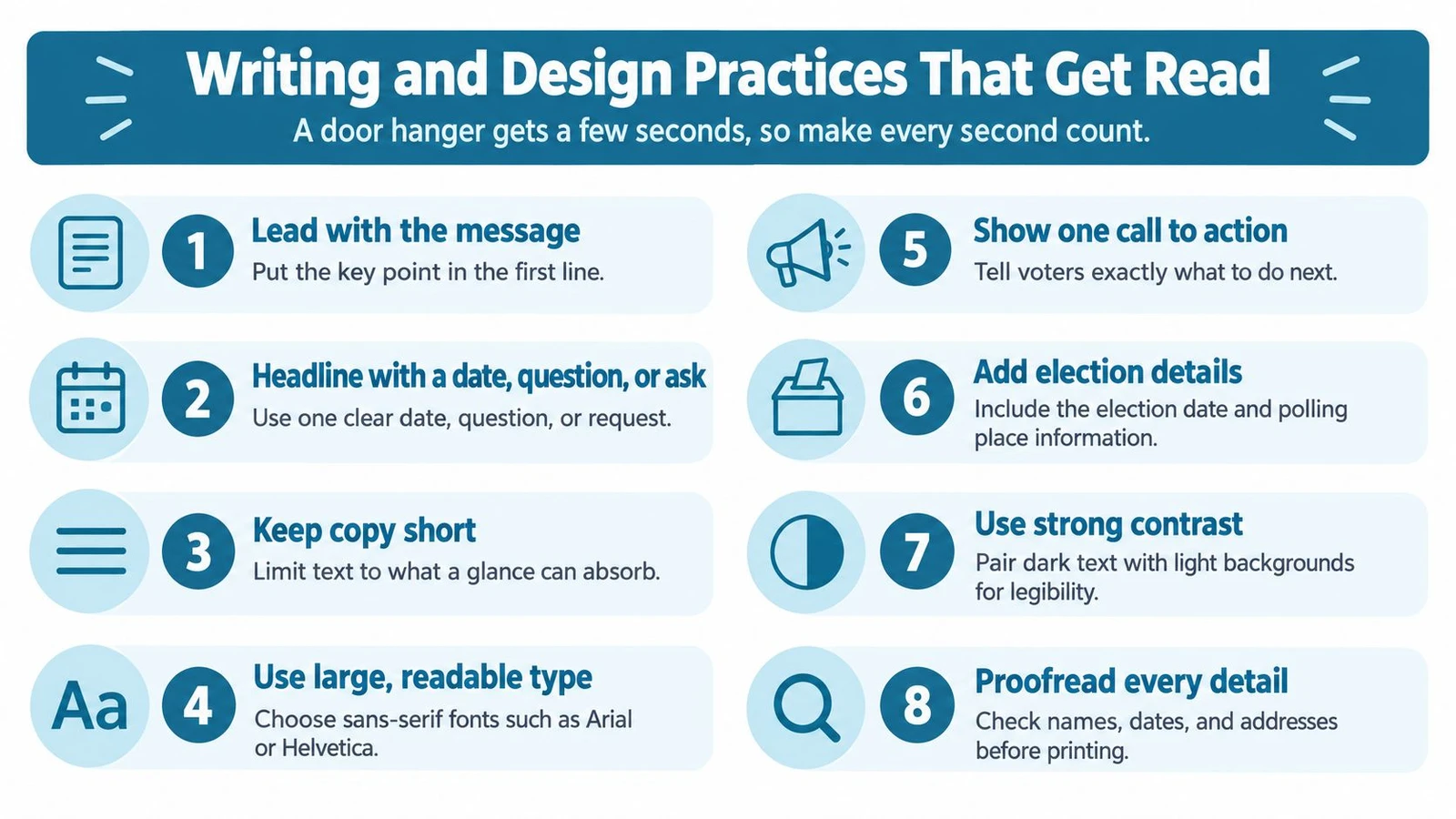
Eight practices before the proof is locked
- One ask per piece. Choose voting, volunteering, or checking a polling place. A crowded piece makes each action harder to spot.
- Write for a quick read. Aim near a sixth- to eighth-grade reading level. Short sentences are easier to scan than stacked clauses.
- Set type for older readers. Use large type and strong contrast. Simon stratford’s guide to advertising fonts offers guidance on choosing type that stays legible at a glance.
- Build a hierarchy. Lead with the name, then the ask, date, and contact details. Readers should find the next step without searching.
- Offer two ways back. Pair a QR code with a phone number. Some readers cannot scan, or prefer not to.
- Match the district’s languages. If households read another language first, an English-only piece can leave the message inaccessible.
- Cite factual claims. Put a source beside each figure so readers can check it, especially on a sample ballot.
- Verify before the run. Ask a second reader to check names, offices, dates, and addresses against the approved information.
A short line can carry an ask without crowding out the date. These political campaign slogan examples show ways to keep a phrase focused.
Equity and corrections
Literature does not reach every neighborhood in the same way. A field experiment on Green Party literature in an Ontario constituency, published in the Canadian Journal of Political Science, found a modest overall effect. The clearest vote-share increase was in higher-socioeconomic-status neighborhoods, and researchers found no significant turnout difference. That is evidence about one campaign and setting, not a guarantee that another drop will raise turnout.
Literacy, language, disability access, housing type, and prior engagement all affect whether someone reads a card through and trusts it. Pieces delivered alone are a weak measure of equitable reach. Track whether the message is understood and credible, then use field feedback to identify where print needs support from personal contact.
A 2025 experiment with 406 participants found that misleading statements improved evaluations and voting intentions for unfamiliar right-leaning politicians, while corrective fact-checks substantially reduced belief in the misinformation and hurt favorability and vote share. Do not repeat a false claim to clarify it. If a piece contains an error, pull it, correct the digital version, and brief walkers before the next shift. Treat each version as tracked field material, so teams can stop distributing outdated copy and direct contact toward voters who still need a clear answer.
Ready-to-Adapt Templates for Common Pieces
Copy the structure, then replace every bracket before anyone sees a proof. A template with a leftover placeholder is worse than a blank card.
Door hanger
[Election date or one ask] [Two-line reason a neighbor would care.] [Candidate name], [office] Paid for by [committee name] [QR code] · [phone]
Postcard mailer
Front: [One issue or one date] Back: [The ask in one sentence.] Source for any figure: [publisher, year] Polling-place lookup: [official election office link] Paid for by [committee name]
Palm card
Front: [Contrast in one sentence.] Back: · [Position on the local issue] · [Contact: phone and site] · Paid for by [committee name]. Authorized by [name] where required.
Volunteer script
Three beats, said out loud, not read as a speech.
“I’m [name] with [campaign], talking with neighbors on [street or precinct].” “Can I ask you to [one action, such as confirming your polling place]?” Close by writing the answer: support, undecided, oppose, or not home. Leave the piece that matches that answer.
A filled school board example
School board election, [weekday, month, year] [Candidate name] wants smaller class sizes at [school name] and a public budget hearing before any cut. [Candidate name] for School Board Paid for by [committee name] Questions: [phone] · [QR to the campaign site]
Swap in the correct weekday only after the election office confirms it. The same rule covers every endorsement on a sample ballot. If the packet’s FAQ changes, reprint the packet. Don’t tell walkers to “ignore page two.”
Turnout Benchmarks and How Many Pieces to Send
A direct-mail program should be planned around modest turnout effects, not assumed to work like a personal conversation. The figures below are percentage-point changes among people in the study, not the share who read a piece. Mail can repeat a door-knock message and put dates or locations in front of voters, but the evidence does not make it a substitute for canvassing.
A randomized field experiment of approximately 30,000 registered voters in New Haven before the 1998 general election, reported in the American Political Science Review, found a small turnout increase from direct mail, a substantially larger increase from canvassing, and no detectable increase from telephone contact.
| Contact method | Reported turnout effect | Study context | Planning implication |
|---|---|---|---|
| Nonpartisan canvassing | Substantially larger than mail | Randomized New Haven experiment, about 30,000 registered voters, 1998 | Treat canvassing as the primary turnout tool |
| Telephone calls | No detectable increase | Same New Haven experiment | Don’t budget calls as a turnout lever on this evidence |
| Direct mail, average | About 0.75 percentage points | Review of 85 field experiments, 1998 to 2014, summarized in the Oxford Academic reference article | Expect a modest lift and budget against it |
| Direct mail with social-pressure message | About 2.3 percentage points | Same review of 85 experiments, summarized in the Oxford Academic reference article | Check ethical and legal limits before using |
| Single mailing, cited study | About 0.6 percentage points | New Mexico’s 2024 campaign-mail coverage | Expect the effect to fade between pieces |
| Get-out-the-vote mail beyond five pieces | No additional gain | Large New Hampshire field experiment, published in the Journal of Experimental Political Science | Stop repeating turnout mail and redirect spend |
What the averages actually buy
A review of 85 direct-mail field experiments from 1998 to 2014, summarized in the Oxford Academic reference article, found an average turnout effect of about 0.75 percentage points. Mail using a social-pressure message averaged about 2.3 percentage points. Use that larger effect only when the audience and legal limits support the message. A message that feels implausible or crosses a legal line can cost credibility, even if the study average is higher.
Frequency has a ceiling. A large New Hampshire field experiment published in the Journal of Experimental Political Science found that get-out-the-vote mail raised turnout but produced no additional gains beyond five mailings. New Mexico’s 2024 campaign-mail coverage reported about 0.6 percentage points per mailing and described familiarity fading quickly. Treat those findings as evidence for testing frequency, not as a guaranteed return for every campaign or voter group.
Where the next dollar goes
Set the objective before printing: turnout, persuasion, volunteer recruitment, or issue salience. Test creative against an untreated control, and keep persuasion mail separate from the turnout schedule so the purpose of each contact remains clear.
After several relevant pieces reach the same household, direct the next dollar to voters you have not reached or to personal contact. Improve the piece before increasing frequency. The guide to increasing direct mail response rates among voters focuses on making each mailing work harder, not adding another identical drop.
Hold out a random group, log delivery dates, and compare turnout with canvass codes. A four-way comparison, literature only, canvass only, both, and neither, can show whether a piece added value alongside a conversation. Use a unique code to connect a piece with a later action. Keep the conclusion measured: voters also encounter news and ads, so the comparison cannot assign every change to the printed material.
Distribution and Tracking with a Canvassing Platform
Print counts aren’t distribution. A piece counts when a walker logs what happened at the door, and when a holdout shows what the piece didn’t do.
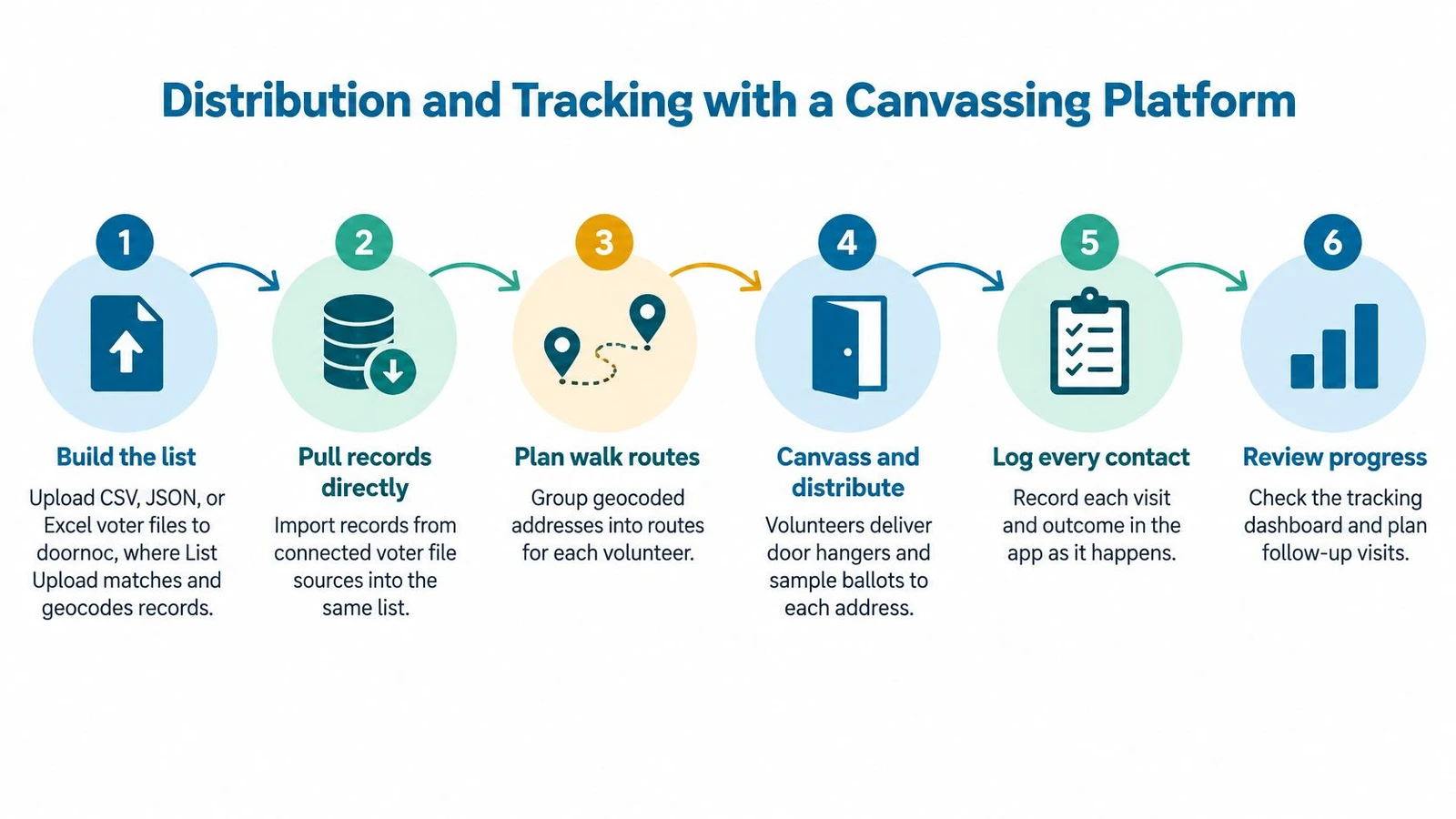
The walk, in order
- Build the list. Upload CSV, JSON, or Excel voter files into the canvassing platform so records are matched and geocoded. Where the voter file already connects, pull those records straight in. Skipping a manual export cuts mismatched addresses.
- Cut turf. Generate balanced, road-bounded routes sized to one shift, or draw a boundary and keep only the voters inside it. A route that crosses a river mid-shift won’t finish.
- Print and pack to the route. Each packet’s piece count matches that route’s doors, and the packet is labeled with the route name. Overstuffing “just in case” is how literature vanishes in a car trunk.
- Deliver. Door-drop or hand the piece to the voter. Offline logging keeps the record when the signal drops and syncs when the phone reconnects. Don’t ask walkers to reconstruct the shift from memory at the staging location.
- Log the outcome. Left a piece, had a conversation, or the voter asked for more. Those three codes change the next list. A blank door is not the same as a refusal.
- Read the day while it is still the day. Route completion and team activity show who is ahead and who is stuck. Move people before the light goes, not at the next morning’s call.
- Feed follow-up lists. Undecided households, not-homes, and requests for a booklet each get a next action. Don’t mail the whole file again because the dashboard looks busy.
Codes, dates, and a group that gets nothing
Put a unique QR code or response code on each version. Store the delivery date on the voter record. Hold out a random set of households that receive no literature so later turnout isn’t credited to paper they never saw.
Attribution stays modest. A scan can mean interest. It doesn’t prove the hanger caused a vote. The useful comparison is route completion plus contact codes plus the holdout, read together after the election, not a vanity total of pieces ordered.
Confirm Compliance and Test Before the Print Run
No piece goes to the printer until it clears three gates. A full run that fails one of them is a bill you can’t walk back.
Legal. The disclaimer is present and readable on every format, including the hanger’s narrow footer. Office-level authorization and disclosure are confirmed. Any date, deadline, or polling place matches the official election office.
Message. One ask. A source on every figure. A reader outside the drafting team has marked the proof. Fresh eyes catch the office title everyone else stopped seeing.
Measurement. A unique code is on the piece, delivery dates will be logged, and a holdout is already pulled from the file. If you can’t name the control group, you aren’t ready to scale.
Run one route or one precinct first. Assign the holdout, walk the literature with the canvass, and compare outcomes before the next order.
Build that pilot route so it fits a single shift. Log every interaction, including doors with weak signal. Review completion the same day and fix the packet before you multiply it. The pilot’s result decides the next print order. The press count does not.
A canvassing platform turns campaign literature into a logged contact instead of a stack in a trunk. doornoc builds walkable routes, keeps offline logs, and shows which doors still need a piece so the next dollar goes to new voters or a real conversation. Set up one pilot route before you approve the full run.
Need the list behind the mail drop? MailVotes voter data turns a targeted voter file into a print-ready mailing list the same day.