

The most popular advice about political mailers is also the least useful: make the piece memorable and the votes will follow. A sharp design can earn a second look, but it can’t prove persuasion, and a large delivery count doesn’t prove turnout. Campaigns should treat mail as one contact channel in a coordinated voter program, then test whether it adds anything beyond the canvassing, calls, and digital messages voters already receive.
A field director facing a tight budget shouldn’t begin by choosing paper stock or approving a headline. The first decisions are operational: What should the mail accomplish? Which voters should receive it? When should it arrive relative to other contact? Answer those questions before production, and the campaign can evaluate the result. Skip them, and a polished mailer can become an expensive way to feel busy.
Why Political Mailers Still Matter in a Digital-First Campaign
Political mail remains a physical channel with a clear delivery record, a defined audience, and a scheduled place in a campaign’s contact plan. Campaigns built that record decades ago. Richard Nixon’s 1960 operation and Barry Goldwater’s 1964 effort used direct mail to raise money, identify supporters, and assemble donor files that outlived the election itself. The medium earned its place as campaign infrastructure long before digital ads existed.
What those campaigns understood still holds. A mailer can introduce a candidate, press one argument on persuadable voters, or push supporters to act, and each of those jobs needs its own audience, creative, timing, and measure of success.
A delivered piece is evidence of contact, nothing more.
Choose the job before the format
Mail can serve persuasion, name recognition, or mobilization, and treating those outcomes as interchangeable is where programs go soft. A voter who remembers a name has not necessarily changed a mind or cast a ballot. A turnout reminder can matter to a supporter while persuading no one.
Physical mail also reaches people in a different setting than a text or an online ad. It gives a message weight and a place on the kitchen counter, yet voters still discard pieces that arrive late, repeat a recent canvass conversation, or land in the wrong household. When a mailing underperforms, audit the delivery file and the contact calendar first. Creative comes last.
Operational test: Before printing, write down the objective, the audience, and the arrival window. A mail plan missing any of the three is not ready.
Treat every mailer as one instrument in the full contact program and measure it accordingly. The question worth answering is whether voters who received the piece acted differently from similar voters who did not, given the calls, door knocks, and digital messages both groups received. Raw response counts cannot answer that, so build the comparison into the plan before the first piece drops.
The Main Types of Political Mailers and When to Use Each
Start with the job, then pick a format. Campaigns usually need a small set of recognizable mail types, each designed for a distinct moment in the voter relationship.
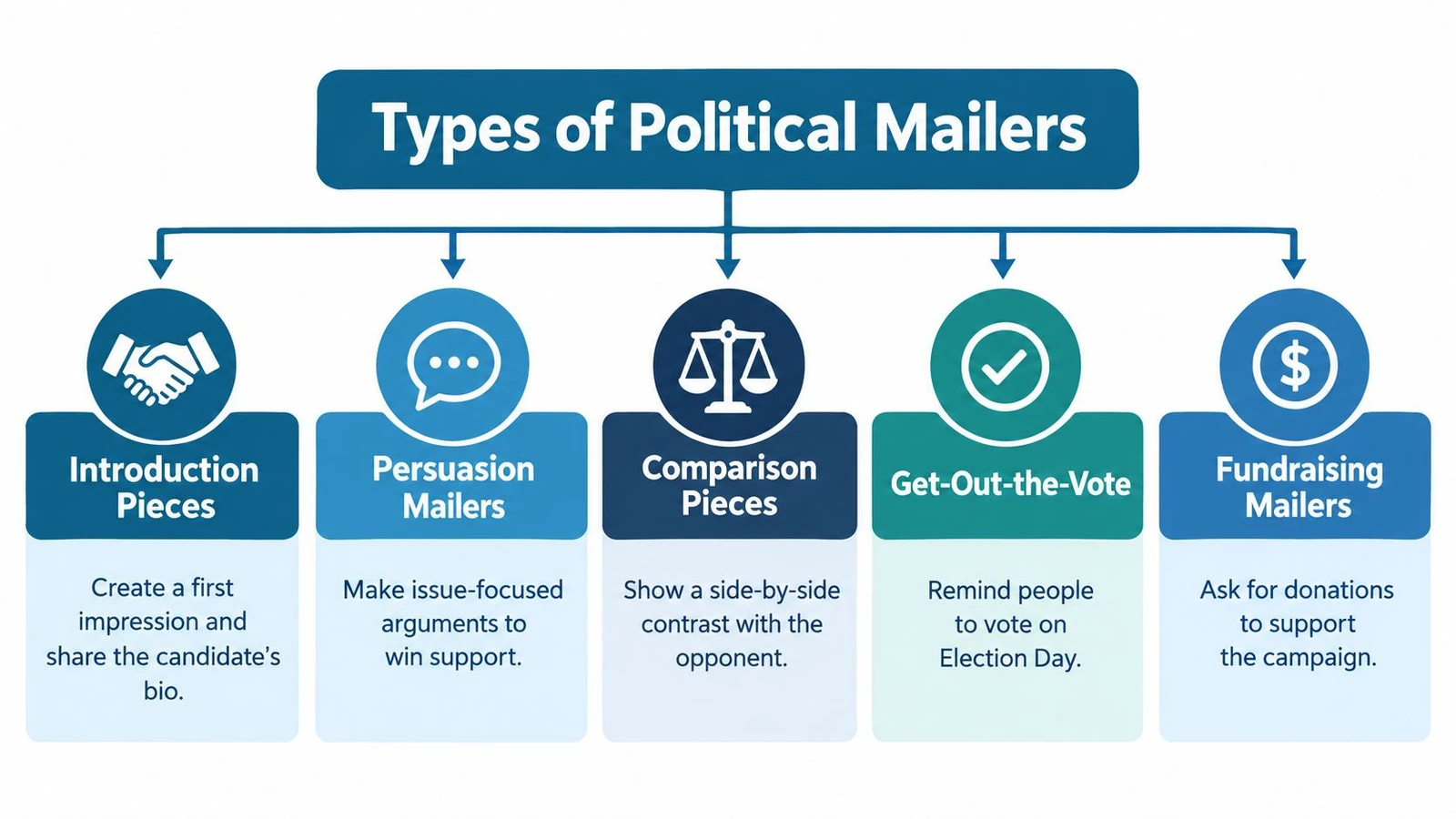
- Introduction pieces establish who the candidate is and what they’re running to do. Keep the biography selective, with a clear reason the voter should care.
- Persuasion mailers make a case on an issue or leadership choice. Give the argument one central point rather than crowding the piece with every campaign position.
- Comparison pieces contrast the candidate with an opponent. Each claim should be clear, supportable, and easy to understand without extra context.
- Get-out-the-vote reminders focus on the action: make a voting plan, check the right information, and cast a ballot.
- Fundraising mailers ask for a contribution. A letter and reply device can give the appeal room for a personal narrative and an explicit donation request.
Other formats fit around these core types. Issue-focused mail narrows the argument to a subject important to the audience. Absentee ballot chase mail supports a campaign’s ballot-return effort, but its wording and timing need careful review. Postcards, self-mailers, tri-folds, and letters each trade space and handling convenience differently. A postcard offers a quick read; a folded piece creates room for explanation; a letter can support a more personal fundraising appeal.
Match format to the audience and task
A small postcard can make sense for a local turnout reminder when the ask is simple. A fundraising letter may suit a broader donor audience that needs more context before giving. Those are starting points, not universal prescriptions: list quality, postage, creative, and timing all affect the choice.
Personalization also needs a purpose. A household-level piece may reduce duplicate delivery to people at one address, while individual versions can tailor a message to voter-specific information. Don’t select a format because it looks impressive in a sample packet. Choose the one that makes the intended message easiest to understand and act on.
Compliance, Disclaimers, and the Rules That Shape Creative
Compliance belongs in the creative and production workflow, not in a final-hour proofread. For U.S. federal campaigns, a political mailer generally qualifies as a regulated mass mailing when it contains more than 500 substantially similar pieces within 30 days. Public communications by political committees generally need a clear, conspicuous disclaimer identifying the sponsor. For printed mail, the disclaimer must sit inside a box set apart from the rest of the content, be clearly readable, and contrast reasonably with its background. (Federal Election Commission advertising and disclaimer rules)
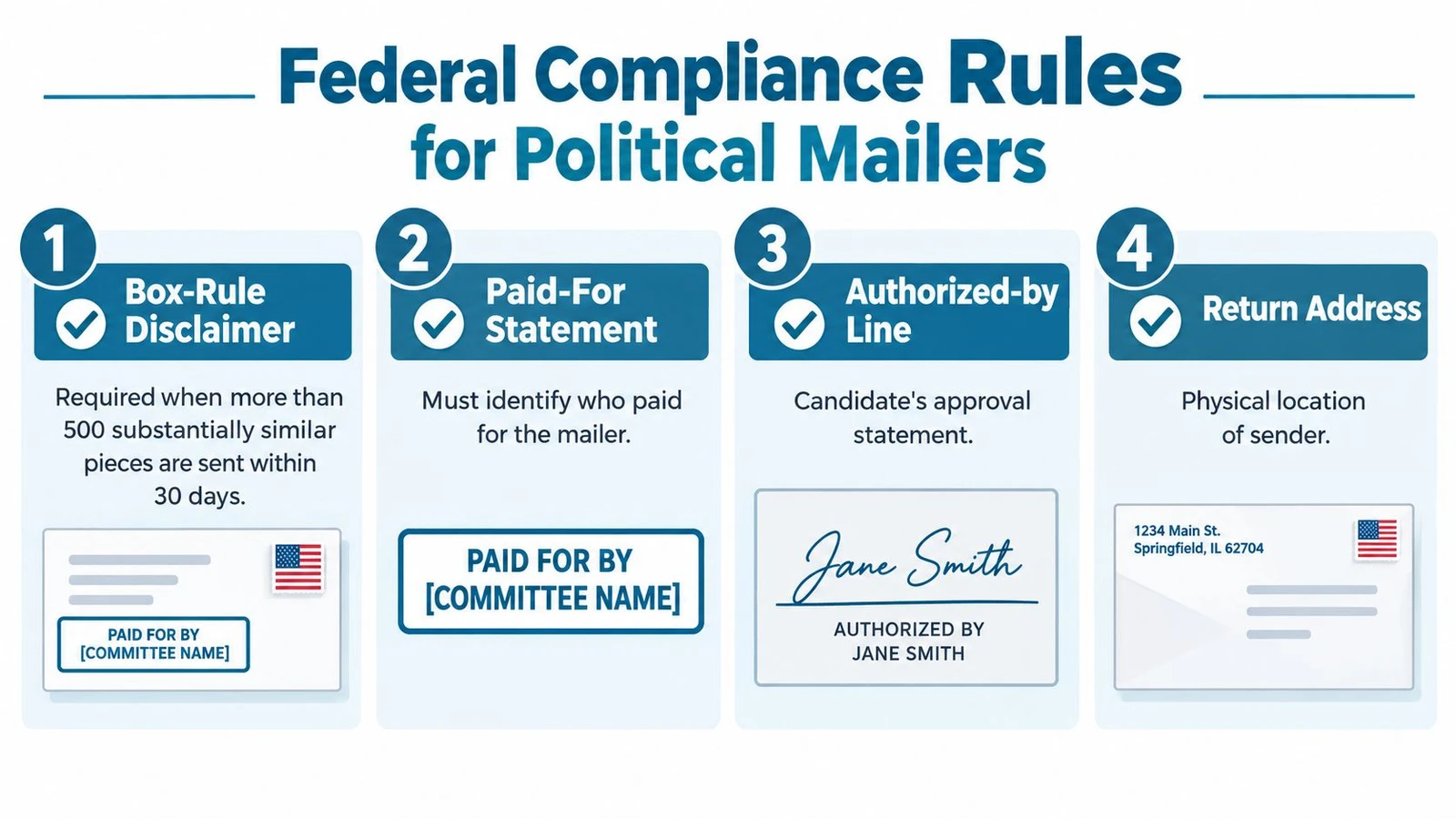
Authorization status changes the required language. Candidate-authorized mail should identify the candidate’s authorized committee as the payer. Unauthorized communications generally need to identify the paying organization and state that the candidate didn’t authorize the communication. Outside groups generally also need to provide their name and a permanent street address, telephone number, or website. (Congressional Research Service overview of political disclaimers)
Put compliance into preflight
A legal review should verify the sponsor and authorization language against the actual version going to print. It should also check the disclaimer’s placement, contrast, and legibility on a rendered proof at its intended size. A disclaimer that’s technically present but hard to read is a production failure, not a minor design preference.
The campaign should keep a record tying each mail batch to its funder, audience definition, creative version, print quantity, and drop date. That record makes it easier to review compliance, reconcile vendor quantities, suppress duplicate or incorrect addresses, and understand which message went to which segment.
For a practical planning checklist that covers political advertising formats, use this guide to political campaign advertisements. Counsel should also review applicable state and local requirements before production, especially where ballot-related language or other election-specific rules may apply. Don’t assume federal disclaimer compliance resolves every local question.
Targeting With Voter Data and Building the Right Audience
A mail list is a campaign decision expressed as an address file. It should begin with the voter universe and the campaign’s objective, not with a vendor’s default selection. Depending on the program and what can legally be used, voter records may include party, voting history, age, household relationships, and geocoded address information. The campaign should select fields that serve a defined purpose, then document the audience rule so the list can be rebuilt and reviewed.

Build the audience in layers
First, define the eligible universe by geography and election. Next, apply the voter characteristics that connect to the mail objective. A turnout piece, for example, shouldn’t automatically go to the same people as a persuasion piece. Then apply suppression rules: remove records the campaign shouldn’t contact, account for recent address changes where the data allows, and suppress households already reached if the contact plan calls for it.
After that, deduplicate the mail file against field records. If a canvasser has just spoken with a household, a same-day mail touch may be wasteful or confusing. The right suppression window depends on the program; the key is that the campaign chooses and records it rather than leaving it to chance.
A useful way to organize a mail test is to create cells: each cell pairs an audience segment with a specific creative version. That lets the campaign compare messages without changing several things at once. Keep audience rules, version identifiers, and print quantities attached to each batch.
Campaigns that need a repeatable filtering workflow can use these voter data filtering strategies as a reference. A voter-data and canvassing system can also reduce manual list transfers by matching and geocoding uploaded records, while keeping the same audience universe available for field planning. The operational goal is a list the campaign can explain, update, and suppress safely, not a complicated model no one can reproduce.
Creative and Copy Decisions That Move Response
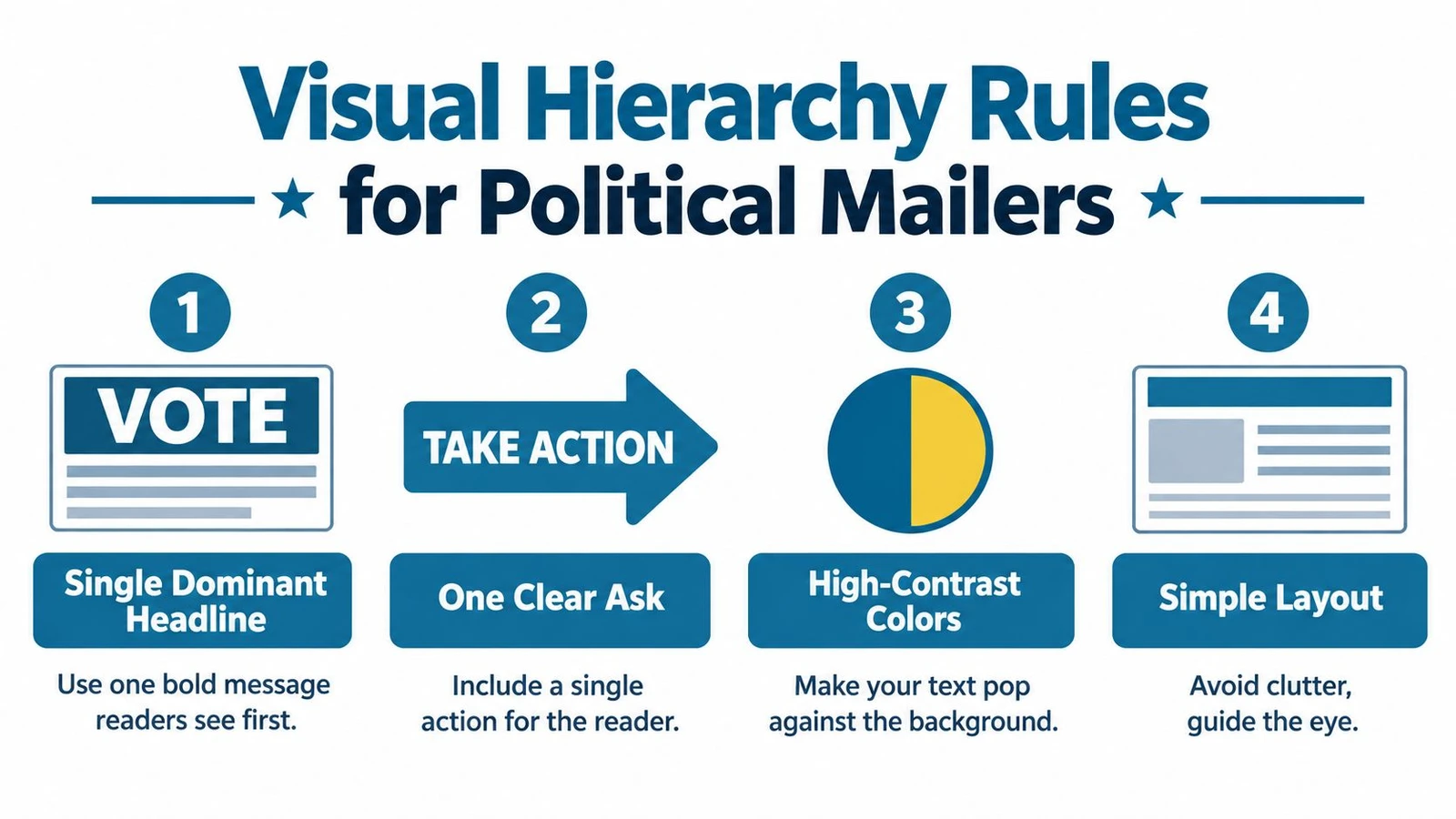
A mailer has seconds inside a cross-channel contact plan, and it gets judged by more than applause in the office. Make the main point obvious at a glance: one dominant headline, one argument, one action. If the candidate photo, slogan, issue list, disclaimer, and ask all shout at equal volume, the voter has to edit the piece. Busy voters do not edit.
Fundraising and persuasion need different copy. A fundraising letter earns the gift with a focused story, a reason this reader’s contribution matters now, and a direct donation ask. A persuasion piece makes a specific argument, uses relevant evidence or contrast, and lands the conclusion before the voter loses patience. Turnout copy should make voting concrete, with dates, locations, or ballot details where the rules allow.
Write for the action, not the slogan
A weak headline says, “A Better Future for Our Community.” It sounds familiar and asks nothing. A stronger headline names the issue or choice directly, then lets body copy explain the candidate’s position. For fundraising, replace a vague “Help Us Win” with a concrete request: give a stated amount, return the reply device, or meet the matching deadline if one exists.
Personalization can make a piece feel relevant, but accuracy is the price of admission. Use a voter’s name or local reference only when it clarifies why the message matters. A mistaken salutation or forced neighborhood line can damage credibility faster than a plain design.
Fundraising response is modest enough that creative discipline matters. Treat any benchmark as a fundraising yardstick; persuasion and turnout mail need their own evidence. Judge every version inside the wider program: compare exposed voters with a matched group left out of the drop where feasible, credit only incremental movement, and ignore vanity metrics like compliments from people already voting for you.
Creative rule: One piece, one main argument, one clear ask. If the voter needs to decode the layout before understanding the message, simplify it.
Hold the audience, drop date, and offer constant while varying one headline or image; campaigns that need a general testing reference can run A/B tests for growth, then apply the same discipline to mail. A prettier piece earns nothing unless it moves the voter file.
Production and Distribution Options From Press to Doorstep
Distribution affects who receives a piece, when it arrives, and how reliably the campaign can connect delivery to voter records. No method wins on every dimension. Choose based on the audience, deadline, geographic coverage, and measurement needs, then confirm production and postage details with the mail house before committing.
| Channel | Typical lead time | Cost per piece (range) | Targeting precision | Household tracking |
|---|---|---|---|---|
| USPS Every Door Direct Mail | Confirm with postal and print providers | Varies by format, quantity, and postage | Carrier-route level | Limited voter-level attribution |
| Bulk postage | Confirm with the mail house and postal provider | Varies by format, quantity, and postage | Address-list based | Can be tied to a prepared voter list |
| Door hangers delivered by walking teams | Depends on field staffing and route readiness | Varies by printing and labor | Route or address level | Field records can log completion |
| Shared drop mail | Depends on partner schedule and geography | Varies by program and format | Often broader than voter-file targeting | Depends on delivery records available |
These are planning categories, not price quotes. Print run, paper, finishing, postage, list preparation, and delivery method all affect cost. Offset printing may suit a large uniform run, while digital production can accommodate shorter runs or variable data. A heavier stock or specialized finish may change handling and postage, so approve a physical proof and confirm postal specifications before release.
Choose the trade-off deliberately
Every Door Direct Mail can reach addresses along selected carrier routes, but it isn’t the same as sending a voter-specific message. Addressed bulk mail offers more control over the list, while walking teams can combine a door hanger with field contact and record route completion. Shared drop services can simplify broad distribution, but campaigns should verify exactly where pieces went and what delivery information they’ll receive.
For a trackable digital action, a QR code can connect a physical piece to a landing page, but scans measure scans, not votes or persuasion. This guide to QR codes in direct mail can help campaigns think through the user path. Keep a separate measure for the outcome the campaign wants, and don’t mistake a scan for proof that the mail changed behavior.
Cost Benchmarks, Response Rates, and How to Measure What Worked
A budget can tell the campaign what it spent. It can’t tell the campaign what the mail caused. Those are different questions, and a useful measurement plan separates delivery, attention, persuasion, and turnout instead of blending them into a single response figure.
Historical estimates show how political mail has operated at scale. A study of congressional campaign spending estimated that mail represented about 7% of combined House and Senate campaign spending. Applying an assumed 10% direct-mail share to campaign spending in 2000 produced an estimated $300 million political-mail market, or about 600 million mailed pieces at an assumed cost of $0.50 per piece. These are historical estimates, not current cost benchmarks. (Analysis of political mail spending and government mass mailings)
Don’t invent a per-piece budget from a generic benchmark. Ask the printer and mail house to itemize printing, list preparation, postage, addressing, finishing, and delivery. Compare like with like: a simple postcard and a personalized letter don’t share the same production assumptions.
Measure the outcome the campaign intends
Delivery tells the campaign whether pieces entered the distribution system. Attention can be assessed through planned mechanisms such as response devices or landing-page visits, but those show engagement, not necessarily persuasion. Persuasion requires a suitable measure of opinion or vote intention, while turnout requires actual voting records or another carefully defined election outcome.
Randomized holdouts offer a stronger test of incremental effect than a before-and-after comparison. Assign similar eligible voters or households to receive mail or to remain in a control group, then keep other contact as consistent as possible. A broader review of 85 direct-mail experiments found an average turnout effect of 0.75 percentage points, while mail using social-pressure appeals averaged 2.3 percentage points. Effects vary by message and audience, so those averages shouldn’t be treated as a forecast for a particular campaign. (Review of field experiments on political contact)
Measurement rule: Report the incremental result against the control, then compare the cost of that added outcome with other voter-contact options. Raw delivery and response counts are activity measures, not proof of votes gained.
Integrating Mail With Canvassing and the Rest of the Voter Contact Plan
Mail earns its budget when it works as one instrument inside the contact plan. Run as a standalone persuasion channel on its own spreadsheet, it mostly generates activity the campaign cannot credit. The test is simple: can the campaign see, for every household, which pieces were sent, which doors were knocked, and in what order? If the answer is no, field and mail will double-contact some voters, skip others entirely, and leave the analyst guessing about which touch moved behavior.
The research record supports that skepticism. The Green and Gerber review of field experiments found mail effects small and variable, while the Gerber and Green Connecticut and New Jersey trials found personal canvassing substantially more effective than professionally produced direct mail. In those same trials, partisan mail produced negligible turnout gains, and negative messaging may have slightly depressed participation. The practical read: never let a mail program claim a turnout lift that followed a canvass visit. A separate discussion of cross-channel contact and measurement makes the same point, arguing that campaigns must account for overlapping voter interactions rather than scoring each channel alone. (Research on coordination and attribution in voter contact)
Make the handoff operational
Before each drop, give the field team the mail audience and the in-home window. Flag or suppress households that were just canvassed when a second touch would waste volunteer hours, and protect a mail-only holdout if the campaign wants a clean read on incremental effect. Log contact timing across mail, field, phone, and digital so the analysis can separate a mail effect from a combined-contact effect.
Then run the routine like clockwork. Sync lists on a fixed cadence, push same-day turf adjustments where records allow, and reconcile the mail file against canvass results and voter history after Election Day. Distinguish three failure types: a piece that never arrived, a piece that arrived late, and a piece that arrived on time but moved nothing. Each calls for a different fix, and confusing them is how campaigns repeat the same production mistakes cycle after cycle.
For teams building this kind of coordinated architecture, the general framework behind what is an integrated marketing campaign translates well to voter contact, though campaigns still need election-specific controls like a defensible holdout and voter-level records. A guide to voter contact methods for local elections helps weigh field and digital trade-offs so mail fills gaps rather than duplicating effort.
doornoc combines a mobile canvassing app with campaign operations tools and voter data services, including offline data collection, route planning, and a handoff from MailVotes voter lists to field work. If the campaign needs to coordinate mail audiences with canvassing records, visit doornoc to see how its tools fit that workflow.
Need the list behind the mail drop? MailVotes voter data turns a targeted voter file into a print-ready mailing list the same day.