Does a bipartisan label describe a bill’s supporters, a vote, or the law that resulted? The distinction matters: a bill may have Democrats and Republicans as cosponsors, yet receive a party-line vote or fail to become law. Each claim describes a different degree of cross-party cooperation.
Congressional voting patterns also shift over time. During the 91st Congress, from 1969 to 1971, lawmakers voted in a substantially bipartisan manner about 76% of the time; during the 104th Congress, from 1995 to 1997, the figure was 33%. The same label can therefore refer to different kinds of evidence and levels of support. To assess a claim, ask what it measures and which members of each party backed it.
What Bipartisan Means in Plain English
Bipartisan means involving, supported by or agreed to by two major political parties, most often Democrats and Republicans in the United States.
That definition is deliberately loose, which is where most confusion starts. Picture a bridge built from both banks: it counts as a joint project because people on both sides pay for it and cross it. A bridge built from one bank and merely tolerated by the other doesn’t qualify, no matter how many people drive over it.
Bipartisan works the same way. It describes what members of both parties did, not what everyone believed. It doesn’t require every member of either party to agree; it means a measure, policy or coalition receives meaningful support from both sides. The Wilson Quarterly analysis of congressional voting shows how much that behavior shifts with the political weather: the rate climbed back to 58% during 2001 to 2002 after a steep slide in the mid-1990s, which tells you the word describes a condition of the moment rather than a permanent trait of Congress.
The label is also a threshold, not a fixed rule. A bill that attracts a handful of minority-party votes gets called bipartisan by one reader and partisan by another who expects broad support from both sides.
Where the word turns up, in practice:
- Legislation and floor votes. A recorded tally with yes votes from both parties.
- Negotiations. A deal struck by members of both parties before a bill is filed.
- Endorsements and agreements. A coalition, a pledge or a joint statement signed across party lines.
- Committee work. Cross-party sign-offs that never reach a floor vote.
For a headline carrying the word, run a two-part test: which parties are involved, and how much support exists. Bipartisan also does not mean both parties agree on the entire policy. It means members of more than one party support, sponsor, negotiate or vote for the same proposal, and that support can be narrow or limited to a single stage of the process. Students working through the distinction for class credit can check it against AI-graded AP US Government exams from Magna Education, which test exactly this difference between cross-party behavior and party-line behavior.
Bipartisan, Partisan and Nonpartisan Compared
The three words describe different things, and only one of them is about a ballot. Here’s the comparison laid out side by side.
| Term | Who is involved | Party label on ballot or record | Everyday example |
|---|---|---|---|
| Bipartisan | Two or more parties, usually Democrats and Republicans | Not a ballot label; describes support or sponsorship in the record | A bill with cosponsors from both parties |
| Partisan | Members acting as a bloc identified with one party | Party identified in the vote or contest | A vote where one party votes together against the other |
| Nonpartisan | Candidates and officeholders without a party nomination | No party identified on the ballot or in the formal contest | A city council or school board race |
One example for each keeps the difference firm. A bill filed by a Republican with three Democratic cosponsors is bipartisan at the sponsorship stage. A floor vote where 90% of one party votes yes and 90% of the other votes no is partisan, whatever the final margin. A city council race where five names appear with no party beside them is nonpartisan.
The mix-up to clear up first: nonpartisan describes the election mechanism, not the people in it. Candidates in those races still hold political views, and voters still form opinions about them. The label only means the formal contest carries no party nomination. The difference between partisan and nonpartisan elections comes down to how the ballot and the filing rules are built, not to whether politics is present.
Bipartisan isn’t a ballot label at all. It describes cooperation or support in a record. That’s why a legislature can hold plenty of bipartisan votes while every one of its elections is fiercely partisan. The two words aren’t opposites and they don’t cancel out.
Two questions sort any race or bill quickly: is a party attached to the name on the ballot, and do members of more than one party appear on the supporting side of the record? For classrooms building that habit early, 8th grade civics worksheets from Kuraplan give students practice at reading a ballot and a vote tally separately.
How Bipartisan Votes and Bills Are Counted
What does a bipartisan label measure: a bill’s supporters, a vote, or its progress into law? The answer depends on the record being described. These measures are related, but none can stand in for the others.
| Measure | Rule that makes it bipartisan | Example |
|---|---|---|
| Roll-call vote | A majority of voting Democrats and a majority of voting Republicans back the same outcome | A 220 to 215 vote is bipartisan only if most voting Democrats and most voting Republicans are among the yes votes |
| Cosponsorship threshold | At least 20% of cosponsors belong to the party opposite the sponsor | Five cosponsors, one from the other party |
| Final passage | Each member’s yea, nay, present or non-vote is recorded separately; cosponsoring is not a vote | A cosponsor who later votes no on passage |
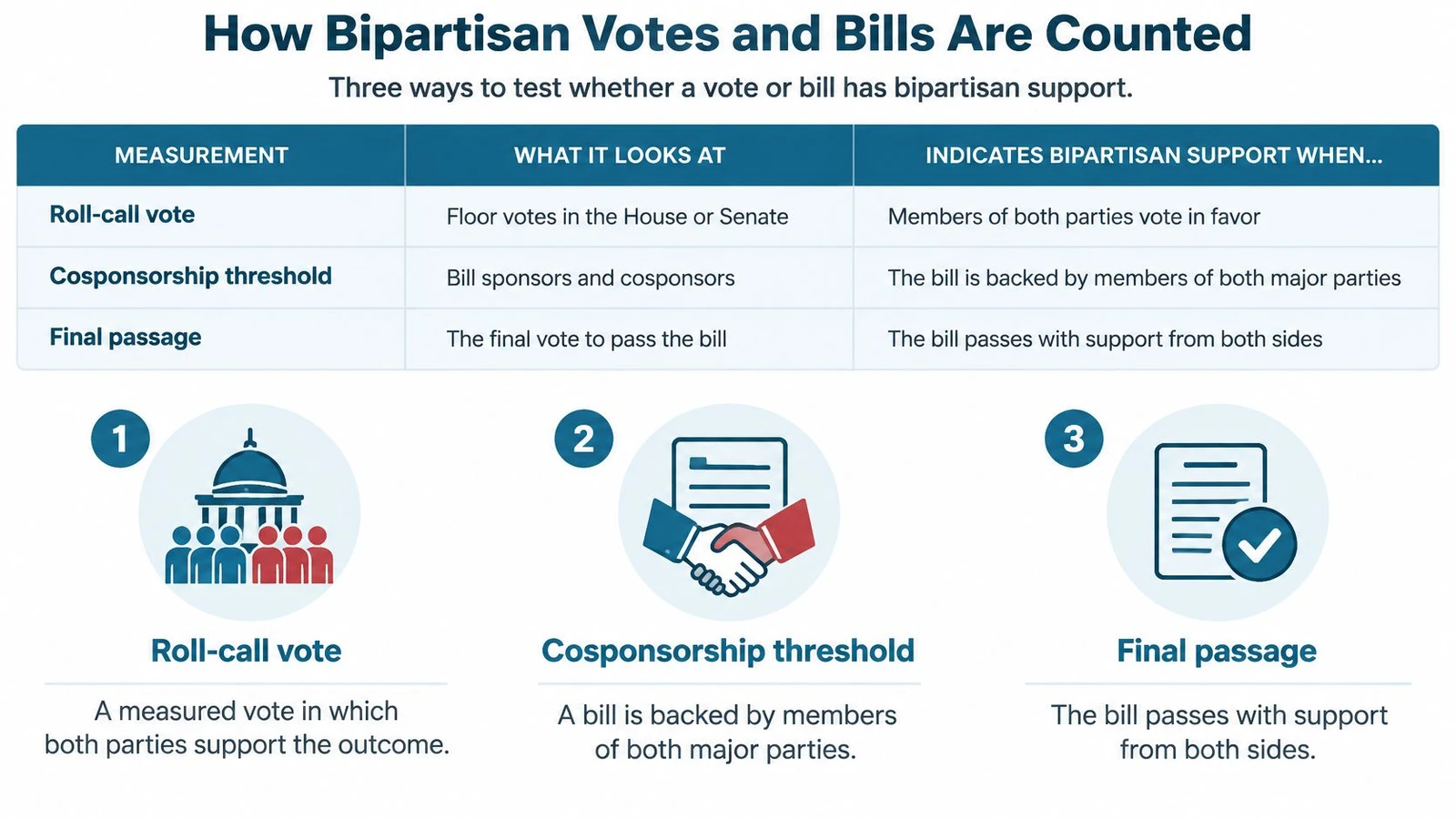
Start with the roll-call rule, which looks at how members vote rather than how many votes the measure receives overall. Under the standard used in legislative research on bipartisan voting, a vote counts as bipartisan when a majority of voting Democrats and a majority of voting Republicans support the same outcome. A 400-to-20 win is not automatically bipartisan; a close vote can be if both party groups meet that threshold.
Cosponsorship uses a separate measure. In the 20% cosponsorship measure described in legislative research, a bill is bipartisan when at least 20% of its cosponsors belong to the party opposite the sponsor. Five cosponsors, with one from the other party, meet that threshold.
The two measures can point in different directions. A bill might win a bipartisan vote without cross-party cosponsors, while a cross-party cosponsor list does not show how members voted later.
The gap in one number: A Bipartisan Policy Center review found 309 immigration-related bills introduced on a bipartisan basis from the 114th through the 118th Congresses. Of the analyzed bills, 15, representing nine distinct bills, became law, and four passed both chambers as standalone measures, according to the Bipartisan Policy Center report.
When you see a bipartisan claim, ask what it describes: the cosponsor list, a recorded vote, or enactment. Then check whose support counts and what threshold is being applied. A label without that context can describe very different levels of cross-party agreement.
Cosponsors and Bipartisan Caucuses in Practice
A bill’s life shows where the label comes from. In the House, a bill has exactly one sponsor, the member listed first, and any number of cosponsors, including members from the other party. Members can add their names at introduction or months later. The Congressional Research Service guide to bill sponsorship treats cosponsorship as a sign of support while separating it from the recorded vote on final passage.
That separation produces the most common misreading in campaign mail. Say a Republican files a broadband bill with four Democratic cosponsors. The sponsorship is bipartisan. The bill can still fail on a near party-line vote, and both facts belong in the same paragraph of any honest description.
A bipartisan caucus extends the same logic beyond one bill. It’s a group of legislators from at least two parties who organize around a shared policy, a region or an institutional interest rather than working only through their individual party caucuses. Congressional guidance on caucuses and legislative support notes that associating legislation with members from different partisan or ideological ranks can demonstrate broader backing, while cautioning that cosponsorship isn’t a final-passage vote.
A rural broadband caucus is a useful generic case. Members from both parties join, recruit sponsors, coordinate messaging and push agencies on permitting. The caucus can show sustained cross-party interest for years without a single bill becoming law. Interest isn’t enactment.
One more distinction worth carrying: party affiliation is the raw material of every bipartisan count, and some contests strip it out entirely. Federal legislative material describes nonpartisan elections as those in which no candidate is nominated or elected as a representative of an identified political party, as the Congressional Research Service explains on election systems.
A reading habit for press releases: check the cosponsor list for names from the other party, then check the recorded final vote. If only the first exists, the claim is about sponsorship. If both exist, the claim is about a coalition that held.
How Often Congress Works Across the Aisle
Congressional cooperation looks different depending on what is counted. A roll-call vote measures how lawmakers voted on one measure; a law’s enactment record asks whether both parties supplied support across the steps required to pass it.
| Measure | Period | Result |
|---|---|---|
| Bipartisan roll-call voting | 91st Congress, 1969 to 1971 | About 76% of votes |
| Bipartisan roll-call voting | 104th Congress, 1995 to 1997 | 33% of votes |
| Bipartisan roll-call voting | 2001 to 2002 | 58% of votes |
| Bipartisan vs partisan legislation | 117th Congress, 2021 to 2022 | 44% bipartisan, 41% partisan |
| Enacted laws with both-party majorities | Since 2012 | More than 80% of laws |
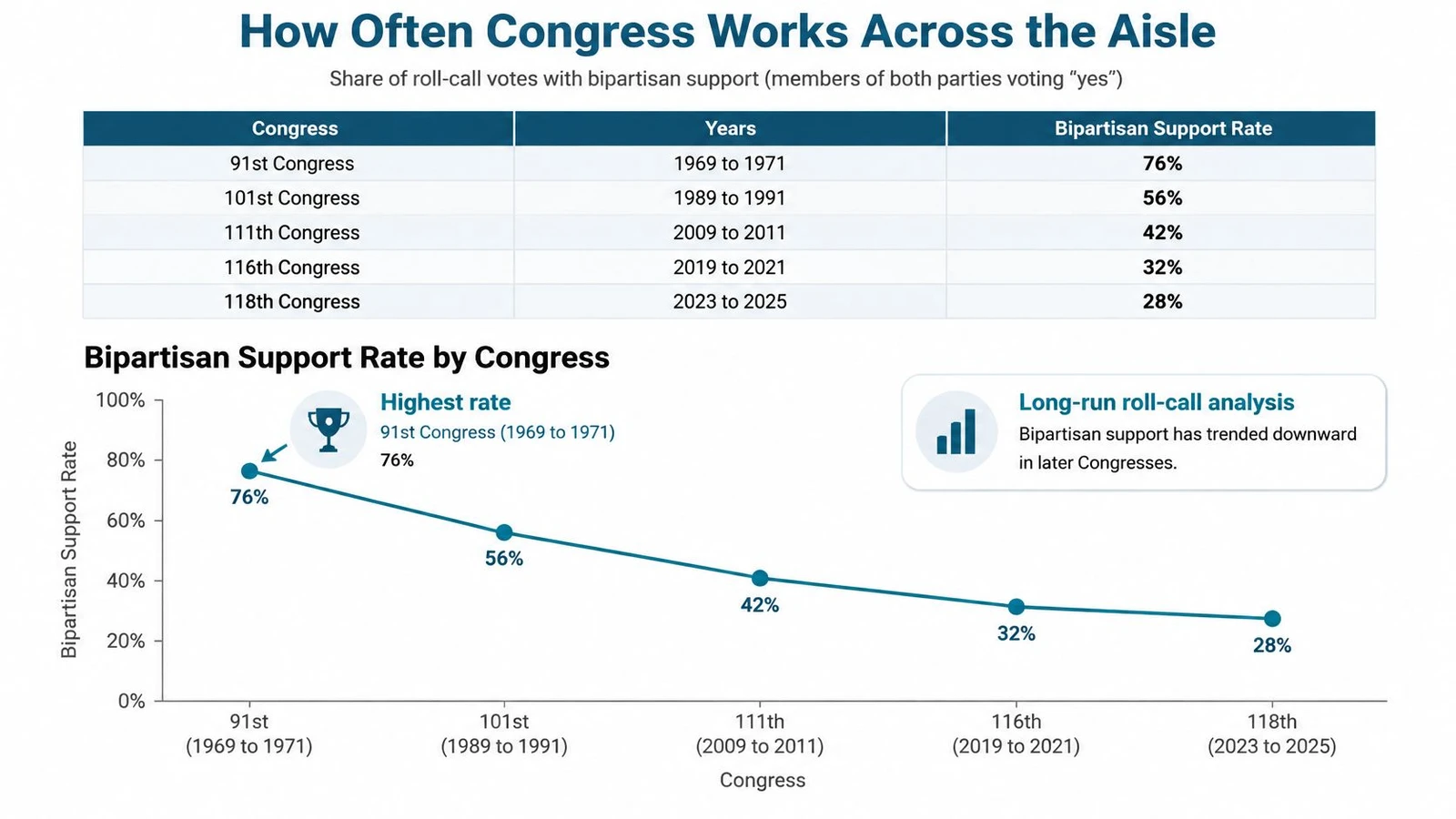
The table’s figures describe different measures, so they are not directly interchangeable. A Miller Center analysis of enacted legislation reports that more than 80% of laws enacted since 2012 passed with majorities of both parties voting yes. In the decade examined, an outright majority of the minority party also supported 64% of important enacted laws.
A floor vote is a snapshot; enactment is a longer process. The same analysis found that most laws passed in both chambers from 1961 through 2008 were bipartisan, with the 104th House as the main exception, following Republicans’ return to majority control after 40 years in the minority. Legislation that clears committees, both chambers and the possibility of a veto may have support that a high-profile recorded vote does not show.
Public concern measures something else. In a January 27 to February 2, 2025 Pew Research Center survey, 56% of U.S. adults called Republicans’ and Democrats’ ability to work together a very big national problem, down slightly from 60% in May 2024. Separately, an analysis of 56 substantive roll-call votes found 33, or 59%, passed with very bipartisan support, while seven, or 12.5%, were strictly party-line.
These findings can coexist. A vote records agreement on a particular measure; public concern reflects wider views about party conflict and cooperation. Cross-party support can also vary by issue, so a bipartisan label alone does not show how broad the coalition was or how much support a bill received at enactment.
Where the label gets stretched: “Bipartisan” describes a degree of cooperation, not a single fixed threshold. Ask whether the claim refers to cosponsors, one vote or an enacted law, then check how much support came from each party.
Why Most Local Offices Are Nonpartisan
Most city, school board and many county contests run without party labels, and the reason is administrative rather than philosophical. A nonpartisan design keeps party nominations out of the formal contest, so candidates file and compete as individuals rather than as Democratic or Republican nominees.
Two familiar scenes make it concrete. In a school board race, the ballot lists names and the office, nothing else, and the winner takes a seat that spends its time on budgets, curriculum contracts and building maintenance. In a city council race, the same thing happens for an office that handles roads, zoning and utility rates.
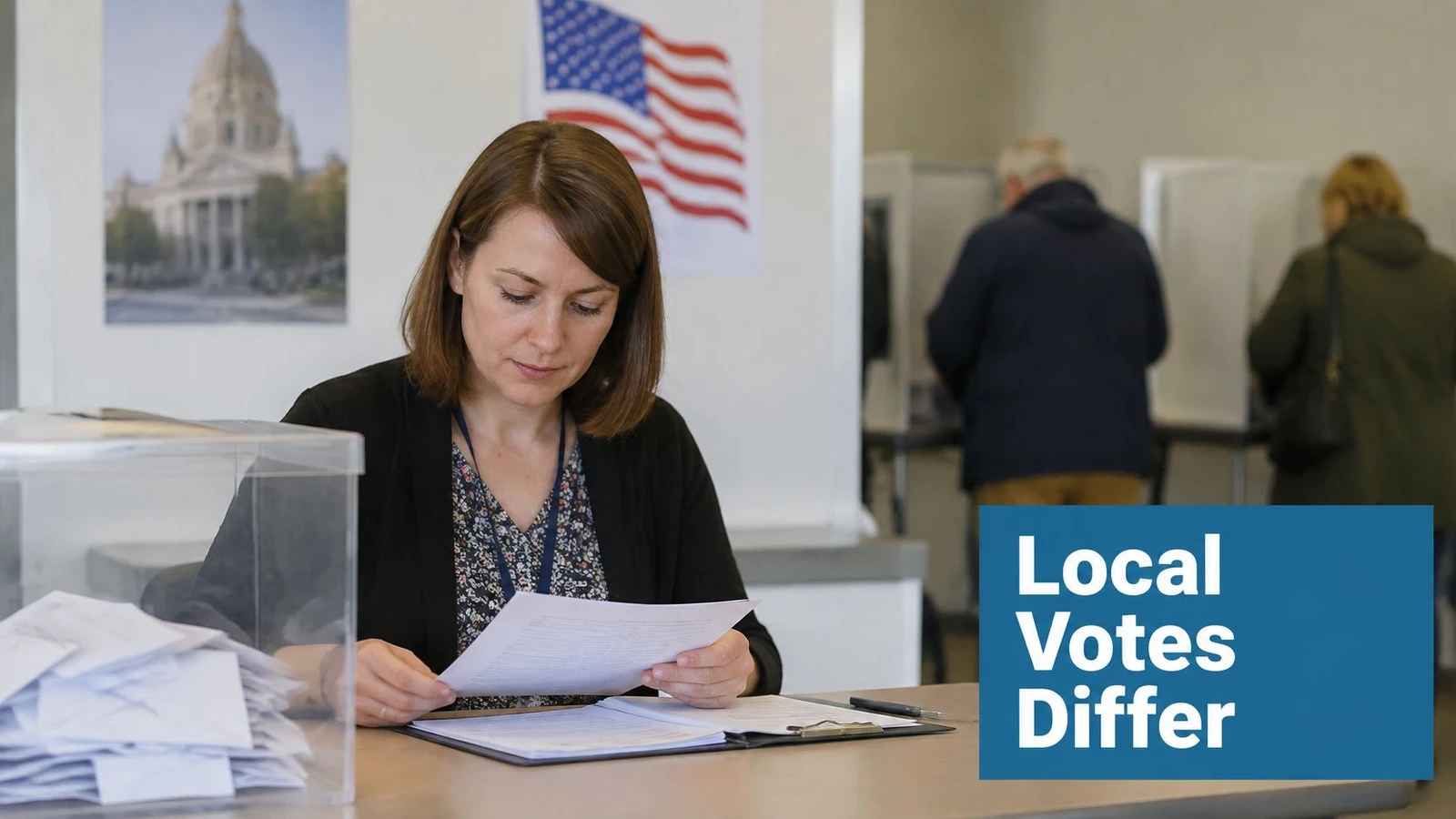
What the label doesn’t do matters just as much. It doesn’t make candidates apolitical, and it doesn’t stop voters from knowing where someone stands. Local issues generate real disagreement about spending, growth and school policy. The arrangement decides that the disagreement plays out without a party stamp on the ballot, which suits offices where the work is mostly delivery.
None of this is uniform. Your state’s rules decide which system you’re voting under, and some cities and counties do run partisan local elections. The earlier doornoc comparison of partisan and nonpartisan elections covers how those structures differ. Before assuming a local race works one way, check the state or city election rules, and if you’re curious about what the job involves, this look at what school board members do sets out the day-to-day work behind the title.
Serving Constituents Across Party Lines
Cross-party thinking applies to service, not just lawmaking. An elected office answers every resident in the district, including the ones who voted against the officeholder and the ones registered with no party at all. Five habits make that work.
- Log every contact in one record. Capture the resident’s name, the issue and the date rather than a party label, so the request reaches the right department; a constituent CRM holds constituent records and casework, with a public contact form that routes messages into the office inbox and a constituent CSV export for reporting.
- Handle every request the same way. A Democrat, a Republican and an unaffiliated voter should get the same timeline, because the office represents a district rather than a coalition.
- Send web form messages into the office inbox. A message that lands where staff already work gets read, while one stranded in a mailbox nobody opens expires.
- Put a follow-up date on every open case. A case with a date attached gets closed, and one without a date fades once the phone stops ringing.
- Export the records when a board asks. A spreadsheet of casework turns a verbal claim about responsiveness into something a council can read in five minutes.
That record does political work later. Research covering House and Senate members from the 93rd through 114th Congresses, 1973 to 2016, found that legislators who attracted a larger share of opposing-party cosponsors were substantially more effective at advancing legislation, according to Dartmouth reporting on bipartisan coalitions, and the pattern held for majority and minority members alike. The wide definition of constituents covers everyone living in the district, so a staff that logs every request builds proof of service to residents who never backed the office.
Frequently Asked Questions
Is Bipartisan the Same as Nonpartisan
No. Bipartisan means members of two or more parties support, sponsor or vote for the same thing, while nonpartisan means no party is identified in the election or its formal structure. A bipartisan effort still involves parties. A nonpartisan race keeps party nominations off the ballot.
Does a Bipartisan Vote Mean the Parties Agree
Usually not. A bipartisan vote shows cross-party agreement on that one measure, which is a much smaller claim than durable trust or a less polarized electorate. Coalitions often form on the least symbolically central items on the calendar.
Can a Bill Be Bipartisan if It Never Passes
Yes. Cosponsors from both parties or a cross-party sponsorship group can exist for years without final passage, and most proposals with bipartisan backing never become law. Check the recorded final vote separately before repeating the label.
What Is a Bipartisan Caucus
It’s a group of legislators from at least two parties organized around a shared policy area, region or institutional interest. Members use it to recruit sponsors, coordinate messaging and build support across party lines, and it can stay active without producing legislation.
Do Bipartisan Labels Apply to Local Races
Rarely in the usual sense, because most city and school board contests are nonpartisan and carry no party designation at all. State and local rules decide which system applies, so check your own jurisdiction before assuming.
doornoc builds canvassing software for U.S. campaigns and elected offices, and it runs in any phone or desktop browser with nothing to install from an app store. The same platform that cuts turf and records door knock results also gives an elected office a place to keep constituent records and casework in order. Visit doornoc to see how voter contact and constituent service fit into one account.
Looking for a tool to run this? doornoc’s canvassing software bundles voter data, automatic turf cutting, the mobile app, and live reporting in one platform.