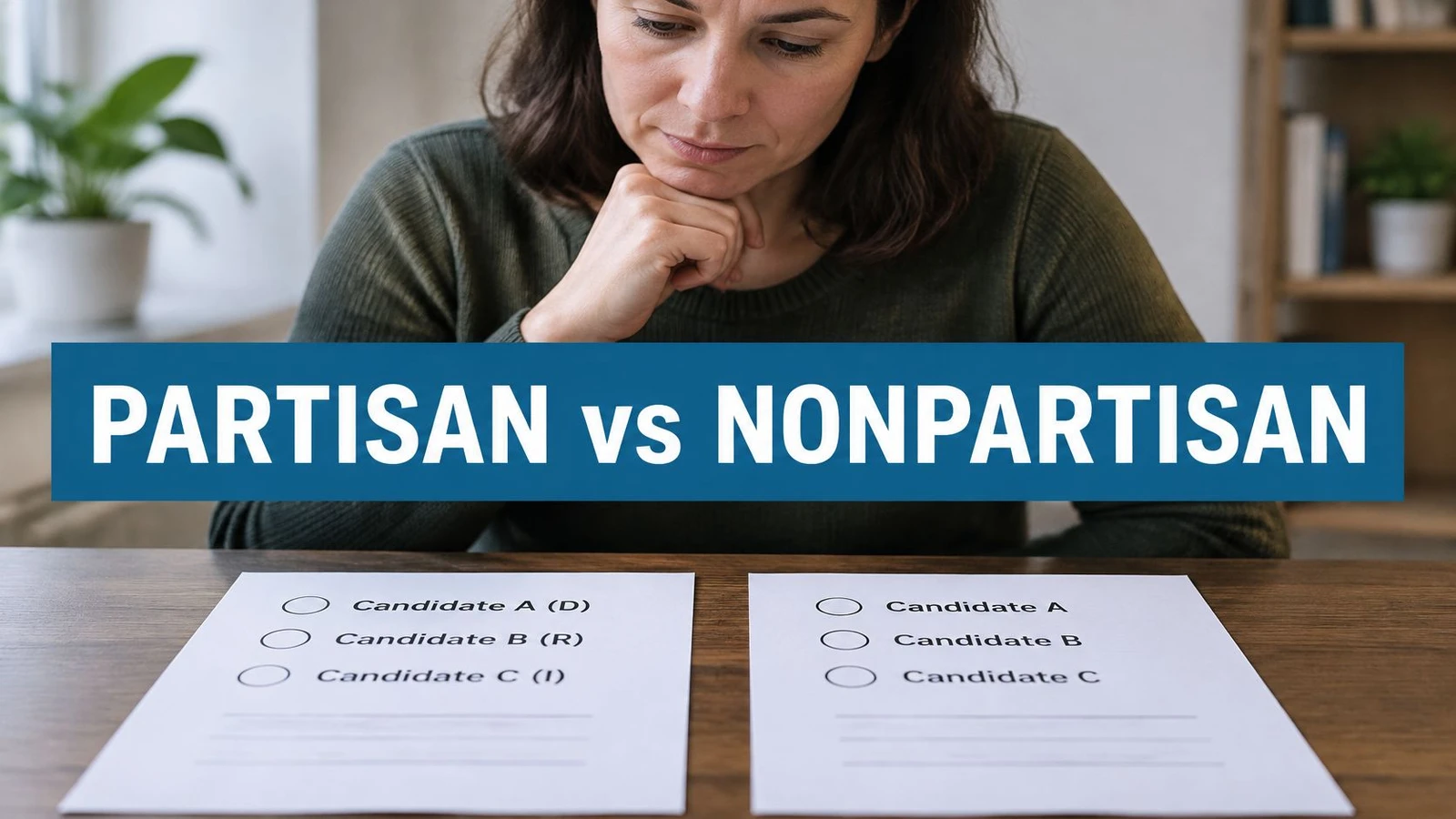
About 70% of U.S. local elections do not put a party next to a candidate’s name. That single ballot choice is what partisan vs nonpartisan turns on, and it changes who shows up, who crosses lines, and what a campaign has to prove at the door.
Partisan vs Nonpartisan Elections Side by Side
A partisan election prints party labels beside candidates’ names. A nonpartisan election leaves those labels off the ballot, placing more weight on candidate records, issues, and endorsements. A scholarly synthesis estimates that roughly 70% of U.S. local elections are nonpartisan and cites a study estimating an 8% drop in participation when party labels are absent. The same review finds only minor differences in policy outcomes. The measurable change is participation: turnout moves, while policy outcomes change little. (Chapter on local election design
The ballot’s format does not determine a voter’s political attachments. Merriam-Webster defines a partisan as “a firm adherent to a party, faction, cause, or person.” A legally nonpartisan race can still involve party-aligned voters, donors, and endorsers. Removing the heading leaves those attachments intact and removes only the official cue beside the name.
| Criterion | Partisan election | Nonpartisan election |
|---|---|---|
| Party label on ballot | Shown next to the candidate’s name | Omitted |
| Main voter cue | Party affiliation | Candidate record, issues and endorsements |
| Who mobilizes voters | Party organizations and candidates | Candidates, endorsers and local networks |
| Typical offices | County offices and most state and federal races | School boards, special-purpose districts and many city offices |
| Share of U.S. local elections (one synthesis) | Roughly 30% | Roughly 70% |
| Campaign’s main tool | Party identity as a shortcut | Candidate-specific evidence and direct voter contact |
Without a party label, the ballot gives voters less information about candidates, and party organizations have fewer reasons to recruit, educate, and mobilize them. Campaigns therefore rely more on candidate-specific evidence and direct contact. The roughly 70% estimate describes one synthesis, not a universal count.
Practical rule: The ballot label, not the candidate’s party history, determines which column applies.
Which Local Offices Use Party Labels
Ballot rules vary by office type. Ballotpedia’s coverage of local offices since 2023 includes approximately 66,000 local offices. Across that coverage, 58% were nonpartisan and 42% partisan, but the overall split obscures sharp differences between office types.
| Office type | Nonpartisan | Partisan | Note |
|---|---|---|---|
| All local offices covered by Ballotpedia | 58% of about 66,000 offices | 42% | Overall benchmark across every office type |
| School boards | Required in 40 of 50 states | Partisan only where state law allows it | Set by state law |
| Special-purpose districts | 96% (2,477 of 2,568) | 4% (91 of 2,568) | Almost always nonpartisan |
| County offices | 26% (of 13,866) | 74% | Usually partisan |
School boards are the clearest example of state-by-state variation. Forty of the 50 states require school-board districts to hold nonpartisan elections. Anyone planning how to become a school board member should check the relevant state’s rules before assuming a party label will appear on the ballot.
Special-purpose districts are overwhelmingly nonpartisan. Ballotpedia’s coverage found that 2,477 of 2,568 offices (96%) in this category were nonpartisan. Water, fire, hospital and similar boards are generally separated from formal party competition.
County offices show the reverse pattern. Only 26% of 13,866 covered county offices were nonpartisan; 74% were partisan. A county clerk race and a school-board race in the same county can therefore use different ballot rules.
Why the split looks like this
The pattern reflects a Progressive Era reform tradition that sought to reduce party-machine influence over local administration and education. State law usually determines the rules, so the same office title may be partisan in one state and nonpartisan in another.
Check the official election source for every office on the campaign calendar before setting a message, voter universe or contact goal.
How Party Labels Shape Voter Choice
In local elections, party cues can strongly shape how voters choose. In county council races, crossover was approximately 5% in contested partisan elections and about 35% in contested nonpartisan elections. The estimates come from cast-vote records covering more than 750,000 votes in contested partisan elections and more than 210,000 in contested nonpartisan elections, reported in Political Research Quarterly. The same study found that voters classified as partisan from their federal and state patterns supported an opposite-party candidate in 15.6% of nonpartisan elections, compared with 5.6% in contested partisan races.
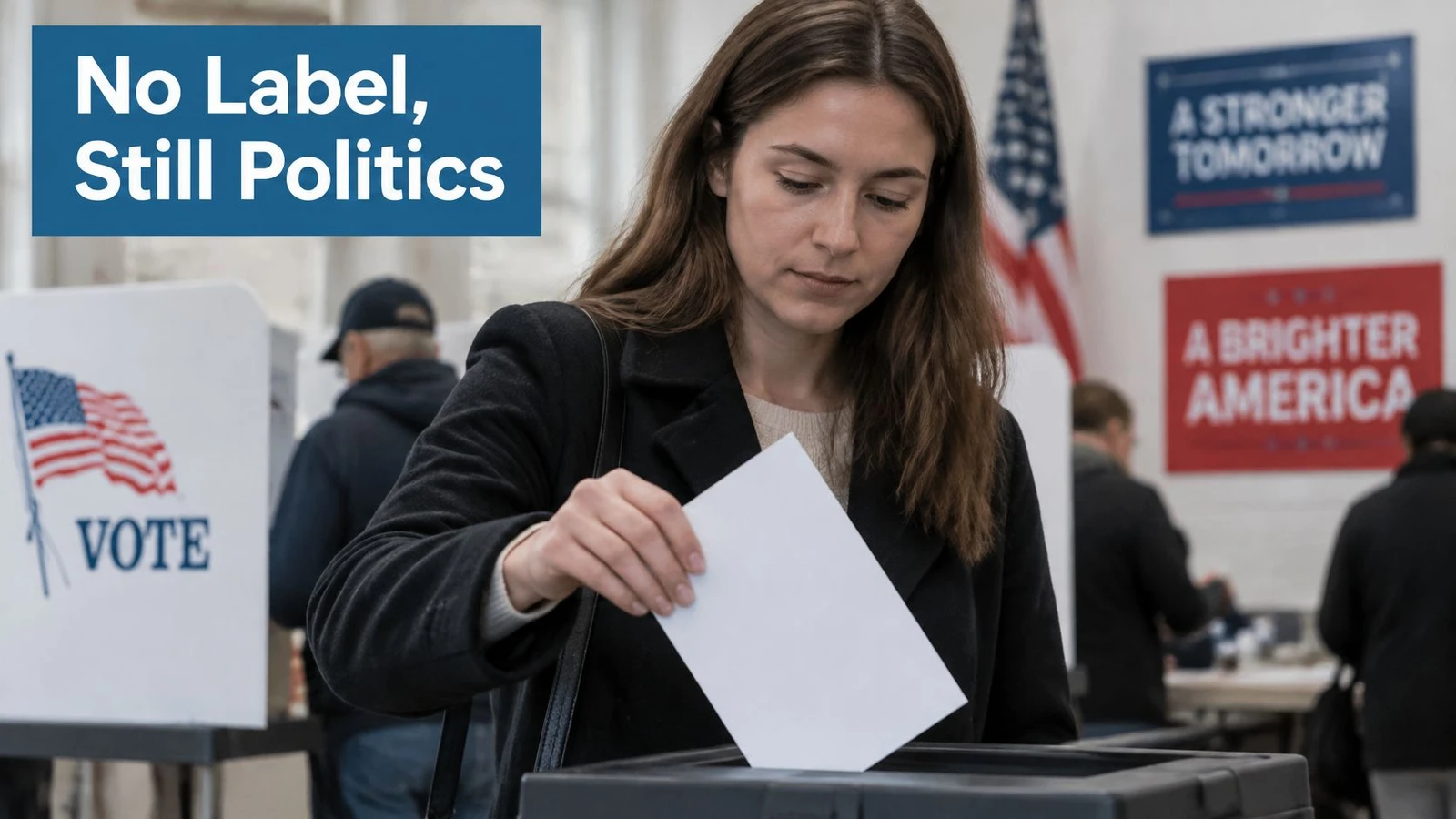
A separate 2020 study examined more than 50 million individual ballots across over 5,700 contested down-ballot contests. Published in the American Political Science Review, it found that national partisanship explained more than 80% of the variation in voting for local partisan offices and less than 8% for local nonpartisan offices. The gap shows how strongly a printed party label can organize choices. Without it, voters rely more on other cues, and their choices become less uniform.
What replaces the label
Voters still sort candidates using ideology, endorsements, biographies, local networks, and campaign messages. These cues vary in visibility and meaning, so they may guide voters less consistently than a party label. The same voter can therefore appear loyal in a partisan county race and flexible on a nonpartisan ballot.
Without a party label, voters weigh a wider mix of candidate cues.
For campaigns, the practical question is which cues voters recognize and trust in a particular race. Test messages around those cues, then make the relevant information clear in literature and at the door.
Turnout Gap and Realistic Contact Targets
Nonpartisan races average roughly 10% lower turnout than comparable partisan races, according to a synthesis of U.S. local-election research summarized by Clark County’s report on elected and nonpartisan positions. That average describes a broad pattern, not a forecast for any particular race.
A party label gives voters a quick cue about ideology. Party organizations can also provide phone banks, slate cards, and election-day reminders, support that many nonpartisan contests lack. Without the label and its mobilization network, campaigns must account for both in their turnout planning.
When the design moves the other way
Alaska’s shift from a partisan to a nonpartisan primary coincided with higher turnout. The reported figures show estimated overall primary turnout rising from 18.6% to 32.5%, independent-voter turnout from 9.1% to 20.2%, and turnout among voters aged 25 to 39 increasing 2.50x. The results illustrate how election rules, voter eligibility, race salience, competition, and mobilization can shape turnout. A primary that invites independent voters is not equivalent to a low-profile nonpartisan city race in November.
A contact target you can calculate
- Pull turnout records for the same office across two or three past cycles.
- Where the voter file allows, compare participation by election type, age, partisanship, income, and education.
- Set contact goals around the expected low-turnout share, treating the 10% average gap as a contingency rather than a local prediction.
- Focus get-out-the-vote work first on voters who participated in similar local contests, then plan a second pass for voters less likely to respond to party cues.
What Changes in Messaging, Endorsements and Targeting
In nonpartisan contests, voters may weigh a candidate’s experience and record without a party label serving as an immediate cue. Campaign materials can make those qualifications easy to assess.
- Lead with a record line. Put the candidate’s role, experience, and a specific result near the start.
- Name and date endorsements. Identify who is endorsing the candidate and when, so readers can assess the endorsement’s relevance.
- Test issue-based messages. Compare a service record with a budget choice or another concrete issue, rather than relying only on party slogans.
- Segment by known concerns and prior engagement. Use available information to tailor outreach to voters’ interests and past participation.
Why the evidence points that way
Conjoint experiments at Yale’s Institution for Social and Policy Studies found that removing partisan information led respondents to place greater weight on job experience, with Republicans emphasizing job experience and Democrats emphasizing political experience. A separate experiment found that partisan labels substantially reduced the importance of race and ethnicity in voters’ initial categorization of candidates. These findings suggest labels shape which traits voters consider early, as well as their eventual choices.
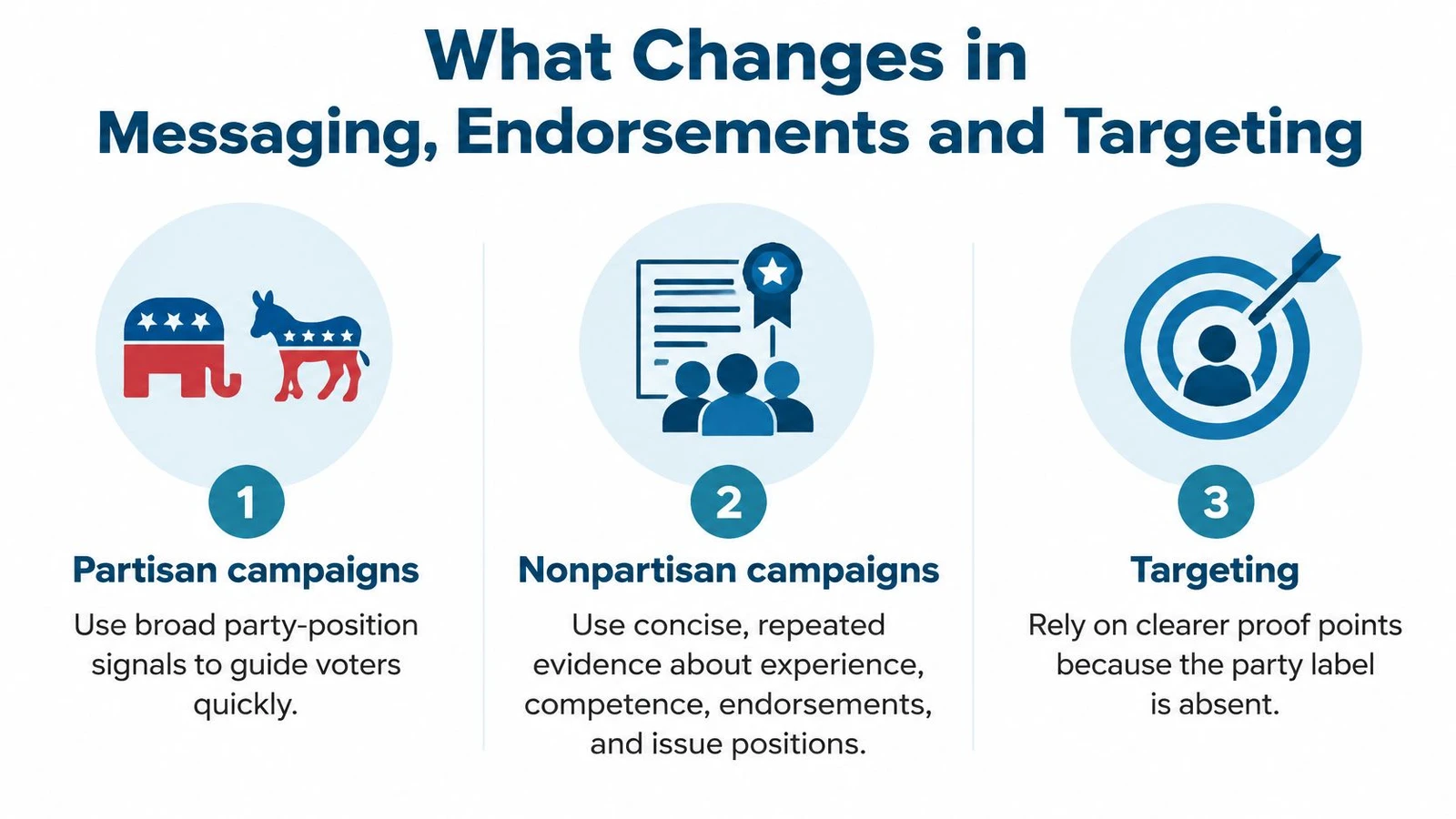
Partisan campaigns can use broad party-position signals. Nonpartisan campaigns can instead make experience, competence, endorsements, issue records, and local performance clear and consistent. Printed materials, including custom printing for election teams, can carry the same qualification line across door hangers and other campaign pieces.
How the file gets used
Campaigns can filter voter files by party, election history, district or precinct, and age. In a formally nonpartisan contest, party can indicate turnout patterns and voting history, but it does not directly establish candidate preference, particularly when ideological information is limited. A door conversation can give voters more context about a candidate’s record and positions.
Write the first literature piece around the candidate’s record before developing other creative.
Neutrality, Trust and Outreach Credibility
Formal neutrality is equal treatment under the rules. Perceived neutrality is whether people believe the organization is fair. A nonpartisan label is the first. It isn’t the second.
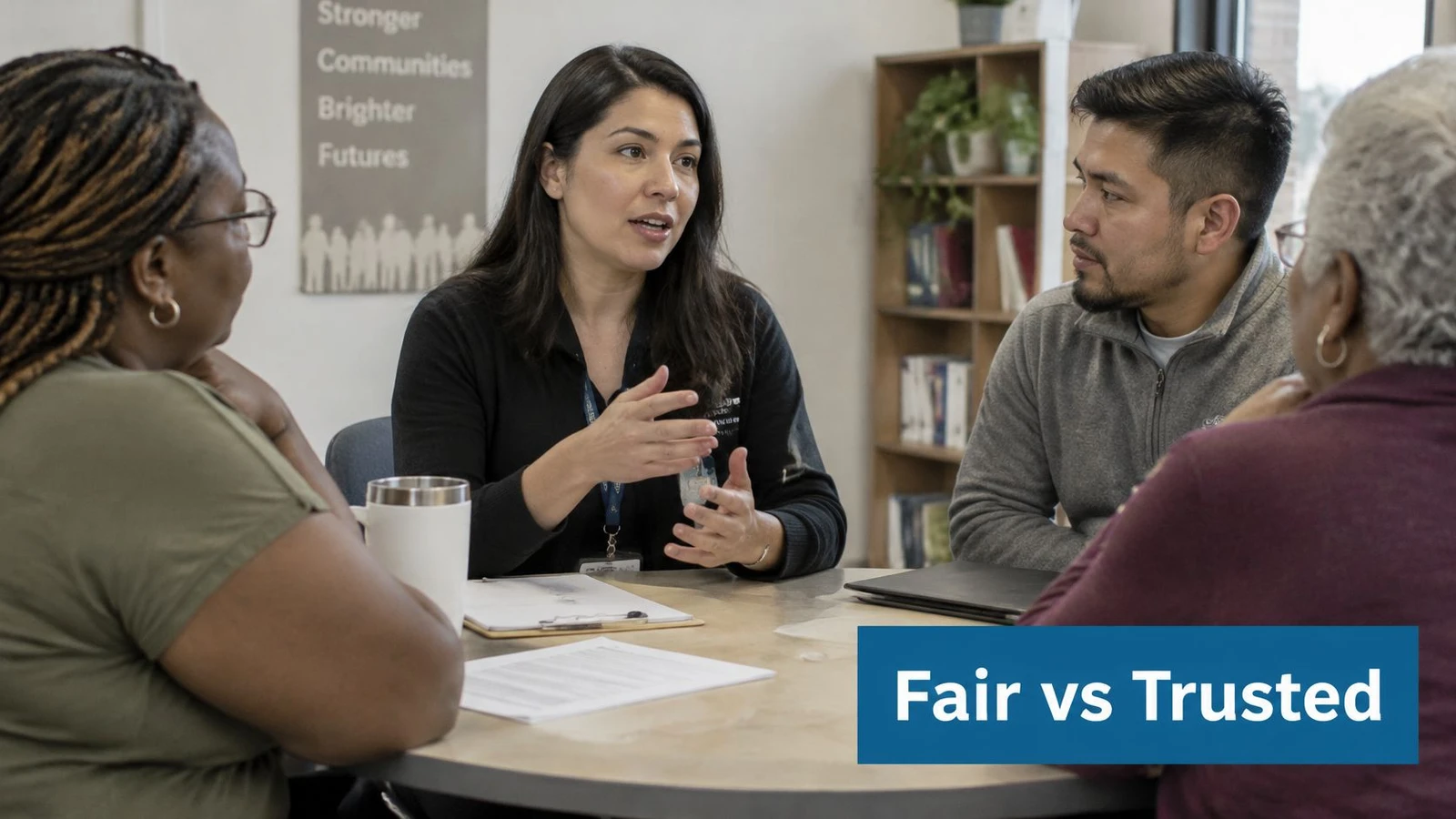
Only 27% of Americans express high trust that nonprofits will remain politically neutral during elections, and only 29% express high trust that they will conduct nonpartisan voter-registration drives, according to Capital Research Center’s reading of recent nonprofit research. Legal compliance doesn’t close that gap. Funding, messengers, targeting rules, language, and public reporting do.
Nonpartisan contact can still land unevenly. A registration drive aimed at three neighborhoods, one age band, or only likely participants treats candidates equally on the script and still changes who participates. That isn’t automatically improper. It is politically consequential, and audiences notice when the criteria stay hidden.
A checklist before the first door
- Actor: Name who is speaking, the campaign, the office, or the civic group.
- Legal status and funding: Say what the organization is allowed to do and who pays for the contact.
- Beneficiary: State who gains if turnout rises in the targeted area.
- Targeting method: Publish the selection criteria in plain language.
- Equal treatment: Check whether every candidate or viewpoint gets materially the same offer of information.
- Records: Use one script, train to it, and document outcomes.
- Separation: Keep official election information distinct from campaign advocacy.
Doornoc is a nonpartisan platform that serves campaigns of all political affiliations, and using it for voter suppression or election interference is prohibited. The same standard applies to any field program. “Nonpartisan” is a design and communication standard. It has to be shown, not asserted.
Choosing Your Approach by Race Type
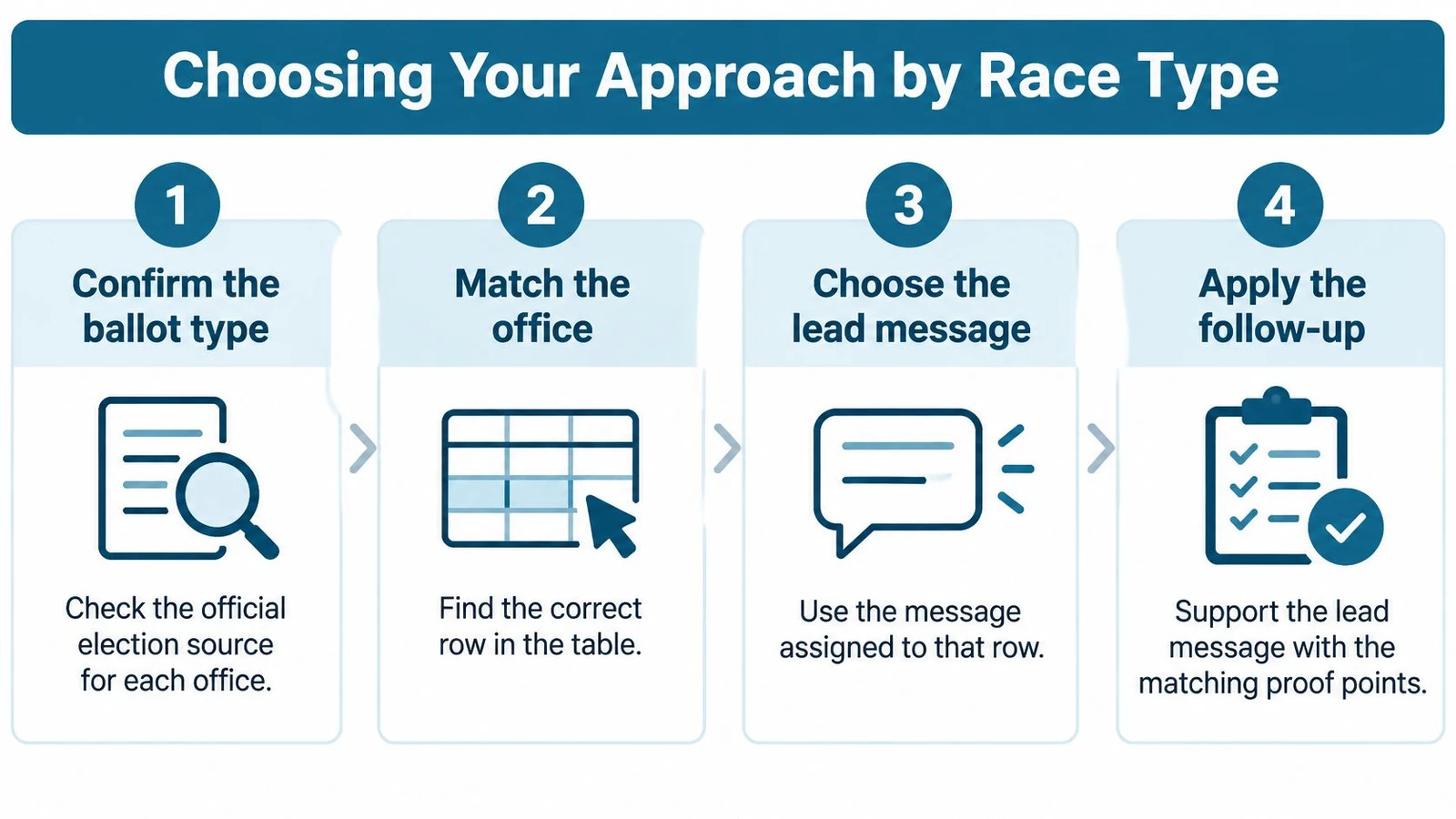
A party label changes which arguments are available, but it does not determine whether voters see a campaign as fair. Start by confirming how each office appears on the ballot, then choose a message and contact plan that fit that race.
| Race type | Ballot treatment | Lead message | Targeting priority |
|---|---|---|---|
| School board | Nonpartisan in most states | Candidate experience and school priorities | Precinct turnout history and district boundaries |
| Special-purpose district | Nonpartisan in nearly all cases | Service record and local budget choices | District map and past turnout |
| County office | Often partisan | Party-linked positions and local record | Party registration and modeled partisanship, paired with local evidence |
| City council | Set by the city charter | Neighborhood issues and endorsements | Ward-level data and prior voters |
| Advocacy voter contact in any race | Matches the office on the ballot | Neutral, verifiable election information | Documented selection criteria and outcome tracking |
In partisan races, party affiliation can help frame a candidate’s positions, but local record still gives voters concrete grounds for comparison. In nonpartisan races, experience, service, and specific policy choices carry more of that burden. For city council, check the charter before adapting a message from another municipality. Guidance on how to become mayor of a small town likewise begins with understanding the local rules and office.
The ballot type determines the message. It also shapes how a campaign should explain its targeting: party data may inform contact in a partisan contest, while nonpartisan outreach calls for clear, documented selection criteria. doornoc serves campaigns of all political affiliations and supports campaign work from local school board races to congressional contests.
Classify each office before approving campaign literature, then set contact priorities using the turnout history for that seat.
Frequently Asked Questions
Is a nonpartisan election the same as a nonpolitical one?
No. Party preferences still shape voters’ views and campaign decisions. Without a party label on the ballot, voters may rely more on candidates’ records, biographies and endorsements.
Are most local races nonpartisan?
The answer depends on the office and jurisdiction. Check the rules for the specific race rather than assuming that a local ballot omits party labels.
Do nonpartisan elections have lower turnout?
Turnout varies with election rules, competition and how the race is scheduled. A turnout pattern from one jurisdiction should not be treated as a forecast for another.
Can campaigns use party data in a nonpartisan race?
Yes, as one indicator of voting history or potential turnout. A party label in a voter file does not establish which candidate someone prefers in a race without party labels.
Does a nonpartisan label make an organization neutral?
No. A label describes the ballot or organization’s formal status, not whether people trust it or view its outreach as fair. Credibility depends on how the organization explains its rules, funding and voter-selection criteria.
Doornoc is canvassing software for managing voter contact lists and territories, planning routes, recording door-to-door interactions and tracking campaign activity. A campaign can filter its voter file by party, election history, district or precinct, and age. Visit doornoc to set up a campaign and start from the ballot type on your calendar.
Looking for a tool to run this? doornoc’s canvassing software bundles voter data, automatic turf cutting, the mobile app, and live reporting in one platform.