


Someone who has sat through a levy hearing, argued about a road that never gets rebuilt, and started telling friends they’re running is closer to a filing deadline than to a victory speech. The part that ends the race early is rarely the message. It’s a residency clock measured from the wrong date, or signatures pulled from the wrong voters.
That’s the practical problem inside how to become a county commissioner. Rules are local. A national checklist that says “be a registered voter and live in the county” won’t say whether a move last spring, or a map redrawn after redistricting, already knocked the candidacy out. The county election office and the state statute have the final word. Money, literature, and doors wait until those two agree the candidate is eligible and the window is still open.
What a County Commissioner Does and How Forms Differ
County commission work is legislative, fiscal, and administrative. Commissioners adopt county budgets, levy taxes or set fees, pass and repeal county ordinances, and oversee county departments. Those powers make up the core of the job.
The portfolio is concrete. It can include roads and bridges, public health, parks and recreation, emergency services, solid waste, building permits, and planning and zoning in unincorporated areas. The Skagit County Board of County Commissioners explains that counties may adopt budgets annually or, where state law permits, biennially. A candidate moving over from a city council feels the difference when a levy and a multi-year road program land in the same vote.
Why the form changes who must be persuaded
The legal form matters because state law defines which powers the county body may exercise. Some counties use a board of commissioners. Others use a county council, a commissioners court, or another structure. Under Utah’s county-government statute, the commission functions as both the legislative body and executive authority, with staggered terms across regular general elections.
Those structural differences change what voters must judge. A body that levies taxes and supervises departments asks them to weigh management judgment alongside policy positions. A council that mainly passes ordinances puts more weight on legislative priorities and coalition building. Across either model, the persuasion universe is the legal electorate, which is why a clear constituents definition in government matters more than a generic description of county residents.
Practical rule: Before planning outreach, write down three answers: the powers attached to this seat, how many seats are actually on the ballot, and which body controls the budget. Confirm those answers in state statute and with the county election office. If one is missing, the campaign is still guessing at the job.
Eligibility Checks to Run Before You File
A candidate who moved across a district line six months before filing may still live in the same county, yet fail the residency test for the seat. The first task is therefore local verification: identify the exact office and district, then check the applicable state statute and county election guidance. Residency timing and the pool of eligible petition signers are two places where a seemingly viable candidacy can run into a disqualifying rule.
Residency and age rules by state
| State or guide | Minimum age | Residency rule | Other requirement |
|---|---|---|---|
| Typical state (NACo summary) | 21 | At least 12 months in the county | Criminal-conviction limits in many jurisdictions |
| Texas | No separate age in this guidance | 12 months in the state and 6 months in the precinct | U.S. citizenship, voter registration, no disqualifying felony |
| Georgia | No separate age in this guidance | At least 12 months in the county | No added test is stated in that guidance |
| Alabama | No separate age in this guidance | 1 year in the county, or 1 year in the district for district-based seats | Exempt from the one-year rule in the first election after redistricting |
| Oklahoma | No separate age in this guidance | Principal residence in the commissioner district for the 6 months before the filing period | Registered voter before filing |
| Kentucky | 24 | 2 years in the county; 1 year in the district for district representatives | Kentucky citizen |
The National Association of Counties summary of county commissioner duties and qualifications describes a typical minimum age of 21 and county residency of at least 12 months, while noting that requirements vary by state. Treat those figures as a starting point, not a national rule.
Texas guidance lists U.S. citizenship, 12 months of state residency, six months in the precinct, voter registration, and no disqualifying felony. Georgia guidance calls for at least 12 months of county residency. Alabama generally requires one year in the county, or one year in the district for district-based seats, with an exception for the first election after redistricting. Oklahoma requires a principal residence in the commissioner district and voter registration for the six months immediately before the filing period. The Texas county commissioner education materials illustrate why state and county guidance must be checked for the specific office. In Adams County, Colorado, district-race petition signatures must come from voters in that district; countywide offices use a different pool.
A map change can alter the answer even when a candidate has not moved. Check the current district boundary against the residency rule’s measurement date, and confirm whether petition signers must live in the district or may come from across the county. The county election office and state statute have the final word.
Before making a public announcement, candidates can also review their public-facing records with a Digital Footprint Check self-search guide.
How to File and Get on the Ballot
Treat ballot access as a compliance project. The announcement can wait.
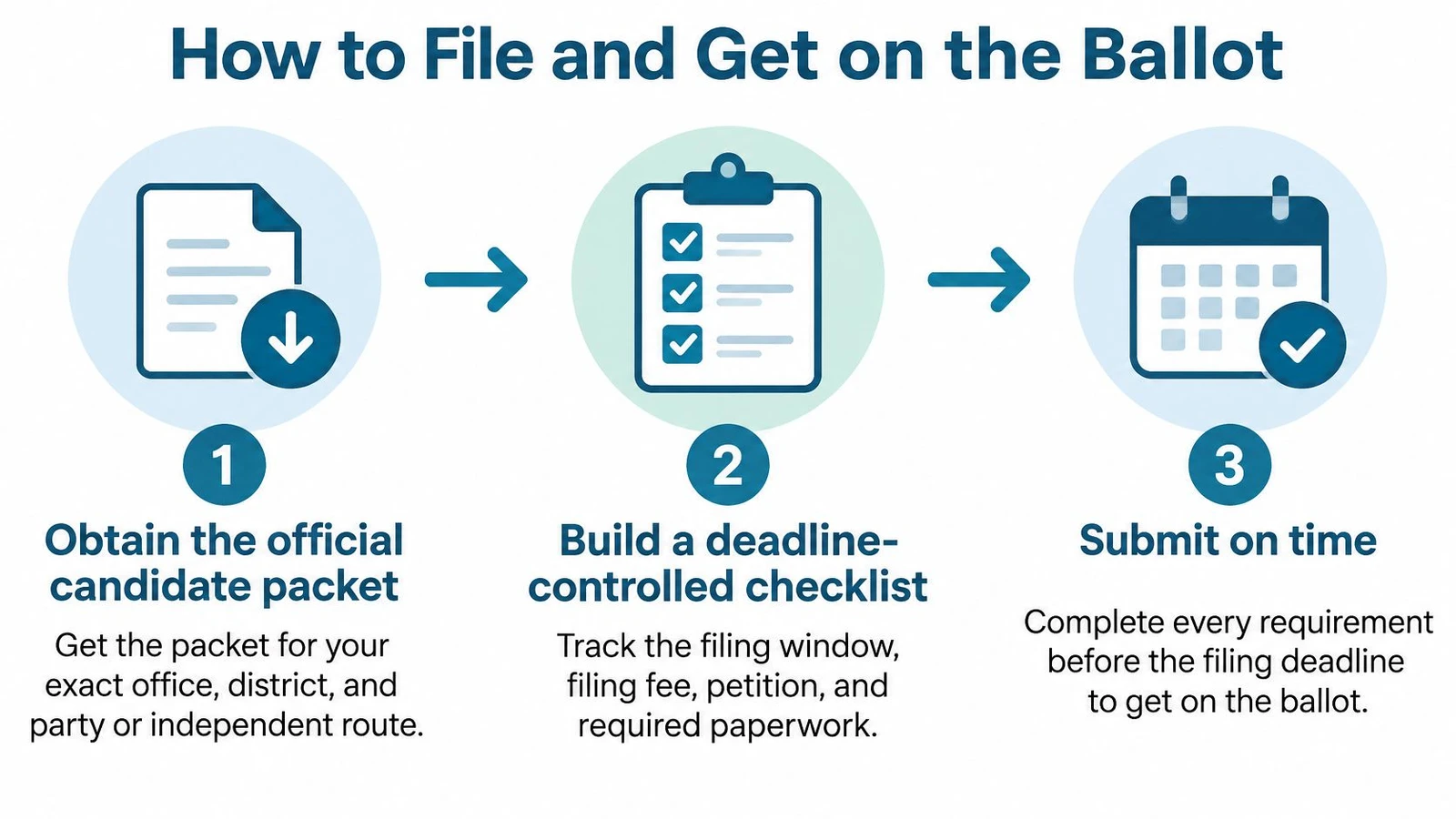
The Indiana 2026 candidate guide is a useful picture of how technical the packet gets, even when another state’s form looks simpler. A filing office does not grade on effort. A packet one signature short or one day late comes back rejected, whatever the candidate’s intentions were.
- Get the official packet for this office. Match the jurisdiction, commissioner district, election type, and party or independent route. A packet for “county office” in general is how people file for the wrong seat.
- Build a deadline-controlled checklist. It should list the filing window, filing fee, petition format, and financial-disclosure obligations. Put the opening and closing dates on a calendar the campaign manager can see, not only in an email.
- Pre-screen residency and registration against the rule that applies on the measurement date. Pull the voter-registration record for that date and gather the documents that prove where the principal residence sat. A challenge gets answered with records, not memory.
- Draft the filing before the window opens. Notarization, fee alternatives, and disclosure forms are slow on the last afternoon. A finished draft also gives election staff something to review while there is still time to fix it.
- Collect more signatures than the statutory minimum, from the correct voters. In Indiana, a candidate may file for a specific commissioner district, yet independent or minor-party petition signatures may need to come from registered voters across the entire county, because the district can function mainly as a residency and representation label.
- Submit inside the official window. Oklahoma sends declarations and any required petitions to the county election board. Early, late, or incomplete submissions are rejected.
- Get written confirmation from the filing office. A verbal “you’re fine” doesn’t survive a challenge.
Failure modes that end the race
- Wrong signature pool: District voters signed a petition that required countywide signers, or the reverse.
- Unapproved petition form: A homemade sheet, even with the right names, gets tossed.
- Missing notarization or a fee alternative: Some states let a candidate file a petition in place of the filing fee, and registration in the territory the office serves generally must be current by the filing deadline. Plan the cash only after the office confirms which option it allows.
- Assuming a district race means district-only petitions: Indiana shows why that assumption fails for some independent and minor-party routes.
Draft the paperwork before the window, collect a surplus of valid signatures, and don’t spend field money until the filing office confirms the packet in writing.
Choosing a District Seat or an At-Large Seat
Pick the seat before the paperwork, because the designation fixes who votes, whose signatures count, and how much ground the campaign has to cover. A district race can be won by concentrating on one slice of the county. An at-large race needs a countywide coalition and a countywide budget. The seat type sets the size of the voter file the campaign must work.
District seat versus at-large seat
| Factor | District seat | At-large seat |
|---|---|---|
| Who votes in the race | Voters in the commissioner district | All county voters |
| Residency test | District residence for the period state law sets | County residence for the period state law sets |
| Petition signature pool | Often district registered voters for major-party filings; some independent or minor-party routes can require a wider pool, so confirm the pool before circulating | Countywide registered voters |
| Campaign geography | Part of the county | Countywide coalition |
| Example from current rules | Oklahoma commissioner district seats | Multi-seat at-large contests, including vote-for-2 races |
A district candidate can build a majority from one part of the county and still have to satisfy the county office on signatures. An at-large candidate starts with more doors, more mail, and more chances for one weak region to sink the map.
What a multi-seat at-large race does to the math
In North Dakota’s 2024 general election, the Mercer County at-large county commissioner contest was a “vote for 2” race, so voters elected two commissioners in that contest, according to the North Dakota Secretary of State. A multi-seat ballot changes the win number, lets more than one opponent survive, and makes a household split its support instead of giving one candidate a straight yes or no.
Staggered terms mean a closed seat this cycle can open on the next ballot. Don’t force a race that isn’t on the ballot.
Confirm the designation in this order. Ask the county election office for the seat type. Read the state statute. Ask whether redistricting is moving lines before petition season, because an old map can turn a correct residency answer into a wrong filing. Geography comes before fundraising. A countywide mail and field plan for a district that only needs one slice burns money the filing fee never required.
Confirm Your Filing Window Before You Spend Anything
The filing window sets the go or no-go decision, and the dates come from the county election office rather than a national checklist. Get the opening and closing dates in writing before a dollar moves, along with the deadline for any paperwork the petition route requires.

The residency measurement date and the fee or petition threshold belong on the same page. Petition signatures take longer to gather than candidates plan for, so when the petition route applies, the closing date decides whether that route is realistic at all.
When the dates work, request the official candidate packet and treat it as the source of truth for every later step. Build the budget and the field plan from that packet, because a neighboring county’s form can carry a different threshold. A workable political campaign timeline runs backward from the closing date, which keeps petition gathering, fee payment, and announcement order inside the window.
When the dates do not work, hold. An announcement that outruns the paperwork costs more than waiting.
Route building is a later cost: 50 credits plus 5 credits per voter, while recording knocks, searching voters, and creating campaigns cost no credits. Hold that spend until the window is confirmed. For the planning stage once the packet is in hand, read how to run for office.
This week’s action is one page. Write down the filing window dates, the residency measurement date, and the fee or petition threshold, and sign off only when each line matches the election office.
Budgeting and Building a Countywide Field Plan
Start from the most recent comparable commissioner contest, not a national win rate. Estimate the votes needed to win from turnout by precinct, contest drop-off, primary versus general participation, and the number of candidates. Then set weekly targets for identified supporters, undecided voters, volunteer recruitment, and turnout commitments.
There isn’t a reliable universal success rate for county commissioner candidates. Outcomes turn on state rules, candidate count, incumbency, geography, and turnout. Build a local baseline from that last comparable race. A precinct with a short drop-off and a history of showing up in local races is worth more than a large list of registered voters who skip county ballots.
Split the budget into filing fees or petition costs, voter-file access, literature, field staffing, and a reserve for revisiting undecided and supportive voters. What local races spend is easier to judge beside a breakdown of what it costs to run for local office.
Build a precinct-level universe and prioritize likely participants. A campaign file can be filtered by party, election history, district or precinct, and age. Assign walkable turf, keep a control group where feasible, and record every door the same way so the campaign can calculate contact rate, supporter conversion, undecided share, and revisit yield. Compare contacted households with untouched ones. Audit each import, deduplicate households, document consent, and reconcile field reports to the voter file after every shift.
Managers can follow canvassers on a live map and export knocks, answer rate, results, issues, route performance, and a canvasser leaderboard as CSV or PDF. Auto Turf can organize walkable areas. It doesn’t set the win number, write the message, or check compliance. Those stay with the campaign.
Common failures are counting knocks instead of verified conversations, skipping a second visit to undecided voters, and ignoring low-turnout local elections. Raw contact volume isn’t a path to a majority.
Frequently Asked Questions
How are petition signatures verified?
The election office checks every line against the voter roll. A signature counts only if the signer is registered, lives in the territory the seat covers, and belongs to the eligible pool for your filing route. Expect part of what you gather to be struck, so pad the count above the minimum. A post-filing challenge can cut further after your margin is already set.
Do I need a party label to run?
No. A party route, an independent route, or a petition route changes the filing steps, the fee, and who may sign. Choose the route before the first signature sheet goes out, because the eligible signers can change with it.
Can I lose a primary and still get on the November ballot?
Often no. Many states bar a primary loser from running as an independent or under another label for the same office in the same cycle. If a fallback path matters, read the rule before you file for the party ballot.
Do I have to resign another office to run?
It depends on the office you hold and the state. Some jurisdictions force a resignation the moment you file for a different seat. Others let you finish the term. Check the rule for your current office before announcing, since filing can trigger it automatically.
What does it cost to file?
Call the county election office for the fee schedule, and ask whether your state lets a petition replace payment. Get the figures for your seat: the fee amount and, on the petition route, the signature count and deadline. A figure from the next county over isn’t a safe placeholder.
doornoc is canvassing software that runs in a phone or desktop browser, so a county campaign can filter voters, cut walkable turf, and record door results without a separate app store download. It fits once the filing window, residency date, and signature pool are already confirmed. Visit doornoc when the packet is accepted and the field plan needs routes instead of guesswork.
Looking for a tool to run this? doornoc’s canvassing software bundles voter data, automatic turf cutting, the mobile app, and live reporting in one platform.