


A constituent is a citizen or resident represented by an elected official, while a constituency is the electoral district or population tied to that official. If that’s the whole answer, why do offices still turn away residents who aren’t on a voter list, or treat a donor from another state as if that person lived in the district?
The confusion isn’t about vocabulary alone. It’s about three different ideas getting squeezed into one word: legal jurisdiction, voter eligibility, and actual participation. A person can live inside a district, be unable to vote, and never contact an office, yet still be someone that office is responsible for serving. Another person can vote in every election, donate regularly, and live somewhere else entirely.
For students learning civics terms and for new legislative staff, that separation changes daily decisions. It determines who gets routed to casework, whose letter gets answered as district correspondence, and whose request belongs to a different official altogether.
Constituent and Constituency Defined and Compared
A constituent is a citizen or resident represented by an elected official, while a constituency is the electoral district or population associated with that official. The Encyclopedia.com entry on constituency gives that core constituents definition government readers usually encounter first. The singular search, constituent definition government, points to the same distinction.
Two senses sit inside the term. The geographic sense covers residents living within a legally established district. The participatory sense covers citizens entitled to vote for a representative. Those groups overlap, but they aren’t identical, because residents may include children, noncitizens, or disenfranchised adults who can’t cast a ballot.
Think of a household plan. A constituent is like a family member covered by the plan, whether or not that person pays the premium or makes the household decisions. Coverage follows membership in the household, not who signed the paperwork. Representation works in a similar way, because responsibility follows residence in the jurisdiction, not voting history alone.
Four Terms That Are Often Confused
A U.S. senator’s constituency is the whole state, while a House member’s constituency is one congressional district. Smaller units inside those districts matter for administration too, and a guide to what a precinct is and how it organizes voters helps show how election geography nests inside larger boundaries. Precincts organize voting, but they don’t define who deserves service.
Constituent terms compared
| Term | Who it covers | What sets the boundary | Where it is used |
|---|---|---|---|
| Constituent | Residents or citizens represented by the official, including nonvoters | Legal jurisdiction | Casework, correspondence and town halls |
| Constituency | The district or population tied to the official | District lines and elections | Redistricting, mapping and outreach planning |
| Registered voter | Citizens on the voter file | State registration rules | Turnout and voter-contact programs |
| Campaign donor | People who give money to a campaign, wherever they live | Campaign finance rules | Fundraising and finance reports, not casework |
Registration shows the gap clearly. In 2024, 73.6% of the U.S. citizen voting-age population, about 174 million people, was registered to vote, according to the U.S. Census Bureau 2024 presidential election tables. That figure only counts citizen adults who registered, so it still leaves out residents who can’t vote and eligible citizens who never registered.
A donor is defined by giving money, not by where that person lives. An out-of-district donor may support a campaign financially, but that donor isn’t a constituent for casework purposes. Staff who merge donor, voter, and resident lists into one file create routing errors from the first day.
Overlapping Circles Around One Official
Political scientist Richard F. Fenno Jr. described four overlapping constituencies in his 1978 framework. The geographic constituency covers everyone in the legal district, and the reelection constituency covers likely supporters. The primary constituency covers the strongest activists and allies, while the personal constituency covers close advisers and confidants.
Those circles don’t match. A resident who never supports the official still sits inside the geographic circle, and a trusted adviser may live outside it. That’s why a voter list can’t stand in for a constituent list, and why an office needs separate fields for residence, registration, and relationship.
A constituent is anyone an elected official is responsible for representing, not only the people who vote for that official.
With that test, a reader can now name the constituent and the constituency in any sentence about a legislature. The constituent is the person, and the constituency is the place or population that connects that person to the official.
Which Office Represents Whom
The constituency changes with the office, because each office carries responsibility for a different legal boundary. A resident doesn’t have one representative. That resident usually has several, each responsible for a different layer of government and a different set of decisions.
Constituency by office
| Office | Constituency | Example of who is represented |
|---|---|---|
| U.S. Senator | Entire state | Every resident of the state |
| U.S. House member | One congressional district | Residents within the district lines |
| State legislator | One state legislative district | Residents of that legislative district |
| City council member | Ward or city | Residents of the ward or city |
| School board member | School district or zone | Residents within the district boundary |
One Address, Several Representatives
Say a family lives in a mid-sized city. The parents and their children are constituents of a city council member for their ward, a state legislator for their state district, and a U.S. House member for their congressional district. They’re also constituents of both U.S. senators for their state and of a school board member for their school district or zone, all at the same time.
That’s not duplication. Each official handles different laws, budgets, and agencies, so the same household may need the council office for a local service and the congressional office for a federal benefit. Staff who ask only, “Is this person a constituent?” ask an incomplete question. The better question is, “A constituent of which office, for this issue?”
Boundaries are set by law and redistricting, not by campaign preference or mailing list history. A street can split between districts, and a ZIP code can cross district lines, which is why a lookup using ZIP codes for congressional districts should be checked against the current map and the official’s jurisdiction notice. An old walk list or a donor record won’t settle the question after lines change.
Routing Beats Refusing
When a request arrives from outside an office’s boundary, the responsible move is routing, not refusal. Staff should identify which office holds responsibility, explain that to the resident, and pass the request along where office policy allows. A short referral note with the correct office name and contact method saves the resident from starting over.
Practical rule: Confirm the jurisdiction by address before assigning a case, because a correct file in the wrong office still leaves the resident unserved.
That check takes a minute at intake. It prevents weeks of follow-up by an office that never had authority over the matter.
Nonvoters and Quiet Residents Still Count
Treating a constituent as only a registered voter is a shortcut, and it fails in ordinary service work. The broader definition in the Ben’s Guide glossary from the U.S. Government Publishing Office supports the practical view that a constituent is a person represented by an elected official. That can include children, lawful residents who can’t vote, and adults who are ineligible for other reasons.
Say a family with a teenage child struggles to resolve a federal benefit that affects the whole household. The teenager can’t vote, but the family’s problem still belongs in front of the representative’s office. Voter-file targeting alone would miss that household’s need, even though the family is entitled to ask for casework help and to be heard on policy.

Silence Doesn’t Mean Consent or Absence
Participation is uneven. A 2025 survey presented to the House Administration Committee found that 22% of U.S. adults reported contacting a member of Congress during the prior year, but the 2025 House Administration Committee testimony document estimated the more realistic rate may be about one in seven, because civic-engagement surveys can overstate participation. In other words, most constituents never appear in an inbox at all.
Who does reach government depends on practical conditions. Education, income, race, geographic isolation, time, social networks, civic knowledge, and trust all shape whether a resident feels able to make contact. Digital channels lower the cost for some residents while excluding others who face accessibility, connectivity, language, or technology barriers.
The implication is uncomfortable but useful. Constituent input isn’t automatically representative of the constituency, and past contact shouldn’t become a measure of who matters. Local policy choices, including how a city pays for services that quiet residents rely on, illustrate the point, and Land value capture for city finance offers useful context on how municipal revenue decisions affect people whether or not they attend a meeting.
A useful closing question for any outreach plan is direct. Who in this district hasn’t contacted the office, and which channel would reach them?
Correspondence, Town Halls and Case Records
Different channels create different records, and treating them as interchangeable loses information. An opinion email, a public question, and a benefits problem may come from the same resident, but they don’t require the same response or the same level of privacy.
Office channels and the records they create
| Channel | What it is | Record to keep | Follow-up |
|---|---|---|---|
| Casework | Individual help with a federal agency or public benefit | Case number, agency, status and due date | Continues until the case is closed |
| Correspondence | Emails, letters, calls and web forms asking for information, an opinion or action | Contact method, issue category and assigned staff member | Acknowledge and answer, or open a case |
| Town hall or district meeting | Public, face-to-face forum for problems and policy concerns | Topics raised and any referrals | Individual follow-up for anyone who needs casework |
| Walk-in visit | Resident visits the office in person | Visit date, district status and issue | Log and route the same day |
Why a Public Question Still Needs a Private File
Town halls and district meetings give residents a public, face-to-face place to raise problems and policy concerns. They don’t replace case-specific follow-up. A resident who mentions a Social Security delay into a microphone has identified a problem in public, but the details needed to act on it belong in a private case file, not in meeting notes passed around the room.
Meeting discipline helps offices separate those two tasks. Anyone learning to run orderly public sessions can borrow structure from Model Diplomat’s student government meeting playbook, then adapt the agenda and minutes habits to a district setting. The public record captures topics raised, while the case record captures the individual’s request.
Correspondence sits between those poles. Emails, letters, phone calls, and web forms may request information, express an opinion, or seek action, and staff typically acknowledge, categorize, and answer them, sometimes converting a message into a case. The Congressional Research Service report on congressional casework notes that each congressional office has substantial discretion in defining and organizing casework, subject to chamber rules and federal law.
That discretion makes a written record standard essential. A useful workflow stores district status, contact method, issue, assigned staff member, response, and follow-up for each contact, rather than counting campaign interactions. Offices that apply the same fields every time can hand a case between staff members without losing the thread.
Keep public outreach data separate from sensitive casework data. A question asked in a crowd shouldn’t expose a resident’s file, and a case file shouldn’t be summarized in a public meeting report.
How Offices Handle Casework From Start to Finish
A resident’s Social Security payment stops arriving, and she calls the district office. A veteran waits months for a benefits decision. A family asks about an immigration application that seems to have vanished. When staff step in on problems like these, the office is doing casework. The Congressional Research Service casework guide defines casework as the responses or services members provide to constituents requesting help, commonly involving federal agencies. Notice that voter registration never came up in those examples: casework follows residence and jurisdiction, and the path from first call to resolved case is one new staff can learn step by step.
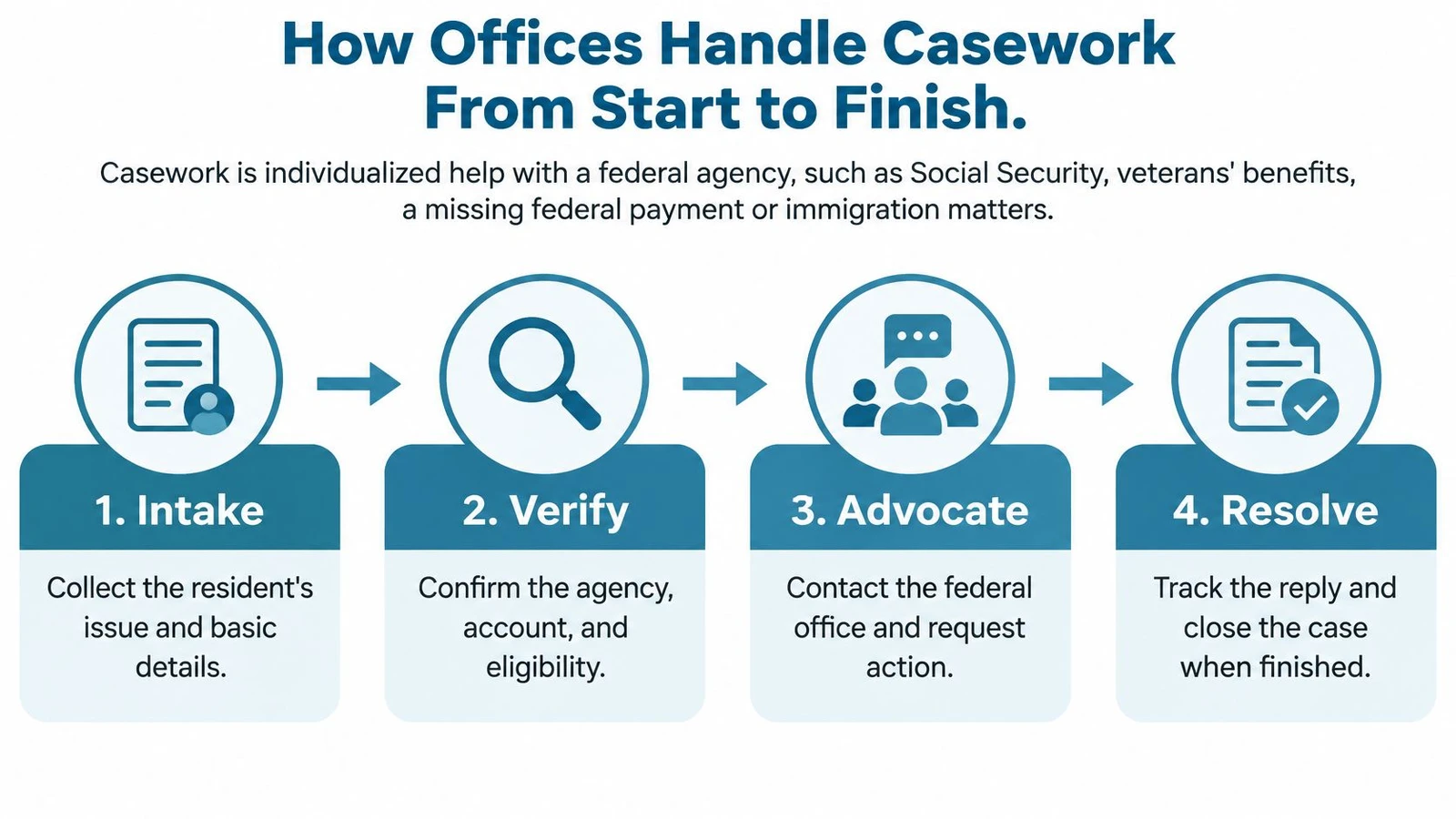
The Five Steps and Their Common Slips
-
Intake comes first. Staff record the request, the resident’s district status, and the agency involved, using the resident’s own description of the problem. Watch for the vague log entry: a file that says “benefits issue” with no agency named forces the next staff member to start over. A guide to constituent case management basics can help offices standardize those intake fields.
-
Verify before sharing anything. Staff confirm the authority to act and obtain any written consent needed before passing personal details to an agency. Teams sometimes reverse that order, sending documents first and seeking consent later. Consent protects the resident and gives the agency a lawful basis to respond.
-
Contact the agency with a specific ask. Offices may request case information and urge the agency to consider the matter promptly. A frequent shortcut is forwarding the resident’s message without stating what’s being requested, such as a status update, a missing record, or a timeline for decision.
-
Stay in the facilitator role. Staff can arrange an appointment, express an assessment, or ask for reconsideration of an administrative response, acting as facilitators or ombudsmen. The temptation at this stage is implying the office can guarantee approval, and residents deserve early clarity about what an office can deliver and what remains in the agency’s hands.
-
Follow up and close the loop. Staff track each status and due date until the resident has an outcome, then tell the resident what the agency said. Cases die when the file closes the moment the agency replies, before anyone checks whether the resident received or understood the result.
Modern service expectations raise the stakes on that follow-up. Staff curious about how response standards are changing can read Yellow.ai’s citizen service interview for a view of how residents now experience public-facing service channels. Whatever tools an office uses, the human obligation stays the same: a resident shouldn’t have to chase an office for news about that resident’s own case.
The Limit Staff Must State Plainly
Congressional staff generally cannot force an agency to decide a case in a particular way or override legal requirements. Stating that limit at intake is honest work, and it lets the resident judge the office on responsiveness and persistence rather than on a promised result.
A complete case file contains the request, the agency response, and the resident’s outcome, in that order, so any staff member can reconstruct what happened.
When those three pieces are present, the file proves the office did its job even when the agency’s answer disappoints the resident. When one piece is missing, nobody can tell whether the case stalled with the agency or inside the office.
Confirm Constituent Rules Before You Reach Out
A resident calls about a benefit problem, gives an address, and mentions a deadline. Before staff type a word into a case file, two checks decide whether the request lands in the right place. First, which office holds responsibility for that address and that issue. Second, whether the record keeps district status, voter registration, and the service relationship as separate facts rather than one blended label.
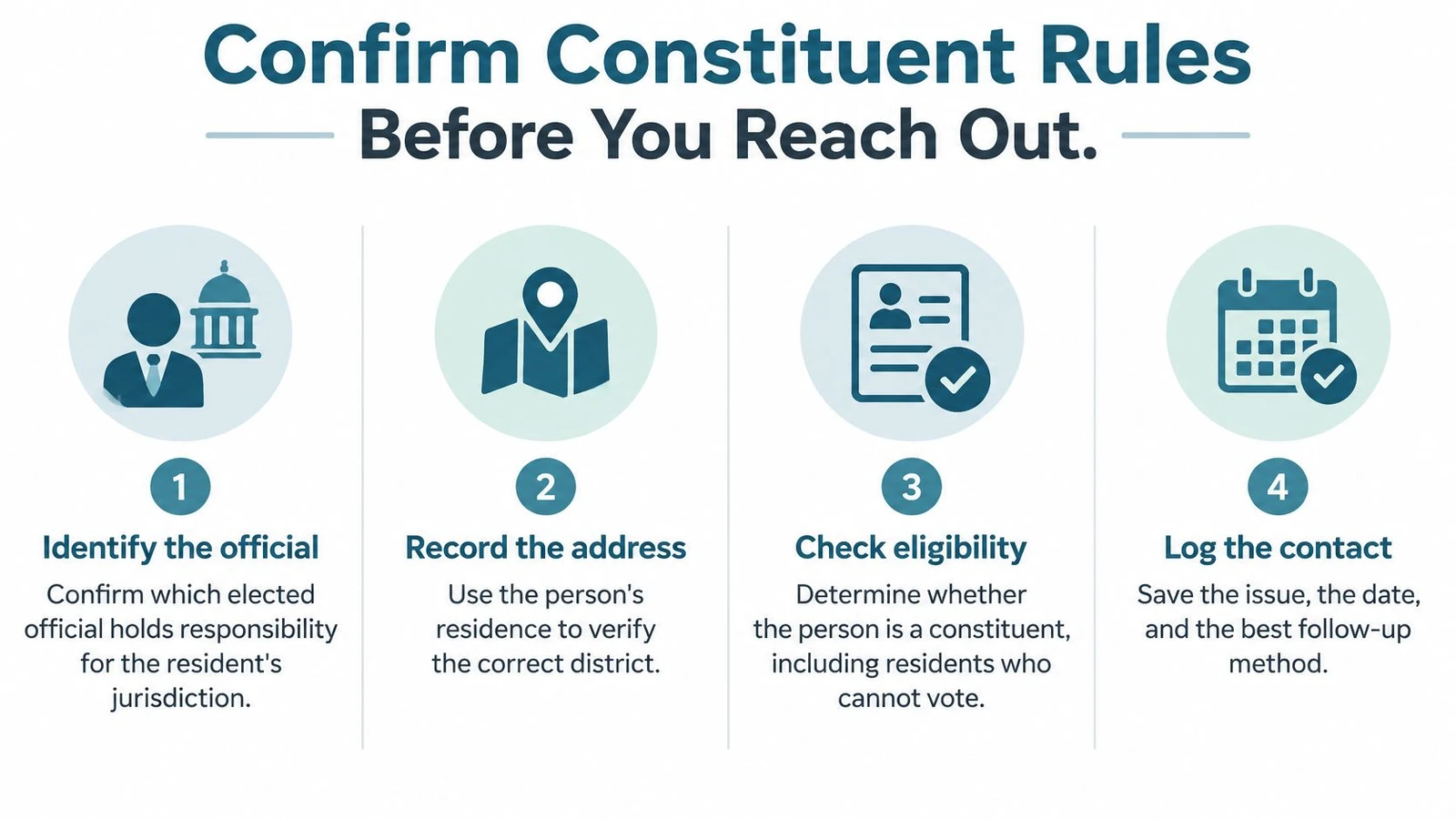
The office check comes first because jurisdiction follows the address, not the voter rolls. An unregistered resident still sits inside a member’s constituency, and a registered voter across the boundary does not. Mixing those up produces two expensive errors: a case opened under the wrong office gets closed and reopened elsewhere, and a contact logged as “nonvoter” reads as “not a constituent” to the next staffer who opens the file.
Running one real contact through these checks this week shows quickly which field the office records well and which it guesses at.
Offices handling many channels can review a constituent CRM built for that workload. Constituent Intelligence is a constituent CRM for legislative offices, where calls, letters, walk-ins and pasted emails go into one office inbox and any message can become a numbered case. The checks apply whether staff work from that inbox or a paper log.
Legislative offices that route calls, letters, walk-ins and emails through a single intake point can see how doornoc handles that flow. Visit doornoc to explore its constituent tools.