

A legislative aide is the staffer who helps a legislator understand, develop, communicate, and advance positions on a set of issues while also handling constituent mail, casework, scheduling, and committee preparation. That’s the plain answer to what does a legislative aide do, and it’s broader than most job titles suggest.
A reader opening a posting for the first time often faces a confusing mix. One listing stresses research, another stresses answering phones, and a third sounds like event planning. All three can describe the same office on different days, because the member has to vote, meet people, and answer the district at the same time, and the aide keeps those obligations moving.
What a Legislative Aide Does
The committee vote is at ten. At nine, an agency calls about a constituent’s delayed benefit, and the member asks for a quick read on an amendment. The aide checks the bill, prepares a concise explanation for the member, and gives the constituent a clear case update. The order of the day has changed, but each task still needs an accurate file and a useful response.
Two jobs in one chair
The Congressional Research Service description of congressional staff roles covers work on legislation and constituent service. Aides monitor bills and committee activity, prepare hearing materials, draft legislation and policy memoranda, write talking points, and meet agency officials or interest groups. They also write constituent mail, answer public inquiries, coordinate visits, and support services such as flag or tour requests.
The aide’s role is to prepare decisions and keep requests moving; the elected official sets the position, casts the vote, and explains it publicly. The aide sequences demands from the member, committees, agencies, advocates, and households back home, much like an air traffic controller organizing arrivals. When an interruption changes the order, a well-kept file helps preserve the useful work already done.
Aides prepare decisions. The elected official owns the position, the vote, and the public explanation for both.
The title appears in congressional personal offices and state legislative offices. Postings may say legislative assistant, legislative correspondent, or session aide. Titles vary, but the work depends on connecting research to the decision or response it supports. A policy memo matters when it reaches the member in time and gives a reliable basis for action.
The role therefore combines portfolio ownership with service coordination. The aide tracks issues and requests, keeps the relevant information clear, and adjusts priorities as the office’s needs change.
Five Work Streams Inside the Office
| Work stream | What arrives | What the aide produces | Who uses it |
|---|---|---|---|
| Constituent mail | Letters, email, and web forms | Replies in the member’s voice, checked against the office position | Constituents and the member |
| Casework | Individual requests about agencies or public programs | A tracked matter with an owner, agency contact, and outcome | The constituent, district staff, and the member |
| Scheduling | Meeting, visit, tour, and flag requests | An accepted, declined, or routed calendar item | The member and front-office staff |
| Policy research | Bills, amendments, agency views, and stakeholder asks on an assigned portfolio | Memos, vote recommendations, and talking points | The member and legislative director |
| Committee preparation | Hearing or markup notices, witness lists, and bill text | Background memos, questions, talking points, and follow-up tasks | The member and committee staff |
Mail, cases, and the calendar
Constituent mail starts as volume and ends as a signed position. The aide sorts letters, email, and web forms by issue, checks what the office has already said, and drafts a reply in the member’s voice. A good reply answers the question asked, states the position plainly, and doesn’t invent a commitment the member hasn’t made.
Casework is narrower and more personal. One person has a problem with an agency or public program, involving benefits, immigration, veterans’ services, or a state agency, and the office opens a tracked matter. The file needs an owner, a record of agency contact, and a next step with a date, because a stalled case usually means a household is waiting on money, care, or paperwork.
Scheduling looks clerical and isn’t. Every accepted meeting displaces something else, so the aide accepts, declines, or routes meeting, tour, and flag requests against legislative and district priorities. A routed request still counts as service when it reaches the right staffer with context attached.
Research and committee work
Policy research runs on an assigned portfolio. The Congressional Research Service analysis of congressional job descriptions found that legislative assistants commonly manage a portfolio of 1 to 9 policy issues, while a more experienced legislative assistant may handle a narrower 1 to 7 issues with higher responsibility for strategy and proposals. Inside that portfolio, the aide reads bill text and amendments, compares stakeholder positions, and writes a short recommendation the member can use before a vote.
Committee preparation turns that research into performance in the room. The aide assembles a background memo, witness context, hearing questions, and talking points, then captures follow-up tasks after the gavel. Sitting behind the member at the dais is the visible part, and it’s the smallest part.
One person rarely owns all five streams equally. A legislative correspondent may live in the mail program, while a legislative assistant owns the portfolio and still drafts correspondence on those issues. State capitol offices run the same five streams on a different calendar, often with fewer people dividing them.
Reading a posting: Match the verbs in the description to the rows in the table. Draft, track, brief, and respond point to different streams, and the heaviest verb usually reveals the real job.
How a Legislative Aide Spends the Day
A committee deadline moves forward, and the member wants to know what changed. The aide checks the latest bill language, gives a concise update, and postpones a writing block to handle an agency call. That kind of reshuffling is ordinary: the day has a pattern, but interruptions decide which task gets attention next.
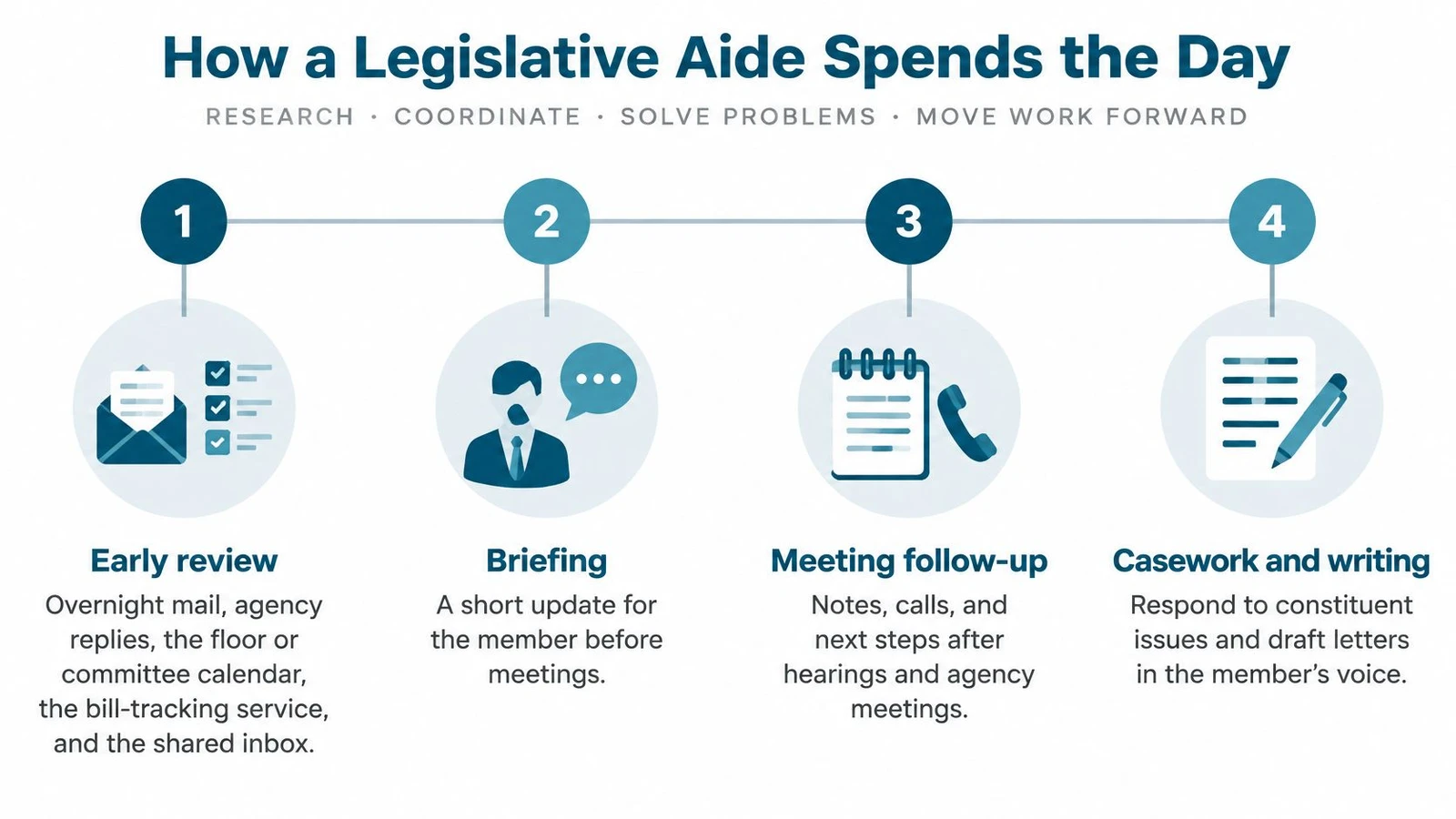
- Early review: The aide checks overnight mail, agency replies, and the floor or committee calendar. Anything that could change a vote, hearing, or waiting constituent’s next step gets flagged before the member arrives.
- Short briefing: The aide gives the member or legislative director a focused update on what may be heard or voted on that day. The aim is to clarify a decision or provide a holding line, not recap every document read.
- Calls and meetings: Stakeholder and constituent calls fit around the floor schedule. Each should end with a record of what was discussed, who owns the follow-up, and what happens next, a discipline shared with a field organizer after a voter conversation.
- Writing blocks: Memos, amendments, hearing questions, and letters get drafted during quieter stretches. These blocks are often the first to move when leadership changes a vote schedule or the member calls from the floor.
- Late pass: The aide records open work in the relevant office files, finishes what research can be completed, and leaves notes another staffer can use the next morning. Clear records let the office pick up a task without relying on someone’s memory.
When everything arrives at once
A hearing runs long. A deadline appears, a political priority needs language, and a constituent emergency arrives in the same hour. The Congressional Research Service report on congressional staff duties identifies prioritization, accuracy, and balancing multiple projects as core skills for the role. In practice, those skills determine whether urgent service and usable policy work can both move forward.
A workable order is to handle the member’s immediate decision, then the time-sensitive need of a specific person, then return to the longer memo. Policy reading often fits in a quieter midmorning stretch or after the floor adjourns, but it is usually the first block displaced when the schedule tightens.
An agency deadline is approaching, and a veterans’ benefits case escalates midafternoon. The planned amendment draft slides back. The aide calls the agency contact, updates the file, and gives the member a status worth reporting. The amendment still gets written, but later; an accurate, current file makes it easier to resume that work without losing the case’s history.
In a state capitol, session weeks compress the same shifting sequence. Between sessions, district days may leave more room for local meetings and constituent matters. A posting that promises a fast-paced office is describing a day where responsiveness and reliable records determine how quickly staff can switch tasks without losing track of either one.
How the Job Changes by Office and Level
A constituent issue can start at a district-office phone and end with a policy aide checking agency rules at the capitol. Where staff sit matters less than whether the office has a clear handoff and enough people to cover both ends.
| Setting | Primary base | Portfolio shape | Where constituent work lands |
|---|---|---|---|
| House or Senate personal office | Capitol plus district offices | Issue areas divided among staff, with policy review often handled at the capitol | District intake with capitol replies on policy |
| State legislative office | Capitol during session, district between sessions | Broad coverage across the member’s committees, held by a small staff | Shared between capitol and district, often by the same aide |
| Committee staff | Committee rooms and hearings | One committee’s jurisdiction | Hearing record more than individual cases |
| District or constituent services staff | District office | Themes drawn from local cases | Intake, agency follow-up, tours, and flags |
The handoff matters more than the address
In a House or Senate personal office, capitol aides usually own bill language, vote memos, and committee preparation. District staff often take the first constituent call, tour, or flag request. The handoff needs a named owner: otherwise, an issue raised on a call can sit between teams without anyone responsible for the next step.
Scale changes how many people review a decision. A statewide constituency and a larger staff may mean more layers between an aide’s draft and the member, while a smaller office may send work directly from the aide to the member. The political campaign manager’s role in coordinating a team offers a useful contrast: legislative offices also coordinate work, but their responsibilities are shaped by chamber, committee, and constituent-service duties.
A state legislative office often has fewer staff to divide those duties. During session, an aide may research a committee issue and then follow up with a constituent; between sessions, district work can take more of the schedule. Committee staff have a narrower remit, centered on the committee’s jurisdiction and hearing record rather than one member’s mail.
Three edge cases worth spotting
- Freshman office: Coverage can be thin while routines are established. One aide may greet stakeholders at the door, then draft a memo on the same issue.
- Leadership office: Floor timing can redirect the aide’s work as scheduling decisions affect other offices.
- District constituent-services role: The work centers on casework and local events, while policy questions go to capitol staff for drafting.
A posting’s location and chamber help reveal who is likely to own the first contact and who will produce the policy response. A district-based aide and a capitol-based aide may share a title, but their daily handoffs can look quite different.
How Casework Moves from Intake to a Closed File
A constituent calls about a delayed benefit payment while the aide is preparing a briefing. The call still needs a record, an owner, and a next step. Casework runs alongside policy work, and interruptions make a reliable file the difference between a request that can be resumed and one that disappears into an inbox.
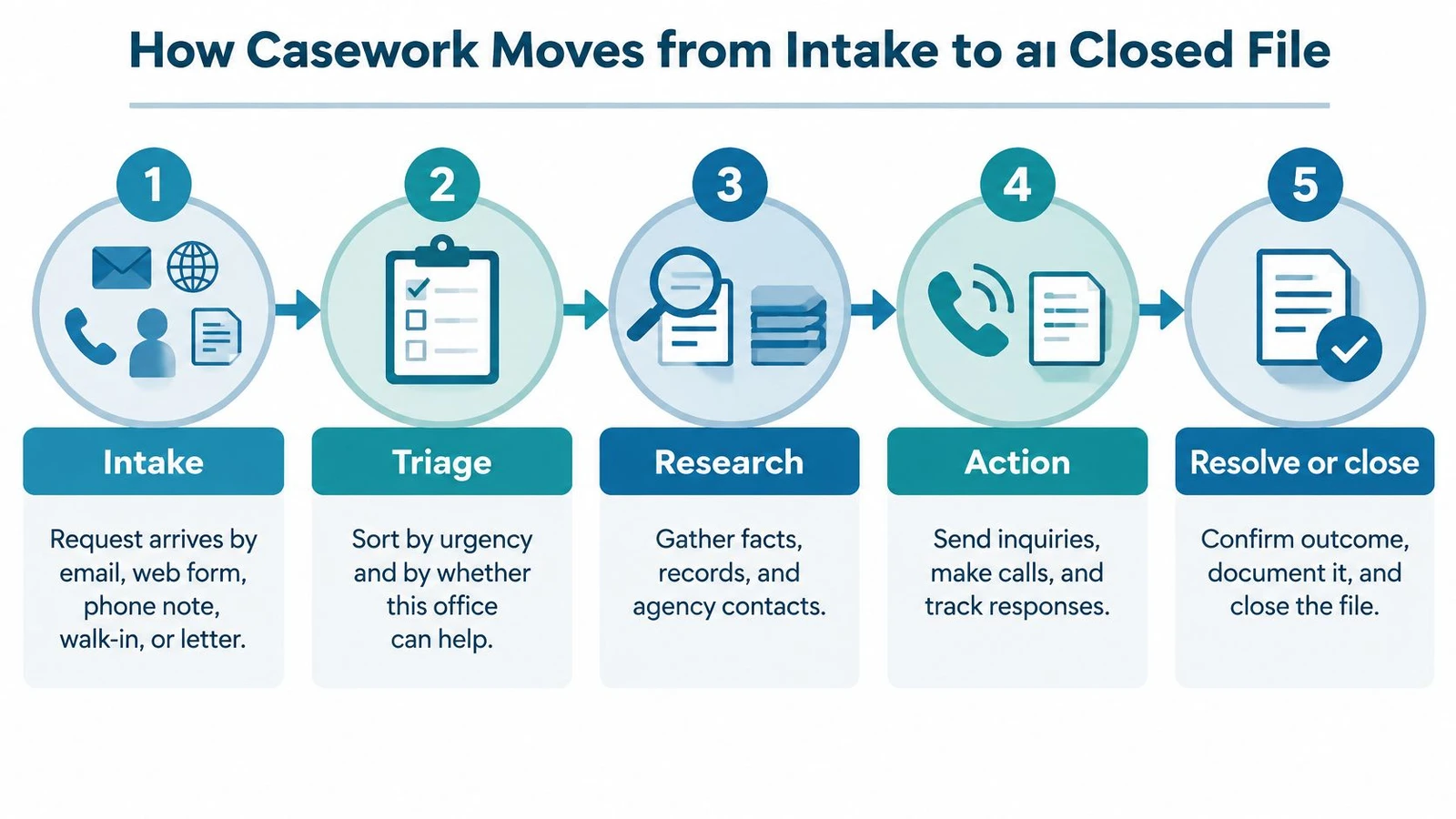
- Intake: A request arrives by email, web form, phone note, walk-in, or letter. Staff record who needs help and what the request concerns.
- Triage: The aide checks urgency and jurisdiction. If another level of government handles the issue, the constituent needs a clear referral rather than a case that sits in the wrong office.
- Assignment: A named aide takes responsibility. Other staff may help, but one person should own the next action.
- Action: The owner contacts the relevant agency or program and records what was requested, who received it, and what response came back.
- Follow-up: The aide tracks the next due date, follows up when a response is late, and keeps the constituent informed.
- Resolution: The aide explains the outcome and preserves the closed file, so another staff member can understand the history if the constituent contacts the office again.
Tools that hold the file together
The same basic process applies to benefits, immigration, veterans’ services, and other public programs. A shared inbox prevents requests from remaining in one staffer’s account. Issue codes help staff sort similar matters, while legislative tracking tools support policy work. A consistent constituent record makes past contacts easier to find, as explained in this guide to constituent case management.
For legislative offices, Constituent Intelligence brings calls, letters, walk-ins, and pasted emails into one office inbox, where a message can become a numbered case. The number gives staff a clear reference for handoffs, follow-up, and correspondence.
Case files can contain personal information. Staff should share status and outcomes with the constituent, protect private details, and follow consent rules when communicating with an agency.
The practical test is retrieval. If a different aide has to take over, the record should make the owner, agency contact, and outcome clear without requiring a search through scattered email threads. That same record-keeping can help staff turn client outcomes into resume evidence.
Skills and Whether the Role Fits
A vote is approaching, a constituent is waiting for an update, and an agency has just called back. The aide has to reorder the day without losing track of the facts or the commitments already made. The job’s core skill is portfolio-and-service coordination: turning incoming information into accurate work that someone else can use.
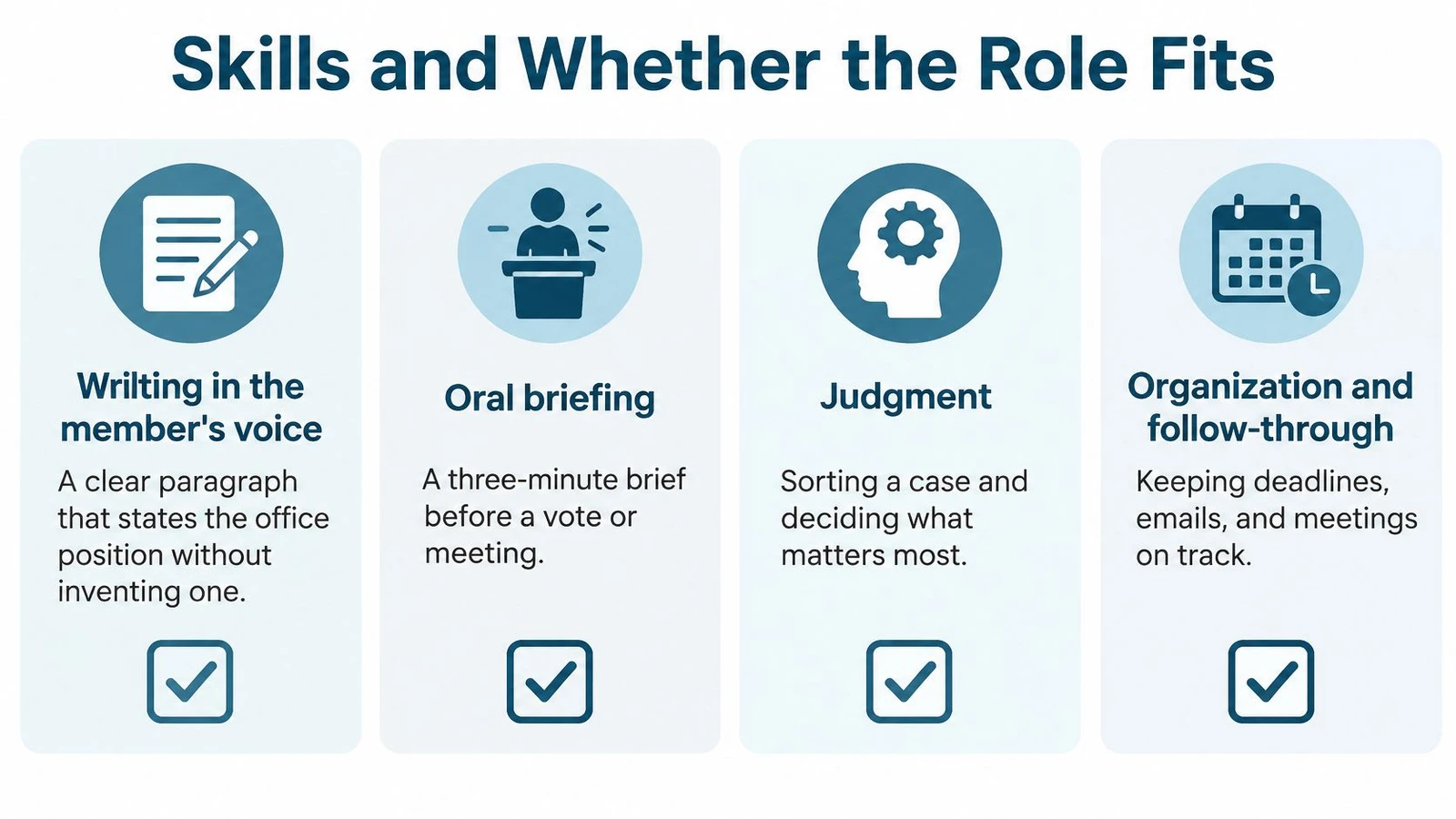
- Writing in the member’s voice: Draft a clear paragraph that states the office’s position without adding claims the member has not made.
- Oral briefing: In three minutes, explain the question, the options, and a recommendation, in that order.
- Judgment: Separate a personal case from a policy question, then check whether either belongs to the office’s jurisdiction before spending time on it.
- Stakeholder conduct: Speak with agency staff, advocates, and upset constituents without letting one conversation’s tone shape the next.
- Record-keeping: Leave dates, names, and outcomes in a file another aide can reopen and continue.
- Prioritization with accuracy: Keep live projects moving as interruptions arrive, while checking names, numbers, commitments, and confidential details.
Why traceability sits underneath every skill
A memo, briefing, or constituent reply can shape what the office says or does. Its claims need to lead back to reliable evidence. The Senate Employment Office position descriptions list duties such as monitoring policy areas, drafting and tracking legislation and amendments, preparing hearing memoranda and briefings, writing floor statements and remarks, and working with committee and agency staff. A source-free memo gives colleagues no way to check its reasoning before they rely on it.
The work sample is one way to show how you handle a task: whether your writing is clear, your facts are traceable, and your handoff gives the next person enough to continue. Subject knowledge can grow as you work in a portfolio. A missing follow-up or unclear file can leave a colleague unable to act.
A self-check and three fit questions
Try three exercises. Write a paragraph in someone else’s voice on an unfamiliar topic. Give a three-minute oral brief from a short document without reading it aloud. Then create a one-page file on a mock case that a colleague could pick up and continue.
Assess the office, too. Who owns each portfolio when the member is on the floor? How does a case move when the person who opened it is out? Who covers after-hours work during session, and how is that coverage shared?
Unclear portfolio ownership, no written handoff, and constant after-hours demand with no backup are warning signs in any chamber, at any level.
The answers show whether the office has a plan for coverage or depends on whoever remains at a desk. During a busy session week, a vote can move, an agency can call back, and a constituent may need an update before the day ends. The aide still has to keep the briefing accurate and record what happened.
The role may fit if you can make that kind of handoff: useful advice for the member, reliable service for constituents, and a clear record for the next aide, even when the day changes without warning. A weak file can make sound research unusable; a clear, traceable file lets the office act on it.
For a legislative office assessing its intake process, doornoc offers Constituent Intelligence, a CRM where calls, letters, walk-ins, and pasted emails enter one office inbox, and any message can become a numbered case. Visit doornoc to explore whether it suits your office’s workflow.