
Constituent relationship management in political campaigns is the systematic practice of recording, tracking, and following up on every interaction with voters and community members to build trust and drive engagement through elections. It works because a campaign can’t rely on memory when the phones are ringing, doors are moving, and the same household has already raised the same issue three times this week.
A field director knows the feeling. The walk sheets are in one folder, the call notes are in another, and nobody can say with confidence whether a constituent who asked for help on Tuesday got a callback by Friday. That is where constituent relationship management stops being an administrative extra and becomes the operating system for the campaign.
The Real Story Behind Successful Constituent Engagement
The first sign of trouble is usually a set of spreadsheets that disagree with each other. One volunteer marked a voter as contacted, another wrote a note about a zoning complaint, and the scheduler has no idea whether a staffer promised a follow-up that never happened. In a compressed campaign week, that kind of drift costs more than time. It breaks trust.

Why ad hoc tracking fails under pressure
When constituent contact lives in scattered files, every new touchpoint creates another chance to lose context. A person’s issue history gets split across staffers, and the campaign ends up treating the same request as a new problem each time. That’s how follow-up slips, messages conflict, and resource allocation gets driven by whoever happens to remember the loudest case.
Public administration has been dealing with constituent service for a long time, well before digital systems existed. The House created a select committee for private claims in 1794, and the Senate created a comparable committee in 1816, both tied to individual requests, documentation, coordination, and follow-up. The point isn’t history for its own sake, it’s that the core job has always been relational and operational, not just digital recordkeeping (Congressional Research Service on constituent service history).
Practical rule: if a request can’t be traced from first contact to resolution, the campaign doesn’t really have a constituent system, it has notes.
What systematic CRM changes
A real system gives a campaign visibility. Staff can see who contacted whom, which issues repeat, where a case sits, and whether the next action is a call, a task assignment, or a final closeout. That matters because a campaign doesn’t just need more contacts, it needs auditable follow-through.
The deeper shift is cultural. Teams stop asking, “Who remembers this?” and start asking, “Where is this recorded, who owns it, and what’s the next step?” That discipline is what lets a lean staff handle a large volume of requests without turning every election week into emergency triage. It also gives managers a cleaner read on team performance, because the record shows not just activity, but completion.
Understanding What Constituent Relationship Management Actually Means
Constituent relationship management grew out of the broader CRM discipline that took shape in the 1980s and early 1990s, then accelerated in business use through the mid-to-late 1990s. Academic work later described CRM as a relatively young management concept, and research publication activity rose sharply beginning in 2001 and continued rising through 2003 (CRM history and research development). That matters because campaigns inherited a mature set of ideas, then redirected them toward voters, residents, and advocates.
The concept is older than the software
Public-facing service has always involved casework-like behavior. Offices receive requests, classify them, route them, and follow up. Modern software only changed the speed, scale, and traceability of the work. It didn’t invent the work itself.
A useful way to think about the practice is to split it into four parts:
- Centralized records, so each person or household has one live profile.
- Segmentation, so teams can group people by issue, geography, role, or priority.
- Interaction histories, so every note, email, call, and form submission stays connected.
- Service workflows, so a request moves from intake to assignment to closure with accountability.
The product of those pieces is not just storage. It’s a working system for representation, privacy, and issue responsiveness.
Why the political version is different
A commercial CRM is often judged by sales or retention. Constituent relationship management is judged by responsiveness, legitimacy, and public accountability. That changes the design priorities. Teams need records that preserve the context of individual interactions while still letting the organization operate consistently across thousands of contacts.
A good explainer on CRM mechanics can help nonpolitical teams understand the base architecture, and the MakeAutomation CRM automation guide is useful background for that. Political teams, though, have to go further. They need workflows that respect case ownership, consent, and issue sensitivity while still moving fast enough for campaign conditions.
Software only creates value when structured records and staff routines turn raw interactions into coordinated action. Without that process, even a well-designed database becomes an expensive archive.
Core Features Every Campaign Constituent CRM System Must Support
A campaign system should start with identity resolution. If the platform can’t tell whether two records belong to the same voter, donor, resident, or household, everything downstream gets noisy. Data-quality practice treats accuracy, completeness, consistency, timeliness, uniqueness, and validity as the core dimensions to monitor, and that framing fits campaign data exactly (data-quality dimensions for CRM).
Build around a canonical record
The first requirement is a single canonical person or household record. That record should normalize names and addresses, timestamp each interaction, and preserve provenance for imported fields. Deterministic matching should use stable keys where available, like voter-file identifiers, email addresses, phone numbers, and normalized postal addresses. Fuzzy matching still matters for spelling variation and incomplete entries, but it should support the record, not overrule confidence controls.
Duplicate profiles don’t just waste staff time. They fragment history, which is how a team misses a prior request or sends conflicting outreach.
A practical system also needs field-level validation. If a date, street, district, or contact method is malformed, the platform should catch it before the record spreads. That’s especially important in campaign environments where canvass uploads, call logs, and form fills all arrive from different workflows.
Case tracking and consent controls are not optional
A basic contact list stores names. A real constituent CRM tracks cases. That means opening a request, assigning an owner, updating status, logging touches, and closing the loop. Consent management belongs in the same category because a contact record without permission context is operationally weak and politically risky.
| Campaign Tier | Required Features | Recommended Add-ons | Typical Budget Range |
|---|---|---|---|
| Local race | Canonical records, duplicate checks, case statuses, exportable lists | Simple workflow rules, basic dashboards | Low to moderate |
| Regional campaign | Validation rules, interaction history, household support, permission flags | Role-based access, automated alerts | Moderate |
| Congressional or large-scale campaign | Identity resolution, lineage tracking, audit logs, detailed routing, consent metadata | APIs, webhooks, reconciliation reporting | Higher and more complex |
The right feature mix depends on scale, but the underlying logic doesn’t change. If records can’t be trusted, the campaign can’t trust the workflow built on top of them.
Integrating Constituent Management with Canvassing and Voter Data Platforms
The strongest campaign systems don’t make staff retype the same information twice. They connect canvassing, voter data, and constituent records through a shared integration contract. That contract starts with semantic interoperability, which means the systems agree on identifiers, field definitions, vocabularies, event schemas, and consent metadata instead of just shuttling files around (interoperability and public-sector data sharing).
The integration contract that keeps field work sane
A durable setup should expose versioned APIs and webhooks, use stable external IDs, support idempotent upserts, preserve source-system IDs, and store lineage for later review. That sounds technical, but the field benefit is simple. A canvasser logs a conversation once, and that note can move safely into the case record, the outreach list, and the analytics view without being mangled in transit.
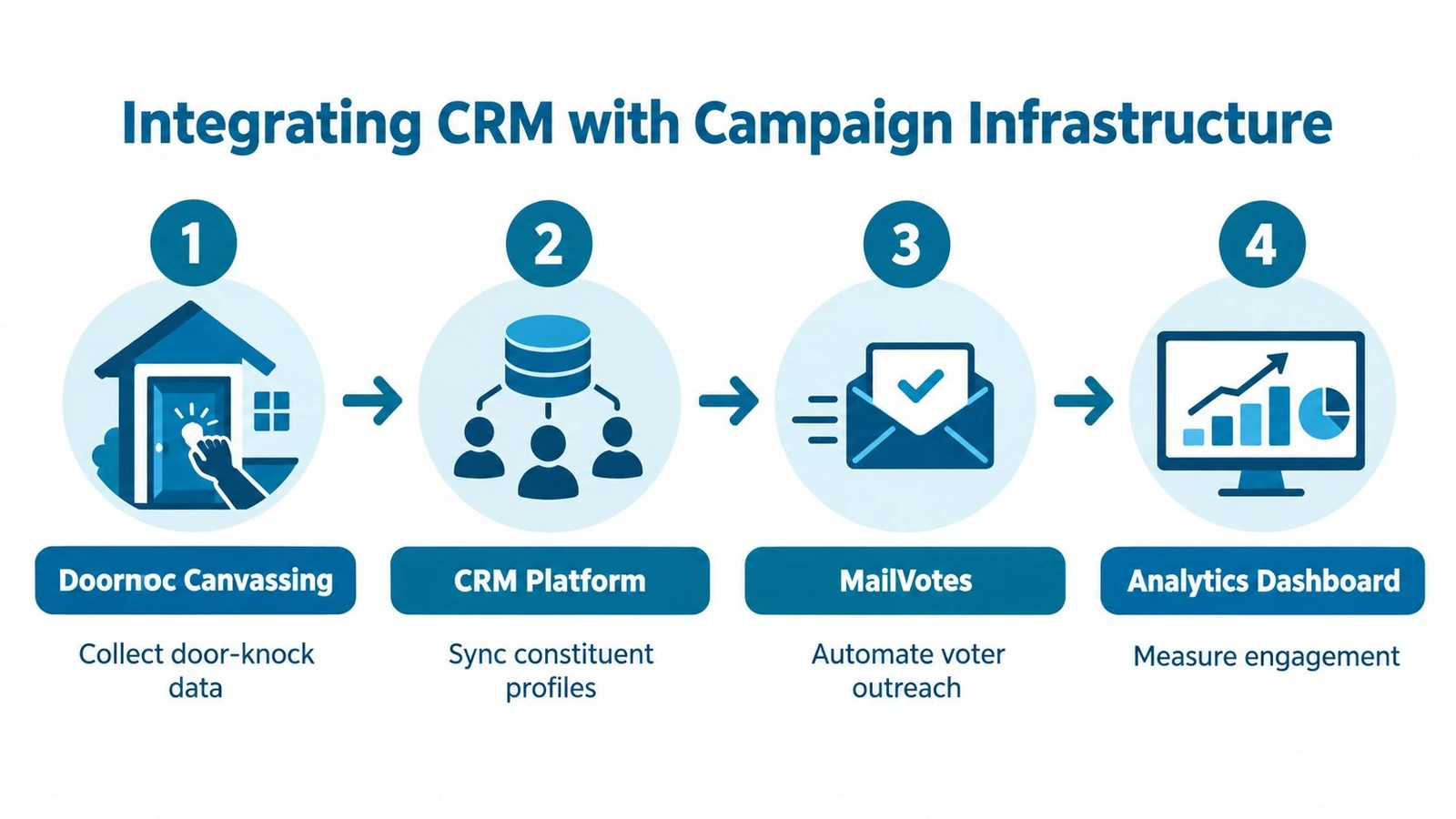
For campaigns using an offline-first canvassing workflow, doornoc’s mobile application, route tools, and MailVotes voter-data connection illustrate the pattern well. The sequence is straightforward, collect door data, sync constituent profiles, use voter records for outreach, then measure results in a dashboard. The important part is not the brand names, it’s the data discipline behind them. A campaign can review campaign data management practices as a model for how to reduce manual exports and keep work moving.
What works in the field
A canvasser should be able to capture a note offline, reconnect later, and let the system reconcile the update safely. A manager should be able to see which lists were used, which households were touched, and which records failed matching. And the operations lead should get reconciliation reports for stale, conflicting, or incomplete records instead of discovering them after the fact.
When that foundation is in place, route planning, list uploads, and constituent case handling stop competing with each other. They become different views of the same operational truth.
Privacy and Compliance Essentials for Political Constituent Data
Political data gets dangerous when teams treat collection as the goal instead of trust as the goal. Transparency about data use matters to stakeholder trust, and organizations that offer consent or opt-out mechanisms can build stronger community trust. The bigger gap is that many CRM guides explain outreach and segmentation while giving weak answers to the questions people ask at the door or on the phone, like what was collected, why it was collected, and how it can be corrected or removed (2025 NTEN Data Empowerment Report).
Build the data contract before you scale
A campaign needs a clear data contract. Collect only what is necessary, record source and permission, expose communication preferences, define retention periods, and give staff a human escalation path when a record is disputed. That’s not just a privacy posture, it’s a field operations decision, because sensitive issue preferences and household details can create damage even when collection is technically lawful.
A practical privacy workflow should answer four questions every time:
- What is being collected? Keep the intake form narrow.
- Why is it needed? Tie each field to a real operational use.
- Who can see it? Use role-based access and audit trails.
- How does a person object? Make opt-out, correction, and deletion requests visible to staff.
For teams that want a plain-language starting point on obligations and controls, the guide to data privacy for SMBs is a useful reference point for shaping internal policy language.
Compliance is operational, not decorative
Campaign compliance isn’t just about checking a legal box after launch. It needs to shape the form design, the staff script, the retention window, and the handoff between channels. If the intake process doesn’t tell people what will happen with their data, the campaign is already creating friction.
The strongest systems make consent legible at the record level. They also keep a clear escalation path for edge cases, because the moment a voter or resident asks for correction, the campaign needs a process that staff can follow under pressure. That’s where trust is either reinforced or lost.
Implementation Roadmap Choosing Between Build and Buy Options
Campaigns usually argue about build versus buy as if it were a philosophy test. On the ground, it is an operations call. A custom build gives you control over workflow and data structure. Platform adoption gets staff working faster. A hybrid setup often fits best when the campaign already has a data stack and needs a front-line workflow layer.
| Factor | Custom Build | Platform Adoption | Hybrid Approach |
|---|---|---|---|
| Speed to launch | Slower | Faster | Moderate |
| Workflow fit | Highly tailored | Depends on configuration | Tailored where needed |
| Maintenance burden | Higher | Lower | Shared |
| Integration complexity | Higher | Moderate | Moderate to higher |
| Best use case | Unique internal processes | Time-pressured campaigns | Teams with existing systems |
Choose by operational pressure, not preference
A city council race with a small staff usually needs something that can go live quickly and stay manageable. A larger campaign with many volunteers, multiple channels, and complex casework often needs tighter integration and clearer permission controls. The more systems already in play, the more important it is to map the data flow before you choose the software stack.
The rollout should follow a clean sequence, foundation setup, migration, team training, pilot testing, full launch, then ongoing tuning. A broader CRM implementation strategy guide is useful for thinking through the order of work, but campaign pressure changes the priorities. The first question is simple. Can staff use the system on deadline without slowing down field work?
What to avoid
Do not migrate messy records without a cleanup rule. Do not let each team invent its own status labels. Do not wait until after launch to decide who owns merges, permissions, and failed imports.
In a campaign environment, the doornoc-MailVotes integration pattern shows why implementation choices matter. Field teams need a clean handoff between canvassing notes, voter records, and follow-up tasks, or the data becomes hard to trust by the next shift. Teams also need a human review path for disputed records, because trust is built when staff can explain what was collected, who can see it, and how corrections get handled without a scramble.
The best implementation reduces cognitive load for field staff and protects data quality for leadership. That is the test that matters.
Metrics That Actually Matter for Constituent Relationship Success
A campaign can stay busy and still miss the mark with constituents. Contact volume alone does not show whether people got help, whether follow-up happened, or whether some groups fell out of the record.
Research on resident satisfaction and digital government trends shows that digital service efforts can improve satisfaction, while funding limits and staff skill gaps still block progress (resident satisfaction and digital government trends). The same pattern shows up in campaigns. A form or dashboard helps, but it does not solve staffing, accessibility, or follow-through by itself.
Measure service quality, not just contact count
A useful constituent dashboard tracks channel-specific reach, failed-contact reasons, language needs, accessibility needs, unresolved cases, and whether a digital interaction led to a real outcome. Those measures show whether the campaign is serving people across communication preferences, instead of only the easiest households to reach.
Managers should also watch where work gets stuck. If phone notes close faster than webform requests, the workflow may fit one channel better than another. If offline contacts never reach the record, the campaign is undercounting some of its strongest field work.
For teams building reports around action instead of vanity, campaign analytics dashboard guidance is a practical reference.
The best dashboard tells managers where trust is fraying, not just where volume is high.
Equity belongs on the scorecard
People who are digitally excluded should not disappear because they never filled out a form. Offline-first capture, multilingual access, and channel-aware reporting keep those constituents visible. A campaign that cannot see who was left out will confuse absence with consent.
The question is whether the campaign heard from the people it was supposed to represent, and whether the record reflects that work truthfully.
Practical Best Practices and Lessons from Real Campaigns
The best constituent systems get used because they fit the pace of the field. Voter research briefs help canvassers start smarter conversations. Real-time dashboards help managers reassign walk lists the same day. Offline capture protects the record in neighborhoods with weak connectivity. And a clean handoff from voter data sourcing to canvassing execution keeps volunteers from wasting time on manual imports.
What consistently works
A few habits show up in campaigns that handle constituent work well:
- Prepare conversation prompts early. Briefs should be ready before turf goes out, not after the shift starts.
- Keep routing balanced and realistic. Walkability matters more than theoretical coverage.
- Let the system match records automatically. Manual CSV cleanup slows every other task.
- Track non-voter contact separately. Advocacy and service programs need their own case logic.
- Use live activity views. Field leads need same-day visibility, not next-week reports.
A strong constituent case workflow also helps staff keep ownership clear from intake to closeout. The constituent case management guide shows why that matters when multiple staffers touch the same request.
Common mistakes to avoid
The most common failure is treating the CRM as a storage bin instead of a workflow engine. Another is letting canvass notes, case notes, and list data drift into different naming conventions. A third is overlooking how often volunteers need simple guidance on what to do when a contact is incomplete, sensitive, or outside their assigned issue lane.
If staff can’t tell whether a record is ready, blocked, or closed, the system is asking for rework.
The campaigns that do this well keep the process short, the ownership clear, and the integrations boring in the best way. That’s what makes constituent relationship management durable under deadline pressure.
If a campaign needs constituent service, canvassing, voter data, offline capture, and live reporting to behave like one system, doornoc is built for that operational mix. It supports field teams that need clean data flow and faster follow-up, and it can be reviewed directly at doornoc.
Running constituent services for an office? doornoc’s constituent intelligence keeps casework, contact history and voter-file data in one record instead of three systems.